

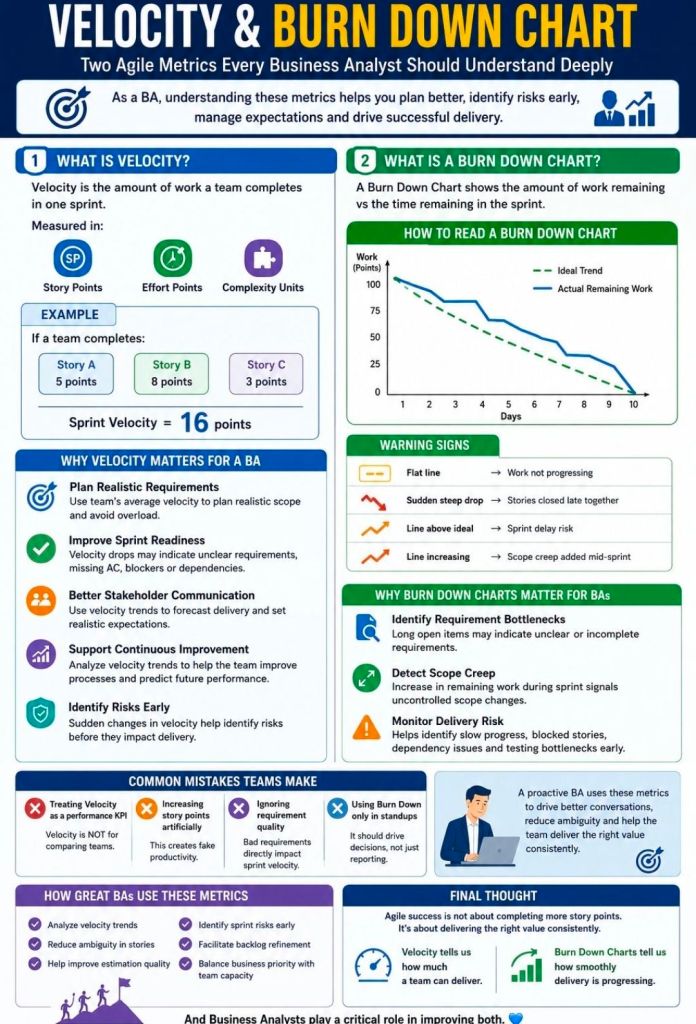
Scrum velocity and burndown charts are essential agile metrics used to measure team capacity and track progress. Velocity measures the average story points completed over past sprints to forecast future capacity. Burndown charts visually represent the remaining work daily, highlighting if the team is on track to meet sprint goals.
Scrum Velocity
- Definition: The amount of work (usually in story points or hours) a team completes in a single sprint.
- Purpose: Helps forecast team capacity for future sprints and promotes sustainable pace.
- Calculation: Sum of story points for all “Done” items at the end of a sprint.
- Best Practice: Average velocity over 3–5 sprints provides a more accurate, stable forecast.
Burndown Chart
- Definition: A graph showing the amount of work remaining versus time (days) in a sprint.
- Components:
- Ideal Work Line: A straight line showing the projected pace to complete work.
- Actual Work Line: A line plotting daily completed work against the ideal line.
- Purpose: Provides daily visibility into progress and detects risks early (e.g., if the line is above the ideal, the team is behind).
- Types: Sprint Burndown (short term) vs. Release/Product Burndown (long term).
Key Differences
- Velocity is a planning metric looking at historical performance.
- Burndown is a monitoring tool looking at current progress.
Common Pitfalls
- Velocity: Treating velocity as a productivity metric (it is a capacity planning metric) or comparing it between teams.
- Burndown: Using “manual updates” rather than automated tools, leading to inaccurate data.
- Both: Neglecting to refine user stories, which makes velocity unpredictable and burndowns inaccurate.


