Agile Scrum Metrics, Inspect, Adapt, Improve

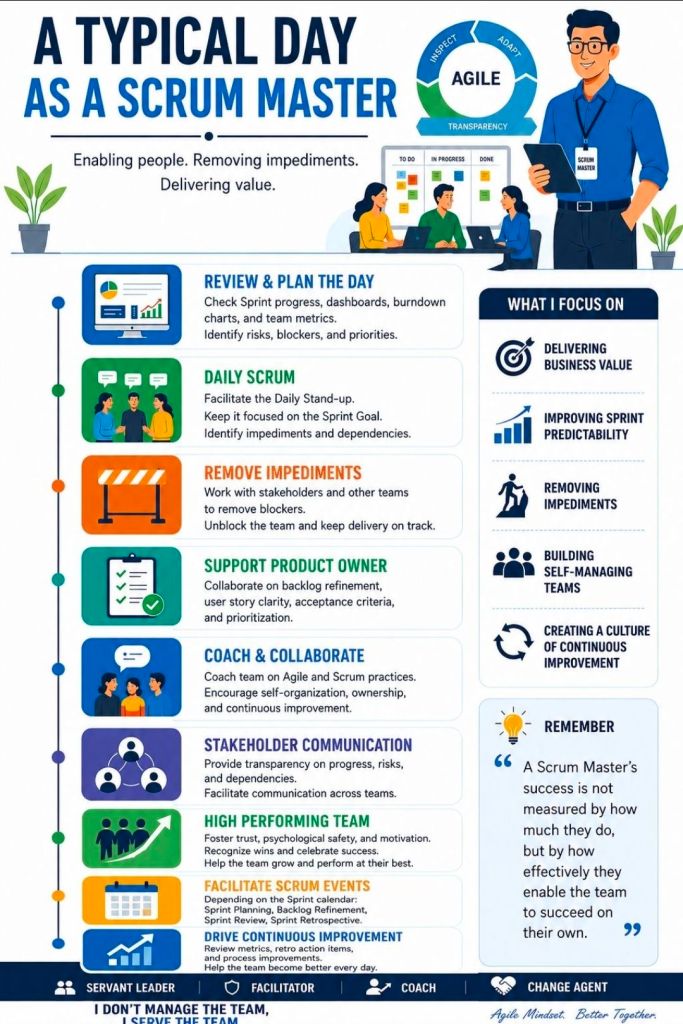
1. Agile Scrum Metrics, Inspect, Adapt, Improve
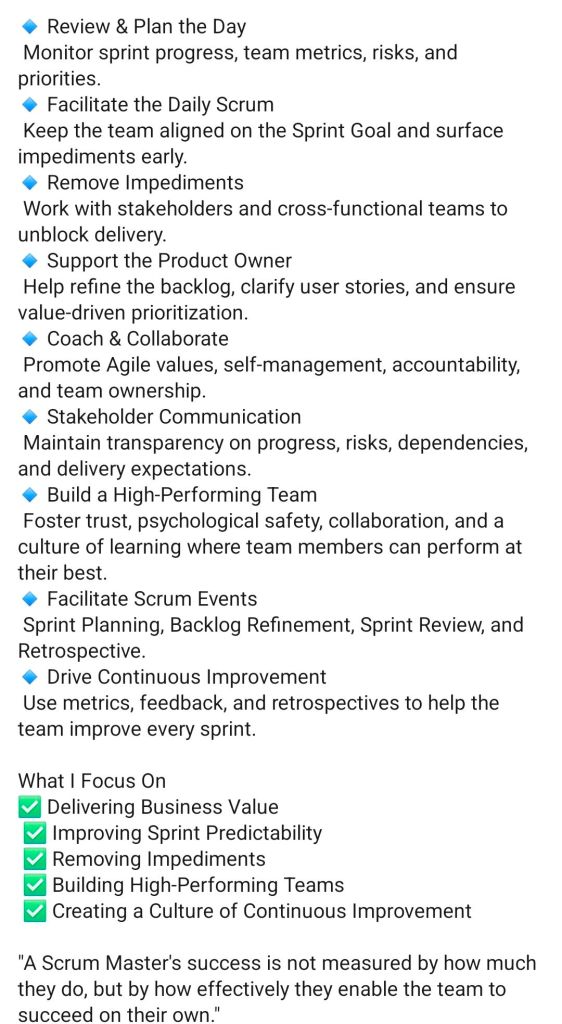
Scrum Metrics summarised
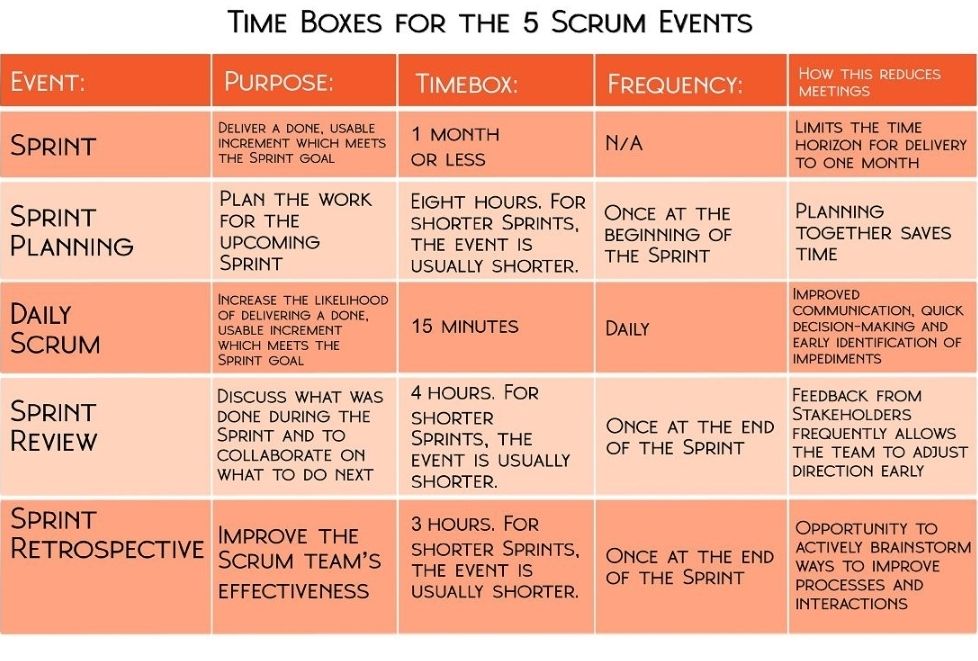
2. Agile Scrum Metrics, Inspect, Adapt, Improve
Scrum Metrics Overview

Free Upgrade MS Project Management Templates for Download

The ⁠Project Management Templates by Mark Whitfield constitute a comprehensive toolkit of over 200 editable resources designed to accelerate project delivery across Agile, Waterfall, and PRINCE2 frameworks.

The structural breakdown of the core templates is organised by functional category, specific template, integrated Microsoft Office tool, and operational description:

1. Project Planning & Scheduling

  • Detailed SDLC Project Plan
    • MS Tool: Microsoft Project (.mpp)
    • Description: A master schedule structured around the Software Development Lifecycle (SDLC) from development through testing, deployment, and Early Live Support (ELS), easily toggled between Agile Scrum and traditional Waterfall.
  • PRINCE2 7th Edition Project Plan
    • MS Tool: Microsoft Project (.mpp) & MS Excel (.xlsm)
    • Description: Fully annotated task list aligned with the 7th edition principles, colour-coded by activity type (blue for artifact creation, brown for management decisions, purple for updates).
  • Detailed Waterfall Project Planner
    • MS Tool: MS Excel
    • Description: A portable, license-free alternative to MS Project featuring baseline versus forecast tracking, an integrated Gantt chart view, and automated progress charts.
  • Plan on a Page (POaP)
    • MS Tool: MS PowerPoint & MS Excel
    • Description: High-level, executive-ready roadmaps containing over 30 slide variations used to communicate project timelines, key milestones, and work streams to senior stakeholders.
1. Project Planning & Scheduling POAP MS PowerPoint
1. Project Planning & Scheduling POAP MS PowerPoint Templates
2. Project Planning & Scheduling MS Project Templates
3. Project Planning & Scheduling MS Excel Templates

2. Operational Control & Governance

  • Comprehensive RAID Log & Charts
    • MS Tool: MS Excel
    • Description: A highly detailed central registry featuring distinct tabs to track Risks, Actions, Issues, Opportunities, Dependencies, Lessons Learned, and Change Requests alongside visual metric dashboards.
  • Basic RAIDs Tracker
    • MS Tool: MS Excel
    • Description: A scaled-down, simplified version of the master RAID log optimized for quick turnarounds, minor bids, and low-complexity projects.
  • RACI Matrix
    • MS Tool: MS Excel
    • Description: A governance sheet mapping project deliverables against specific team roles to clarify who is Responsible, Accountable, Consulted, and Informed.
  • Agile Story Dependency Tracker
    • MS Tool: MS Excel
    • Description: A specialised log to document and track blocker stories tied to external suppliers or client-side dependencies that risk driving scope changes.
1. Operational Control & Governance MS Excel RACI Template

3. Financial & Resource Management

  • Project Financial Tracker
    • MS Tool: MS Excel
    • Description: A financial controller mapping internal and external forecast costs against actuals, factoring in margins, variances, supplier fees, and expense categories.
  • Resource, Sickness, & Leave Tracker
    • MS Tool: MS Excel
    • Description: An operational matrix monitoring annual leave, sickness, and training schedules to adjust resource availability and capacity within the master schedule.
1. Financial & Resource Management MS Excel Templates

4. Agile Delivery Metrics

  • Agile Burn Down & Burn Up Charts
    • MS Tool: MS Excel
    • Description: Manual data-table tracking solutions designed to visualise sprint or release velocity for teams operating without access to enterprise tools like Jira.
1. Agile Burn Down Chart in MS Excel
1. Agile Burn Down Chart in MS Excel Template Example
2. Agile Burn Up Chart in MS Excel
2. Agile Burn Up Chart in MS Excel Template Example

5. Communications & Administration

  • PRINCE2 Management Products
    • MS Tool: MS Word (.doc)
    • Description: A full portfolio of standard documentation masters including Project Initiation Documents (PID), Project Briefs, Highlight Reports, and Business Cases.
  • Project Status Report
    • MS Tool: MS Word & MS PowerPoint
    • Description: Weekly and monthly progress reporting templates featuring structured sections for milestones, blockers, financial status, and RAG indicators.
  • Kick-Off Deck & Mobilisation Kit
    • MS Tool: MS PowerPoint
    • Description: Onboarding and alignment slide decks designed to define scope, establish ground rules, and guide teams through project initiation.
  • Meeting Minutes Template
    • MS Tool: MS Word
    • Description: An action-oriented meeting layout tailored for capturing critical decisions, owners, and deadlines uniformly.
1. Communications & Administration MS Excel Status Report Template Example

If you are looking to purchase or deploy these, the complete ecosystem is distributed on marketplaces like the ⁠ProjectTemplatesSoft Etsy Shop or through his official site Mark Whitfield’s Project Management Templates.

Agile Scrum Master Interview Questions & Preparation Advice

Agile Scrum Master Interview Questions
Agile Scrum Master Interview Preparation Advice

Typical Agile Scrum Master interview questions evaluate your understanding of the Scrum Framework (the 3-5-3 structure), your ability to facilitate continuous improvement, and your soft skills in conflict resolution and servant leadership.

The questions generally fall into four core categories:

1. Scrum Fundamentals & Frameworks

These questions test your technical knowledge of Scrum and how it compares to other frameworks.

  • Explain Scrum vs. Agile: Agile is the overarching mindset and set of principles; Scrum is a specific, lightweight framework for implementing Agile.
  • The 3-5-3 structure: What are the three roles (Product Owner, Scrum Master, Developers), five events (Sprint, Sprint Planning, Daily Scrum, Sprint Review, Sprint Retrospective), and three artifacts (Product Backlog, Sprint Backlog, Increment)?
  • Scaling Agile: What experience do you have scaling Agile (e.g., SAFe, Scrum of Scrums, Nexus) if the organization is large?

2. Facilitation & Coaching

Interviewers want to see how you run events, coach Product Owners, and improve team delivery.

  • Daily Scrum: What is your approach to running the Daily Scrum, and how do you prevent it from becoming just a status update?
  • Retrospectives: What specific techniques or games do you use to keep retrospectives fresh and actionable?
  • Definition of Done (DoD): How do you help a team create and adhere to a clear Definition of Done?
  • Metrics: How do you track a team’s effectiveness (e.g., velocity, sprint goal success, cycle time, burndown charts)?

3. Behavioral & Situational Scenarios

These “tell me about a time when…” questions assess your real-world experience.

  • Team Conflict: Can you describe a time when you had to resolve a conflict between team members or between a developer and the Product Owner?
  • Resistant Teams: What would you do if a team member or stakeholder doesn’t see the value in Scrum ceremonies and refuses to participate?
  • Management Intervention: How do you handle managers or executives who try to bypass the Scrum process or assign work directly to the developers?
  • Scope Creep: How do you handle sudden mid-sprint requirement changes or scope creep?

4. Self-Awareness & Servant Leadership

Hiring managers ask these to test your humility and growth mindset.

  • Your Greatest Failure: Can you share a time you failed as a Scrum Master, and what you learned from the experience?
  • Protecting the Team: How do you say “no” to leadership or protect the team from external noise while still serving the broader organization?

__________

More Agile Scrum Questions with Example Answers:

Mastering a Scrum Master interview involves demonstrating a deep understanding of servant leadership, the Agile mindset, and hands-on experience navigating team dynamics. Below are the most common interview questions, summarized with strategic, industry-recommended answers to help you stand out.

Core Scrum Framework & Mechanics

Question 1: Explain the 3-5-3 structure of Scrum.

  • What they’re looking for: A solid foundation in Scrum basics.
  • Recommended Answer: “Scrum is governed by a ‘3-5-3’ rule: 3 roles (Product Owner, Scrum Master, Developers), 5 events (Sprint, Sprint Planning, Daily Scrum, Sprint Review, Sprint Retrospective), and 3 artifacts (Product Backlog, Sprint Backlog, Increment).”

Question 2: What is the difference between a Product Backlog and a Sprint Backlog?

  • What they’re looking for: Understanding of backlog management and scope.
  • Recommended Answer: “The Product Backlog is a continuously evolving, prioritized list of everything needed for the product, owned by the Product Owner. The Sprint Backlog is a subset of the Product Backlog—it’s the specific forecast of items the team commits to delivering during the current sprint.”

Behavioral & Situational Questions

Question 3: How do you handle conflict within the Scrum team?

  • What they’re looking for: Your facilitation and conflict-resolution skills, avoiding direct intervention where the team can self-manage.
  • Recommended Answer: “I avoid playing the role of a micromanager. Instead, I facilitate open dialogue and encourage the team to address the conflict directly using the Scrum values of openness and respect. My goal is to guide them to find a mutually agreeable solution while fostering an environment of psychological safety.”

Question 4: What do you do if a team member refuses to adopt Scrum practices?

  • What they’re looking for: Change management skills and patience.
  • Recommended Answer: “I first try to understand the root cause of their resistance, as it usually stems from a lack of understanding or fear of change. I would have a private one-on-one conversation to address their concerns. I might pair them with an experienced Agile advocate or use team-building exercises to demonstrate the value of Scrum in a low-pressure way.”

Leadership & Stakeholder Management

Question 5: Tell me about a time you had to challenge leadership or management.

  • What they’re looking for: The courage to protect the team’s focus and uphold Scrum principles.
  • Recommended Answer: “I once had a stakeholder attempt to bypass the Product Owner and directly assign high-priority tasks to Developers mid-sprint. I respectfully but firmly challenged this by explaining how breaking the Sprint Goal jeopardizes the team’s focus and the project’s overall velocity. I then helped the stakeholder work with the Product Owner to place the new task in the Product Backlog for the next sprint planning.”

Question 6: How do you measure if your team is truly Agile?

  • What they’re looking for: Focus on delivering value over measuring arbitrary metrics like velocity.
  • Recommended Answer: “Velocity is for planning, not for measuring success. I look at outcome-based metrics, such as Sprint Goal success rates, customer satisfaction scores, time-to-market, and the quality of increments. The ultimate measure is whether we are continuously delivering iterative business value to our end users.”
Agile Scrum, Capacity Planning

Plan on a Page, POAP – is a visual summary of a project’s core elements

A Plan on a Page (POAP) is a concise, visual summary of a project’s core elements. It distills complex, granular project details into a highly accessible, single-page format.

It acts as an executive summary rather than a replacement for comprehensive, detailed project plans. Example, tailorable Agile and Waterfall MS PowerPoint POaP project templates can be purchased at this link.

A Plan on a Page (POAP) is a concise, visual summary of a project's core elements
Plan On a Page also known as a POAP

🎯 Primary Purpose

  • Executive Communication: Provides busy stakeholders and C-level management with rapid visibility into a project’s status without overwhelming them with data.
  • Alignment: Ensures teams, sponsors, and stakeholders share a unified understanding of project goals and direction.
  • Focus & Risk Management: Keeps the strategic vision front-and-center, prevents teams from getting “lost in the weeds,” and allows leaders to spot high-level risks early.
  • Decision Support: Serves as a quick reference guide during steering committee and status meetings.
POAP is a concise, visual summary of a project's core elements
A Plan on a Page (POAP) is a concise, visual summary of a project’s core elements

📝 Content Summary

To fit on a single page, a POAP strips away tactical daily tasks and focuses only on the most critical strategic and timeline components:

  • Project Vision & Scope: A concise statement of what the project aims to deliver.
  • Objectives & KPIs: Specific, measurable targets and Key Performance Indicators to measure success.
  • Visual Timeline: A high-level roadmap, Gantt chart, or phase-based breakdown (e.g., Discovery, Execution, Launch) displaying major milestones.
  • Project Health/Status: Current RAG (Red/Amber/Green) status or progress tracking.
  • Resource & Budget Allocation: High-level overview of assigned budget and key personnel.
  • Risk & Dependencies: Notable blockers, constraints, or critical assumptions.
  • Governance & Contacts: The project sponsors, managers, and the best way to get support.
Plan on a Page concise, visual summary of a project's core elements
All POAP templates can be purchased by clicking on the link on the website banner

Agile Scrum Explained Simply

Agile Scrum Explained Simply

Agile is a project management philosophy, while Scrum is the structured, real-world framework used to put that philosophy into action. Think of Agile as a commitment to healthy living, and Scrum as the specific daily workout routine you follow to stay fit. Instead of planning a massive project from start to finish upfront, Scrum breaks the work down into small, manageable pieces delivered in short cycles.

The easiest way to understand Scrum is through the 3-5-3 Rule: 3 Roles, 5 Events, and 3 Artifacts.


👥 The 3 Roles

A standard Scrum team is small, cross-functional, and self-managing, meaning they have all the skills needed to complete the work without relying on outsiders.

  • Product Owner: The visionary. They understand customer needs, decide what needs to be built, and maintain the master to-do list.
  • Scrum Master: The coach. They do not manage the team; instead, they protect them from distractions, facilitate meetings, and clear roadblocks.
  • Developers: The builders. This includes the engineers, designers, or writers who do the hands-on work and decide how to build it.

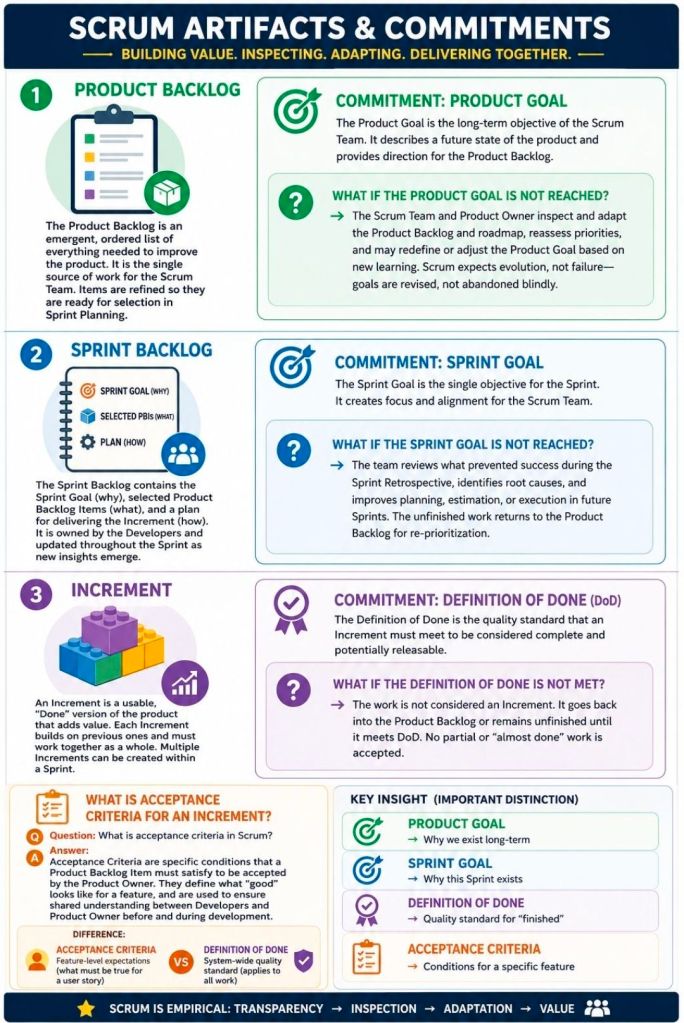
📦 The 3 Artifacts

Artifacts are simply the tangible items or lists used to maintain transparency across the project.

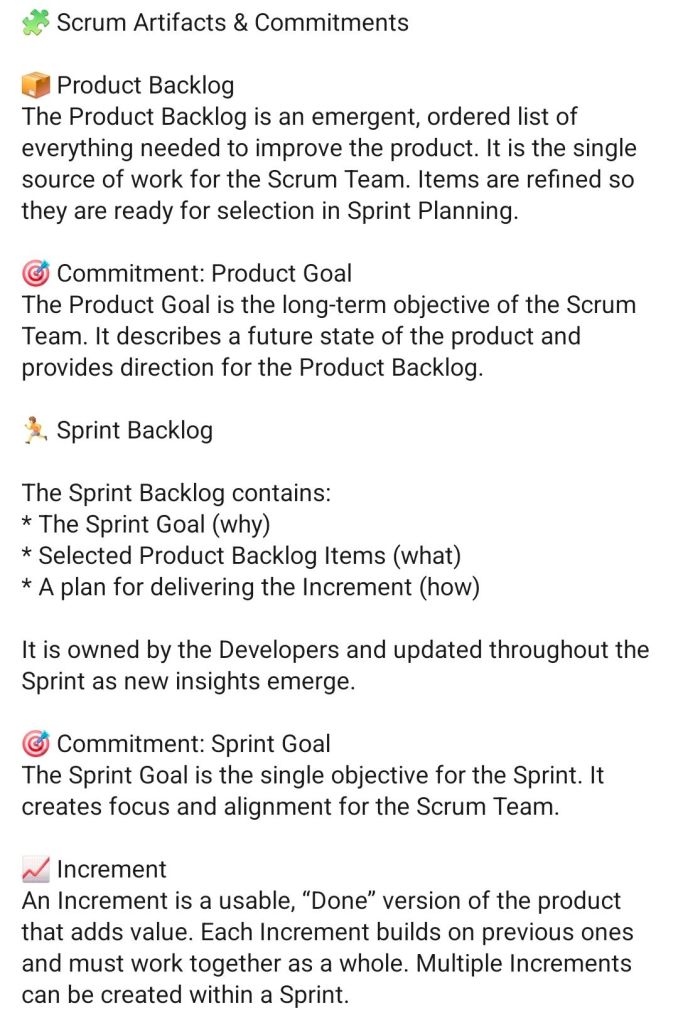
  • Product Backlog: The ultimate master list of features, fixes, and requirements needed for the product, prioritized by value.
  • Sprint Backlog: The specific subset of items selected from the master list that the team commits to finishing during the current cycle.
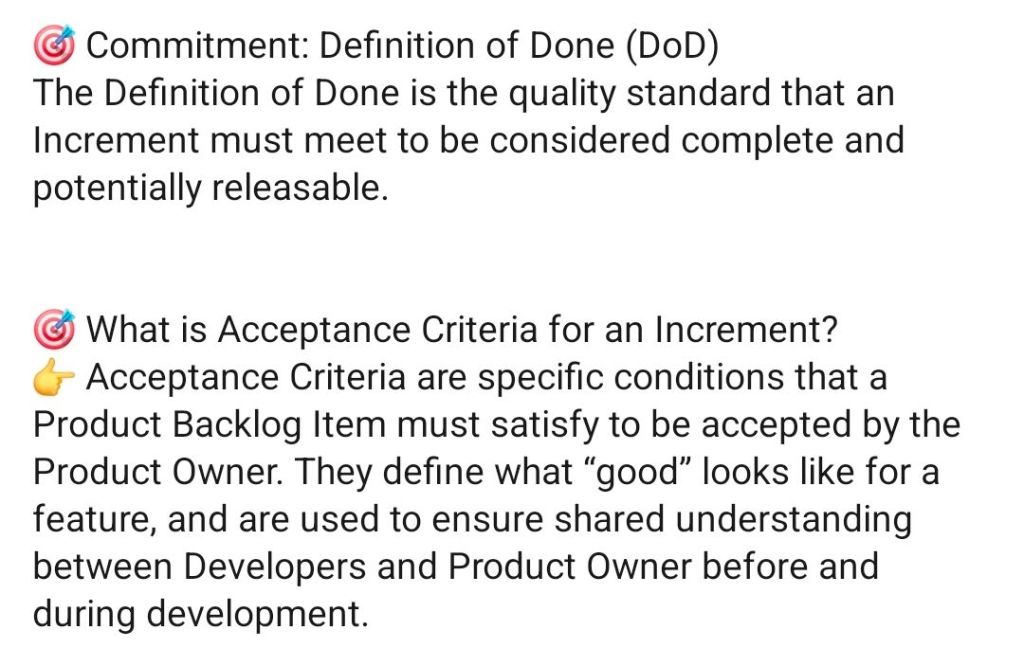
  • Increment: The final, working piece of the product delivered at the end of a cycle that meets the team’s “Definition of Done”.

📅 The 5 Events (Ceremonies)

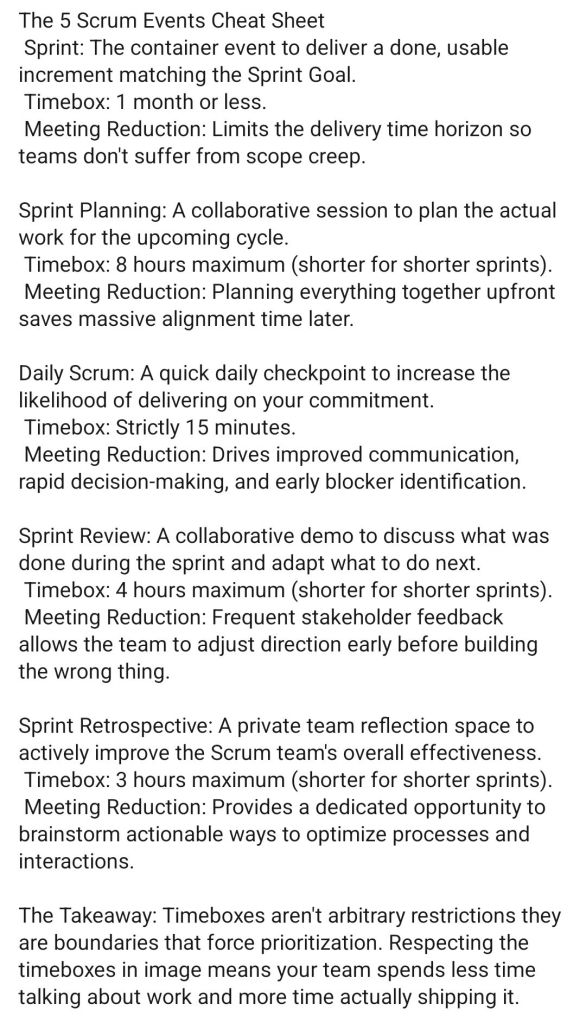
Scrum operates in time-boxed blocks called Sprints, which usually last 1 to 4 weeks. Each Sprint includes four distinct meetings:

  1. The Sprint: The time-box itself where the actual building happens.
  2. Sprint Planning: A meeting at the start of a Sprint where the team decides what they can realistically achieve and creates a plan.
  3. Daily Scrum (Stand-up): A quick, 15-minute daily meeting where developers sync on progress, plan the next 24 hours, and flag blockers.
  4. Sprint Review: A showcase held at the end of the Sprint to demo the working increment to stakeholders and gather feedback.
  5. Sprint Retrospective: An internal team meeting to review what went well, what went wrong, and how to improve the process for the next Sprint.

🏗️ Why Does Scrum Work?

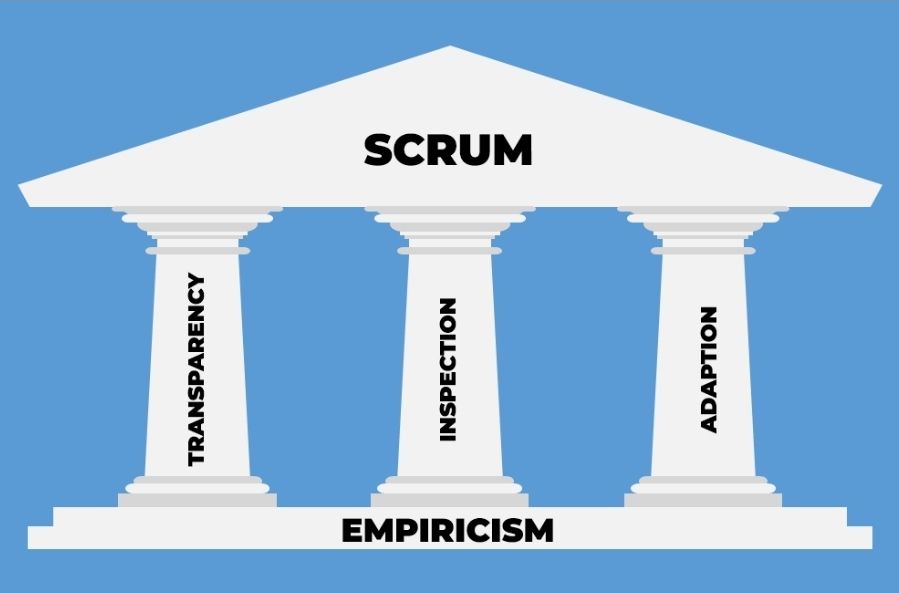
Scrum relies entirely on Empiricism, meaning making decisions based on real-world evidence rather than guesswork. It stands firmly on three pillars:

  • Transparency: Everyone involved sees exactly what is happening.
  • Inspection: The team frequently stops to check the quality of the product and progress.
  • Adaptation: If something goes off-course, the team shifts direction immediately rather than blindly following an outdated plan.

Mark Whitfield – Senior Project Manager – Projects Chronologically

Mark Whitfield is an SC-cleared Senior IT Project and Engagement Manager with over 30 years of experience. His career spans from early mainframe programming to leading multi-million-pound cloud migrations and digital transformations for major financial, utility, and government clients.

The chronological breakdown of his professional project portfolio, structured by his definitive career eras, is detailed below:

1. The Technical Era (1990–1995)

During this foundational era, Mark worked as a Programmer and Lead Analyst for The Software Partnership (acquired by Deluxe Data in 1994). He focused strictly on the development, optimization, and deployment of the sp/ARCHITECT-BANK electronic banking solution on Tandem Mainframe Computers.

  • Project: Barclays Business Master II (BBM II)
    • Year: 1990–1992
    • Client: Barclays (On-site at Knutsford, Cheshire)
    • Budget: Internal banking operational budget
    • Details: Handled the custom design and backend coding for a high-profile desktop electronic business banking application.
  • Project: Automated Touch-Tone Phone Banking Suite
    • Year: 1992–1993
    • Client: Girofon (Denmark)
    • Budget: Client-retained vendor contract
    • Details: Coded automated, menu-driven voice solutions operating on a Periphonics VRAM device to fetch live customer balances directly from mainframes.
  • Project: Early Digital Inter-Account Transfers
    • Year: 1993–1994
    • Client: TSB & Bank of Scotland
    • Budget: Internal product development
    • Details: Directed logic design and mainframe coding to support pioneering inter-account electronic funds transfers.
  • Project: International Banking Optimization
    • Year: 1994–1995
    • Client: Rabobank
    • Budget: Vendor-driven custom development framework
    • Details: Managed localized software optimization, custom patches, and deployment testing for global banking operations.

2. The Infrastructure & Monitoring Era (1995–2014)

Mark transitioned into a Product and Project Manager role at Insider Technologies Limited (and later a brief stint at Wincor Nixdorf). His focus shifted heavily toward platform diagnostics, high-availability transaction monitoring, and financial hardware software integrations.

  • Project: Reflex (Reflex 80:20) System Co-Development
    • Year: 1995–2004
    • Client: Multiple Tier-1 Investment Banks (including Euroclear/Crestco, Bank of England, and Deutsche Bank)
    • Budget: Part of a broader £3M Management Buyout (MBO) product portfolio
    • Details: Acted as Senior Programmer and Technical Lead to co-develop diagnostic monitoring modules for high-availability mainframes.
  • Project: ATM & Point-of-Sale (POS) Transaction Monitoring
    • Year: 2005–2013
    • Client: Barclays, HSBC, and Alliance & Leicester (now Santander)
    • Budget: Multi-year strategic technical vendor account
    • Details: Managed the integration of transaction tracking across ATM networks using ACI’s XPNET and HP NonStop architecture.
  • Project: Legacy ATM Software Modernisation
    • Year: 2013–2014
    • Client: Major UK Retail Bank (via Wincor Nixdorf Professional Services)
    • Budget: Corporate financial service transformation
    • Details: Served as Project Manager executing the swap-out of outdated, legacy ATM client systems for modernized software stacks.

3. The Digital and Cloud Era (2014–Present)

This era highlights Mark’s leadership of large-scale Agile and Waterfall digital delivery frameworks, moving from corporate gambling technology to complex, high-budget UK public sector programs.

  • Project: Mobile & Online Gaming Sportsbook Platforms
    • Year: 2014–2016
    • Client: Betfred Limited (Online & Mobile Division)
    • Budget: Multi-million phased agile commercial releases
    • Details: Led Agile Scrum development teams to upgrade payment gateways, implement fraud detection, and roll out football/horse racing mobile interfaces.
  • Project: National Air Space Real-Time Mobile Applications
    • Year: 2016
    • Client: NATS (UK-wide Air Traffic Organisation)
    • Budget: Corporate custom applications initiative
    • Details: Managed the secure Agile delivery of Apple iOS applications displaying live military and public airspace information.
  • Project: Core Systems Interface Data Centre Migration
    • Year: 2016 (May–October)
    • Client: Royal Mail Group (RMG) / Postal Services
    • Budget: £4.3 Million
    • Details: Led a massive cross-functional team of 90 Capgemini engineers to migrate over 1,100 platform data interfaces ahead of peak annual trading.
  • Project: Automated Call Centre CCaaS Telephony Implementation
    • Year: 2017 (May onwards)
    • Client: Local Regional Government
    • Budget: £400,000
    • Details: Deployed a programmatic dialler system linked with Microsoft Azure CRM to facilitate the “Support for Mortgage Interest” campaign.
  • Project: Automotive Online Car Sales and Digital Readiness
    • Year: 2017 (October)
    • Client: Jaguar Land Rover (JLR) / Aston Agile Delivery Centre
    • Budget: £1.1 Million (Split into a £670k Customer Sales Portal and a £430k Readiness project)
    • Details: Engagement Manager implementing a new-car ecommerce vehicle pipeline.

Project: Middleware & MuleSoft Anypoint Integrations

  • Year: 2018–2019
  • Client: UK Utility, Accounting, and Recruitment Industries (via MuleSoft augmentation)
  • Budget: Enterprise-wide technology vendor accounts
  • Details: Delivery Manager structuring API integration architectures across multi-million-pound client portfolios.

Project: Multi-App Cloud Migration Proof-of-Concept

  • Year: 2020 (Feb–May)
  • Client: UK Government
  • Budget: £375,000
  • Details: Directed a 3-month proof of concept migrating legacy Access, Oracle, and SQL databases to Microsoft Azure and Dynamics 365.

Project: Document Management Cloud Transformation

  • Year: 2021–2022
  • Client: UK Utility Industry (e.g., Welsh/Scottish Water)
  • Budget: £500,000+
  • Details: Managed the platform decommissioning and cloud modernization from legacy EQS document storage over to Azure Enablon.

Project: Enterprise Dynamics 365 Online Cloud Migration

  • Year: 2022 (November onwards)
  • Client: UK Government
  • Budget: £1 Million+ (Part of a larger £13.5M cloud program moving 130 apps)
  • Details: Orchestrated the launch and configuration of Azure Cloud frameworks migrating 12 historical Dynamics 2016 platforms to Dynamics 365 Online.

Project: Fish Export Service (FES) to CHIP Inspection Portal

  • Year: 2023–2024 (Nov–Feb)
  • Client: UK Government / Northern Ireland Trading Framework
  • Budget: £1 Million+
  • Details: Served as Technical Delivery Manager directing Agile Scrum teams to build cloud-hosted APIs supporting catch verification under the Windsor Framework.

Agile Projects Overview and Timeline by year

Agile project management is an iterative, adaptive approach that breaks projects down into small, manageable cycles called sprints or iterations. Instead of planning the entire project upfront, teams continuously deliver functional increments, gather immediate feedback, and adapt to changing requirements. It prioritizes team collaboration, customer involvement, and rapid value delivery over rigid documentation and sequential phases.


Comprehensive Timeline Breakdown by Era and Year

Era 1: The Foundational Seeds (1950s – 1980s)

Before “Agile” existed as a formal term, engineers and researchers laid the groundwork through lean manufacturing and early iterative computing.

  • 1957: IBM begins utilizing incremental development concepts under Gerald M. Weinberg.
  • 1958: Software for Project Mercury (NASA’s first human spaceflight program) is developed using rapid half-day iterations.
  • 1970: Dr Winston Royce publishes a paper describing the Waterfall methodology. Paradoxically, he presents it as high-risk, yet it becomes the dominant, rigid corporate framework for decades.
  • 1980: Toyota refines “Just-In-Time” logistics and visual management system concepts, which later directly inspire Kanban and Lean software practices.
  • 1986: Authors Hirotaka Takeuchi and Ikujiro Nonaka publish “The New New Product Development Game” in the Harvard Business Review. They introduce a holistic, “rugby-style” team approach, coining the term “Scrum”.
  • 1988: Dr Barry Boehm introduces the Spiral Model, formalizing risk-driven, iterative lifecycle planning.

Era 2: The “Lightweight” Revolt (1990s)

Driven by frustration over the high failure rates and slow delivery of Waterfall, software pioneers independently build faster, more flexible frameworks.

  • 1991: James Martin formalizes Rapid Application Development (RAD), highlighting timeboxing, prototyping, and active customer involvement.
  • 1993: Jeff Sutherland, John Scumniotales, and Jeff McKenna deploy the very first operational Scrum process at Easel Corporation.
  • 1994: The Dynamic Systems Development Method (DSDM) is launched in the UK, providing one of the earliest structured frameworks for iterative project delivery.
  • 1995: Ken Schwaber and Jeff Sutherland co-present the formal Scrum Framework to the public at the OOPSLA conference.
  • 1996: Kent Beck introduces Extreme Programming (XP), introducing core engineering mechanics like pair programming and test-driven development (TDD).
  • 1997: Jeff De Luca and Peter Coad design Feature-Driven Development (FDD) to focus strictly on client-valued functional results.

Era 3: The Manifesto Moment (2000 – 2001)

The pivotal pivot point where separate iterative movements unite into a single, cohesive global movement.

  • 2000: Pre-meeting alignment occurs. Martin Fowler publishes his definitive article on Continuous Integration (CI), and Extreme Programming teams begin adopting Scrum’s three-question daily standup format.
  • February 2001: The Agile Manifesto is Born. Seventeen software development pioneers meet at a ski resort in Snowbird, Utah. They discover common ground, author the Manifesto for Agile Software Development, and establish the 4 Core Values and 12 Principles.
  • Late 2001: The Agile Alliance non-profit is established to safeguard, evolve, and distribute Agile education globally.

Era 4: Mainstream Adoption & Scaling (2002 – 2019)

Agile shifts from a rebellious IT trend into a standard corporate expectation, requiring frameworks that can scale across massive enterprises.

  • 2002: Ken Schwaber co-founds the Scrum Alliance to offer standardized certifications (like Certified ScrumMaster), dramatically accelerating global adoption.
  • 2003: Mary and Tom Poppendieck publish Lean Software Development, cleanly mapping Toyota’s manufacturing efficiencies directly onto digital projects.
  • 2009: The Software Craftsmanship Manifesto is created to ensure technical excellence and code quality are not forgotten during rapid business sprints.
  • 2011: Dean Leffingwell releases the Scaled Agile Framework (SAFe), allowing massive corporate enterprises to align hundreds of agile teams across entire portfolios.
  • 2015: Global project management authorities officially pivot; AXELOS releases PRINCE2 Agile, and the Project Management Institute (PMI) introduces Agile certifications into its core curriculum.

Era 5: Modern Continuous Agility (2020s – Present)

Agile transcends IT entirely, cementing its place as an overarching organizational strategy for business survival in an uncertain world.

  • 2020: The Scrum Guide receives its most significant structural update, streamlining language, eliminating prescriptive micro-management, and focusing intensely on a single, unified team working toward a singular “Product Goal”.
  • 2021–2023: Business Agility explodes. Non-technical departments—including HR, Marketing, Legal, and Finance—broadly restructure their workflows into iterative agile backlogs to manage volatile hybrid work environments.
  • 2024–Present: AI-Driven Agility becomes standard practice. Project management tools use generative AI to automatically draft user stories, estimate team velocity, and dynamically rewrite project sprint backlogs based on real-time market shifts.

Agile Projects Overview and Timeline by year

Project Management Roles and some Certifications

Project Management Roles and some Certifications