PRINCE2 (PRojects IN Controlled Environments) Overview and Timeline by Year

PRINCE2 (PRojects IN Controlled Environments) is a structured, process-based project management methodology focusing on organization, control, and business justification. Originating from UK government IT standards in the 1970s, it has evolved into a globally recognized, tailorable standard used in over 150 countries for projects across various industries. 

PRINCE2 Project Management Summary

  • Core Philosophy: Continued Business Justification (projects must make sense financially), Manage by Exception (delegating authority within limits), and Product-Based Planning.
  • Seven Principles: Projects must have continued business justification, learn from experience, define roles and responsibilities, manage by stages, manage by exception, focus on products, and tailor to suit the project.
  • Seven Processes: Starting a Project, Directing a Project, Initiating a Project, Controlling a Stage, Managing Product Delivery, Managing a Stage Boundary, and Closing a Project.
  • Key Themes: Business Case, Organization, Quality, Plans, Risk, Change, and Progress.
  • Main Benefits: Provides a common language, clear accountability, defined roles, and tailored, consistent documentation. 

Detailed Historical Timeline (1975–2023+)

Era 1: The PROMPT Origins (1975–1988) 

  • 1975: Simpact Systems Ltd develops PROMPT (Project Resource Organisation Management and Planning Techniques) in response to IT projects running over time and budget. PROMPT II introduces a phased approach (Initiation, Specification, Design, Development, Installation, Operation). 

Era 2: The PRINCE Birth (1989–1995)

  • April 1989: The UK Central Computer and Telecommunications Agency (CCTA) adopts PROMPT II as the standard for IT projects, renaming it PRINCE (initially “PROMPT II IN the CCTA Environment”).
  • 1990: PRINCE is released into the public domain and widely adopted by the private sector for non-IT projects, although it is perceived as too rigid for small projects. 

Era 3: The Birth of PRINCE2 (1996–2008) 

  • 1996: PRINCE2 is published by the CCTA. It is rewritten for broader use (not just IT), removing jargon to become a generic project management framework.
  • 1998: PRINCE2 begins undergoing revisions based on user feedback.
  • 2000: The Office of Government Commerce (OGC) becomes the owner of PRINCE2.
  • 2002: The international user community begins consultative updates to the method. 

Era 4: The Modern Revision Era (2009–2022) 

  • 2009: PRINCE2: 2009 Refresh is released by the OGC. This major revision simplifies the method, makes it more customizable, and introduces the seven core principles.
  • 2013: Ownership transfers from the UK Cabinet Office to AXELOS Ltd, a joint venture between the UK Government and Capita.
  • 2017: PRINCE2 2017 Update is published, focusing on increased flexibility, scalability, and better tailoring guidance.
  • 2018: PRINCE2 Agile is launched, bringing a governance layer to agile delivery methods like Scrum and Kanban.
  • 2020: PRINCE2 2017 is renamed “PRINCE2 6th Edition”.
  • 2021: PeopleCert becomes the sole owner of AXELOS and PRINCE2. 

Era 5: The Current Era (2023–Present) 

  • September 2023: PRINCE2 7th Edition is released. The update introduces a “People” element, focusing on change management and team leadership, along with new guidance on Sustainability, Commercial, and Digital & Data management. 
PRINCE2 Key Evolution Summary
May 2011 – Registered PRINCE2 Practitioner with ILX, Mark Whitfield

PRINCE2 (PRojects IN Controlled Environments) Overview and Timeline by Year

Waterfall project management is a linear, sequential methodology

Waterfall project management is a linear, sequential methodology where progress flows steadily downward through defined phases, much like a physical waterfall. In this model, each stage—such as requirements, design, implementation, and testing—must be fully completed and approved before the next one begins. 

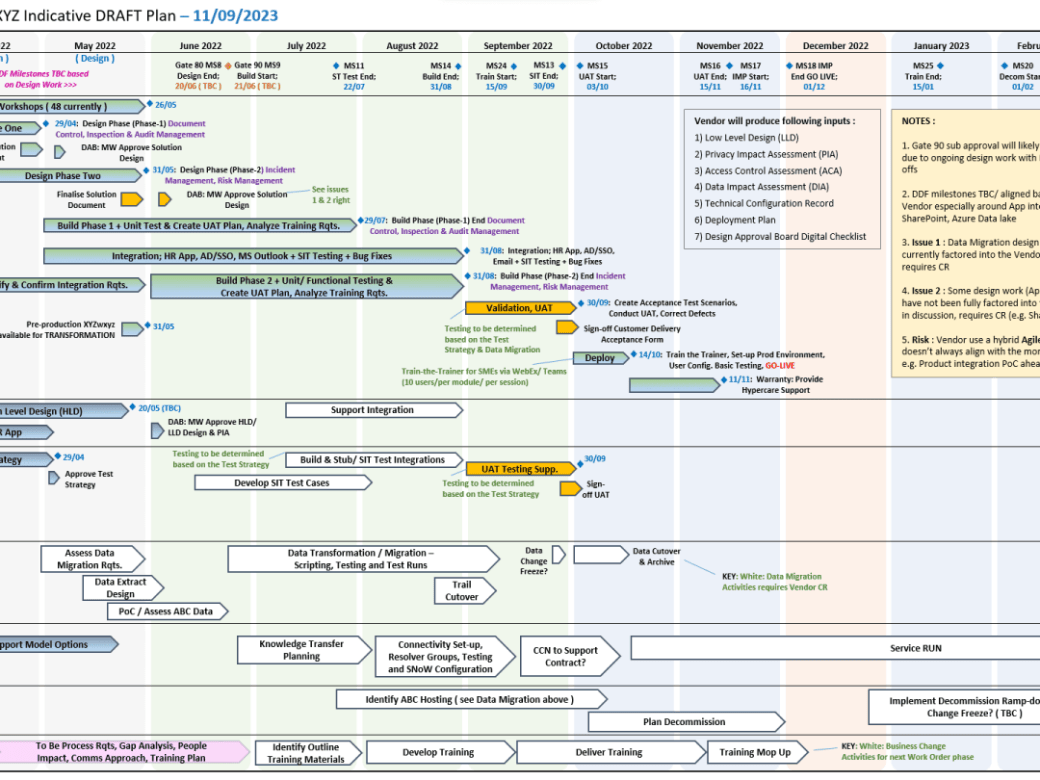
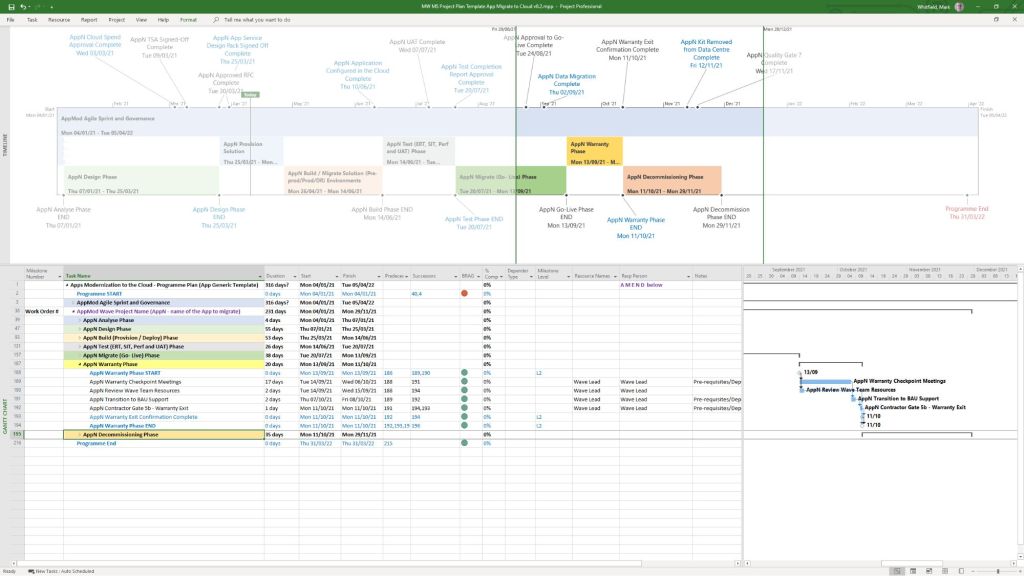
Waterfall Project Plans, .xls and .mpp file formats respectively

Core Characteristics

  • Sequential Design: No overlapping phases; each “cascades” into the next.
  • Documentation-Driven: Extensive upfront planning and detailed records are required at every step.
  • Fixed Scope: Requirements are gathered at the start, making the project’s timeline and budget highly predictable but difficult to change.
  • Specialised Use: Best suited for regulated industries like aerospace, construction, and healthcare, where changes are costly or safety is paramount. 

Historical Timeline by Era and Year

The following timeline tracks Waterfall from its origins in post-WWII engineering to its current role in hybrid project management.

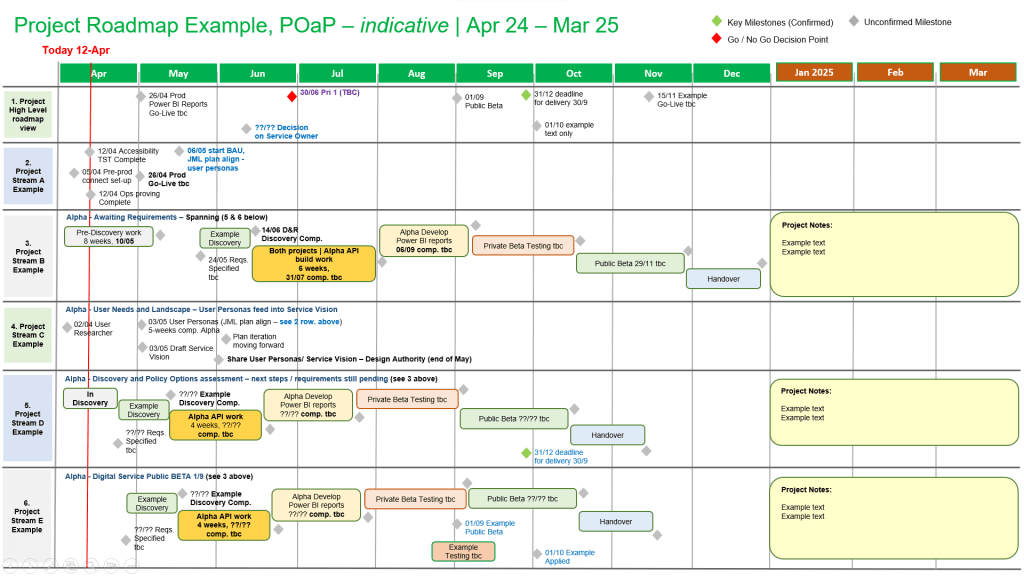
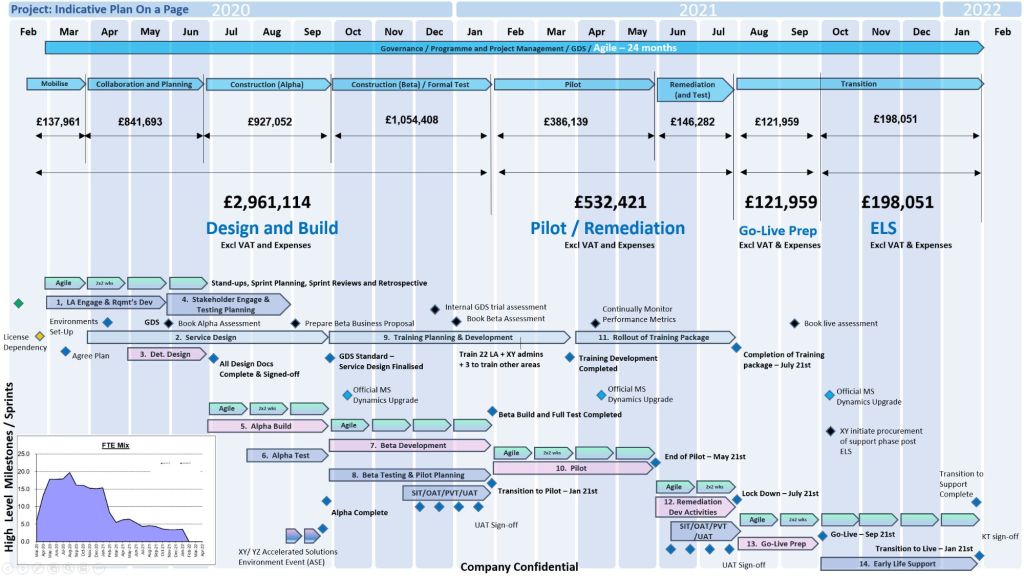
Examples, Waterfall Plan On a Page POaP in MS PowerPoint format

The Pre-Formal Era (1950s – 1969)

Software development adopted structured, sequential approaches from engineering, largely driven by complex, high-risk projects. 

  • 1956Herbert D. Benington documented a sequential process for the SAGE project, establishing the technical roots.
  • Late 1960sNASA applied linear, rigid methodologies to Apollo missions, setting a precedent for high-stakes, documentation-heavy development.
  • 1968: The NATO Software Engineering Conference highlighted the “software crisis,” prompting a push for formal, disciplined development models. 

The Formalisation Era (1970 – 1979)

The model was officially, yet ironically, described and named. 

  • 1970Dr. Winston W. Royce published his foundational paper on managing large software systems, often cited as the origin of the “Waterfall” model, though he originally presented it as a cautionary, flawed approach.
  • 1976T.E. Bell and T.A. Thayer likely first used the term “Waterfall” in literature. 

The Institutional Era (1980 – 1999)

Waterfall became the mandatory standard for large-scale, complex projects. 

  • 1985: The U.S. DoD mandated DOD-STD-2167, cementing Waterfall as the standard for military software.
  • 1989: The UK Government introduced PRINCE2, deeply influenced by Waterfall principles.
  • 1994: The U.S. DoD formally abandoned strict Waterfall mandates for more flexible methods. 

The Modern & Hybrid Era (2000 – Present)

Waterfall transitioned from the default standard to a specialised methodology. 

  • 2001: The Agile Manifesto marked a shift toward iterative development, reducing Waterfall’s dominance.
  • Present Day: It remains vital in regulated sectors (e.g., aerospace) and is often combined with Agile in hybrid approaches.

Waterfall project management is a linear, sequential methodology

Click on the link in the website banner above to purchase example, editable template project plans shown and many others.

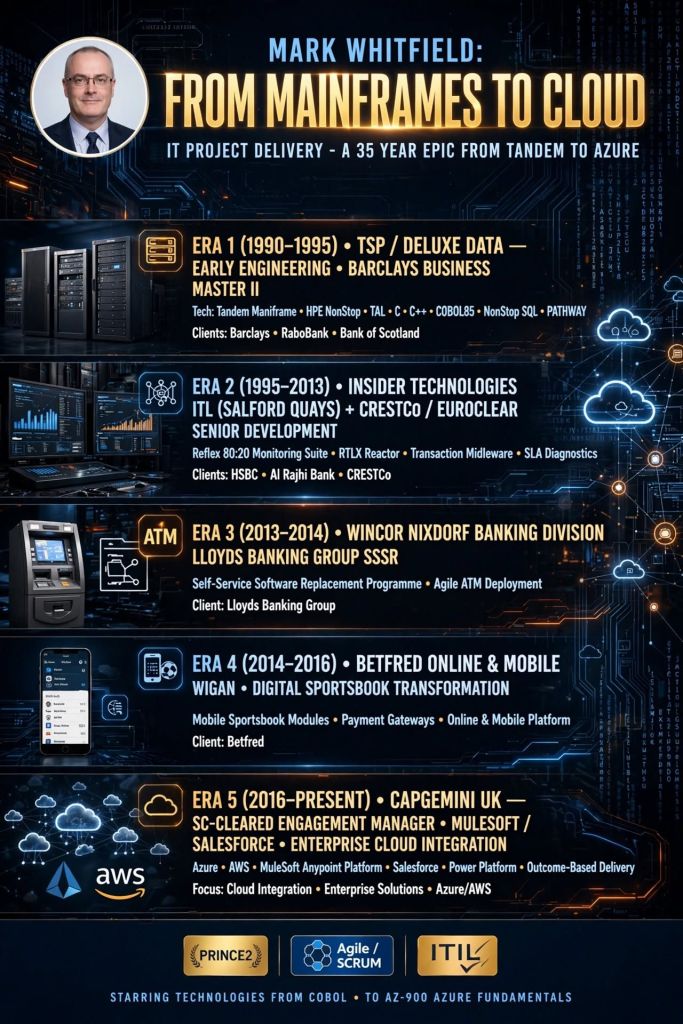
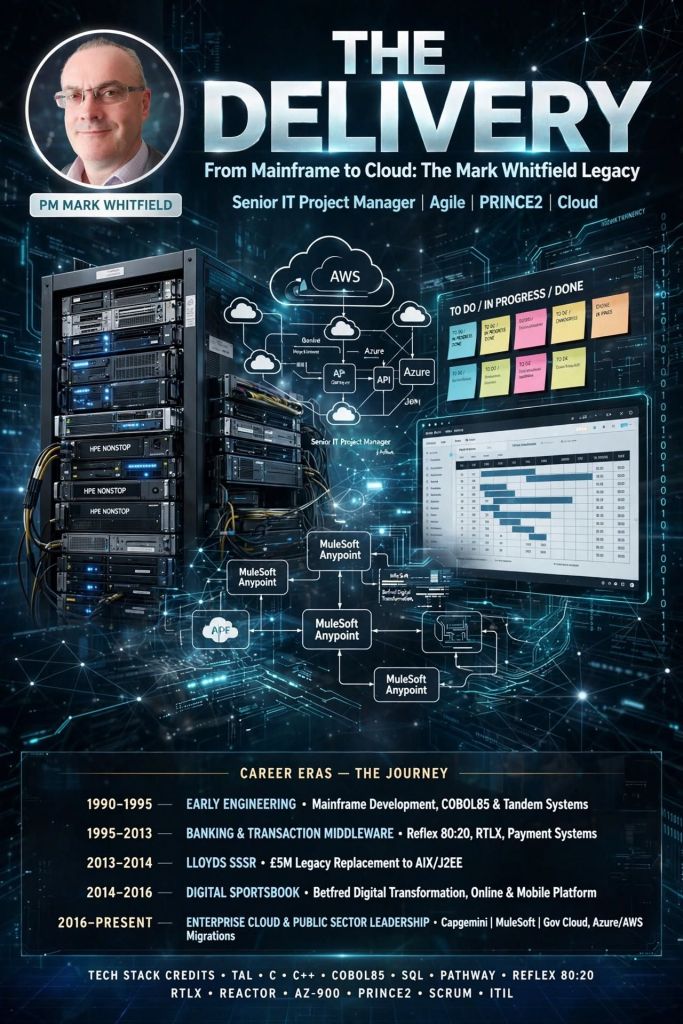
Mark Whitfield, Website Author – Background and Career Timline

Mark Whitfield is a Senior IT Project Manager and Engagement Manager with over 30 years of experience in the software development lifecycle (SDLC). He is currently a SC-cleared Engagement Manager at Capgemini UK. 

Professional Background by Era

  • 1990–1995: Early Programming (The Software Partnership/Deluxe Data)
    • Role: Programmer/Lead Analyst.
    • Focus: Developed electronic banking software (sp/ARCHITECT-BANK) on Tandem Mainframe Computers (now HPE NonStop).
  • 1995–2013: Senior Development & Product Management (Insider Technologies)
    • Role: Progressed from Senior Programmer to Project Manager for Strategic Technical Initiatives.
    • Focus: Developed platform health and diagnostic modules for the “Reflex” monitoring product.
  • 2013–2014: Project Management (Wincor Nixdorf)
    • Role: Project Manager, Professional Services – Banking Division.
    • Focus: Managed the Wincor Nixdorf workstream for Lloyds Banking Group’s Self-Service Software Replacement (SSSR) programme.
  • 2014–2016: Digital Project Management (Betfred)
    • Role: Senior Digital Project Manager, Online and Mobile Division.
    • Focus: Delivered payment gateways, sportsbooks, and virtual gaming components for iOS, Android, and Windows.
  • 2016–Present: Senior Engagement Management (Capgemini)
    • Role: Engagement Manager (A8), Custom Bespoke Solutions.
    • Focus: Leading digital transformation and cloud migration projects for public and private sector clients. 

Technologies & Frameworks

  • Project Methodologies: Agile SCRUM, PRINCE2 (Practitioner), Waterfall, ITIL, and ISO QA.
  • Mainframe & Infrastructure: HPE NonStop (Tandem), IBM ESB, UNIX shell scripting, and Cloud (MS Azure/AWS).
  • Programming & Databases: C/C++, MS SQL, Java, COBOL85, TAL, TACL, and SCOBOL.
  • Tools: MS Project, MS Excel/Office, MuleSoft Anypoint Platform, and Jira. 

Major Projects & Customers

  • UK Government: Managed a £13.5m cloud migration of 130 applications and the £1m+ Fish Export Service (FES) to CHIP portal.
  • Royal Mail Group (RMG): Managed a £4.3m data centre migration project involving over 1,100 interfaces.
  • Lloyds Banking Group (LBG): Led a £5m+ self-service software replacement project.
  • Other Notable Clients: Jaguar Land Rover (JLR), Heathrow, NATS (Air Traffic Control), Barclays, HSBC, Deutsche Bank, and Euroclear. 

Awards & Education

  • Awards:
    • C&CA UK’s Communications & Engagement Award (2022) at Capgemini UK.
    • Project Recognition Award from Wincor Nixdorf for achievements on the LBG SSSR project.
  • Education:
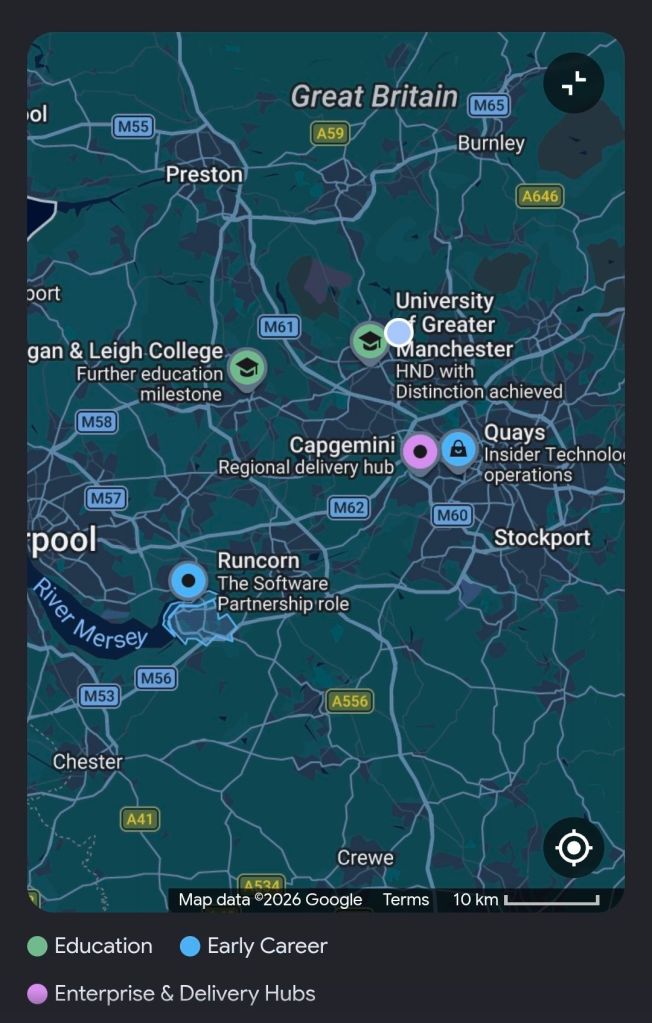
    • HND in Computer Studies (Distinction) from the University of Greater Manchester (formerly BIHE), 1988–1990.
    • A-Levels in Computer Science and Biology from Leigh College. 

Project Management Templates

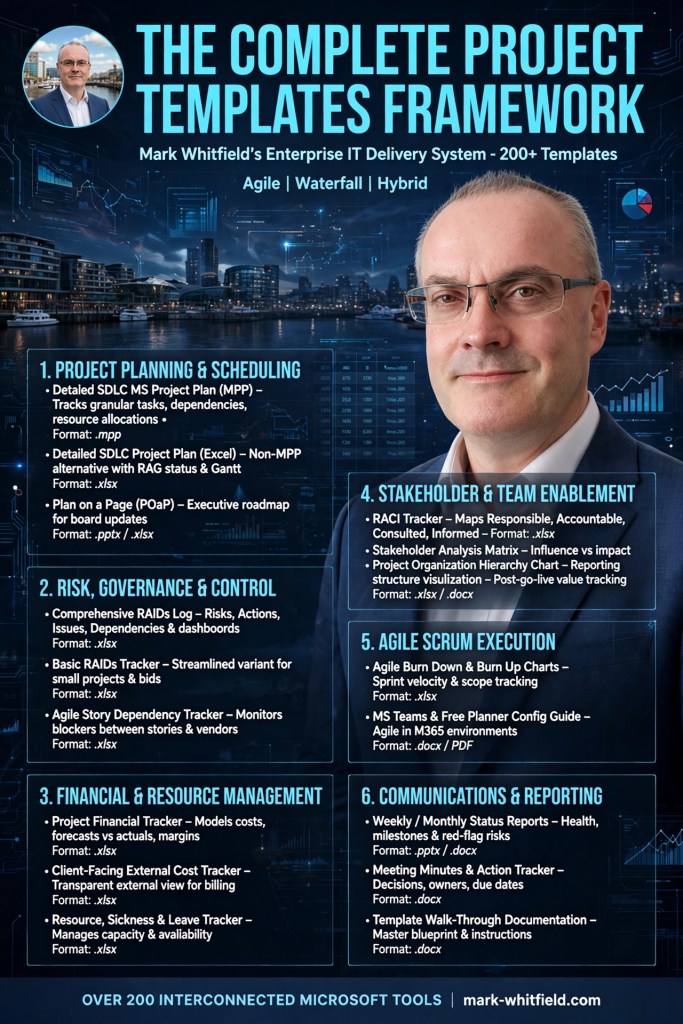
Whitfield provides a library of over 200 editable resources through his site, PROject Templates, designed for Agile, Waterfall, and PRINCE2 7th Edition delivery. Key items include: 

  • Plan on a Page (POaP): Over 35+ executive-level summary slides.
  • Detailed Project Plans: Templates in MS Project (MPP) and Excel for SDLC tracking.
  • RAID Logs: Comprehensive registers for risks, actions, issues, and dependencies. 

Mark Whitfield Background and Career Timline

PRINCE2 Management Products Templates Overview and Historical Timeline

PRINCE2 management products are the 26 standard documents (templates) used to manage a project throughout its lifecycle. They are categorised into Baselines (plans and definitions), Records (registers and logs), and Reports (periodic updates). 

PRINCE2 Microsoft Project & Excel templates

Management Products Overview

The core templates provided in the methodology ensure consistent project control. Official templates are often available through accredited providers, this website or the official AXELOS website. 

  • Baselines: Used to define the project foundation (e.g., Business Case, Project Initiation Document, Plan).
  • Records: Dynamic logs to track day-to-day data (e.g., Risk Register, Issue Register, Lessons Log).
  • Reports: Snapshots of progress or specific events (e.g., Highlight Report, Checkpoint Report, Exception Report). 

Historical Timeline of Templates & Methodology

The evolution of these products reflects a shift from rigid, IT-specific documents to flexible, industry-agnostic templates. 

The Pre-PRINCE Era (1975 – 1988) 

  • 1975PROMPT II (Project Resource Organisation Management and Planning Techniques) was developed by Simpact Systems Ltd.
  • Key Focus: Introduced the concept of project phases (Initiation, Specification, Design) but was strictly for IT. 

The PRINCE Era (1989 – 1995) 

  • 1989PRINCE (PROMPT II in the CCTA Environment) launched by the UK Government’s CCTA.
  • Key Focus: Added Critical Path Analysis and formal management roles, but remained IT-heavy and rigid. 

The PRINCE2 Emergence (1996 – 2008)

  • 1996PRINCE2 (1st Edition) was released as a generic framework.
  • Key Change: IT-specific jargon was removed to make templates applicable to any industry.
  • 2002/2005: Minor updates (3rd and 4th Editions) focused on minor refinements based on user feedback. 

The Revision Era (2009 – 2022)

  • 2009PRINCE2:2009 Refresh (5th Edition) introduced the seven core principles.
  • Key Change: Templates were simplified and made more customisable to reduce “prowess-driven” bureaucracy.
  • 2017PRINCE2 6th Edition (formerly the 2017 Update) launched.
  • Key Change: Emphasis on Tailoring and scalability for different project sizes. 

The Modern Era (2023 – Present)

  • 2023PRINCE2 7th Edition was released.
  • Key Change: Added a “People” element and introduced three new management approaches: SustainabilityCommercial, and Digital & Data

Template Kits & Resources

For those seeking pre-formatted digital versions:

  • PRINCE2 7th Edition Template Bundle: Comprehensive sets including MS Project MPP, Excel Gantt charts, and Word artifacts are available at Etsy and eBay.
  • Specialised Packs: Focused collections like the PRINCE2 Control & Monitoring Pack can be found at WorkFlo Design.
  • Individual Documents: Individual templates like the Project Initiation Document (PID) are often sold separately for specific project needs. 
  • PRINCE2 Templates can be purchased directly from this website including a Microsoft Project Plan in MPP format and also a Microsoft Excel Project Plan in XLS format, see below and website link.

PRINCE2 Management Products Templates Overview and Historical Timeline

PRINCE2 Microsoft Project MPP file template
PRINCE2 Microsoft Excel XLS template 1
PRINCE2 Microsoft Excel XLS template 2

PRINCE2 Templates FREE Upgrades

Mark Whitfield’s PRINCE2 template collection is a comprehensive set of over 200 editable Microsoft Office documents designed to support both waterfall and agile project delivery. These templates are classified into several key categories, ranging from core PRINCE2 management products to advanced planning and tracking tools. 

Example Microsoft Project MPP file template

Core PRINCE2 Management Product Templates

This category includes the standard documentation required by the PRINCE2 methodology, often provided in MS Word (.doc) format. 

  • Project Initiation & Definition:
    • Project Brief: Initial summary used to gain approval for the initiation stage.
    • Project Initiation Document (PID): A comprehensive document containing the project definition, approach, business case, and management strategies.
    • Business Case: The primary justification for the project’s existence.
  • Registers and Logs:
    • Risk Register: For identifying and managing project risks.
    • Issue Register & Issue Report: For tracking and detailing specific project problems.
    • Lessons Log & Lessons Report: To capture and share knowledge gained throughout the project.
    • Daily Log: For the Project Manager to record informal issues or activities.
  • Reporting and Progress:
    • Highlight Report: Periodic progress updates for the Project Board.
    • Checkpoint Report: Updates from the Team Manager to the Project Manager.
    • End Stage & End Project Reports: Summaries of performance at key project milestones.
    • Exception Report: Used when a project is forecast to exceed its tolerances.
  • Quality and Configuration:
    • Product Description: Detailed specifications for each project deliverable.
    • Quality Register: Records all planned and completed quality activities.
    • Configuration Item Record: Tracks the status and version of project products. 

Advanced Planning and Tracking Templates 

Whitfield provides specialized tools for visual scheduling and financial management, primarily in MS Excel and MS Project (.mpp) formats. 

  • Project Planners:
    • PRINCE2 Waterfall Project Planner: A detailed Gantt-view planner in Excel for those without MS Project licenses.
    • MS Project (MPP) Templates: Pre-configured plans for PRINCE2 7th Edition, including end-to-end tasks and lifecycle stages.
    • Plan on a Page (POaP): High-level visual summaries of project timelines.
  • Resource and Financial Management:
    • Project Financial Tracker: Monitors forecast vs. actual costs, including margins and expenses.
    • Resource Costing Grid: Detailed grids for calculating costs per project phase.
    • RACI Tracker: Defines Roles and Responsibilities (Responsible, Accountable, Consulted, Informed). 

Operational and Agile Support

These supplemental templates assist with daily project operations and hybrid agile environments. 

  • RAID Log: A centralized tracker for Risks, Actions, Issues, and Dependencies.
  • Agile Specifics: Burn-down/up charts and sprint-view Gantt charts for scrum-based delivery.
  • Stakeholder Analysis Plan: Tools to map stakeholder influence versus impact.
  • Mobilisation/On-boarding Kit: PowerPoint templates for team kick-offs and onboarding. 

Visual Classification (Font Coding) 

In many of Whitfield’s automated plans, tasks are color-coded for quick visual breakdown: 

  • Black: Traditional PRINCE2 stage or activity.
  • Blue: Creation of a PRINCE2 artefact (e.g., creating a log).
  • Purple: Updating an existing artefact.
  • Green: Formal closing of an artefact. 

The full bundle is available for purchase on Mark Whitfield’s Official Website or through his Etsy Store

PRINCE2 Templates FREE Upgrades

Waterfall Methodology in Project Management, a Timeline History

The Waterfall methodology is a linear, sequential project management approach where progress flows steadily downward through defined phases, such as requirements, design, implementation, and testing. Each stage must be completed and approved before the next begins, making it highly structured but often inflexible to changes. 

Waterfall template available on this website

Historical Timeline by Era and Year

The history of the Waterfall model spans from early post-WWII engineering to its formalisation in software and eventual institutionalisation in government standards. 

The Pre-Formal Era (1950s – 1969)

During this period, software development borrowed heavily from established engineering and manufacturing processes. 

  • 1956: Herbert D. Benington presents a paper on the Semi-Automatic Ground Environment (SAGE) project, describing a structured process that many consider the true technical origin of the sequential approach.
  • Late 1960s: Major NASA projects and government software systems for rockets (e.g., Apollo missions) utilise rigid specifications and linear development due to the high cost of changes.
  • 1968: The NATO Software Engineering Conference identifies the “software crisis”—projects consistently running over budget and time—leading to a push for more disciplined models. 

The Formalisation Era (1970 – 1979)

The methodology was formally described, ironically as a cautionary tale, and finally given its name. 

  • 1970: Dr. Winston W. Royce publishes “Managing the Development of Large Software Systems”. He presents the sequential diagram but explicitly critiques it as “risky and invites failure,” suggesting a more iterative approach instead.
  • 1976: The term “Waterfall” is officially coined in a paper by Bell and Thayer, “Software Requirements: Are They a Problem?”. 

The Institutional Era (1980 – 1999)

Waterfall becomes the global standard for large-scale and regulated industries. 

  • 1985: The U.S. Department of Defense (DoD) adopts DOD-STD-2167, which mandates the use of the Waterfall model for all software development contractors. This cements Waterfall as the “one true way” for government and aerospace projects.
  • 1989: The UK Government creates PRINCE2, a process-based method largely rooted in Waterfall principles, still widely used in the public sector today.
  • 1991: In response to Waterfall’s rigidity, James Martin introduces Rapid Application Development (RAD), one of the first major departures from the linear model. 

The Modern & Hybrid Era (2000 – Present)

As Agile became dominant, Waterfall shifted from the default choice to a specialised or hybrid tool. 

  • 2001: The Agile Manifesto is published, marking a significant industry-wide shift away from traditional Waterfall toward iterative development.
  • 2009: Major institutions like George Washington University and others begin documenting their Project Management Lifecycle (PMLC) to standardise Waterfall and hybrid models for better oversight.
  • 2020s: Waterfall persists in regulated domains like healthcare, aerospace, and construction. It is increasingly integrated into hybrid methodologies that use Waterfall for high-level planning and Agile for execution. 

Waterfall Methodology in Project Management, a Timeline History

Waterfall template available on this website

Free Upgrade Project Management Templates Download by focus area

Mark Whitfield provides a comprehensive suite of over 200 editable project management templates designed for both Agile and Waterfall delivery. These tools are built based on 21+ years of IT project delivery experience and are formatted for Microsoft Office (Excel, Word, PowerPoint) and Microsoft Project (MPP).


Core Planning & Tracking Templates

  • Detailed Project Plans: Comprehensive MPP and Excel files covering the full Software Development Life-cycle (SDLC), including Waterfall and Agile Scrum sprints.
  • Plan on a Page (POaP): High-level visual summaries in PowerPoint or Excel for client reporting and executive snapshots.
  • RAID Log: A central tracker for Risks, Actions, Issues, and Dependencies, often including tabs for Decisions, Opportunities, and Lessons Learned.
  • RACI Matrix: A tracker to define roles and responsibilities (Responsible, Accountable, Consulted, Informed). 

Financial & Resource Management

  • Project Finance Tracker: Tools for managing project budgets, including forecasts vs. actuals, margin analysis, and variation tracking.
  • Resource Planning: Grid templates for costing project resources per phase and tracking team allocations.
  • Benefits Realisation: A spreadsheet to compare initial project goals against actual business outcomes and costs. 

Reporting & Communication

  • Status Reports: Weekly and monthly templates in Word and PowerPoint that include milestone dashboards, project health indicators, and “next steps”.
  • Organisation Charts: Templates for visualising the project hierarchy and stakeholder contacts.
  • Agile Dashboards: Excel-based Burn Down and Burn Up charts for teams that do not have access to tools like Jira. 

Methodology Support

  • PRINCE2 7th Edition: Specific MPP and Excel templates aligned with the latest PRINCE2 standards.
  • Agile Frameworks: Templates for Sprint Planning, Daily Stand-ups, and Sprint Retrospectives. 

These templates are available for purchase on Mark Whitfield’s official site and typically include free lifetime upgrades. 

Free Upgrade Project Management Templates Download by focus area

Mark Whitfield IT Project Manager Training Focus

Mark Whitfield, an IT Project Manager specializing in HP NonStop systems, has a career and training history that spans over three decades, from his academic beginnings in the late 1980s to advanced cloud certifications in the 2020s. 

Early Career & Foundations (1988–1995)

During this era, Whitfield focused on core computer science and specialized mainframe systems while working for The Software Partnership (TSP) and Deluxe Data

  • 1988–1990: Completed a Higher National Diploma (HND) in Computing at the Bolton Institute of Higher Education (BIHE). Modules included Computer Systems Architecture, Programming Methodology, and Data Processing.
  • May 1993: Tandem Guardian Principles Course.
  • September 1994: VPS 7000/9000 Series and VPS Application Development (VOS 4.3).
  • June 1995: HP NonStop (Tandem) Performance Analysis and Tuning.

Development & Technical Specialisation (1995–2005)

Working primarily with Insider Technologies Limited, this period was marked by software development training in languages like C++ and initial forays into project management. 

  • November 1995: HP NonStop TAL Programming.
  • March 1997: C / C++ Programming at Comtec Computer Training.
  • October 1998: Managing Multiple Projects, Objectives, and Deadlines at SkillPath.
  • February 1999: Successful Project Management at SkillPath.
  • May 2000Microsoft Project ’98 Certification (Orange Belt) at the IIL UK Education Centre.
  • February 2001: Sales and Marketing training (In-House).
  • March 2004: MultiBatch NSK Job Scheduling Product.
  • February 2005: Web Services and SOA. 

Web Development & Security Focus (2006–2010) 

This era shows a shift toward web-based technologies and specialized security products. 

  • January 2006: PRINCE2 Project Management Foundation.
  • February 2006: NetObjects Fusion.
  • March 2006: Cryptography (In-House at Thales e-Security).
  • December 2006: Thales e-Security SafeSign Product.
  • January 2007: Developing Web Applications Using Microsoft Visual Studio .NET.
  • March 2009: Querying Microsoft SQL 2000 with Transact SQL (M2071) at QA Training.
  • May 2009: Writing for the Web and Website Visibility & Promotion at iTrain Education.
  • November 2009: Thales e-Security HP NonStop Security Resource Manager (SRM). 

Agile & Advanced Management (2011–Present) 

In his current era at companies like Betfred and Capgemini, Whitfield has prioritized professional certifications in management and cloud infrastructure. 

  • May 2011: Agile SCRUM Training (RADTAC) and PRINCE2 Practitioner Certification (ILX Group).
  • June–July 2011: Java and Google Android programming using the Eclipse IDE.
  • January 2012: ITIL Foundation Course.
  • July 2014: Advanced Microsoft Excel 2013.
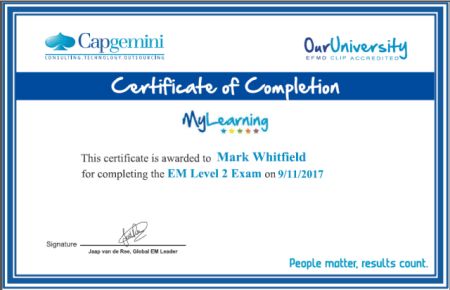
  • November 2017Advanced Engagement Management Certification (Level 2) at Capgemini.
  • February 2022AZ-900 Microsoft Certified Azure Fundamentals.
  • July 2024: Microsoft Excel Refresher 2024 via Udemy. 

Mark Whitfield IT Project Manager Training Focus

Mark Whitfield Senior SC Cleared IT Project Manager

Mark Whitfield is a Senior, SC cleared IT Project and Engagement Manager with over 30 years of experience, specializing in the software development lifecycle (SDLC) for large-scale digital and financial payment systems. 

Mark Whitfield is a Senior, SC cleared IT Project and Engagement Manager

Professional Experience by Year

  • 2016–Present: Capgemini UK (Manchester)
    • Role: SC cleared Engagement Manager (A8), Custom Bespoke Solutions.
    • Key Projects: Leading high-value digital transformations and cloud migrations for UK Government applications, automotive (Jaguar Land Rover), and aerospace (Air Traffic Management iOS apps).
  • 2014–2016: Betfred Limited (UK)
    • Role: IT Senior Digital Project Manager, Online and Mobile Division.
    • Key Projects: Managed multiple Agile SCRUM projects for payment gateways, sportsbooks, and virtual gaming components across iOS, Android, and Windows platforms.
  • 2013–2014: Wincor Nixdorf Limited (UK)
    • Role: Project Manager, Professional Services – Banking Division.
    • Key Projects: Managed a £5M+ workstream for Lloyds Banking Group’s Self-Service Software Replacement (SSSR) program, migrating legacy HP NonStop systems to AIX-based Oracle technologies.
  • 1995–2013: Insider Technologies Limited
    • Role: Project Manager – Strategic Technical Initiatives / Senior Development Engineer.
    • Key Projects: Led the development of diagnostic products like Reflex 80:20 and RTLX for global banks including HSBC and Al Rajhi Bank in Saudi Arabia.
  • 1990–1995: The Software Partnership (later Deluxe Data/FIS)
    • Role: Senior Programmer / Lead Analyst.
    • Key Projects: Developed electronic banking software (sp/ARCHITECT) for major banks like Barclays and TSB on Tandem/HP NonStop mainframes. 
Led the development of diagnostic products like Reflex 80:20 and RTLX

Education

  • Higher National Diploma (HND) in Computer Studies (1988–1990)
    • Institution: Bolton Institute of Higher Education, BIHE (now University of Greater Manchester).
    • Achievement: Graduated with Distinction (overall first in class across 2 years).
  • A-Levels in Computer Science and Biology (1985–1988)
    • Institution: Leigh College. 

Awards and Key Certifications

Higher National Diploma (HND) in Computer Studies (1988–1990)
  • Communications & Engagement Award Winner (2022): Awarded by Capgemini UK for Cloud & Custom Applications.
  • Project Recognition Award (2014): Awarded by Wincor Nixdorf for successful delivery of the Lloyds Banking Group SSSR project.
  • Microsoft Certified: Azure Fundamentals (AZ-900) (2022).
  • Certified Engagement Manager (2016): Level 2 Certification through Capgemini.
  • Registered PRINCE2 Practitioner (Since 2011).
  • Agile SCRUM Certified (Since 2011).
  • ITIL Foundation Certified (Since 2012).

Mark Whitfield Senior SC Cleared IT Project Manager

Editable Project Management Templates for Agile and Waterfall projects

Mark Whitfield’s project management (PM) template collection is a comprehensive professional toolkit containing over 200 editable templates. Designed for both Agile Scrum and PRINCE2/Waterfall delivery, the set is built on over 24 years of real-world experience and is available for purchase on his official website and Etsy

Core Planning & Tracking Templates

  • Detailed Project Plans: Comprehensive Microsoft Project (MPP) and Excel plans mapped to the Software Development Life Cycle (SDLC).
  • Plan on a Page (POaP): High-level visual summaries for client presentations, provided in both Excel and PowerPoint.
  • RAID Log: A robust Excel tracker managing Risks, Assumptions, Issues, and Dependencies, often including tabs for Change Requests and Lessons Learned.
  • Financial Trackers: Detailed spreadsheets for tracking project forecasts, actuals, variance, and resource costing.
  • RACI Matrix: Essential for defining roles (Responsible, Accountable, Consulted, Informed) within the project team. 

Methodology-Specific Artifacts

  • Agile Scrum: Includes burn-down and burn-up charts, sprint planning logs, and templates for daily stand-ups and retrospectives.
  • PRINCE2/Waterfall: Tailored plans for 7th Edition standards, including project mandates, transition plans, and close-out checklists. 

Reporting & Documentation

  • Status Reports: Weekly and monthly templates in Word and PowerPoint to communicate project health to stakeholders.
  • Walkthrough Guides: The ZIP package includes Microsoft Word documents explaining how to use and customise each major template.
  • Additional Tools: Benefits realisation plans, resource trackers, project organisation charts, and dependency logs. 

Key Features

  • Format: Primarily Microsoft Office (Excel, Word, PowerPoint, Project) for compatibility across desktop and mobile.
  • Lifetime Value: A one-time purchase typically includes FREE upgrades for life; users can re-contact the author for updated versions of the toolkit.
  • Customisability: All files are fully editable to suit specific project or organizational needs.

Editable Project Management Templates for Agile and Waterfall projects

Building a Product on Paper and in Reality

Building a Product on Paper and in Reality

Project Management LinkedIn Group

Project Management LinkedIn Group

https://www.linkedin.com/groups/163300

Project Management Café, PRINCE2 Agile SCRUM Kanban MPP MSP Templates ITIL LEAN DevOps PMP Six Sigma

This is a Project Management Group Café for PM students, graduates and professionals looking to either locate, discuss or contribute ideas for PM templates for; Agile, Scrum, Kanban, PRINCE2 Waterfall projects, e.g. Plan on a Page (POaP), RACI, MPP, RAID logs, finance trackers, status reports, org charts etc. etc.

Project Management LinkedIn Group

PRINCE2 and Agile Project Management Templates Gallery

A gallery and inventory of screenshots for the Project Management Templates (both Agile and PRINCE2 waterfall projects) that are all available to be purchased as a bundle from this website link (note: upgrades to the latest template package after purchase, are totally FREE).

PRINCE2 & Agile PM Templates Gallery

PM templates include MS Project MPP and MS Excel detailed plans including PRINCE2 and Agile delivery, Gantt Plan on a Page examples (POaP), finance trackers, status reports, RAID logs (Risk, Issue, Assumption, Dependency log), RACI tracker (Responsible, Accountable, Consulted, Informed), agile burn down chart and burn up chart, resource tracker, benefits realization plan etc. etc.

(Download the Template Inventory PDF file – 15MB)

Join the FREE PM templates related Facebook Group (LIKE Facebook page) and LinkedIn Group.

PRINCE2 and Agile Project Management Templates Gallery examples

MPP Microsoft Project Plan Examples
Agile Scrum Burn Down (and Up) Chart in Microsoft Excel
Example Microsoft Excel Spreadsheet Examples for Project Planning

PRINCE2 & Agile PM Templates Gallery

Website Author IT Career Timeline Breakdown

Mark Whitfield is a highly experienced IT professional with a career spanning over 30 years, transitioning from a technical programmer to a senior digital engagement and project manager. His expertise is rooted in HPE NonStop (Tandem) systems and has evolved to encompass complex Agile and Cloud delivery across diverse industries. 

Early Technical Era (1990–1995)

Following his graduation in Computing in 1990, Whitfield began his career as a Programmer at The Software Partnership (later Deluxe Data). 

  • Focus: Electronic banking software, specifically sp/ARCHITECT-BANK on Tandem Mainframe Computers.
  • Key Work: Developed code for major banks including TSB, Barclays, and Rabobank. This included early digital innovations like voice-driven phone banking and inter-account transfers before the internet was widespread. 

Growth and Product Management Era (1995–2004) 

Whitfield joined Insider Technologies Limited (ITL) in 1995 as a Senior Programmer

  • Focus: Platform health and diagnostic software for HPE NonStop systems.
  • Key Projects:
    • Co-developed diagnostic plug-ins for the Reflex monitoring suite.
    • Managed the first HP OpenView Operations (OVO) Smart Plug-In certification for the NonStop platform in 2002.
    • Consulted for CRESTCo (Euroclear) in 1997, conducting benchmark testing on new S7000 nodes. 

Strategic Leadership and Project Management Era (2005–2014) 

During this decade, he transitioned into IT Project Management, focusing on high-value financial transaction tracking. 

  • Focus: Waterfall and Agile project delivery for payment systems and banking infrastructure.
  • Key Milestones:
    • 2011: Led a massive transaction tracking project at Al Rajhi Bank (Saudi Arabia), parsing terabytes of tape-archived data into a normalised SQL database.
    • 2013–2014: At Wincor Nixdorf, managed a £5+ million project for Lloyds Banking Group to migrate ATM driving responsibilities from legacy systems to AIX-based Oracle technologies. 

Senior Digital Engagement Era (2014–Present)

Since 2014, Whitfield has focused on senior-level digital transformation and engagement management. 

  • Betfred (2014–2016): Served as Senior Digital Project Manager for online and mobile platforms (iOS/Android), managing fraud detection and payment gateway integrations.
  • Capgemini (2016–Present): Joined as an Engagement Manager (SC cleared).
    • Focus: Managing large-scale Agile and Waterfall digital projects across aerospace, defence, and government sectors.
    • Notable Projects: Leading a £13.5m programme to migrate 130 UK government applications to the cloud (AWS/Azure) and delivering real-time airspace monitoring apps for air traffic organisations. 
Mark Whitfield IT Career Timeline Breakdown

Mark Whitfield Online Resume Overview

Mark Whitfield is a highly experienced Senior IT Project Manager and former developer with over 30 years of expertise in HP NonStop (formerly Tandem) systems, primarily within the electronic banking and payments sectors. He is currently a Senior Project Manager at Capgemini (SC cleared until 2031) and maintains a professional portfolio at mark-whitfield.com

Historical Timeline & Customer Breakdown

  • 1990 – 1995: The Software Partnership / Deluxe Data (now FIS)
    • Customer/Projects: Developed electronic banking software, specifically sp/ARCHITECT-BANK, for major financial institutions including TSBBank of ScotlandRabobank, and Girofon (Denmark).
    • Technical Breakdown: Focused on low-level programming using COBOL85NonStop SQL, and TAL (Transaction Application Language).
    • Role: Programmer.
  • 1995 – 2013: Insider Technologies Ltd (ITL)
    • Customer/Projects: Focused on HP NonStop monitoring, diagnostic, and payment software for high-value banking clients. Key products included Enterprise ManagerXPNETBASE24, and EPS.
    • Technical Breakdown:
      • XPERT24: Produced technical designs for this performance monitoring tool to track XPNET layers and transaction interchange counters (ATM/POS approval rates).
      • RTLX Payments: Served as IT Project Manager for RTLX (Real-Time Long-term eXchange) payment software.
      • Infrastructure: Extensive use of Guardian utilities (PATHWAY, SCF, FUP, INSPECT), TACL, and SCOBOL.
    • Role: Software Design, Team Leading, and Product Management.
  • 2013 – 2016: Freelance / Contract Projects
    • Customer/Projects: Managed software development lifecycle (SDLC) projects for various blue-chip companies.
    • Role: IT Project Manager.
  • 2016 – Present: Capgemini
    • Customer/Projects: Managing large-scale digital and public sector transformations. Notable clients include UK Government (MS Azure Cloud migration), Jaguar Land Rover (JLR)HeathrowRoyal Mail GroupBank of EnglandHSBCBarclays, and Deutsche Bank.
    • Technical Breakdown: Transitioned from legacy Tandem environments to modern Agile Scrum delivery and Microsoft Azure Cloud hosting.
    • Role: Senior Project Manager / Technical Delivery Manager.

Technical Breakdown by Competency

  • Operating Systems: HP NonStop (Guardian/NSK), Windows, Linux, Unix.
  • Programming Languages: TALTACLCOBOL85SCOBOL, C, C++, Java, and ASP.NET framework.
  • Databases: NonStop SQL/MP, MS SQL.
  • NonStop Middleware: PATHWAYXPNETBASE24EPS, and EMS (Event Management System).
  • Methodologies: Registered PRINCE2 PractitionerAgile SCRUM, ITIL, and ISO9001:2008. 

Web Hyperlinks & Resources

iProPMTemplates on Etsy for Project Management Templates with FREE Upgrades

Mark Whitfield is a Senior Project Manager with over 30 years of experience in delivering PRINCE2 Waterfall and Agile Scrum projects. Operating the Etsy shop ProjectTemplatesSoft (also known as iProPMTemplates), he provides a comprehensive bundle of over 200 professional project management templates. 

Operating the Etsy shop ProjectTemplatesSoft (also known as iProPMTemplates)

Author Overview: Mark Whitfield

  • Professional Background: Graduated in Computing in 1990 and began his career as a programmer in electronic banking software.
  • Expertise: Senior Project Manager and PRINCE2 Practitioner with extensive experience in the Software Development Lifecycle (SDLC).
  • Value Proposition: His templates are designed to be “imitation-proof” professional toolsets used in real-world project delivery.
  • Support Policy: Offers FREE upgrades and additions for life to anyone who purchases his template bundles; users simply contact him via Etsy or his official website

Detailed Project Templates Inventory

The expanded inventory typically included in his master ZIP file covers the entire project lifecycle across various formats (Excel, Word, PowerPoint, and MS Project). 

1. Planning & Scheduling Templates

  • MS Project (MPP) Plans: Detailed SDLC Microsoft Project plans adaptable for Waterfall and Agile Scrum, including PRINCE2 7th Edition specific plans.
  • Excel Project Planners: Robust Waterfall and PRINCE2 planners with automated Gantt views, designed for users without MS Project licenses.
  • Plan on a Page (POaP): High-level PowerPoint and Excel templates for stakeholder presentations, showing project timelines and key milestones.
  • Agile Frameworks: Templates for Sprint planning, Daily Stand-ups, Sprint Reviews, and Retrospectives. 

2. Tracking & Control (RAID & RACI)

  • Comprehensive RAID Log: An Excel-based master tracker for Risks, Assumptions, Issues, Dependencies, and Decisions.
  • RACI Matrix: For defining roles and responsibilities (Responsible, Accountable, Consulted, Informed).
  • Agile Trackers: Includes Burn Down and Burn Up charts for teams not using Jira or similar tools. 

3. Financial & Resource Management

  • Project Financial Tracker: Detailed spreadsheets for tracking forecasts, actuals, margins, and variance.
  • Resource Costing Grid: Tools for estimating resource costs across project phases, useful for bidding and Statements of Work (SoW).
  • Capacity Planning: Templates for managing team availability and on-boarding mobilization kits

4. Documentation & Reporting

  • Status Reports: Weekly and monthly templates in Word and PowerPoint.
  • Standard PRINCE2 Artifacts: Complete set including Business Cases, Project Briefs, Highlight Reports, and End Stage Reports.
  • Governance Tools: Meeting minutes, stakeholder analysis plans, and Benefits Realisation Plans

iProPMTemplates on Etsy for Project Management Templates with FREE Upgrades

Project Management Templates Overview and Author Timeline

Mark Whitfield provides a comprehensive suite of over 200 editable project management templates designed for Agile, Waterfall, and PRINCE2 methodologies. These tools are based on his 30+ years of project delivery experience in high-stakes sectors like banking and aerospace. 

Overview of Project Management Templates

Whitfield’s collection, available on his official website and Etsy, includes specialized tools for various delivery phases: 

  • Planning & Scheduling: Includes Plan on a Page (POaP) (30+ PowerPoint examples for executive summaries), detailed MS Project (MPP) plans, and Excel-based Gantt charts for those without MS Project licenses.
  • Tracking & ControlRAID Logs (Risks, Actions, Issues, Dependencies/Decisions) with built-in charts, and RACI Trackers for defining roles and responsibilities.
  • Methodology-Specific Tools:
    • PRINCE2: Full 7th Edition MS Project plans and standard Word templates.
    • Agile/Scrum: Agile burn-down and burn-up charts, story dependency trackers, and sprint overview templates.
  • Financial Management: Detailed trackers for budgets, forecasts, actuals, margins, and resource costing per project phase.
  • Reporting & Governance: Weekly/monthly status report templates (Word and PowerPoint), project organization charts, stakeholder analysis plans, and meeting minutes.
  • Delivery & Mobilization: Onboarding kits, deployment runbooks, and Statement of Work (SOW) guidance for both Agile and Waterfall. 

Historical Career Timeline

Mark Whitfield’s template development is rooted in a career that evolved from technical programming to senior engagement management. 

  • 1990–1995: The Software Partnership / Deluxe Data: Started as a programmer specializing in electronic banking software for Tandem Computers (HPE NonStop).
  • 1995–2013: Insider Technologies (18 years):
    • 1997: Consultant at CRESTCo (now Euroclear) for volume testing and performance benchmarking.
    • 2002: Managed the first HP OpenView Operations 2-way Smart Plug-In certification for the NonStop platform.
    • Early 2000s: Transitioned to IT Project Manager, managing waterfall projects for real-time log extraction (RTLX) products for clients like HSBC.
    • Late 2000s–2013: Senior roles in product and project management, managing large-scale transaction monitoring for global banks.
  • 2013–2014: Wincor Nixdorf: Served as a Project Manager for the Banking Division, managing a £5m+ project for Lloyds Banking Group (LBG) to replace legacy software across their ATM estate.
  • 2014–2016: Betfred: Senior IT Digital Project Manager in the Online and Mobile Division, delivering projects using the Agile Scrum framework.
  • 2016–Present: Capgemini UK:
    • 2016: Lead Project Manager for a UK Air Traffic organization, delivering iOS apps for airspace visualization.
    • 2023–2024: Technical Delivery Manager for a £1m+ UK Government project involving fish export and health document portals.
    • Current: Serving as an Engagement Manager (Certified PRINCE2 Practitioner and Agile SCRUM) augmented into MuleSoft. 

Project Management Templates Overview and Author Timeline

Key Skills for the Project Manager

Key Skills for the Project Manager

PRINCE2 Management Stages Overview

In PRINCE2, a project is managed through a series of management stages, which are discrete sections of a project that the Project Board authorises at specific decision points. Every PRINCE2 project must have at least two stages: an initiation stage and at least one further delivery stage

PRINCE2 Management Stages Overview

A detailed breakdown of these stages, aligned with the seven core PRINCE2 processes, is provided below. 

1. Starting Up a Project (SU)

This is a pre-project process designed to determine if the project is viable and worthwhile before committing significant resources. 

  • Key Activities:
    • Appointing the Executive and Project Manager.
    • Developing an Outline Business Case.
    • Creating a Project Brief which defines objectives and scope.
    • Planning the initiation stage itself. 

2. Initiating a Project (IP)

This represents the first management stage of the project. It establishes the firm foundation for the project’s execution. 

  • Key Activities:
    • Creating the Project Initiation Documentation (PID), which includes the full Business Case, Project Plan, and management strategies for risk, quality, and communication.
    • Setting up project controls and refining the project approach.
    • Securing formal approval from the Project Board to proceed. 

3. Directing a Project (DP)

This is an ongoing process that spans the entire project lifecycle, focusing on high-level decision-making by the Project Board. 

  • Key Activities:
    • Authorising the project to start and approving each subsequent stage.
    • Giving ad hoc direction and advice to the Project Manager.
    • Making the final “stop/proceed” decisions at stage boundaries.

4. Controlling a Stage (CS)

This covers the day-to-day management of each delivery stage by the Project Manager. 

  • Key Activities:
    • Assigning work to teams via Work Packages.
    • Monitoring progress and managing risks and issues.
    • Reporting status to the Project Board through Highlight Reports

5. Managing Product Delivery (MP)

This process manages the link between the Project Manager and the Team Managers who are actually building the products

  • Key Activities:
    • Teams accepting and executing Work Packages.
    • Ensuring work meets the specified quality standards.
    • Delivering completed and tested products back to the Project Manager. 

6. Managing a Stage Boundary (SB)

This occurs at the end of each stage (except the final one) to help the Project Board decide whether to continue. 

  • Key Activities:
    • Reporting on the performance of the current stage.
    • Creating a detailed Stage Plan for the next stage.
    • Updating the overall Project Plan and Business Case with the latest information. 

7. Closing a Project (CP)

This is the final part of the last management stage, ensuring the project is shut down in a controlled manner. 

  • Key Activities:
    • Confirming all products have been accepted by the customer.
    • Capturing Lessons Learned for future projects.
    • Preparing an End Project Report to evaluate performance against the original plan.

PRINCE2 Management Stages Overview

PRINCE2 7 Themes / Practices of PRINCE2

In the PRINCE2 project management methodology, Themes (renamed to Practices in the 7th edition released in 2023) are the seven functional areas of project management that must be addressed continuously throughout the project lifecycle. They provide a structured framework for managing key aspects like cost, risk, and quality to ensure the project remains on track. 

7 Themes / Practices of PRINCE2

Overview of the Seven Themes (Practices)

  • Business Case: Focuses on the “Why” of the project. It establishes the justification for the investment and ensures the project remains desirable, viable, and achievable.
  • Organisation: Addresses the “Who” by defining the project’s structure of accountability and responsibilities. It identifies key stakeholders and establishes the project management team.
  • Quality: Focuses on the “What” by defining the user’s requirements and quality standards. It ensures that deliverables are fit for purpose and meet stakeholder expectations.
  • Plans: Describes the “How,” “How Much,” and “When”. This theme provides techniques for creating project, stage, and team plans to facilitate communication and control.
  • Risk: Manages the “What If” by identifying, assessing, and controlling uncertainties that could impact the project’s objectives, whether they are threats or opportunities.
  • Change (Issues): Deals with the impact of changes and unexpected events. It provides a formal process for capturing, assessing, and controlling requests for change to project baselines.
  • Progress: Evaluates “Where are we now?” versus “Where are we going?”. It establishes mechanisms to monitor actual achievements against planned outcomes and manage deviations through tolerances. 

Key Concepts and Terminology

  • Continuous Application: Unlike processes, which follow a sequence, themes are applied simultaneously throughout the project.
  • Tolerances: Each theme uses tolerances (allowable deviations for time, cost, quality, etc.) to support the principle of Manage by Exception.
  • PRINCE2 7 Updates: The latest edition introduces Sustainability as a 7th performance target and emphasizes People as a core element alongside Principles, Practices, and Processes.