Completing the Stakeholder List using Process Analysis
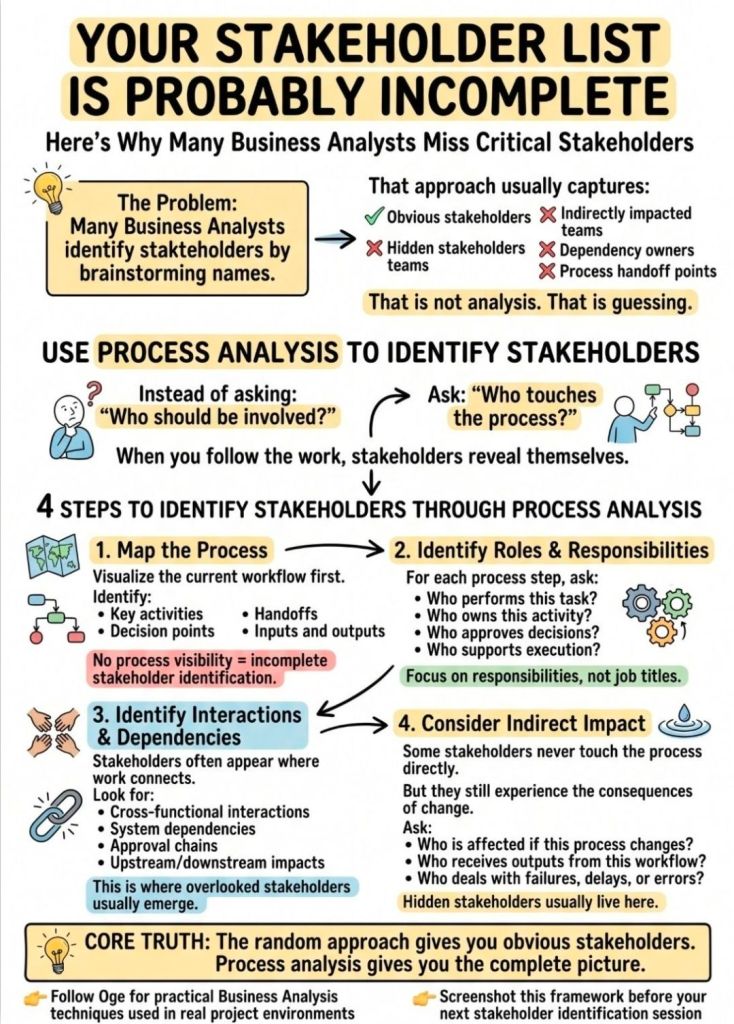
Completing a stakeholder list using process analysis involves tracing the end-to-end lifecycle of a process to identify every individual, team, or organization that interacts with, influences, or is impacted by it. This ensures no hidden users, bottlenecks, or approvers are missed.
A four-step approach will ensure your list is thorough and actionable:
1. Map the Process Flow
Create a step-by-step flowchart of the current or future process. Break it down into key phases: Inputs, Activities, Outputs, and Outcomes. This visual map acts as a blueprint to spot every touchpoint where someone is involved.
2. Identify Stakeholders at Each Touchpoint
Go through each phase of your process map and ask the following dependency questions to pinpoint roles:
Input Stage: Who supplies the data, materials, or funding? (e.g., vendors, regulators, finance departments)
Activity Stage: Who performs the work or oversees it? (e.g., project teams, department managers, QA testers)
Output Stage: Who receives the final deliverable? (e.g., end-users, clients, customers)
Outcome Stage: Who is affected by the long-term results? (e.g., the community, executives, maintenance teams)
3. Classify and Prioritize
Once your comprehensive list is built, categorize stakeholders using the Power/Interest Matrix. This helps allocate your engagement efforts efficiently:
High Power, High Interest: Manage closely and collaborate heavily (e.g., Project Sponsors, Product Owners).
High Power, Low Interest: Keep satisfied but do not over-communicate (e.g., Regulators, Steering Committees).
Low Power, High Interest: Keep informed and consult regularly (e.g., End-users, Support Staff).
Wincor Nixdorf was a premier global provider of IT solutions, hardware, software, and services tailored for retail banks and the retail industry.
Headquartered in Paderborn, Germany, the company historically commanded roughly 35% of the global automated teller machine (ATM) market and stood as a dominant force in electronic point-of-sale (EPOS) systems.
Its operations focused deeply on business process optimisation, automated cash handling, and retail self-checkout systems. In 2016, Wincor Nixdorf merged with its US rival Diebold, Inc., creating the modern consolidated market leader, Diebold Nixdorf.
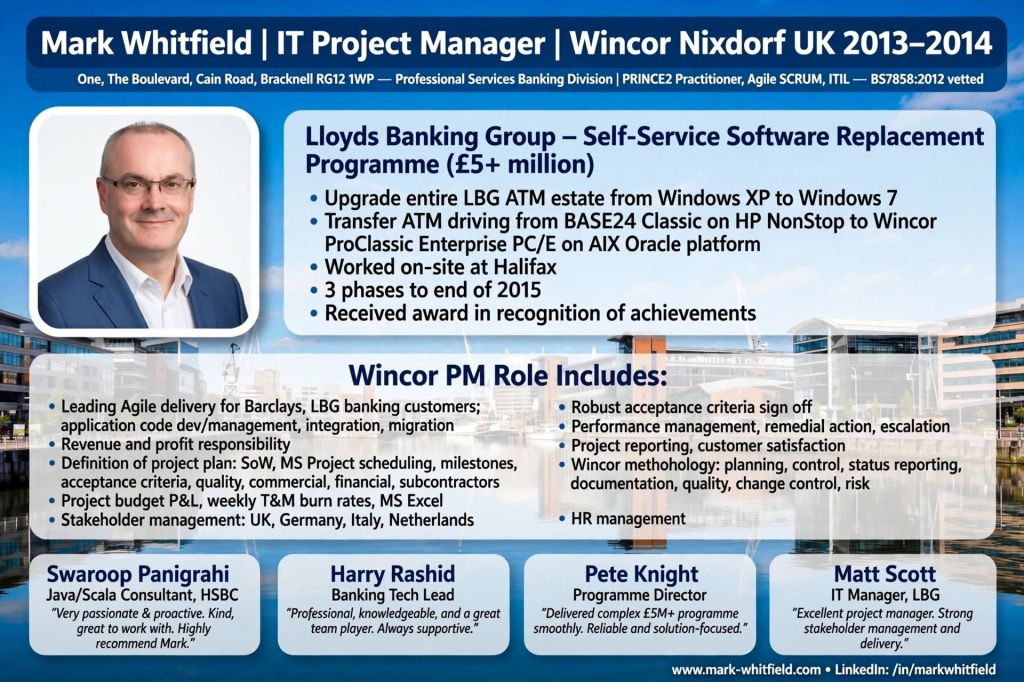
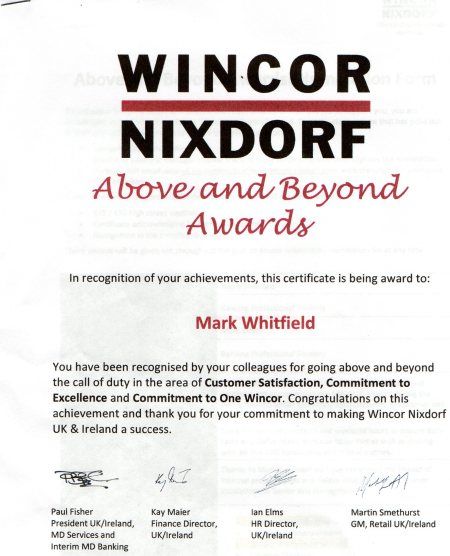
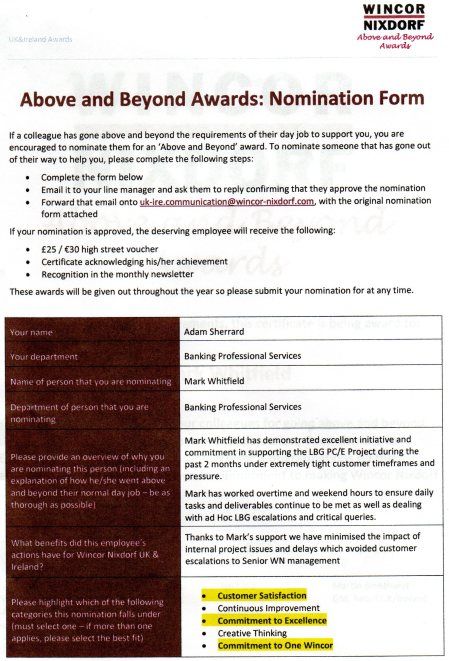
Mark Whitfield | IT Project Manager | Wincor Nixdorf UK | 2013 thru 2014
Detailed Historical Timeline
The history of Wincor Nixdorf spans several distinct strategic eras, tracing its evolution from a post-war calculator workshop into a modern global fintech titan.
Era 1: The Founding & Decentralised Computing (1952–1989)
This era was defined by entrepreneur Heinz Nixdorf, who pioneered small-to-medium business computing and electronic banking terminals across Europe.
1952: Heinz Nixdorf establishes Labor für Impulstechnik in Paderborn, Germany. The small enterprise builds electronic calculators for businesses rebuilding in post-war Europe.
1964: The company shifts from acting as a third-party component supplier to marketing office calculators and billing systems under its own brand name. []
1968: Following corporate acquisitions, the company officially rebrands as Nixdorf Computer AG and develops some of the world’s earliest decentralized minicomputers.
1969: The firm enters the North American market by purchasing the electronics division of the US office equipment manufacturer Victor Comptometer.
1971: Secures its first landmark international banking contract, supplying 1,000 terminals to the Swedish banking industry.
1978: Global sales cross DEM 1 billion, and the workforce grows to over 10,000 employees globally.
1982: Expands its engineering breadth by forming a dedicated corporate telecommunications division.
1984: Launches its initial public offering (IPO), floating shares publicly on the Frankfurt Stock Exchange.
1986: Founder Heinz Nixdorf suddenly dies of a heart attack at a corporate event. The company struggles to pivot from hardware-locked minicomputers to emerging open personal computer architectures.
1989: Amid intensifying global hardware margins and strategic missed steps, corporate financial losses top DEM 1 billion.
Era 2: The Siemens Integration & Corporate Carve-Out (1990–1998)
During this stage, corporate giant Siemens rescued and absorbed the distressed business, later reorganizing its retail and banking assets into a specialized standalone vehicle.
1990: Siemens AG steps in to purchase the shares of Nixdorf Computer AG, officially merging it with its own Data Information Services division to create Siemens Nixdorf Informationssysteme (SNI) AG.
1992: SNI expands heavily across European IT markets, operating as a distinct, specialized computing arm under the Siemens umbrella.
1996: Becomes the largest IT company in Germany and the second largest across the European continent.
1998: Siemens restructures its computing strategy; it sells its personal computer division to Acer and spins off the highly profitable banking and retail segments into a new unit: Siemens Nixdorf Retail and Banking Systems GmbH.
Era 3: Private Equity Buyout & The Rise of Wincor Nixdorf (1999–2015)
This period marked the official birth of the independent “Wincor Nixdorf” brand, characterized by aggressive global expansion, software-driven solutions, and public market listing.
1999: Private equity firms Kohlberg Kravis Roberts (KKR) and Goldman Sachs Capital Partners complete a buyout of the Siemens unit. The company is formally renamed Wincor Nixdorf GmbH.
2000: Launches major end-to-end IT outsourcing and infrastructure managed services alongside its standard terminal hardware.
2004: On 19 May, Wincor Nixdorf successfully returns to the public markets, listing as Wincor Nixdorf AG on the Frankfurt Stock Exchange via a high-performing IPO.
2006: Longtime Chief Executive Officer Karl-Heinz Stiller resigns from the board, leaving a structurally sound company expanding deep into automated cash recycling and software.
2009–2014: Deploys multi-vendor banking software and automated checkout machines worldwide, expanding operations across roughly 100 countries.
2015: Reports global revenues of €1.8 billion, split roughly 65% in banking services and 35% in retail point-of-sale solutions. On 23 November, US rival Diebold announces a formal business combination agreement to acquire the company.
Era 4: The Diebold Nixdorf Consolidation (2016–Present)
This current era represents the unification of American and European ATM powerhouses to navigate shifting brick-and-mortar financial landscapes.
2016: Diebold Inc. officially completes its $1.8 billion voluntary public takeover of Wincor Nixdorf AG on 15 August. The consolidated global giant begins unified operations as Diebold Nixdorf on 16 August.
2017: The UK Competition and Markets Authority (CMA) formally clears the merger following a comprehensive antitrust review, requiring Diebold to divest its legacy UK customer ATM operation to avoid localized market monopoly.
2021: Capitalizing on self-checkout shifts accelerated by the pandemic, the combined entity launches its next-generation DN Series™ EASY self-service retail product line.
2023: Burdened by legacy debt structures, supply chain disruptions, and pandemic operational challenges, Diebold Nixdorf files for a prepackaged Chapter 11 bankruptcy protection in June. The restructuring swiftly sheds $2.1 billion in debt. By August, it successfully emerges from bankruptcy, resuming trading on the New York Stock Exchange (NYSE).
2024–2026: The restructured firm shifts its focus from low-margin hardware to high-margin managed services and cloud software, stabilizing its global operations with annual revenues reaching $3.75 billion.
A Capgemini Engagement Manager is a senior-level, client-facing role responsible for end-to-end delivery of complex business and technology transformation programs. They bridge strategy and execution, acting as a trusted advisor to clients while maintaining operational and financial control over projects.
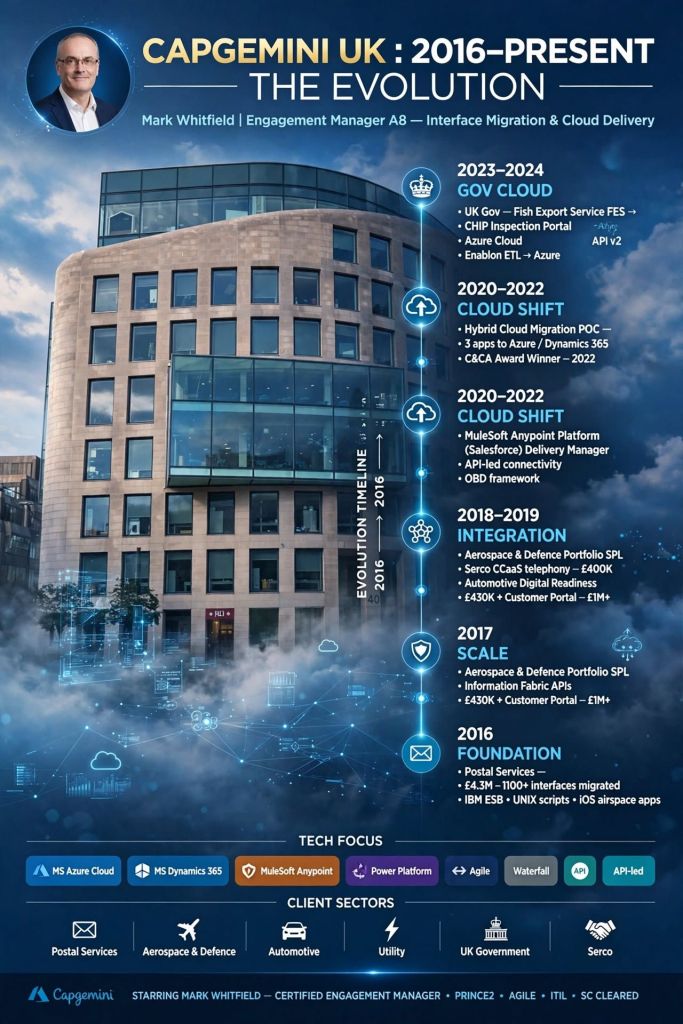
Mark Whitfield | Capgemini projects timeline – 2016 thru to present
Engagement Manager, from 2016
Key Responsibilities
End-to-End Delivery: Overseeing projects from start to finish, ensuring milestones, SLAs, and contractual obligations are met on time and within budget.
Stakeholder Management: Acting as the primary client point of contact while aligning cross-functional and globally distributed delivery teams.
Risk & Governance: Identifying potential roadblocks, proactively managing risks, and ensuring strict adherence to project governance standards.
Business Growth: Spotting opportunities for additional business and supporting bid activities for account expansion.
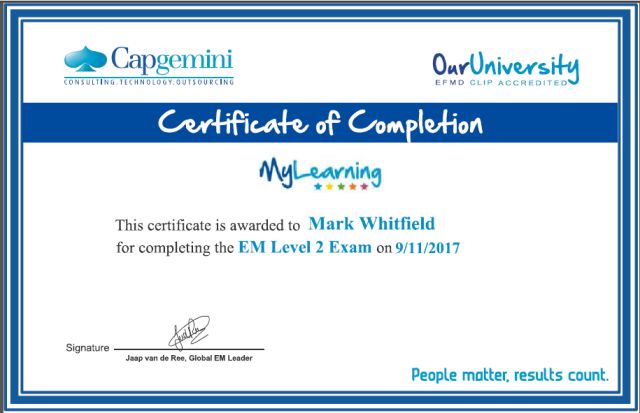
Mark Whitfield, Engagement Management EM Level 2 Exam Passed 2017
Ideal Candidate Profile
Experience: Typically requires a degree in Business, Engineering, or IT, combined with at least 5+ years of experience in project management or service delivery within a B2B environment.
Skills: Strong commercial acumen, proficiency in formal methodologies (e.g., Agile, ITIL), and the ability to lead diverse, multinational teams.
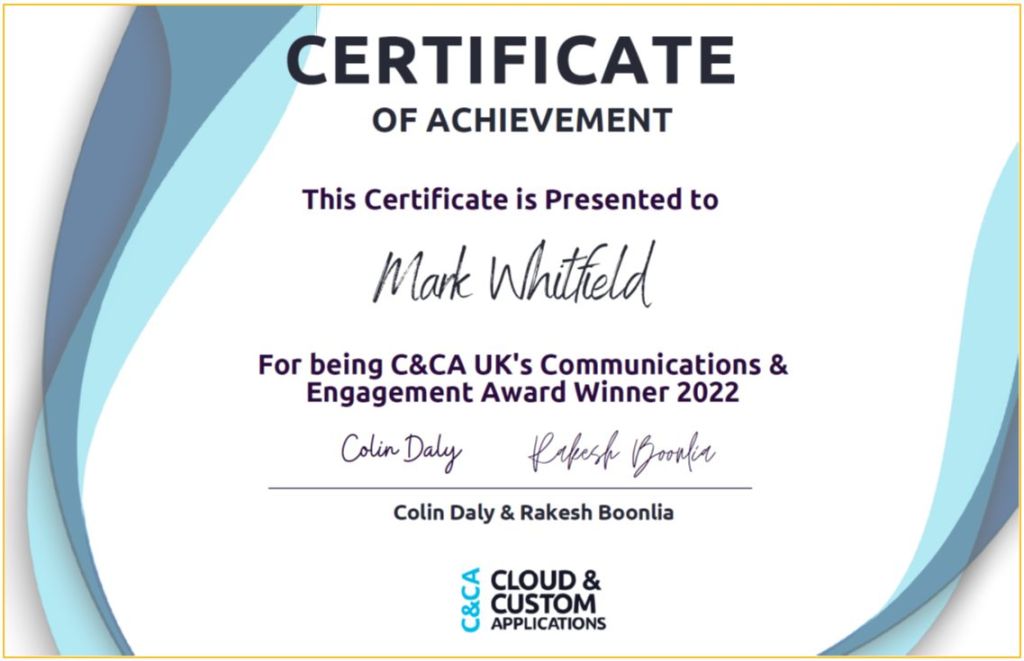
C&CA UK’s Communications & Engagement Award Winner 2022, Cloud & Custom Applications, Mark Whitfield
Mark Whitfield, an SC cleared Senior Project Manager based in the Manchester area, has over 30 years of experience transitioning from a software engineer to an IT program leader.
His extensive technical and project management training spans methodologies, cloud infrastructure, and software applications.
A detailed breakdown of his training, certifications, and academic background includes:
Project Management Methodologies
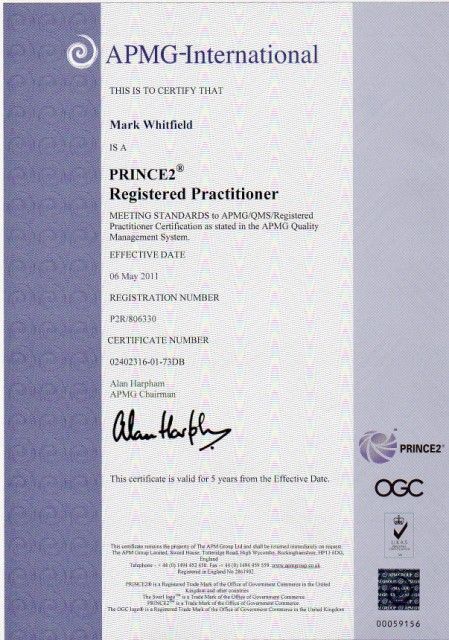
PRINCE2 Practitioner: Certified via the ILX Group.
Agile SCRUM: Trained in-house with RADTAC.
Advanced Engagement Management: Level 2 certification completed via Capgemini.
Project Fundamentals: Completed “Fundamentals of Successful Project Management” and “Managing Multiple Projects” via Skillpath.
Microsoft Project: Microsoft Project ’98 certified.
Technical & Cloud Training
Microsoft Azure: AZ-900 Microsoft Certified Azure Fundamentals.
MuleSoft: Completed outcome-based delivery training and is a specialized Delivery Manager.
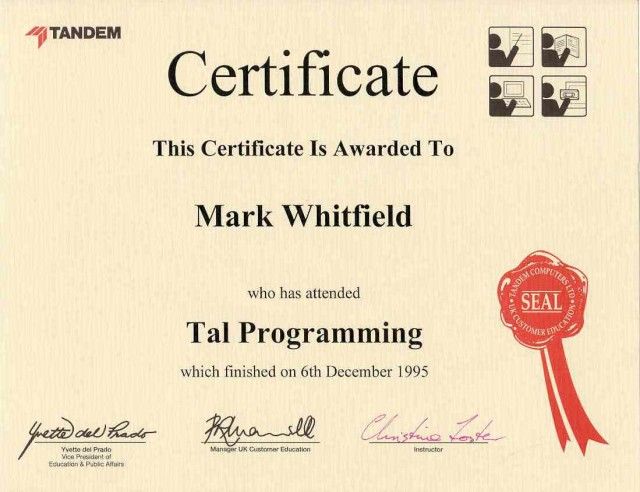
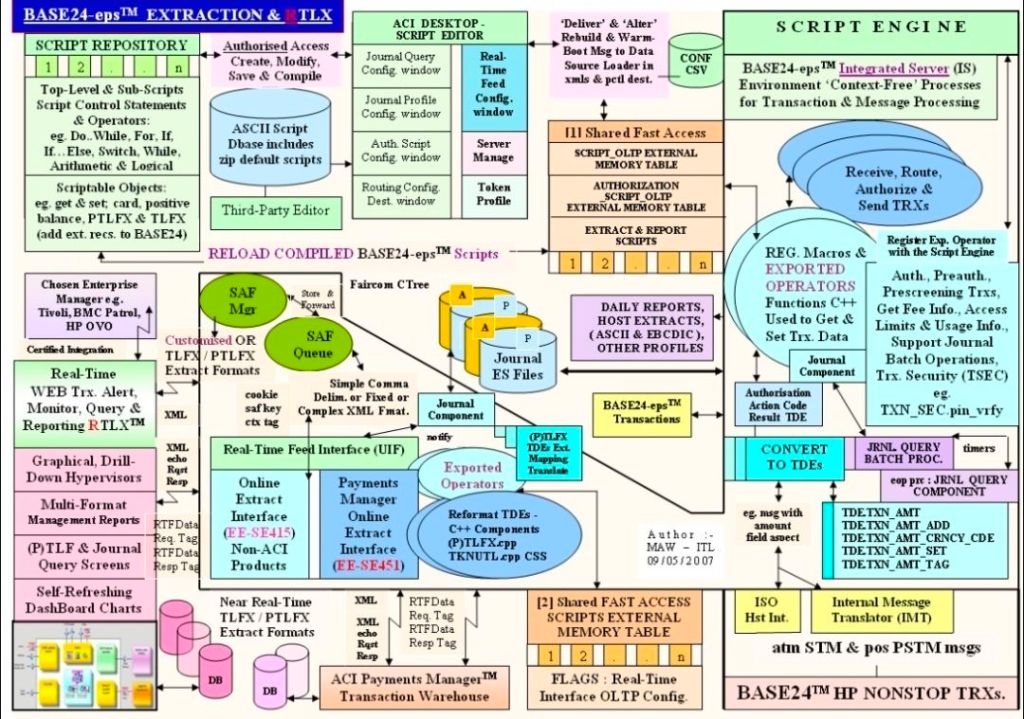
Technical Programming: Includes foundational database and software language training, such as C++ and MS SQL 2000 query training, as well as VPS and Tandem (HPE NonStop) technical/development courses.
Productivity: Completed Microsoft Excel Refresher and Expert skills training (Udemy and Microsoft).
Formal Education
Higher National Diploma (HND): Graduated with a Distinction (top) in Computing (1990).
Mark Whitfield invested many years in the HPE NonStop field from 1990. The HPE NonStop architecture (originally Tandem Computers) is a legendary fault-tolerant system known for 100% continuous availability. The platform’s hardware and software execution evolved across six distinct eras and processor transitions:
Architecture: The foundational “shared-nothing” parallel architecture. Featured redundant components (processors, disks, power supplies) connected by a proprietary dual-bus (Dynabus). The operating system provided instant automated failover.
Architecture: Expanded into 32-bit computing. To keep pace with industry performance, Tandem transitioned from proprietary processors to off-the-shelf MIPS RISC processors while heavily emulating the original instruction set for compatibility.
3. The Himalaya/ServerNet Era (1997–2004)
Years: 1997–2004
Processors: MIPS R-series
Architecture: Replaced the legacy Dynabus with ServerNet, a high-speed system interconnect that served as an early precursor to modern networking fabrics. (Compaq acquired Tandem in 1997, which subsequently merged with HP in 2002).
4. The Integrity Itanium Era (2005–2013)
Years: 2005–2013
Processors: Intel Itanium (TNS/E)
Architecture: Branded as HP Integrity NonStop (NonStop i). The platform moved off proprietary silicon to standard Intel Itanium processors. This was driven by the “NonStop Advanced Architecture” (NSAA), lowering hardware costs while maintaining Availability Level 4 (AL4) standards.
5. The NonStop X (x86-64) Era (2014–Present)
Years: 2014–2026
Processors: Intel Xeon x86-64 (TNS/X)
Architecture: Fully decoupled the OS from proprietary hardware by shifting to standard Intel x86-64 processors and InfiniBand fabric. The latest compute nodes (such as the NS5 X5 and NS9 X5) utilize modern Intel Xeon Scalable processors to maintain maximum Availability Level 4 (AL4) workloads.
6. The Virtualized NonStop Era (Present)
Years: 2015–Present
Processors: Virtual Machines / Cloud / x86
Architecture: HPE extended the platform to support Virtualized NonStop Software, allowing fault-tolerant enterprise workloads to run entirely in private clouds via standard VMware or hybrid architectures, independent of specific physical servers.
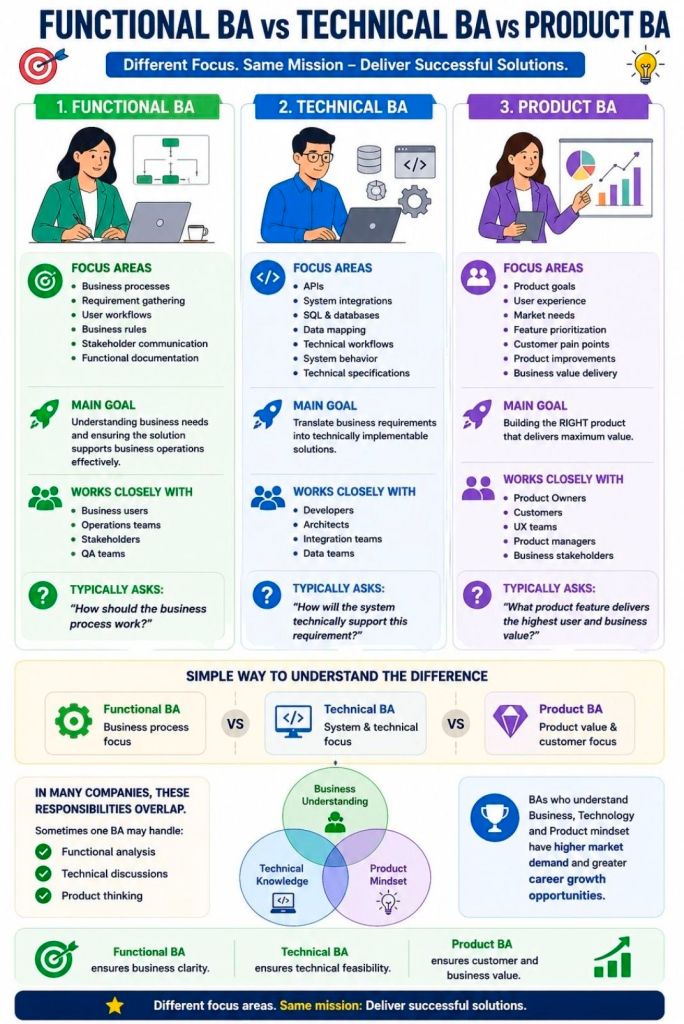
While all three roles fall under the “Business Analyst” umbrella, they differ in their primary focus: Functional BAs translate business needs into user requirements, Technical BAs focus on system architecture and integration, and Product BAs drive the product’s market value and long-term strategy.
1. Functional BA (The ‘Business’ Translator)
The Functional BA acts as the primary bridge between business stakeholders and the IT delivery team. They focus on what the business needs to achieve and how users will interact with the system.
Core Focus: Business processes, stakeholder communication, and end-user experience.
Day-to-day Responsibilities: Gathering requirements, mapping out user journeys, defining acceptance criteria, and creating process flow diagrams.
Key Skills: Stakeholder management, requirements elicitation, and deep domain knowledge (e.g., finance, healthcare).
2. Technical BA (The ‘System’ Architect)
The Technical BA bridges the gap between the functional requirements and the software development team. They focus on how the system will be built, ensuring the proposed solution is technically feasible, scalable, and secure.
Core Focus: System architecture, data flow, integrations, and non-functional requirements (like performance).
Day-to-day Responsibilities: Defining API structures, mapping data models, documenting system interfaces, and writing complex technical user stories.
Key Skills: Understanding of system integrations, database structures, basic coding logic, and system-to-system communication.
3. Product BA (The ‘Value’ Strategist)
The Product BA merges business analysis with product management principles. Rather than just fulfilling requested requirements, they focus on why a product or feature should be built, ensuring it aligns with overarching company goals and delivers tangible ROI.
Core Focus: Product strategy, feature prioritization, market viability, and user adoption.
Day-to-day Responsibilities: Conducting market research, managing the product backlog, defining Key Performance Indicators (KPIs), and analyzing user feedback/metrics.
Key Skills: Product discovery, data analysis, competitive analysis, and strategic roadmapping.
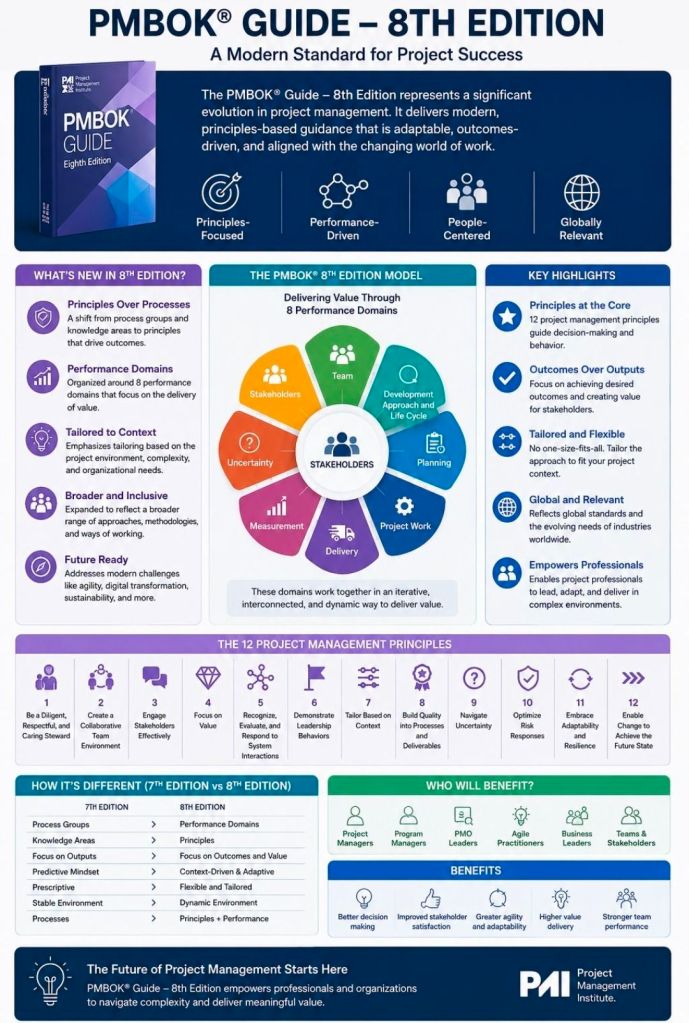
The PMBOK Guide 8th Edition is an integrated, value-driven framework that bridges the high-level principles of the 7th edition with the practical, process-oriented structure of older editions. It reintroduces 40 non-prescriptive processes alongside six core principles and seven performance domains.
📚 The Structure: Two Books in One
Similar to its predecessors, the printed volume of the 8th Edition includes two integrated publications:
The Standard for Project Management: An official ANSI standard that focuses on strategic alignment, value delivery systems, and global applicability.
A Guide to the Project Management Body of Knowledge (PMBOK Guide): The practical handbook containing the processes, tools, techniques, and tailoring considerations.
🟢 The 6 Core Principles
The 8th Edition streamlines the 12 principles from the 7th edition into six actionable pillars designed to guide professional behavior and mindset:
Adopt a Holistic View: Think in terms of systems and understand how a project integrates with organizational strategy.
Focus on Value: Direct efforts toward long-term outcomes and net-positive benefits rather than just output production.
Build Accountable Leadership: Cultivate a culture of transparency, clear responsibilities, and high-performance teamwork.
Embed Quality: Ensure quality processes and continuous improvement are woven into every phase of the work.
Integrate Sustainability: Consider the long-term environmental, social, and economic impacts of project delivery.
Build Empowered Teams: Foster environments where team members are supported, trusted, and empowered to solve problems.
🔵 The 7 Performance Domains
These represent key areas of practice, serving as the technical “what” of your project:
Governance: Setting the rules, decision frameworks, and oversight mechanisms.
Scope: Defining boundaries, deliverables, and requirements.
Schedule: Managing timeframes, milestones, and critical paths.
Finance: Budgeting, forecasting, and cost management.
Stakeholders: Managing expectations, engagement, and communications.
Resources: Allocating people, equipment, and physical/material assets.
Risks: Identifying, analyzing, and mitigating uncertainties.
🟠 The 40 Evolved Processes & Focus Areas
A highly praised update in the 8th edition is the return of process guidance. To offer structured “how-to” guidance without becoming rigid, the processes are grouped into five Focus Areas (replacing the traditional Process Groups):
Initiating
Planning
Executing
Monitoring & Controlling
Closing
Across these five focus areas, there are 40 non-prescriptive processes that detail the typical inputs, tools, techniques, and outputs (ITTOs). The guide includes explicit tailoring advice on how to adapt these processes for predictive, hybrid, and agile environments.
💡 Key Modern Additions
Reflecting over 48,000 global practitioner data points, the 8th Edition expands coverage into modern project environments:
Artificial Intelligence (AI): Guidance on using AI and data analytics in project management.
Project Management Offices (PMOs): Expanded focus on PMO structures and strategic value alignment.
If you are planning to take the PMP exam, make sure to check the official PMI PMP Certification Overview for the most up-to-date Exam Content Outline (ECO). The exam relies heavily on the ECO, and the 8th Edition guide serves as foundational reference material.
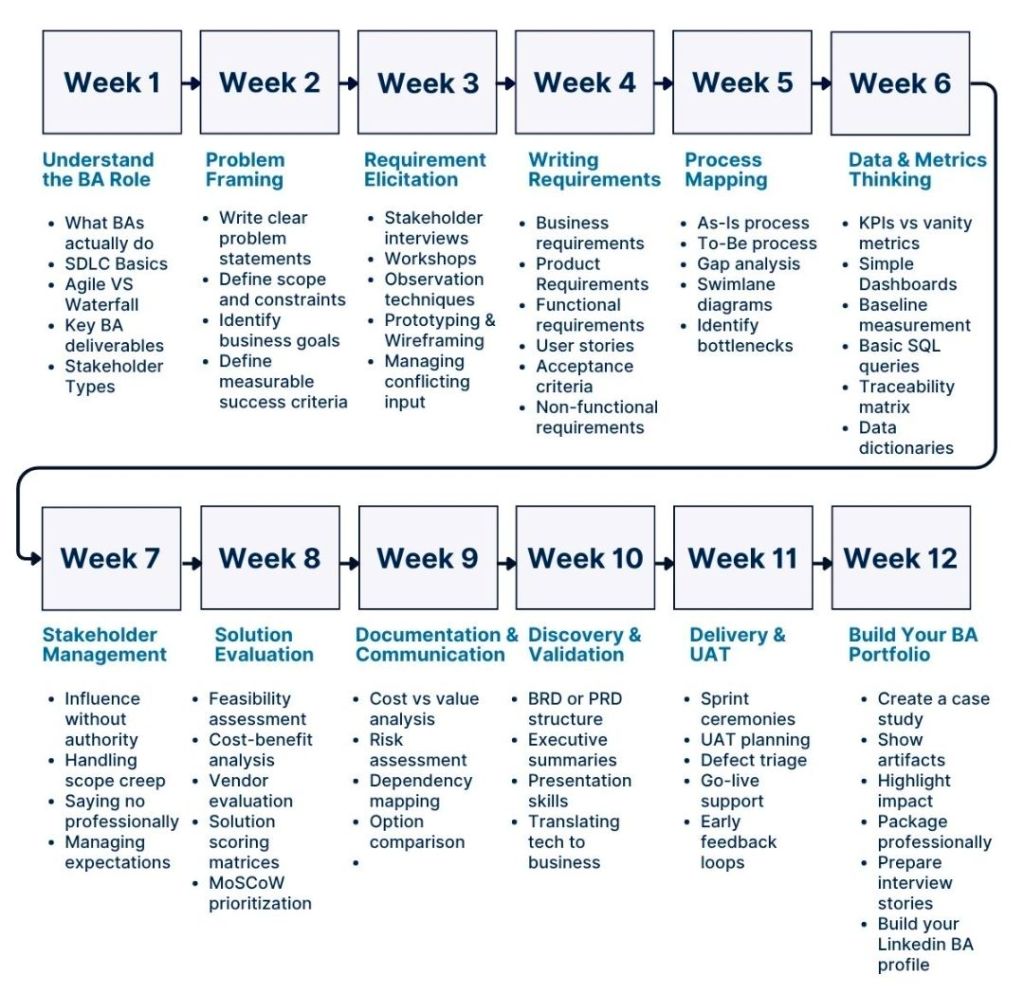
Business Analysis (BA) from week to week, across an example project
Another example;
Business Analysis (BA) across an example project—like building a custom mobile app—follows a dynamic, week-to-week lifecycle. It shifts focus from initial high-level strategy and stakeholder alignment to granular requirements, testing support, and post-launch evaluation.
Here is how a typical BA lifecycle breaks down across an example 8-week project timeline:
Week 1: Project Kickoff & Discovery
Focus: Understanding the business problem and setting boundaries.
Activities:
Facilitating kickoff workshops with key stakeholders.
Creating a Business Case or Vision Document to define the “why.”
Identifying key project sponsors, users, and subject matter experts (SMEs).
Week 2: Stakeholder Engagement & Elicitation
Focus: Extracting needs from the people who matter.
Activities:
Conducting interviews, surveys, and Focus Groups to gather initial wants and needs.
Mapping out high-level Business Processes (current “As-Is” workflows and future “To-Be” workflows).
Week 3: Analysis & Requirements Definition
Focus: Turning raw data into structured requirements.
Activities:
Writing user stories and establishing Acceptance Criteria (often using the Given-When-Then format).
Creating documentation like process models, wireframes, and data dictionaries.
Week 4: Prioritization & Scope Management
Focus: Deciding what gets built first.
Activities:
Facilitating prioritization sessions using frameworks like the MoSCoW Method (Must have, Should have, Could have, Won’t have).
Defining the Minimum Viable Product (MVP) to prevent scope creep.
Week 5: Backlog Refinement & Solution Design
Focus: Preparing work for the development team.
Activities:
Refining the product backlog alongside the Product Owner.
Working directly with UI/UX designers and technical architects to ensure designs align with business rules.
Week 6: Development Support & Clarification
Focus: Answering daily questions and unblocking the team.
Activities:
Hosting Agile ceremonies like Sprint Planning and Daily Stand-ups.
Clarifying edge cases and adjusting requirements if technical constraints arise during development.
Week 7: Testing & Validation
Focus: Ensuring the solution works and meets business needs.
Activities:
Assisting Quality Assurance (QA) teams by explaining acceptance criteria.
Facilitating User Acceptance Testing (UAT) with real business users to sign off on the software.
Week 8: Deployment & Post-Implementation Review
Focus: Launching the product and measuring success.
Activities:
Helping prepare training materials, user manuals, and release notes.
Conducting a Retrospective to identify process improvements for the next project phase.