

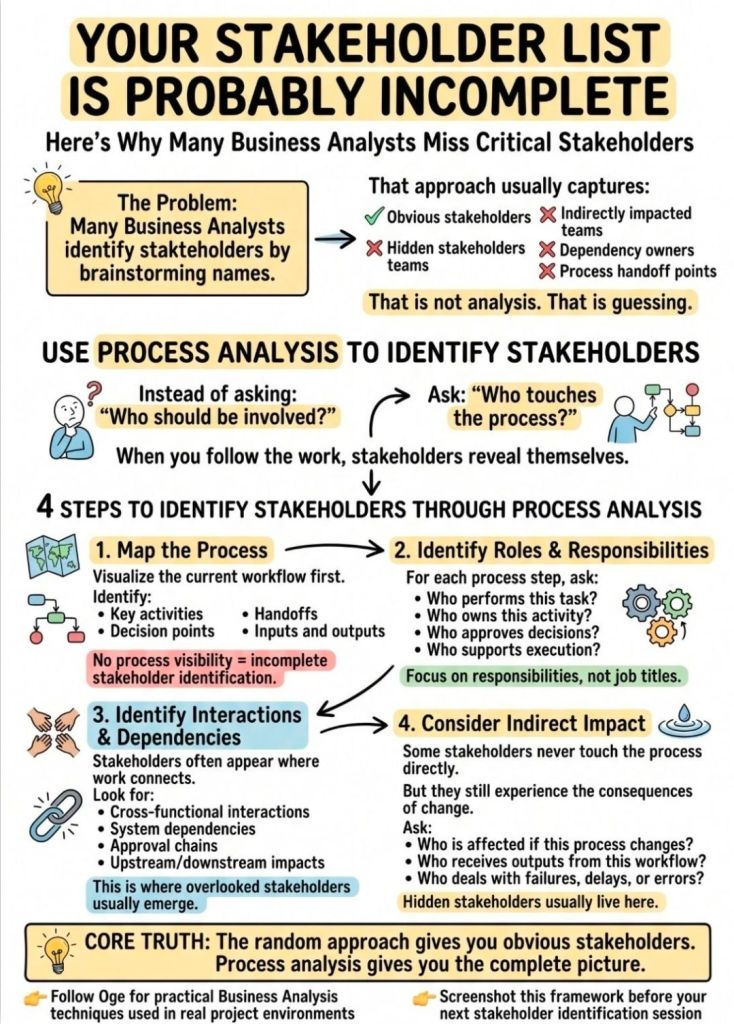
Completing a stakeholder list using process analysis involves tracing the end-to-end lifecycle of a process to identify every individual, team, or organization that interacts with, influences, or is impacted by it. This ensures no hidden users, bottlenecks, or approvers are missed.
A four-step approach will ensure your list is thorough and actionable:
1. Map the Process Flow
Create a step-by-step flowchart of the current or future process. Break it down into key phases: Inputs, Activities, Outputs, and Outcomes. This visual map acts as a blueprint to spot every touchpoint where someone is involved.
2. Identify Stakeholders at Each Touchpoint
Go through each phase of your process map and ask the following dependency questions to pinpoint roles:
- Input Stage: Who supplies the data, materials, or funding? (e.g., vendors, regulators, finance departments)
- Activity Stage: Who performs the work or oversees it? (e.g., project teams, department managers, QA testers)
- Output Stage: Who receives the final deliverable? (e.g., end-users, clients, customers)
- Outcome Stage: Who is affected by the long-term results? (e.g., the community, executives, maintenance teams)
3. Classify and Prioritize
Once your comprehensive list is built, categorize stakeholders using the Power/Interest Matrix. This helps allocate your engagement efforts efficiently:
- High Power, High Interest: Manage closely and collaborate heavily (e.g., Project Sponsors, Product Owners).
- High Power, Low Interest: Keep satisfied but do not over-communicate (e.g., Regulators, Steering Committees).
- Low Power, High Interest: Keep informed and consult regularly (e.g., End-users, Support Staff).
- Low Power, Low Interest: Monitor with minimal effort (e.g., Peripheral departments).
4. Document and Review
Log all identified stakeholders in a Stakeholder Register. Key details to capture include:
- Stake / Impact: How the process affects them (or vice-versa).
- Expectations: What they need from the process.
- Engagement Strategy: How and how often you will communicate with them.
Completing the Stakeholder List using Process Analysis

