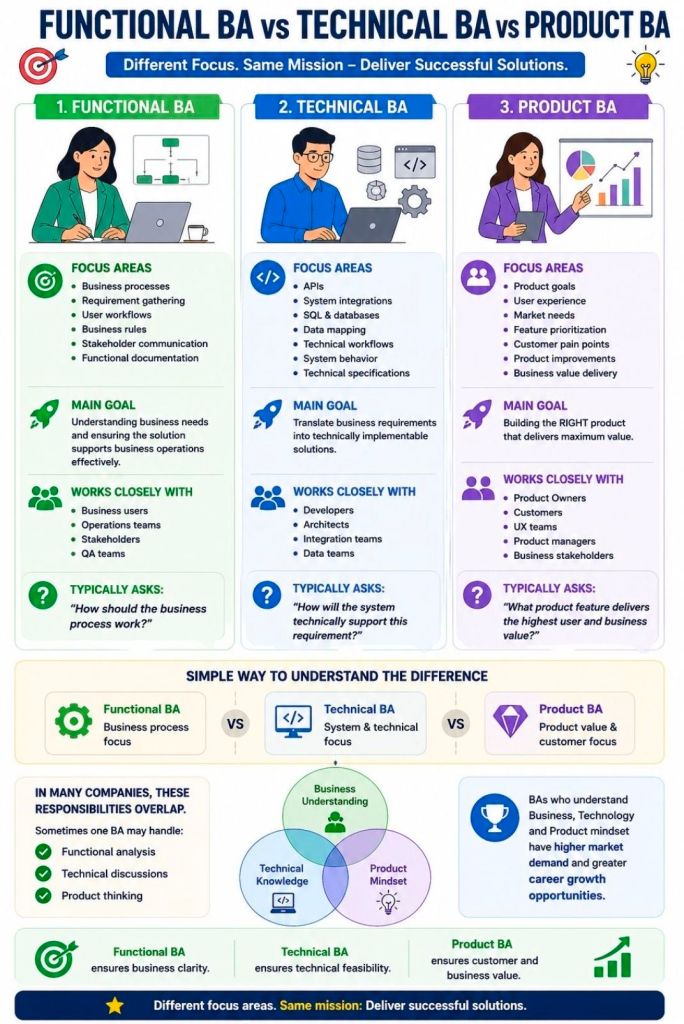
Functional BA vs Technical BA vs Product BA

Functional BA vs Technical BA vs Product BA

While all three roles fall under the “Business Analyst” umbrella, they differ in their primary focus: Functional BAs translate business needs into user requirements, Technical BAs focus on system architecture and integration, and Product BAs drive the product’s market value and long-term strategy.

1. Functional BA (The ‘Business’ Translator)

The Functional BA acts as the primary bridge between business stakeholders and the IT delivery team. They focus on what the business needs to achieve and how users will interact with the system.

  • Core Focus: Business processes, stakeholder communication, and end-user experience.
  • Day-to-day Responsibilities: Gathering requirements, mapping out user journeys, defining acceptance criteria, and creating process flow diagrams.
  • Key Skills: Stakeholder management, requirements elicitation, and deep domain knowledge (e.g., finance, healthcare).

2. Technical BA (The ‘System’ Architect)

The Technical BA bridges the gap between the functional requirements and the software development team. They focus on how the system will be built, ensuring the proposed solution is technically feasible, scalable, and secure.

  • Core Focus: System architecture, data flow, integrations, and non-functional requirements (like performance).
  • Day-to-day Responsibilities: Defining API structures, mapping data models, documenting system interfaces, and writing complex technical user stories.
  • Key Skills: Understanding of system integrations, database structures, basic coding logic, and system-to-system communication.

3. Product BA (The ‘Value’ Strategist)

The Product BA merges business analysis with product management principles. Rather than just fulfilling requested requirements, they focus on why a product or feature should be built, ensuring it aligns with overarching company goals and delivers tangible ROI.

  • Core Focus: Product strategy, feature prioritization, market viability, and user adoption.
  • Day-to-day Responsibilities: Conducting market research, managing the product backlog, defining Key Performance Indicators (KPIs), and analyzing user feedback/metrics.
  • Key Skills: Product discovery, data analysis, competitive analysis, and strategic roadmapping.

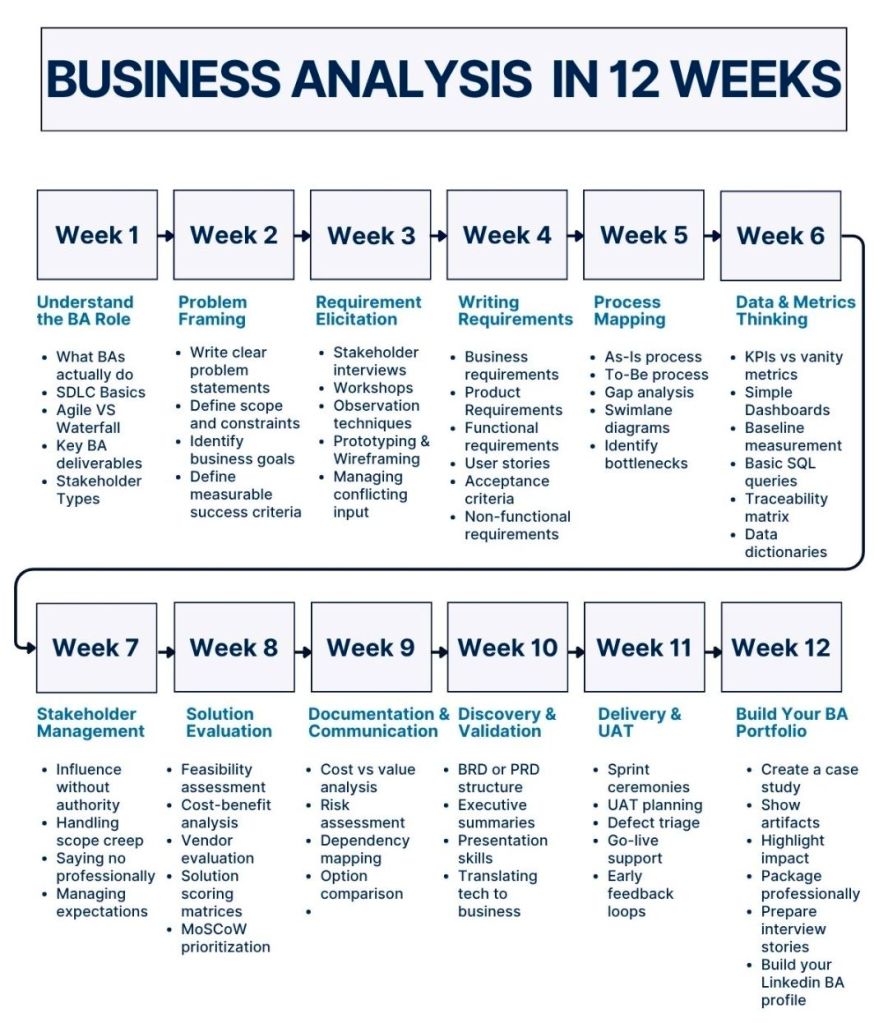
Business Analysis (BA) from week to week, across an example project

Business Analysis (BA) from week to week, across an example project

Another example;

Business Analysis (BA) across an example project—like building a custom mobile app—follows a dynamic, week-to-week lifecycle. It shifts focus from initial high-level strategy and stakeholder alignment to granular requirements, testing support, and post-launch evaluation.

Here is how a typical BA lifecycle breaks down across an example 8-week project timeline:

Week 1: Project Kickoff & Discovery

  • Focus: Understanding the business problem and setting boundaries.
  • Activities:
    • Facilitating kickoff workshops with key stakeholders.
    • Creating a Business Case or Vision Document to define the “why.”
    • Identifying key project sponsors, users, and subject matter experts (SMEs).

Week 2: Stakeholder Engagement & Elicitation

  • Focus: Extracting needs from the people who matter.
  • Activities:
    • Conducting interviews, surveys, and Focus Groups to gather initial wants and needs.
    • Mapping out high-level Business Processes (current “As-Is” workflows and future “To-Be” workflows).

Week 3: Analysis & Requirements Definition

  • Focus: Turning raw data into structured requirements.
  • Activities:
    • Writing user stories and establishing Acceptance Criteria (often using the Given-When-Then format).
    • Creating documentation like process models, wireframes, and data dictionaries.

Week 4: Prioritization & Scope Management

  • Focus: Deciding what gets built first.
  • Activities:
    • Facilitating prioritization sessions using frameworks like the MoSCoW Method (Must have, Should have, Could have, Won’t have).
    • Defining the Minimum Viable Product (MVP) to prevent scope creep.

Week 5: Backlog Refinement & Solution Design

  • Focus: Preparing work for the development team.
  • Activities:
    • Refining the product backlog alongside the Product Owner.
    • Working directly with UI/UX designers and technical architects to ensure designs align with business rules.

Week 6: Development Support & Clarification

  • Focus: Answering daily questions and unblocking the team.
  • Activities:
    • Hosting Agile ceremonies like Sprint Planning and Daily Stand-ups.
    • Clarifying edge cases and adjusting requirements if technical constraints arise during development.

Week 7: Testing & Validation

  • Focus: Ensuring the solution works and meets business needs.
  • Activities:
    • Assisting Quality Assurance (QA) teams by explaining acceptance criteria.
    • Facilitating User Acceptance Testing (UAT) with real business users to sign off on the software.

Week 8: Deployment & Post-Implementation Review

  • Focus: Launching the product and measuring success.
  • Activities:
    • Helping prepare training materials, user manuals, and release notes.
    • Conducting a Retrospective to identify process improvements for the next project phase.

Agile Product Backlog Refinement Grooming

Agile Product Backlog Refinement Grooming

Business Analysis Beyond the Workflow

Business Analysis Beyond the Workflow

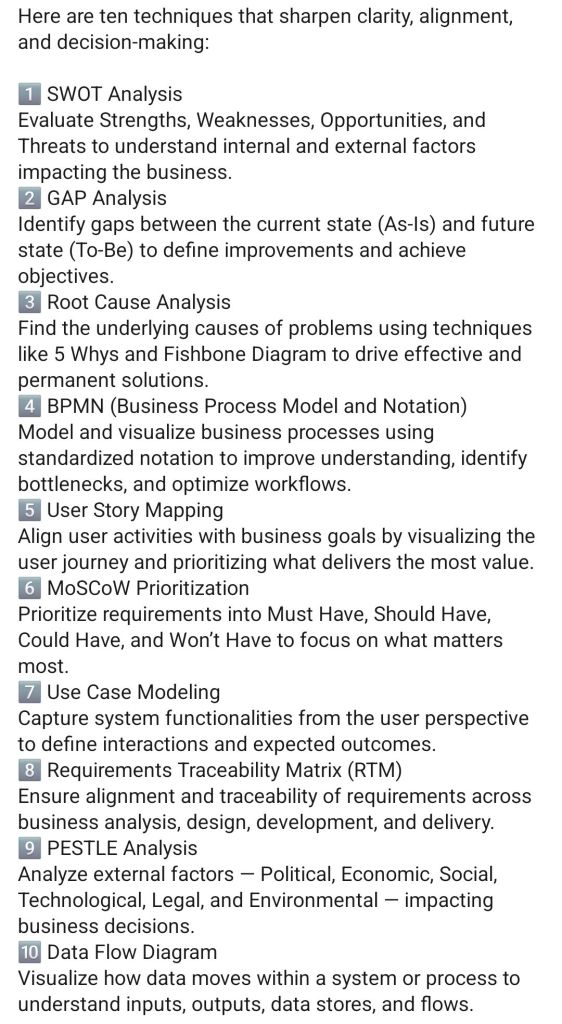
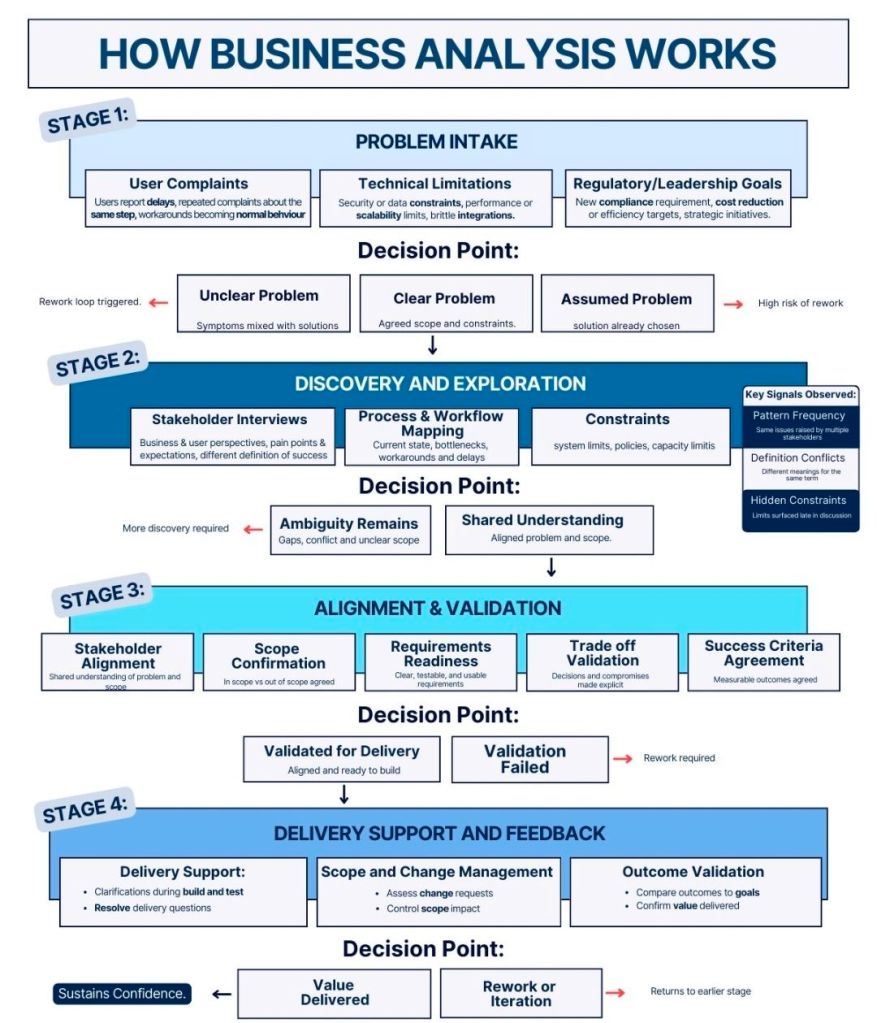
How Business Analysis Works

How Business Analysis Works

10 Rules of Business Analysis

10 Rules of Business Analysis

Business Analysis from Idea to Delivery and Benefits Realisation

Business Analysis from Idea to Delivery and Benefits Realisation

Business Analysis in Product Led Companies BA vs PO

Business Analysis in Product Led Companies BA vs PO