

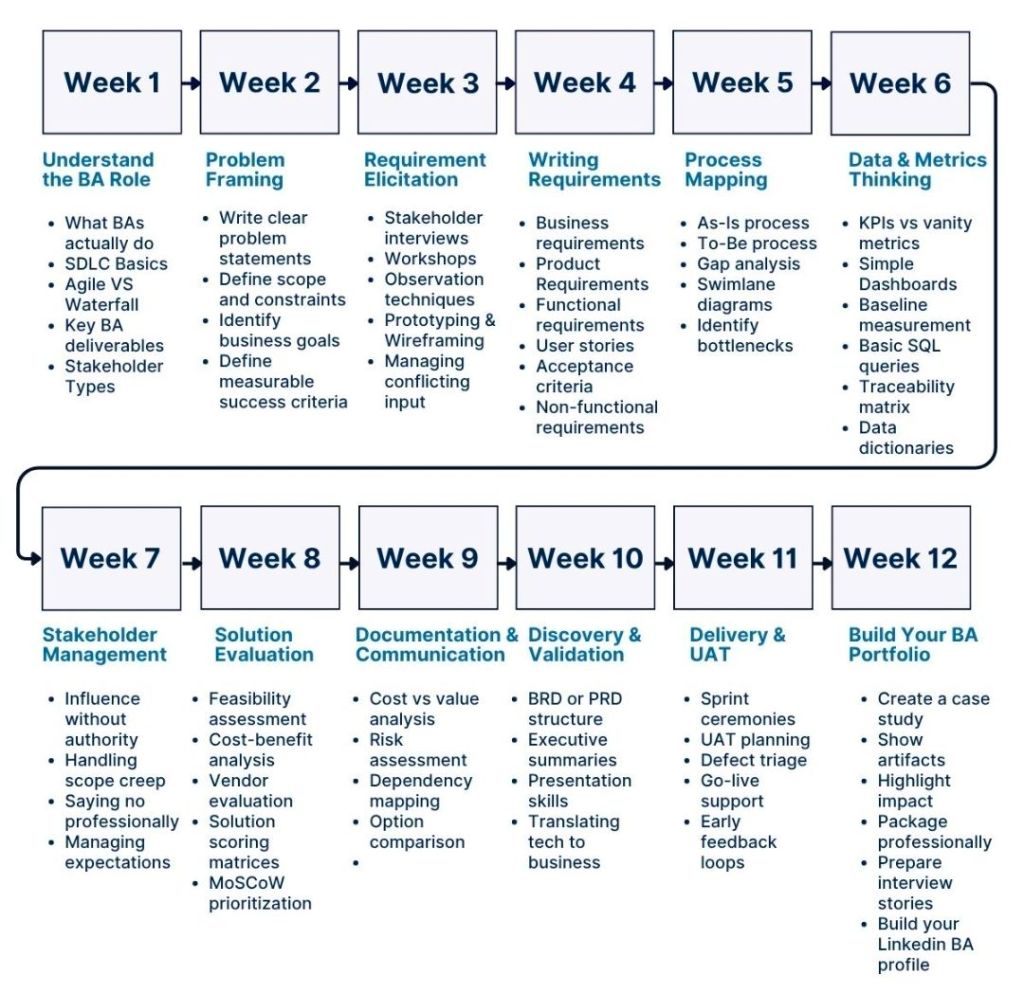
Another example;
Business Analysis (BA) across an example project—like building a custom mobile app—follows a dynamic, week-to-week lifecycle. It shifts focus from initial high-level strategy and stakeholder alignment to granular requirements, testing support, and post-launch evaluation.
Here is how a typical BA lifecycle breaks down across an example 8-week project timeline:
Week 1: Project Kickoff & Discovery
- Focus: Understanding the business problem and setting boundaries.
- Activities:
- Facilitating kickoff workshops with key stakeholders.
- Creating a Business Case or Vision Document to define the “why.”
- Identifying key project sponsors, users, and subject matter experts (SMEs).
Week 2: Stakeholder Engagement & Elicitation
- Focus: Extracting needs from the people who matter.
- Activities:
- Conducting interviews, surveys, and Focus Groups to gather initial wants and needs.
- Mapping out high-level Business Processes (current “As-Is” workflows and future “To-Be” workflows).
Week 3: Analysis & Requirements Definition
- Focus: Turning raw data into structured requirements.
- Activities:
- Writing user stories and establishing Acceptance Criteria (often using the Given-When-Then format).
- Creating documentation like process models, wireframes, and data dictionaries.
Week 4: Prioritization & Scope Management
- Focus: Deciding what gets built first.
- Activities:
- Facilitating prioritization sessions using frameworks like the MoSCoW Method (Must have, Should have, Could have, Won’t have).
- Defining the Minimum Viable Product (MVP) to prevent scope creep.
Week 5: Backlog Refinement & Solution Design
- Focus: Preparing work for the development team.
- Activities:
- Refining the product backlog alongside the Product Owner.
- Working directly with UI/UX designers and technical architects to ensure designs align with business rules.
Week 6: Development Support & Clarification
- Focus: Answering daily questions and unblocking the team.
- Activities:
- Hosting Agile ceremonies like Sprint Planning and Daily Stand-ups.
- Clarifying edge cases and adjusting requirements if technical constraints arise during development.
Week 7: Testing & Validation
- Focus: Ensuring the solution works and meets business needs.
- Activities:
- Assisting Quality Assurance (QA) teams by explaining acceptance criteria.
- Facilitating User Acceptance Testing (UAT) with real business users to sign off on the software.
Week 8: Deployment & Post-Implementation Review
- Focus: Launching the product and measuring success.
- Activities:
- Helping prepare training materials, user manuals, and release notes.
- Conducting a Retrospective to identify process improvements for the next project phase.


