

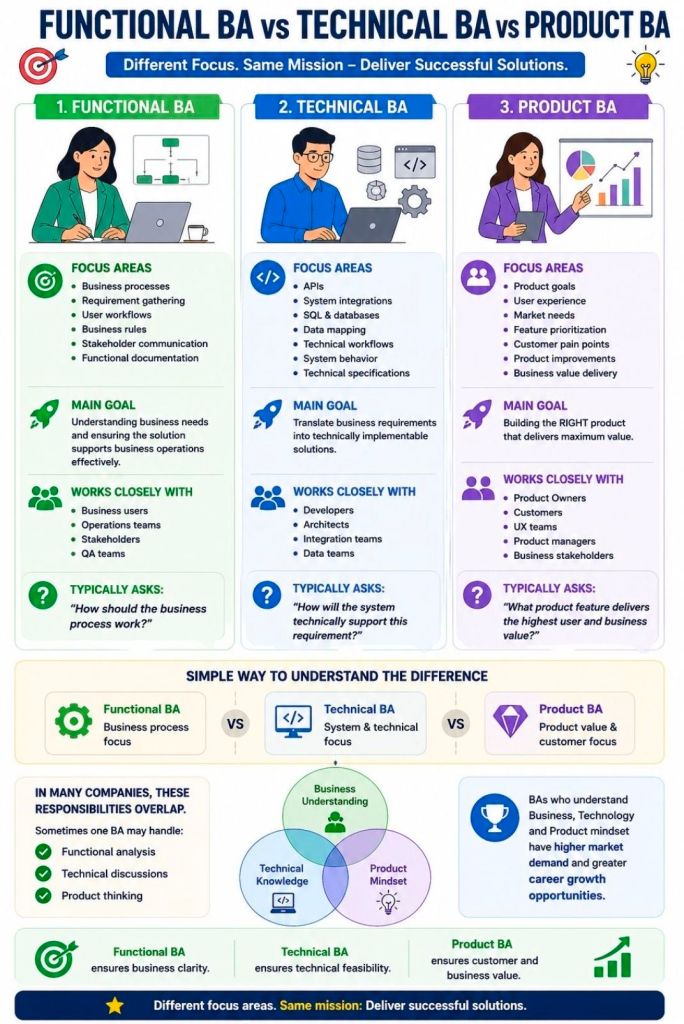
While all three roles fall under the “Business Analyst” umbrella, they differ in their primary focus: Functional BAs translate business needs into user requirements, Technical BAs focus on system architecture and integration, and Product BAs drive the product’s market value and long-term strategy.
1. Functional BA (The ‘Business’ Translator)
The Functional BA acts as the primary bridge between business stakeholders and the IT delivery team. They focus on what the business needs to achieve and how users will interact with the system.
- Core Focus: Business processes, stakeholder communication, and end-user experience.
- Day-to-day Responsibilities: Gathering requirements, mapping out user journeys, defining acceptance criteria, and creating process flow diagrams.
- Key Skills: Stakeholder management, requirements elicitation, and deep domain knowledge (e.g., finance, healthcare).
2. Technical BA (The ‘System’ Architect)
The Technical BA bridges the gap between the functional requirements and the software development team. They focus on how the system will be built, ensuring the proposed solution is technically feasible, scalable, and secure.
- Core Focus: System architecture, data flow, integrations, and non-functional requirements (like performance).
- Day-to-day Responsibilities: Defining API structures, mapping data models, documenting system interfaces, and writing complex technical user stories.
- Key Skills: Understanding of system integrations, database structures, basic coding logic, and system-to-system communication.
3. Product BA (The ‘Value’ Strategist)
The Product BA merges business analysis with product management principles. Rather than just fulfilling requested requirements, they focus on why a product or feature should be built, ensuring it aligns with overarching company goals and delivers tangible ROI.
- Core Focus: Product strategy, feature prioritization, market viability, and user adoption.
- Day-to-day Responsibilities: Conducting market research, managing the product backlog, defining Key Performance Indicators (KPIs), and analyzing user feedback/metrics.
- Key Skills: Product discovery, data analysis, competitive analysis, and strategic roadmapping.

