Mark Whitfield, an SC cleared Senior Project Manager based in the Manchester area, has over 30 years of experience transitioning from a software engineer to an IT program leader.
His extensive technical and project management training spans methodologies, cloud infrastructure, and software applications.
A detailed breakdown of his training, certifications, and academic background includes:
Project Management Methodologies
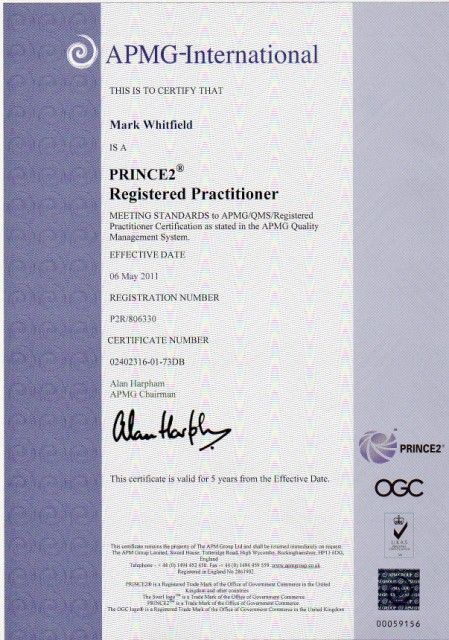
PRINCE2 Practitioner: Certified via the ILX Group.
Agile SCRUM: Trained in-house with RADTAC.
Advanced Engagement Management: Level 2 certification completed via Capgemini.
Project Fundamentals: Completed “Fundamentals of Successful Project Management” and “Managing Multiple Projects” via Skillpath.
Microsoft Project: Microsoft Project ’98 certified.
Technical & Cloud Training
Microsoft Azure: AZ-900 Microsoft Certified Azure Fundamentals.
MuleSoft: Completed outcome-based delivery training and is a specialized Delivery Manager.
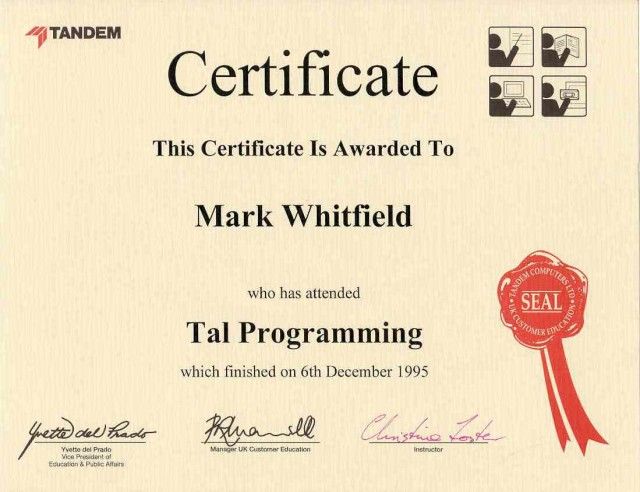
Technical Programming: Includes foundational database and software language training, such as C++ and MS SQL 2000 query training, as well as VPS and Tandem (HPE NonStop) technical/development courses.
Productivity: Completed Microsoft Excel Refresher and Expert skills training (Udemy and Microsoft).
Formal Education
Higher National Diploma (HND): Graduated with a Distinction (top) in Computing (1990).
Mark Whitfield invested many years in the HPE NonStop field from 1990. The HPE NonStop architecture (originally Tandem Computers) is a legendary fault-tolerant system known for 100% continuous availability. The platform’s hardware and software execution evolved across six distinct eras and processor transitions:
Architecture: The foundational “shared-nothing” parallel architecture. Featured redundant components (processors, disks, power supplies) connected by a proprietary dual-bus (Dynabus). The operating system provided instant automated failover.
Architecture: Expanded into 32-bit computing. To keep pace with industry performance, Tandem transitioned from proprietary processors to off-the-shelf MIPS RISC processors while heavily emulating the original instruction set for compatibility.
3. The Himalaya/ServerNet Era (1997–2004)
Years: 1997–2004
Processors: MIPS R-series
Architecture: Replaced the legacy Dynabus with ServerNet, a high-speed system interconnect that served as an early precursor to modern networking fabrics. (Compaq acquired Tandem in 1997, which subsequently merged with HP in 2002).
4. The Integrity Itanium Era (2005–2013)
Years: 2005–2013
Processors: Intel Itanium (TNS/E)
Architecture: Branded as HP Integrity NonStop (NonStop i). The platform moved off proprietary silicon to standard Intel Itanium processors. This was driven by the “NonStop Advanced Architecture” (NSAA), lowering hardware costs while maintaining Availability Level 4 (AL4) standards.
5. The NonStop X (x86-64) Era (2014–Present)
Years: 2014–2026
Processors: Intel Xeon x86-64 (TNS/X)
Architecture: Fully decoupled the OS from proprietary hardware by shifting to standard Intel x86-64 processors and InfiniBand fabric. The latest compute nodes (such as the NS5 X5 and NS9 X5) utilize modern Intel Xeon Scalable processors to maintain maximum Availability Level 4 (AL4) workloads.
6. The Virtualized NonStop Era (Present)
Years: 2015–Present
Processors: Virtual Machines / Cloud / x86
Architecture: HPE extended the platform to support Virtualized NonStop Software, allowing fault-tolerant enterprise workloads to run entirely in private clouds via standard VMware or hybrid architectures, independent of specific physical servers.
These terms map directly to the foundational 1990s technology stack behind Barclays Business Master II (BBM II), one of the UK’s earliest enterprise electronic desktop banking platforms.
Before the mainstream internet, this corporate banking infrastructure relied on specialized high-availability mainframe software to process secure corporate transactions.
🧱 Architectural Component Breakdown
Barclays Business Master (BBM / BBM II): A landmark corporate desktop electronic banking solution developed by Barclays Bank. It allowed businesses to dial directly into the bank to perform inter-account transfers, check balances, and automate book-keeping long before web browser banking became standard.
sp/ARCHITECT (or sp/ARCHITECT-BANK): The core electronic banking software package that powered BBM. It was originally engineered in the late 1980s and early 1990s by The Software Partnership (a UK-based fintech software house based in Runcorn that was later acquired by Deluxe Data). It eventually evolved into the widely known CONNEX advantage payment solution.
NonStop (Tandem Computers): The underlying hardware and operating system environment. Because banking infrastructure requires absolute uptime, sp/ARCHITECT was built to run on Tandem NonStop fault-tolerant computers (now HPE NonStop). These systems utilize a unique “shared-nothing” architecture to ensure zero transactional data loss.
💻 Legacy Technical Environment
During the era when BBM was deployed across Barclays’ tech hubs (such as Knutsford), developers working on this specific stack utilized highly specialized mainframe tools:
Languages: Code for sp/ARCHITECT was primarily written in TAL (Transaction Application Language) or COBOL85, which were native to the Tandem platform.
Interfaces: Early implementations integrated desktop client interactions with the Tandem host via middleware components like Tandem Pathway and Remote Server Call (RSC) facilities.
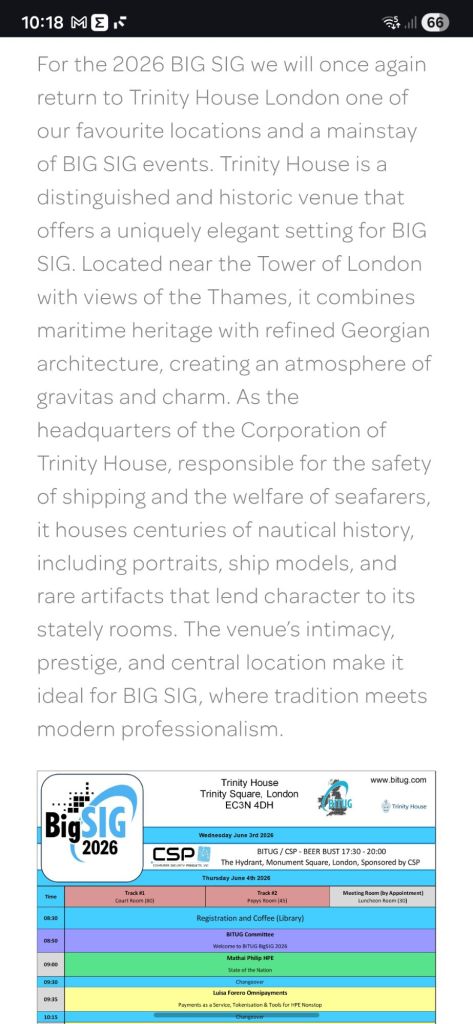
The BITUG BIG SIG 2026 event is scheduled for Thursday, 4 June 2026.
Organized by the British Isles NonStop User Group (BITUG), this annual conference gathers HPE NonStop professionals, partners, and vendors across the region.
Event Details
Date: Thursday, 4 June 2026.
Location: Trinity House, London.
Key Focus Areas: HPE NonStop architecture roadmaps, technical breakout tracks, data security, and specialized data resiliency updates.
Attendees: The conference hosts end-users, system administrators, and developers, alongside community sponsors such as comforte, XYPRO, and ETI-NET.
Networking: Collaborative environments allowing users to connect directly with senior HPE executives and product experts.
Admission: Complimentary registration is available for active end-user members. Official ticket registration and full session listings are hosted on the BITUG Big SIG Event Page.
The BITUG BIG SIG 2026 event is scheduled for Thursday, 4 June 2026
The BITUG BigSIG 2026 conference, hosted by the British Isles Tandem User Group at Trinity House, London, brings together the premier vendors within the HPE NonStop ecosystem. Key participating vendors and sponsors focus on data integration, compliance, zero-trust security, storage, and infrastructure management tailored for mission-critical enterprise systems.
The primary vendors participating in the 2026 HPE NonStop ecosystem event are organized by their specialization below.
🛡️ Data Security & Cyber Resilience
comforte AG: Serving as a key event sponsor, comforte AG hosts dedicated breakout sessions demonstrating tokenization strategies designed to secure sensitive data elements and enhance corporate data usability without breaking downstream application logic.
XYPRO Technology Corporation: A long-standing HPE NonStop security partner delivering compliance management, real-time threat detection, and risk mitigation tools. They focus heavily on enabling Zero-Trust architectures and automating compliance reporting for frameworks like PCI-DSS.
CSP (Compliance Systems Platforms): Specializes in vulnerability management, security hardening, and automated security compliance checking. They provide the administrative tools required to monitor audit logs and secure environments against internal and external threats.
🔄 Data Replication & Continuity
NTI (Network Technologies International): Presenting active strategies for multi-platform data distribution. NTI highlights methods for data movement away from legacy Oracle GoldenGate setups while integrating real-time HPE NonStop compute platforms with enterprise IT and agentic AI pipelines.
Gravic, Inc.: Promotes its HPE Shadowbase software line. Gravic focuses on high-availability business continuity, active-active data replication, data validation, and real-time streaming analytics for global telecommunications and financial exchanges.
💾 Backup, Storage & Infrastructure Management
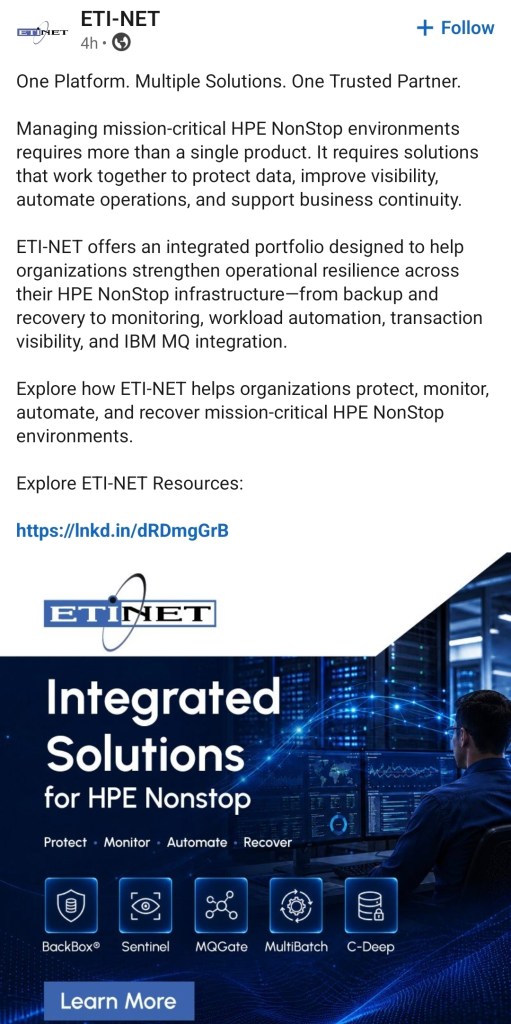
ETI-NET: Showcases technical advancements inside its Sentinel and BackBox VTC software suites. ETI-NET’s 2026 showcase highlights immutable data tiering, object-locking architectures designed to resist ransomware, and AI/ML-driven anomaly detection within data backups.
TCM Solutions: Focuses on physical and virtual NonStop optimization. TCM specializes in hardware management, KVM hypervisor integrations for Virtualized NonStop environments, and transitioning infrastructure architecture over high-performance fabrics like InfiniBand.
💳 Application Modernization & Payments
OmniPayments: Showcases cloud-adjacent, high-volume payment processing switch architecture. They highlight transaction survivability, fraud prevention integrations, and end-to-end tokenization for multi-channel banking networks.
NuWave Technologies: Specializes in middleware solutions that connect HPE NonStop heritage code with modern RESTful web services. They focus heavily on API management as enterprise building blocks to quickly web-enable NonStop applications without rewriting backend logic.
4tech Software: Delivers tactical operational monitoring, system auditing, and database performance management tools designed to keep NonStop SQL applications running with minimal administrative overhead.
The European BASE24 User Group (EBUG) was a prominent, community-led organization dedicated to the ACI BASE24 payment processing system. It provided a vendor-neutral forum for IT professionals, banks, and processors to collaborate, share knowledge, and discuss technical tracks like HPE NonStop monitoring and payment security.
Conference Timeline
1980s — Establishment: EBUG is formed as a regional community for European financial institutions utilizing the growing BASE24 platform.
Early 2000s — Technical Growth: EBUG annual conferences become prominent technical forums featuring specialized tracks focused on Tandem/HP NonStop hardware and payment system security.
2007 — Istanbul Conference: Features heavily attended technical sessions and workshops addressing growing transaction volumes and early EMV (chip card) migrations.
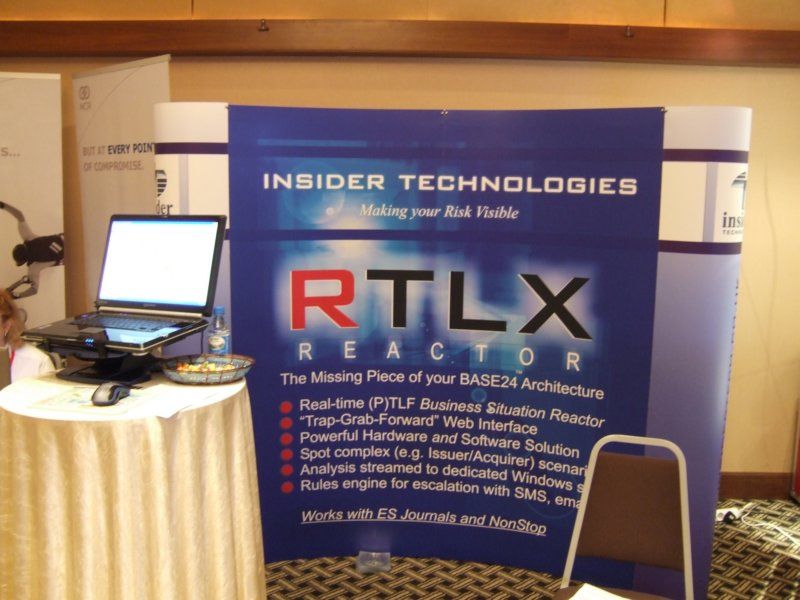
Insider Technologies regularly attended EBUG, booth in 2007
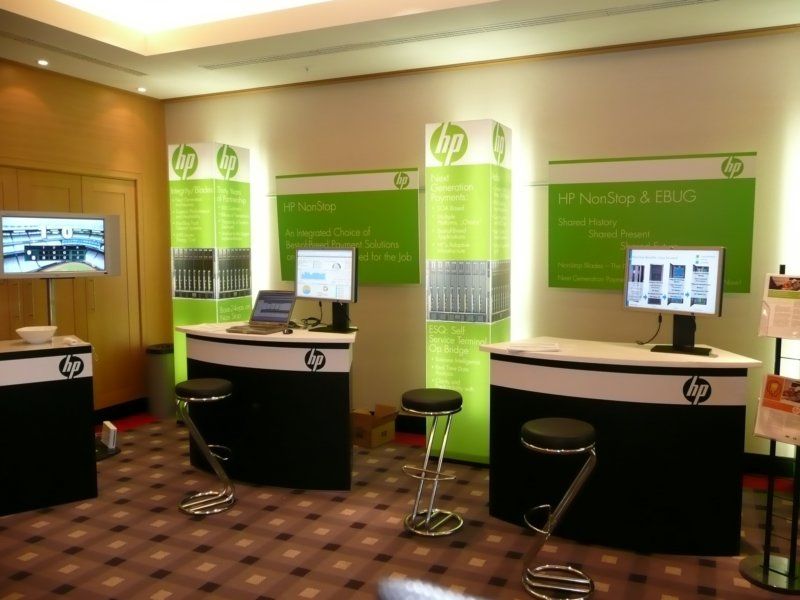
2008 — Vienna Conference: Notable for introducing ACI’s strategic shift to support IBM platforms alongside traditional HPE NonStop environments.
HP booth at Vienna EBUG, 2008
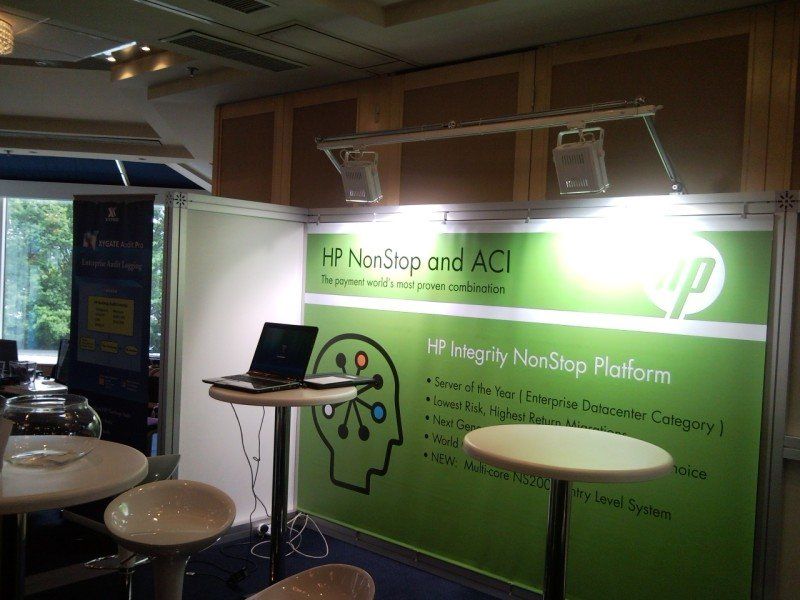
2009 — Prague Conference: Continues strong advocacy and technical troubleshooting for BASE24 on NonStop despite broader industry platform shifts.
HP Booth at Prague conference, 2009
2012 — London TFG: A technical focus group is held in London at Trinity House, bringing together engineers and ACI product managers to debug and refine system architecture.
Late 2010s to Present — The “Everybody Belongs” Era: As ACI broadened its product portfolio, the user group expands its scope to include other payment technologies like Postilion. The conference formally rebrands as an independent entity, later transitioning into The Payments Knowledge Forum, to serve all payment systems users inclusively.
European BASE24 User Group (EBUG) was a prominent, community-led organization
HPE NonStop Reflex (often referred to as Reflex 80:20) is a graphical, integrated IT management suite developed by Insider Technologies. It provides continuous health monitoring, automated workflow management, and diagnostic logging for mission-critical HPE NonStop environments, serving as a single, consolidated “pane of glass” for fault-tolerant network operations.
Detailed Timeline Breakdown by Era & Year
The history of the NonStop Reflex suite closely mirrors the architectural evolution of the underlying HPE NonStop (originally Tandem) fault-tolerant hardware platforms.
1. The Tandem / ITUG Era (1989 – 1996)
1989: Insider Technologies was founded in Salford Quays, Manchester, UK, establishing an early specialization in Tandem (NonStop) messaging software and message tracking utilities.
1990s: As massive online transaction processing (OLTP) workloads grew, native Tandem utilities proved increasingly cumbersome. This spurred the initial development of platform diagnostic and event-filtering tools that would soon become the Reflex suite.
1995: Insider Technologies actively codes and launches the initial iterations of Reflex 80:20, providing operators with an aggregated view of Tandem platform events.
2. The Compaq & Early HP Transition Era (1997 – 2014)
1997: Compaq acquires Tandem Computers. Reflex 80:20 begins updating its backend architecture to handle ServerNet clustering and the newly combined enterprise platforms.
2002: Hewlett-Packard (HP) acquires Compaq. HP begins the hardware migration from proprietary processors to Intel Itanium (HP Integrity NonStop).
2004: Insider Technologies formalizes its ongoing product development, heavily pushing both Reflex 80:20 and releasing new variants like Reflex ONE24 to support extended tracking for ATM and POS networks.
2007: Reflex and other Insider monitoring software platforms are highly integrated into FIS solutions, serving tier-one global banks and stock exchanges.
2013: Insider Technologies solidifies the Reflex 80:20 status as the ultimate consolidated replacement for legacy HP components, publishing technical insights in dedicated NonStop journals.
3. The Modern HPE & x86 Era (2014 – 2019)
2014: Hewlett Packard Enterprise (HPE) is formed and officially launches NonStop X, moving the architecture onto standard Intel x86-64 processors. Reflex 80:20 interfaces are updated to support InfiniBand fabrics and the newer Open System Services (OSS) environments.
2017 – 2019: HPE launches Virtualized NonStop (vNS), bringing continuous application fault tolerance directly to private and hybrid clouds. Reflex adapts its system management capabilities to securely monitor both physical x86 non-stop servers and virtual hypervisor instances.
4. The AI & Hybrid Cloud Era (2020 – 2026)
2020: HPE ends the sale of older Itanium-based platforms. Reflex fully commits its diagnostic support to modern HPE NonStop X and vNS environments.
2023 – 2024: The NonStop platform embraces AI integrations, expanded SQL/cloud workloads, and integrations with modern DevOps tools. Reflex tools receive updates to accommodate enhanced cyber resilience tracking and modern API-driven services.
2025: HPE celebrates 50 years of the fault-tolerant NonStop computing ecosystem. The Reflex suite provides compatibility for the upgraded, high-capacity hardware iterations running the L25 series OS.
2026: Reflex remains a staple ecosystem management suite for complex enterprise networks, processing and escalating exception conditions, EMS events, and subsystem alerts within the highly available HPE GreenLake consumption models.
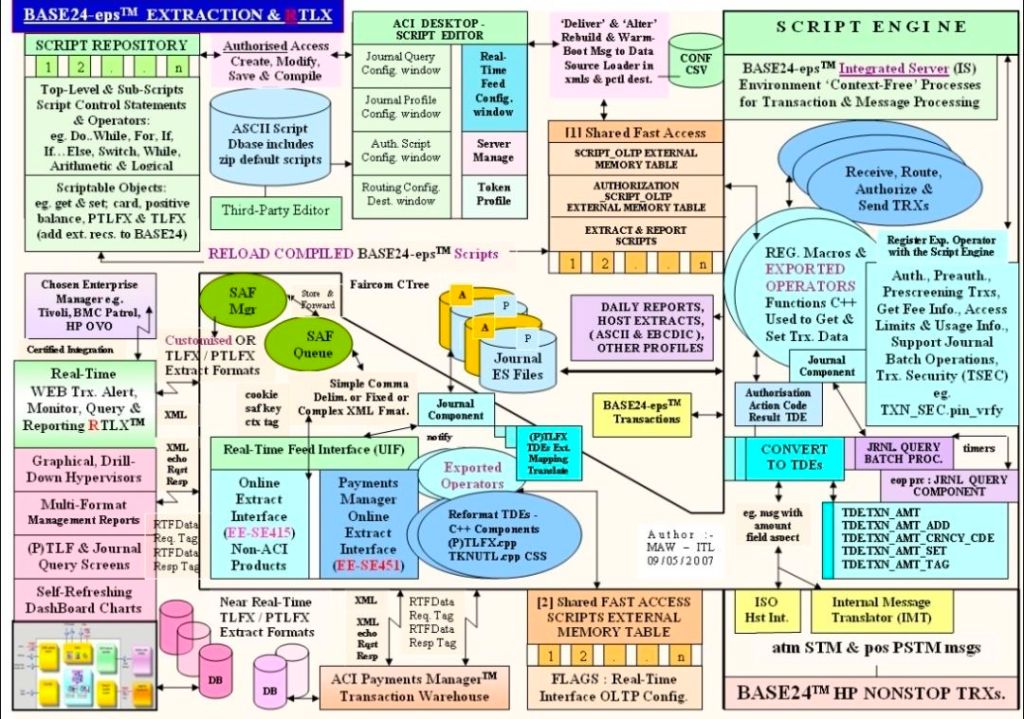
The Insider RTLX product at ETI-NET is now called C-Deep for Transaction Monitoring;
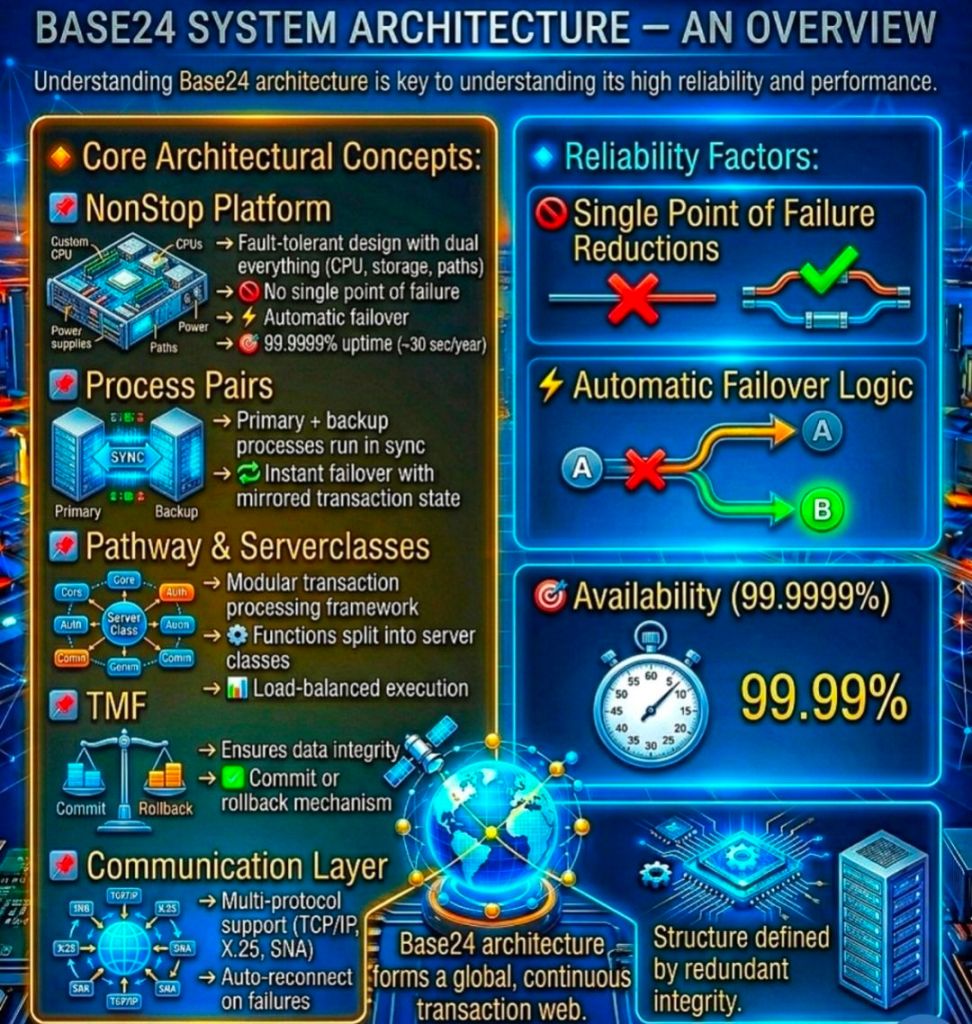
The BASE24 electronic payment system developed by ACI Worldwide exists in two primary architectural generations:
BASE24 Classic (historically deployed on HPE NonStop / Tandem fault-tolerant hardware) and
BASE24-eps (Enterprise Payments System, built using an object-oriented C++ framework deployable across open systems, z/OS, and cloud infrastructure).
Despite structural differences, both share a highly optimized, component-based transaction routing engine.
BASE24 architecture overview
Core Structural Component Layers
The component architecture maps the complete end-to-end lifecycle of a financial message (such as ISO 8583) through five distinct functional sub-systems:
1. Network & Message Routing Component (XPNET)
Purpose: Coordinates all message traffic across internal processes and physical network nodes.
Function: Operates as a specialized middleware network manager that decouples low-level communication links from upper transaction routing layers.
Configuration: Relies on a Logical Network Configuration File (LCONF) to define active execution nodes, hardware lines, and physical stations.
2. Perimeter Access Layer (Device Handlers)
Purpose: Translates device-specific message protocol formats into the system’s unified internal format.
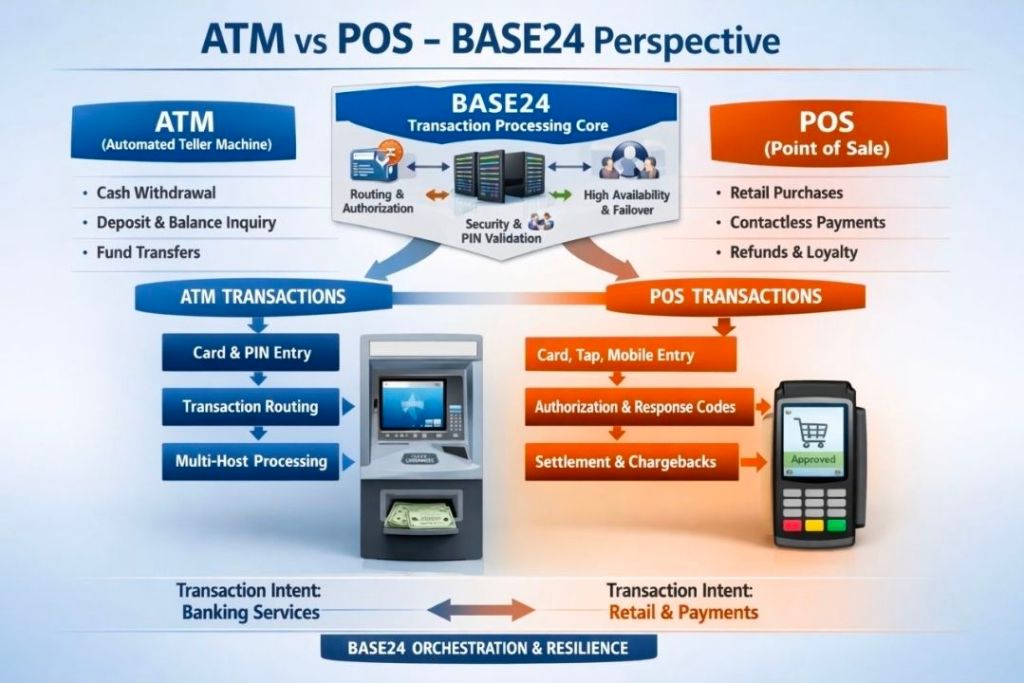
ATM Device Handlers (ATMDH): Manage direct connectivity to automated teller machines, unpack specific vendor dialects (such as Diebold or NCR states), and track terminal hardware statuses.
POS Device Handlers (POSDH): Interface with point-of-sale acquirer terminals and merchants.
Security Operations: Triggers immediate payload encryption/decryption and Hardware Security Module (HSM) PIN-block translation directly within this ingestion ring.
3. Core Transaction Logic (Authorization System)
Purpose: Determines whether a payment request should be accepted, rejected, or modified.
Full On-Us Authorization: Inspects internal databases for matching account records, positive balances, and velocity thresholds to issue real-time decisions.
Parametric/Negative Checks: Validates card status against offline negative files, usage restrictions, or custom risk parameters.
Scripting Engine: Modern BASE24-eps variants execute localized transaction routing scripts via customized operators without forcing a compile rewrite of the core engine core.
Interchange Interfaces (ICH): Package and transform the transaction payload into international network profiles (e.g., Visa, Mastercard, regional switches). It handles strict message mapping and regional network check requirements.
Host Interfaces (HIF): Create synchronous links back to an institution’s underlying Core Banking system to apply ledger adjustments, check balances, or execute real-time holds.
5. Offline & Administrative Subsystems
Extract Component: Gathers active transaction logs and streams filtered payloads out to analytical reporting databases.
Refresh Component: Updates terminal operational data, key packages, and card exclusion lists from parent systems down to active execution nodes.
Settlement Initiator: Groups, cleanses, and batches net-clearing totals to finalize payment entries into regional clearinghouses.
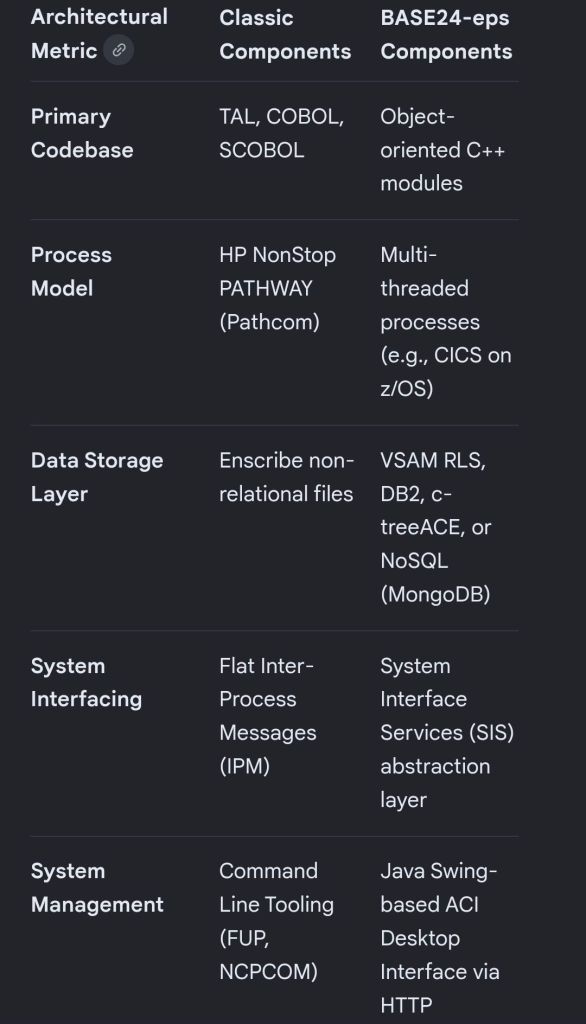
Architectural Divergence: Classic vs. EPS
The structural design varies significantly depending on the generation of the software deployment:
BASE24 and BASE24-eps architecture overview
End-to-End Component Transaction Flow
An ATM transaction arrives at the network interface layer managed by XPNET.
The message is routed to the Device Handler, which strips hardware packaging and requests translation from the HSM.
The clean internal message passes to the Authorization Engine.
If it is a “Not-On-Us” card, the engine identifies the destination BIN and transfers routing control to the Interchange Interface.
The Interchange Interface maps the payload to the external scheme standard (such as Visa) and transmits it to the external network.
The outbound network response is unwrapped by the Interchange component and tracked through the core engine to log final response codes.
The transaction safely records inside the active log file, allowing the Extract / Settlement components to pick it up later during batch processing.
MultiBatch is a robust enterprise workload automation and job scheduling tool designed specifically for the HPE NonStop parallel architecture. Developed originally by Insider Technologies and subsequently managed/distributed alongside partners like ETI-NET, it enables organization-wide task automation.
MultiBatch provides high-performance, concurrent execution of batch schedules across multiple nodes. It natively supports both Guardian and OSS environments. By utilizing modern graphical user interfaces (GUIs) alongside traditional Pathway components, it eliminates the need for complex, manual, and high-maintenance TACL or JCL scripts.
Core Technical Capabilities
Parallel Execution: Uses NonStop architecture to execute batch workloads concurrently across one or multiple nodes.
Advanced Scheduling: Drives automated tasks based on time parameters, complex intervals, custom calendars, and direct cross-job dependencies.
Reusable Infrastructure: Environment classes—including PARAM, ASSIGN, DEFINE, FD, and environmental variables—can be configured once and safely shared across various jobs.
Inbuilt Disaster Recovery: Features automated, built-in monitor recovery mechanisms to preserve execution integrity during hardware or connection failures.
Seamless Migration: Simplifies moving production workloads between environments via a deep migration utility that automatically handles environmental translation without manual intervention.
Timeline Breakdown by Year and Version
The evolution of MultiBatch highlights its transition toward broader configuration capacities, simplified environment integrations, and eventual product lifecycle milestones.
2020: Operational and Security Consolidation
Version Focus: Pre-v10 Infrastructure (Enterprise Deployments)
Key Enhancements:
Formalized rigid separation of internal user roles, establishing MBAT.OPS for view-only status monitoring and MBAT.CONFIG for structural schedule maintenance.
Refined the “Migrator” module, eliminating manual TACL operations when extracting and inserting batch definitions across network test and production nodes.
Added capabilities allowing all MultiBatch jobs to execute securely under the system Batch Monitor Process (BMON) owner or explicitly assigned application user IDs.
2022 (November): MultiBatch Version 10.0 Launch
Version Focus: Architecture Restructuring
Key Enhancements:
Define Classes: Introduced reusable Define Classes to group environments cleanly.
Scale Upgrades: Upgraded the main Batch Monitor (BMON) subsystem to actively scale up to 2,500 jobs concurrently.
Parameterization: Modified the core configuration boundaries and decoupled utility processes (MBPARHK) to seamlessly process non-step related records across database structures.
Clean Up: Formally deprecated legacy components including UTCSV to reduce technical debt.
2023 (February): MultiBatch Version 10.1 Refinement
Version Focus: OSS Overhaul & Operational Control
Key Enhancements:
OSS Reworking: Re-engineered and optimized support for Open System Services (OSS) processes, granting them equal parity with traditional Guardian tasks.
On-Demand Execution: Enabled ad-hoc “On Demand Job” invocation directly through user channels without altering master schedules.
Conditional Variables: Extended character limits for Conditional Parameter values up to 100 characters.
Subsystem Unification: Consolidated Event Timer processing and Conditional Parameters fully into standard MultiBatch menus, auditing frameworks, and security tracking.
Control Commands: Integrated the SWITCH BMON command line directive to easily pass control between operational monitors.
Interface Upgrade: Rolled out an entirely new Ops GUI Server to modernize scheduling visibility.
Current Era: Version 10.2 Maintenance & Commercial Sunset
Version Focus: Version 10.2 / Product Lifecycle Transition
Key Milestones:
MultiBatch 10.2: Operates as the current, stable production tier delivered via ETI-NET, featuring deep parameterization and centralized network deployment protocols.
Commercial End of Life: As of March 1, 2026, new software licenses for Multi-Batch are no longer available for purchase. The software has officially reached the end of its commercial sales life.
Ongoing Support: Existing license holders retain full permission to execute, maintain, and run the product inside their environments according to their long-term licensing agreements.
HPE NonStop MultiBatch Batch Job Scheduling Overview and Timeline