Bluetooth Overview and Detailed Chronological Timeline

Bluetooth is a universal, short-range wireless communication standard that enables electronic devices to exchange data and audio over ultra-high frequency (UHF) radio waves (operating between 2.402 GHz and 2.480 GHz). It forms localized, temporary networks known as piconets to seamlessly bridge data gaps without the clutter of physical wires or cables.

To combat signal congestion in the crowded 2.4 GHz band—which it shares with Wi-Fi and microwaves—Bluetooth uses a technique called Adaptive Frequency Hopping (AFH), rapidly switching between 79 or 40 channels up to 1,600 times per second to maintain a stable, secure connection.

Named by Intel engineer Jim Kardach after the 10th-century Scandinavian King Harald “Bluetooth” Gormsson—who famously united warring Danish tribes into a single kingdom—the technology was built to similarly unify incompatible PC, cellular, and digital device ecosystems. The iconic Bluetooth logo is a direct nod to this heritage, fusing the ancient Norse runes ᚼ (Hagall) and ᛒ (Bjarkan) representing King Harald’s initials.
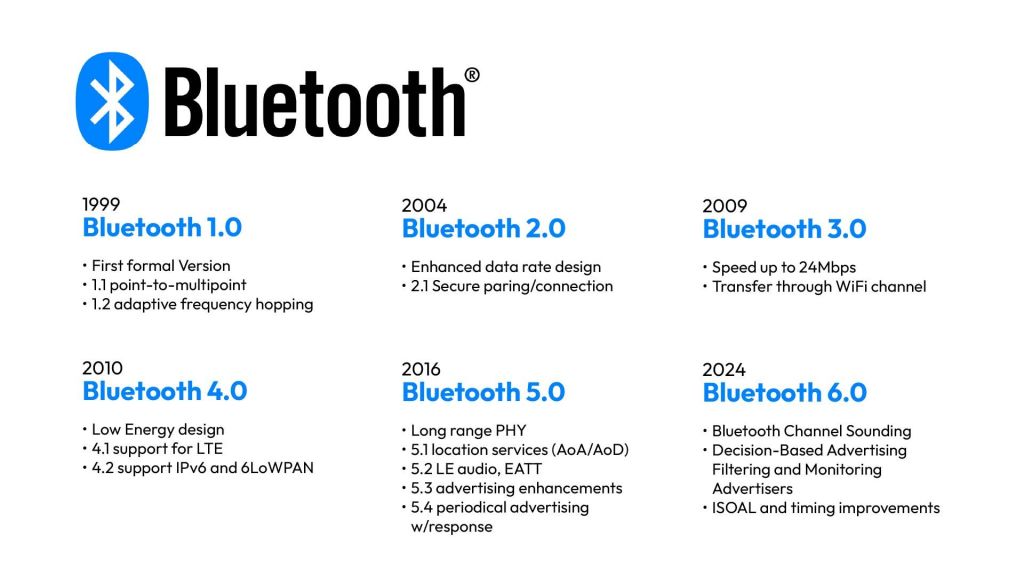
Bluetooth Overview and Detailed Chronological Timeline

🏛️ Era 1: Pre-Commercialization & Foundation (1989–1998)

Before becoming an open global standard, Bluetooth began as a proprietary corporate feasibility project aimed at liberating electronics from restrictive RS-232 data cables.

  • 1989: Nils Rydbeck (CTO of Ericsson Mobile) and inventor Johan Ullman initiate a “short-link” radio technology project designed to develop comfortable wireless headsets.
  • 1994: Jaap Haartsen and Sven Mattisson are tasked by Ericsson leadership to formally design the hardware infrastructure in Lund, Sweden. They focus on low-power, low-cost radio architectures.
  • 1997: The engineering team achieves a functional, workable link layer solution. Intel’s Jim Kardach proposes the temporary codename “Bluetooth”.
  • 1998: Recognizing a global framework requires cross-industry alignment, Ericsson joins forces with IBM, Intel, Nokia, and Toshiba to found the Bluetooth Special Interest Group (SIG) to establish an open, license-free standard.

📱 Era 2: The Classic Bluetooth Era (1999–2009)

The first commercial implementation focused heavily on replacing peripheral wires. However, early builds struggled with device-role conflicts, high power consumption, and severe data limitations.

  • 1999 (v1.0 & v1.0b): The Bluetooth SIG publishes the official Bluetooth 1.0 specification. It is heavily plagued by interoperability issues and mandatory hardware address exposure, creating distinct privacy gaps.
  • 2001 (v1.1): Standardized globally under the IEEE 802.15.1 banner. Fixes version 1.0 connection bugs, supports point-to-multipoint slave connections, and introduces unencrypted channel support. The Sony Ericsson T36 debuts as the first commercial phone with integrated Bluetooth.
  • 2003 (v1.2): Introduces Adaptive Frequency Hopping (AFH) to stop Wi-Fi network interference. Adds Extended Synchronous Connections (eSCO) to rescue voice audio quality by allowing packet retransmissions.
  • 2004 (v2.0 + EDR): Unleashes Enhanced Data Rate (EDR). Maximum throughput leaps from a nominal 721 kbps to 3 Mbps, greatly reducing power draw through shorter transmission cycles.
  • 2007 (v2.1 + EDR): Introduces Secure Simple Pairing (SSP). This eliminates complex PIN-code handshakes, improving device security while seamlessly supporting Near Field Communication (NFC) proximity pairings.
  • 2009 (v3.0 + HS): Debuts High Speed (HS) architecture. It uses a clever dual-radio configuration where Bluetooth creates the initial handshake, but offloads large media payloads to an internal 802.11 Wi-Fi link for speeds up to 24 Mbps.

🔋 Era 3: The Bluetooth Low Energy (BLE) & IoT Era (2010–2015)

Prior versions consumed too much power for miniature electronic applications. This era redefined the standard, establishing an entirely separate protocol tier optimized to run on tiny coin-cell batteries for the burgeoning Internet of Things (IoT) market.

  • 2010 (v4.0): The pivotal launch of Bluetooth Low Energy (BLE) (branded initially as Bluetooth Smart). Devices can remain asleep until data bursts happen, drastically dropping baseline energy consumption.
  • 2013 (v4.1): Engineers adjust software layers to prevent direct frequency collision with 4G LTE bands. Devices can now act as both an independent hub and peripheral sensor simultaneously.
  • 2014 (v4.2): Designed entirely for smart home architecture, this update adds support for IPv6 and 6LoWPAN. This allows smart sensors to connect directly to the internet without intermediary mobile gateways.

🌐 Era 4: High-Performance & High-Precision Mesh Era (2016–Present)

Modern iterations have fundamentally transformed the technology from a basic local data-link pipe into a highly robust, secure mesh network and precision spatial positioning framework.

  • 2016 (v5.0): Doubles BLE transmission speeds to 2 Mbps and quadruples operational range up to 240 metres. It optimizes performance for large-scale smart homes and multi-room layouts.
  • 2019 (v5.1): Introduces Direction Finding via Angle of Arrival (AoA) and Angle of Departure (AoD) antennae arrays. Devices achieve hyper-local indoor positioning down to centimeter-level accuracy.
  • 2020 (v5.2): Unveils LE Audio running over the highly efficient LC3 Codec. It introduces Auracast, which enables a single source device to stream high-fidelity audio to an infinite number of nearby headphones or hearing aids.
  • 2021 (v5.3): Adds connection subrating to reduce communication switching latencies. Improves peripheral device power optimization and encryption control keys.
  • 2023 (v5.4): Adds Periodic Advertising with Responses (PAwR) alongside Encrypted Advertising Data (EAD). This allows two-way secure mass communication, tailored specifically for thousands of commercial electronic shelf labels.
  • 2024 (v6.0): Incorporates groundbreaking Channel Sounding technology. It employs phase-based time-of-flight measurements to provide centimeter-level distance awareness, creating incredibly secure digital car and home keys that prevent relay signal tracking attacks.

Bluetooth Overview and Detailed Chronological Timeline

HPE NonStop Tandem EMS Subsystem Overview and Chronological Timeline

In the HPE NonStop ecosystem, EMS (Event Management Service) is the core software subsystem responsible for collecting, formatting, filtering, logging, and routing system and application event messages. It provides fault-tolerant monitoring by gathering data from EMS collectors and selectively delivering alerts to consoles, log files, or automated management applications.

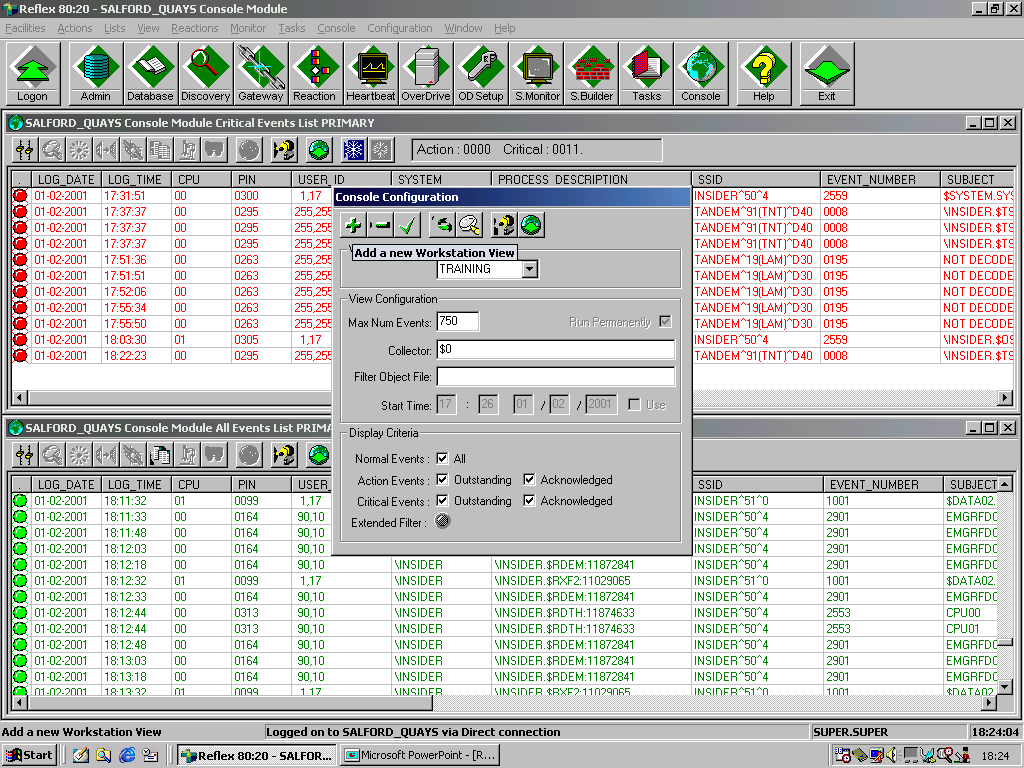
EMS events as viewed in Console, Reflex 80:20 event viewer (ITL)
EMS event detail as viewed in Console, Reflex 80:20 event viewer (ITL)
EMS event view configuration window in Console

The evolution and detailed historical timeline of NonStop EMS events and architecture is broken down by era below:

1. The Tandem Guardian Era (Late 1970s – 1980s)

Focus: Foundation of Fault-Tolerant Event Logging

  • 1976: Tandem releases the original Tandem/16 (NonStop I) system. Early event handling was primarily a rudimentary terminal console logging process.
  • 1978: System administrators struggled with message scaling as clusters and terminal networks expanded. Tandem began developing structured event tracking, paving the way for standardized subsystem messages.
  • 1980s: Introduction of early message formatting. Event messages 1 through 511 were reserved for unformatted, raw console events. The Event Management Service (EMS) was gradually formalized to centralize scattered terminal messages.

2. The D-Series & TMF Era (1990s)

Focus: Distributed Management & The Birth of Modern EMS

  • 1991: Tandem releases the Cyclone/R (CLX/R) and later the Himalaya K-series using MIPS processors.
  • 1993: The publication of the seminal EMS Reference Summaries standardized EMS APIs and SPI (System Programming Interface). Event IDs were structured into standardized subsystems (e.g., negative-numbered kernel messages).
  • 1995: The NonStop Kernel introduced Open System Services (OSS), natively integrating Unix-like event logs into the Guardian architecture.
  • 1997: Compaq acquires Tandem Computers. EMS underwent significant rewrites to interface with remote servers and client networks. The S-Series was launched utilizing ServerNet fabric, introducing advanced, distributed event collectors and distributors.

3. The Compaq Transition & HP Integration (2000s)

Focus: Web-Based Management and Automation

  • 2000 – 2003: Legacy ViewPoint tools were expanded. The emergence of GUI interfaces and DSM/PM (Distributed Systems Management/Performance Monitor) allowed operators to browse and filter EMS logs on alternate/primary event files.
  • 2003 – 2005: The transition to Web ViewPoint commenced, turning text-based EMS event logs into interactive, web-based graphical operations interfaces.
  • 2006 – 2009: With HP fully in charge after merging with Compaq, EMS event viewing was modernized through TSM (Tandem/HP Systems Management) and the Open System Management (OSM) Event Viewer.

4. The Modern HPE Era (2010s – 2026)

Focus: Cloud Integration, Virtualization, & Real-Time Analytics

  • 2015 – 2017: The platform is rebranded as HPE NonStop as the architecture migrates to x86 processors. EMS systems are upgraded to handle large datasets, feeding complex event processing (CEP) and SNMP trap frameworks for modern data centers.
  • 2018 – 2023: HPE integrates NonStop systems with HPE GreenLake. EMS event logging is modernized with API-driven integrations, allowing system events to be consumed by off-platform enterprise loggers, Splunk, and cloud-management consoles.
  • 2024 – 2026: EMS events operate in highly virtualized and hybrid cloud (x86 and Virtual NonStop) environments. Event management heavily relies on modern distributed systems where EMS distributors push logs seamlessly into centralized IT monitoring suites and continuous availability dashboards.

To look up specific system-generated event codes or statuses from any era, consult the legacy ⁠HP NonStop Operator Messages Manual or the broader ⁠HPE Nonstop Compute documentation portal.

eBUG (European BASE24 User Group) Conference Overview and Chronological  Timeline

The eBUG (European BASE24 User Group) Conference is the premier annual gathering for financial institutions, retail banking professionals, and technical architects utilizing ⁠ACI Worldwide’s foundational retail payment engine, BASE24 and BASE24-eps.

Operating alongside global HPE NonStop hardware environments, the conference traditionally functions as a collaborative technical focus group (TFG) and customer roundtable. It brings together industry experts to address mission-critical transaction switching, regulatory compliance mandates, payment security architectures, and core software migrations.


Detailed Era Breakdown & Timeline

Era 1: The Classic BASE24 & ITUG Tandem Era (1980s – Late 1990s)

Focus: Evolution of core ATM/POS switching on Tandem (HPE NonStop) platforms, localized compliance, and basic card processing networks.

  • 1982–1985: The birth of the early European user networks following the launch of BASE24 software by Applied Communications Inc. (now ACI Worldwide). Early meetings are heavily dependent on regional vendor user group support.
  • 1992: Initial formations of explicit regional sub-committees under the International Tandem User Group (ITUG). The European base of users establishes formal communication pipelines.
  • 1996: Increased focus on the early adoption of regional card mandates, standardising early transaction switching over X.25 networks, and prepping mainframe systems for high-availability roundups.
  • 1999: A definitive milestone focused on Y2K compliance readiness. Conferences during this era are heavily centered on stress-testing legacy BASE24 code blocks, ensuring clock dates rollover flawlessly across financial networks without disrupting global merchant processing.

Era 2: The EMV Mandate & “Classic-to-EPS” Transition Era (2000 – 2010)

Focus: Overhauling core code for Chip & PIN (EMV) regulations, migrating toward open system frameworks, and introducing the next-generation BASE24-eps payment platform.

  • 2003: The EMV Blueprint Era. The conference takes a primary steering role for European banks facing strict Eurocard, Mastercard, and Visa (EMV) liabilities. User sessions heavily focus on updating terminal messaging scripts.
  • 2005: Introduction of BASE24-eps to the wider user group community. Discussions shift away from the classic architecture toward modern open-systems deployments, leveraging UNIX, Linux, and IBM z/OS alongside traditional NonStop environments.
  • 2007 (Istanbul, Turkey): The group expands geographic footprints into the borders of Europe and Asia. Themes heavily stress global interoperability, cross-border transactional routing, and real-time fraud monitoring.
  • 2008 (Vienna, Austria): High-water mark for attendance during the mid-2000s. Presentations focus on deep-dive technical configurations of BASE24-eps Release 08.2, service-oriented architecture (SOA) wrappers, and high-availability testing matrices.
  • 2009 (Prague, Czech Republic): Real-time monitoring tools become a central talking point. Despite global financial pressures, the user community explicitly defends the strength of ⁠HPE NonStop infrastructure for running foundational retail networks.

Era 3: Security Hardening & The Independent Pivot Era (2011 – 2018)

Focus: Adapting payment loops to rigid PCI-DSS requirements, cloud capability tracking, and shifting the conference structure to independent consulting sponsorships.

  • 2011: Focus turns squarely onto PCI-DSS Compliance and tokenisation. Roundtables detail architectural techniques to secure transaction journals, encrypt key lines, and prevent man-in-the-middle exploits at the ATM level.
  • 2012 (London, UK): Held at the historic ⁠Trinity House near Tower Bridge, this event marks a structural pivot. Moving away from a pure ACI-hosted workspace, independent payment consultancies (such as PayX) drive user discussions. This Technical Focus Group explicitly evaluates the limits of legacy systems against “intelligent” multi-vendor ATM software.
  • 2015: Immediate focus addresses the challenges of Real-Time / Instant Payments mandates across the Eurozone. Systems engineers share optimization scripting paradigms to support sub-second processing SLA ceilings.
  • 2018: The rise of Open Banking / PSD2 Regulations. Technical breakout sessions outline how to safely open classic BASE24 architectures to third-party APIs through microservices wrappers and middleware adapters without breaking strict system uptime criteria.

Era 4: Modernisation & Cloud-Native Coexistence Era (2019 – Present)

Focus: ISO 20022 message standard migrations, cloud-native deployments, and containerization strategies.

  • 2020–2022: Transition to hybrid tracking methodologies due to travel constraints. The baseline focus targets data integration, remote system management, and virtualized system-hardening techniques.
  • 2023–2024: The ISO 20022 Mandate. Sessions are dominated by the industry-wide migration from legacy ISO 8583 message lines to the XML-based ISO 20022 financial standard. Systems architects present automated script parsers to translate real-time payment formats across legacy logic systems.
  • 2025–2026: Integration of ⁠Cloud-Native BASE24-eps architectures. Contemporary meetups explore containerized execution patterns, utilizing AI models within the authorization loop to spot edge-case fraud patterns in real-time, and evaluating long-term roadmaps for hardware-security modules (HSMs).

eBUG (European BASE24 User Group) Conference Overview and Chronological  Timeline

Leigh Cotton Mill Heritage – Overview and Chronological Timeline

Leigh’s cotton mill heritage represents the peak and final generation of the Lancashire textile empire. Originally a dairy farming and domestic weaving town, Leigh evolved rapidly into a highly specialised fine-cotton spinning powerhouse, capitalising on local coal measures and the Bridgewater Canal.

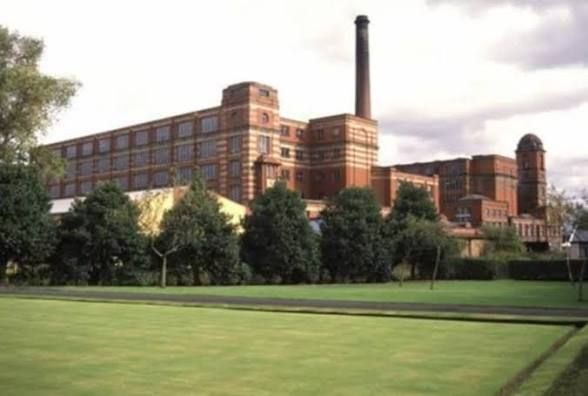
Unlike older mill towns that grew haphazardly, Leigh’s industry peaked late, culminating in massive 20th-century “double mills” like the iconic Grade II listed Leigh Spinners Mill*. Today, these red-brick giants have transitioned from empty eyesores into thriving community hubs, arts centers, and commercial business parks.

The iconic Grade II listed Leigh Spinners Mill

Detailed Timeline Breakdown by Era

1. The Pre-Industrial & Domestic Era (Pre-1830)

Before massive brick factories dominated the skyline, textile production was a distributed, domestic industry.

  • 1740s–1770s: Local weavers produce “fustians” (coarse cotton-linen fabrics) in their own homes. The invention of the fly shuttle and Richard Arkwright’s water frame begins to shift production from homes to early water-powered mills.
  • 1800s–1820s: The local economy relies heavily on agriculture, domestic handloom spinning, and a flourishing silk weaving trade.

2. The Early Factory & Industrialisation Era (1830–1879)

The introduction of rotative steam engines allowing mills to move away from rivers, combined with cheap local coal, sparks Leigh’s factory revolution.

  • 1830s: The first dedicated steam-powered cotton mills are constructed in Leigh.
  • 1839: The “Leigh Fight” (14 August). Amid massive unemployment and Chartism protests, a mob of 2,000 workers threatens to burn down Hayes Mill. The Riot Act is read, leading to violent clashes with troops.
  • 1858: Construction begins on the multi-storey mill on Kirkhall Lane (later known as Pennington Spinning Company).
  • 1861–1865: The Lancashire Cotton Famine. The American Civil War blockades southern US ports. Raw cotton supplies dry up, causing widespread starvation and temporary mill closures across Leigh.
  • 1862: F.W. Bouth founds Bouth’s Mill. []
  • 1870s: The local silk industry collapses due to foreign competition; multi-storey silk factories like Rose Mill and Welch Mill are rapidly converted to cotton weaving.
  • 1875: The local townships of Pennington, Westleigh, and Bedford officially merge to form the Leigh Local Board District.

3. The Boom & “Super-Mill” Era (1880–1925)

Leigh enters its golden economic age, specialising in fine-mule cotton spinning and building architectural “super-mills”.

  • 1880s: Major industrial development concentrates along the banks of the Bridgewater Canal, including the construction of the landmark Mather Lane Mill.
  • 1899: Leigh is officially incorporated as a Municipal Borough, reflecting its vast commercial wealth.
  • 1905: The Butts Spinning Company constructs Butts Mill.
  • 1911: The industry reaches its employment peak. Over 6,000 people are directly employed in Leigh’s textile sector.
  • 1913: Entrepreneurs John Horrocks and Edward Crowther found Leigh Spinners Mill. Designed by architects Bradshaw, Gass & Hope, “Mill 1” (East Section) opens alongside its boiler house and landmark chimney stack.
  • 1914–1918: Outbreak of World War I halts the export markets and severely disrupts further building expansions.
  • 1923–1925: Construction resumes post-war. “Mill 2” (West Section) is completed, making Leigh Spinners one of the most complete double mill complexes in the United Kingdom.

4. The Slump, War, & Industrial Decline (1926–1999)

Global competition, lack of technical modernization, and shifting markets trigger a long, irreversible contraction.

  • 1920s–1930s: The Great Depression triggers massive closures. Despite slumps, cotton still provides about 14% of all local employment (approx. 6,000 jobs). Pennington Mill shuts its doors in 1930.
  • 1939–1945: World War II temporarily shifts mill focus to industrial war fabrics, and some empty sheds are utilised as prisoner-of-war camps.
  • 1950s–1960s: Post-war decline accelerates. Butts Mill ceases spinning operations entirely in 1960. Across Lancashire, mills close at a catastrophic rate of one per week.
  • 1969: Facing the total collapse of the cotton thread trade, Leigh Spinners Ltd structurally shifts its business model from cotton yarn spinning to carpet manufacturing.

5. Dereliction & Modern Regeneration (2000–Present)

The 21st century sees a major pivot toward preserving architectural heritage via community asset conversion.

  • 2012: Leigh Spinners expands its manufacturing footprint to produce modern synthetic turf products for sports and landscaping.
  • 2013: The Leigh Building Preservation Trust (LBPT) is formed to save the decaying sections of the mill and its rare Yates & Thom cross-compound steam engine. They secure a vital £75,000 restoration grant.
  • 2018: Volunteers successfully turn the historic mill steam engine for the first time in decades. Roof repairs begin on Mill 2.
  • 2020s: Rapid floor-by-floor expansion transforms the site into a massive dynamic space.
  • Present Day: Leigh Spinners Mill functions as a premier heritage centre. It hosts more than 60 local tenants, featuring sports gyms, art studios, an independent cinema, a computer museum, and community facilities.
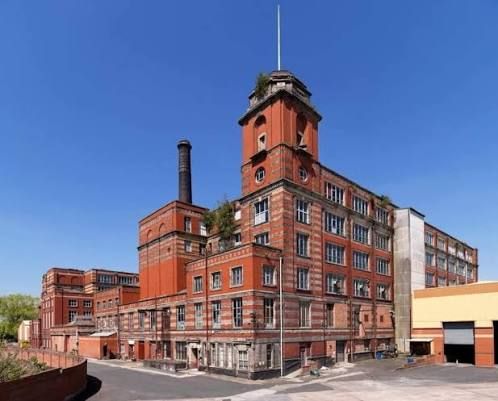
Leigh Spinners Mill functions as a premier heritage centre

Leigh Spinners Mill is a premier heritage and community hub that has transformed a historic industrial space into a thriving cultural asset. Located in Leigh, Greater Manchester, this Grade II* listed former cotton mill stands as one of the finest and most intact double-mill complexes in the UK.

Today, managed by the Leigh Building Preservation Trust (LBPT), it functions as a vibrant mix of historical preservation, business enterprise, and creative arts.

The Heritage Experience

  • The Heritage Centre: Located on the first floor, it showcases a vast collection of local history displays, photographs, oral histories, and industrial artefacts discovered during the mill’s renovation.
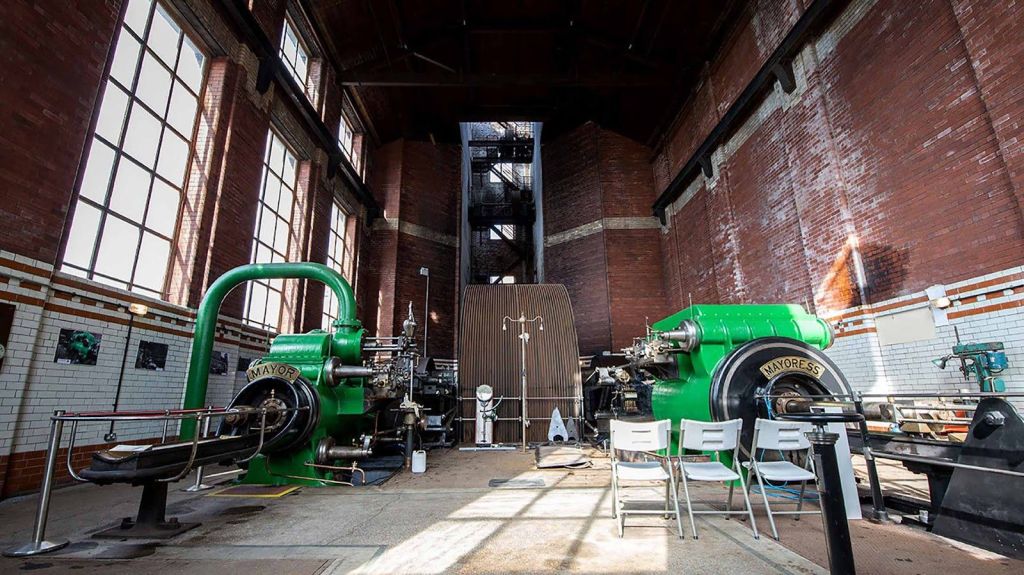
  • The Steam Engine House: Home to the “Mayor and Mayoress,” a massive 1,800-horsepower twin horizontal cross-compound steam engine built in 1923 by Yates & Thom. It is the largest surviving mill engine of its type in the UK.
Steam Engine House: the "Mayor and Mayoress," a massive 1,800-horsepower steam engine
Steam Engine House: the “Mayor and Mayoress,” a massive 1,800-horsepower steam engine
  • Architectural Tours: Enthusiastic volunteer guides lead public tours detailing the mill’s 20th-century Italianate and neo-Baroque architecture designed by Bradshaw Gass & Hope.

A Thriving Multi-Floor Community Hub

Beyond its industrial history, the mill has been partitioned into creative and commercial spaces housing over 80 independent businesses, charities, and sports facilities across its upper floors:

  • Arts & Culture Floor: Houses creative art studios, a dedicated community theatre space, and Leigh’s only independent cinema (The Film Factory), a comfortable 110-seat venue.
  • Northwest Computer Museum: A massive retro-tech attraction showcasing fully working generation-one computers and classic video game consoles like the Commodore 64 and Sinclair Spectrum amongst many others.
  • Sports & Leisure Floor: Features diverse athletic groups including martial arts dojos, an archery centre, a boxing club, table tennis, and yoga studios.
  • Retail & Amenities: Visitors can browse local maker spaces and craft workshops or relax at the mill’s local café.

Visitor Information

  • Address: Park Lane, Leigh, Greater Manchester, WN7 2LB.
  • Cost: Entry to the Heritage Centre and engine room displays is completely free of charge (donations to the trust are welcome).
  • Heritage Centre Opening Hours: Generally open to the public on Thursdays and Saturdays from 10:00 AM to 2:00 PM. Individual tenant hours across the rest of the mill vary daily.
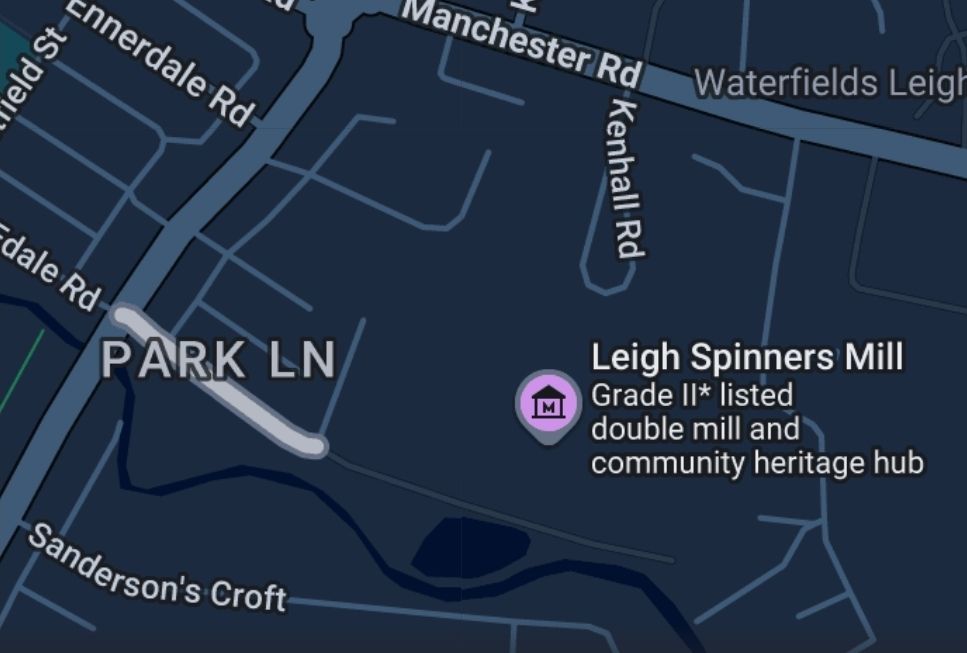
Park Lane, Leigh, Greater Manchester, WN7 2LB