

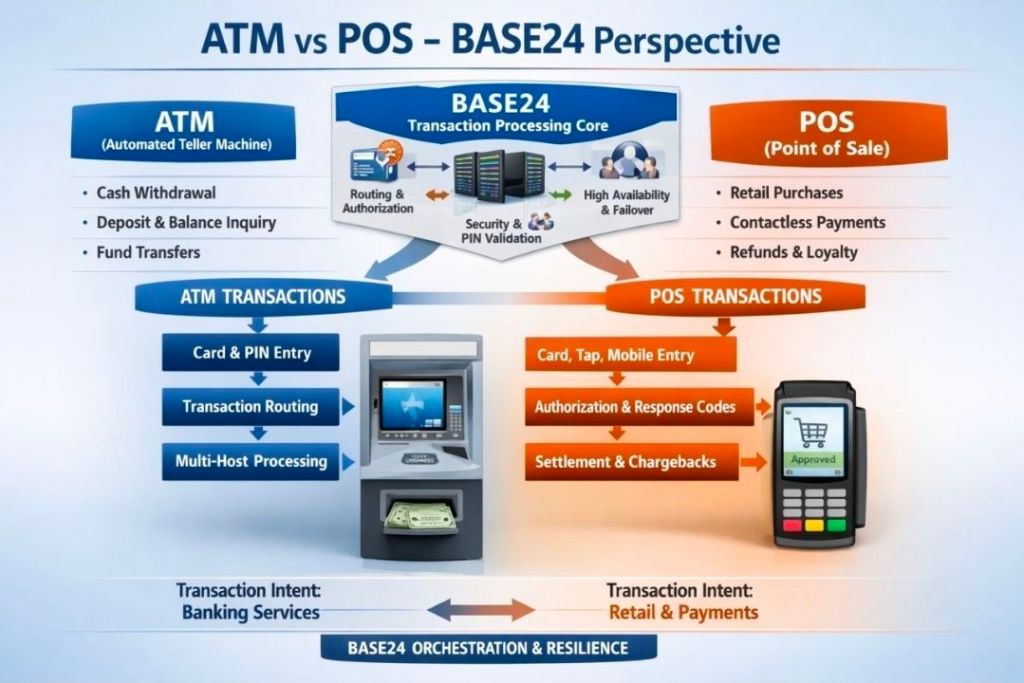
BASE24 is a market-leading, fault-tolerant Electronic Funds Transfer (EFT) software application developed by ACI Worldwide. For decades, it has served as the backbone for global banking, processing billions of ATM, Point of Sale (POS), and smart card transactions.
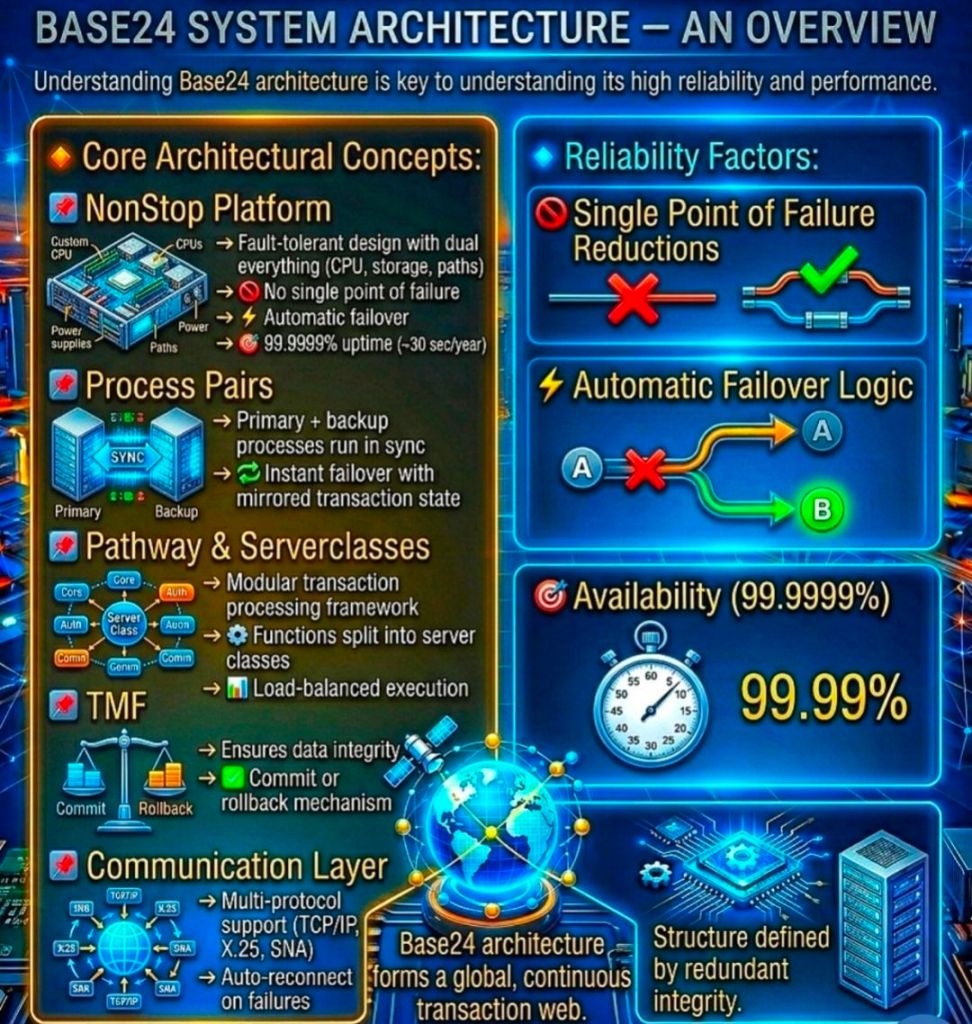
The product achieves its landmark 24/7/365 uptime by running natively on the HPE NonStop architecture—originally engineered by Tandem Computers.
1. Underlying Technology Stack
BASE24 Classic was built from the ground up to utilize the unique properties of the Tandem/HPE NonStop platform:
- Operating System: HPE NonStop Kernel (NSK) / Guardian.
- Database: Enscribe, a native hierarchical/flat file database optimized for ultra-fast, unstructured file access. Newer iterations use NonStop SQL/MX.
- Programming Languages: Primarily TAL (Tandem Application Language), pTAL, and COBOL/SCOBOL.
- Middleware: PATHWAY (PATHCOM), which acts as the transaction processing monitor to dynamically manage and load-balance server processes.
2. High-Level Component Architecture
BASE24 relies on an interconnected network of specialized processes that route and manage messages.
A. XPNET (The Networking Engine)
XPNET is a critical, proprietary communication subsystem. It provides the messaging infrastructure where applications interface with network communication lines. XPNET acts as the buffer layer, monitoring physical lines, enforcing transaction timing checks, and distributing data loads uniformly across CPUs.
B. Device Handlers (DH)
Device Handlers act as the translators for peripheral devices.
- Function: They intercept hardware-specific protocol messages (e.g., Diebold or NCR formats from ATMs) and normalize them into BASE24’s internal standard message format.
- Security: DH processes handle terminal-level PIN encryption, coordinate MAC (Message Authentication Code) keys, and initiate terminal downline loads.
C. Authorization Process (AUTH)
AUTH is the core decision engine of the application.
- Function: It validates card restrictions, tracks card usage accumulations, and performs transaction risk checks.
- Fallback Management: If a bank’s core system goes offline, AUTH drops into “Stand-Alone” or “Negative/Parametric Authorization” mode, approving transactions locally up to safe, pre-defined limits.
D. Host Interfaces (HI)
The Host Interface connects BASE24 to the financial institution’s primary backend core banking systems. It handles “On-Us” transactions—meaning the card used belongs to the bank owning the terminal.
E. Interchange Interfaces (II)
The Interchange Interface formats, translates, and routes transactions to global credit/debit networks (such as Visa, Mastercard, AMEX) or regional switches. It transforms internal BASE24 data formats into compliance standard formatting, such as ISO 8583. It handles “Not-On-Us” transactions.
3. Core Database & File Structure
BASE24 captures system activities across specialized transactional and tracking files, mostly utilizing Enscribe:
- TLF (Transaction Log File): The primary log capturing every ATM event, amount, response code, and terminal ID in real-time.
- PTLF (POS Transaction Log File): Mirrors the utility of the TLF, but optimizes records strictly for merchant POS transactions.
- LCONF (Logical Network Configuration File): Dictates how network configurations, devices, institutions, and communication paths map into XPNET.
- CAF (Cardholder Authorization File): Stores specific card numbers, limits, and statuses used for stand-alone authorization if host links break down.
4. Daily Operational Processes
Beyond live message switching, BASE24 executes several critical back-office operations:
- Extract: Periodically filters transaction data from live TLF/PTLF logs to move to external billing arrays.
- Refresh: Downloads updated data dumps (such as blacklisted cards or updated balances) from core hosts into local BASE24 database files.
- Settlement Initiator: Aggregates transaction volumes at specified cutoff times to reconcile balanced records between ATMs, POS terminals, and clearing networks.
5. Why Tandem/HPE NonStop is Essential to BASE24
BASE24 relies on the hardware/software synergy provided by HPE NonStop to achieve near-zero downtime:
- Shared-Nothing Architecture: Processors operate independently with their own memory stacks. If a physical CPU suffers hardware failure, it cannot corrupt the rest of the application.
- Process Pairs: BASE24 components operate via a primary process in one CPU and a backup process in an alternate CPU. The primary constantly syncs checkpoint data with its backup. If the primary drops, the backup assumes processing instantly without interrupting transaction flights.
- Active/Active Configuration: Utilizing replication software like HPE Shadowbase or DRNet, financial firms link distinct geographic NonStop locations. Both processing sites operate concurrently, managing localized transactions and replicating states reciprocally.
6. Product Evolution: BASE24 Classic vs. BASE24-eps
ACI Worldwide evolved the platform from BASE24 Classic into BASE24-eps (Enterprise Payment System):
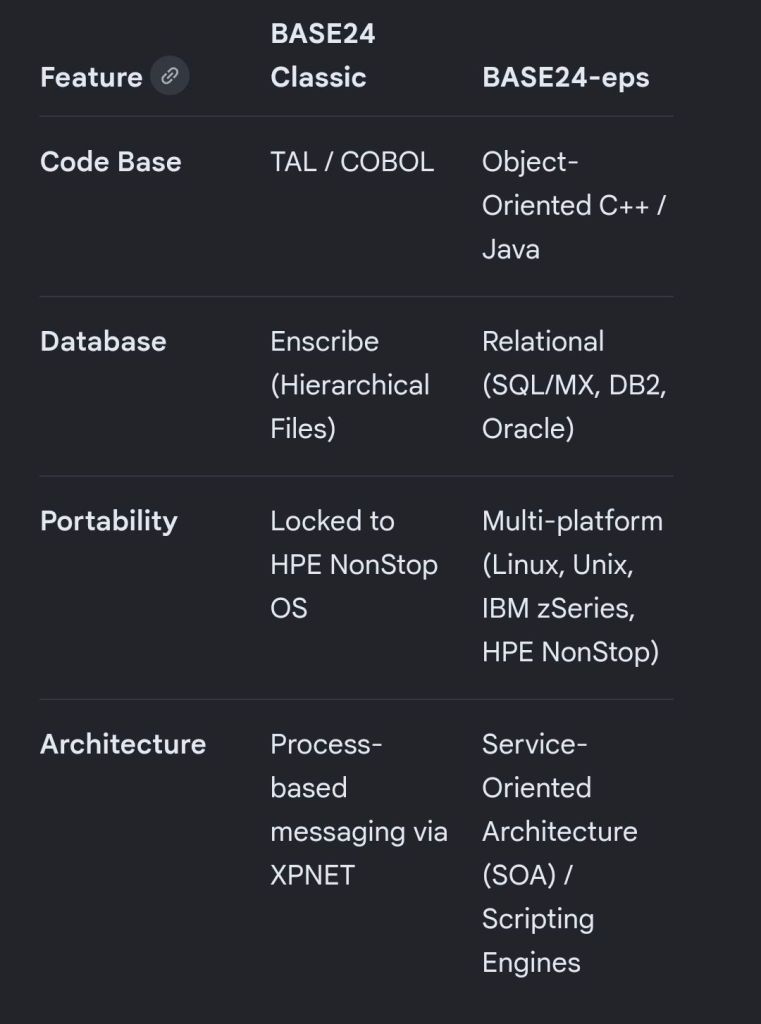
BASE24 Electronic Funds Transfer (EFT) software application developed by ACI Worldwide, Overview


One thought on “BASE24 Electronic Funds Transfer (EFT) software application developed by ACI Worldwide, Overview”