HPE NonStop Pathway is a transaction processing & application server environment (TS/MP)

HPE NonStop Pathway is a premier transaction processing and application server environment (TS/MP) that powers mission-critical Online Transaction Processing (OLTP). It handles critical application services—such as fault tolerance, load balancing, memory management, and process scheduling—automatically, allowing developers to focus strictly on business logic.
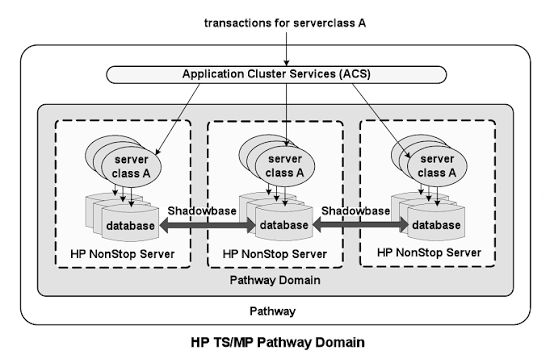
HPE NonStop Pathway is a premier transaction processing and application server environment (TS/MP) that powers mission-critical Online Transaction Processing (OLTP)
HPE NonStop Pathway is a transaction processing & application server environment (TS/MP)

Detailed Timeline Breakdown

The history and evolution of the Tandem NonStop platform and its Pathway environment span decades of architectural transformations and corporate ownership, categorized by distinct hardware and software eras:

1. The Tandem Era (1974–1997)

  • 1974: Tandem Computers Inc. is founded by Jimmy Treybig to build the first fault-tolerant commercial hardware.
  • 1976: The first Tandem NonStop system (NSI) is launched. Early apps had to be manually coded for fault tolerance.
  • 1981: NonStop II is released, bringing 32-bit addressing.
  • 1983: The Transaction Monitoring Facility (TMF) is introduced. Together with the launch of the Pathway transaction management software, the need for programmers to write manual fault-tolerance logic into their code is officially eliminated.
  • 1986: Tandem releases the EXT as an entry-level system, followed by the VLX.
  • 1991: Tandem introduces the Cyclone/R and initiates a massive architectural shift away from proprietary stack machines towards MIPS RISC processors.
  • 1997: Compaq acquires Tandem Computers, placing the NonStop product line under its umbrella.

2. The Compaq & Early HP Era (1997–2014)

  • 2001–2002: Hewlett-Packard (HP) merges with Compaq. The platform is rebranded as HP NonStop.
  • 2005: The HP Integrity NonStop (TNS/E) series is introduced, migrating the fault-tolerant platform to Intel Itanium microprocessors. Pathway continues to be the main driver for high-volume banking and telecom applications.
  • 2011: Further hardware advancements lead to the release of HP Integrity NonStop BladeSystems.

3. The Modern HPE Era (2015–Present)

  • 2015: Hewlett-Packard splits, and the NonStop environment transitions to Hewlett Packard Enterprise (HPE).
  • 2015/2016: Introduction of NonStop X (TNS/X) systems, marking the platform’s migration to standard Intel x86-64 processors and adopting InfiniBand interconnects. Pathway capabilities are updated to span dynamic server classes across multiple systems (Pathway Domains).
  • Present: HPE continues to modernize the NonStop architecture, integrating the platform with HPE GreenLake for consumption-based models and providing native support for modern DevOps tools and hybrid cloud deployments.
HPE NonStop PATHCOM, interactive management interface, Pathway transaction processing environment

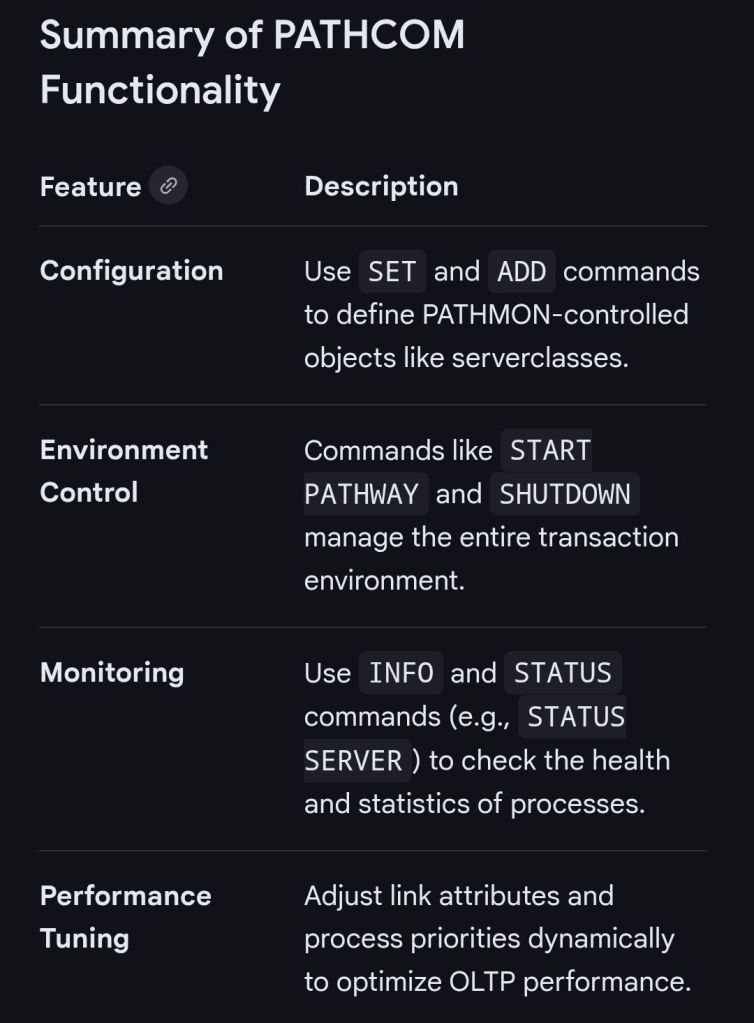
HPE NonStop PATHCOM is the interactive management interface for the Pathway transaction processing environment. It allows administrators to configure, monitor, and control PATHMON-governed objects such as serverclasses, TCPs (Terminal Control Processes), and links. 

Historical Timeline: The Evolution of Pathway & PATHCOM

The history of PATHCOM is inseparable from the Tandem NonStop platform, which pioneered fault-tolerant Online Transaction Processing (OLTP). 

The Tandem Era (1974 – 1997) 

  • 1974 – 1976: Tandem Computers is founded. The first NonStop I system ships in 1976.
  • 1983: Tandem introduces Pathway software alongside the Transaction Monitoring Facility (TMF). This milestone removes the requirement for developers to manually code fault tolerance into applications, as the Pathway infrastructure (managed via PATHCOM) handles it automatically.
  • Early 1990s: The platform migrates from proprietary stack machines to MIPS RISC processors (TNS/R architecture). PATHCOM evolves to manage more complex distributed environments.
  • 1994Open System Services (OSS) is introduced, allowing NonStop to support a Unix-like POSIX environment. 

The Compaq & Early HP Era (1997 – 2014) 

  • 1997Compaq acquires Tandem.
  • 2002HP merges with Compaq.
  • 2005: Migration from MIPS to Intel Itanium (Integrity NonStop) begins.
  • 2010s: Pathway evolves into HPE NonStop Pathway with TS/MP (Transaction Services/Massive Parallelism), enabling near-linear scalability for massive OLTP workloads. 

The Modern HPE Era (2014 – Present)

  • 2014NonStop X is introduced, migrating the architecture to Intel x86-64 processors.
  • 2015: Hewlett-Packard splits; the platform continues under Hewlett Packard Enterprise (HPE).
  • 2020 – 2024: Focus shifts toward virtualisation and hybrid cloud. Modern Pathway/TS environments now support massive scaling up to 24,480 cores in a single system image.
Summary of PATHCOM Functionality

Future of NonStop Pathway

HPE’s roadmap for NonStop focuses on integrating mission-critical reliability with modern data centre technologies:

  • Modernisation: Support for Kubernetes Helm deployments and cloud-native frameworks.
  • Hardware Advancements: New NS9 X5 and NS5 X5 platforms offer double the memory capacity and 2x faster system interconnects.
  • Open Integration: Continued emphasis on open application development environments and open-source frameworks.
  • Hybrid Cloud: Positioning NonStop as a key component of HPE GreenLake for mission-critical workloads in the cloud.

HPE NonStop PATHCOM, interactive management interface, Pathway transaction processing environment

HPE NonStop Pathway (now often part of NonStop TS/MP) – Detailed Timeline

HPE NonStop Pathway (now often part of NonStop TS/MP) has a legacy spanning nearly five decades, evolving from a terminal management system into a sophisticated middleware for high-scale, fault-tolerant Online Transaction Processing (OLTP)

Comprehensive Evolution Timeline

  • 1976: Genesis (Tandem Computers)
    The HP NonStop platform was originally introduced by Tandem Computers Inc. as the first fault-tolerant commercial computer. Pathway was soon developed to manage the distribution of transaction requests across multiple server processes.
  • 1980s: The Classic Pathway Era
    Pathway became the standard for “Screen COBOL” applications. It introduced the PATHMON process to monitor and manage serverclasses, ensuring that if one process failed, another would immediately take its place.
  • 1997: Compaq Acquisition
    Compaq acquired Tandem, integrating the NonStop technology into its enterprise portfolio. During this time, Pathway began adapting to newer networking protocols and client-server architectures.
  • 2002: Hewlett-Packard (HP) Acquisition
    HP merged with Compaq, and the platform was rebranded as HP NonStop. Pathway evolved into NonStop TS/MP (Transaction Services/Massive Parallelism), allowing for even greater scalability across massive clusters of processors.
  • 2014–2015: The x86 Revolution
    HP announced the NonStop X architecture, moving the platform from Itanium processors to standard Intel x86 hardware. Pathway (TS/MP) was optimized to run on this new architecture, providing the same high availability with modern hardware performance.
  • 2015–Present: HPE and Modern Middleware
    Following the split of HP, Hewlett Packard Enterprise (HPE) continued developing Pathway. Modern versions (like NonStop TS/MP 2.8) support advanced features like:
    • Dynamic Server Processes: Automatically scaling server instances based on load.
    • Heterogeneous Interoperability: Allowing TUXEDO or Java clients to access Pathway servers.
    • Virtualization: Deployment via HPE NonStop Virtual Enterprise (vNS). 

Core Components Over Time

  • PATHMON: The “manager” process that monitors all objects in the environment.
  • PATHCOM: The command-line interface used to configure and start Pathway objects.
  • Serverclasses: Groups of identical server processes that distribute transaction load for fault tolerance. 

HPE NonStop Pathway (now often part of NonStop TS/MP) – Detailed Timeline