

HPE NonStop Pathway is a premier transaction processing and application server environment (TS/MP) that powers mission-critical Online Transaction Processing (OLTP). It handles critical application services—such as fault tolerance, load balancing, memory management, and process scheduling—automatically, allowing developers to focus strictly on business logic.
Detailed Timeline Breakdown
The history and evolution of the Tandem NonStop platform and its Pathway environment span decades of architectural transformations and corporate ownership, categorized by distinct hardware and software eras:
1. The Tandem Era (1974–1997)
- 1974: Tandem Computers Inc. is founded by Jimmy Treybig to build the first fault-tolerant commercial hardware.
- 1976: The first Tandem NonStop system (NSI) is launched. Early apps had to be manually coded for fault tolerance.
- 1981: NonStop II is released, bringing 32-bit addressing.
- 1983: The Transaction Monitoring Facility (TMF) is introduced. Together with the launch of the Pathway transaction management software, the need for programmers to write manual fault-tolerance logic into their code is officially eliminated.
- 1986: Tandem releases the EXT as an entry-level system, followed by the VLX.
- 1991: Tandem introduces the Cyclone/R and initiates a massive architectural shift away from proprietary stack machines towards MIPS RISC processors.
- 1997: Compaq acquires Tandem Computers, placing the NonStop product line under its umbrella.
2. The Compaq & Early HP Era (1997–2014)
- 2001–2002: Hewlett-Packard (HP) merges with Compaq. The platform is rebranded as HP NonStop.
- 2005: The HP Integrity NonStop (TNS/E) series is introduced, migrating the fault-tolerant platform to Intel Itanium microprocessors. Pathway continues to be the main driver for high-volume banking and telecom applications.
- 2011: Further hardware advancements lead to the release of HP Integrity NonStop BladeSystems.
3. The Modern HPE Era (2015–Present)
- 2015: Hewlett-Packard splits, and the NonStop environment transitions to Hewlett Packard Enterprise (HPE).
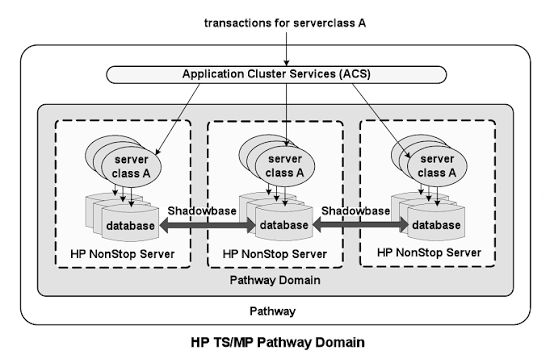
- 2015/2016: Introduction of NonStop X (TNS/X) systems, marking the platform’s migration to standard Intel x86-64 processors and adopting InfiniBand interconnects. Pathway capabilities are updated to span dynamic server classes across multiple systems (Pathway Domains).
- Present: HPE continues to modernize the NonStop architecture, integrating the platform with HPE GreenLake for consumption-based models and providing native support for modern DevOps tools and hybrid cloud deployments.

