Facilitating Workshops as a Business Analyst BA

Facilitating Workshops as a Business Analyst BA
Facilitating Workshops as a Business Analyst
Facilitating Workshops as a Business Analyst BA

As a Business Analyst (BA), facilitating workshops is a core competency used to elicit requirements, align cross-functional teams, and achieve stakeholder consensus. Success hinges on meticulous pre-session planning, active moderation of group dynamics during the session, and timely post-workshop documentation.

A proven framework for facilitating impactful BA workshops involves three critical phases:

1. Preparation

Planning is the most important step for a successful workshop. Poorly planned sessions waste valuable stakeholder time.

  • Define the Objective: Identify exactly what needs to be achieved (e.g., process mapping, feature prioritization, or user story mapping).
  • Select Participants: Invite subject matter experts (SMEs), decision-makers, and end-users. Keep the group size manageable, usually between 5 to 10 people to ensure productivity.
  • Create a Clear Agenda: Break the time down into specific activities. Allocate time for introductions, the core activity, breaks (if >1 hour), and a summary.
  • Prepare Materials: Set up whiteboards (physical or digital like Miro/Mural) and prepare your facilitation techniques (e.g., brainstorming, MoSCoW prioritization).

2. Execution (In the Session)

Your role is to act as a neutral guide, keeping the team focused on the objective rather than getting bogged down in implementation details.

  • Set Ground Rules: Establish parameters early, such as one conversation at a time, keeping devices put away, and respecting everyone’s input.
  • Manage Group Dynamics: Encourage quieter participants to speak up while politely reigning in dominant voices.
  • Use a ‘Parking Lot’: Create a designated section on a whiteboard for off-topic ideas, out-of-scope concerns, or unresolved questions to prevent the meeting from derailing.
  • Visual Collaboration: Use process flows, mockups, or sticky notes to give the conversation a focal point. This triggers ideas and helps maintain stakeholder attention.

3. Post-Workshop

The work doesn’t end when the meeting concludes. You must synthesize the information gathered to ensure it translates into actionable project deliverables.

  • Consolidate Documentation: Clean up notes, digitize whiteboard sessions, and format the elicited requirements.
  • Distribute and Align: Send a clear, written summary to participants outlining decisions made, parking lot items that need resolution, and agreed-upon next steps (who is doing what and by when).

Resources and Best Practices

  • For structured, globally recognized techniques and study material, explore the International Institute of Business Analysis (IIBA).
  • To learn practical workshop formats like user story mapping and discovery, watch this BA Requirements Workshop Guide on YouTube.

Mark Whitfield PM – Website & Blog focus areas

The blog posts by Mark Whitfield, a Senior IT Project and Engagement Manager, primarily focus on practical project management (PM) frameworks, methodology implementation, and digital delivery execution.

Mark Whitfield PM - Website and Blog focus areas

Hosted on his platform, PROject Templates, the blog acts as an extension of his 30+ year career transitioning from mainframe engineering to leading large-scale Agile and Waterfall digital transformations.

Blog Overview and Key Topics

The core purpose of the blog is to guide project professionals through real-world deployment challenges while showcasing an ecosystem of over 200 editable Microsoft Office templates.

The main content focus areas include:

  • Framework Implementation: In-depth overviews on aligning project lifecycles with PRINCE2 (7th Edition), Agile Scrum, and Kanban methodologies.
  • Detailed Project Planning: Actionable steps for setting up Software Development Life Cycles (SDLC), defining dependencies, establishing milestones, and handling project baselines.
  • Operational Checklists: Daily, highly practical guides tailored for specific team roles, such as his “Daily Checklist for Scrum Masters”.
  • Risk and Governance Control: Best practices on organizing and managing RAIDs logs (Risks, Actions, Issues, Dependencies), change requests, and corporate project governance.
  • High-Level Reporting: Frameworks for structural communication with stakeholders, utilizing Plan on a Page (POaP) examples, dashboard designs, and financial budget tracking templates.
  • Digital & Cloud Delivery Lessons: Real-world insights drawn from his corporate and public sector experiences, covering topics like middleware architecture deployments and hybrid cloud application refactoring.

Agile for Business Analysts BA

Agile for Business Analysts BA

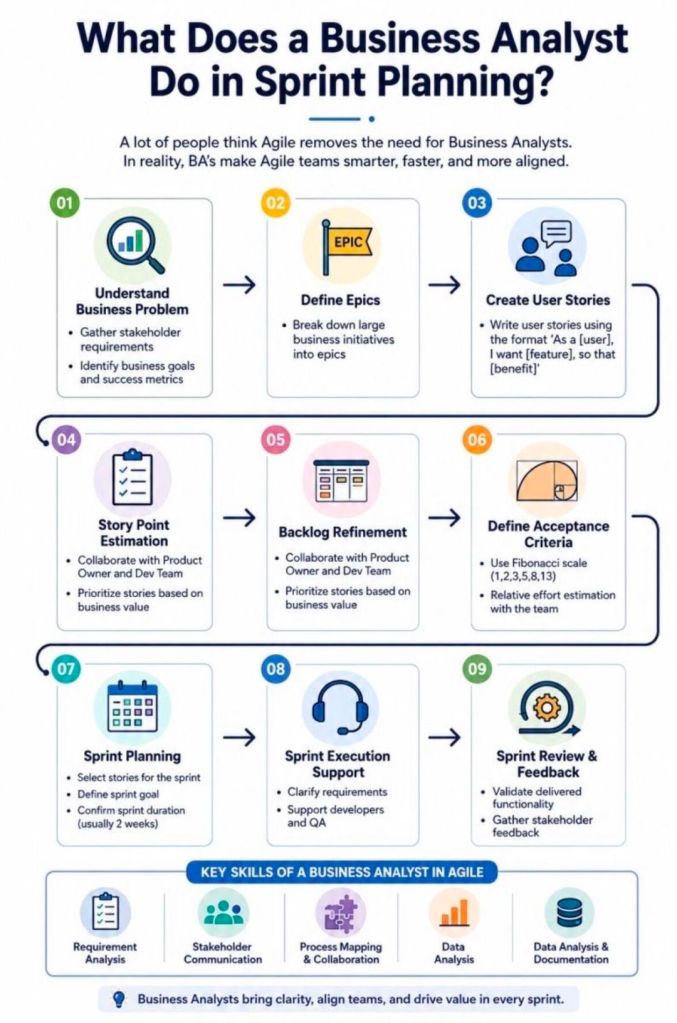
In an Agile environment, a Business Analyst (BA)acts as the crucial bridge between business stakeholders and the technical team. Rather than gathering all requirements upfront, Agile BAs focus on continuous analysis, delivering value in small increments, and writing lightweight user stories that adapt as the product evolves.

Transitioning from traditional (Waterfall) analysis to an Agile framework requires a fundamental shift in how requirements are handled, documented, and delivered.

The Core Shifts in an Agile BA Role

  • Continuous Discovery: Instead of producing a massive Requirements Document at the start, BAs analyze and refine requirements just-in-time and just-enough to keep the development team moving.
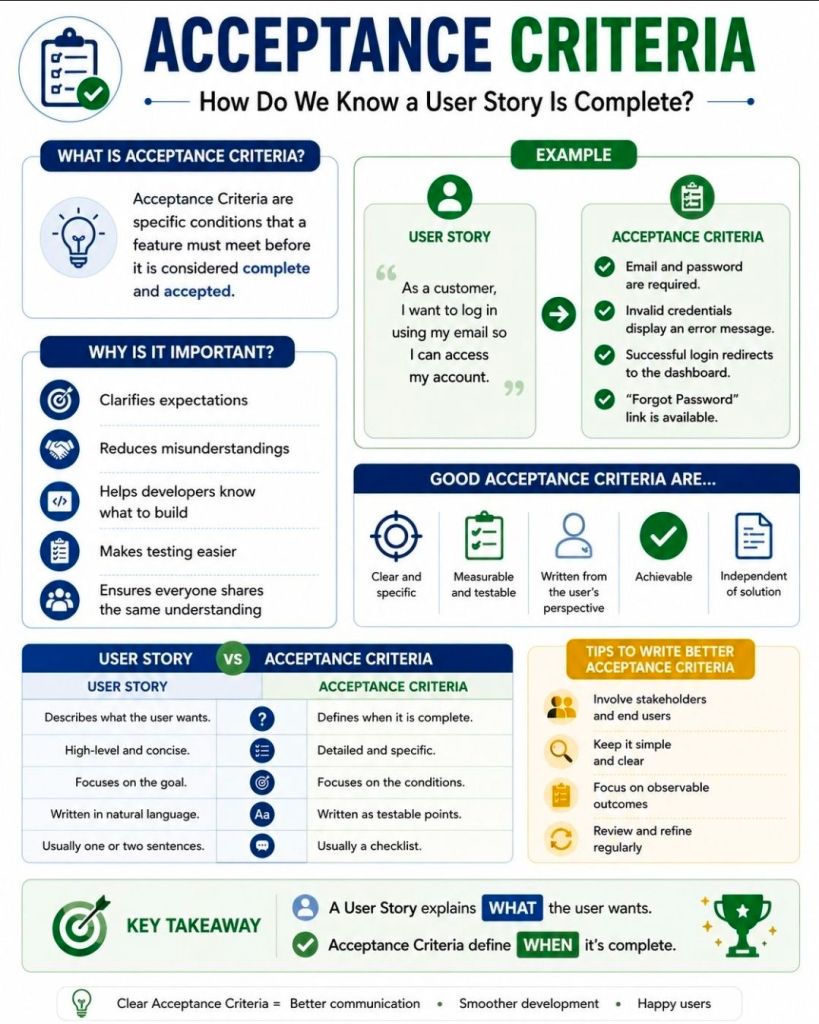
  • User Stories over BRDs: Traditional Business Requirements Documents (BRDs) are replaced with collaborative user stories and acceptance criteria.
  • Value-Driven Prioritization: The BA continuously helps the Product Owner (or acts as the Product Owner proxy) rank the Product Backlog so that the highest-value features are built first.
  • Shared Understanding: The focus is on face-to-face communication, workshops, and visual modeling (like wireframes) to ensure developers fully grasp what needs to be built.

Key Responsibilities

Agile BAs operate across several domains throughout the sprint lifecycle:

  1. Backlog Refinement: Collaborating with stakeholders to break down large, complex requirements into smaller, manageable chunks (Epics to User Stories).
  2. Definition of Ready (DoR): Ensuring that user stories are clear, testable, and have defined acceptance criteria before they are pulled into an active sprint.
  3. Sprint Support: Answering questions from the development team in real-time, clarifying business rules, and helping to remove blockers.
  4. Acceptance Testing: Assisting Quality Assurance (QA) teams or business users to validate that the delivered software works as intended and solves the underlying business problem.
Agile BA versus Traditional BA

Common Frameworks for Agile BAs

  • Scrum: Working alongside the Scrum Master, Product Owner, and Developers in short iterations (sprints), typically lasting 2 to 4 weeks.
  • Kanban: Managing a continuous flow of analysis work, prioritizing items on a visual board as development capacity allows.
  • AgileBA: A specific certification and framework designed by the Agile Business Consortium that provides BAs with practical tools for working in Agile settings.

Recommended Resources for Skill Building

To deepen your expertise in Agile business analysis, explore these highly regarded methodologies and guides:

  • Use the AgileBA Certification guide to understand official best practices.
  • Read the IIBA Agile Extension to the BABOK Guide for authoritative frameworks.
  • Review Bridging the Gap for practical, real-world implementation strategies.

Agile Scrum vs SAFe (Scaled Agile Framework), Key Differences

Agile Scrum vs SAFe (Scaled Agile Framework), Key Differences
Agile Scrum vs Scaled Agile Framework (SAFe)

The fundamental difference is scale: Agile Scrum is designed for a single, autonomous team (typically 5–9 people), whereas Scaled Agile Framework (SAFe) is built for the enterprise level to coordinate dozens of teams (50+ people) working toward shared business goals.

Scrum prioritizes team flexibility and speed. Conversely, SAFe trades complete autonomy for centralized alignment, consistency, and structural predictability.

Industry Perspectives on the Trade-offs

While SAFe solves enterprise synchronization challenges, it faces regular scrutiny from product leaders who argue that its highly prescriptive nature can stifle the true spirit of agility.

A popular comment from an agile practitioner on Reddit’s Scrum Community highlights the developer sentiment regarding the process overhead:

“I’ve never seen SAFe implemented without a meeting explosion. More planning, more roles, more acronyms and way more time blocked on calendars.”

Another developer shared a similar perspective on Reddit’s ExperiencedDevs Community:

“Number of meetings have increased 4x. More time is spent for planning to build software than actually building software. Bureaucratic rituals are more important than getting things done.”

Ultimately, SAFe does not replace Scrum. Most organizations implementing SAFe still utilize standard Scrum practices at the team level, leveraging the macro framework solely to manage the dependencies that threaten to derail massive initiatives.


Choosing the Right Approach

  • Choose Scrum if: You have a small or mid-sized setup, your teams operate independently, you are early in your Agile journey, and your primary pain point is a need for fast market-feedback loops.
  • Choose SAFe if: You are coordinating 50 to 1,000+ engineers across complex legacy systems, cross-team dependencies frequently delay your releases, and you need strict regulatory compliance or top-down executive alignment.

PRINCE2 and Waterfall, an Overview and Comparison

PRINCE2 is a structured project management framework, whereas Waterfall is a linear-sequential software development lifecycle (SDLC) methodology. While people often compare them, they are not mutually exclusive. PRINCE2 tells you how to manage a project, while Waterfall defines how to build the product.

PRINCE2 & Waterfall Overview and Comparison
PRINCE2 & Waterfall –
Overview and Comparison

Here is a detailed overview and comparison of both.


Overview of PRINCE2

PRINCE2 (PRojects IN Controlled Environments) is a process-based method for effective project management. It provides a highly structured framework that focuses on business justification and clear roles.

  • Core Logic: Divided into 7 Principles, 7 Themes, and 7 Processes.
  • Structure: Focuses on high-level management, governance, and organization.
  • Flexibility: Product-based planning allows it to wrap around any delivery method.
  • Roles: Explicitly defines responsibilities (Project Board, Project Manager, Team Manager).

Overview of Waterfall

Waterfall is a traditional development methodology where a project moves sequentially through distinct phases. Each phase must be completed before the next one begins.

  • Core Logic: Requirements → Design → Implementation → Verification → Maintenance.
  • Structure: Linear, rigid, and heavily reliant on early stage documentation.
  • Flexibility: Extremely low; changes to requirements are costly once development begins.
  • Roles: Focuses on execution roles (Business Analysts, Developers, QA Testers).

Key Structural Differences

PRINCE2 and Waterfall, an Overview and Comparison

How They Work Together

PRINCE2 is frequently used to govern Waterfall projects.

  • The Management Layer: The Project Board uses PRINCE2 to manage budgets, risks, and business justification.
  • The Specialist Layer: The technical team uses Waterfall to execute work packages (e.g., designing, coding, testing).

Which One Should You Choose?

  • Choose PRINCE2 if: You need robust corporate governance, clear stakeholder accountability, and a way to manage high-budget, high-risk projects.
  • Choose Waterfall if: Your product requirements are completely fixed, the technology is well-understood, and the physical architecture cannot be easily changed (e.g., construction).

Types of Agile Delivery in Project Management

Types of Agile Delivery in Project Management

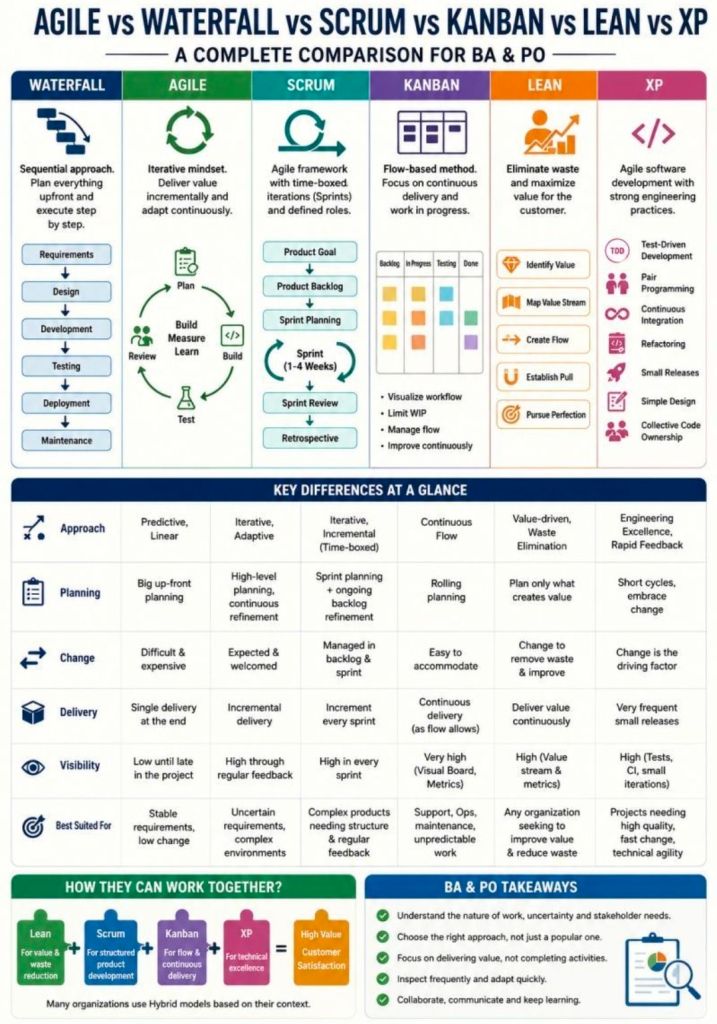
Agile delivery is an iterative approach to project management that focuses on delivering value early, frequently adapting to change, and maintaining continuous customer feedback. Rather than executing a project sequentially, teams break work into small increments to maximize flexibility and product quality.

The most common types and frameworks of agile delivery include the following structured methodologies:

1. Scrum

Scrum is the most widely used agile framework, characterized by highly structured, time-boxed iterations called Sprints (typically 1 to 4 weeks long).

  • Key Concept: Teams work toward a single, actionable goal during each sprint.
  • Key Roles: Product Owner (represents the customer), Scrum Master (removes obstacles and enforces the framework), and Developers.
  • Best For: Projects where requirements change frequently and close collaboration with clients is required.

2. Kanban

Kanban is a visual workflow management system that emphasizes continuous delivery and transparency without strict time-boxed iterations.

  • Key Concept: Work is tracked on a Kanban board divided into columns (e.g., “To Do,” “In Progress,” “Done”).
  • Key Roles: Self-organizing teams with a pull-based approach.
  • Best For: Operational workflows, support/maintenance teams, and organizations that need to limit “work in progress” (WIP) to prevent bottlenecks.

3. Lean Software Development

Adapted from Toyota’s lean manufacturing principles, Lean focuses on maximizing customer value while minimizing waste.

  • Key Concept: Focuses on “eliminating waste” (anything that doesn’t add value to the end user), amplifying learning, and delivering as fast as possible.
  • Best For: Optimizing overall organizational workflows and reducing overhead.

4. Extreme Programming (XP)

XP focuses heavily on technical excellence and software engineering practices to boost product quality and responsiveness.

  • Key Concept: Uses practices like pair programming, test-driven development (TDD), and continuous integration.
  • Best For: Development teams that need to release updates frequently while maintaining strict quality and low bug rates.

5. Feature-Driven Development (FDD)

FDD is a model-driven approach that is highly structured and focuses on building software in short, feature-by-feature iterations.

  • Key Concept: Work revolves around creating detailed software models and planning by specific features, which are built one by one.
  • Best For: Teams that prefer structured, step-by-step processes or environments with traditional hierarchical structures.

6. Scaled Agile Framework (SAFe)

SAFe is designed for larger enterprises that need to align cross-functional, multiple Agile teams toward a single business strategy.

  • Key Concept: Blends Lean, Agile, and DevOps principles to coordinate alignment, governance, and delivery across a massive scale.
  • Best For: Large organizations and complex projects requiring multiple teams to coordinate efforts.

For further implementation details, you can refer to comprehensive resources like the Atlassian Agile Project Management Guide or the ICAgile Types of Agile Methodology Overview.

Agile Delivery Journey from Requirements to Release

Agile Delivery Journey from Requirements to Release

Agile Scrum Master Misconceptions versus Reality

Agile Scrum Master Misconceptions versus Reality