PRINCE2 – PRojects IN Controlled Environments – Timeline

PRINCE2 (PRojects IN Controlled Environments) has evolved from a rigid, IT-specific framework into a globally recognised, flexible project management standard. 

Historical Evolution Timeline

  • 1975: PROMPT Origins – Simpact Systems Ltd developed PROMPT (Project Resource Organisation Management and Planning Techniques) to address IT project overruns.
  • 1989: The Birth of PRINCE – The UK’s Central Computer and Telecommunications Agency (CCTA) licensed PROMPT, renaming it PRINCE (originally “PROMPT II IN the CCTA Environment”).
  • 1996: PRINCE2 Launch – Developed with input from 150 European organisations, PRINCE2 was released as a generic, scalable framework suitable for any industry.
  • 2000–2013: Ownership Shifts – Ownership moved from the CCTA to the Office of Government Commerce (OGC) in 2000, then to AXELOS Ltd (a joint venture) in 2013.
  • 2009: Major “Refresh” – Introduced the seven core principles and made the method more customisable.
  • 2017: 6th Edition Update – Formerly known as the “2017 Update,” this version focused heavily on scalability and tailoring to specific project needs.
  • 2021–Present: PeopleCert Era – PeopleCert acquired AXELOS in 2021. In 2023, PRINCE2 7 was launched, introducing a greater emphasis on people management and sustainability. 

Comprehensive Project Timeline Breakdown

A standard PRINCE2 project follows a lifecycle defined by seven processes

  1. Pre-Project: Starting up a Project (SU)
    • Ensures the project is viable and worthwhile.
    • Key Output: Project Brief.
  2. Initiation: Initiating a Project (IP)
  3. High-Level Oversight: Directing a Project (DP)
    • An ongoing process where the Project Board provides guidance and makes key decisions without managing day-to-day tasks.
  4. Day-to-Day Management: Controlling a Stage (CS)
    • The Project Manager monitors work, manages risks, and reports progress for each individual stage.
  5. Technical Delivery: Managing Product Delivery (MP)
    • The Team Manager ensures products (deliverables) are created, tested, and handed over according to specifications.
  6. Transition: Managing a Stage Boundary (SB)
  7. Finalisation: Closing a Project (CP)
    • The formal decommissioning of the project, ensuring all products are accepted and lessons are documented. 

PRINCE2 – PRojects IN Controlled Environments

Mark Whitfield IT Career Timeline, AI generated from Google

The technical timeline for 

Mark Whitfield, an SC cleared, Senior IT Project Manager and Engagement Manager, spans over 30 years and transitions from specialized banking software development to high-level project leadership and cloud migrations. 

Professional Career Timeline

  • 1990 – 1994: Programmer at The Software Partnership (later Deluxe Data). Developed electronic banking software (sp/ARCHITECT-BANK) on Tandem Computers (now HPE NonStop) for major banks like TSB and Bank of Scotland.
  • 1994 – 1995: Lead Analyst at Deluxe Data International, continuing support and development for banking customer systems.
  • 1995 – 2013: Project Manager of Strategic Technical Initiatives at Insider Technologies Limited. Oversaw projects involving Reflex 80:20, Sentra development, and corporate website authoring.
  • 2013 – 2014: Project Manager (Banking Division) at Wincor Nixdorf Limited, focusing on professional services for the banking sector.
  • 2014 – 2016: Senior Digital Project Manager at Betfred Limited, managing the Online and Mobile Division.
  • 2016 – Present:Engagement Manager / Senior PM at Capgemini UK.
    • 2016: Led a £4.3M data centre migration for Royal Mail (RMG) involving 1,100+ interfaces.
    • 2018 – 2019: Augmented into MuleSoft as a Delivery Manager for the Anypoint Platform.
    • 2020 – Present: Leading a £13.5M cloud migration program moving 130 UK government apps to Azure and AWS. 

Technical Training & Education

Whitfield maintains an active Professional Training timeline to adapt to changing technologies:

  • 1990: Graduated in Computing.
  • 1995: HP NonStop TAL Programming and Performance Tuning.
  • 1997: C/C++ Programming at Comtec.
  • 2006 – 2009: Deep dive into security and databases, including Cryptography, Thales e-Security, and Microsoft SQL 2000.
  • 2011: Java and Google Android programming using Eclipse IDE.
  • 2014 – 2024: Advanced Microsoft Excel and AI-focused refreshers. 

He is also a Certified Engagement Manager and a registered PRINCE2 Practitioner proficient in both Agile Scrum and Waterfall methodologies.

Capgemini’s evolution from a small French startup to a global IT leader

Capgemini’s evolution from a small French startup to a global IT leader is marked by strategic mergers and a shift toward high-growth technologies like AI. 

Corporate History Timeline

  • 1967: Serge Kampf founded Sogeti in Grenoble, France, focusing on enterprise management and data processing.
  • 1973–1975: Through hostile takeovers and mergers with CAP and Gemini Computer Systems, the group became CAP Gemini Sogeti.
  • 1985–1988: The company was listed on the Paris Stock Exchange (1985) and entered the CAC 40 index (1988).
  • 1996: The name was simplified to Cap Gemini, and a new logo was launched.
  • 2000: Acquired Ernst & Young Consulting for $11 billion, expanding its global reach, especially in North America.
  • 2004: The brand officially became Capgemini to reflect a unified global identity.
  • 2015: Acquired iGate for $4 billion, making North America its largest market.
  • 2019–2021: Acquired Altran (2019), later rebranded as Capgemini Engineering (2021), to dominate the engineering and R&D services sector.
  • 2024–2025: The strategic focus shifted to AI. In July 2025, Capgemini announced a €3.3 billion deal to acquire WNS Global Services to bolster its agentic AI and intelligent operations. 

Recruitment & Career Timelines

The hiring process typically follows this path:

  • Hiring Process: Usually takes a few weeks, involving application screening, multiple interview rounds (technical and HR), and background verification.
  • Graduate/Mass Hiring: Often conducted via the Superset platform, where status updates like “offered” appear roughly a week after interviews.
  • Graduate Programme: The Accelerate Programme (UK) spans approximately 21 months, starting with a 3-month business overview followed by 18 months in a specific pathway academy.
My own Capgemini career path 2016 – 2025
C&CA UK’s Communications & Engagement Award Winner 2022 – Cloud & Custom Applications – Capgemini UK
Campus – Serge Kampf Les Fontaines, Chantilly, France – Advanced EM Course – November 2017 Class – 2nd from left
November 2017 – Advanced Engagement Management Course – Level 2 Exam

Capgemini’s evolution from a small French startup to a global IT leader

Project Management Terms Explained Overview

Project Management Terms Explained Overview

Acronyms in Project Management, Waterfall and Agile

Acronyms in Project Management, Waterfall and Agile

Traditional Project Management vs Agile Management

Traditional Project Management vs Agile Management

Scrum Framework, the Heart of the Agile Methodology

Scrum Framework, the Heart of the Agile Methodology

Capacity Planning in Agile Scrum

Capacity Planning in Agile Scrum

Agile User Story Definition of Done DoD

Agile User Story Definition of Done DoD

Why Projects Fail

Why Projects Fail

A Successful Project Plan Approach includes

A Successful Project Plan Approach includes

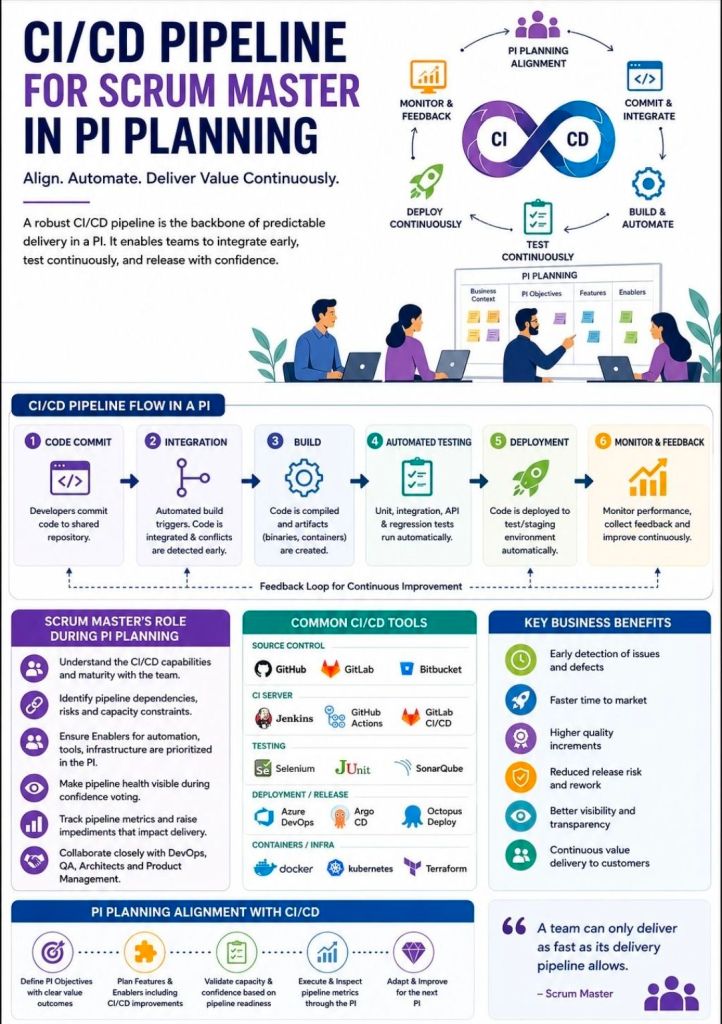
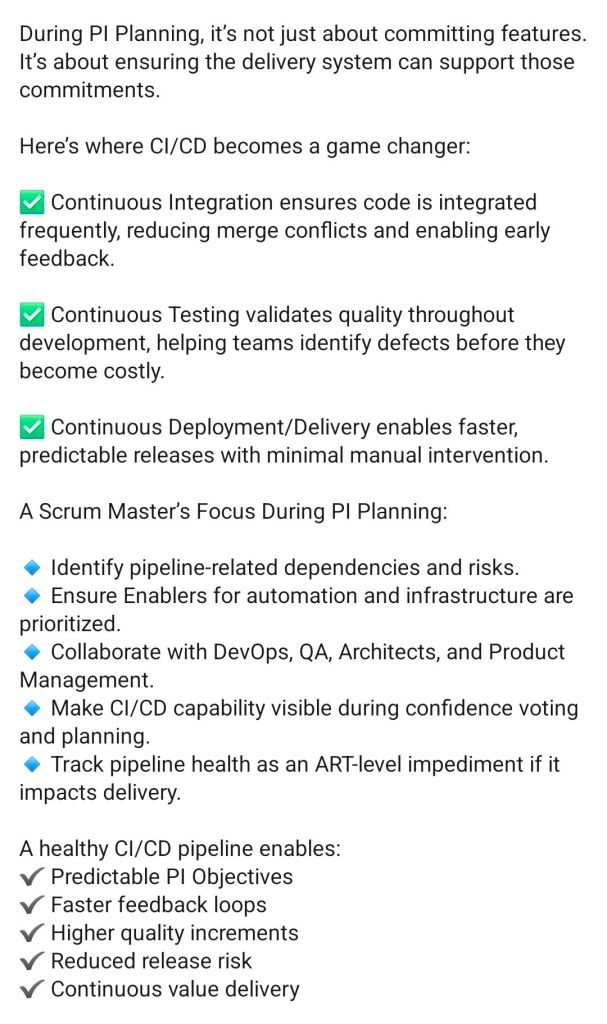
Agile Development – Continuous Integration CI, Continuous Delivery/Deployment CD

Agile Development – Continuous Integration CI, Continuous Delivery/Deployment CD

Project Management Soft Skills Overview

Project Management Soft Skills Overview

PRINCE2 7 Process Model, 2026 – 7th Edition

In 2026, the PRINCE2 7 (7th Edition) remains the current global standard for the methodology. The core diagram, known as the PRINCE2 Process Modelillustrates how the 7 processes interact across the four management levels: Corporate, Direction, Management, and Delivery

The PRINCE2 7 Process Model

The diagram typically visualises the project lifecycle from a “Project Mandate” to “Project Closure” through these processes: 

  • Starting Up a Project (SU): The pre-project process where a mandate is converted into a project brief.
  • Directing a Project (DP): The Project Board’s high-level oversight, running from project start to finish.
  • Initiating a Project (IP): Establishing firm foundations, including the Project Initiation Documentation (PID) and the Business Case.
  • Controlling a Stage (CS): The daily management of a stage by the Project Manager.
  • Managing Product Delivery (MP): The link between the Project Manager and Team Managers to ensure products are built.
  • Managing a Stage Boundary (SB): Occurs at the end of each management stage to plan the next one and review the current.
  • Closing a Project (CP): The final process for a formal decommissioning of the project. 
PRINCE2 7 Process Model, 2026 – 7th Edition

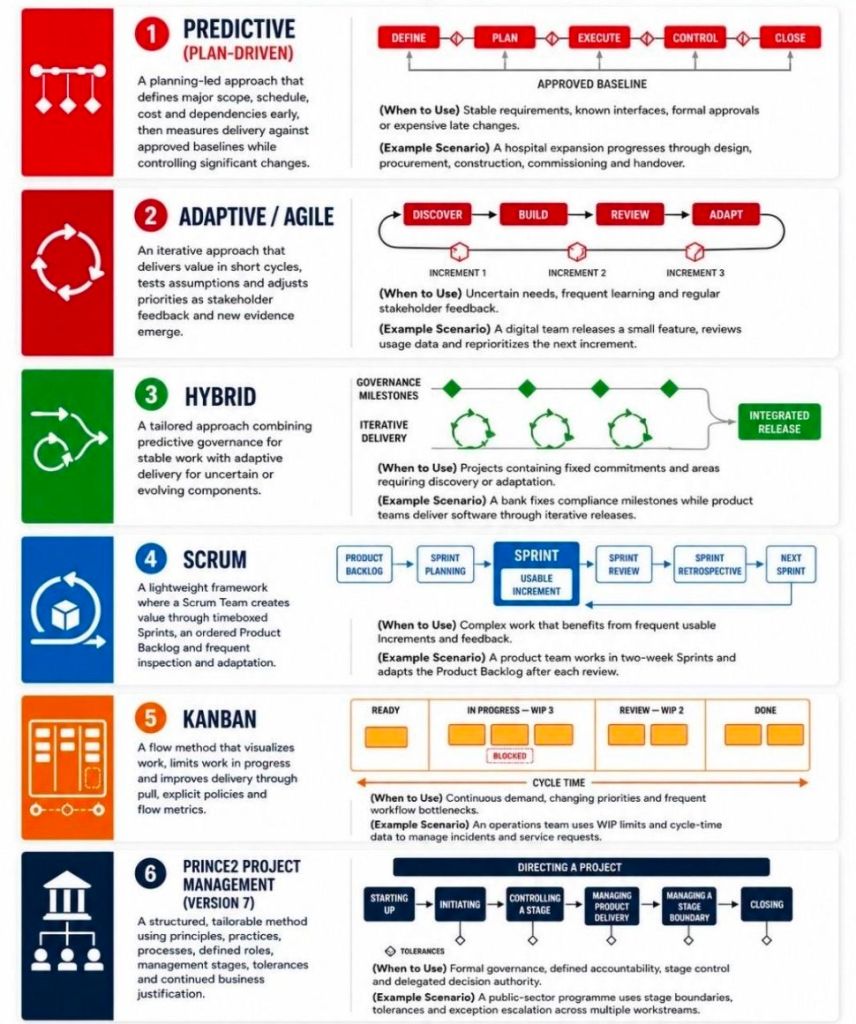
Project Management Types Summarised, Overview

Project Management Types Summarised, Overview