

Here is the high-level summary of Capgemini and Professional training received by Senior IT Project / Engagement Manager Mark Whitfield.
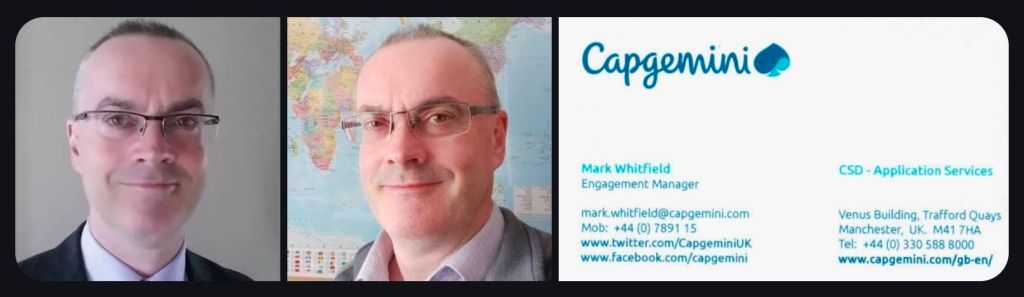
Mark Whitfield, High-Level Training
Summary from 1990 thru 2026
The courses are aggregated and categorized from his official PROject Templates Professional Training Records and Certificates Portfolio.
☁️ Cloud & Infrastructure Technologies
- AZ-900 Microsoft Certified Azure Fundamentals Course (Feb 2022): Complete foundational validation of Microsoft Azure cloud concepts, core services, security, privacy, compliance, and architectural structures.
- MuleSoft Anypoint Platform Ecosystem Deployments: Direct continuous delivery, API lifecycle design, and microservices architecture training mapping to corporate cloud-refactoring framework targets.
- Developing MS ASP.NET Web Applications using MS Visual Studio.Net (Jan 2007): Practical design framework for building web architectures, server controls, dynamic application data-mapping, and platform services.
- Querying Microsoft SQL 2000 with Transact-SQL – M2071 (Mar 2009): Database query execution, advanced data extraction, transaction architecture, and pipeline data structures.
🛠️ Agile, Project Management & Framework Governance
- Advanced Engagement Management – Level 2 Certification (Nov 2017): High-tier corporate Capgemini certification focused on managing multi-million pound digital transformations, complex off-shore delivery models, financial structures, and target risk containment.
- PRINCE2 Foundation & Registered Practitioner – ILX Group (May 2011): Complete verification of Waterfall governance frameworks, encompassing structured lifecycle controls, change exceptions, and Project Governance Plans (PGPs).
- Agile Training – Scrum Course – RADTAC (May 2011): Immersive framework training covering sprint planning mechanics, scrum master roles, burndown metrics, and high-frequency agile delivery loops.
- ITIL Foundation Course – e-Learning (Jan 2012): System infrastructure training focused on IT service design, continuous availability management, incident recovery models, and standard operational workflows.
- UPM (Unified Project Management) – Module 1 Overview: Mandatory project alignment training covering structural delivery baselines, regional quality management compliance, and delivery tracking toolsets.
- Transition Webinar – Global Transition Method 4.1: Deep-dive session targeting the architecture of the 4.1 method blueprint for re-hosting, shifting, and hand-over workflows.
- USM Module 2 – Transition Handover-In Phase: Comprehensive operational training detailing handover-in protocols, stream dependencies, and high-risk phase deliverables.
- RapidStart Framework Training: Focuses on continuous implementation metrics, critical risk mitigation during system handoffs, and stakeholder alignment strategies.
- Microsoft Project Orange Belt Series (May 2000): Structural tool mapping for tracking individual project components, schedule baselines, and cross-functional work dependencies.
- Fundamentals of Successful Project Management (Feb 2000): Baseline professional training encompassing requirements definition, operational baseline design, and constraint mapping.
- Managing Multiple Projects, Objectives and Deadlines (Oct 1999): High-capacity workload optimization training targeting critical path analysis across complex parallel timelines.
🔒 Risk, Compliance, Cybersecurity & Corporate Strategy
- Cybersecurity Essentials – Modules 3, 4 & 5: Comprehensive workspace protection training covering data classification levels, strict remote storage boundaries, visual/digital asset containment, and active incident response frameworks.
- Intellectual Property Rights (IPR): Legal compliance overview identifying workplace regulations regarding trademarks, patents, software licensing rules, and patent infringement avoidance.
- Group Anti-Corruption Training: Compliance course detailing the Capgemini Group Anti-Corruption Policy, legal indicators, anti-bribery measures, and corporate ethical behavior.
- LEAD – Unified-Go-To-Market (UGTM) & Portfolio Learning: Structural mapping of business focus capabilities, specific application practices, and cross-organizational service offerings.
- Pinnacle Corporate Limited: Resilience & Peak Performance (Nov 2019): Corporate leadership development detailing stress containment, high-impact workplace dynamics, and team delivery under extreme pressure.
💻 Legacy Architecture & High-Performance Engineering
- HP NonStop TANDEM TAL Programming Course (Dec 1995): Low-level transaction programming logic, algorithm design, and microcode interaction for business-critical processing platforms.
- TANDEM Performance Analysis and Tuning (Jun 1995): Legacy mainframe systems diagnostic optimization targeting structural bottleneck elimination and thread processing enhancement.
- TANDEM Guardian Principles Course (May 1993): Foundational training on file system control layers, kernel-level execution boundaries, and fault-tolerant computing architectures.
- C++ for Non-C Programmers (Mar 1997): Object-oriented development foundations detailing code compilation, structural memory containment, and type logic.
- VPS 7000/9000 Series Application Development – VOS 4.3 (Sep 1994): Production system software development mapping, transactional tracking, and framework deployments.
📊 Business Analytics, Content Strategy & Design
- Microsoft Excel Refresher & Expert Skills (Apr 2017 / Jul 2024): Advanced workbook orchestration covering logical formatting models, cross-sheet data lookups, pivot table structures, and programmatic macro scripts.
- Writing for the Web – iTrain Education (May 2009): Digital formatting rules for creating targeted structural content, maximizing text scannability, and aligning online resources.
- Website Promotion and Visibility by Design (May 2009): Applied search discoverability design targeting information architecture, logical metadata design, and structural search indexing properties.
- Designing Attention-Grabbing Media (Apr 2006): Technical graphic composition focusing on report scannability, informational design systems, and visually cohesive layouts.

