Gantt Chart Detailed Timeline History by Era and Year

Henry Gantt (1861–1919) was an American mechanical engineer and management consultant who revolutionized project management by introducing visual tools to track work against time. A close associate of Frederick Taylor, he humanized “scientific management” by focusing on employee motivation and social responsibility alongside industrial efficiency. 

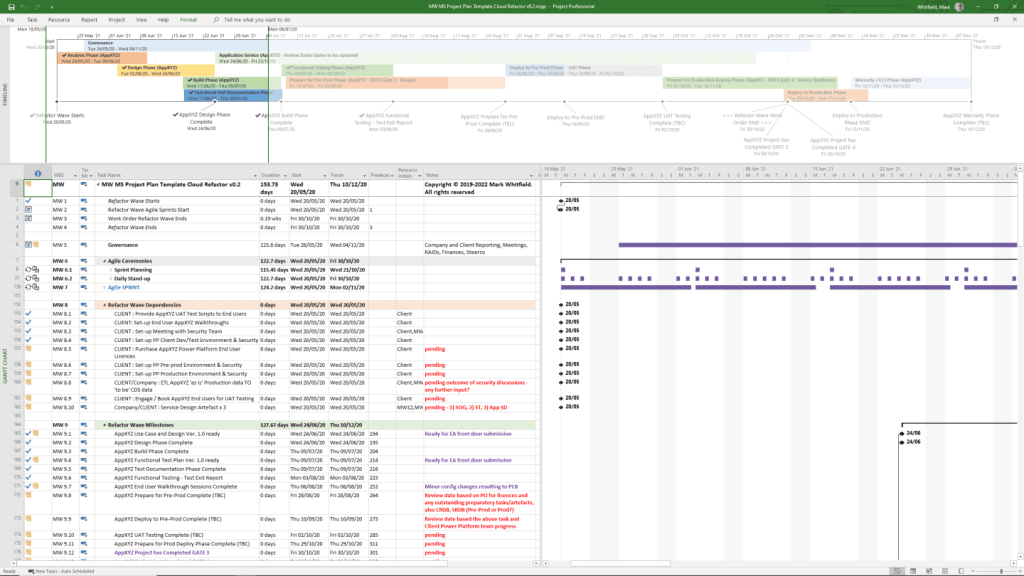
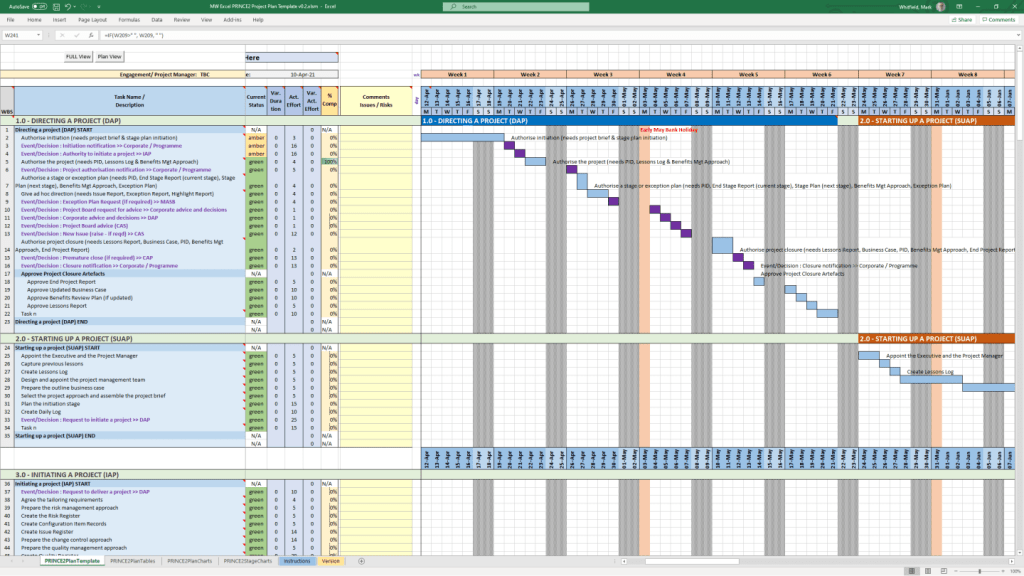
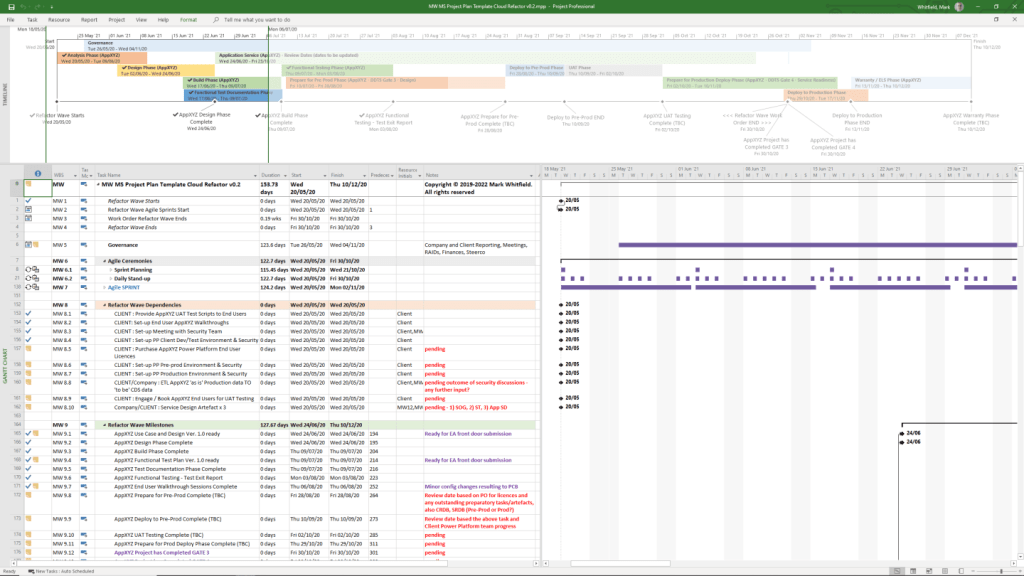
Gantt Chart in MS Project, templates can be downloaded at website banner link

Overview of Henry Gantt’s Contributions

  • The Gantt Chart: His most famous invention, a horizontal bar chart that illustrates a project schedule, including task durations and progress.
  • Task and Bonus System: A wage system that guaranteed a base rate but offered bonuses to workers who exceeded daily production goals.
  • Social Responsibility: He argued that businesses have a moral obligation to the welfare of the society in which they operate, not just to their owners.
  • Industrial Efficiency: He advocated for using scientific analysis to eliminate “chance and accidents” in manufacturing. 

Comprehensive Gantt Timeline History

Era 1: Pre-Gantt & Early Origins (1765–1896)

  • 1765: Joseph Priestley creates early timeline charts, which some consider the conceptual distant ancestors of the Gantt chart.
  • 1896: Polish engineer Karol Adamiecki develops the “Harmonogram,” a precursor that displayed interdependent processes. However, he published it only in Polish and Russian, limiting its global recognition. 

Era 2: The Henry Gantt Era (1903–1919)

  • 1903: Henry Gantt develops his first version of a production chart for the American Locomotive Company.
  • 1910–1915: Gantt refines and popularizes his chart through articles and his book Work, Wages and Profits (1910).
  • 1917–1918: At the request of General William Crozier, Gantt charts are used to manage massive military production for the U.S. during World War I.
  • 1919: Henry Gantt passes away. 

Era 3: Global Adoption & Infrastructure (1920s–1970s) 

  • 1922: Wallace Clark, a colleague of Gantt, publishes The Gantt Chart: A Working Tool of Management, leading to international adoption.
  • 1929: Walter Polakov introduces Gantt charts to the Soviet Union for their First Five Year Plan.
  • 1931–1936: Gantt charts are used on massive infrastructure projects like the Hoover Dam and later the U.S. Interstate highway system.
  • 1940s: Extensively used for logistics and military project management during World War II.
  • 1950s: Become a staple in the construction and engineering industries; the first digital predecessors like PERT and Critical Path Method (CPM) emerge. 

Era 4: The Digital Revolution (1980s–Present) 

  • 1980s: The advent of personal computers allows project managers to create and update charts without redrawing them by hand.
  • 1990s: Software like Microsoft Project adds “link lines” to display complex dependencies between tasks.
  • 2000s–2010s: Web-based and cloud-based applications (like Jira or Asana) integrate Gantt charts for real-time team collaboration.
  • Present: Modern tools use AI to automate chart maintenance and predict risks based on historical data.

Gantt Chart Detailed Timeline History by Era and Year

Research Machines Limited, Link Timeline History by Era and Device

Research Machines (now RM plc) has a long-standing history as a primary provider of technology for the UK education sector. Founded in 1973, the company transitioned from a hobbyist component supplier to a leading manufacturer of educational microcomputers and networking systems. 

Overview of Research Machines “LINK”

The LINK designation primarily referred to the RM Link 480Z, introduced in 1982. It was designed as a lower-cost, diskless network station that could “link” into a chain, typically using a more powerful 380Z as a file server. This system was one of three chosen for the UK government’s 1982 Educational Scheme. 


Timeline History by Era and Device

The Founding Era (1973–1976)

  • 1973: Founded as Research Machines Limited in Oxford by Mike Fischer and Mike O’Regan.
  • 1974: Operated under the name Sintel, a mail-order supplier of electronic components for hobbyists. 

The Z80 Era (1977–1984)

  • 1977: Launched the RML 380Z, an 8-bit microcomputer based on the Zilog Z80 processor. It typically ran the CP/M operating system and was often housed in a distinctive large black metal case.
  • 1982: Introduced the RM Link 480Z.
    • Purpose: Designed as a diskless network node for schools.
    • Networking: Used the proprietary CHAIN Network or Z-Net to connect to a 380Z file server.
    • Hardware: Featured a Z80 CPU and up to 256 KB of bank-switched RAM. Early models had black metal cases, later replaced by cream plastic. 

The Nimbus & PC Transition (1985–1990s) 

  • 1985: Launched the RM Nimbus PC-186, using the Intel 80186 processor. While not fully IBM-compatible, it could run early versions of Microsoft Windows (up to 3.0).
  • 1986: Released the RM AX (using the Intel 80286), often used as a file server for Nimbus networks.
  • Late 1980s: Introduced the M Series (PC-286/386) and S Series (PC-386 and later), which were fully IBM PC compatible. 

The PC Era & Diversification (1994–Present)

  • 1994: Floated on the London Stock Exchange as RM plc.
  • 1997: Introduced the C Series of computers for schools.
  • 2003: Launched the F Series (blue chassis) pre-installed with Windows XP.
  • 2010: Released a new line of black and silver RM computers for Windows 7.
  • Current: RM has pivoted from hardware manufacturing to becoming a global EdTech solutions provider, focusing on digital assessment (RM Ava) and managed IT services.

Research Machines Limited, Link Timeline History by Era and Device

Budgeting vs Forecasting, Financial Concepts overview

Budgeting vs Forecasting, Financial Concepts overview

Project Management and Cost Control

Project Management and Cost Control

Rational Unified Process RUP Overview and Timeline History

The Rational Unified Process (RUP) timeline is a two-dimensional framework where the horizontal axis represents time (divided into phases and iterations) and the vertical axis represents work/activities (divided into disciplines)

Rational Unified Process, RUP

The process is structured into four sequential phases, each culminating in a major milestone where the project’s progress is assessed before moving forward. 

RUP Phases, Iterations and Workflows

RUP Project Phases and Milestones

Each phase of the RUP lifecycle has a specific objective and a corresponding milestone. 

  • Inception Phase
    • Goal: Define project scope, identify business risks, and establish the Business Case.
    • MilestoneLifecycle Objective Milestone – Stakeholders agree on scope and cost/schedule estimates.
  • Elaboration Phase
    • Goal: Analyze requirements in detail and design a stable Software Architecture.
    • MilestoneLifecycle Architecture Milestone – The architecture is validated and major risks are mitigated.
  • Construction Phase
    • Goal: Build the software system by developing and testing all components and features.
    • MilestoneInitial Operational Capability Milestone – A product is ready for beta testing by users.
  • Transition Phase
    • Goal: Deploy the software to the end users and perform final Beta Testing and training.
    • MilestoneProduct Release Milestone – The development cycle is finished and the product is formally accepted. 

Detailed Iteration Timeline

Within each phase, work is performed in iterations (typically lasting 2 to 6 weeks). Each iteration is a mini-lifecycle that includes: 

  1. Requirements Analysis: Refining what needs to be built.
  2. Design: Modeling the system architecture and components.
  3. Implementation: Writing the code for specific features.
  4. Testing: Verifying the quality of the iteration’s output.
  5. Assessment: Evaluating the iteration against its planned goals. 

Historical Development Timeline

  • 1988Objectory AB defines the core process.
  • 1995: Rational Software Corporation acquires Objectory.
  • 1998: RUP 5.0 is released, introducing UML integration.
  • 2003: IBM acquires Rational Software.
  • 2012: RUP is largely succeeded by Disciplined Agile Delivery (DAD) and SAFe.

Rational Unified Process RUP Overview and Timeline History

A Practical Guide to the Rational Unified Process RUP

Setting up effective meetings

Setting up effective meetings

ISO 9001 Quality Assurance Detailed Timeline History by year

ISO 9001 is founded on seven core Quality Management Principles (QMPs) designed to guide organisations toward improved performance and consistent quality. Its history is a progression from rigid, procedure-heavy military-style standards to flexible, risk-based management systems. 

Core Principles of ISO 9001:2015

These seven principles form the foundation of the current standard: 

  • Customer Focus: Meeting and exceeding customer expectations is the primary focus to drive loyalty and revenue.
  • Leadership: Leaders at all levels establish unity of purpose and direction, creating an environment where people are engaged.
  • Engagement of People: Competent, empowered, and engaged people across all levels are essential to enhance the organisation’s value.
  • Process Approach: Understanding activities as interrelated processes that function as a coherent system leads to more predictable results.
  • Improvement: A permanent objective of every successful organisation is the continual improvement of its performance.
  • Evidence-based Decision Making: Decisions based on the analysis and evaluation of data are more likely to produce desired results.
  • Relationship Management: Managing relationships with interested parties, such as suppliers and partners, optimizes their impact on performance. 

Detailed Timeline History

The evolution of ISO 9001 can be categorised into four distinct eras: 

1. The Pre-ISO Foundations (1950s – 1986)

  • 1959: US and UK military departments establish MIL-SPECS for procurement.
  • 1969NATO AQAP standards are introduced for defense industry mutual recognition.
  • 1971: The British Standards Institution (BSI) releases BS 9000 for the electronics industry.
  • 1979BS 5750 is published in the UK, becoming the first general-purpose quality management standard for industry. 

2. The Procedural & Quality Assurance Era (1987 – 1999)

  • 1987 (ISO 9001:1987): First international publication. Focused on quality assurance through procedural controls and final product inspections. Three models existed: 9001 (Design/Production), 9002 (Production), and 9003 (Inspection).
  • 1994 (ISO 9001:1994): First revision. Shifted focus toward preventative actions rather than just checking finished products. However, it remained “document-heavy,” often leading to excessive bureaucracy. 

3. The Process Management Era (2000 – 2014)

  • 2000 (ISO 9001:2000): A major overhaul. Consolidated ISO 9001, 9002, and 9003 into a single standard. Introduced the Process Approach and the original eight Quality Management Principles.
  • 2008 (ISO 9001:2008): A minor update focusing on clarification and consistency with other standards like ISO 14001 (Environment). No new requirements were added. 

4. The Risk-Based & Strategy Era (2015 – Present)

  • 2015 (ISO 9001:2015): Introduced Risk-Based Thinking and the High-Level Structure (HLS) to ease integration with other management systems. It reduced prescriptive documentation requirements, focusing instead on organisational context and leadership accountability.
  • 2026 (Upcoming): The next major revision is currently under development (target: September 2026), expected to address digitalisation, sustainability (ESG), and climate change.

ISO 9001 Quality Assurance Detailed Timeline History by year

GDPR General Data Protection Regulation timeline history by year

The history of the General Data Protection Regulation (GDPR) spans several decades, evolving from early privacy concepts to a globally adopted gold standard for data protection. 

The Early Era: Foundations of Privacy (1890–1990) 

  • 1890: The “Right to Privacy” concept is first articulated in the USA by Warren and Brandeis.
  • 1950: The European Convention on Human Rights is established, protecting the right to respect for private and family life.
  • 1970: The German state of Hesse passes the world’s first data protection law.
  • 1973: Sweden enacts the first national Data Protection Act.
  • 1980: The OECD issues privacy principles to harmonise international data flows.
  • 1981Convention 108 is signed, becoming the first legally binding international treaty for data protection. 

The Directive Era: Pre-Internet Regulation (1995–2011) 

  • 1995: The EU adopts the Data Protection Directive (95/46/EC), setting minimum standards for member states.
  • 1998: The UK implements the directive through the Data Protection Act 1998.
  • 2000Safe Harbour Principles are developed to facilitate EU-US data transfers.
  • 2009: The European Commission launches a public consultation on data protection reform. 

The Development Era: Crafting the GDPR (2012–2015) 

  • 2012: The European Commission releases the first proposal for the GDPR.
  • 2014: The European Parliament votes overwhelmingly in favour of the draft regulation (621 to 10).
  • 2015: Formal “Trilogue” negotiations between the Parliament, Council, and Commission reach a final agreement.
  • 2015 (Oct): The European Court of Justice invalidates the Safe Harbour agreement in the Schrems I case. 

The Enforcement Era: Implementation and Fines (2016–2020)

  • 2016 (Apr): The GDPR is officially adopted by the European Parliament and Council.
  • 2016 (May): The regulation enters into force, beginning a two-year grace period for compliance.
  • 2018 (May 25): The GDPR becomes fully enforceable across the EU.
  • 2019: Regulators begin issuing major fines, including a €50 million penalty against Google by France’s CNIL.
  • 2020: The Schrems II ruling invalidates the EU-US Privacy Shield, causing uncertainty for international transfers. 

The Modern Era: Brexit and AI Evolution (2021–Present) 

  • 2021 (Jan): Post-Brexit, the UK GDPR and Data Protection Act 2018 take full effect as domestic law in the UK.
  • 2022: The EU Data Governance Act enters into force.
  • 2023: Italy’s regulator temporarily bans ChatGPT over GDPR concerns, highlighting the regulation’s role in governing AI.
  • 2024–2026: Expansion of GDPR-style laws globally and the introduction of the EU AI Act to complement data protection rules. 

GDPR General Data Protection Regulation timeline history by year