Augmented into MuleSoft as a Delivery Manager 2018 – 2019

During his tenure as a client-facing Engagement Manager for Capgemini UK, Senior IT Project Manager Mark Whitfield was augmented directly into MuleSoft (a Salesforce company) as a Delivery Manager from October 2018 to June 2019.
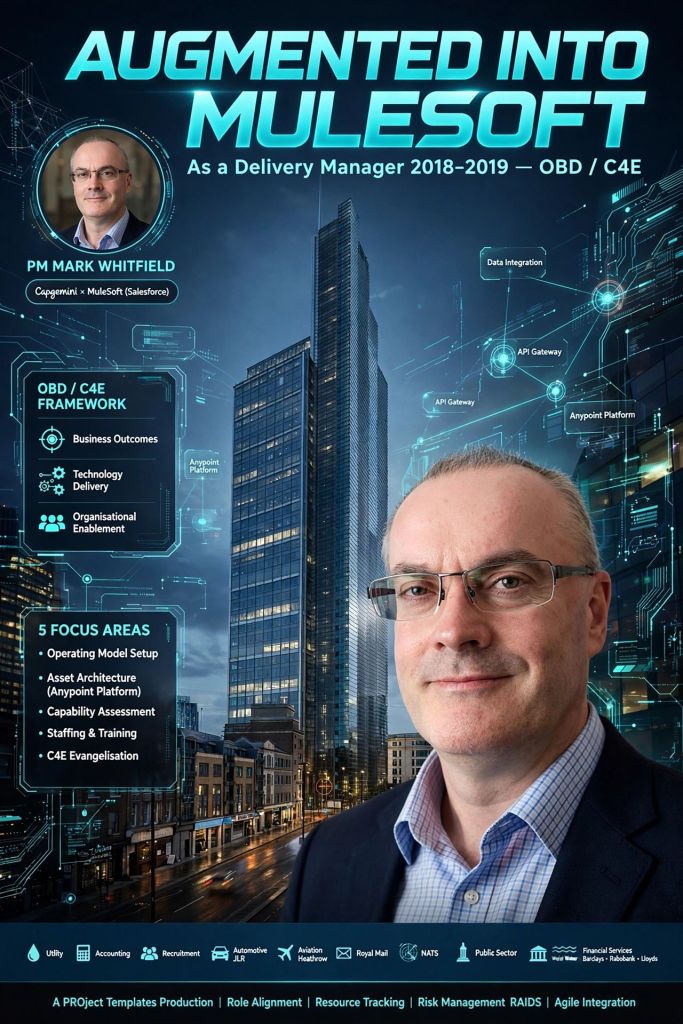
Operating out of MuleSoft’s London headquarters in the Salesforce Tower, his role mirrored that of a Programme Manager. He aligned client project plans with MuleSoft’s structured delivery frameworks to establish self-sufficient integration capabilities.

MuleSoft's London office is located within the Salesforce Tower (formerly known as Heron Tower) at 110 Bishopsgate.
MuleSoft’s London office is located within the Salesforce Tower at 110 Bishopsgate

The focus areas of his augmentation, the Outcome Based Delivery (OBD) / Centre for Enablement (C4E) framework, and the enterprise clients he managed are detailed below.

📋 Overview of MuleSoft Delivery Manager Augmentation

  • Role Alignment: Linked directly with client-side Project/Programme Managers to align execution timelines with MuleSoft’s implementation standards.
  • Resource Tracking: Monitored MuleSoft partner and consultant efforts, project costs, and timelines against statements of work (SOW).
  • Risk Management: Owned and tracked client-side OBD risks, assumptions, issues, and dependencies via specialized OBD RAIDs logs.
  • Agile Integration: Facilitated the prioritization and assignment of integration tasks into Agile Sprints or structured Waterfall milestones.

🏛️ C4E & OBD Focus Areas

MuleSoft’s Outcome Based Delivery (OBD) framework is built across three primary streams—Business Outcomes, Technology Delivery, and Organisational Enablement—specifically engineered to build a functional client-side Centre for Enablement (C4E).

Whitfield’s delivery focus focused heavily on Organisational Enablement:

  1. Operating Model Setup: Establishing the foundational C4E operating model and internal technical support structures.
  2. Asset Architecture: Guiding teams to build, govern, and publish reusable foundational assets and APIs on the Anypoint Platform.
  3. Capability Assessment: Assessing the client’s existing software integration maturities to benchmark project targets.
  4. Staffing & Training: Creating comprehensive training, onboarding, and experiential learning pathways to upskill client IT and business personnel.
  5. C4E Evangelisation: Promoting self-serve materials and governance guidance across the broader enterprise to eliminate reliance on external MuleSoft SMEs.

🏢 MuleSoft Ecosystem & Enterprise Clients Managed

As part of his broader Capgemini UK Consultancy footprint and his direct MuleSoft delivery assignment, Whitfield spearheaded cross-functional integration deployments for multiple blue-chip, public sector, and utility accounts across the UK:

  • MuleSoft Accounts: Managed complex software delivery accounts spanning the UK Utility, Accounting, and Recruitment industries during his direct augmentation.
  • Automotive Integration: Directed the Jaguar Land Rover (JLR) iFAB Middleware Project, coordinating multi-vendor supply chain data pipelines.
  • Aviation & Logistics: Managed enterprise architecture environments for major infrastructure clients including Heathrow Airport, Royal Mail Group (RMG), and NATS (National Air Traffic Services).
  • Public Sector & Utilities: Guided digital transformation frameworks for UK Government Agencies, UK Export Finance (UKEF), and water utilities like Welsh Water.
  • Financial Services: Handled integration and core enterprise ecosystems for banking giants such as Barclays, Rabobank, and Lloyds Banking Group (LBG).

History of the x86 IBM PC platform by Era and Year

The history of the x86 IBM PC platform is defined by a shift from a proprietary IBM product to an open industry standard (“Wintel”) and finally to the modern diverse ecosystem of high-performance computing. 

Era 1: The Foundation & The “Big Blue” Monopoly (1978–1981)

Before the first PC, the building blocks of the x86 architecture were established by Intel. 

  • 1978: Intel introduces the 8086 microprocessor, the 16-bit foundation of the x86 instruction set.
  • 1979: Intel releases the 8088, a lower-cost version with an 8-bit external bus, which IBM would later choose for its first PC.
  • 1980: Microsoft signs a contract with IBM to develop an operating system (MS-DOS/PC DOS) for their upcoming machine.
  • 1981 (August 12): IBM announces the IBM Personal Computer (Model 5150).
    • Spec highlights: 4.77 MHz 8088 CPU, 16KB–256KB RAM, and CGA graphics.
    • Impact: Its “open architecture” allowed third-party expansion, though the BIOS remained proprietary. 

Era 2: The Rise of the Clones (1982–1986) 

IBM’s dominance was quickly challenged as other companies “cloned” the hardware and reverse-engineered the BIOS. 

  • 1982Columbia Data Products introduces the MPC 1600, the first 100% IBM PC compatible.
  • 1982: Intel announces the 80286, supporting protected mode and up to 16MB of RAM.
  • 1983Compaq releases the Compaq Portable, the first highly successful 100% compatible clone with a clean-room engineered BIOS.
  • 1983: IBM launches the PC/XT (Model 5160), the first PC with a built-in hard drive.
  • 1984: IBM introduces the PC/AT (Model 5170) using the 80286 chip, which sets the standard for PC architecture for the next decade.
  • 1985: Intel introduces the 80386, the first 32-bit x86 processor.
  • 1986Compaq beats IBM to market with the first 386-based PC, the Deskpro 386, signalling IBM’s loss of control over the platform’s technical lead.

Era 3: The “Wintel” Standard & Multimedia (1987–1999)

As IBM tried and failed to regain control with proprietary standards, Microsoft and Intel became the new “de facto” leaders. 

  • 1987: IBM launches the PS/2 line with the proprietary MicroChannel Architecture (MCA), but the industry rejects it in favour of the open AT-bus (ISA).
  • 1989: Intel releases the 486DX, integrating the math co-processor and L1 cache onto the chip.
  • 1993: Intel debuts the Pentium processor, moving away from numbers to a trademarked brand to prevent competitors from using the name.
  • 1995Windows 95 is released, cementing the GUI as the standard interface for x86 PCs.
  • 1997: Intel launches MMX technology to improve multimedia performance on PCs. 

Era 4: 64-Bit & Multi-Core (2000–2019)

The platform evolved to handle massive data and professional workloads through architectural shifts. 

  • 2003AMD introduces x86-64, the 64-bit extension that Intel eventually adopts as the industry standard.
  • 2005: Intel ships its first dual-core processor, starting the “core war” to improve performance without increasing heat.
  • 2005: IBM exits the PC market entirely, selling its division to Lenovo.
  • 2006: Apple transitions its Macintosh line to Intel x86 processors (a move that lasted until 2020).
  • 2011: The 30th anniversary of the IBM PC; by this time, “PC” almost exclusively meant an x86 machine running Windows. 

Era 5: The Modern Era (2020–Present)

Current x86 systems focus on massive core counts, high-speed storage (NVMe), and integrated AI. 

  • 2020–2022: Development of high-performance multi-core architectures like Intel’s 12th Gen (Alder Lake), introducing hybrid performance and efficiency cores.
  • 2025–2026: Transition to “AI PCs” using processors like the Intel Core Ultra series (Series 2), which include NPUs (Neural Processing Units) for local AI workloads.
  • Today: Modern x86 PCs, such as those from Dell or Lenovo, feature 20+ cores, DDR5 memory, and PCIe 5.0 expansion.

History of the x86 IBM PC platform by Era and Year