Project Management Plan Components, PMBOK

Project Management Plan Components, PMBOK

AI Projects and Methodologies for Managing AI Projects

Artificial intelligence (AI) is transforming project management through two distinct but related paths: the use of AI-powered tools to manage general projects and the specialized methodologies required to manage AI development itself

1. Methodologies for Managing AI Projects

Traditional software development methods (like Waterfall) often fail for AI because these projects are experimental and non-linear. Specialized frameworks have emerged to handle the “data-first” nature of AI: 

  • CPMAI (Cognitive Project Management for AI): A leading methodology that combines Agile principles with data-centric phases: Business Understanding, Data Understanding, Data Preparation, Model Development, Model Evaluation, and Model Operationalization.
  • Agile-AI Hybrid: Adapts standard Agile by using “short-boxed” iterations for model training and allowing for a “flexible scope” because model performance is unpredictable until tested.
  • Data Driven Scrum: A variation of Scrum that prioritizes work based on data availability and experimental results rather than just feature backlogs.
  • MLOps (Machine Learning Operations): An operational framework focused on the continuous integration, deployment, and monitoring of models to prevent “model drift” after a project officially “ends”. 

2. AI-Augmented Project Management (The “AI Copilot”)

For non-AI projects, AI acts as an intelligent assistant to automate administrative tasks and provide predictive insights. 

3. Implementation Strategy

Experts recommend a phased approach to integrating AI into management workflows: 

  1. Assess Inefficiencies: Identify repetitive tasks (e.g., status reporting) that can be automated first.
  2. Data Governance: Ensure project data is clean and centralized; AI is only as good as the data it consumes (“Garbage In, Garbage Out”).
  3. Human-in-the-Loop: Use AI for data-heavy lifting, but retain human judgment for high-stakes leadership, ethics, and stakeholder empathy.

AI Projects and Methodologies for Managing AI Projects

Key Skills for the Project Manager

Key Skills for the Project Manager

Technical Program Manager Roadmap

Technical Program Manager Roadmap

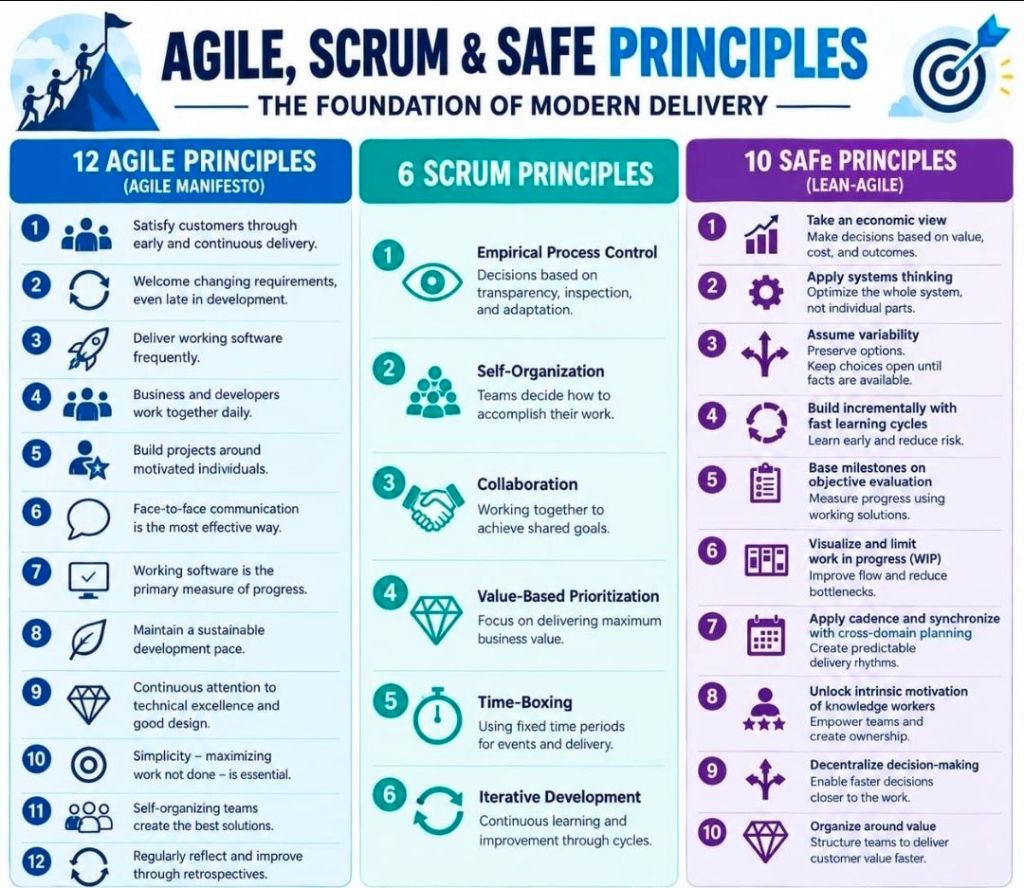
Agile Scrum Methodology Summary Breakdown Overview

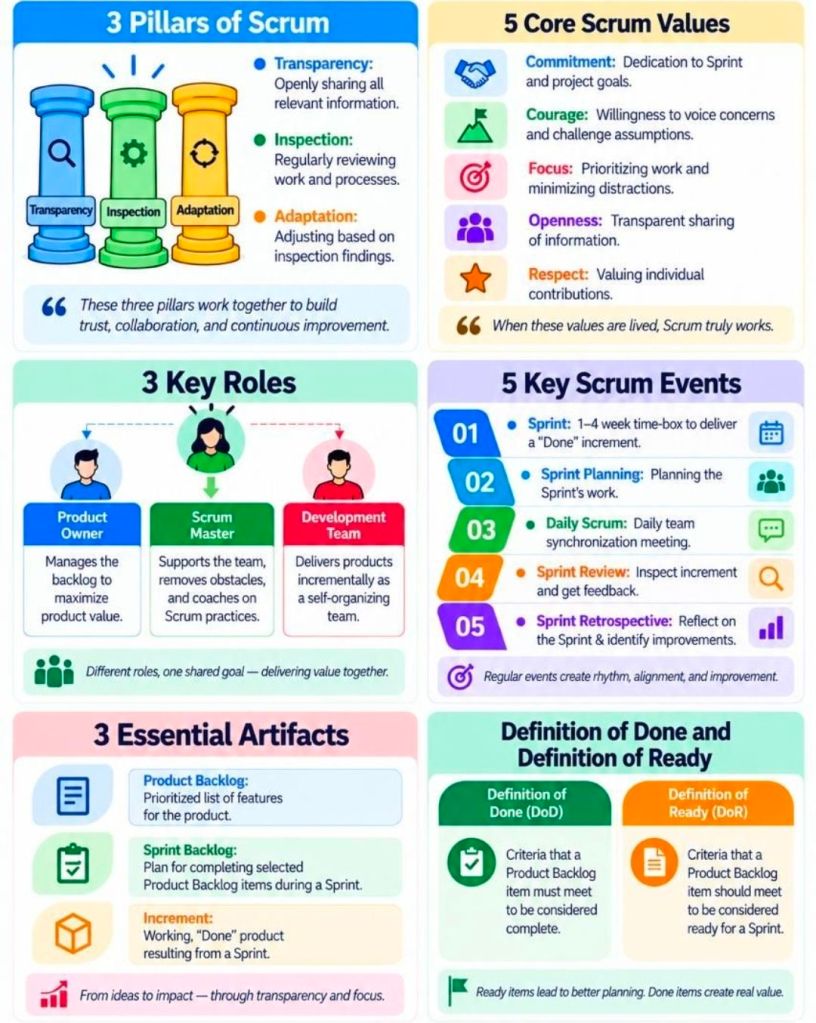
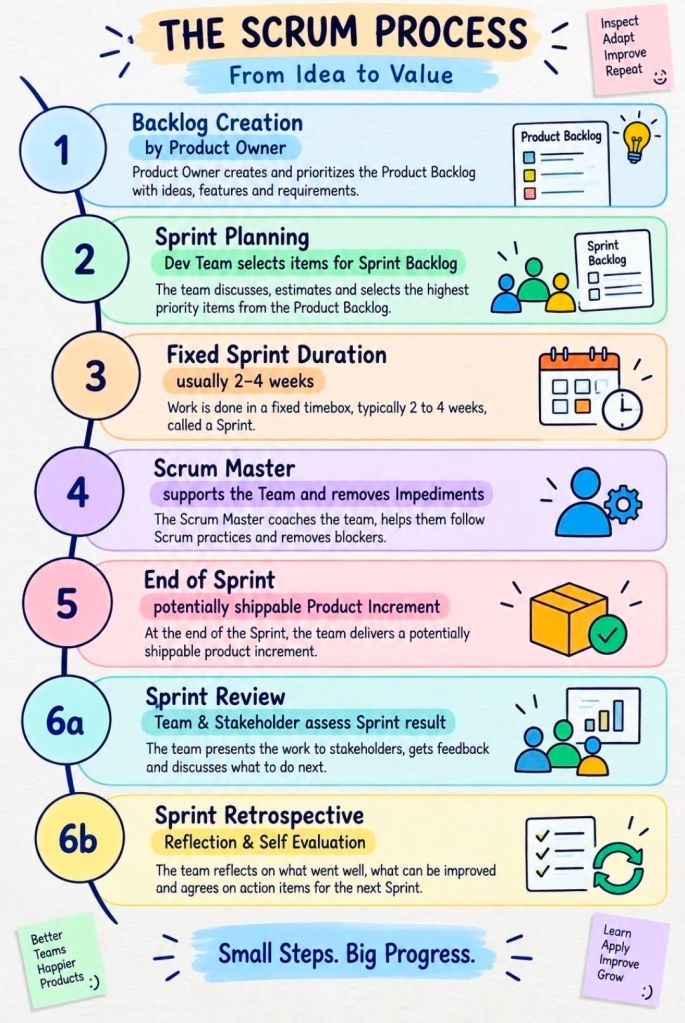
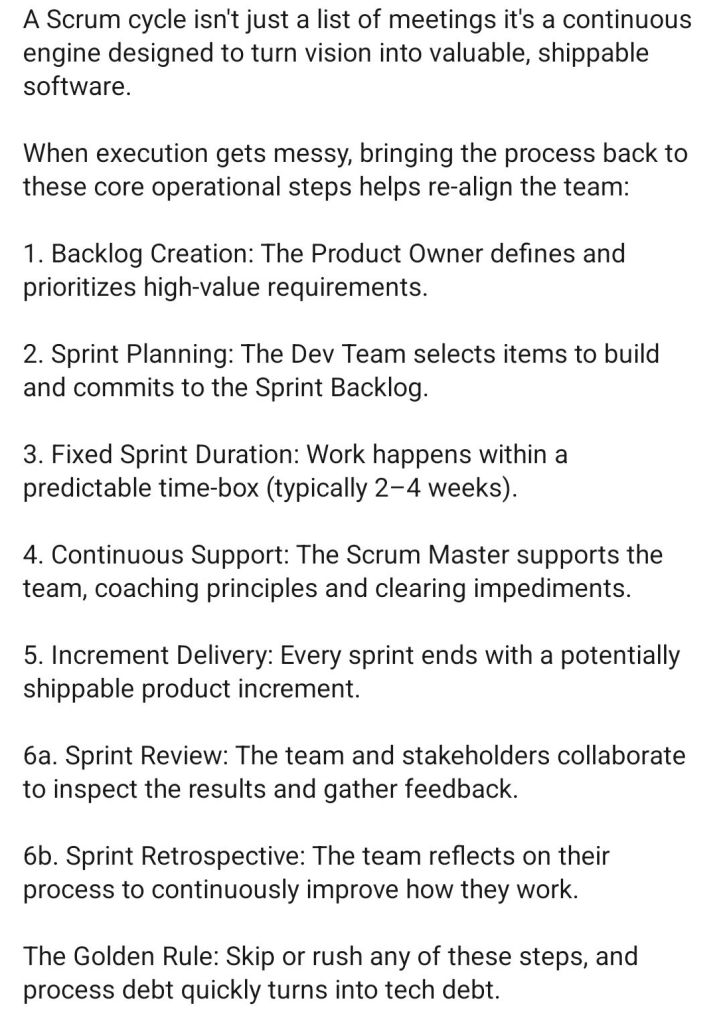
Scrum is lightweight framework within the broader Agile methodology used to manage complex work through iterative, incremental delivery. It organizes work into fixed-length cycles called sprints, typically lasting two to four weeks, to deliver a usable “increment” of value at the end of each cycle. 

Core Components (The 3-5-3 Structure)

The framework is built around three accountabilities, five events, and three artifacts. 

1. Three Accountabilities (Roles)

  • Product Owner: Represents the customer and stakeholders. They manage the Product Backlog and prioritize work to maximize the value delivered by the team.
  • Scrum Master: A servant leader who coaches the team on Scrum theory and removes impediments that block progress.
  • Developers: A cross-functional, self-managing team that does the actual work to create the product increment. 

2. Five Events (Ceremonies)

  • The Sprint: The container for all other events; a time-boxed period where work is performed.
  • Sprint Planning: The team defines what will be delivered in the sprint and how the work will be achieved.
  • Daily Scrum: A 15-minute daily check-in for developers to synchronize progress and plan the next 24 hours.
  • Sprint Review: Held at the end of the sprint to inspect the outcome with stakeholders and adapt the Product Backlog.
  • Sprint Retrospective: An internal team meeting to reflect on the process and identify improvements for the next sprint. 

3. Three Artifacts

  • Product Backlog: An ordered, evolving list of everything needed for the product.
  • Sprint Backlog: The subset of product backlog items selected for the current sprint, plus a plan for delivering them.
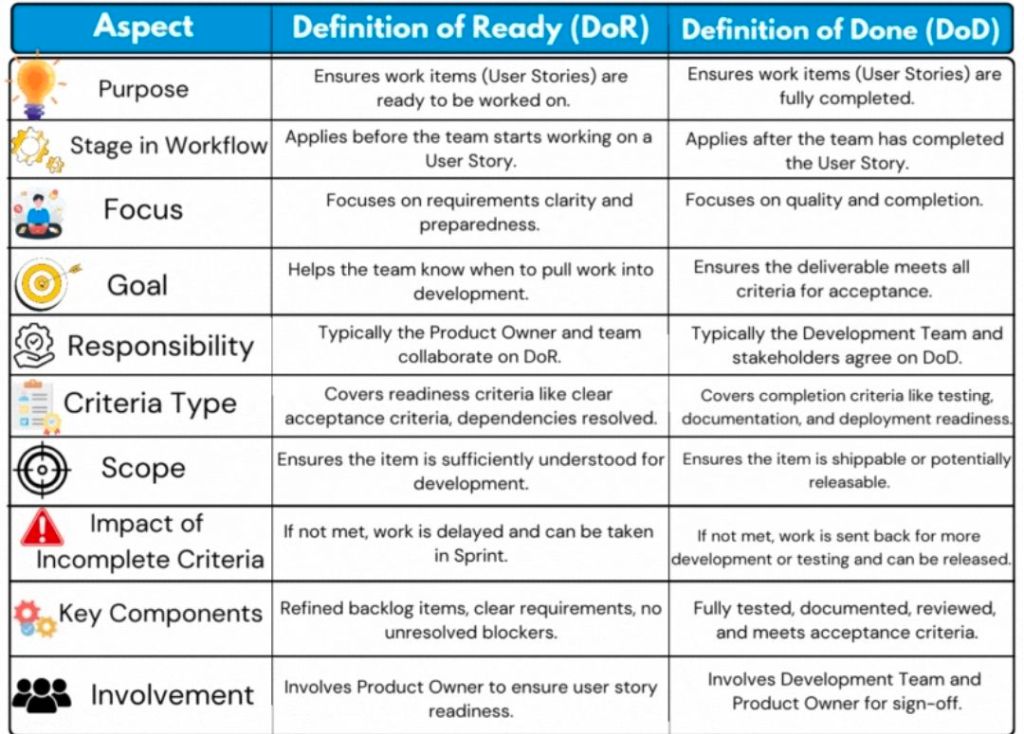
  • Increment: The concrete sum of all completed backlog items that meet the Definition of Done. 

The Three Pillars of Empiricism

Scrum is founded on empirical process control, which relies on: 

  1. Transparency: The process and work must be visible to everyone involved.
  2. Inspection: Frequent checks of artifacts and progress to detect variances.
  3. Adaptation: Adjusting the process or product if an inspection reveals unacceptable deviations. 

Key Values

Success with Scrum depends on the team’s commitment to five core values: Commitment, Courage, Focus, Openness, and Respect

Agile Scrum Methodology Summary Breakdown Overview

PRINCE2 (PRojects IN Controlled Environments) framework is built on seven core principles

PRINCE2 framework is built on seven core principles

The PRINCE2 (PRojects IN Controlled Environments) framework is built on seven core principles that serve as guiding obligations for any project using this methodology. For a project to be considered a “PRINCE2 project,” all seven must be applied. 

  • Continued Business Justification: A project must have a valid reason to start and must remain justified throughout its lifecycle. This is documented in a Business Case, which is regularly reviewed to ensure the project remains viable, desirable, and achievable.
  • Learn from Experience: Project teams are required to seek out lessons from previous projects and record new lessons as the current project progresses. A Lessons Log is typically used to capture these insights.
  • Defined Roles and Responsibilities: Every person involved must understand what is expected of them and who is responsible for specific tasks. PRINCE2 defines a clear management hierarchy: Project Board (Direction), Project Manager (Management), and Team Manager (Delivery).
  • Manage by Stages: Projects are broken down into manageable chunks called management stages. Each stage acts as a “stop/continue” decision point for the Project Board to assess progress before committing more resources.
  • Manage by Exception: Senior management (Project Board) only intervenes when the project deviates beyond agreed tolerances for time, cost, quality, scope, risk, or benefits. This empowers the Project Manager while ensuring efficient use of executive time.
  • Focus on Products: The methodology prioritizes the definition and delivery of high-quality products (outputs) rather than just completing activities. Product descriptions specify the quality criteria and requirements for each deliverable.
  • Tailor to Suit the Project: PRINCE2 is not a rigid “one-size-fits-all” approach; it must be adapted to the project’s specific scale, complexity, and environment. Tailoring ensures that the controls are appropriate for the level of risk involved. 

Agile Framework Executive Summary Overview Snapshot

Agile Framework Executive Summary Overview Snapshot

Gantt Chart Detailed Timeline History by Era and Year

Henry Gantt (1861–1919) was an American mechanical engineer and management consultant who revolutionized project management by introducing visual tools to track work against time. A close associate of Frederick Taylor, he humanized “scientific management” by focusing on employee motivation and social responsibility alongside industrial efficiency. 

Gantt Chart in MS Project, templates can be downloaded at website banner link

Overview of Henry Gantt’s Contributions

  • The Gantt Chart: His most famous invention, a horizontal bar chart that illustrates a project schedule, including task durations and progress.
  • Task and Bonus System: A wage system that guaranteed a base rate but offered bonuses to workers who exceeded daily production goals.
  • Social Responsibility: He argued that businesses have a moral obligation to the welfare of the society in which they operate, not just to their owners.
  • Industrial Efficiency: He advocated for using scientific analysis to eliminate “chance and accidents” in manufacturing. 

Comprehensive Gantt Timeline History

Era 1: Pre-Gantt & Early Origins (1765–1896)

  • 1765: Joseph Priestley creates early timeline charts, which some consider the conceptual distant ancestors of the Gantt chart.
  • 1896: Polish engineer Karol Adamiecki develops the “Harmonogram,” a precursor that displayed interdependent processes. However, he published it only in Polish and Russian, limiting its global recognition. 

Era 2: The Henry Gantt Era (1903–1919)

  • 1903: Henry Gantt develops his first version of a production chart for the American Locomotive Company.
  • 1910–1915: Gantt refines and popularizes his chart through articles and his book Work, Wages and Profits (1910).
  • 1917–1918: At the request of General William Crozier, Gantt charts are used to manage massive military production for the U.S. during World War I.
  • 1919: Henry Gantt passes away. 

Era 3: Global Adoption & Infrastructure (1920s–1970s) 

  • 1922: Wallace Clark, a colleague of Gantt, publishes The Gantt Chart: A Working Tool of Management, leading to international adoption.
  • 1929: Walter Polakov introduces Gantt charts to the Soviet Union for their First Five Year Plan.
  • 1931–1936: Gantt charts are used on massive infrastructure projects like the Hoover Dam and later the U.S. Interstate highway system.
  • 1940s: Extensively used for logistics and military project management during World War II.
  • 1950s: Become a staple in the construction and engineering industries; the first digital predecessors like PERT and Critical Path Method (CPM) emerge. 

Era 4: The Digital Revolution (1980s–Present) 

  • 1980s: The advent of personal computers allows project managers to create and update charts without redrawing them by hand.
  • 1990s: Software like Microsoft Project adds “link lines” to display complex dependencies between tasks.
  • 2000s–2010s: Web-based and cloud-based applications (like Jira or Asana) integrate Gantt charts for real-time team collaboration.
  • Present: Modern tools use AI to automate chart maintenance and predict risks based on historical data.

Gantt Chart Detailed Timeline History by Era and Year

Rational Unified Process RUP Overview and Timeline History

The Rational Unified Process (RUP) timeline is a two-dimensional framework where the horizontal axis represents time (divided into phases and iterations) and the vertical axis represents work/activities (divided into disciplines)

Rational Unified Process, RUP

The process is structured into four sequential phases, each culminating in a major milestone where the project’s progress is assessed before moving forward. 

RUP Phases, Iterations and Workflows

RUP Project Phases and Milestones

Each phase of the RUP lifecycle has a specific objective and a corresponding milestone. 

  • Inception Phase
    • Goal: Define project scope, identify business risks, and establish the Business Case.
    • MilestoneLifecycle Objective Milestone – Stakeholders agree on scope and cost/schedule estimates.
  • Elaboration Phase
    • Goal: Analyze requirements in detail and design a stable Software Architecture.
    • MilestoneLifecycle Architecture Milestone – The architecture is validated and major risks are mitigated.
  • Construction Phase
    • Goal: Build the software system by developing and testing all components and features.
    • MilestoneInitial Operational Capability Milestone – A product is ready for beta testing by users.
  • Transition Phase
    • Goal: Deploy the software to the end users and perform final Beta Testing and training.
    • MilestoneProduct Release Milestone – The development cycle is finished and the product is formally accepted. 

Detailed Iteration Timeline

Within each phase, work is performed in iterations (typically lasting 2 to 6 weeks). Each iteration is a mini-lifecycle that includes: 

  1. Requirements Analysis: Refining what needs to be built.
  2. Design: Modeling the system architecture and components.
  3. Implementation: Writing the code for specific features.
  4. Testing: Verifying the quality of the iteration’s output.
  5. Assessment: Evaluating the iteration against its planned goals. 

Historical Development Timeline

  • 1988Objectory AB defines the core process.
  • 1995: Rational Software Corporation acquires Objectory.
  • 1998: RUP 5.0 is released, introducing UML integration.
  • 2003: IBM acquires Rational Software.
  • 2012: RUP is largely succeeded by Disciplined Agile Delivery (DAD) and SAFe.

Rational Unified Process RUP Overview and Timeline History

A Practical Guide to the Rational Unified Process RUP

IT Career snapshot of Mark Whitfield, Senior IT Project Manager (SC cleared)

This resume summarizes the career of Mark Whitfield, a Senior IT Project Manager with over 30 years of experience specializing in digital and software development lifecycles, cloud migrations, and HP NonStop systems

Personal Details

  • Name: Mark A. Whitfield
  • Location: Manchester, UK
  • Nationality: British
  • Security Clearance: SC Cleared to 2031
  • Professional Profiles: Official Website | LinkedIn Profile 

Executive Summary

  • Experience: 30+ years in IT.
  • Core Focus: Senior Project Management for Digital/ Software Development Lifecycles (SDLC).
  • Expertise: Transitioning from a technical background in programming (pre-2000) to senior leadership in large-scale projects for global blue-chip companies. 

Key Skills & Competencies

  • Methodologies: PRINCE2 Practitioner, Agile (Scrum/ Kanban), Waterfall, ITIL, ISO QA.
  • Project Controls: MS Project, Budget & Burn Tracking, GDPR compliance, Supplier & Stakeholder Management, Statement of Work (SoW).
  • Technical Proficiencies:
    • Platforms: HP NonStop (Tandem), Cloud Migration (Hybrid).
    • Languages (Historical): C/C++, Java, COBOL85, TAL, TACL, SCOBOL, SQL, MS SQL.
    • Utilities: PATHWAY, SCF, FUP, INSPECT, XPNET. 

Professional Experience

  • Senior IT Project Manager (Various Projects):
    • Managed large-scale solutions for clients including Jaguar Land Rover (JLR)HeathrowRoyal Mail Group (RMG)NATS, and Euroclear.
    • Extensive work within the financial sector for Bank of EnglandBarclaysHSBCSantanderStandard CharteredDeutsche Bank, and Global Payments.
    • Government and public sector projects for DefraUKEFWelsh Water, and Scottish Water.
  • Early Career (Programmer / Technical Lead):
    • 1990 – 1995: Programmer at The Software Partnership (later Deluxe Data) in Runcorn, specializing in electronic banking software (sp/ARCHITECT-BANK) on Tandem Mainframe Computers. 

Education & Certifications

  • Degree: Higher National Diploma (HND) in Computing (Distinction, Graduated 1990).
  • Certifications:
    • Microsoft Azure Fundamentals (Certified).
    • PRINCE2 Practitioner.
    • Agile/ Radtac Course Completion. 

Agile Methodology Iceberg Overview

Agile Methodology Iceberg Overview

Structured Systems Analysis and Design Method (SSADM) Timeline

The Structured Systems Analysis and Design Method (SSADM) is a highly structured, “waterfall” methodology developed in the 1980s for the UK government to standardise IT project management. Its timeline can be viewed through two lenses: its historical evolution as a standard and its internal execution phases

Historical Evolution Timeline

SSADM evolved through several versions to become an “open” standard used widely in public and private sectors. 

  • 1980: The Central Computer and Telecommunications Agency (CCTA) evaluates various analysis and design methods.
  • 1981: Consultants from Learmonth & Burchett Management Systems (LBMS) are selected to develop SSADM v1.
  • 1983: SSADM is made mandatory for all new information system developments within the UK government.
  • 1984–1986: Version 2 (1984) and Version 3 (1986) are released, with the latter being adopted by the National Computing Centre (NCC).
  • 1990: Version 4 is launched, introducing more refined modules and stages.
  • 1995: SSADM V4+ is announced, followed by the release of V4.2.
  • 2000: The CCTA rebrands SSADM as “Business System Development,” repackaging it into 15 core modules with additional specialized modules. 

Methodological Execution Timeline (Stages 0–6)

SSADM follows a strict linear sequence where each stage must be completed and “signed off” before the next begins. 

  1. Stage 0: Feasibility Study – Analyzes technical, financial, and organizational feasibility to determine if the project is cost-effective.
  2. Stage 1: Investigation of Current Environment – Models the existing system using Data Flow Diagrams (DFDs) to understand current data and processes.
  3. Stage 2: Business System Options – Presents up to six different ways to build the new system, allowing users to choose the best strategic direction.
  4. Stage 3: Requirements Specification – A complex stage that builds a full logical specification of what the system must do, including Entity Life Histories (ELHs).
  5. Stage 4: Technical System Options – Evaluates hardware and software architectures to determine the best technical implementation.
  6. Stage 5: Logical Design – Defines user dialogues, update processes, and enquiry processes in an implementation-independent manner.
  7. Stage 6: Physical Design – The final stage where logical specifications are converted into real hardware and software database structures and program specifications.

Jackson Structured Programming (JSP) Timeline  by year

Jackson Structured Programming (JSP) was developed by British software consultant Michael A. Jackson to provide a rigorous, data-driven alternative to the intuitive “top-down” methods prevalent in the 1970s. Its evolution is characterized by a transition from micro-level program design to macro-level system architecture. 

The Early 1970s: Foundation and Invention

  • 1970: Michael Jackson founded his firm, Michael Jackson Systems Limited, to fully develop a new program design methodology.
  • 1974: The name Jackson Structured Programming (JSP) was coined by the company’s Swedish licensee.
  • 1975: Jackson published the seminal book Principles of Program Design, which formally documented the JSP method and is now considered a classic. 

The Late 1970s: Standardisation and Expansion

  • 1977: JSP reached global recognition, being taught in universities and used across Europe, the US, and Asia.
  • Government Adoption: The UK government adopted JSP as its standard program design method under the name SDM (System Development Methodology).
  • Industry Use: Large organisations like the World Health Organization (WHO) began using JSP as a standard for specifying programs. 

The 1980s: Evolution into System Development (JSD)

  • 1980: Jackson published JSP, A Practical Method of Program Design, further refining the technique for practical industry use.
  • 1982–1983: Jackson, along with John Cameron, introduced Jackson System Development (JSD). While JSP focused on individual programs, JSD expanded these principles to entire systems.
  • Integration: JSD was widely incorporated into the UK’s SSADM (Structured Systems Analysis and Design Method), specifically for entity and event modelling. 

The 1990s to Present: Legacy and Modern Relevance

  • 1990s: Jackson introduced his third major method, Problem Analysis (or the Problem Frames Approach), focusing on requirements and software specifications.
  • Legacy: While JSP has faded from mainstream daily practice due to the rise of Object-Oriented Programming, its core concepts—like deriving program structure from data structures—influenced modern practices like Event Storming in Domain-Driven Design (DDD). 

Jackson Structured Programming (JSP) Timeline  by year

Essential Project Management Skills

Essential Project Management Skills

Agile Scrum Master Skills for Success

Agile Scrum Master Skills for Success

Centiun Microsoft Business Applications and AI Specialists

Websitehttps://centiun.com

Centiun Microsoft Business Applications and AI Specialists

Centiun Overview

Centiun is a British IT services consulting company and Microsoft Partner, helping enterprise public and private sector organisations achieve digital transformation excellence through the Microsoft cloud.

We specialise in Microsft Dynamics 365, Power Platform, and Micrisoft 365, delivering expert consultancy, solution architecture, implementation, and managed services that enable organisations to modernise operations, improve service delivery, and unlock greater value from their technology investment.

From CRM transformation and business process automation to secure collaboration, data-driven decision making, and AI enabled innovation, Centiun supports customers to build smarter, faster and more resilient ways of working.

Our approach combines deep Microsoft expertise with a practical focus on outcomes – designing and delivering solutions that are scalable, compliant, and tailored to the needs of complex organisations.

Whether you’re starting your digital journey or optimising an existing platform, Centiun is your trusted Microsoft for long-term transformation and support.

Website: https://centiun.com

On LinkedIn: https://www.linkedin.com/company/centiun/

Email: info@centiun.com

Centiun services
Centiun Microsoft Business Applications and AI Specialists

Mark Whitfield IT Training Career Timeline Overview

Mark Whitfield, an experienced IT Project Manager, has a career and certification history spanning over 30 years. His professional development includes a range of technical, project management, and cloud-based qualifications. 

2020s: Cloud & Modern Platforms

  • 2024 (July): Microsoft Excel Refresher Course – Udemy.
  • 2022 (December/February): C&CA UK’s Communications & Engagement Award and AZ-900 Microsoft Certified Azure Fundamentals. 

2010s: Advanced Management & Development 

  • 2017 (November/April): Advanced Engagement Management (Level 2) and Microsoft Excel 2010 Expert Skills.
  • 2014 (July): Advanced Microsoft Excel 2013.
  • 2011 (May–July): PRINCE2 Practitioner, Agile SCRUM, Java, and Android programming. 

2000s: Web Applications & Database Systems 

  • 2009 (March–November): Thales e-Security, BIRT, Web Design, and SQL Server training.
  • 2006 (Feb–Dec): NetObjects Fusion, Cryptography, and Thales e-SECURITY SafeSign.
  • 2004 (March): MultiBatch NSK Job Scheduling.
  • 2000 (February): Fundamentals of Successful Project Management. 

1990s: Core Programming & System Fundamentals

  • 1990s (1993–1999): TANDEM/HP NonStop systems, C/C++ programming, project management, and HND in Computer Studies (1990).

Mark Whitfield Training IT Career Timeline Overview

Mark Whitfield, a Senior IT Project Manager who has spent over 30 years specialising in HP NonStop (formerly Tandem) computing systems

Professional Background

  • Specialisation: Mark Whitfield is a highly experienced technician and project manager for the HP NonStop platform, which is a high-availability, fault-tolerant mainframe environment used primarily for mission-critical financial transactions.
  • Career Timeline:
    • The Software Partnership / Deluxe Data (1990–1995): Began as a programmer working on the sp/ARCHITECT-BANK solution for Tandem computers.
    • Insider Technologies (1995–2013): Spent 18 years focusing on monitoring and diagnostic software for HP NonStop, including products like Reflex 80:20XPERT24, and Enterprise Manager.
    • Capgemini (2016–Present): Currently serves as an SC-cleared Senior Project Manager, delivering complex IT projects for major banks and government agencies. 

Key Technical Contributions to NonStop

  • Product Development: He co-developed Reflex (a platform health/diagnostic tool) and designed XPERT24 to monitor performance in the XPNET layer of BASE24.
  • Financial Systems: He has managed major projects for global financial entities, including BarclaysHSBCBank of England, and Royal Mail Group, often involving ATM and POS monitoring systems.
  • Programming Expertise: His technical skill set includes NonStop-specific languages and tools such as TAL (Tandem Application Language)PATHWAYXPNETCOBOL85, and C++

About HP NonStop Systems

In the context of Mark Whitfield’s work, NonStop refers to a “shared-nothing” architecture designed by Tandem Computers. These systems are uniquely capable of: 

  • Fault Tolerance: Handling hardware or software failures without system downtime.
  • Scalability: Doubling throughput by adding processors (up to 4,000) without hitches in performance.
  • Core Banking: Processing massive commercial workloads for retail banks and stock exchanges globally.

Project planning timeline is typically structured to five phases

A project planning timeline is typically structured around the five phases of the project management lifecycleInitiation, Planning, Execution, Monitoring/Control, and Closure. This framework breaks a complex project into manageable stages to ensure systematic progress and stakeholder alignment. 

1. Project Initiation

The foundation phase where the project’s value and feasibility are established. 

  • Primary Objective: Secure formal approval to begin.
  • Key Activities: Identify stakeholders, perform feasibility studies, and create a Project Charter.
  • Output: Project Charter or Business Case. 

2. Project Planning

The most critical stage for the timeline, where the high-level vision is translated into a detailed roadmap. 

  • Primary Objective: Define the “how” of project delivery.
  • Key Activities:
    • Scope Definition: Establish what is and is not included.
    • Work Breakdown Structure (WBS): Break large goals into “bite-sized” tasks.
    • Scheduling: Sequence tasks, estimate durations, and link dependencies.
    • Resource & Risk Planning: Allocate staff/budget and identify potential bottlenecks.
  • Output: Gantt Chart or Project Management Plan

3. Project Execution

The “action” phase where the team carries out the planned tasks to produce deliverables. 

  • Primary Objective: Complete the work according to the finalized plan.
  • Key Activities: Assign tasks, hold kickoff meetings, and manage workflows using tools like Asana or Trello.
  • Output: Status reports and tangible deliverable packages. 

4. Project Monitoring and Controlling

This phase runs concurrently with Execution to ensure the project stays on track. 

  • Primary Objective: Track progress against the original timeline and budget.
  • Key Activities: Measure KPIs (e.g., ROI, cost performance), manage scope creep, and adjust schedules as needed.
  • Output: KPI Dashboards and Change Logs. 

5. Project Closure

The final wrap-up where the project is formally ended and evaluated. 

  • Primary Objective: Formal handover and knowledge capture for future projects.
  • Key Activities: Host a Post-Mortem Meeting, archive project documents, and release remaining resources.
  • Output: Final reports and a lessons-learned document. 

Project planning timeline is typically structured to five phases

Project Management evolution timeline by era

The history of project management has evolved from ancient manual coordination to highly sophisticated, digital-first methodologies

Pre-20th Century: The Era of Ancient Marvels

During this era, project management was characterized by massive labour forces and basic resource coordination without standardized scheduling tools. 

  • 2570 BC: Completion of the Great Pyramid of Giza. Documentation shows managers were assigned to each of the four faces to oversee progress.
  • 208 BC: Construction of the Great Wall of China. Labour was systematically organized into groups of soldiers, civilians, and criminals.
  • 1850s: Construction of the Pacific Railroad. This is often cited as one of the first large-scale industrial project management undertakings in the U.S.. 

1900–1950: The Birth of Modern Project Management 

This era introduced scientific management principles and the first visual scheduling tools. 

  • 1911Frederick Taylor publishes The Principles of Scientific Management, focusing on efficiency and unskilled labour training.
  • 1917Henry Gantt develops the Gantt Chart, a radical tool for visualising schedules that remains a global standard today.
  • 1931–1936: Construction of the Hoover Dam. This project was a major early adopter of Gantt’s scheduling techniques.
  • 1942–1945The Manhattan Project. This complex R&D effort pioneered the use of large-scale task coordination and resource management. 

1950–1980: The Era of Management Science 

Driven by the Cold War and space race, this period saw the creation of mathematical scheduling techniques. 

  • 1956: AACE International is formed, focusing on cost engineering.
  • 1957–1958: Development of Critical Path Method (CPM) by DuPont and Program Evaluation and Review Technique (PERT) by the U.S. Navy.
  • 1962–1975: Introduction of Work Breakdown Structure (WBS) by the DoD, founding of IPMA and PMI, and development of PROMPT (later PRINCE). 

1980–2000: The Computing Revolution 

Personal computers allowed project management software to proliferate into the private sector. Key milestones included the early Scrum framework and the initial PMBOK Guide release. 

  • 1989–1997: Widespread adoption of Earned Value Management (EVM), release of PRINCE2, and development of Critical Chain Project Management (CCPM)

2000–Present: The Agile and Digital Era 

Modern project management emphasizes flexibility, speed, and digital tools. 

  • 2001: The Agile Manifesto is published.
  • 2012–2021: Release of ISO 21500, major updates to PRINCE2 and PMBOK to integrate Agile, and the shift to performance-based standards in PMBOK 7th Ed.

Project Management evolution timeline by era

Project management has evolved from ancient engineering feats to a highly structured, data-driven discipline. Below is a comprehensive timeline of its historical development and the evolution of its core methodologies. 

Ancient & Early Eras

  • 2570 BC: The Great Pyramid of Giza – Completed with record-keeping and oversight for each of the four faces, demonstrating early forms of planning and control.
  • 208 BC: The Great Wall of China – Built with a massive labour force organised into specific groups: soldiers, ordinary people, and criminals.
  • 1917: Gantt Chart – Developed by Henry Gantt, this scheduling diagram became a radical innovation for tracking project tasks chronologically. 

The Mid-20th Century: Formalization

  • 1956: AACE International Formed – Early practitioners of cost engineering and scheduling founded what is now the leading society for project control specialists.
  • 1957: Critical Path Method (CPM) – Invented by DuPont to address chemical plant maintenance; it saved the company $1 million in its first year.
  • 1958: PERT (Program Evaluation Review Technique) – Developed for the U.S. Navy’s Polaris project to analyse the minimum time needed for task completion.
  • 1962: Work Breakdown Structure (WBS) – Mandated by the U.S. Department of Defense as a hierarchical tree structure for project deliverables.
  • 1965: IPMA Founded – The world’s first project management association was started in Vienna as a global forum for networking.
  • 1969: Project Management Institute (PMI) Launched – Founded to advance the profession, PMI has since become the primary publisher of global standards. 

Late 20th Century: Methodology Proliferation 

  • 1975: PROMPTII & “The Mythical Man-Month” – Guidelines were created for computer projects, while Fred Brooks’s Brooks’s law observed that adding manpower to late software projects makes them later.
  • 1984: Theory of Constraints (TOC) – Introduced by Dr. Eliyahu M. Goldratt, focusing on identifying system bottlenecks.
  • 1986: Scrum – First named as a project management style for software development in a Harvard Business Review paper.
  • 1987: PMBOK Guide First Published – PMI published the first “A Guide to the Project Management Body of Knowledge” as a white paper to standardise practices.
  • 1989: PRINCE & Earned Value Management – The PRINCE method was developed for UK government IT projects; meanwhile, Earned Value Management (EVM) became an essential part of procurement.
  • 1996: PRINCE2 – A more generic revision of PRINCE was published, applicable to any project type.
  • 1997: Critical Chain Project Management (CCPM) – Invented to keep resources levelly loaded and flexible. 

21st Century: Agile & Global Standards

  • 2001: The Agile Manifesto – Written by 17 developers in Utah, codifying the principles of lightweight, iterative software development.
  • 2006: Total Cost Management Framework – Released by AACE International as the first integrated process for portfolio and project management.
  • 2012: ISO 21500:2012 – The International Organisation for Standardisation released its global guidance on project management.
  • 2017: PMBOK 6th Edition & PRINCE2 Update – Updates reflected the integration of Agile practices into traditional project settings.
  • 2021: PMBOK 7th Edition – Shifted toward a principle-based approach to help practitioners be more proactive and innovative.

Project Management Framework – Core Foundations

Project Management Framework – Core Foundations