MoSCoW Requirements Prioritization Method

MoSCoW Requirements Prioritization Method

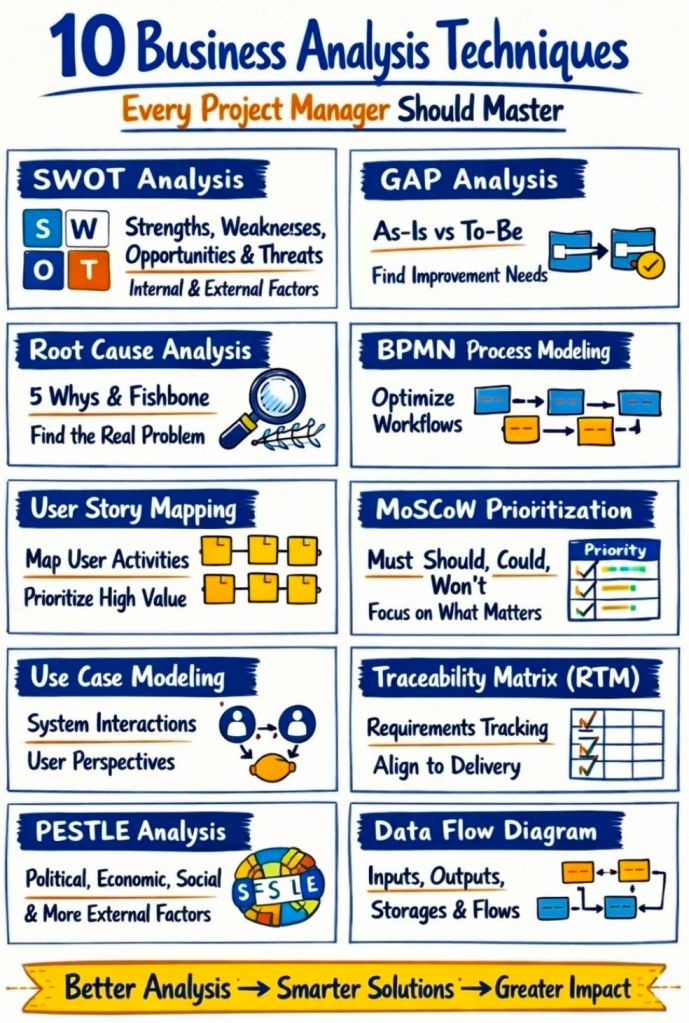
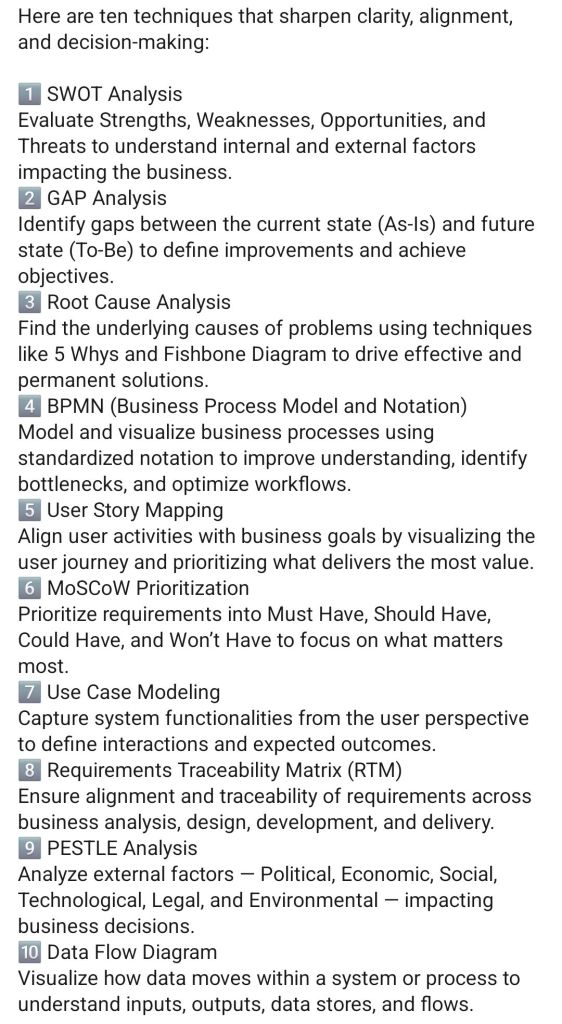
The MoSCoW method is a popular requirements prioritization technique used in project management and software development to help stakeholders reach a common understanding on the importance of deliverables. It categorizes tasks into Must, Should, Could, and Won’t have.

The MoSCoW Categories

  • Must Have: Non-negotiable requirements that are critical for success, compliance, or safety. Without these, the project is considered a failure and cannot be deployed.
  • Should Have: High-priority, important features that add significant value but are not strictly vital for immediate delivery. These are generally included if time permits, or they may have a manual workaround.
  • Could Have: Desirable, “nice-to-have” features that are small and easy to implement. These improve user experience but can be deferred or dropped without impacting the project’s overall success.
  • Won’t Have (or Won’t Have this time): Features that have been mutually agreed upon as out-of-scope for the current release or timeframe. They are deliberately excluded to prevent scope creep, though they may be added to the backlog for future cycles.

Why and When to Use It

  • Resource Management: It helps maximize limited time, budget, and resources by focusing effort on the features that provide the most immediate ROI.
  • Stakeholder Alignment: It acts as a negotiation tool, forcing stakeholders to agree on what is genuinely critical versus what is purely desirable.
  • Agile Environments: It is a foundational practice in Agile frameworks like DSDM, where teams adhere to fixed deadlines (timeboxes) and adjust the project scope instead.

Best Practices for Implementation

  • The 60-20-20 Rule: A common best practice is to ensure that Must Haves consume no more than 60% of the team’s total effort. Roughly 20% should be allocated to Should Haves, and 20% reserved for Could Haves to act as contingency room.
  • Challenge Assumptions: When classifying a requirement as a Must, ask: “What happens if we don’t do this? Can we still deploy the product?” If the project can still function—even awkwardly—it is likely a Should or Could.
  • Continuous Review: Priorities aren’t static. Re-evaluate your MoSCoW list at the end of every sprint or development cycle, as a Could Have from a previous phase might be upgraded or permanently discarded.

MoSCoW Requirements Prioritization Method

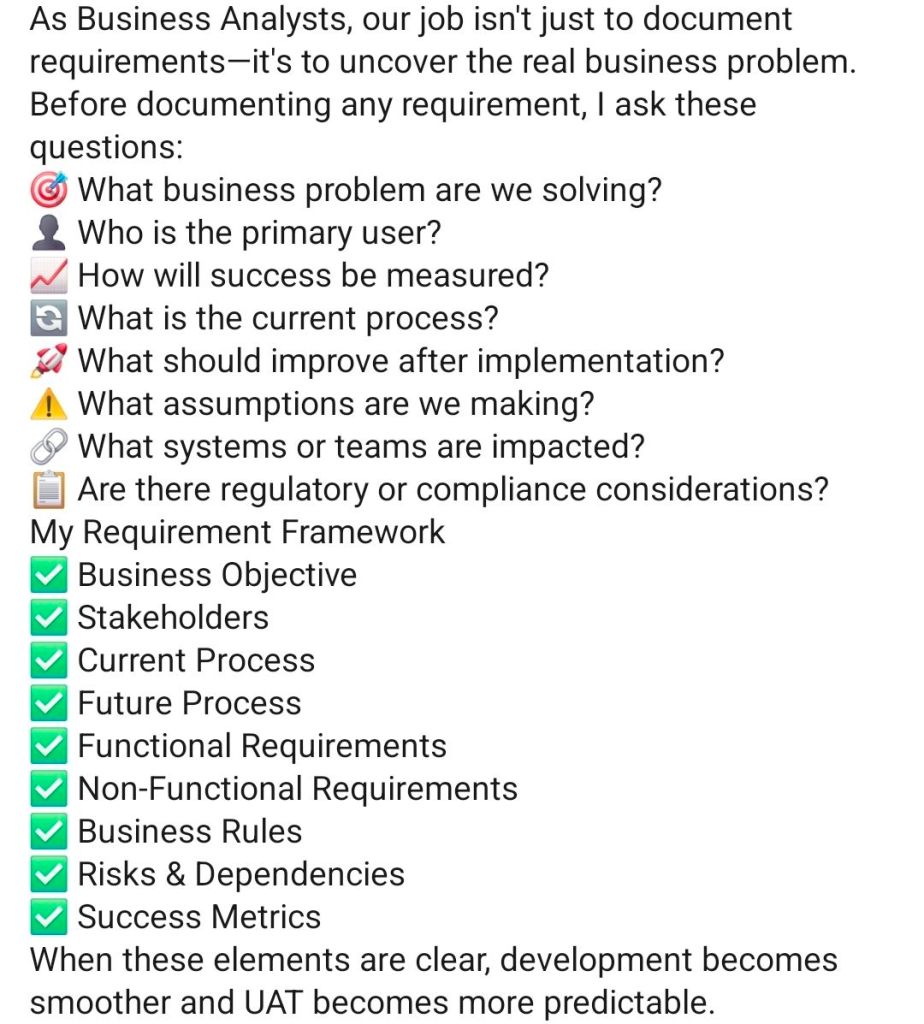
Frameworks for Business Analysts BAs

Frameworks for BA Business Analysts BAs
Frameworks for Business Analysts BAs

Completing the Stakeholder List using Process Analysis

Completing the Stakeholder List using Process Analysis

Completing a stakeholder list using process analysis involves tracing the end-to-end lifecycle of a process to identify every individual, team, or organization that interacts with, influences, or is impacted by it. This ensures no hidden users, bottlenecks, or approvers are missed.

A four-step approach will ensure your list is thorough and actionable:

1. Map the Process Flow

Create a step-by-step flowchart of the current or future process. Break it down into key phases: Inputs, Activities, Outputs, and Outcomes. This visual map acts as a blueprint to spot every touchpoint where someone is involved.

2. Identify Stakeholders at Each Touchpoint

Go through each phase of your process map and ask the following dependency questions to pinpoint roles:

  • Input Stage: Who supplies the data, materials, or funding? (e.g., vendors, regulators, finance departments)
  • Activity Stage: Who performs the work or oversees it? (e.g., project teams, department managers, QA testers)
  • Output Stage: Who receives the final deliverable? (e.g., end-users, clients, customers)
  • Outcome Stage: Who is affected by the long-term results? (e.g., the community, executives, maintenance teams)

3. Classify and Prioritize

Once your comprehensive list is built, categorize stakeholders using the Power/Interest Matrix. This helps allocate your engagement efforts efficiently:

  • High Power, High Interest: Manage closely and collaborate heavily (e.g., Project Sponsors, Product Owners).
  • High Power, Low Interest: Keep satisfied but do not over-communicate (e.g., Regulators, Steering Committees).
  • Low Power, High Interest: Keep informed and consult regularly (e.g., End-users, Support Staff).
  • Low Power, Low Interest: Monitor with minimal effort (e.g., Peripheral departments).

4. Document and Review

Log all identified stakeholders in a Stakeholder Register. Key details to capture include:

  • Stake / Impact: How the process affects them (or vice-versa).
  • Expectations: What they need from the process.
  • Engagement Strategy: How and how often you will communicate with them.

Completing the Stakeholder List using Process Analysis

Functional BA vs Technical BA vs Product BA

Functional BA vs Technical BA vs Product BA

While all three roles fall under the “Business Analyst” umbrella, they differ in their primary focus: Functional BAs translate business needs into user requirements, Technical BAs focus on system architecture and integration, and Product BAs drive the product’s market value and long-term strategy.

1. Functional BA (The ‘Business’ Translator)

The Functional BA acts as the primary bridge between business stakeholders and the IT delivery team. They focus on what the business needs to achieve and how users will interact with the system.

  • Core Focus: Business processes, stakeholder communication, and end-user experience.
  • Day-to-day Responsibilities: Gathering requirements, mapping out user journeys, defining acceptance criteria, and creating process flow diagrams.
  • Key Skills: Stakeholder management, requirements elicitation, and deep domain knowledge (e.g., finance, healthcare).

2. Technical BA (The ‘System’ Architect)

The Technical BA bridges the gap between the functional requirements and the software development team. They focus on how the system will be built, ensuring the proposed solution is technically feasible, scalable, and secure.

  • Core Focus: System architecture, data flow, integrations, and non-functional requirements (like performance).
  • Day-to-day Responsibilities: Defining API structures, mapping data models, documenting system interfaces, and writing complex technical user stories.
  • Key Skills: Understanding of system integrations, database structures, basic coding logic, and system-to-system communication.

3. Product BA (The ‘Value’ Strategist)

The Product BA merges business analysis with product management principles. Rather than just fulfilling requested requirements, they focus on why a product or feature should be built, ensuring it aligns with overarching company goals and delivers tangible ROI.

  • Core Focus: Product strategy, feature prioritization, market viability, and user adoption.
  • Day-to-day Responsibilities: Conducting market research, managing the product backlog, defining Key Performance Indicators (KPIs), and analyzing user feedback/metrics.
  • Key Skills: Product discovery, data analysis, competitive analysis, and strategic roadmapping.

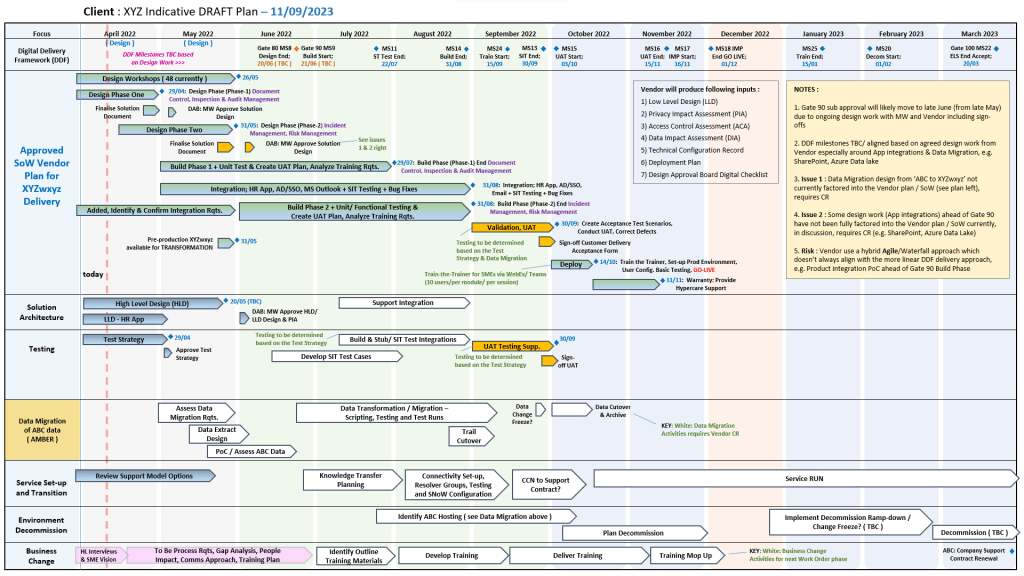
Business Analysis (BA) from week to week, across an example project

Business Analysis (BA) from week to week, across an example project

Another example;

Business Analysis (BA) across an example project—like building a custom mobile app—follows a dynamic, week-to-week lifecycle. It shifts focus from initial high-level strategy and stakeholder alignment to granular requirements, testing support, and post-launch evaluation.

Here is how a typical BA lifecycle breaks down across an example 8-week project timeline:

Week 1: Project Kickoff & Discovery

  • Focus: Understanding the business problem and setting boundaries.
  • Activities:
    • Facilitating kickoff workshops with key stakeholders.
    • Creating a Business Case or Vision Document to define the “why.”
    • Identifying key project sponsors, users, and subject matter experts (SMEs).

Week 2: Stakeholder Engagement & Elicitation

  • Focus: Extracting needs from the people who matter.
  • Activities:
    • Conducting interviews, surveys, and Focus Groups to gather initial wants and needs.
    • Mapping out high-level Business Processes (current “As-Is” workflows and future “To-Be” workflows).

Week 3: Analysis & Requirements Definition

  • Focus: Turning raw data into structured requirements.
  • Activities:
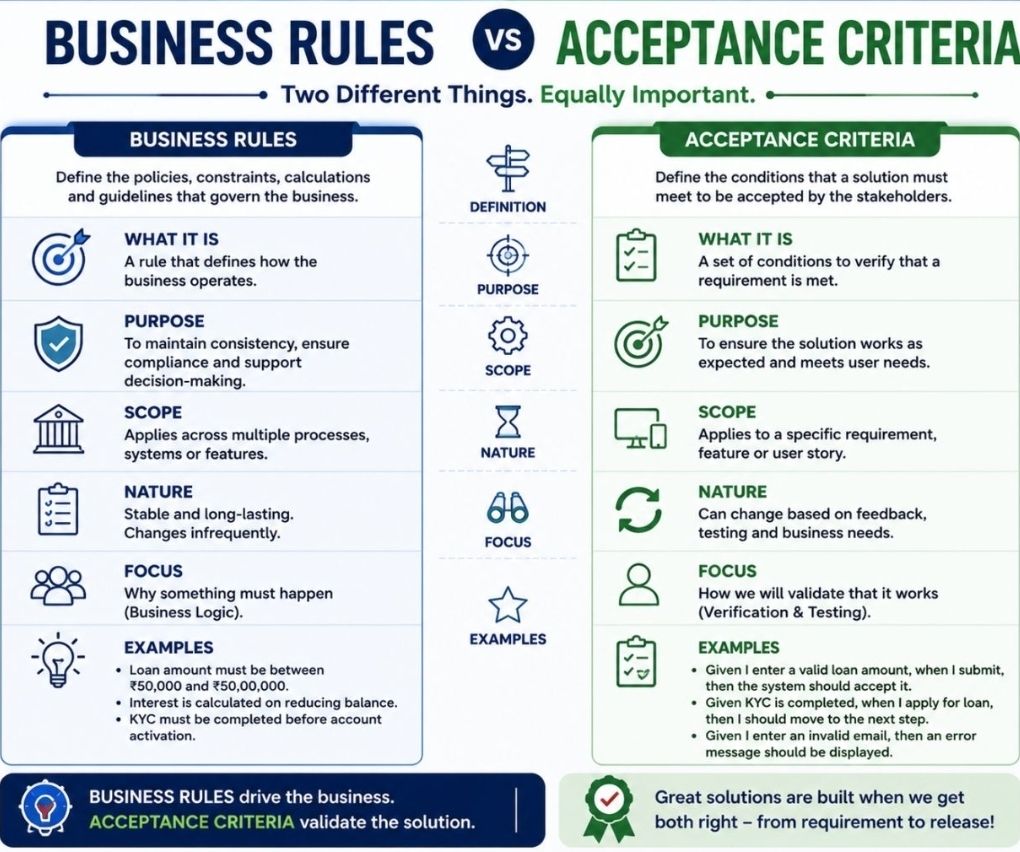
    • Writing user stories and establishing Acceptance Criteria (often using the Given-When-Then format).
    • Creating documentation like process models, wireframes, and data dictionaries.

Week 4: Prioritization & Scope Management

  • Focus: Deciding what gets built first.
  • Activities:
    • Facilitating prioritization sessions using frameworks like the MoSCoW Method (Must have, Should have, Could have, Won’t have).
    • Defining the Minimum Viable Product (MVP) to prevent scope creep.

Week 5: Backlog Refinement & Solution Design

  • Focus: Preparing work for the development team.
  • Activities:
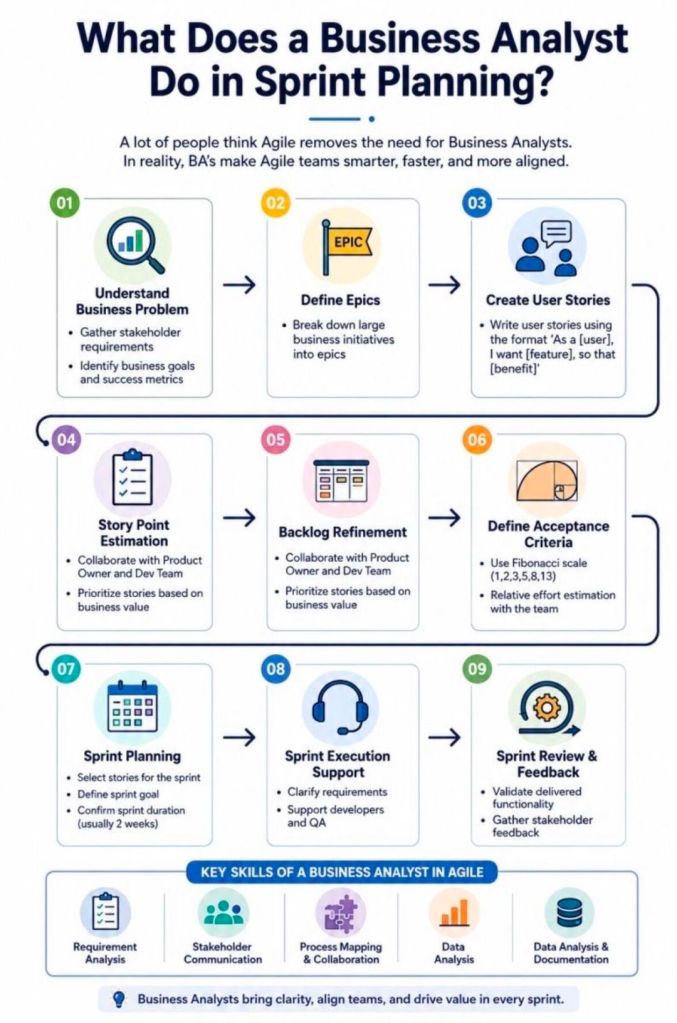
    • Refining the product backlog alongside the Product Owner.
    • Working directly with UI/UX designers and technical architects to ensure designs align with business rules.

Week 6: Development Support & Clarification

  • Focus: Answering daily questions and unblocking the team.
  • Activities:
    • Hosting Agile ceremonies like Sprint Planning and Daily Stand-ups.
    • Clarifying edge cases and adjusting requirements if technical constraints arise during development.

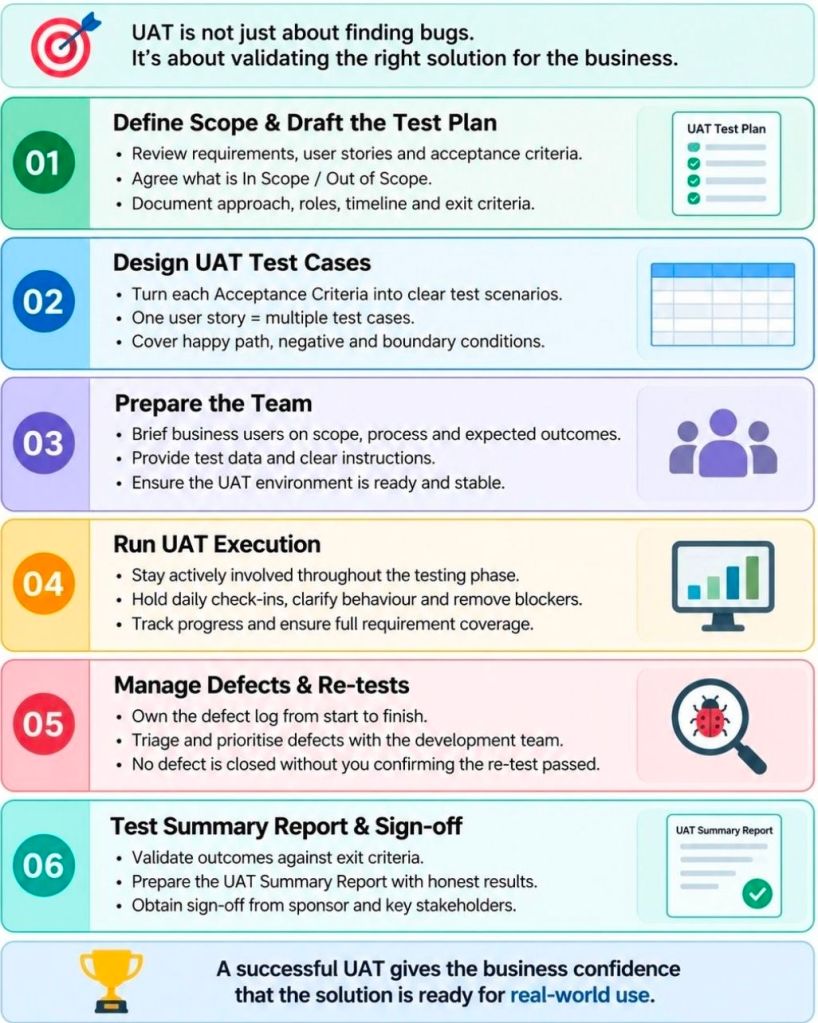
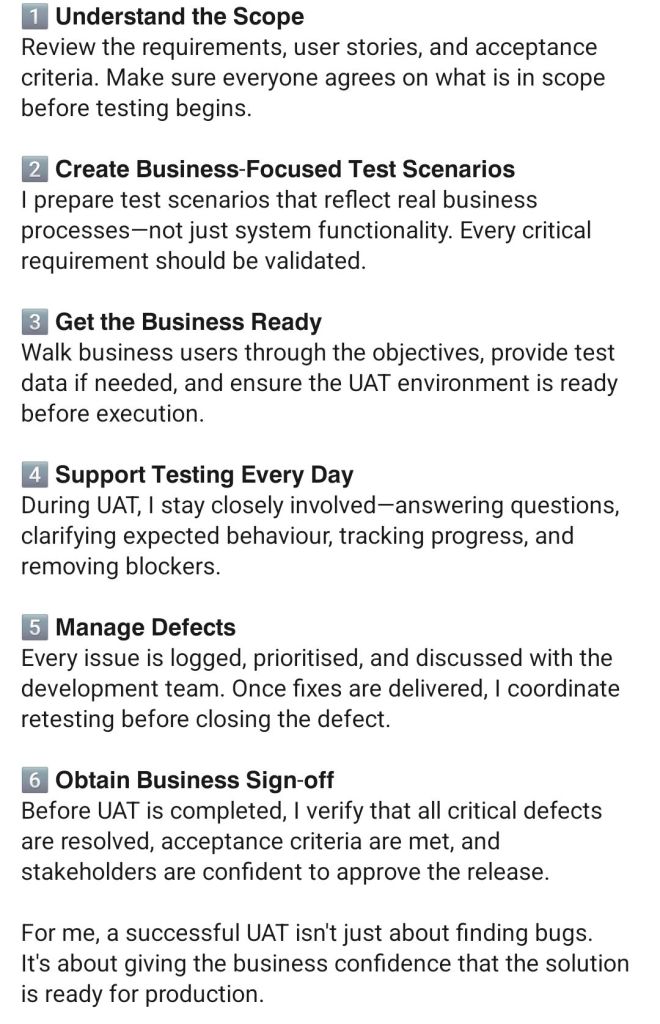
Week 7: Testing & Validation

  • Focus: Ensuring the solution works and meets business needs.
  • Activities:
    • Assisting Quality Assurance (QA) teams by explaining acceptance criteria.
    • Facilitating User Acceptance Testing (UAT) with real business users to sign off on the software.

Week 8: Deployment & Post-Implementation Review

  • Focus: Launching the product and measuring success.
  • Activities:
    • Helping prepare training materials, user manuals, and release notes.
    • Conducting a Retrospective to identify process improvements for the next project phase.

Business Analyst Deliverables across the Full Deliverable Lifecycle

Business Analyst Deliverables across the Full Deliverable Lifecycle

Business Analyst vs Project Manager

Business Analyst vs Project Manager

Business Analyst BA Interview Prep Items

Business Analyst BA Interview Prep Items

Business Analyst (BA) interview prep focuses on demonstrating how you translate business problems into technical/process solutions. Preparation revolves around three core pillars: competence (technical knowledge), communication (behavioral stories), and cultural fit.

1. Technical & Core Knowledge Prep

Familiarize yourself with the fundamental BA methodologies, documentation, and tools:

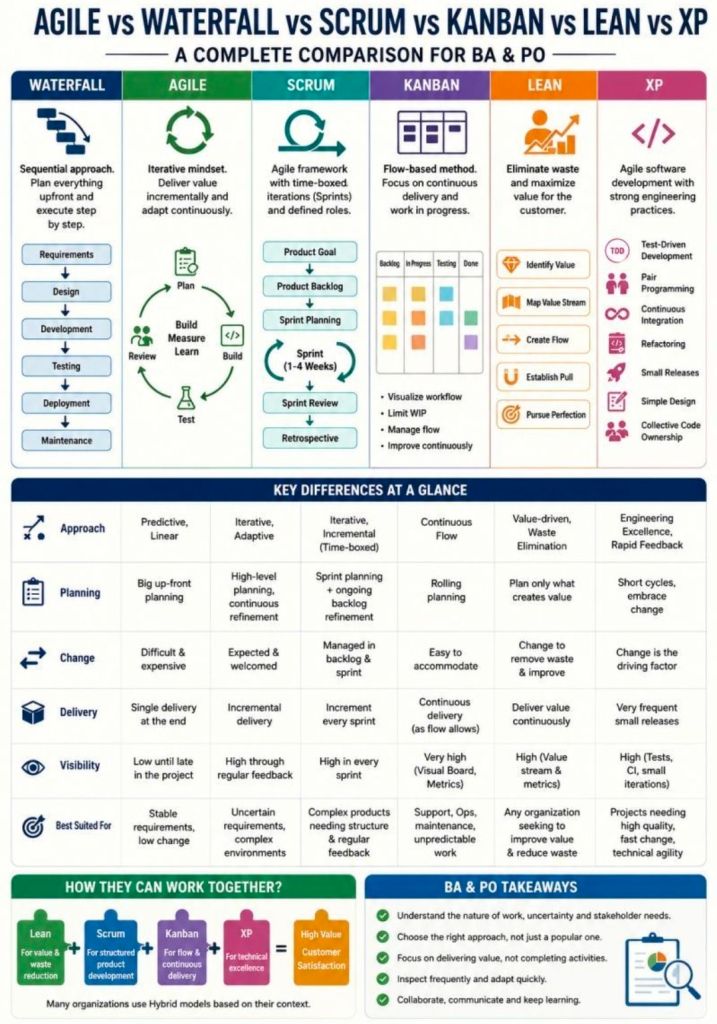
  • Methodologies: Understand the differences between Agile (Scrum, Kanban, sprints, user stories) and Waterfall (structured phase-gating).
  • Documentation: Review how to create a Business Requirements Document (BRD), Functional Requirements Document (FRD), and Software Requirements Specification (SRS).
  • Process Modeling: Refresh your knowledge on reading and creating Use Cases, User Stories, and UML diagrams (Activity diagrams, Flowcharts).
  • Requirements Gathering: Be ready to discuss techniques like interviews, workshops, prototyping, and document analysis.

2. Behavioral & Scenario Prep (The STAR/STARS Method)

Expect situational questions that require you to tell a story about your past experience. Structure your answers using the STAR method (Situation, Task, Action, Result):

  • Conflict Resolution: How do you align stakeholders with opposing views or conflicting priorities?
  • Scope Creep: How do you manage a stakeholder requesting major changes midway through a project?
  • Ambiguity: Tell me about a time you had to work with limited data or changing requirements.
  • Failure/Mistakes: Describe a time you made an analytical error or missed a requirement and how you resolved it.

3. Interview Action Items Checklist

  • Work Samples: Bring a physical or digital portfolio containing redacted work samples (e.g., a process flow, user story backlog, or requirements document you’ve built).
  • The 30-60-90 Day Plan: Think about how you would approach the first few months on the job. (e.g., Day 1-30: Learn the business domain; Day 31-60: Map current processes; Day 61-90: Identify optimization opportunities.)
  • Reverse Questions: Prepare engaging questions to ask the interviewer, such as: “What does success look like in this role in the first 6 months?” or “Can you share more about how BAs collaborate with the technical team here?”