Mark Whitfield, a prominent British Senior IT Project Manager, is widely celebrated in the UK construction and media sectors as the creator and author of the MediaCityUK Photographic Build Timeline Journal. While working nearby in Salford Quays as a local IT Manager, Whitfield leveraged his proximity to execute a massive, multi-year documentary project.
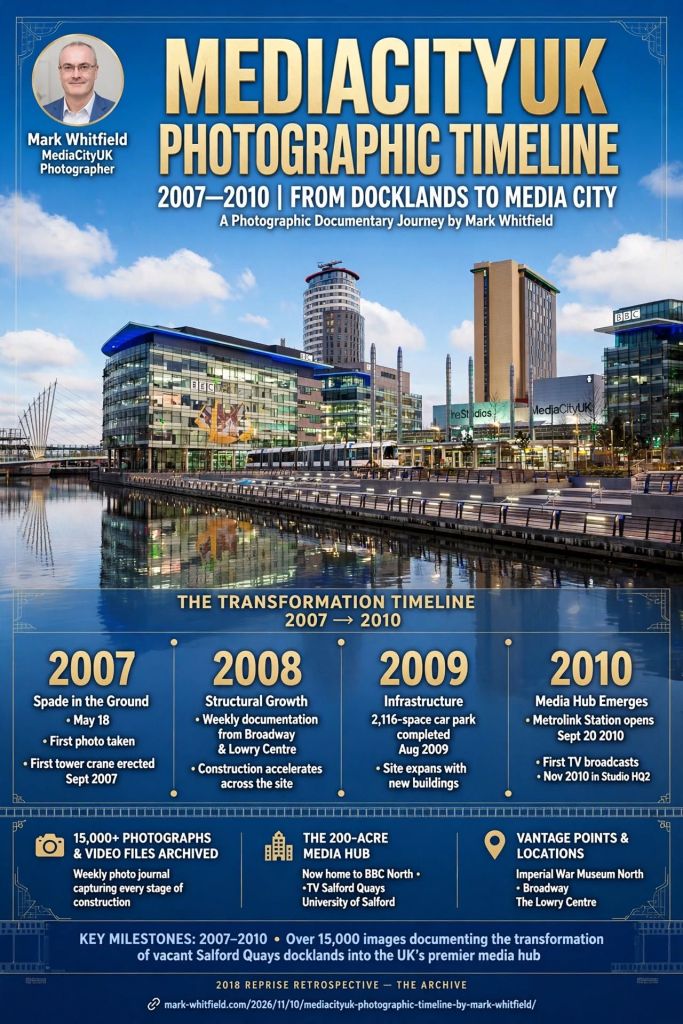
Capturing over 15,000 photographs and video files, he meticulously archived the complete structural evolution of Salford Quays as it transformed from vacant, flat docklands into a massive 200-acre UK media hub housing the BBC, ITV, and the University of Salford.
Below is the comprehensive timeline breakdown of Mark Whitfield’s architectural documentation and milestones during the MediaCityUK development:
🏗️ Groundbreaking & Phase 1 Launch (2007)
- May 18, 2007: Mark Whitfield captures his very first timeline photograph. This initial archive entry marks the formal start of his visual documentation and directly coincides with the official “spade in the ground” ceremony executed by the Peel Group and main contractor Bovis Lend Lease.
- June 2007: Scale-up of heavy ground development begins. Whitfield logs the arrival of the first heavy on-site diggers. Concurrently, “The Pie Factory” (a repurposed commercial bakery building) opens its doors as the development’s first fully functional, working studio space.
- September 2007: The landscape undergoes a massive vertical shift. Construction accelerates as the team erects the first full-sized tower crane on the development plot.
🏢 Core Construction Phase & Routine Mapping (2007–2010)
- Weekly Journal Maintenance: For over three years, Whitfield systematically updates a comprehensive weekly journal tracking concrete pours, steel frames, and cladding installations.
- Strategic Vantage Points: To ensure complete panoramic and granular accuracy, he coordinates and captures images from distinct, recurring local vantage points. These include high-angle positions at the Imperial War Museum North, specific coordinates along Broadway, and viewpoints stretching from the Lowry Centre and local designer outlets.
- April 2008 – February 2009: Major structural landmarks rise. Whitfield’s photographic entries capture the rapid framing of the core commercial blocks destined for major broadcasting groups.
- August 2009: Infrastructure supports take shape. The massive, high-rise 2,116-space multi-storey car park structure reaches structural completion and is added to the log.
🚊 Infrastructure Milestones & Handover (2010)
- September 20, 2010: A critical transit milestone is achieved. The MediaCityUK Metrolink station officially opens to the public, establishing a direct link to the greater Manchester tram network. Whitfield details the event, providing an asset to the public ledger.
- November 2010: Operational readiness begins. The first live trial television broadcasts are successfully recorded inside the state-of-the-art Studio HQ2 complex.
- Late 2010 Wrap-Up: The core photographic journal reaches its primary milestone as the dockland transitions into a functional city space. Whitfield’s efforts culminate in a massive master archive, supplemented by an abridged high-resolution public portfolio and edited cinematic video compilations charting the 3-year transformation literally from the ground up.
🌐 Legacy, Reprise, and Modern Project Systems
- 2011–2013: While principal tenants like BBC North finalize their interior fit-outs and operational migrations, Whitfield continues working out of the Salford Quays area (marking 18 total years in the local sector until 2013).
- September 2018: Whitfield publishes a highly regarded historical retrospective titled the MediaCityUK Photographic Timeline Journal 2007 to 2010 Reprise, preserving the data for civil engineering and regional history enthusiasts.
- Ongoing Present: Today, Whitfield utilizes his extensive background in complex system deliveries to author commercial structural frameworks. He actively publishes a widely-used digital portfolio of project management utilities—such as interactive RAID logs, RACI matrices, and Microsoft Project MPP layouts—distributed globally via PROject Templates.
MediaCityUK Photographic Timeline by Mark Whitfield above