Agile project management summary and detailed historical timeline by era and year

Agile project management is an iterative, incremental approach to project management that focuses on flexibility, continuous improvement, and rapid delivery of value. Unlike the linear “Waterfall” approach, Agile breaks projects into small, time-boxed cycles (sprints or iterations) to allow for frequent feedback and adaptation to changing requirements. 

Summary of Agile Project Management

  • Core Values: Individuals/interactions over tools, working software over documentation, customer collaboration over negotiation, and responding to change over following a plan.
  • Key Techniques: Sprints, daily stand-up meetings, visual control (Kanban boards), and user stories.
  • Primary Benefits: Increased adaptability, higher quality through continuous testing, faster ROI, and better team collaboration.
  • Common Frameworks: Scrum, Kanban, Extreme Programming (XP), Crystal, and Dynamic Systems Development Method (DSDM). 

Detailed Historical Timeline of Agile (1950s–Present) 

1. The Pre-Agile Era: Iterative Roots (1950s–1980s) 

Before “Agile” was a term, software pioneers experimented with iterative approaches to break away from linear, heavy-documentation processes. 

  • 1957: Gerald M. Weinberg begins experimenting with incremental development at IBM.
  • 1968: “Conway’s Law” is coined, highlighting the impact of organizational communication on system design.
  • 1970s: Barry Boehm proposes “Wideband Delphi,” a forerunner to modern estimation techniques like Planning Poker.
  • 1985: Tom Gilb introduces the “Evolutionary Delivery Model” (Evo), focusing on small, incremental releases.
  • 1986: Takeuchi and Nonaka publish “The New New Product Development Game” in Harvard Business Review, describing a rugby-like approach that inspires Scrum.
  • 1988: Scott Schultz describes timeboxing in “Rapid Iterative Production Prototyping”. 

2. The Birth of “Lightweight” Methods (1990s)

Practitioners, frustrated with the “Waterfall” approach, created new, faster methodologies, often called “lightweight” methods. 

  • 1991: James Martin releases Rapid Application Development (RAD), popularizing prototyping and iterative feedback.
  • 1993: Jeff Sutherland, John Scumniotales, and Jeff McKenna develop the first Scrum framework at Easel Corporation.
  • 1994: The Dynamic Systems Development Method (DSDM) is created to provide structure to RAD.
  • 1995: Ken Schwaber and Jeff Sutherland co-present the Scrum methodology at the OOPSLA Conference.
  • 1996: Kent Beck develops Extreme Programming (XP) at Chrysler; Jon Kern, Ivan Joseph, and Peter Coad create Feature-Driven Development (FDD).
  • 1997: Ken Schwaber describes the “Daily Scrum”.
  • 1998: The Chrysler Goes to Extremes case study popularizes XP practices like pair programming and three-week iterations. 

3. The Agile Manifesto and Formalization (2000s)

  • 2000: A group of 17 thought leaders meets in Oregon to discuss lightweight development, setting the stage for the Manifesto.
  • 2001 (Feb): The 17 developers meet at Snowbird, Utah, to formulate the “Manifesto for Agile Software Development”.
  • 2001 (Late): The Agile Alliance is formed to support the community.
  • 2004: Ken Schwaber and Mike Beedle publish Agile Software Development with Scrum; Jim Highsmith publishes Agile Project Management.
  • 2009: Kanban gains significant traction in the IT sector, focusing on continuous flow. 

4. Mainstream Adoption and Scaling (2010s)

  • 2010s: Real-life success metrics and case studies accompany Agile, driving adoption above 50%.
  • 2011: The Agile Alliance holds “Agile2011” to reflect on ten years of the Manifesto.
  • 2012-2015: Large-scale adoption accelerates, prompting the creation of frameworks like SAFe (Scaled Agile Framework) and LeSS (Large-Scale Scrum).
  • 2017: AXELOS releases PRINCE2 Agile; Agile Testing gains a formal, collaborative definition. 

5. Enterprise Agility and Beyond (2020s)

  • 2020: COVID-19 pandemic drastically accelerates the adoption of remote/distributed Agile and digital tools like Jira.
  • 2021+: Continued focus on “Business Agility,” moving Agile principles from IT departments into HR, marketing, and leadership teams. 

Evolution of Core Methodologies

  • Scrum: Emerged 1993/1995 (Sutherland/Schwaber).
  • XP (Extreme Programming): Emerged 1996 (Beck).
  • Crystal: Emerged 1991 (Cockburn).
  • FDD (Feature Driven Development): Emerged 1997.
  • Kanban: Adopted from manufacturing (Toyota 1940s) and applied to IT in late 2000s. 

Agile project management summary and detailed historical timeline by era and year

Kanban project management summary and detailed historical timeline by era and year

Kanban is a visual project management framework used to implement lean and agile methodologies, focusing on reducing waste, managing work-in-progress (WIP), and ensuring continuous, high-quality flow. Originating from Japanese manufacturing in the 1940s, it has evolved into a dominant, flexible system for knowledge work, software development, and everyday task management, characterized by “pulling” work only when capacity allows. 

Summary of Kanban Project Management

  • Definition: “Kanban” is Japanese for “signboard” or “visual card”. It is a system for managing work as it moves through a process.
  • Core Principles: Visualize workflow, limit work-in-progress (WIP), manage flow, make process policies explicit, and improve collaboratively.
  • Key Components: Kanban Board (visual representation), Kanban Cards (work items), and Columns (workflow stages like To Do, Doing, Done).
  • Key Benefits: Increased visibility of bottlenecks, improved team focus, flexibility in priorities, and reduced waste (overproduction/excess inventory).
  • “Pull” System: Work is only started when a downstream team member “pulls” a new card, preventing overburdening.

Detailed Historical Timeline

Era 1: Roots & Conceptualization (1600s – 1930s)

  • 1600s (Edo Period): The term “Kanban” originates, referring to signboards used by Japanese shops to attract customers and distinguish their services, representing the need to communicate content clearly.
  • 1920s: Sakichi Toyoda, founder of Toyoda Automatic Loom Works, invents automatic looms that stop if a thread breaks, establishing the “jidoka” (automation with a human touch) principle.
  • 1930s: Toyota releases its first automobiles, with manufacturing heavily influenced by American assembly line methods. 

Era 2: Toyota Production System (1940s – 1990s) 

  • Late 1940s: Taiichi Ohno, an industrial engineer at Toyota, develops the “Just-in-Time” (JIT) production system to minimize waste and inventory costs while increasing manufacturing efficiency.
  • 1953: Toyota applies supermarket-style “pull” logic to its main plant machine shop, using cards to signal demand and replenish materials.
  • 1956: Ohno visits American supermarkets and studies how shelf-stocking relies on customer demand to trigger replenishment.
  • 1963: The Kanban system is officially implemented and adopted across all Toyota factories.
  • 1973–1978: Ohno publishes the principles of the Toyota Production System, popularizing Lean Manufacturing. 

Era 3: Transition to Knowledge Work (2000s) 

  • 2001: The Agile Manifesto is published, highlighting the need for faster software development, which Kanban later helps achieve.
  • 2003: Mary and Tom Poppendieck publish “Lean Software Development: An Agile Toolkit,” mapping manufacturing principles to IT.
  • 2004: David J. Anderson applies “pull system” principles to Microsoft’s XIT Sustaining Engineering group, creating the “Kanban Method”.
  • 2005: David Anderson implements the first Kanban system for change request management at Corbis.
  • 2007: Anderson introduces Kanban to the Agile community at the Agile 2007 conference. Karl Scotland introduces Kanban to Yahoo!.
  • 2008: The “kanbandev” Yahoo! group is formed, fostering community development of virtual kanban systems. 

Era 4: Modernization and Global Adoption (2009 – Present)

  • 2009: Corey Ladas publishes “Scrumban,” exploring the mix of Scrum and Kanban. The first Lean Kanban conference is held in Miami.
  • 2009 (Summer): Jim Benson begins developing Personal Kanban, applying the methodology to personal organization.
  • 2010: Anderson publishes “Kanban: Successful Evolutionary Change for Your Technology Business”, cementing the framework in tech management.
  • 2011: Jim Benson and Tonianne DeMaria Barry publish “Personal Kanban”.
  • 2016: “Essential Kanban Condensed” is published by David Anderson and Andy Carmichael, distilling the method into five core practices.
  • 2020s: Digital Kanban tools become industry standard for remote work, and adoption spreads to non-tech industries like marketing, human resources, and law.

Kanban project management summary and detailed historical timeline by era and year

Waterfall project management is a linear, sequential methodology

Waterfall project management is a linear, sequential methodology where progress flows steadily downward through defined phases, much like a physical waterfall. In this model, each stage—such as requirements, design, implementation, and testing—must be fully completed and approved before the next one begins. 

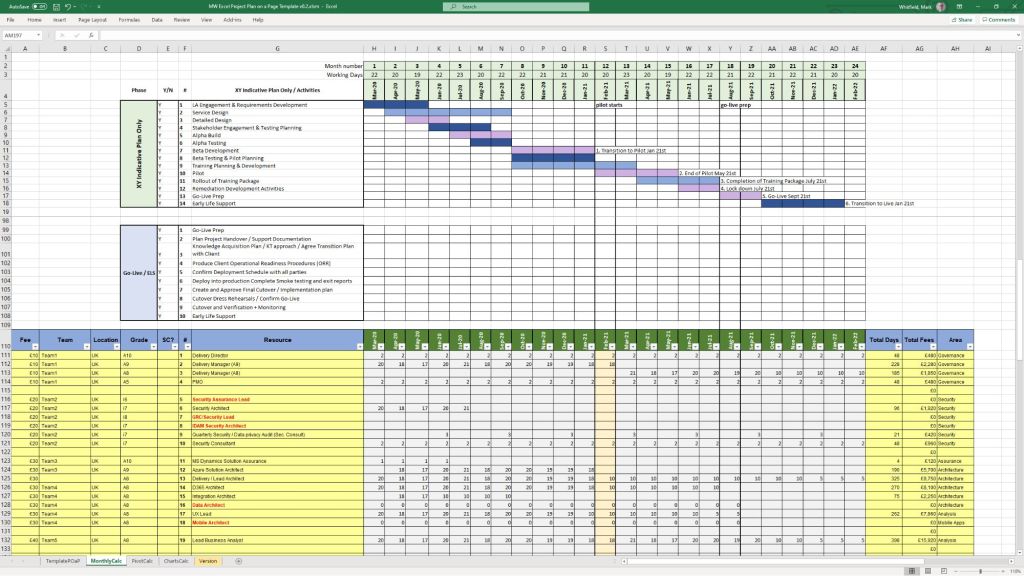
Waterfall Project Plans, .xls and .mpp file formats respectively

Core Characteristics

  • Sequential Design: No overlapping phases; each “cascades” into the next.
  • Documentation-Driven: Extensive upfront planning and detailed records are required at every step.
  • Fixed Scope: Requirements are gathered at the start, making the project’s timeline and budget highly predictable but difficult to change.
  • Specialised Use: Best suited for regulated industries like aerospace, construction, and healthcare, where changes are costly or safety is paramount. 

Historical Timeline by Era and Year

The following timeline tracks Waterfall from its origins in post-WWII engineering to its current role in hybrid project management.

Examples, Waterfall Plan On a Page POaP in MS PowerPoint format

The Pre-Formal Era (1950s – 1969)

Software development adopted structured, sequential approaches from engineering, largely driven by complex, high-risk projects. 

  • 1956Herbert D. Benington documented a sequential process for the SAGE project, establishing the technical roots.
  • Late 1960sNASA applied linear, rigid methodologies to Apollo missions, setting a precedent for high-stakes, documentation-heavy development.
  • 1968: The NATO Software Engineering Conference highlighted the “software crisis,” prompting a push for formal, disciplined development models. 

The Formalisation Era (1970 – 1979)

The model was officially, yet ironically, described and named. 

  • 1970Dr. Winston W. Royce published his foundational paper on managing large software systems, often cited as the origin of the “Waterfall” model, though he originally presented it as a cautionary, flawed approach.
  • 1976T.E. Bell and T.A. Thayer likely first used the term “Waterfall” in literature. 

The Institutional Era (1980 – 1999)

Waterfall became the mandatory standard for large-scale, complex projects. 

  • 1985: The U.S. DoD mandated DOD-STD-2167, cementing Waterfall as the standard for military software.
  • 1989: The UK Government introduced PRINCE2, deeply influenced by Waterfall principles.
  • 1994: The U.S. DoD formally abandoned strict Waterfall mandates for more flexible methods. 

The Modern & Hybrid Era (2000 – Present)

Waterfall transitioned from the default standard to a specialised methodology. 

  • 2001: The Agile Manifesto marked a shift toward iterative development, reducing Waterfall’s dominance.
  • Present Day: It remains vital in regulated sectors (e.g., aerospace) and is often combined with Agile in hybrid approaches.

Waterfall project management is a linear, sequential methodology

Click on the link in the website banner above to purchase example, editable template project plans shown and many others.

Project Management Process Summary

Project Management Process Summary

Project Management Processes Summary

Project Management Processes Summary

Waterfall Methodology in Project Management, a Timeline History

The Waterfall methodology is a linear, sequential project management approach where progress flows steadily downward through defined phases, such as requirements, design, implementation, and testing. Each stage must be completed and approved before the next begins, making it highly structured but often inflexible to changes. 

Waterfall template available on this website

Historical Timeline by Era and Year

The history of the Waterfall model spans from early post-WWII engineering to its formalisation in software and eventual institutionalisation in government standards. 

The Pre-Formal Era (1950s – 1969)

During this period, software development borrowed heavily from established engineering and manufacturing processes. 

  • 1956: Herbert D. Benington presents a paper on the Semi-Automatic Ground Environment (SAGE) project, describing a structured process that many consider the true technical origin of the sequential approach.
  • Late 1960s: Major NASA projects and government software systems for rockets (e.g., Apollo missions) utilise rigid specifications and linear development due to the high cost of changes.
  • 1968: The NATO Software Engineering Conference identifies the “software crisis”—projects consistently running over budget and time—leading to a push for more disciplined models. 

The Formalisation Era (1970 – 1979)

The methodology was formally described, ironically as a cautionary tale, and finally given its name. 

  • 1970: Dr. Winston W. Royce publishes “Managing the Development of Large Software Systems”. He presents the sequential diagram but explicitly critiques it as “risky and invites failure,” suggesting a more iterative approach instead.
  • 1976: The term “Waterfall” is officially coined in a paper by Bell and Thayer, “Software Requirements: Are They a Problem?”. 

The Institutional Era (1980 – 1999)

Waterfall becomes the global standard for large-scale and regulated industries. 

  • 1985: The U.S. Department of Defense (DoD) adopts DOD-STD-2167, which mandates the use of the Waterfall model for all software development contractors. This cements Waterfall as the “one true way” for government and aerospace projects.
  • 1989: The UK Government creates PRINCE2, a process-based method largely rooted in Waterfall principles, still widely used in the public sector today.
  • 1991: In response to Waterfall’s rigidity, James Martin introduces Rapid Application Development (RAD), one of the first major departures from the linear model. 

The Modern & Hybrid Era (2000 – Present)

As Agile became dominant, Waterfall shifted from the default choice to a specialised or hybrid tool. 

  • 2001: The Agile Manifesto is published, marking a significant industry-wide shift away from traditional Waterfall toward iterative development.
  • 2009: Major institutions like George Washington University and others begin documenting their Project Management Lifecycle (PMLC) to standardise Waterfall and hybrid models for better oversight.
  • 2020s: Waterfall persists in regulated domains like healthcare, aerospace, and construction. It is increasingly integrated into hybrid methodologies that use Waterfall for high-level planning and Agile for execution. 

Waterfall Methodology in Project Management, a Timeline History

Waterfall template available on this website

Project Management LinkedIn Group

Project Management LinkedIn Group

https://www.linkedin.com/groups/163300

Project Management Café, PRINCE2 Agile SCRUM Kanban MPP MSP Templates ITIL LEAN DevOps PMP Six Sigma

This is a Project Management Group Café for PM students, graduates and professionals looking to either locate, discuss or contribute ideas for PM templates for; Agile, Scrum, Kanban, PRINCE2 Waterfall projects, e.g. Plan on a Page (POaP), RACI, MPP, RAID logs, finance trackers, status reports, org charts etc. etc.

Project Management LinkedIn Group

PRINCE2 and Agile Project Management Templates Gallery

A gallery and inventory of screenshots for the Project Management Templates (both Agile and PRINCE2 waterfall projects) that are all available to be purchased as a bundle from this website link (note: upgrades to the latest template package after purchase, are totally FREE).

PRINCE2 & Agile PM Templates Gallery

PM templates include MS Project MPP and MS Excel detailed plans including PRINCE2 and Agile delivery, Gantt Plan on a Page examples (POaP), finance trackers, status reports, RAID logs (Risk, Issue, Assumption, Dependency log), RACI tracker (Responsible, Accountable, Consulted, Informed), agile burn down chart and burn up chart, resource tracker, benefits realization plan etc. etc.

(Download the Template Inventory PDF file – 15MB)

Join the FREE PM templates related Facebook Group (LIKE Facebook page) and LinkedIn Group.

PRINCE2 and Agile Project Management Templates Gallery examples

MPP Microsoft Project Plan Examples
Agile Scrum Burn Down (and Up) Chart in Microsoft Excel
Example Microsoft Excel Spreadsheet Examples for Project Planning

PRINCE2 & Agile PM Templates Gallery

Project Management Success Wheel, 8 Key Elements

Project Management Success Wheel, 8 Key Elements

Project Management Mistakes Overview

Project Management Mistakes Overview

Project Management KPIs to track

Project Key Performance Indicators KPIs
Key Performance Indicators KPI overview

Project Management KPIs to track

Mark Whitfield HP NonStop Tandem experience & Project Management Templates

Mark Whitfield is an experienced IT Project Manager and software developer who has spent over 22 years specialising in HP NonStop (formerly Tandem) systems. He is currently an Engagement Project Manager at Capgemini

Career & Expertise

Whitfield’s career in HP NonStop began in 1990 and includes significant technical and leadership roles across the financial and technology sectors: 

  • Software Development: Early in his career, he worked as a programmer for The Software Partnership (later Deluxe Data/FIS), focusing on electronic banking software like sp/ARCHITECT on Tandem mainframes.
  • Insider Technologies (1995–2013): He spent 18 years at Insider Technologies as a Senior Development Engineer and Project Manager. His work involved:
    • Developing monitoring and diagnostic software such as Reflex 80:20Reflex ONE24, and RTLX (Real-Time Log Extraction) for payment systems.
    • Managing the first HP OpenView Operations Smart Plug-In certification for the NonStop platform.
    • Designing XPERT24, a performance tracking product for ACI’s XPNET layer.
  • Capgemini (2016–Present): As an Engagement Project Manager, he has led digital projects for major clients in the automotive, government, and aerospace sectors, including a cloud migration for UK Government applications. 

Technical Contributions

  • Publications: He has authored articles for globally published journals like The Connection (2013), discussing topics such as querying terabytes of legacy transaction log data from NonStop mainframes.
  • Project History: He has managed high-value projects, including a £5 million initiative to migrate legacy HP NonStop software to AIX-based technologies for a large UK retail bank.
  • Training: He is trained in various NonStop-specific technologies, including TAL (Transaction Application Language), COBOL85PATHWAY, and NonStop SQL

Whitfield also maintains a professional website, mark-whitfield.com, where he provides project management templates and resources related to HP NonStop and Tandem systems. 

Mark Whitfield provides a comprehensive bundle of over 200 editable project management templates designed for Agile, Waterfall, and PRINCE2 methodologies. These templates are based on over 30 years of project delivery experience and are available for purchase via his official website or Etsy shop. 

Key Template Categories

The bundle includes a wide variety of tools across different formats (Excel, PowerPoint, Word, and MS Project): 

  • Planning & Scheduling:
    • Plan on a Page (POaP): Over 30 PowerPoint slide examples for executive-level summaries.
    • Detailed Project Plans: MS Project (MPP) and Excel templates for SDLC, PRINCE2 7th Edition, and Agile Scrum projects.
    • Gantt Charts: Built-in tracking views for both MS Project and Excel.
  • Tracking & Control:
    • RAID Logs: Comprehensive logs for tracking Risks, Actions, Issues, and Dependencies, plus additional tabs for Change Requests and Lessons Learned.
    • RACI Matrix: Templates to define project roles and responsibilities (Responsible, Accountable, Consulted, Informed).
    • Finance Trackers: Tools for internal and external forecast vs. actual costs, including margin and variance tracking.
  • Agile Specific Tools:
    • Burn Down & Burn Up Charts: Excel-based alternatives when tools like Jira are unavailable.
    • Agile Story Dependency Tracking: Specifically for managing dependencies between agile stories and external suppliers.
  • Reporting & Governance:
    • Status Reports: Weekly and monthly templates in Word and PowerPoint formats.
    • Stakeholder Analysis: Power/interest mapping and engagement plan templates.
    • Benefits Realisation: Plans to track project outcomes against initial business goals. 

Purchase Benefits

  • Lifetime Upgrades: Once purchased, all future additions and updates to the template package are provided for free.
  • Compatibility: Templates are designed for Microsoft Office 365 but also include Excel versions compatible with earlier software.
  • Support: The package typically includes walkthrough Word documents to guide users on how to use each major template.

Mark Whitfield HP NonStop Tandem experience & Project Management Templates

Project Management mindset, 8 thought processes

Project Management mindset, 8 thought processes

Product and Project Management

Product and Project Management

Project Management, Pre-Contract vs Post- Contract Phase

Project Management, Pre-Contract vs Post- Contract Phase

Project Management, Servant Leadership

Project Management, Servant Leadership

Project Scope vs Project Scope Statement in Project Management

Project Scope vs Project Scope Statement in Project Management

Project Management and Cost Control

Project Management and Cost Control

Essential Project Management Skills

Essential Project Management Skills

Project Management evolution timeline by era

The history of project management has evolved from ancient manual coordination to highly sophisticated, digital-first methodologies

Pre-20th Century: The Era of Ancient Marvels

During this era, project management was characterized by massive labour forces and basic resource coordination without standardized scheduling tools. 

  • 2570 BC: Completion of the Great Pyramid of Giza. Documentation shows managers were assigned to each of the four faces to oversee progress.
  • 208 BC: Construction of the Great Wall of China. Labour was systematically organized into groups of soldiers, civilians, and criminals.
  • 1850s: Construction of the Pacific Railroad. This is often cited as one of the first large-scale industrial project management undertakings in the U.S.. 

1900–1950: The Birth of Modern Project Management 

This era introduced scientific management principles and the first visual scheduling tools. 

  • 1911Frederick Taylor publishes The Principles of Scientific Management, focusing on efficiency and unskilled labour training.
  • 1917Henry Gantt develops the Gantt Chart, a radical tool for visualising schedules that remains a global standard today.
  • 1931–1936: Construction of the Hoover Dam. This project was a major early adopter of Gantt’s scheduling techniques.
  • 1942–1945The Manhattan Project. This complex R&D effort pioneered the use of large-scale task coordination and resource management. 

1950–1980: The Era of Management Science 

Driven by the Cold War and space race, this period saw the creation of mathematical scheduling techniques. 

  • 1956: AACE International is formed, focusing on cost engineering.
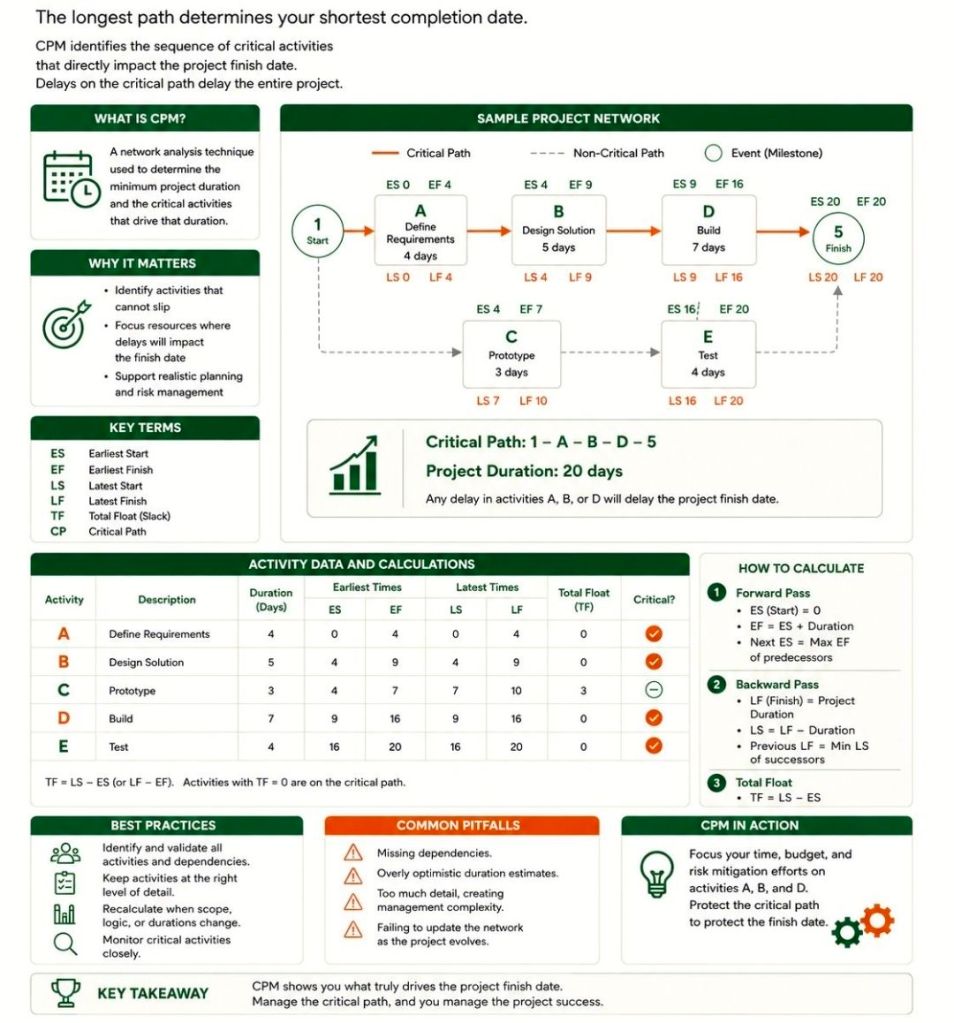
  • 1957–1958: Development of Critical Path Method (CPM) by DuPont and Program Evaluation and Review Technique (PERT) by the U.S. Navy.
  • 1962–1975: Introduction of Work Breakdown Structure (WBS) by the DoD, founding of IPMA and PMI, and development of PROMPT (later PRINCE). 

1980–2000: The Computing Revolution 

Personal computers allowed project management software to proliferate into the private sector. Key milestones included the early Scrum framework and the initial PMBOK Guide release. 

  • 1989–1997: Widespread adoption of Earned Value Management (EVM), release of PRINCE2, and development of Critical Chain Project Management (CCPM)

2000–Present: The Agile and Digital Era 

Modern project management emphasizes flexibility, speed, and digital tools. 

  • 2001: The Agile Manifesto is published.
  • 2012–2021: Release of ISO 21500, major updates to PRINCE2 and PMBOK to integrate Agile, and the shift to performance-based standards in PMBOK 7th Ed.

Project Management evolution timeline by era

Project management has evolved from ancient engineering feats to a highly structured, data-driven discipline. Below is a comprehensive timeline of its historical development and the evolution of its core methodologies. 

Ancient & Early Eras

  • 2570 BC: The Great Pyramid of Giza – Completed with record-keeping and oversight for each of the four faces, demonstrating early forms of planning and control.
  • 208 BC: The Great Wall of China – Built with a massive labour force organised into specific groups: soldiers, ordinary people, and criminals.
  • 1917: Gantt Chart – Developed by Henry Gantt, this scheduling diagram became a radical innovation for tracking project tasks chronologically. 

The Mid-20th Century: Formalization

  • 1956: AACE International Formed – Early practitioners of cost engineering and scheduling founded what is now the leading society for project control specialists.
  • 1957: Critical Path Method (CPM) – Invented by DuPont to address chemical plant maintenance; it saved the company $1 million in its first year.
  • 1958: PERT (Program Evaluation Review Technique) – Developed for the U.S. Navy’s Polaris project to analyse the minimum time needed for task completion.
  • 1962: Work Breakdown Structure (WBS) – Mandated by the U.S. Department of Defense as a hierarchical tree structure for project deliverables.
  • 1965: IPMA Founded – The world’s first project management association was started in Vienna as a global forum for networking.
  • 1969: Project Management Institute (PMI) Launched – Founded to advance the profession, PMI has since become the primary publisher of global standards. 

Late 20th Century: Methodology Proliferation 

  • 1975: PROMPTII & “The Mythical Man-Month” – Guidelines were created for computer projects, while Fred Brooks’s Brooks’s law observed that adding manpower to late software projects makes them later.
  • 1984: Theory of Constraints (TOC) – Introduced by Dr. Eliyahu M. Goldratt, focusing on identifying system bottlenecks.
  • 1986: Scrum – First named as a project management style for software development in a Harvard Business Review paper.
  • 1987: PMBOK Guide First Published – PMI published the first “A Guide to the Project Management Body of Knowledge” as a white paper to standardise practices.
  • 1989: PRINCE & Earned Value Management – The PRINCE method was developed for UK government IT projects; meanwhile, Earned Value Management (EVM) became an essential part of procurement.
  • 1996: PRINCE2 – A more generic revision of PRINCE was published, applicable to any project type.
  • 1997: Critical Chain Project Management (CCPM) – Invented to keep resources levelly loaded and flexible. 

21st Century: Agile & Global Standards

  • 2001: The Agile Manifesto – Written by 17 developers in Utah, codifying the principles of lightweight, iterative software development.
  • 2006: Total Cost Management Framework – Released by AACE International as the first integrated process for portfolio and project management.
  • 2012: ISO 21500:2012 – The International Organisation for Standardisation released its global guidance on project management.
  • 2017: PMBOK 6th Edition & PRINCE2 Update – Updates reflected the integration of Agile practices into traditional project settings.
  • 2021: PMBOK 7th Edition – Shifted toward a principle-based approach to help practitioners be more proactive and innovative.

Project Management Framework – Core Foundations

Project Management Framework – Core Foundations

Project Management Mistakes and How to Avoid

Project Management Mistakes and How to Avoid

RACI and DACI in Project Management

RACI and DACI in Project Management

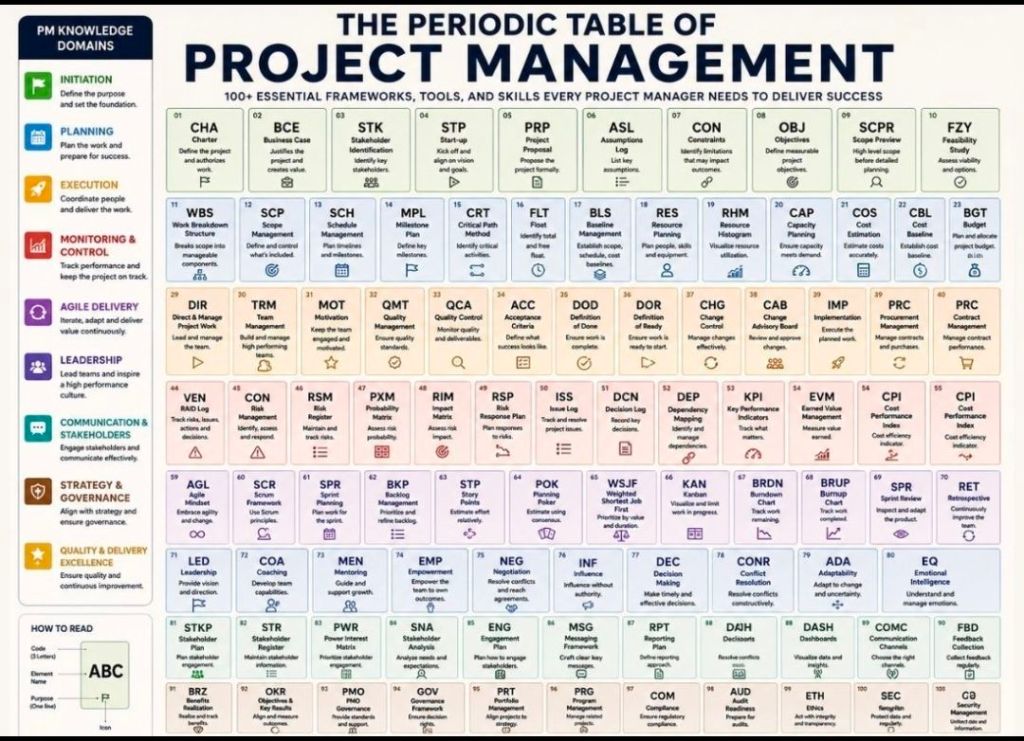
Acronyms in Project Management, Waterfall and Agile

Acronyms in Project Management, Waterfall and Agile

Traditional Project Management vs Agile Management

Traditional Project Management vs Agile Management