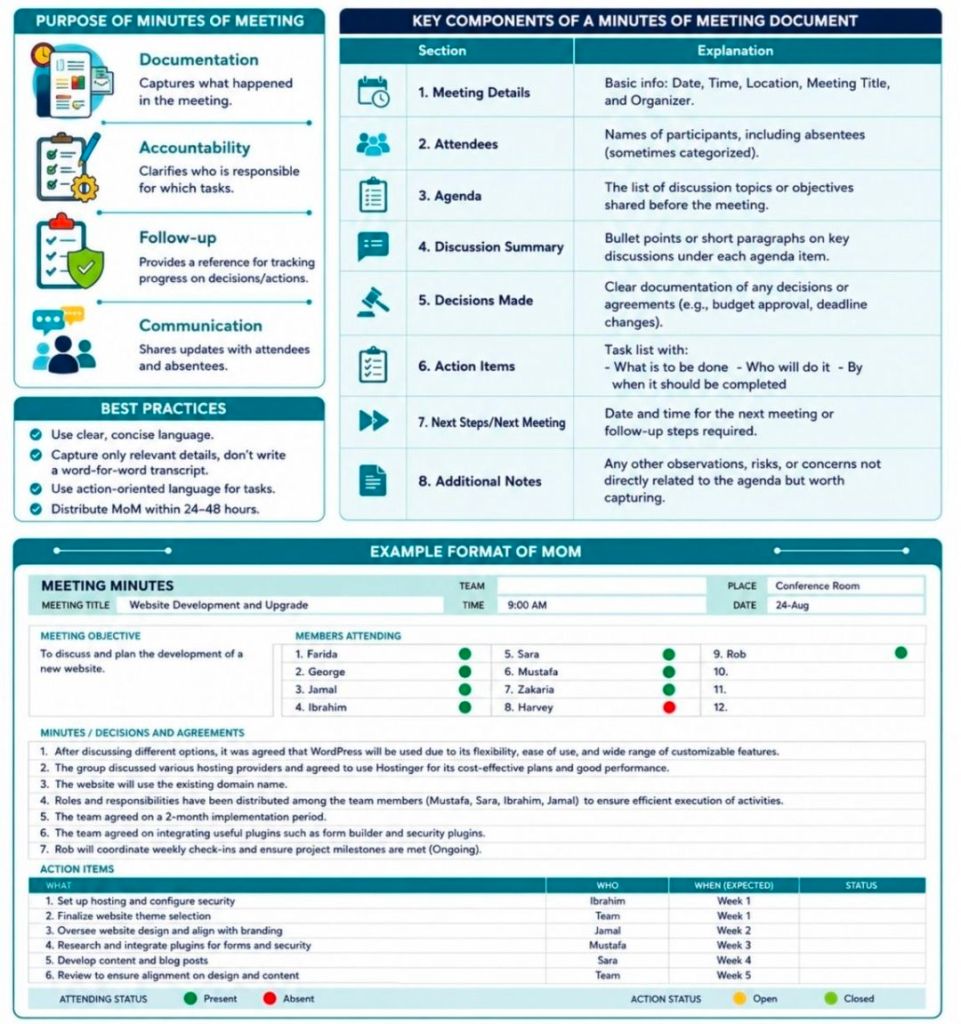
Minutes of Meeting (MoM), or MOM, is the official written record of a project meeting, capturing critical discussions, decisions made, and assigned action items.
In project management, MOM serves as a single source of truth to hold team members accountable, track project requirements, and provide a legal paper trail to prevent disputes over scope, timeline, or budget.
Essential Elements of an Effective MOM
To be effective, your meeting minutes should always contain the following core components:
Meeting Overview: Project name, meeting title, date, time, and location (or virtual platform).
Attendees & Absentees: A clear list of who was present (and their roles) and who gave apologies for being unable to attend.
Agenda: The topics scheduled for discussion.
Key Discussion Points: A concise summary of what was debated and the context behind decisions.
Decisions Made: Clear, unambiguous notes on agreements, approvals, or rejections.
Action Items: The most critical section. Every task must include a description, the Person in Charge (PIC), and a Due Date.
Next Meeting: The date, time, and objective of the follow-up meeting.
Best Practices for Project Managers
Draft Immediately: Write or format your minutes within the first hour post-meeting while the discussions are still fresh.
Distribute for Sign-Off: Circulate the finalized document to all stakeholders to ensure everyone’s understanding matches and to allow for corrections.
Store Securely: Maintain a chronological, searchable digital repository for all project meetings.
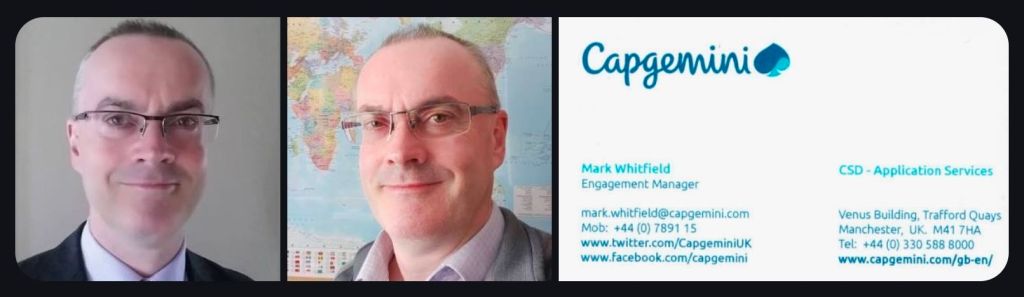
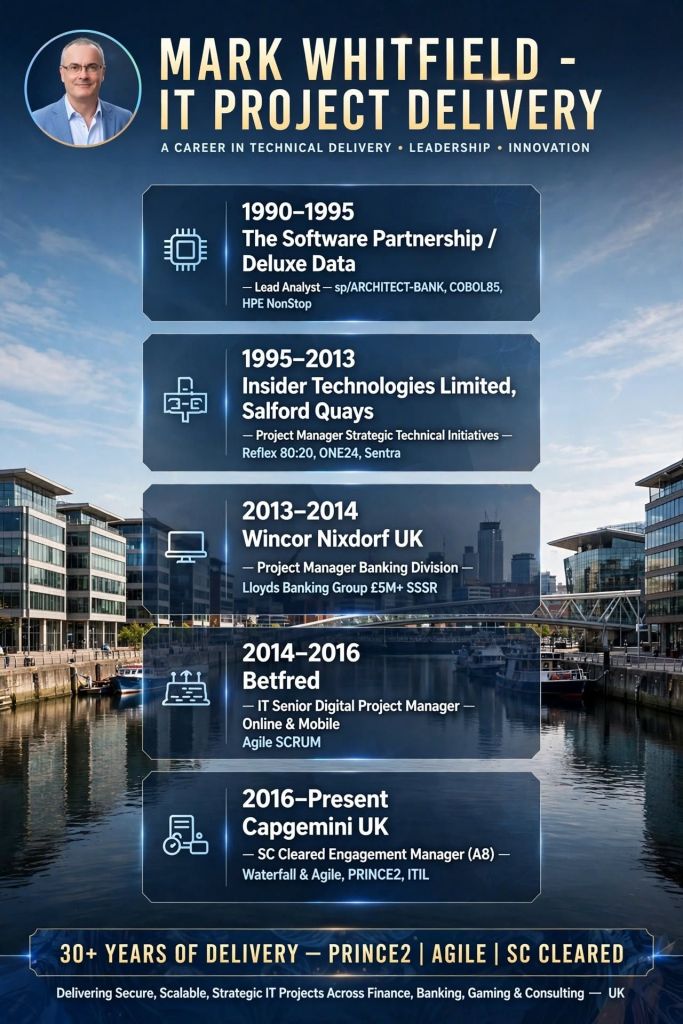
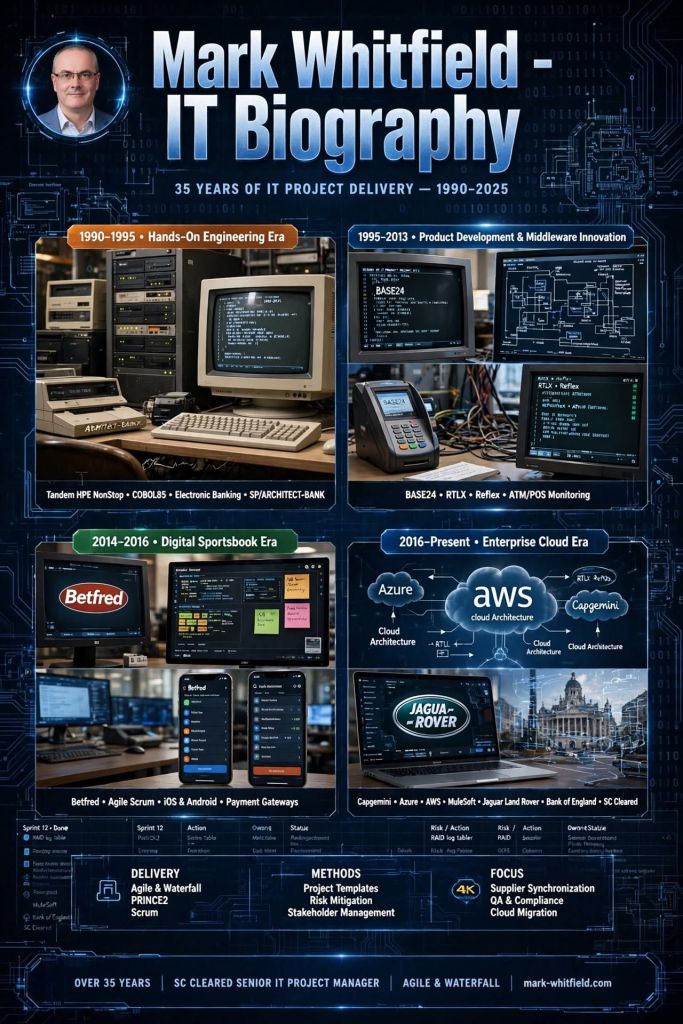
Mark Whitfield is a UK-based, SC-cleared Senior IT Project Manager and Engagement Manager whose career spans over three decades of evolution within the software development lifecycle (SDLC) and project delivery areas.
Mark Whitfield | SC-cleared Senior IT Project Manager and Engagement Manager
Graduating with a Distinction level Higher National Diploma (HND) in Computing from the University of Bolton (formerly the Bolton Institute of Higher Education, BIHE), his professional journey documents a foundational shift from hands-on mainframe engineering to managing enterprise-scale cloud migrations and API-led integration ecosystems.
His professional transformation reflects broader shifts across four technological eras and political-economic landscapes:
1. Mainframe & Early Electronic Banking (1990–1995)
Technology Era: Dominated by localized infrastructure, Tandem Mainframe Computers (now HPE NonStop), COBOL, C, C++, TAL, PATHWAY, and Jackson Structured Programming (JSP).
Political & Economic Landscape: The aftermath of Thatcherite deregulation (the 1986 “Big Bang”) triggered intense competition in retail banking. Financial institutions aggressively adopted bespoke desktop and telephone banking applications to acquire market share.
Role & Projects: Working as a Programmer and Lead Analyst for The Software Partnership (acquired by Deluxe Data International in 1994), Whitfield engineered core software architectures like sp/ARCHITECT-BANK. He spent significant time on-site at Knutsford and Poole (Dorset) delivering the Barclays Business Master II (BBM II) platform, pushing desktop corporate banking into reality before the commercial internet matured.
2. Infrastructure Middleware & System Monitoring (1995–2013)
Technology Era: Shift toward web-enabled browser monitoring, middleware solutions, client-server architectures, and automated system diagnostics.
Political & Economic Landscape: The rise of New Labour, globalisation, and cross-border European integration. Financial sectors faced stricter service levels and skyrocketing volumes due to the growing ubiquity of ATMs, Point-of-Sale (POS) systems, and cross-border settlement demands.
Role & Projects: Joining Insider Technologies Limited (ITL) at Salford Quays (Manchester), Whitfield ascended from a Senior Programmer to an IT Project Manager overseeing strategic technical initiatives.
He co-developed system diagnostic modules for the Reflex platform.
He famously secured the first HP OpenView Operations Enterprise Manager 2-way Smart Plug-In (SPI) certification for HPE NonStop platforms.
Managing structured Waterfall frameworks, he led high-volume automated transaction deployments (notably BASE24 Classic and EPS) via the browser-enabled RTLX (Real-Time Log eXtraction) Reactor for heavyweights like HSBC, Alliance & Leicester, and Standard Chartered.
Technology Era: The definitive mass pivot from rigid Waterfall, PRINCE2 models toward Agile Scrum frameworks, mobile applications (iOS, Android), and multi-vendor hybrid software integration.
Political & Economic Landscape: Post-2008 financial crash regulatory overhauls paired with UK coalition government-driven austerity. High-street legacy architectures required rapid rationalization, while private entertainment industries (like consumer gambling) exploded due to mobile deregulation.
Role & Projects:
Wincor Nixdorf (2013–2014): Served as an award winning Agile IT PM modernizing legacy ATM networks and deploying multi-vendor software integrations (PC/E Enterprise, Oracle, Windows 7) for Lloyds Banking Group.
Betfred (2014–2016): Pivoted to the gambling sector as a Senior IT Project Manager. He spearheaded multiple complex Agile release cycles to take mobile sportsbook components, virtual gaming, and secure fraud-detection payment gateways live.
4. Enterprise Cloud, Security, & API Integration (2016–Present)
Technology Era: Modern hybrid cloud platforms (Azure, AWS), SaaS, MuleSoft Anypoint Platform, API-led connectivity, and microservices.
Political & Economic Landscape: The post-Brexit geopolitical landscape coupled with heightened national security frameworks. Public and private sectors faced mounting mandates for secure, interoperable architectures, requiring professionals to carry strict government Security Clearance (SC) credentials to manage critical infrastructure.