SAFe Scaled Agile Framework summary and detailed historical timeline by era and year

The Scaled Agile Framework (SAFe) is a set of organization and workflow patterns intended to guide enterprises in scaling lean and agile practices across large-scale software and systems development. Created by Dean Leffingwell in 2011, it combines Agile development, Lean product development, and systems thinking to enable alignment, collaboration, and delivery across hundreds or thousands of practitioners. 

SAFe Project Management Summary

SAFe structures project management across multiple levels to bring agility to the enterprise: 

  • Team Level: Scrum or Kanban teams operate in 2-week iterations (sprints) to deliver working software.
  • Program Level (Agile Release Train – ART): A “team of teams” (typically 50-125+ people) aligns to a common mission, planning, and releasing together on a fixed cadence, usually via Program Increments (PIs) lasting 8–12 weeks.
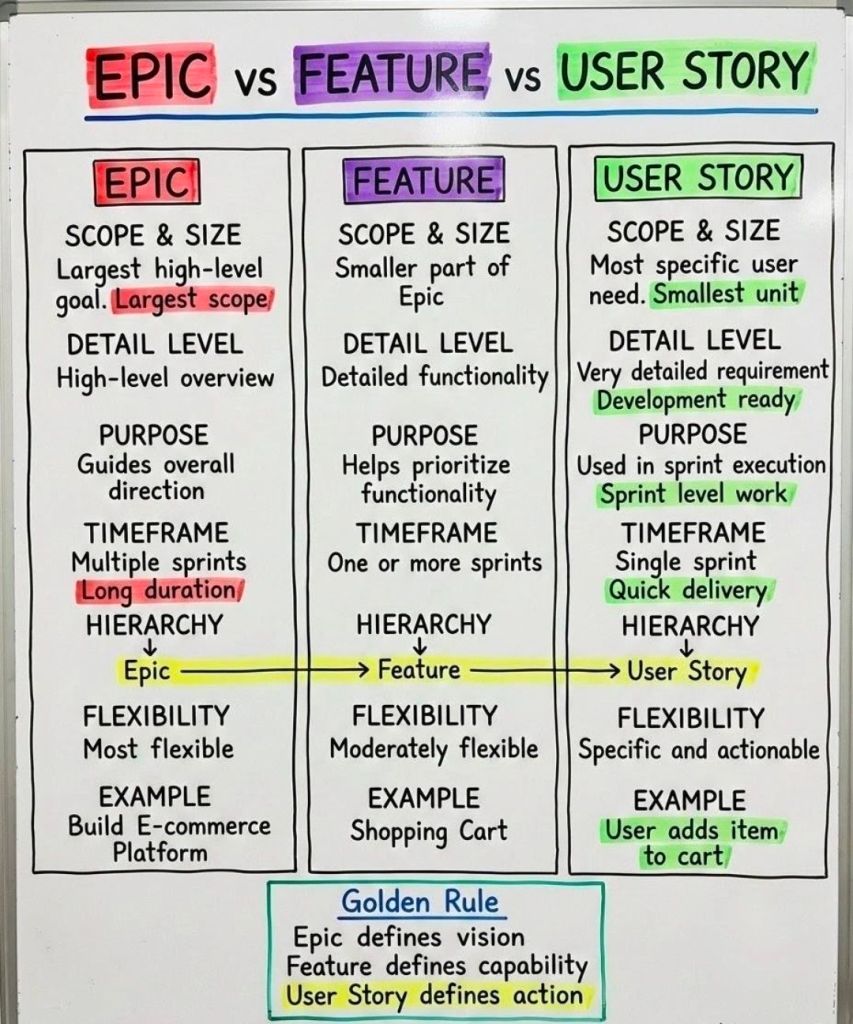
  • Portfolio Level: Aligns strategy to execution, managing investment themes (Epics) through Lean Portfolio Management.
  • Core Values & Principles: SAFe is grounded in 10 principles (e.g., “Take an economic view,” “Apply systems thinking”) and four core values: Alignment, Built-in Quality, Transparency, and Program Execution. 

Historical Timeline by Era and Version

The evolution of SAFe tracks the growing need for business agility and faster delivery in complex organizations. 

1. Foundation & Initial Concept (2007–2010)

  • 2007–2008: Dean Leffingwell publishes Scaling Software Agility, laying the foundation for enterprise agile patterns.
  • 2010: Agile Software Requirements is published, bridging Agile with enterprise needs. 

2. The Early Years: SAFe 1.0 – 2.0 (2011–2013) 

  • 2011: SAFe 1.0 released, initially termed “Agile Enterprise Big Picture,” focusing on applying Scrum/XP at scale.
  • 2012: SAFe 2.0 (October) released to restructure portfolio and program levels.
  • 2013: Initial refinements to the “Big Picture” to better integrate lean principles. 

3. Expansion: SAFe 3.0 – 4.0 (2014–2016) 

  • 2014: SAFe 3.0 introduced, introducing more emphasis on DevOps and faster, value-driven delivery.
  • 2016: SAFe 4.0 launched, introducing a dedicated “Value Stream” level for larger, complex systems and enhancing Kanban adoption. 

4. The Enterprise & DevOps Era: SAFe 4.5 – 4.6 (2017–2018) 

  • 2017: SAFe 4.5 released, emphasizing Lean Startup techniques, Lean UX, and faster, more flexible “Essential SAFe” configuration.
  • 2018: SAFe 4.6 updated to further incorporate the “Five Core Competencies of the Lean Enterprise”. 

5. Business Agility Era: SAFe 5.0 – 5.1 (2020–2021)

  • 2020: SAFe 5.0 (January) released, focusing on “Business Agility,” expanding agile principles beyond IT to the entire business (Human Resources, Finance, etc.).
  • 2021: SAFe 5.1 introduced, with enhanced focus on distributed teams, DevOps, and Accelerate metrics. 

6. AI & Continuous Learning Era: SAFe 6.0 (2023–Present) 

  • 2023: SAFe 6.0 (March) released, providing updated guidance on AI, Big Data, and Cloud technologies, while enhancing flow-based planning and accelerating value delivery.
  • 2024/2025: Focus on “AI-Empowered” SAFe, integrating artificial intelligence into the framework’s roles and ceremonies. 

SAFe Scaled Agile Framework summary and detailed historical timeline by era and year

PRINCE2 (PRojects IN Controlled Environments) Overview and Timeline by Year

PRINCE2 (PRojects IN Controlled Environments) is a structured, process-based project management methodology focusing on organization, control, and business justification. Originating from UK government IT standards in the 1970s, it has evolved into a globally recognized, tailorable standard used in over 150 countries for projects across various industries. 

PRINCE2 Project Management Summary

  • Core Philosophy: Continued Business Justification (projects must make sense financially), Manage by Exception (delegating authority within limits), and Product-Based Planning.
  • Seven Principles: Projects must have continued business justification, learn from experience, define roles and responsibilities, manage by stages, manage by exception, focus on products, and tailor to suit the project.
  • Seven Processes: Starting a Project, Directing a Project, Initiating a Project, Controlling a Stage, Managing Product Delivery, Managing a Stage Boundary, and Closing a Project.
  • Key Themes: Business Case, Organization, Quality, Plans, Risk, Change, and Progress.
  • Main Benefits: Provides a common language, clear accountability, defined roles, and tailored, consistent documentation. 

Detailed Historical Timeline (1975–2023+)

Era 1: The PROMPT Origins (1975–1988) 

  • 1975: Simpact Systems Ltd develops PROMPT (Project Resource Organisation Management and Planning Techniques) in response to IT projects running over time and budget. PROMPT II introduces a phased approach (Initiation, Specification, Design, Development, Installation, Operation). 

Era 2: The PRINCE Birth (1989–1995)

  • April 1989: The UK Central Computer and Telecommunications Agency (CCTA) adopts PROMPT II as the standard for IT projects, renaming it PRINCE (initially “PROMPT II IN the CCTA Environment”).
  • 1990: PRINCE is released into the public domain and widely adopted by the private sector for non-IT projects, although it is perceived as too rigid for small projects. 

Era 3: The Birth of PRINCE2 (1996–2008) 

  • 1996: PRINCE2 is published by the CCTA. It is rewritten for broader use (not just IT), removing jargon to become a generic project management framework.
  • 1998: PRINCE2 begins undergoing revisions based on user feedback.
  • 2000: The Office of Government Commerce (OGC) becomes the owner of PRINCE2.
  • 2002: The international user community begins consultative updates to the method. 

Era 4: The Modern Revision Era (2009–2022) 

  • 2009: PRINCE2: 2009 Refresh is released by the OGC. This major revision simplifies the method, makes it more customizable, and introduces the seven core principles.
  • 2013: Ownership transfers from the UK Cabinet Office to AXELOS Ltd, a joint venture between the UK Government and Capita.
  • 2017: PRINCE2 2017 Update is published, focusing on increased flexibility, scalability, and better tailoring guidance.
  • 2018: PRINCE2 Agile is launched, bringing a governance layer to agile delivery methods like Scrum and Kanban.
  • 2020: PRINCE2 2017 is renamed “PRINCE2 6th Edition”.
  • 2021: PeopleCert becomes the sole owner of AXELOS and PRINCE2. 

Era 5: The Current Era (2023–Present) 

  • September 2023: PRINCE2 7th Edition is released. The update introduces a “People” element, focusing on change management and team leadership, along with new guidance on Sustainability, Commercial, and Digital & Data management. 
PRINCE2 Key Evolution Summary
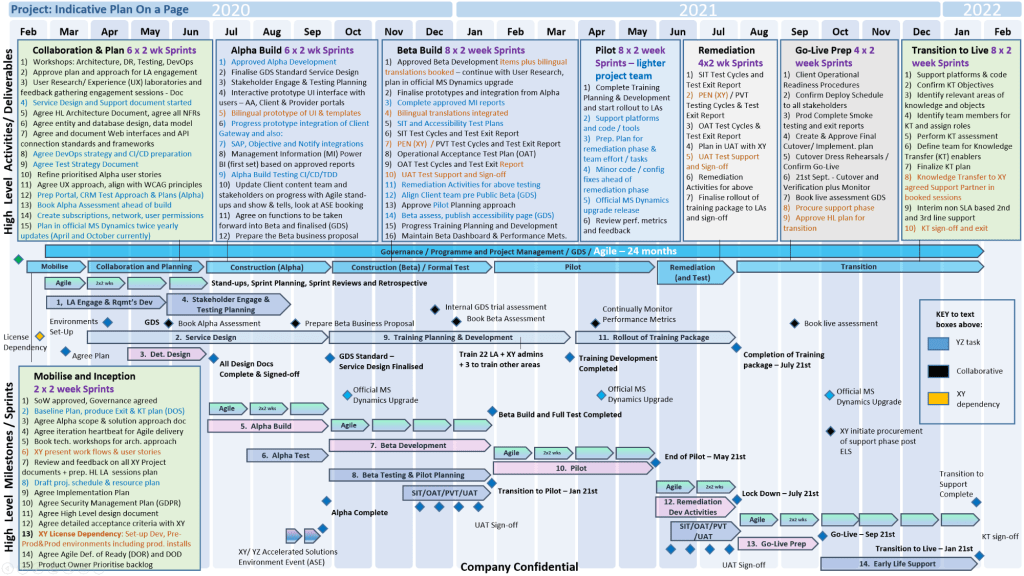
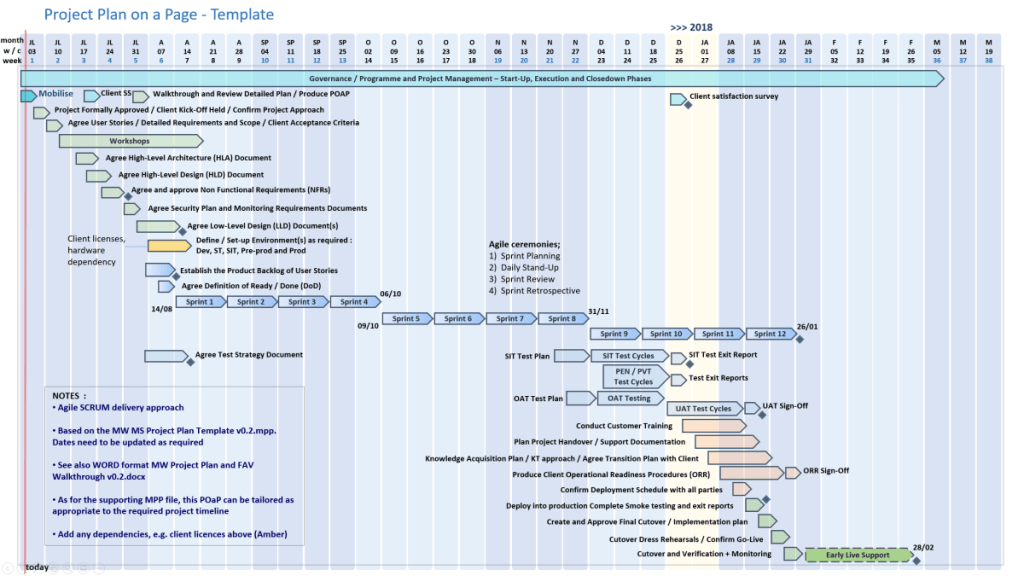
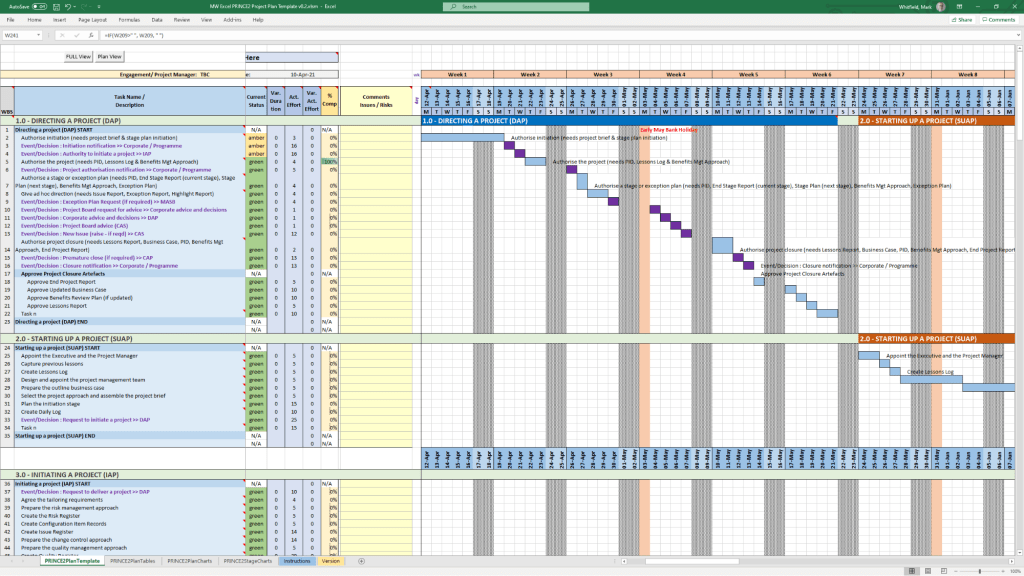
May 2011 – Registered PRINCE2 Practitioner with ILX, Mark Whitfield

PRINCE2 (PRojects IN Controlled Environments) Overview and Timeline by Year

PMP Project Management Professional summary and detailed historical timeline by era and year

Project Management Professional (PMP) history, as guided by the Project Management Institute (PMI), tracks the evolution from ancient craft systems to a modern, standardized profession combining predictive, agile, and hybrid approaches. Modern project management as a formal discipline emerged in the 1950s, with PMP certification officially launching in 1984. 

Summary of Project Management Eras

  • Pre-1950s (Craft Era): Large-scale construction (Pyramids, Great Wall) relied on master builders, intuitive planning, and heavy labor.
  • 1950s-1960s (Birth of Modern PM): Scheduling tools (CPM, PERT) and the Work Breakdown Structure (WBS) were developed for defense and construction.
  • 1969-1980s (Standardization Era): PMI was founded, and the PMP certification was introduced to create a shared professional language.
  • 1990s-2000s (Digital & Agile Era): Project software matured, the PMBOK Guide was published, and Agile techniques began reshaping software development.
  • 2010s-Present (Hybrid & AI Era): Focus on flexibility, stakeholder management, hybrid approaches, and AI integration. 

Detailed Historical Timeline

Ancient to Early 20th Century: Foundations

  • 2570 BC: Completion of the Great Pyramid of Giza, showing advanced resource planning.
  • 208 BC: Construction of the Great Wall of China, demonstrating large-scale logistical management.
  • 1917: Henry Gantt develops the Gantt Chart, a cornerstone of project scheduling. 

1950s-1960s: Birth of Modern Project Management 

  • 1957-1958: Development of key scheduling tools, Critical Path Method (CPM) and Program Evaluation Review Technique (PERT).
  • 1962: WBS approach mandated by the U.S. Department of Defense.
  • 1969: Project Management Institute (PMI) founded in Pennsylvania to standardize the profession. 

1970s-1980s: Professionalization and Certification 

  • 1975: Publication of The Mythical Man-Month by Fred Brooks, identifying software project risks.
  • 1984: First PMP certification exam administered by PMI.
  • 1986: Takeuchi and Nonaka introduce “Scrum” as a project management style.
  • 1987: First PMBOK Guide published as a white paper. 

1990s: PMBOK and Formalization 

2000s-2010s: Agile and Global Expansion 

  • 2001: Agile Manifesto written, emphasizing flexibility.
  • 2003: PMP exam revised to incorporate Agile techniques.
  • 2017: PMBOK 6th Edition released, integrating Agile and adaptive environments. 

2020s-Present: Modernization and AI

  • 2021: PMBOK 7th Edition released, shifting from process-based to principle-based standards.
  • 2024: PMI launches initiatives to incorporate Generative AI (PMIxAI) into project management. 

Key Evolution Trends

  1. From Craft to Science: Moving from intuitive, “master builder” approaches to structured, data-driven methodologies (PERT/CPM).
  2. From Fixed to Adaptive: Transitioning from rigid “waterfall” plans to iterative Agile and Hybrid approaches.
  3. Standardization: The PMP credential has shifted from solely construction/engineering focus to a global, cross-industry benchmark.
  4. Technology Integration: The rise of Artificial Intelligence (AI) and automated tools for risk management and scheduling.

PMP Project Management Professional summary and detailed historical timeline by era and year

PMBOK Project Management Body of Knowledge summary and detailed historical timeline by era and year

The PMBOK (Project Management Body of Knowledge) Guide, published by the Project Management Institute (PMI), is the globally recognized standard for project management best practices. Its evolution reflects the shift from rigid, industrial-era scheduling to flexible, value-driven, and hybrid methodologies. 

Summary of PMBOK Evolution

  • 1980s (Origins): PMI sought to standardize knowledge, starting with a white paper in 1983 and the first “Body of Knowledge” document in 1987.
  • 1996 (1st Edition): The first official PMBOK Guide was published, introducing a foundational process framework.
  • 2000s (Expansion): The 2nd (2000) and 3rd (2004) editions expanded on integration and finalized the standard for project management.
  • 2010s (Integration): The 4th (2008) and 5th (2012) editions added stakeholder management and aligned with enterprise needs. The 6th Edition (2017) formally bridged predictive (waterfall) and agile practices.
  • 2020s (Transformation): The 7th Edition (2021) marked a massive shift from process-based to principle-based, focusing on project outcomes rather than just outputs. The 8th Edition (2025) reintroduces practical, tailored process guidance alongside principles. 

Detailed Historical Timeline by Era and Year
Ancient Era to Pre-Modern (Before 1950s)

  • 2570 BC: Completion of the Great Pyramid of Giza, requiring complex organization, planning, and control.
  • 208 BC: Construction of the Great Wall of China, demonstrating massive, orchestrated labour management.
  • 1917: Henry Gantt developed the Gantt chart, a foundational scheduling tool still used today.

The Foundation Era (1950s – 1960s) 

  • 1956: American Association of Cost Engineers (now AACE International) formed.
  • 1957: Critical Path Method (CPM) invented by Dupont.
  • 1958: Program Evaluation and Review Technique (PERT) developed by the U.S. Navy for the Polaris missile program.
  • 1962: U.S. Dept of Defense mandated the Work Breakdown Structure (WBS) approach.
  • 1969: Project Management Institute (PMI) founded to promote the profession and set standards. 

The Formalization Era (1970s – 1980s) 

  • 1975: PROMPTII method created (later becoming PRINCE).
  • 1984: Dr. Eliyahu M. Goldratt introduced the Theory of Constraints (TOC) in his book “The Goal”.
  • 1986: Scrum named as a project management style.
  • 1987: First PMBOK Guide published by PMI as a white paper, attempting to standardize practices. 

The Standardization Era (1990s – 2000s)

  • 1991: Navy A-12 Avenger II Program cancelled due to poor performance detected by EVM.
  • 1996: 1st Edition of the PMBOK Guide released, establishing it as the foundational standard.
  • 1997: Critical Chain Project Management (CCPM) invented.
  • 1998: PMBOK recognized as a standard by ANSI (American National Standards Institute) and IEEE.
  • 2000: 2nd Edition of the PMBOK Guide released, adding more practical, in-depth material.
  • 2001: Agile Manifesto written, focusing on adaptability in software development.
  • 2004: 3rd Edition of the PMBOK Guide released, changing focus from “generally accepted” to “good practice”. 

The Modern Age & Agility Era (2010s – Present)

  • 2008: 4th Edition of the PMBOK Guide released, improving consistency and introducing new processes.
  • 2012: 5th Edition of the PMBOK Guide released, introducing the 10th Knowledge Area: Project Stakeholder Management.
  • 2017: 6th Edition of the PMBOK Guide released, incorporating Agile, Iterative, and Adaptive methodologies into every knowledge area.
  • 2021: 7th Edition of the PMBOK Guide released, a major shift towards a principle-based, value-delivery approach.
  • 2025: 8th Edition of the PMBOK Guide released, reintroducing tailored, practical processes along with principles.

PMBOK Project Management Body of Knowledge summary and detailed historical timeline by era and year

LeSS Large-Scale Scrum project management summary and detailed historical timeline by era and year

Large-Scale Scrum (LeSS) is a product management framework designed to scale the principles and purpose of Scrum across multiple teams working on a single product. Unlike other scaling frameworks that add complex layers of management, LeSS focuses on “descaling” organisational complexity by maintaining a single Product Owner and one unified Product Backlog for up to eight teams (Basic LeSS) or thousands of people (LeSS Huge). 

Historical Timeline of LeSS

The development of LeSS followed the maturation of Scrum and the need for a simplified way to apply it to large-scale, multi-site environments.

Era 1: Pre-Framework Foundation (1986–2004)

  • 1986: The term “Scrum” is first used in a management context by Hirotaka Takeuchi and Ikujiro Nonaka in their Harvard Business Review article, “The New New Product Development Game”.
  • 1993–1995: Jeff Sutherland and Ken Schwaber formalise Scrum as a practical software development framework.
  • 2001: The Agile Manifesto is authored, setting the cultural stage for lightweight scaling methods.
  • 2002: The Scrum Alliance is founded to promote and standardise Scrum training.

Era 2: Conception and Early Implementation (2005–2007)

  • 2005Craig Larman and Bas Vodde begin collaborating at Nokia Siemens Networks. They start combining their experiences to address the challenges of multi-site, large-scale agile development, laying the groundwork for what would become the LeSS framework.
  • 2005–2007: The principles are tested and refined in large-scale environments at companies like Nokia, Xerox, and Siemens. 

Era 3: Formalisation and Publication (2008–2015)

  • 2008: The first major book detailing these practices, Scaling Lean & Agile Development: Thinking and Organizational Tools for Large-Scale Scrum, is published by Larman and Vodde.
  • 2010Practices for Scaling Lean & Agile Development is released, providing concrete experiments and guides for practitioners.
  • 2014: The official LeSS.works website is launched to provide a centralized hub for LeSS rules, principles, and guides.
  • 2015: LeSS is increasingly recognized as a major scaling framework alongside others like SAFe and Nexus. 

Era 4: Consolidation and Modern Scaling (2016–Present)

  • 2016: The third book, Large-Scale Scrum: More with LeSS, is published, distilling the framework into its most essential rules and guides.
  • 2017–Present: LeSS adoption expands globally into diverse sectors including finance (JP Morgan), telecom, and large-scale hardware-software systems.
  • 2020s: Continuous evolution of “LeSS Huge” cases, showing the framework’s ability to support up to 2,500 people working on a single integrated product. 

Core Principles Summary

LeSS is guided by 10 core principles that differentiate it from other frameworks: 

  • Large-Scale Scrum is Scrum: It is not a “new” version but Scrum applied to many teams.
  • Empirical Process Control: Reliance on transparency, inspection, and adaptation.
  • More with LeSS: Scaling by removing roles and artifacts rather than adding them.
  • Whole-Product Focus: One Product Backlog and one Product Owner regardless of team count.
  • Systems Thinking: Optimising the whole system rather than individual team performance.

LeSS Large-Scale Scrum project management summary and detailed historical timeline by era and year

Lean project management summary and detailed historical timeline by era and year

Lean Project Management is a strategic methodology aimed at maximizing customer value while minimizing waste, derived primarily from the Toyota Production System (TPS). It focuses on efficient workflows, continuous improvement (Kaizen), and delivering high-quality results in smaller, faster increments. 

Summary of Core Principles

  1. Define Value: Identify what the customer is willing to pay for.
  2. Map the Value Stream: Analyze all steps required to produce the product/service and eliminate non-value-added steps (waste).
  3. Create Flow: Ensure tasks move smoothly without bottlenecks or interruptions.
  4. Establish Pull: Produce only what is needed, when it is needed, based on customer demand.
  5. Seek Perfection (Kaizen): Continuously improve processes to reduce waste further. 

Detailed Historical Timeline: The Evolution of Lean

The origins of Lean span from early American mass production to post-war Japanese necessity, maturing into a global management philosophy. 

Era 1: Pre-Lean & Industrial Foundations (1890s–1920s)

  • Early 1900s: Frank and Lillian Gilbreth develop motion studies to reduce wasted movement, laying the groundwork for waste elimination.
  • 1913: Henry Ford pioneers “Flow Production” at his Highland Park factory, combining standardized interchangeable parts with the moving assembly line to create continuous flow. 

Era 2: The Birth of Toyota Production System (1920s–1945) 

  • 1924: Sakichi Toyoda invents an automatic loom (Jidoka) that stops when a thread breaks, introducing the concept of autonomation (automation with a human touch).
  • 1937: Kiichiro Toyoda creates the automotive division of Toyota Loom Works, adopting Ford’s flow techniques while focusing on adapting to a small-demand market.
  • 1939-1945: Wartime shortages force Japanese industry to focus on resourceful, fast production. 

Era 3: Development of TPS (1945–1970s)

  • 1948–1975: Toyota engineers Taiichi Ohno and Eiji Toyoda develop the Toyota Production System (TPS).
  • 1950: Eiji Toyoda visits US factories but realizes they must adapt to a low-volume, high-variety environment, leading to the “supermarket” system.
  • 1954: Just-in-Time (JIT) production is implemented, shifting production scheduling from forecasts to real demand.
  • 1962: The TPS system is deployed across all Toyota plants. 

Era 4: International Adoption & “Lean” Coined (1970s–1990s)

  • 1973: Oil shock highlights Toyota’s efficiency compared to competitors, causing worldwide interest.
  • 1978: Taiichi Ohno publishes “Toyota Production System – Aiming at an Off-Scale Management”.
  • 1988: John Krafcik coins the term “Lean Production” in his MIT thesis “Triumph of the Lean Production System”.
  • 1990: James P. Womack, Daniel Roos, and Daniel T. Jones publish “The Machine That Changed the World,” popularizing TPS worldwide. 

Era 5: Modern Lean Management (1990s–Present) 

  • 1992: Professor Lauri Koskela formally introduces Lean construction, arguing for the transformation of production systems.
  • 1996: Womack and Jones publish “Lean Thinking,” further distilling the five principles.
  • 2001-2011: “The Toyota Way” is published by Jeffrey Liker, detailing the culture and continuous improvement aspects of the philosophy.
  • 2020s: Lean is widely applied beyond manufacturing to services, healthcare, and software development (Agile/Lean mix).

Lean project management summary and detailed historical timeline by era and year

Hybrid HPM project management summary and detailed historical timeline by era and year

Hybrid Project Management (HPM) is a tailored approach that combines structured, predictive methods—most commonly Waterfall—with flexible, iterative methods like Agile to maximize efficiency, speed, and control. As organizations face increasingly complex, rapid-change environments, HPM allows for detailed upfront planning of scope and budget, while utilizing sprints for development and stakeholder feedback. 

Summary of Hybrid Project Management

  • Definition: A blended approach merging Waterfall’s discipline with Agile’s adaptability.
  • Why It Emerged: To bridge the gap between rigid traditional methods and the high-speed needs of modern, often digital, projects.
  • Core Characteristics:
    • Predictive Planning: Upfront requirement gathering and high-level scheduling (Waterfall).
    • Adaptive Execution: Iterative development, Scrum ceremonies, or Kanban workflows (Agile).
    • Fit-for-Purpose: Tailoring the project lifecycle to specific organizational, technical, or regulatory needs rather than using a one-size-fits-all framework.
  • When to Use: Projects requiring high predictability for deliverables/compliance (e.g., infrastructure) but requiring flexibility in implementation (e.g., software).
  • Benefits: Increased speed, improved resource management, and higher adaptability to change. 

Detailed Historical Timeline: Evolution Toward Hybrid

The history of project management shows a progression from early manual techniques to structured “Golden Age” methodologies, eventually diversifying into Agile before merging into modern Hybrid approaches. 

I. Pre-Modern Era (Before 1950) – The Birth of Structure

  • ~2570 BC: Completion of the Great Pyramid of Giza, demonstrating early massive-scale planning.
  • 1910s: Henry Gantt develops the Gantt chart, introducing visual scheduling for tasks, dependencies, and timelines.
  • 1931: Hoover Dam project uses early scheduling techniques. 

II. The “Golden Age” (1950s-1960s) – Introduction of Predictive Methods 

  • 1956: The American Association of Cost Engineers (now AACE International) is formed.
  • 1957: DuPont Corp develops the Critical Path Method (CPM) to manage complex, repetitive projects.
  • 1958: Program Evaluation and Review Technique (PERT) is developed by the US Navy for the Polaris missile project, focusing on handling uncertainty in task durations.
  • 1960s: Formalization of the Waterfall method.
  • 1962: US Department of Defense mandates the Work Breakdown Structure (WBS).
  • 1969: Project Management Institute (PMI) is founded, establishing a standard profession. 

III. The “Silver Age” (1970s-1980s) – Diversification & Lean 

  • 1970: Winston Royce publishes the first formal description of the Waterfall process.
  • 1975: PROMPTII method created (the ancestor to PRINCE).
  • 1978: Toyota Production System, including early Kanban and Lean principles, gains attention.
  • 1984: Theory of Constraints (TOC) introduced by Eliyahu Goldratt.
  • 1986: Takeuchi and Nonaka define Scrum as a new product development game.
  • 1987: PMI publishes the first Guide to the Project Management Body of Knowledge (PMBOK Guide)

IV. The Digital Age & Agile Revolution (1990s-2000s) – Flexibility 

  • 1991: Crystal Clear Agile methodology developed.
  • 1995: Jeff Sutherland and Ken Schwaber formalize Scrum.
  • 1996: PRINCE2 published by the UK Government.
  • 1997: Critical Chain Project Management (CCPM) invented.
  • 2001: Agile Manifesto published, accelerating the shift toward iterative software development.
  • 2000s: Proliferation of project management software (Microsoft Project, Jira, Asana). 

V. The Hybrid Era (2010s-Present) – Tailored Integration 

  • 2010s: Hybrid Methodologies gain popularity, bridging the gap between Waterfall’s rigid structure for milestones and Agile’s flexibility for development.
  • 2015-2018: Increased adoption of “ScrumBan” (Scrum + Kanban) and early “Agile-Waterfall” hybrid models.
  • 2020s: COVID-19 pandemic acts as a catalyst, forcing remote work and accelerating hybrid adoption for greater resilience.
  • 2021-2024: Shift towards “fit-for-purpose” approaches, where projects combine predictive and adaptive lifecycles based on risk and complexity.
  • 2024: PMI data shows traditional predictive methods decreasing, while hybrid methodologies rise significantly (over 57% increase) as the dominant project management trend.
  • 2025+: Integration of Artificial Intelligence (AI) and automated tools into hybrid frameworks to further refine efficiency. 

Hybrid HPM project management summary and detailed historical timeline by era and year

Extreme Programming XP project management summary and detailed historical timeline by era and year

Extreme Programming (XP) is a prominent, disciplined Agile software development framework designed to improve software quality and responsiveness to changing customer requirements. Developed by Kent Beck in the mid-1990s, it focuses on taking beneficial engineering practices—such as pair programming, testing, and continuous integration—to “extreme” levels. 

Project Management Summary: Core XP Components

XP differs from other Agile methods by focusing intensely on technical engineering practices alongside project management techniques. 

  • Core Values: Communication, Simplicity, Feedback, Courage, and Respect.
  • Key Practices: Pair Programming, Test-Driven Development (TDD), Collective Ownership, Continuous Integration, Refactoring, and Small Releases.
  • Project Management Focus:
    • The Planning Game: Combines business priorities with technical estimates to determine what to build next.
    • Small Releases: Frequent, working software releases (often 1–2 weeks) to gather rapid customer feedback.
    • On-site Customer: A customer representative works with the team to provide instant feedback and clarify requirements.
    • Sustainable Pace: Limiting work weeks to 40 hours to avoid burnout and maintain quality. 

Detailed Historical Timeline of XP

Era 1: Origins and The Chrysler C3 Project (1993–1996) 

  • 1993: Chrysler launches the Comprehensive Compensation System (C3) project to upgrade payroll software, which struggles for years.
  • March 1996: Kent Beck is brought in to lead the C3 project. To salvage the project, Beck starts encouraging team members to adopt a set of technical practices he developed based on his experiences.
  • 1996: Ward Cunningham heavily influences the development of early XP concepts, particularly the “metaphor”.
  • 1996: The project begins adopting daily meetings, pair programming, and TDD.

Era 2: Formalization and “Embracing Change” (1997–2000) 

  • 1997: Ron Jeffries is brought in to coach the C3 team, helping solidify the practices.
  • 1998: The term “Extreme Programming” becomes widely discussed within the Smalltalk and Object-Oriented programming communities.
  • October 1999: Kent Beck publishes Extreme Programming Explained: Embrace Change, formally defining the framework.
  • February 2000: Daimler-Benz acquires Chrysler and cancels the C3 project after 7 years of work. Despite cancellation, the methodology proved that it could produce working, high-quality software, just not fast enough to overcome the legacy backlog. 

Era 3: Rise of Agile and Expansion (2001–2005)

  • February 2001: Kent Beck and Ron Jeffries are among the 17 developers who draft the Manifesto for Agile Software Development at Snowbird, Utah. XP is recognized as one of the foundational “Agile” methods.
  • 2001: The first Agile Alliance conference is held. XP is considered the dominant agile methodology during this period.
  • 2002–2003: XP gains global popularity; numerous books are published expanding on the core 12 practices.
  • 2004: The second edition of Extreme Programming Explained is released, shifting focus from 12 rigid practices to more adaptive principles. 

Era 4: Integration with DevOps and Continuous Delivery (2006–Present)

  • 2006-2010: As Scrum gains popularity for general project management, XP practices like TDD and Pair Programming become the “standard” technical practices for high-performing teams, often blended with Scrum (ScrumXP).
  • 2010s: The rise of DevOps and continuous delivery, which inherently requires XP practices like CI/CD (Continuous Integration/Continuous Delivery).
  • 2020-2026: While fewer companies identify strictly as doing “XP,” its technical practices are considered essential to modern software development and are integrated into almost all Agile methodologies to ensure quality and speed.

Extreme Programming XP project management summary and detailed historical timeline by era and year