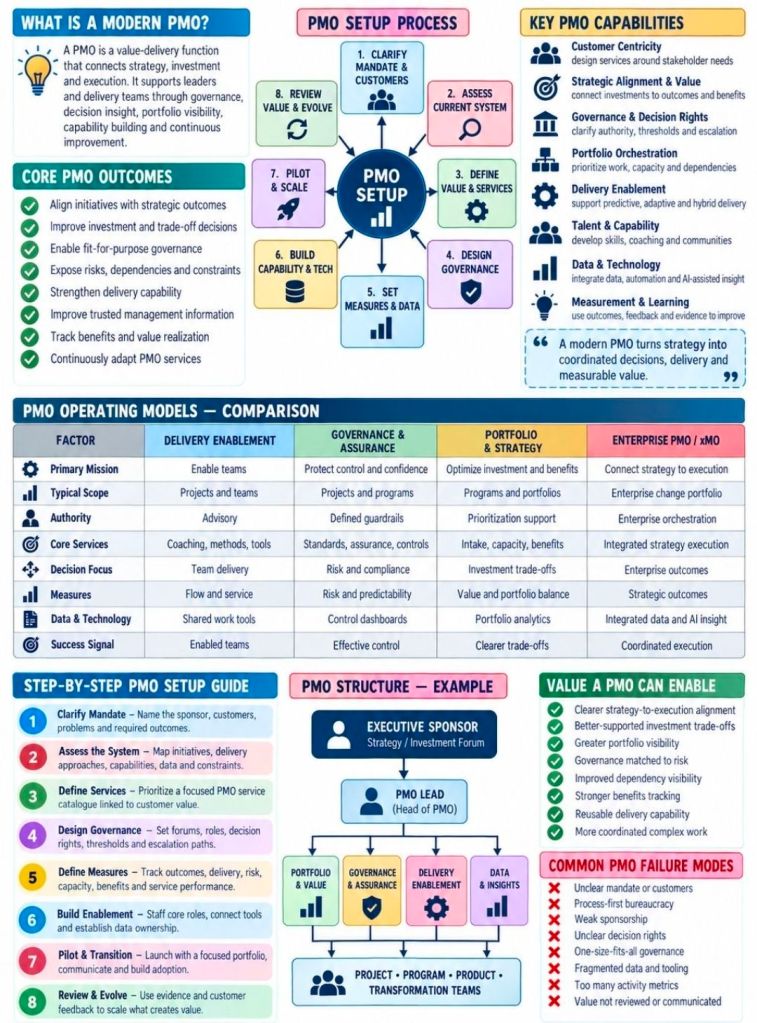
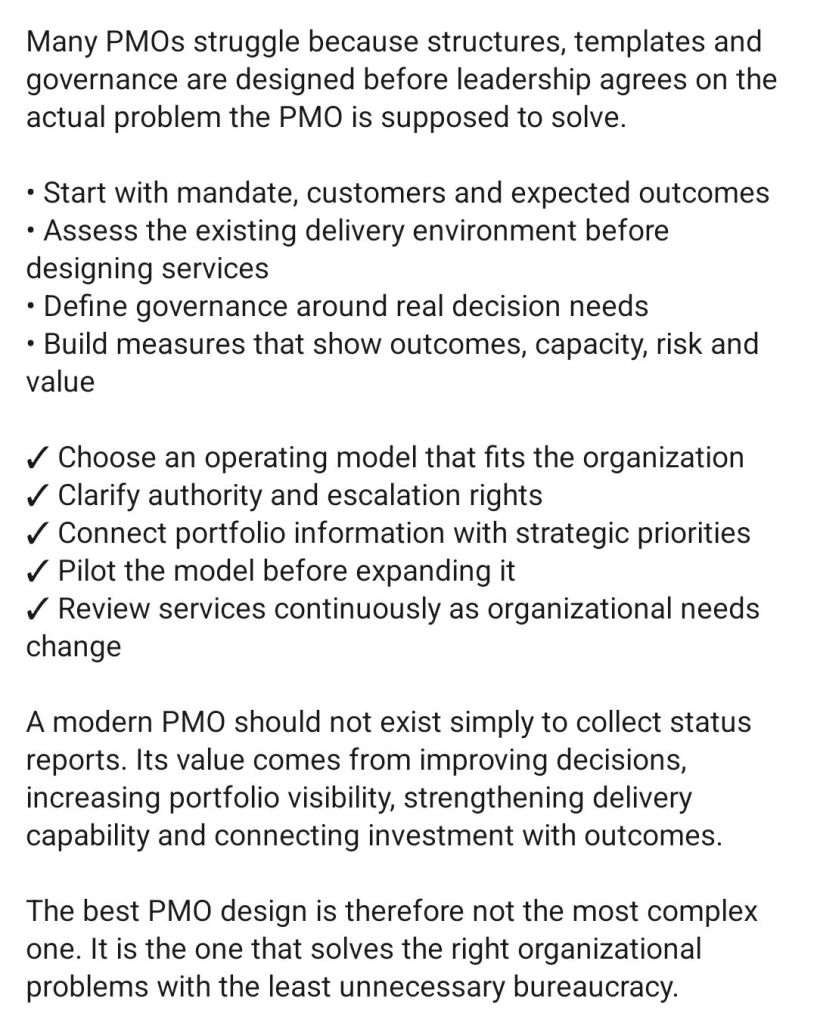
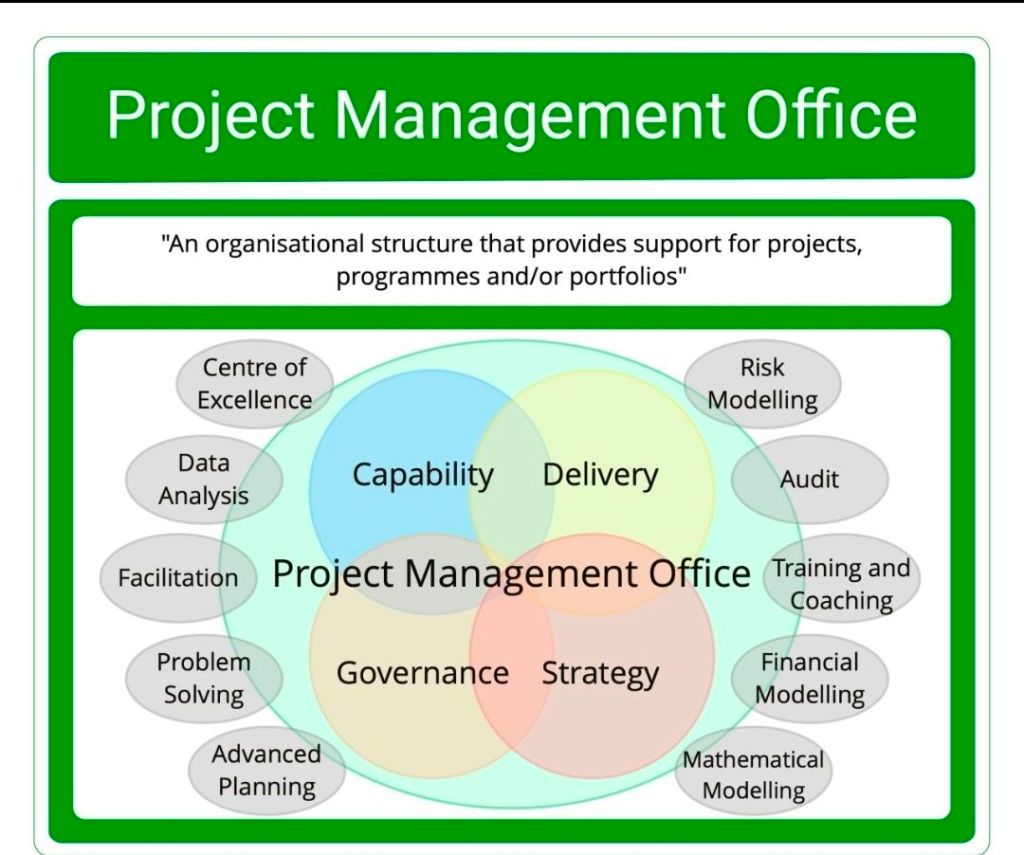
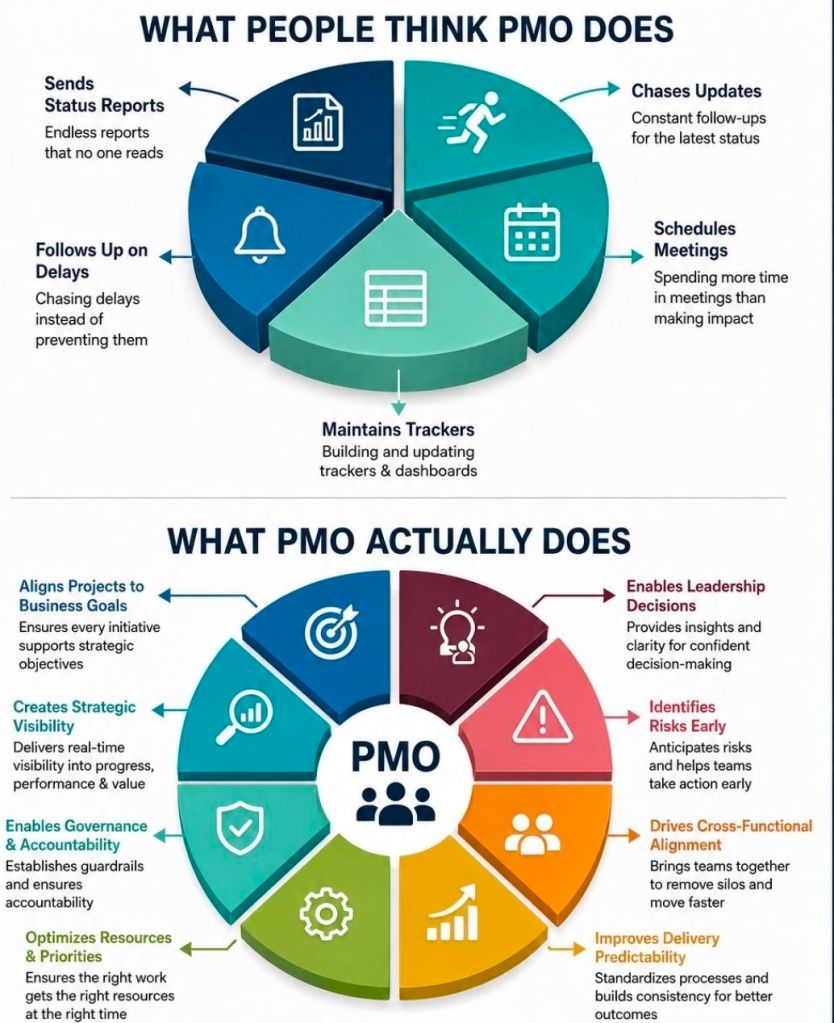
A Project Management Office (PMO) is a dedicated department or team within an organisation that defines, maintains, and standardises project management practices across the business. It serves as the central authority that ensures projects are executed efficiently, remain aligned with strategic business goals, and deliver maximum value.
Think of it as the regulatory and support hub for an organisation’s initiatives; while a project manager runs an individual project, the PMO creates the overall ecosystem in which all projects operate.
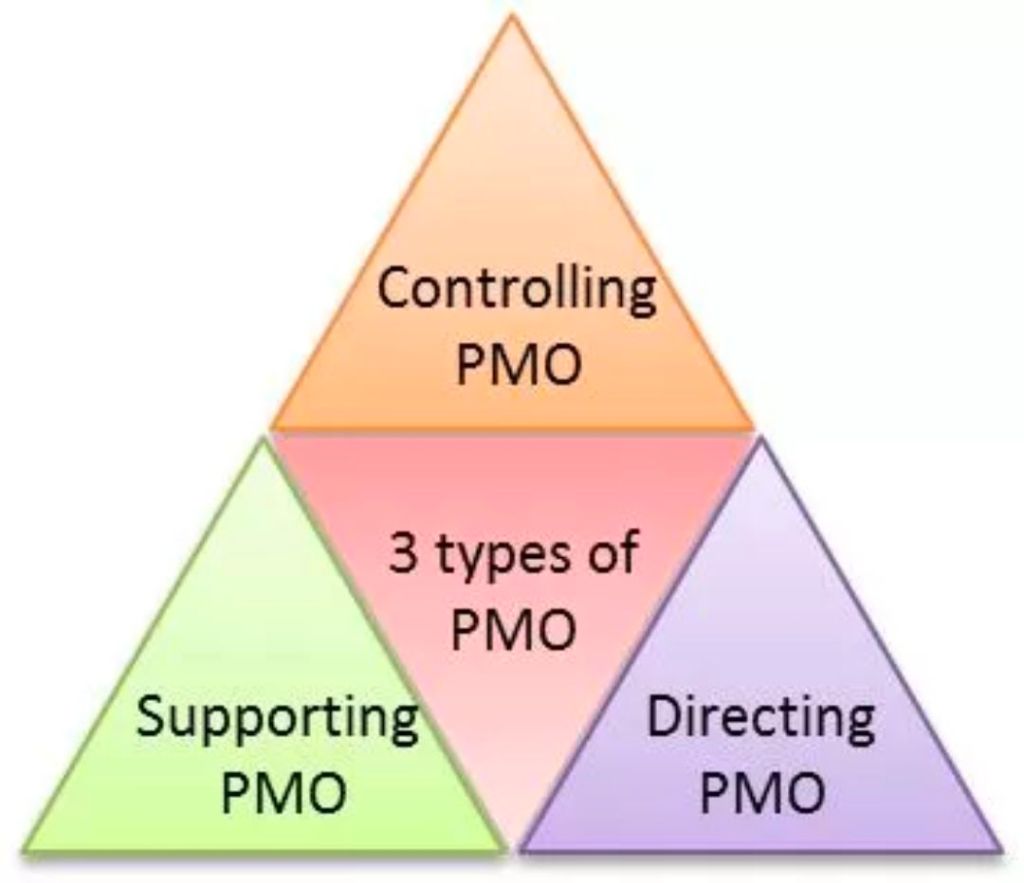
🔎 The 3 Main Types of PMOs (By Degree of Control)
Depending on the organization’s needs, a PMO typically falls into one of three structural categories:
Supportive PMO: Acts as a consultative hub. It provides templates, best practices, and training but exercises very low control over the actual project execution.
Controlling PMO: Enforces compliance and governance. It mandates that project teams adopt specific methodologies, templates, and frameworks, exercising a moderate level of control.
Directive PMO: Takes direct ownership of the projects. The PMO provides the project managers themselves and maintains high control, ensuring strict execution according to organizational standards.
📊 Key Responsibilities of a PMO
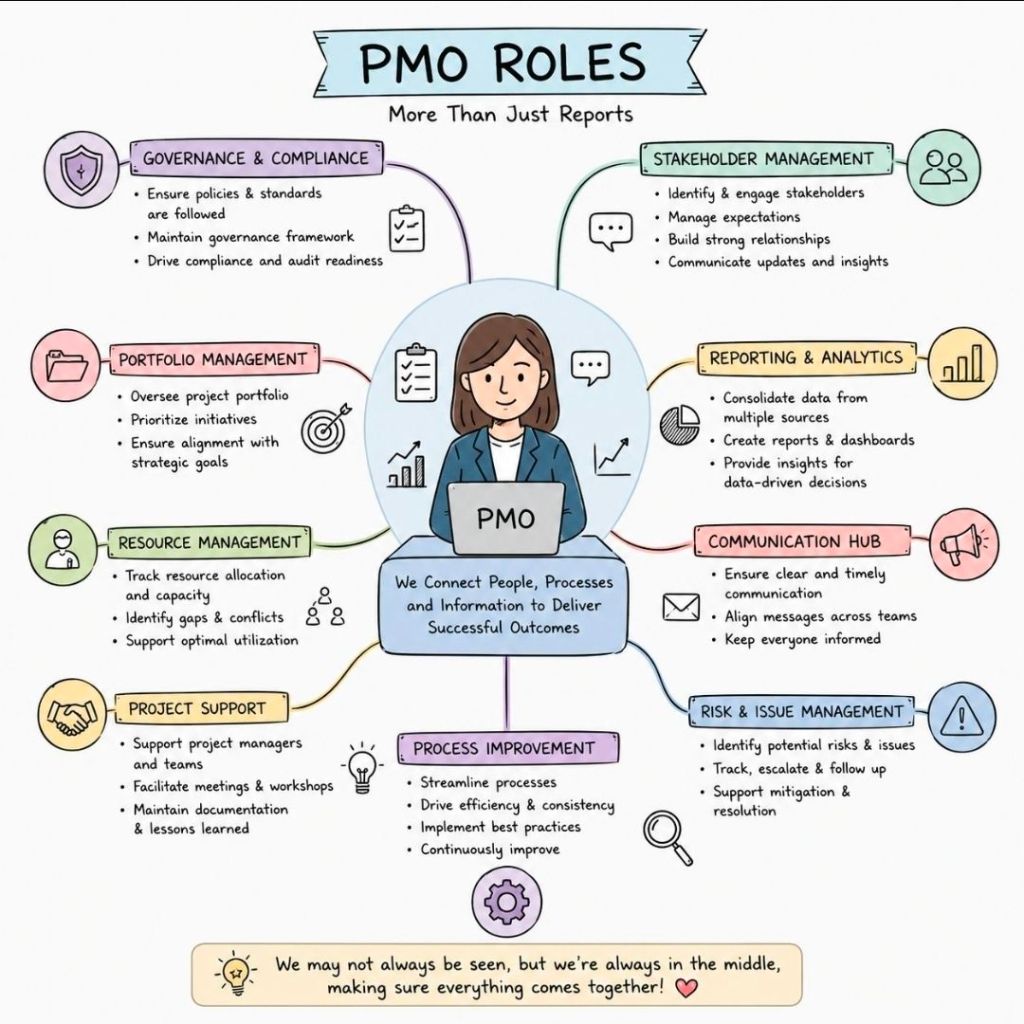
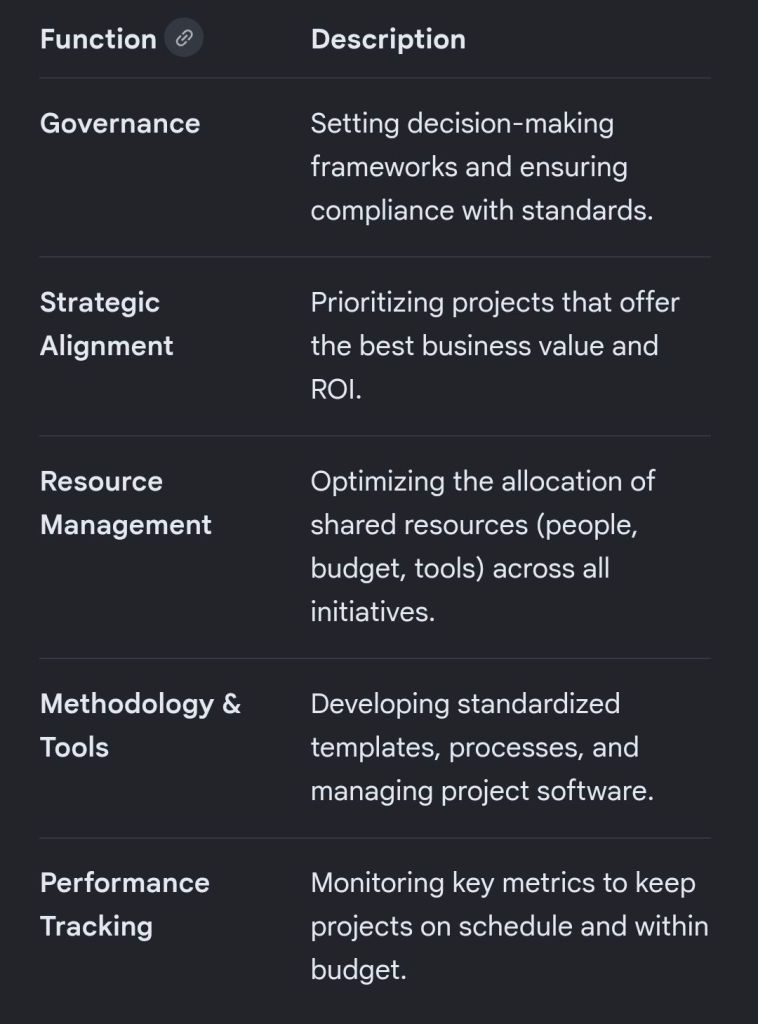
A high-performing PMO bridges the gap between executive strategy and day-to-day project execution through several core functions:
Governance and Compliance: Establishes approval workflows, audits project health, and ensures all teams comply with internal and external policies.
Standardisation: Creates standardized rules, templates, and methodologies (such as Agile or Prince2) so that everyone speaks the same project language.
Resource Management: Acts as a “traffic cop” to balance shared resources—like budget, tech tools, and personnel—across conflicting project schedules.
Strategic Portfolio Management: Reviews and prioritizes proposed projects against company priorities to ensure the business is spending its money on the right initiatives.
Performance Reporting: Tracks Key Performance Indicators (KPIs) and provides clean, objective data dashboards to stakeholders and C-suite executives.
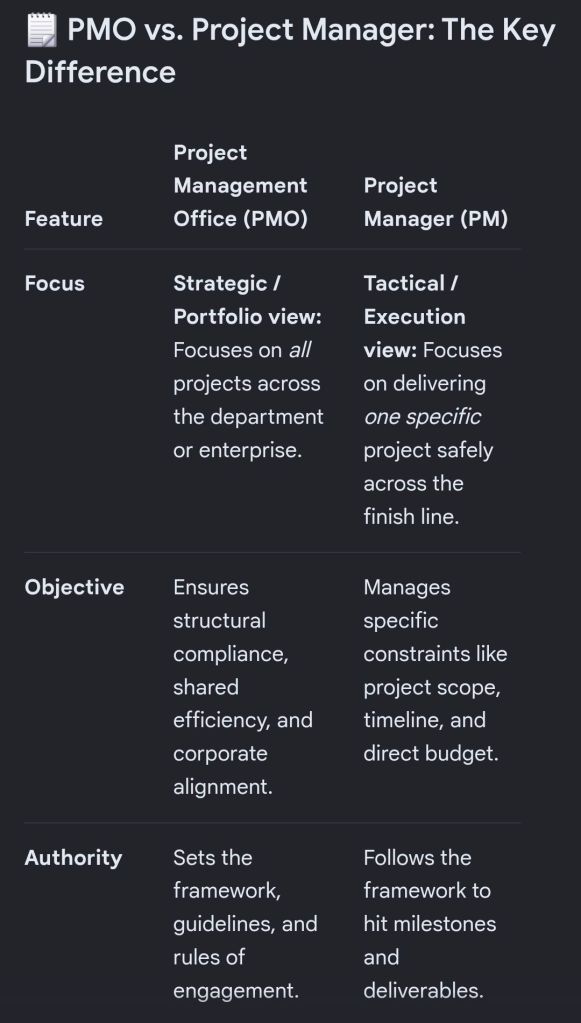
PMO vs. Project Manager, the key difference
💡 Core Benefits of a PMO
Organisations with a mature PMO report significantly better project success rates. A PMO delivers value by reducing project financial waste via standard budgeting, speeding up execution timelines through repeatable templates, and preventing team burnout with proactive resource allocation. It also establishes a central “lessons learned” database so that the company does not repeat past mistakes on new ventures.
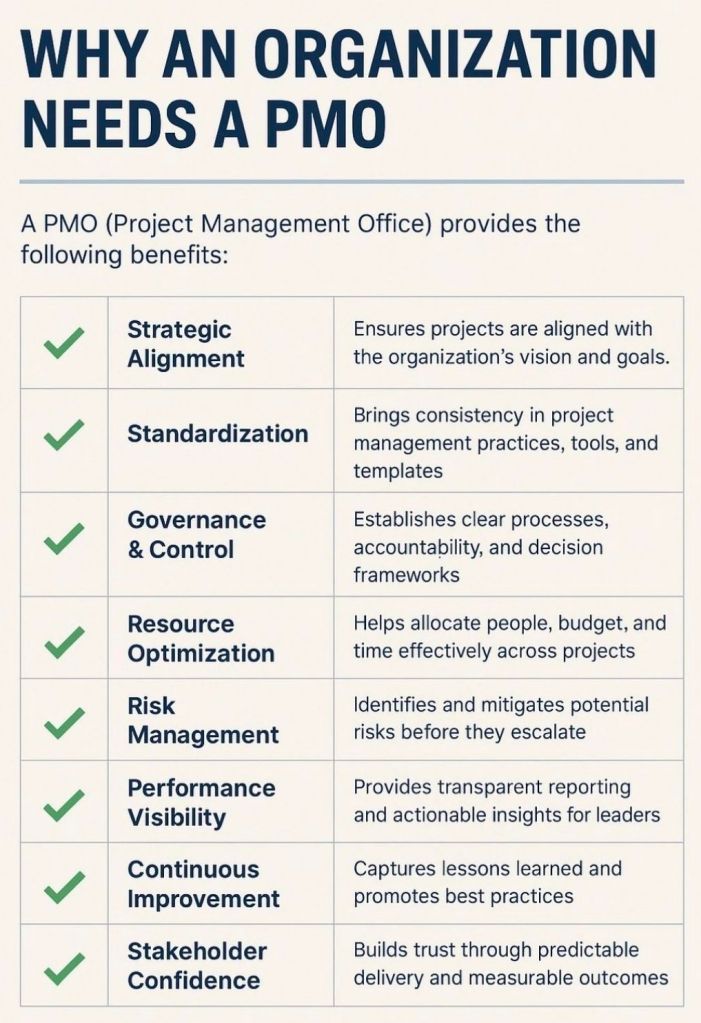
Why an Organisation Needs a PMO, Project Management Office
An organisation needs a Project Management Office (PMO) to act as the strategic backbone that standardises processes, minimises operational risks, and directly aligns day-to-day project execution with long-term business goals.
Research by the Project Management Institute (PMI) highlights that 80% of high-performing organisations have established PMOs. Furthermore, companies utilizing a PMO deliver initiatives up to 2.5 times faster and waste 38% less budget compared to those operating without one.
1. Strategic Alignment & Portfolio Prioritisation
Goal connection: PMOs act as a filter, continuously checking that all active projects serve the corporate strategy.
Value redirection: The office can proactively recommend pausing or canceling redundant projects, redirecting resources to high-value initiatives.
Intake governance: They design a structured framework for project intake to stop random, impulsive investments.
2. Standardisation & Quality Assurance
Unified framework: PMOs replace chaotic “every-team-for-itself” habits with shared templates, common metrics, and standard delivery methodologies.
Repetitive economy: Creating consistent guidelines allows multi-project execution to become a predictable machine, reducing human error.
Performance baselines: Standardised metrics give leadership an objective rubric to compare project health across entirely different business units.
3. Resource Optimisation
Bottleneck reduction: Centralised control prevents staff from being unsustainably double-booked across competing silo projects.
Capacity visibility: Real-time capacity mapping lets the executive suite understand exactly who is available before approving future workloads.
Skills leverage: PMOs actively track internal talents, allowing organisations to pivot specialized professionals to high-priority issues quickly.
4. Data-Driven Governance & Risk Management
Executive transparency: PMOs deliver aggregated status dashboards (like “Stop Light” reporting) to keep stakeholders clearly informed without digging through minor details.
Early risk mitigation: Using institutional tools like RAID logs, they catch budget variances and deadline slips before they cascade out of control.
Compliance protection: They ensure strict adherence to industry regulations, corporate ethics, and legal benchmarks to safeguard the firm from penalties.
5. Knowledge Management & Continuity
Lessons learned: The PMO retains historical metrics, helping project teams build realistic, accurate cost and timeframe estimates on subsequent iterations.
Mentorship hubs: They provide ongoing skills coaching and workshops to organically raise the project management maturity level across the company.
Project Management Office (PMO) models dictate the structure, control level, and strategic focus of a PMO within an organization. The most common frameworks break down into three primary operational types, alongside broader structural and strategic classifications that define how governance is applied.
Project Management Office (PMO) models overview
1. Operational Models (By Control Level)
These models define how the PMO interacts with project teams and enforces standards.
Supportive PMO: Acts as an advisory entity. It provides templates, best practices, training, and tools on demand, but has no direct control or authority over project execution. Best for: Organizations with a decentralized, highly autonomous culture.
Controlling PMO: Enforces strict governance, standardizes methodologies, and ensures compliance across all initiatives. It provides more than advice and actively verifies adherence, but typically relies on established escalation paths rather than direct authority. Best for: Organizations that need consistency and reduced risk.
Directive PMO: Assumes full control and direct ownership of projects. The PMO assigns project managers, directs resources, and takes total responsibility for execution, timelines, and outcomes. Best for: Complex or mission-critical projects requiring rigid governance.
2. Structural Models (By Scope & Placement)
These classifications indicate where the PMO sits and its organizational reach.
Enterprise PMO (EPMO): Operates at the highest organizational level, overseeing the entire project portfolio. It ensures all programs directly align with overarching corporate business objectives and strategy.
Departmental/Divisional PMO: Supports specific business units (such as IT, Marketing, or Engineering). It is highly tailored to the specialized needs of that function, though it runs the risk of creating siloed practices.
Embedded or Project-Specific PMO: A temporary model dedicated to one large, highly complex, or mission-critical project or program. It lasts for the duration of the project and then disbands or reallocates.
3. Advanced / Strategic Models (By Focus)
Modern organizations often adapt the PMO to focus on high-level value rather than just tracking timelines.
Center of Excellence (CoE): Focuses heavily on continuously elevating the organization’s project management maturity. It acts as an innovation hub for methodologies, technology evaluation, and skill-building.
Value Management Office (VMO): Focuses entirely on benefits realization and return on investment (ROI). Rather than just asking “are we on time?”, it asks “is this project generating the business value we wanted?”
A Project Management Office (PMO) is a centralized department within an organization tasked with standardizing project management processes, enforcing governance, and aligning projects with strategic business goals. Its primary mission is to optimize resource utilization, mitigate risks across the portfolio, and improve the overall success rate of projects.
The core responsibilities of a PMO vary based on its organizational maturity and type (Supportive, Controlling, or Directive), but generally span five major domains:
1. Governance and Standardisation
Developing Methodologies: Establishing uniform frameworks, processes, and project management methodologies (such as Agile, Waterfall, or hybrid models) across all departments.
Creating Templates: Developing standard documentation, templates, and tools to ensure consistency in project initiation, tracking, and reporting.
Conducting Audits: Monitoring compliance with established standards through health checks and project reviews to identify and correct process deviations.
2. Strategic Portfolio Management
Strategic Alignment: Ensuring every project investment directly supports the organization’s high-level strategy and long-term business goals.
Project Prioritization: Evaluating incoming project proposals and business cases to prioritize high-value initiatives while deferring or canceling low-priority options.
Benefits Realization: Tracking and measuring project outcomes to ensure that completed deliverables provide the expected economic or structural value to the company.
3. Monitoring, Tracking, and Reporting
Performance Reporting: Collecting and analyzing performance metrics via dashboards to provide regular progress updates to senior executives and stakeholders.
Dependency Management: Tracking cross-project dependencies, scheduling overlaps, and potential bottlenecks to prevent organizational conflicts.
Risk Management: Identifying systemic risks and early-warning signs of failing projects to trigger timely interventions or escalation protocols.
4. Resource and Capacity Management
Resource Optimization: Coordinating the allocation and utilization of personnel, skill sets, and budgets across the entire project portfolio.
Capacity Planning: Assisting line managers with strategic capacity planning to identify talent gaps, prevent team burnout, and support hiring decisions.
Effort Estimation Support: Providing historical data and expert insights to help project teams produce accurate cost and time estimates.
5. Training and Knowledge Management
Mentorship and Coaching: Providing regular guidance, professional coaching, and continuous support to project managers and their delivery teams.
Skills Development: Organizing training sessions and educational paths on core project management practices, specialized software, and new industry standards.
Lessons Learned Repository: Maintaining a centralized repository of project documentation, historical metrics, and post-project reviews to drive continuous organizational learning.
A Project Management Office (PMO) is a centralized department or group that defines, maintains, and ensures project management standards across an organization. It serves as the “command center” that aligns project execution with broader business strategy to improve success rates and ROI.
Core PMO Models
The level of control a PMO exerts depends on its specific operational model:
Supportive PMO: Provides a consultative role by supplying templates, best practices, and training. It has low control, acting primarily as a project repository.
Controlling PMO: Enforces governance and requires compliance through specific frameworks and tools. It maintains a moderate degree of control.
Directive PMO: Directly manages projects by assigning project managers who report to the PMO. This model offers the highest degree of control and accountability.
Key Responsibilities
A PMO’s daily functions bridge the gap between high-level strategy and ground-level execution:
Common PMO Roles:
Common PMO Roles
Staffing varies by organization size, but typical roles include:
PMO Director/Manager: Oversees the entire office, ensuring processes are followed and goals are met.
PMO Analyst: Collects and analyzes project data to support decision-making and reporting.
Project/Portfolio Managers: Lead individual projects or entire portfolios to completion.
PMO Specialist: Focuses on implementing methodologies and providing expert advice on project management.
Organizational Levels
PMOs can operate at different tiers within a company:
Project PMO: Focused on a single, large-scale project.
Program/Department PMO: Oversees a group of related projects within a specific department (e.g., IT or Marketing).
Enterprise PMO (EPMO): Operates at the executive level, ensuring all projects across the entire organization align with strategic corporate goals.