Download Templates for PROject Management | FREE Upgrades & Additions
Author: Mark Whitfield
Welcome to my site!
After graduating in Computing in 1990, I accepted a position as a programmer at a Runcorn based software house specialising in electronic banking software, namely sp/ARCHITECT-BANK on Tandem Computers (now HPE NonStop). This was before the internet became more prevalent and so the notion of enabling desktop access to company accounts for inter-account transfers and book keeping was still quite a cutting edge idea (and smartphones only ever hinted at in Space 1999). The company was called The Software Partnership (which was taken over by Deluxe Data in 1994).
I spent 5 years in Runcorn developing code for SP/ARCHITECT for various banks like TSB, Bank of Scotland, Rabobank and Girofon (Denmark) to name but a few. I then moved onto a software house in Salford Quays for further bank facing projects. After a further 23 years in the IT industry and now a Senior IT Project Manager (both Agile and Waterfall delivery), I thought I would echo out my Career Profile in this corner of the internet for quick and easy access.
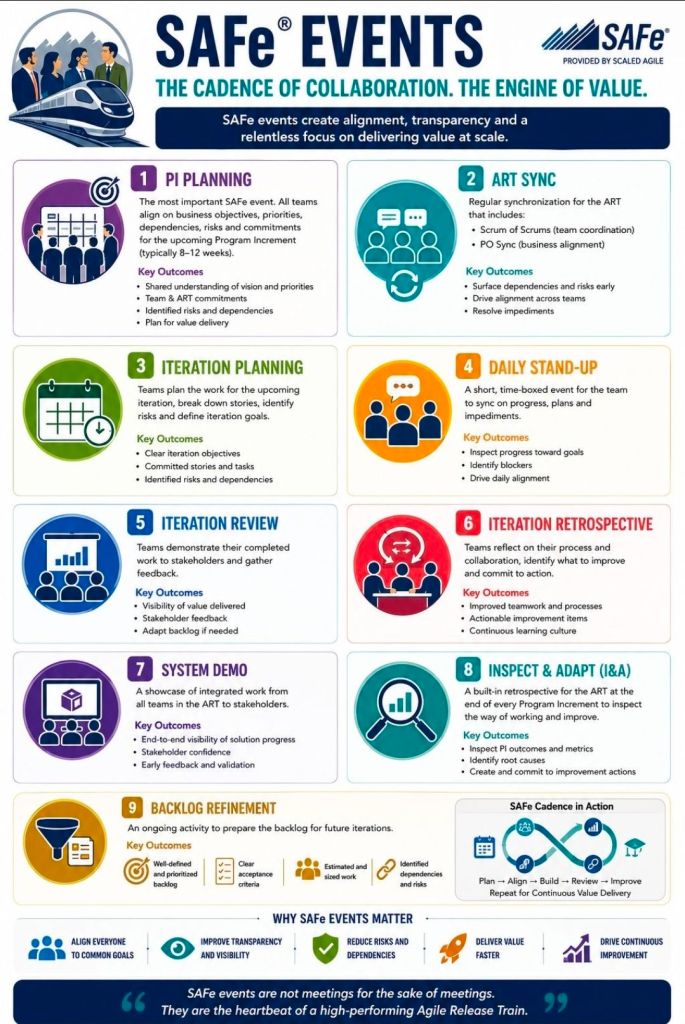
SAFe (Scaled Agile Framework) events are structured, time-boxed ceremonies designed to drive synchronization, alignment, and continuous improvement across different levels of an enterprise.
These events are primarily categorized into Team-level events (which mirror standard Scrum practices) and Agile Release Train (ART) level events (which orchestrate multiple teams working toward a shared goal).
The core events within Essential SAFe are broken down below by organizational layer.
👥 Agile Team-Level Events
These recurrent ceremonies occur inside a short timebox called an Iteration (typically lasting 2 weeks) and focus on local execution.
Iteration Planning: Teams refine the iteration plan, select backlog stories, and commit to a set of Iteration Goals.
Team Sync (Daily Stand-up): A brief, daily 15-minute meeting where team members align on progress, discuss daily goals, and highlight impediments.
Iteration Review: A cadence-based showcase at the end of the iteration where teams demo working software to gather immediate feedback.
Iteration Retrospective: Held at the end of each iteration to reflect on the process, team dynamics, and behaviors to drive relentless improvement.
Backlog Refinement: A weekly meeting where the Product Owner and team flesh out, estimate, and prep user stories for upcoming iterations.
🚊 Agile Release Train (ART) Level Events
These higher-level events drive the Planning Interval (PI), an 8 to 12-week timebox where an entire “train” of 5–12 teams delivers cross-functional value.
PI Planning: The multi-day flagship event of SAFe where all teams, stakeholders, and leaders align on a shared business vision, map dependencies, and commit to PI objectives.
System Demo: A regular event occurring every iteration where the integrated functionality built by the entire ART is demonstrated to stakeholders for feedback.
Coach Sync (formerly Scrum of Scrums): Facilitated by the Release Train Engineer (RTE), Scrum Masters meet to resolve cross-team dependencies, risks, and progress hurdles.
PO Sync: Product Owners and Product Management meet to track milestone progress, manage scope adjustments, and ensure the train remains aligned with business goals.
ART Sync: A combined session of Coach Sync and PO Sync used to streamline communication regarding execution and deployment.
Inspect & Adapt (I&A): A major event held at the end of the PI consisting of a system demo, quantitative measurements, and a problem-solving workshop to implement systemic backlog improvements.
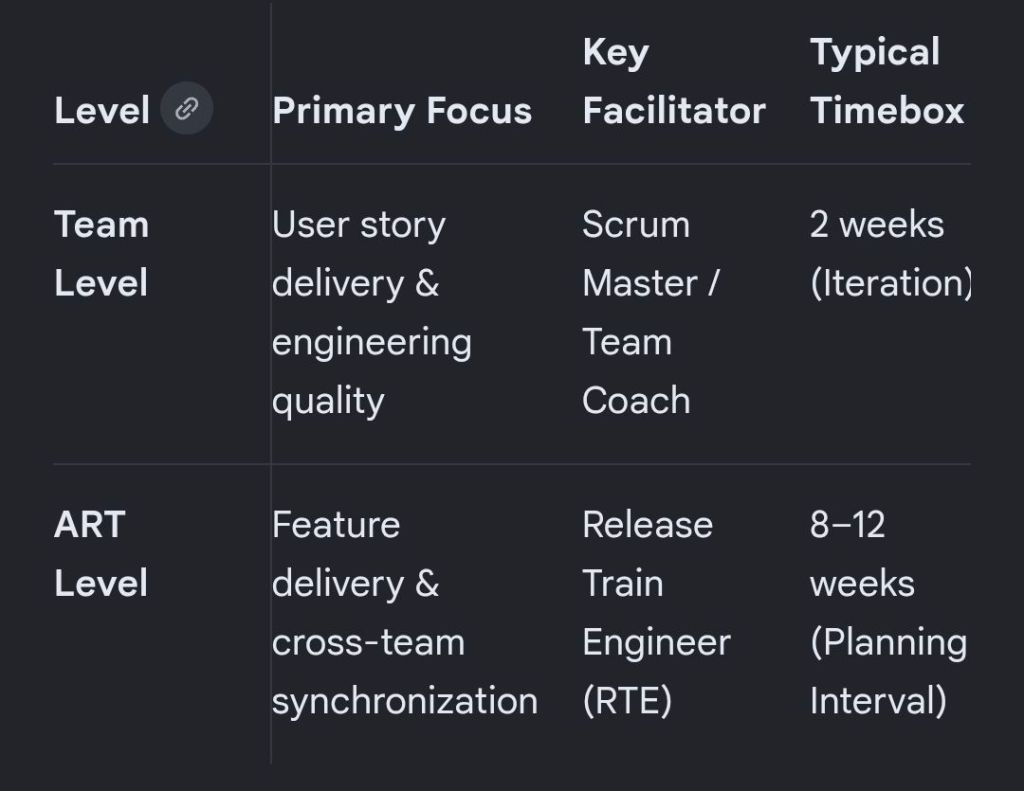
Summary of Differences
For a quick comparison, you can look at how responsibilities scale across the framework:
SAFe (Scaled Agile Framework) events are structured, time-boxed ceremonies designed to drive synchronization, alignment, and continuous improvement across different levels of an enterprise
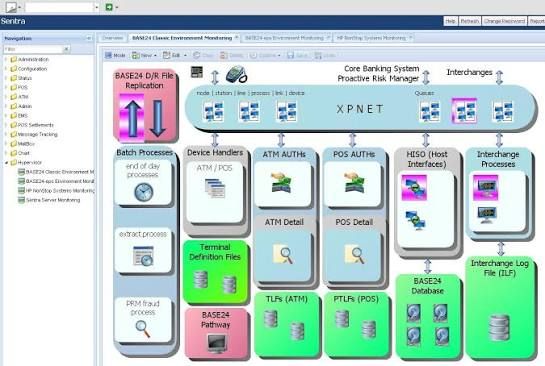
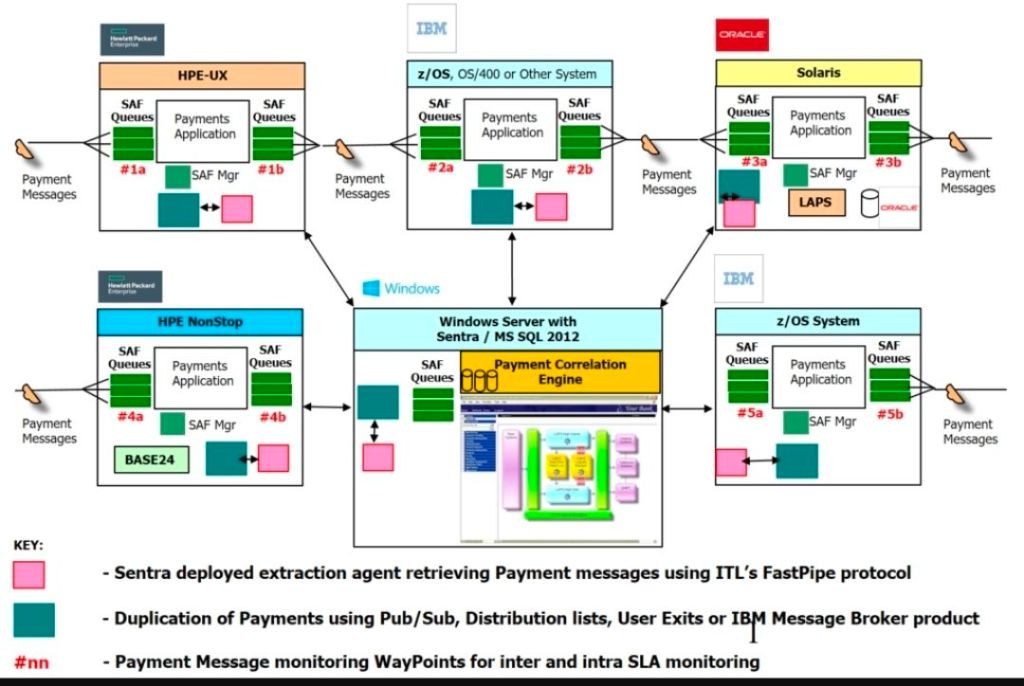
Sentra is a premier tracking and service management software platform developed by Insider Technologies Limited. Designed specifically for high-volume, mission-critical operations, Sentra is deployed across major financial, government, and defense institutions. It specializes in real-time tracking, information mediation, and multi-platform service level agreement (SLA) monitoring.
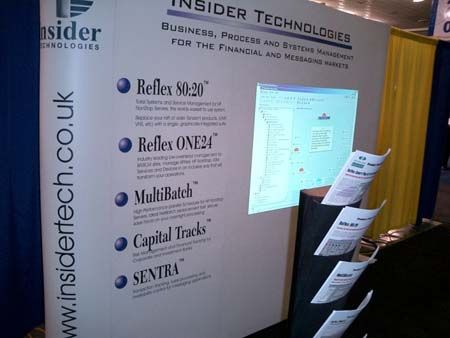
Insider Technologies in 2003 (San Jose), Business, Process and Systems Management for the Financial and Messaging Markets
The system operates across Windows, HP NonStop, Linux, and Unix environments to guarantee maximum uptime for transaction processing and data transmission.
Product Description & Capabilities
Sentra acts as a powerful tracking diagnostics framework. It evaluates the flow of files, payments, and system events to prevent costly service outages.
Real-Time Transaction Extraction: Utilizes extraction agents to pull live transaction data—such as ATM and Point-of-Sale (POS) logs—from core banking applications.
High-Speed Middleware Ingestion: Relays transaction lifecycle files (TLF) directly to a Windows server and Microsoft SQL database. This uses the company’s proprietary, high-speed TCP/IP sockets protocol known as FastPipe.
Rigorous SLA Enforcement: Provides end-to-end monitoring metrics optimized to help financial firms achieve extremely demanding targets, including 99.999% system availability.
Detailed Timeline Breakdown by Year
Because Insider Technologies is a private, specialized enterprise software house, its continuous internal product updates are primarily mapped through corporate evolution and key platform milestones:
1989 — Corporate Foundation
Insider Technologies Limited is incorporated in Manchester, UK. It targets 24×7 mission-critical systems like Tandem Computers (which later evolved into HP NonStop computing architecture).
1990s to Early 2000s — The Monitoring Evolution
The company relies heavily on its early flagship monitoring software suites, Reflex and MultiBatch.
Recognizing a shift toward heterogeneous environments, engineering teams begin conceptualizing Sentra to bridge real-time tracking between Windows and legacy systems.
2004 — Core Sentra Framework Launch
Official design, infrastructure layout, and core coding begin for the specialized Sentra platform architecture.
Sentra is formalized to extend tracking metrics outside of traditional mainframe environments into multi-platform Linux, Unix, and Windows installations.
2006 — Banking Application Integration
Development accelerates on custom add-ons to integrate Sentra directly with core banking infrastructure.
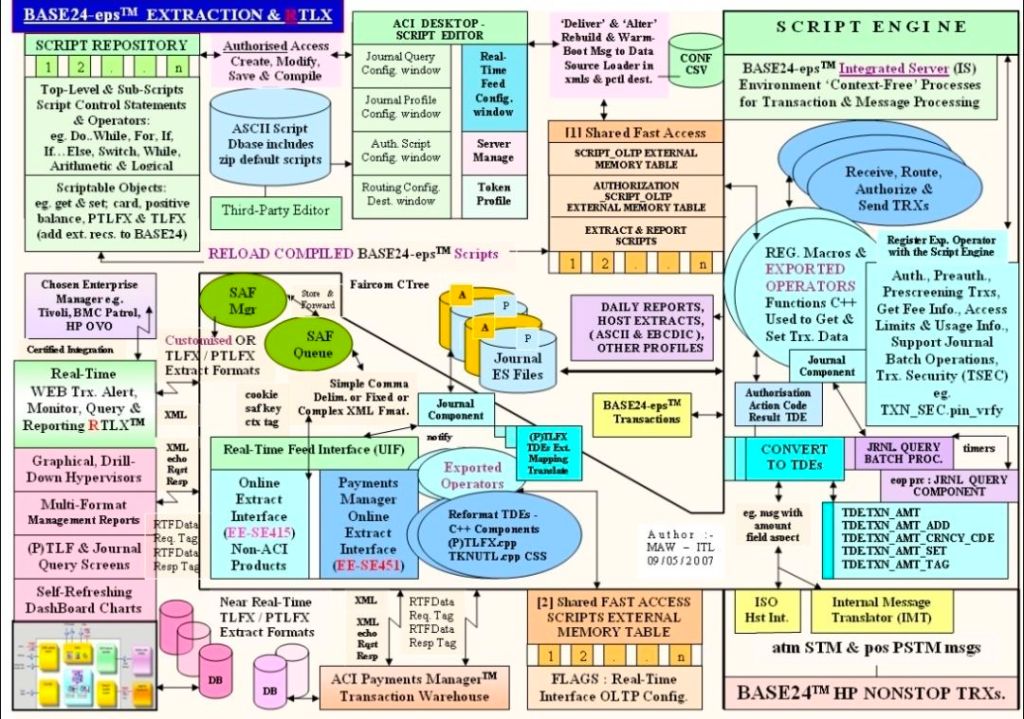
Teams design specialized mechanisms to track high-volume transactions routed via ACI Worldwide’s popular BASE24™ transaction-processing software.
2008 to 2011 — The RTLX Reactor Expansion
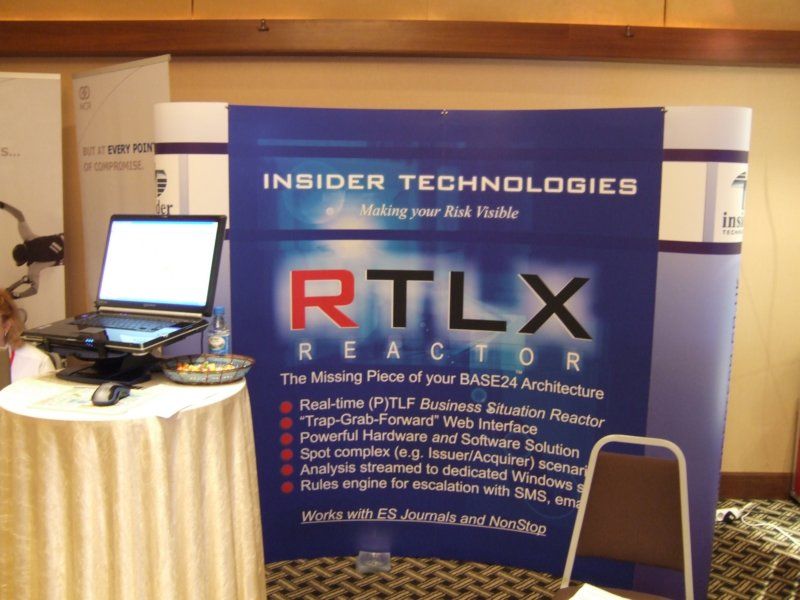
Insider Technologies releases RTLX Reactor, a major add-on module built entirely on top of the Sentra framework.
This expands Sentra’s market footprint by offering retail banks direct, real-time diagnostic visibility into live ATM and POS cash terminal traffic.
2013 — Framework Optimization & Digital Web Presence
A multi-year architectural overhaul wraps up, introducing enhanced information mediation and updated corporate digital resources mapping the platform’s core tracking methodologies.
Celebrating 30 years in operation, Insider Technologies rolls out modernised visual dashboards and broader diagnostic tracking capabilities across the Sentra portfolio. This addresses the escalating scale of electronic payments.
2024 to 2026 — PartnerOne Era & Cyber-Resilience
Insider Technologies transitions into operating as part of the global PartnerOne group.
Sentra continues to serve as an indispensable middleware tracking and monitoring asset. It runs alongside updated proactive cybersecurity, XDR, and IT operations infrastructure tailored for the UK government, defense sector, and multinational banking institutions.
ActionView.400 is an enterprise tracking and diagnostics software solution developed by Insider Technologies Limited. It was purpose-built as a dedicated monitoring tool for the Open System Interconnection / Message Handling System (OSI/MHS) X.400 subsystem deployed on Tandem, Compaq, HP, and HPE NonStop server platforms.
The software acts as a critical infrastructure layer used heavily by banking institutions, telecommunications providers, and government/military defense sectors.
It ensures that high-volume, secure electronic mail infrastructure meets strict Service Level Agreements (SLAs) by allowing engineers to account for every message, calculate end-to-end processing times, and issue real-time tracking metrics.
Detailed Timeline Breakdown by Year
1989: Insider Technologies Limited is incorporated in Manchester, England, by a collective of IT industry veterans. The firm initially focuses on building service management and custom tracking middleware for the rapidly expanding Tandem NonStop server ecosystem.
1990s (Early to Mid): As X.400 protocols become the global standard for secure EDI (Electronic Data Interchange) and military messaging, Insider Technologies develops ActionView 400. The product is integrated directly into Tandem’s core software stack and begins shipping natively with Tandem NonStop platforms.
1997: Tandem Computers is acquired by Compaq. ActionView 400 is sustained through this transition to maintain critical operations for tier-one banks and national military infrastructures relying on NonStop systems.
2002: Compaq merges with Hewlett-Packard (HP). ActionView 400 is bundled under the HP NonStop software catalog (product designation T8443), managing and diagnosing log audits like the AUDLOG framework.
2000s (Mid to Late): Insider Technologies starts shifting forward-looking tracking requirements toward its newer central architecture platform, Sentra. While ActionView 400 continues handling legacy X.400 pipelines, Sentra begins acting as a unified web console to consolidate both X.400 and modern SMTP/MIME email flows across multi-vendor systems.
2015: HP splits its corporate structures. The NonStop computing line and the management of ActionView 400 shift over to Hewlett Packard Enterprise (HPE).
2018: In December 2018, HPE officially moves ActionView 400 to Obsolete status, marking the formal end of its product life cycle and standard vendor service life.
2019 – Present: Despite official obsolescence on the HPE hardware list, Insider Technologies continues to directly support and maintain the solution for deep-legacy military, defense, and governmental bodies. Because these sectors still mandate uncompromised, zero-loss X.400 message accounting, the software remains active, feeding tracking telemetry directly into Insider’s modern Middleware Monitoring and Sentra platform interfaces.
Sentra – unified web console to consolidate both X.400 and modern SMTP / MIME email flows across multi-vendor systems
Mark Whitfield is an SC-cleared Senior IT Project Manager with over 30 years of experience delivering high-availability financial, cloud, and digital transformation projects. Over his career, he has transitioned from deep technical engineering on HPE NonStop (Tandem) mainframe systems to leading major corporate and public sector Agile and Waterfall software rollouts.
A comprehensive, year-by-year timeline breakdown of his project history and clients since 1990 is outlined below.
💻 The Technical Era (1990–1995)
During this period, Whitfield worked as a Programmer and Lead Analyst for The Software Partnership (acquired by Deluxe Data in 1994). He focused on electronic banking software (sp/ARCHITECT-BANK) on Tandem Mainframe Computers.
1990–1992: Barclays Bank – Placed on-site at Knutsford, Cheshire to design and code software for the high-profile Barclays Business Master II (BBM II) electronic desktop banking project.
1992–1993: Girofon (Denmark) – Developed a touch-tone phone banking suite. This allowed clients to use automated voice/menu-driven systems via a Periphonics VRAM device to fetch live balances from back-end mainframes.
1993–1994: TSB & Bank of Scotland – Conducted early-era digital investigations, logic design, and mainframe coding for inter-account desktop money transfers.
1994–1995: Rabobank – Headed software optimization, custom electronic coding patches, and on-site deployment validation for international operations.
🛡️ Monitoring & Infrastructure Era (1995–2013)
Whitfield joined Insider Technologies Limited (ITL) in Salford Quays, specializing in platform diagnostics, transaction monitoring, and financial logging systems for mission-critical infrastructure.
1995–1996: Internal ITL Product R&D – Core developer on the Reflex monitoring suite (Reflex 80:20), creating platform health and diagnostic plug-in modules.
1997–1998: CRESTCo (now Euroclear) – Brought in as a technical infrastructure consultant to run benchmark tests on newly released Tandem S7000 processing hardware nodes.
1999–2001: Bank of England / Deutsche Bank – Deployed real-time tracking protocols utilizing ITL’s MultiBatch scheduling architectures and file monitors.
2002–2003: Hewlett-Packard (HP) – Successfully managed the rigorous certification process for the first HP OpenView Operations (OVO) Smart Plug-In built for the NonStop mainframe environment.
2008–2010: Saudi Arabian Retail Bank – Acted as Project Manager overseeing the cross-border rollout of a high-volume ATM and Point-of-Sale (POS) monitoring system.
2011–2013: Global Payments / Standard Chartered – Integrated transaction monitoring capabilities with external corporate frameworks such as TIVOLI and XPERT24 using ACI’s XPNET architecture.
This timeframe marked a total transition into senior contract project management, dealing directly with multi-million-pound programs.
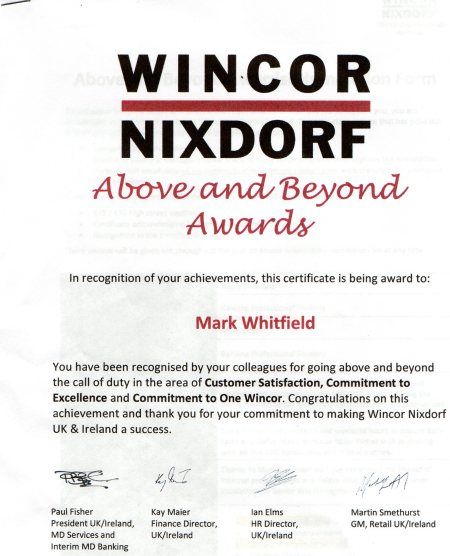
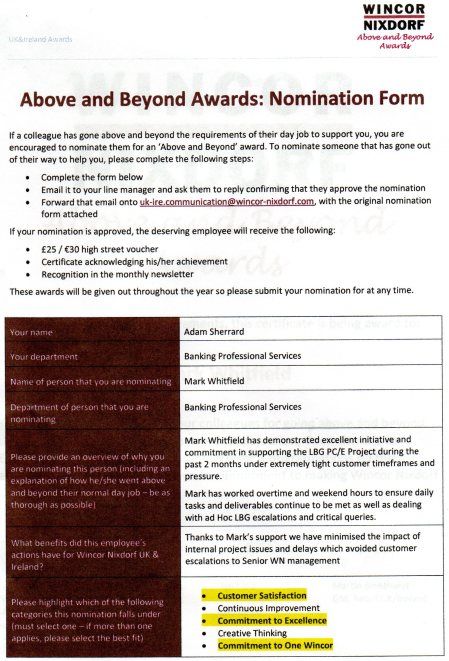
2013–2014: Lloyds Banking Group (LBG) – Augmented into Wincor Nixdorf as the IT Project Manager leading a £5+ million workstream. This was part of LBG’s comprehensive Self-Service Software Replacement (SSSR) initiative to modernise legacy ATM software.
2014–2016: Betfred – Senior IT Project Manager inside an Agile Scrum structure. Directed cross-functional software vendors to deliver updates for mobile apps (iOS/Android), fraud detection systems, and payment gateways for their digital sportsbook platforms.
In January 2016, Whitfield joined global consultancy firm Capgemini as a Senior client-facing Engagement/Delivery Manager.
2016–2017: Aerospace & Defence Client – Managed an enterprise-level integration project to deploy a Salesforce-driven Single Customer View (SCV) portal platform.
2017–2018: Jaguar Land Rover (JLR) – Served as Project Manager for the iFAB Middleware Project, a complex 12-month architecture development program linking global manufacturing supply components.
2018–2019: MuleSoft (A Salesforce Company) – Augmented directly into MuleSoft’s London headquarters as a Delivery Manager, spearheading API-led connectivity deployments via the Anypoint Platform.
2019–2021: UK Government Agency (UK Gov) – Commanded a major Hybrid Cloud Migration initiative to refactor, re-host, and re-platform 130 legacy agency software applications directly to cloud servers.
2022: UK Utility Sector (Welsh Water / Scottish Water) – Dual-management lead executing a £0.5 million contract to migrate an aging, on-premise document management program (EQS) onto the Microsoft Azure cloud via Enablon.
2023–2026: Public Sector & Core Tooling (Current) – Managing high-value middleware and API integrations for entities like the Royal Mail Group (RMG), NATS, and regional government bodies. Concurrently authors a widely used portfolio of commercial project management templates (RAID logs, RACI matrixes, and MS Project MPP layouts) published via PROject Templates.
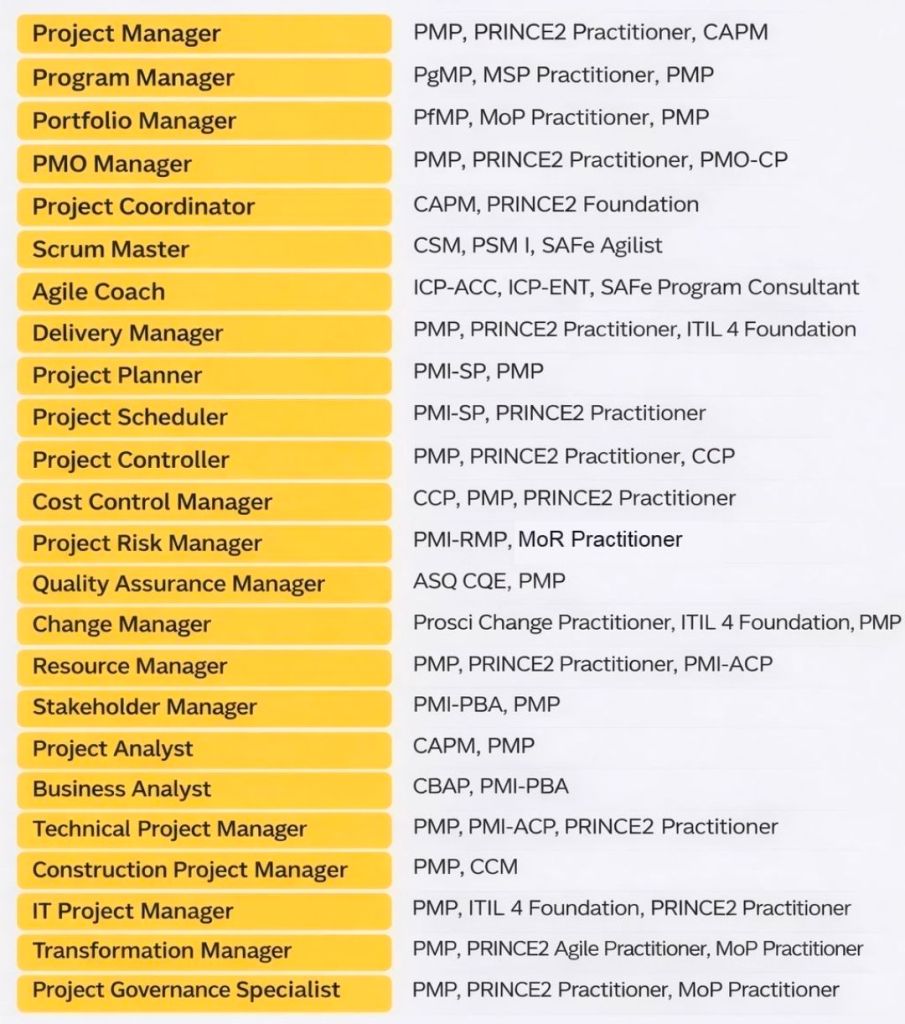
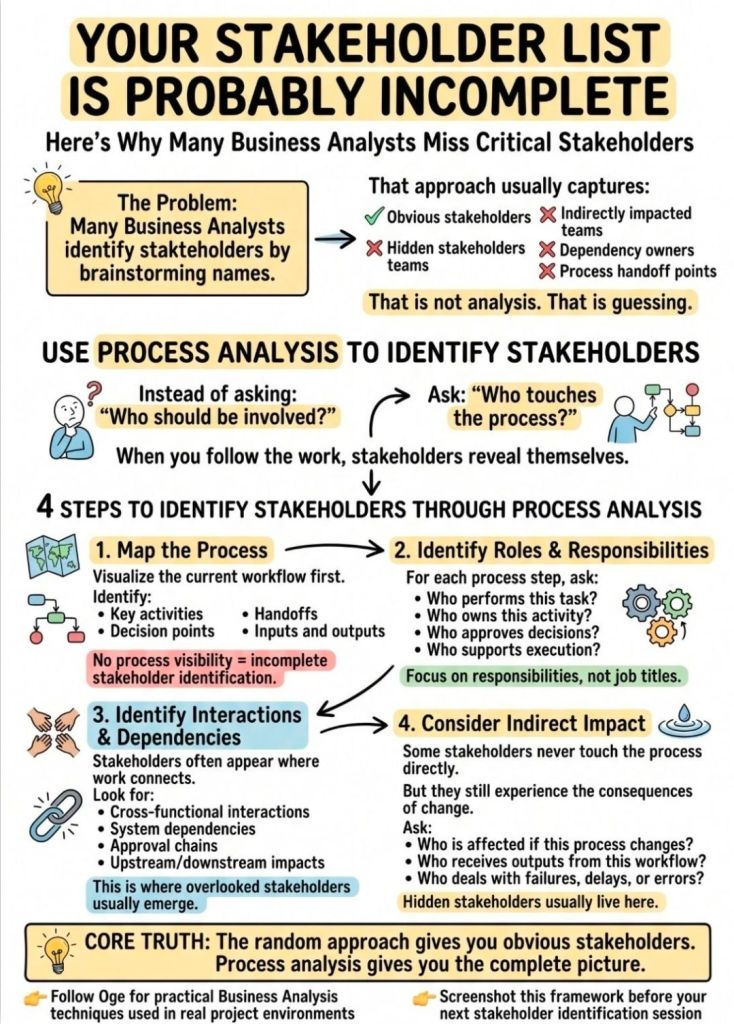
Completing the Stakeholder List using Process Analysis
Completing a stakeholder list using process analysis involves tracing the end-to-end lifecycle of a process to identify every individual, team, or organization that interacts with, influences, or is impacted by it. This ensures no hidden users, bottlenecks, or approvers are missed.
A four-step approach will ensure your list is thorough and actionable:
1. Map the Process Flow
Create a step-by-step flowchart of the current or future process. Break it down into key phases: Inputs, Activities, Outputs, and Outcomes. This visual map acts as a blueprint to spot every touchpoint where someone is involved.
2. Identify Stakeholders at Each Touchpoint
Go through each phase of your process map and ask the following dependency questions to pinpoint roles:
Input Stage: Who supplies the data, materials, or funding? (e.g., vendors, regulators, finance departments)
Activity Stage: Who performs the work or oversees it? (e.g., project teams, department managers, QA testers)
Output Stage: Who receives the final deliverable? (e.g., end-users, clients, customers)
Outcome Stage: Who is affected by the long-term results? (e.g., the community, executives, maintenance teams)
3. Classify and Prioritize
Once your comprehensive list is built, categorize stakeholders using the Power/Interest Matrix. This helps allocate your engagement efforts efficiently:
High Power, High Interest: Manage closely and collaborate heavily (e.g., Project Sponsors, Product Owners).
High Power, Low Interest: Keep satisfied but do not over-communicate (e.g., Regulators, Steering Committees).
Low Power, High Interest: Keep informed and consult regularly (e.g., End-users, Support Staff).
Wincor Nixdorf was a premier global provider of IT solutions, hardware, software, and services tailored for retail banks and the retail industry.
Headquartered in Paderborn, Germany, the company historically commanded roughly 35% of the global automated teller machine (ATM) market and stood as a dominant force in electronic point-of-sale (EPOS) systems.
Its operations focused deeply on business process optimisation, automated cash handling, and retail self-checkout systems. In 2016, Wincor Nixdorf merged with its US rival Diebold, Inc., creating the modern consolidated market leader, Diebold Nixdorf.
Detailed Historical Timeline
The history of Wincor Nixdorf spans several distinct strategic eras, tracing its evolution from a post-war calculator workshop into a modern global fintech titan.
Era 1: The Founding & Decentralised Computing (1952–1989)
This era was defined by entrepreneur Heinz Nixdorf, who pioneered small-to-medium business computing and electronic banking terminals across Europe.
1952: Heinz Nixdorf establishes Labor für Impulstechnik in Paderborn, Germany. The small enterprise builds electronic calculators for businesses rebuilding in post-war Europe.
1964: The company shifts from acting as a third-party component supplier to marketing office calculators and billing systems under its own brand name. []
1968: Following corporate acquisitions, the company officially rebrands as Nixdorf Computer AG and develops some of the world’s earliest decentralized minicomputers.
1969: The firm enters the North American market by purchasing the electronics division of the US office equipment manufacturer Victor Comptometer.
1971: Secures its first landmark international banking contract, supplying 1,000 terminals to the Swedish banking industry.
1978: Global sales cross DEM 1 billion, and the workforce grows to over 10,000 employees globally.
1982: Expands its engineering breadth by forming a dedicated corporate telecommunications division.
1984: Launches its initial public offering (IPO), floating shares publicly on the Frankfurt Stock Exchange.
1986: Founder Heinz Nixdorf suddenly dies of a heart attack at a corporate event. The company struggles to pivot from hardware-locked minicomputers to emerging open personal computer architectures.
1989: Amid intensifying global hardware margins and strategic missed steps, corporate financial losses top DEM 1 billion.
Era 2: The Siemens Integration & Corporate Carve-Out (1990–1998)
During this stage, corporate giant Siemens rescued and absorbed the distressed business, later reorganizing its retail and banking assets into a specialized standalone vehicle.
1990: Siemens AG steps in to purchase the shares of Nixdorf Computer AG, officially merging it with its own Data Information Services division to create Siemens Nixdorf Informationssysteme (SNI) AG.
1992: SNI expands heavily across European IT markets, operating as a distinct, specialized computing arm under the Siemens umbrella.
1996: Becomes the largest IT company in Germany and the second largest across the European continent.
1998: Siemens restructures its computing strategy; it sells its personal computer division to Acer and spins off the highly profitable banking and retail segments into a new unit: Siemens Nixdorf Retail and Banking Systems GmbH.
Era 3: Private Equity Buyout & The Rise of Wincor Nixdorf (1999–2015)
This period marked the official birth of the independent “Wincor Nixdorf” brand, characterized by aggressive global expansion, software-driven solutions, and public market listing.
1999: Private equity firms Kohlberg Kravis Roberts (KKR) and Goldman Sachs Capital Partners complete a buyout of the Siemens unit. The company is formally renamed Wincor Nixdorf GmbH.
2000: Launches major end-to-end IT outsourcing and infrastructure managed services alongside its standard terminal hardware.
2004: On 19 May, Wincor Nixdorf successfully returns to the public markets, listing as Wincor Nixdorf AG on the Frankfurt Stock Exchange via a high-performing IPO.
2006: Longtime Chief Executive Officer Karl-Heinz Stiller resigns from the board, leaving a structurally sound company expanding deep into automated cash recycling and software.
2009–2014: Deploys multi-vendor banking software and automated checkout machines worldwide, expanding operations across roughly 100 countries.
2015: Reports global revenues of €1.8 billion, split roughly 65% in banking services and 35% in retail point-of-sale solutions. On 23 November, US rival Diebold announces a formal business combination agreement to acquire the company.
Era 4: The Diebold Nixdorf Consolidation (2016–Present)
This current era represents the unification of American and European ATM powerhouses to navigate shifting brick-and-mortar financial landscapes.
2016: Diebold Inc. officially completes its $1.8 billion voluntary public takeover of Wincor Nixdorf AG on 15 August. The consolidated global giant begins unified operations as Diebold Nixdorf on 16 August.
2017: The UK Competition and Markets Authority (CMA) formally clears the merger following a comprehensive antitrust review, requiring Diebold to divest its legacy UK customer ATM operation to avoid localized market monopoly.
2021: Capitalizing on self-checkout shifts accelerated by the pandemic, the combined entity launches its next-generation DN Series™ EASY self-service retail product line.
2023: Burdened by legacy debt structures, supply chain disruptions, and pandemic operational challenges, Diebold Nixdorf files for a prepackaged Chapter 11 bankruptcy protection in June. The restructuring swiftly sheds $2.1 billion in debt. By August, it successfully emerges from bankruptcy, resuming trading on the New York Stock Exchange (NYSE).
2024–2026: The restructured firm shifts its focus from low-margin hardware to high-margin managed services and cloud software, stabilizing its global operations with annual revenues reaching $3.75 billion.
HPE NonStop MultiBatch is an advanced workload automation and scheduling manager designed explicitly for mission-critical HPE NonStop environments. Originally created to support complex scheduling needs in banking and finance, it automates job flows and parallel processing across multiple CPUs.
Detailed Description
The original NonStop batch scheduler (NetBatch) was built for basic sequential job queues. As large enterprises required deeper integration with databases, real-time events, and complex parallel schedules, MultiBatch (developed originally by Insider Technologies, now part of ETI-NET) emerged.
Core Functions: It automates job submission, tracks job flow, handles conditional parameters, manages event timers, and triggers jobs “On Demand” based on real-time system events.
High Availability: Like the underlying HPE NonStop system, MultiBatch is engineered for fault tolerance, ensuring automated workflows do not fail due to hardware or software interruptions.
Enterprise Integration: It supports Open System Services (OSS) and standardizes auditing, security, and menu-based operations across distributed NonStop systems.
Breakdown by Year / Era
The evolution of MultiBatch parallels the architectural changes of the HPE NonStop platform.
1985–1990s: Tandem Era & Origin
1985: Conceived. MultiBatch was developed by Insider Technologies specifically to meet the complex batch schedule demands of large financial institutions that exceeded native NetBatch capabilities.
Early 1990s: The system was officially rolled out for Tandem processors to automate transaction data loads and daily reconciliation tasks for ATMs and financial ledgers.
1997–2014: Compaq & Early HP Era
1997: Following Compaq’s acquisition of Tandem, MultiBatch was adapted to support the NonStop Himalaya systems and server software, which expanded data and network scaling.
2000s: During the HP Itanium and MIPS Era, MultiBatch evolved to support more dynamic processing pools and expanded job limits, increasing fault tolerance under the HP-UX integrated environment.
2014–2020: Transition to NonStop X & Modernization
2014: As HPE shifted the platform to standard Intel x86-64 processors (NonStop X), MultiBatch was updated for L-series operating systems to run efficiently on high-speed InfiniBand fabrics.
2019: Insider Technologies made significant updates to MultiBatch to modernize the GUI and improve code stability for the new generation of NonStop users transitioning to X-series hardware.
2020–Present: MultiBatch 10 & 10.2
2023: MultiBatch 10 was released. It included a new Operations GUI Server, significantly increased configuration limits (e.g., supporting up to 2,500 jobs), enhanced conditional parameters, improved processing of Open System Services (OSS), and “On Demand” job capabilities.
2025: MultiBatch 10.2 was released by ETI-NET. This update focused heavily on digital resilience, providing deep alignment with the NIST Cybersecurity Framework to protect against operational and cyber threats.
Current Status: Fully integrated into modern systems supporting the HPE GreenLake consumption-based cloud model, MultiBatch 10.2 serves as the primary automation engine for large enterprises executing complex HTAP (Hybrid Transaction/Analytical Processing) workloads.