ActionView.400 Monitoring Tool for OSI/MHS X.400 Subsystem on HPE NonStop

ActionView.400 is an enterprise tracking and diagnostics software solution developed by Insider Technologies Limited. It was purpose-built as a dedicated monitoring tool for the Open System Interconnection / Message Handling System (OSI/MHS) X.400 subsystem deployed on Tandem, Compaq, HP, and HPE NonStop server platforms.

ActionView 400 Monitoring Tool for OSI/MHS X.400 Subsystem on HPE NonStop
Insider Technologies Limited, Salford Quays, Manchester. M50 2YR

The software acts as a critical infrastructure layer used heavily by banking institutions, telecommunications providers, and government/military defense sectors.

It ensures that high-volume, secure electronic mail infrastructure meets strict Service Level Agreements (SLAs) by allowing engineers to account for every message, calculate end-to-end processing times, and issue real-time tracking metrics.


Detailed Timeline Breakdown by Year

  • 1989: Insider Technologies Limited is incorporated in Manchester, England, by a collective of IT industry veterans. The firm initially focuses on building service management and custom tracking middleware for the rapidly expanding Tandem NonStop server ecosystem.
  • 1990s (Early to Mid): As X.400 protocols become the global standard for secure EDI (Electronic Data Interchange) and military messaging, Insider Technologies develops ActionView 400. The product is integrated directly into Tandem’s core software stack and begins shipping natively with Tandem NonStop platforms.
  • 1997: Tandem Computers is acquired by Compaq. ActionView 400 is sustained through this transition to maintain critical operations for tier-one banks and national military infrastructures relying on NonStop systems.
  • 2002: Compaq merges with Hewlett-Packard (HP). ActionView 400 is bundled under the HP NonStop software catalog (product designation T8443), managing and diagnosing log audits like the AUDLOG framework.
  • 2000s (Mid to Late): Insider Technologies starts shifting forward-looking tracking requirements toward its newer central architecture platform, Sentra. While ActionView 400 continues handling legacy X.400 pipelines, Sentra begins acting as a unified web console to consolidate both X.400 and modern SMTP/MIME email flows across multi-vendor systems.
  • 2015: HP splits its corporate structures. The NonStop computing line and the management of ActionView 400 shift over to Hewlett Packard Enterprise (HPE).
  • 2018: In December 2018, HPE officially moves ActionView 400 to Obsolete status, marking the formal end of its product life cycle and standard vendor service life.
  • 2019 – Present: Despite official obsolescence on the HPE hardware list, Insider Technologies continues to directly support and maintain the solution for deep-legacy military, defense, and governmental bodies. Because these sectors still mandate uncompromised, zero-loss X.400 message accounting, the software remains active, feeding tracking telemetry directly into Insider’s modern Middleware Monitoring and Sentra platform interfaces.
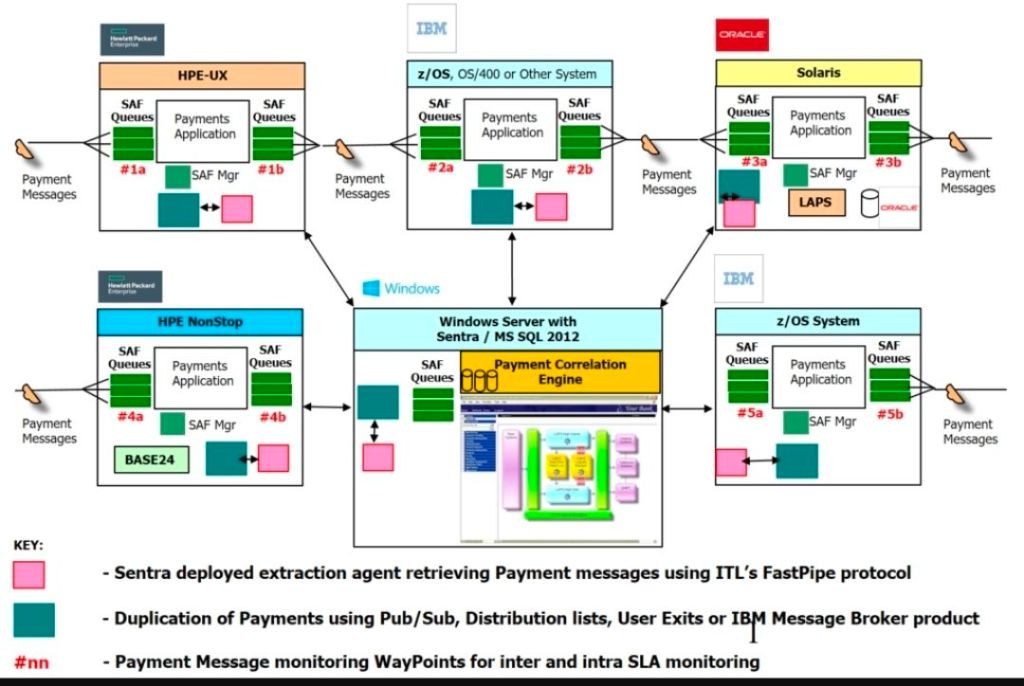
Sentra - unified web console to consolidate both X.400 and modern SMTP / MIME email flows across multi-vendor systems
Sentra – unified web console to consolidate both X.400 and modern SMTP / MIME email flows across multi-vendor systems

HPE NonStop Spoolcom subsystem Spooler Command Language program Overview and Timeline

The HPE NonStop Spoolcom (Spooler Command Language) program is the administrative interface for managing the Spooler subsystem on HPE NonStop systems. It allows operators to configure, monitor, and control print jobs, collectors, and print processes. 

Program Summary

  • Purpose: Used to define and manage spooler objects such as collectors, devices, and jobs.
  • Key Functions: Starting/stopping the spooler, modifying device attributes, and controlling job states (e.g., hold, release, delete).
  • Architecture: Operates within the Guardian environment, communicating with the Spooler supervisor process to maintain 24/7 fault-tolerant printing operations. 

Historical Timeline by Era

1. The Tandem Era (1974–1997) 

  • 1976: Introduction of the Tandem NonStop system; basic spooling capabilities were essential for early OLTP (Online Transaction Processing).
  • 1980s: The Spooler evolved to handle complex routing and multiple collectors to support growing enterprise needs.
  • 1997: Spooler D41 released, providing stable management for the MIPS-based architecture. 

2. The Compaq & Early HP Era (1997–2014)

  • 1999–2000: Release of Spooler D46, enhancing device ownership and virtual device support.
  • 2001–2002: Spooler D48 released during the transition to the HP Integrity NonStop (Itanium) platform.
  • 2012: Major updates to Spooler D48 to support H01 and H02 RVUs, improving scalability for high-end systems. 

3. The Modern HPE Era (2014–Present)

  • 2014NonStop X (x86-64) introduced. Spoolcom adapted to support the new architecture and virtualised environments.
  • 2018–2020: Focus shifted toward modernised interfaces. While Spoolcom remains the CLI standard, graphical alternatives like MultiBatch began gaining traction for batch management.
  • 2023–2024: Continued integration with HPE GreenLake and hybrid cloud models, ensuring spooling services are available in private cloud deployments. 

Futures and Roadmap

  • Modernisation: HPE is pushing toward “modernisation through tradition,” which includes better integration of legacy tools like Spoolcom with modern DevSecOps and cloud-native frameworks.
  • Kernel-Level Threading (KLT): Future updates aim to leverage KLT to improve the performance and scale-up capabilities of management processes.
  • Data-Centric Security: Integration with security platforms like TAMUNIO for field-level tokenization ensures that printed data remains compliant with PCI DSS 4.0 and GDPR. 

Useful Resources

HPE NonStop Spoolcom subsystem Spooler Command Language program – Overview and Timeline