PRINCE2 (PRojects IN Controlled Environments) Overview and Timeline by Year

PRINCE2 (PRojects IN Controlled Environments) is a structured, process-based project management methodology focusing on organization, control, and business justification. Originating from UK government IT standards in the 1970s, it has evolved into a globally recognized, tailorable standard used in over 150 countries for projects across various industries. 

PRINCE2 Project Management Summary

  • Core Philosophy: Continued Business Justification (projects must make sense financially), Manage by Exception (delegating authority within limits), and Product-Based Planning.
  • Seven Principles: Projects must have continued business justification, learn from experience, define roles and responsibilities, manage by stages, manage by exception, focus on products, and tailor to suit the project.
  • Seven Processes: Starting a Project, Directing a Project, Initiating a Project, Controlling a Stage, Managing Product Delivery, Managing a Stage Boundary, and Closing a Project.
  • Key Themes: Business Case, Organization, Quality, Plans, Risk, Change, and Progress.
  • Main Benefits: Provides a common language, clear accountability, defined roles, and tailored, consistent documentation. 

Detailed Historical Timeline (1975–2023+)

Era 1: The PROMPT Origins (1975–1988) 

  • 1975: Simpact Systems Ltd develops PROMPT (Project Resource Organisation Management and Planning Techniques) in response to IT projects running over time and budget. PROMPT II introduces a phased approach (Initiation, Specification, Design, Development, Installation, Operation). 

Era 2: The PRINCE Birth (1989–1995)

  • April 1989: The UK Central Computer and Telecommunications Agency (CCTA) adopts PROMPT II as the standard for IT projects, renaming it PRINCE (initially “PROMPT II IN the CCTA Environment”).
  • 1990: PRINCE is released into the public domain and widely adopted by the private sector for non-IT projects, although it is perceived as too rigid for small projects. 

Era 3: The Birth of PRINCE2 (1996–2008) 

  • 1996: PRINCE2 is published by the CCTA. It is rewritten for broader use (not just IT), removing jargon to become a generic project management framework.
  • 1998: PRINCE2 begins undergoing revisions based on user feedback.
  • 2000: The Office of Government Commerce (OGC) becomes the owner of PRINCE2.
  • 2002: The international user community begins consultative updates to the method. 

Era 4: The Modern Revision Era (2009–2022) 

  • 2009: PRINCE2: 2009 Refresh is released by the OGC. This major revision simplifies the method, makes it more customizable, and introduces the seven core principles.
  • 2013: Ownership transfers from the UK Cabinet Office to AXELOS Ltd, a joint venture between the UK Government and Capita.
  • 2017: PRINCE2 2017 Update is published, focusing on increased flexibility, scalability, and better tailoring guidance.
  • 2018: PRINCE2 Agile is launched, bringing a governance layer to agile delivery methods like Scrum and Kanban.
  • 2020: PRINCE2 2017 is renamed “PRINCE2 6th Edition”.
  • 2021: PeopleCert becomes the sole owner of AXELOS and PRINCE2. 

Era 5: The Current Era (2023–Present) 

  • September 2023: PRINCE2 7th Edition is released. The update introduces a “People” element, focusing on change management and team leadership, along with new guidance on Sustainability, Commercial, and Digital & Data management. 
PRINCE2 Key Evolution Summary
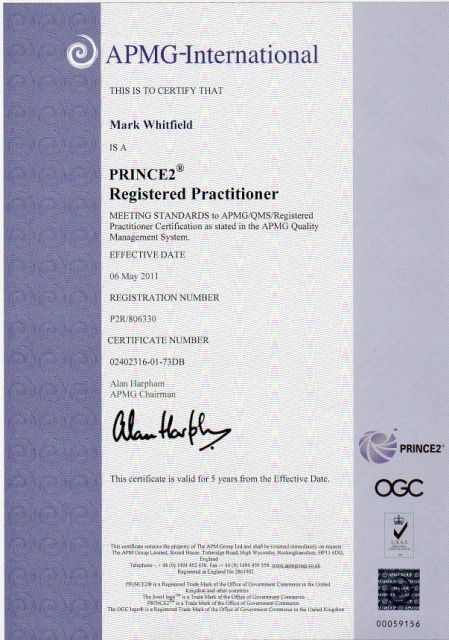
May 2011 – Registered PRINCE2 Practitioner with ILX, Mark Whitfield

PRINCE2 (PRojects IN Controlled Environments) Overview and Timeline by Year

PASCAL Programming Language Overview, Timeline and Technical Insight

Pascal is a historically significant imperative and procedural programming language designed by Niklaus Wirth between 1968 and 1969. It was created to encourage structured programming and efficient data structuring, serving as a clean, disciplined alternative to more complex languages of the time like ALGOL 60 and FORTRAN. 

Key Features and Overview

  • Strong Typing: Every variable must have a defined type (e.g., Integer, Real, Boolean, Char), and the compiler strictly enforces these to prevent errors during execution.
  • Rich Data Structures: Pascal introduced built-in support for complex types including records, sets, enumerations, subranges, and pointers.
  • Structured Control: It uses clear, English-like keywords such as beginendif-then-else, and while to organize program logic into manageable blocks.
  • Educational Focus: Originally intended as a teaching tool, it became the global standard for introductory computer science courses for nearly two decades. 

Historical Timeline of Pascal

The Foundation Era (1960s)

  • 1964–1966: Niklaus Wirth joins the IFIP Working Group to design a successor to ALGOL 60. His “pragmatic” proposal is rejected in favour of the more complex ALGOL 68.
  • 1966: Wirth implements his proposal at Stanford as ALGOL W, which introduces many concepts later found in Pascal.
  • 1968: Wirth begins designing a new language at ETH Zurich, naming it Pascal after the 17th-century mathematician Blaise Pascal. 

The Emergence Era (1970–1979)

  • 1970: The first Pascal compiler becomes operational on the CDC 6000 mainframe, and the official language definition is published.
  • 1971: Formal announcement of Pascal appears in Communications of the ACM.
  • 1972: The first successful port to another system (ICL 1900) is completed by Welsh and Quinn.
  • 1973: The Pascal-P kit (P-code) is released, providing a portable intermediate code that allows Pascal to be easily ported to different hardware.
  • 1975: The UCSD Pascal system is developed at the University of California, San Diego, eventually bringing the language to microcomputers like the Apple II.
  • 1979: Apple releases Apple Pascal, licensing the UCSD p-System for its platforms. 

The Dominance Era (1980–1989)

  • 1983ISO 7185:1983 is published, establishing the first international standard for Pascal.
  • 1983: Borland International releases Turbo Pascal 1.0. Priced at $49.95, its extreme speed and integrated environment revolutionize PC programming.
  • 1984: The Educational Testing Service (ETS) adopts Pascal as the official language for the AP Computer Science exam in the U.S..
  • 1985: Apple introduces Object Pascal on the Macintosh to support object-oriented programming.
  • 1989: Borland adds object-oriented features to Turbo Pascal 5.5, adopting the Apple Object Pascal extensions. 

The Transition and Legacy Era (1990–Present)

  • 1990: The Extended Pascal standard (ISO/IEC 10206) is released, adding modularity and separate compilation.
  • 1995: Borland releases Delphi, a Rapid Application Development (RAD) tool based on Object Pascal, designed for the Windows graphical interface.
  • 1997: The open-source Free Pascal compiler (originally FPK Pascal) emerges to provide a cross-platform alternative to commercial tools.
  • 1999: Pascal is replaced by C++ as the official language for the AP Computer Science exam, marking the end of its educational dominance.
  • Present: Pascal remains active through projects like Lazarus (an open-source IDE for Free Pascal) and continued updates to Embarcadero Delphi for Windows, macOS, Android, and iOS development. 

Pascal is a historically significant, high-level, and statically typed programming language designed in the late 1960s by Niklaus Wirth. Its primary technical goal was to encourage structured programming—a disciplined approach that uses clear, logical sequences and data structuring to make code more readable and reliable. 

Technical Insights

The technical architecture of Pascal is built on a few core pillars that distinguish it from its contemporaries like C or FORTRAN: 

  • Strong Typing: Unlike many early languages, Pascal is strongly typed, meaning data types cannot be mixed or converted without explicit instruction. This reduces runtime errors by catching type mismatches during compilation.
  • Block-Structured Design: Programs are organized into clear blocks (using BEGIN and END), including nested procedures and functions. This hierarchical structure allows for precise control over variable scope.
  • Unique Data Structures: Pascal introduced native support for sets (representing mathematical sets as bit vectors) and variant records, which allow different fields to overlap in memory to save space.
  • One-Pass Compilation: The strict ordering of declarations (constants, then types, then variables, then procedures) was originally designed to allow the compiler to process the entire program in a single pass. 

General Programming Approach

Pascal enforces a “think before you code” philosophy through its rigid syntax and organizational requirements: 

  1. Top-Down Design: The language encourages breaking complex problems into smaller, manageable sub-tasks (procedures and functions).
  2. Explicit Declarations: Every variable must be declared in a specific VAR section before the executable code begins. This prevents the “spaghetti code” common in earlier languages.
  3. Algorithmic Focus: Because the syntax is so close to pseudo-code, the approach focuses heavily on the logic of the algorithm rather than language-specific “tricks”.
  4. Parameter Passing Control: Developers have explicit control over how data moves; using the VAR keyword allows passing by reference (modifying the original variable), while omitting it passes by value (working on a copy). 

Modern Relevance

While its peak in education was the 1980s and 90s, Pascal evolved into Object Pascal, which powers modern tools: 

  • Delphi: A popular IDE by Embarcadero Technologies used for rapid application development (RAD) on Windows, macOS, and mobile.
  • Free Pascal (FPC) & Lazarus: Open-source alternatives that bring modern features like generics and anonymous methods to the language. 

COBOL Programming Overview & Detailed Timeline History by Era and Year

COBOL, (COmmon Business-Oriented Language) is a high-level, compiled programming language designed specifically for business, finance, and administrative systems. Developed as a portable “stopgap” for the US Department of Defense, it has endured for over 65 years and remains the backbone of global financial infrastructure. 

Programming Overview

  • Design Philosophy: It features a “prose” syntax designed to be self-documenting and readable by non-technical business professionals.
  • Structure: Programs are strictly divided into four Divisions:
    1. Identification: Defines the program name and metadata.
    2. Environment: Specifies the physical computer and files used.
    3. Data: Defines variables, structures, and record layouts.
    4. Procedure: Contains the logic and executable statements.
  • Core Paradigms: Originally strictly procedural and imperative, COBOL was updated in 2002 to include object-oriented features.
  • Key Characteristics: It is known for its verbosity (using over 300 reserved words), weak/static typing, and exceptional reliability in large-scale batch and transaction processing. 

Detailed Historical Timeline

Era 1: The Foundation (1950s)

This era focused on consolidating disparate manufacturer-specific languages into a single, hardware-independent standard for business. 

  • 1955: Grace Hopper develops FLOW-MATIC, which introduced English-like commands and influenced COBOL’s design.
  • 1958: IBM releases COMTRAN, another major precursor focused on commercial translation.
  • 1959 (April): Mary Hawes organizes a meeting at the University of Pennsylvania to propose a common business language.
  • 1959 (May): The Pentagon hosts a meeting creating CODASYL (Committee on Data Systems Languages) to oversee the project.
  • 1959 (December): The first specifications, “COBOL – Specifications for a COmmon Business Oriented Language,” are released. 

Era 2: Early Versions & Rapid Adoption (1960–1967)

The language quickly transitioned from a theoretical specification to a functioning industry standard. 

  • 1960COBOL-60 is officially published.
  • 1960 (August): The first COBOL program runs on an RCA 501.
  • 1961COBOL-61 is released, providing a major cleanup of original logical flaws.
  • 1962: IBM announces COBOL as its primary development language, ending work on COMTRAN.
  • 1963COBOL-61 Extended is released, introducing “Sort” and “Report Writer” facilities.
  • 1965COBOL Edition 1965 adds mass storage file handling and table processing.

Era 3: Standardization & Dominance (1968–1984)

COBOL became the most widely used language in the world as ANSI and ISO codified its rules. 

  • 1968COBOL-68 (ANSI X3.23-1968) is published as the first official US standard.
  • 1970: COBOL becomes the world’s most widely used programming language.
  • 1974COBOL-74 is standardized, introducing the DELETE statement and file organization improvements.
  • 1978: ISO formally adopts the COBOL-74 standard. 

Era 4: Structured Programming & Modernization (1985–2001) 

The language evolved to support better logic flow while managing the massive global codebase. 

  • 1985COBOL-85 introduces structured programming features like END-IFEVALUATE, and nested subprograms.
  • 1989: First amendment to COBOL-85 adds Intrinsic Function Modules.
  • 1997: Gartner Group estimates 200 billion lines of COBOL code are in existence.
  • 1999: Massive effort peaks to patch legacy COBOL code for the Y2K (Year 2000) problem

Era 5: The Object-Oriented & Modern Era (2002–Present)

Recent updates focus on interoperability with modern web and cloud environments. 

  • 2002COBOL-2002 introduces Object-Oriented Programming (OOP), Unicode support, and recursion.
  • 2014COBOL-2014 standardizes IEEE 754 data types and method overloading.
  • 2020: The COVID-19 pandemic highlights a critical shortage of COBOL programmers to maintain aging state unemployment systems.
  • 2023COBOL-2023 adds asynchronous messaging (SEND/RECEIVE) and transaction processing (COMMIT/ROLLBACK).
  • 2024: COBOL celebrates its 65th anniversary of active service.

COBOL Programming Overview & Detailed Timeline History by Era and Year

RTLX by Insider Technologies, Overview and Timeline by Year

Insider Technologies RTLX (now C-Deep (Transaction Monitoring) https://etinet.com/products/c-deep-transaction-monitoring/ ) is a real-time monitoring and tracking solution designed to provide end-to-end visibility for high-volume electronic payments and transactional processes. It specifically ensures that every stage of a payment—from the initial card “tap” at a point-of-sale (POS) terminal to the final movement of funds from an account—is monitored to maintain operational continuity. 

RTLX Overview

  • Function: Real-time transaction and payment monitoring.
  • Platforms: Runs on HP NonStop, Windows, Linux, and Unix.
  • Core Value: Simplifies “Big Data” for IT operations by alerting teams to potential failures before they impact consumers (e.g., preventing ATM or online banking outages).
  • Key Use Case: Used by major financial institutions like the Bank of England and Royal Bank of Scotland for settlement and transaction security. 

RTLX Historical Timeline

The development of RTLX is closely tied to Insider Technologies’ growth as a specialist in mission-critical HP NonStop environments. 

EBUG Conference, Mark Whitfield – Product Manager

The Foundational Era (1989–2000)

  • 1989Insider Technologies Limited is founded in Manchester, UK, by IT industry veterans.
  • 1990s: The company establishes its “DNA” in the HP NonStop (Tandem) platform, developing core products like MultiBatch and Reflex.
  • 1995: Insider begins a period of rapid growth, providing technical support for critical UK financial infrastructure, including Euroclear (formerly CRESTCo), which settles 88% of UK equities. 

The Expansion Era (2001–2014)

  • 2002: Launch of the state-of-the-art Systems Training Platform, featuring 4x patented cloning technology for hyper-realistic simulations.
  • 2004–2013: Development of the Reflex suite (Reflex 80:20 and Reflex ONE24) and the introduction of Sentra and RTLX Reactor monitoring products.
  • 2014: Insider expands its product initiatives to include diagnostic and trending solutions for real-time electronic payments, solidifying the role of RTLX in global banking. 

The Acquisition & Integration Era (2015–Present)

  • 2015ETI-NET acquires Insider Technologies on 1 July, integrating its monitoring expertise with ETI-NET’s mainframe storage and backup solutions.
  • 2019: Insider celebrates its 30th year of operations, highlighting RTLX’s role in monitoring modern POS and “tap” payment systems.
  • 2023–Present: Insider becomes part of the PartnerOne group, a global family of mission-critical software companies, further scaling its threat detection and real-time monitoring capabilities. 

RTLX by Insider Technologies, Overview and Timeline by Year

PRINCE2 Management Products Templates Overview and Historical Timeline

PRINCE2 management products are the 26 standard documents (templates) used to manage a project throughout its lifecycle. They are categorised into Baselines (plans and definitions), Records (registers and logs), and Reports (periodic updates). 

PRINCE2 Microsoft Project & Excel templates

Management Products Overview

The core templates provided in the methodology ensure consistent project control. Official templates are often available through accredited providers, this website or the official AXELOS website. 

  • Baselines: Used to define the project foundation (e.g., Business Case, Project Initiation Document, Plan).
  • Records: Dynamic logs to track day-to-day data (e.g., Risk Register, Issue Register, Lessons Log).
  • Reports: Snapshots of progress or specific events (e.g., Highlight Report, Checkpoint Report, Exception Report). 

Historical Timeline of Templates & Methodology

The evolution of these products reflects a shift from rigid, IT-specific documents to flexible, industry-agnostic templates. 

The Pre-PRINCE Era (1975 – 1988) 

  • 1975PROMPT II (Project Resource Organisation Management and Planning Techniques) was developed by Simpact Systems Ltd.
  • Key Focus: Introduced the concept of project phases (Initiation, Specification, Design) but was strictly for IT. 

The PRINCE Era (1989 – 1995) 

  • 1989PRINCE (PROMPT II in the CCTA Environment) launched by the UK Government’s CCTA.
  • Key Focus: Added Critical Path Analysis and formal management roles, but remained IT-heavy and rigid. 

The PRINCE2 Emergence (1996 – 2008)

  • 1996PRINCE2 (1st Edition) was released as a generic framework.
  • Key Change: IT-specific jargon was removed to make templates applicable to any industry.
  • 2002/2005: Minor updates (3rd and 4th Editions) focused on minor refinements based on user feedback. 

The Revision Era (2009 – 2022)

  • 2009PRINCE2:2009 Refresh (5th Edition) introduced the seven core principles.
  • Key Change: Templates were simplified and made more customisable to reduce “prowess-driven” bureaucracy.
  • 2017PRINCE2 6th Edition (formerly the 2017 Update) launched.
  • Key Change: Emphasis on Tailoring and scalability for different project sizes. 

The Modern Era (2023 – Present)

  • 2023PRINCE2 7th Edition was released.
  • Key Change: Added a “People” element and introduced three new management approaches: SustainabilityCommercial, and Digital & Data

Template Kits & Resources

For those seeking pre-formatted digital versions:

  • PRINCE2 7th Edition Template Bundle: Comprehensive sets including MS Project MPP, Excel Gantt charts, and Word artifacts are available at Etsy and eBay.
  • Specialised Packs: Focused collections like the PRINCE2 Control & Monitoring Pack can be found at WorkFlo Design.
  • Individual Documents: Individual templates like the Project Initiation Document (PID) are often sold separately for specific project needs. 
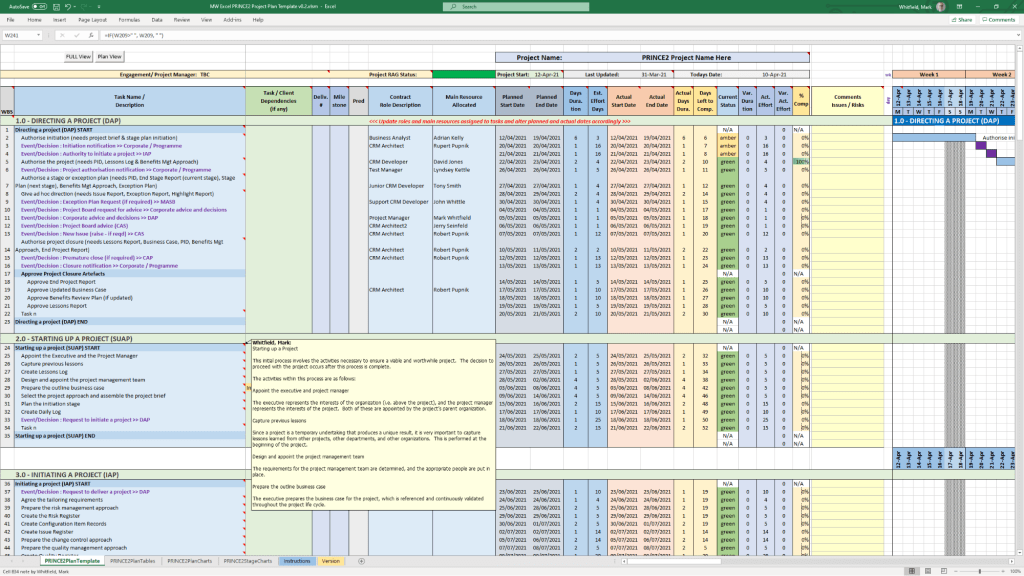
  • PRINCE2 Templates can be purchased directly from this website including a Microsoft Project Plan in MPP format and also a Microsoft Excel Project Plan in XLS format, see below and website link.

PRINCE2 Management Products Templates Overview and Historical Timeline

PRINCE2 Microsoft Project MPP file template
PRINCE2 Microsoft Excel XLS template 1
PRINCE2 Microsoft Excel XLS template 2

Roger Federer Overview and Historical Timeline by Era and Year

Roger Federer is a Swiss former professional tennis player who is widely regarded as one of the greatest athletes in history. His 24-year career (1998–2022) is defined by a “deadly combination of power and grace,” characterized by an effortless one-handed backhand and fluid movement. He won 20 Grand Slam singles titles, including a record eight at Wimbledon, and held the world No. 1 ranking for 310 weeks, including a record 237 consecutive weeks

Historical Career Timeline

Era 1: Junior Years and Professional Transition (1992–2002) 

Before his global dominance, Federer was a temperamental junior who transformed into a top-ten professional. 

  • 1992–1993: Served as a ballboy at the Swiss Indoors in his hometown of Basel.
  • 1995: Accepted into the Swiss Tennis national development programme at age 14.
  • 1998: Won the Wimbledon junior singles and doubles titles; finished the year as the world’s No. 1 junior. Made his ATP debut at the Swiss Open Gstaad.
  • 1999: Became the youngest player (18 years, 4 months) to end the year in the top 100.
  • 2000: Reached the bronze-medal match at the Sydney Olympics (finished 4th) and met his future wife, Mirka Vavrinec.
  • 2001: Gained international fame by defeating defending champion Pete Sampras at Wimbledon to reach his first major quarter-final. Won his first ATP title in Milan.
  • 2002: Ended the year ranked No. 6 globally; qualified for his first year-end Masters Cup (ATP Finals). 

Era 2: Unrivalled Dominance (2003–2007) 

Federer established a “Golden Era,” reaching all four Grand Slam finals in a single year three times during this period (2006, 2007, 2009). 

  • 2003: Won his first Grand Slam title at Wimbledon, defeating Mark Philippoussis.
  • 2004: Won three Grand Slams (Australian Open, Wimbledon, US Open) and became world No. 1 for the first time on 2 February, a position he would not relinquish for 237 weeks.
  • 2005: Defended his Wimbledon and US Open titles.
  • 2006: Arguably his greatest season, winning three majors and reaching the final of the fourth (French Open); finished with a 92–5 match record.
  • 2007: Reached all four Grand Slam finals again, winning three. Defeated Novak Djokovic in the US Open final to claim his 12th major.

Era 3: Rivalries and Record-Breaking (2008–2012) 

As rivals Rafael Nadal and Novak Djokovic emerged, Federer achieved his most significant career milestones. 

  • 2008: Battled mononucleosis but won a fifth consecutive US Open. Won Olympic Gold in doubles with Stan Wawrinka.
  • 2009: Completed the Career Grand Slam by winning the French Open and broke Pete Sampras’s record of 14 majors by winning his 15th at Wimbledon.
  • 2010: Won his fourth Australian Open.
  • 2011: The first year since 2002 he did not win a major title, despite ending Djokovic’s 43-match win streak at the French Open.
  • 2012: Won a record-equalling 7th Wimbledon title, returned to world No. 1, and won Olympic Silver in singles at the London Games. 

Era 4: Injury Struggles and Late Renaissance (2013–2019) 

After several years of injury and titles eluding him, Federer staged a historic comeback. 

  • 2013–2016: Plagued by back and knee injuries. Underwent knee surgery in 2016 and missed the second half of that season, dropping out of the top 10 for the first time in 14 years.
  • 2017: Returned from a 6-month layoff to win the Australian Open (defeating Nadal) and a record 8th Wimbledon title without dropping a set.
  • 2018: Won his 20th and final Grand Slam title at the Australian Open and became the oldest world No. 1 in history at age 36.
  • 2019: Won his 100th career title (Dubai) and reached his 12th Wimbledon final, losing an epic 5-set match to Djokovic despite holding championship points. 

Era 5: Retirement (2020–2022) 

  • 2020–2021: Limited by multiple knee surgeries. Played his final Grand Slam match at Wimbledon 2021, reaching the quarter-finals.
  • 2022: Announced his retirement in September. Played his final match—a doubles pairing with Rafael Nadal—at the Laver Cup in London.

Roger Federer Overview and Historical Timeline by Era and Year

Roger Federer career statistics

with hyperlinks

Roger Federer‘s professional career spanned 24 years, from his ATP debut in 1998 to his emotional retirement at the Laver Cup on 23 September 2022. He concluded his career with 103 singles titles and 20 Grand Slam championships, including a record eight Wimbledon titles. 

Career Timeline (1998–2022)

  • 1998: Professional Debut
    • Federer made his ATP debut at the Swiss Open Gstaad.
    • Won the Wimbledon junior singles and doubles titles.
  • 2001: Breakthrough Victory
    • Defeated defending champion Pete Sampras at Wimbledon, ending Sampras’s 31-match win streak and reaching his first major quarter-final.
  • 2003: First Grand Slam Title
  • 2004: Ascending to World No. 1
    • Won the Australian Open, Wimbledon, and US Open.
    • Became World No. 1 for the first time on 2 February, beginning a record-breaking streak of 237 consecutive weeks at the top.
  • 2006: The “Career-Best” Season
    • Reached the final of all four Grand Slams, winning three of them (Australian Open, Wimbledon, US Open) and finishing the year with 12 titles and a 92–5 record.
  • 2008: Olympic Gold
  • 2009: Career Grand Slam
    • Won the French Open to complete his Career Grand Slam and equaled Pete Sampras’s then-record of 14 major titles.
    • Secured his 15th major title at Wimbledon shortly after.
  • 2012: Olympic Silver & No. 1 Return
    • Won an eighth Wimbledon title and reclaimed the World No. 1 ranking.
    • Earned an Olympic silver medal in singles at the London Games.
  • 2014: Davis Cup Triumph
    • Led Switzerland to its first-ever Davis Cup title, defeating France in the final.
  • 2017: The Renaissance
    • After a six-month injury hiatus, won the Australian Open and a record eighth Wimbledon title.
  • 2018: 20th Grand Slam & Oldest No. 1
  • 2022: Retirement
    • Announced his retirement on 15 September.
    • Played his final competitive match in doubles alongside Rafael Nadal at the Laver Cup in London.

HP NonStop MultiBatch Overview and Historical Timeline

HP NonStop MultiBatch is a “mainframe-class” workload automation and batch scheduling manager developed by Insider Technologies (distributed by ETI-NET). It is designed specifically for the HPE NonStop (formerly Tandem) platform to automate, manage, and secure complex batch processing across both Guardian and OSS environments. 

Product Overview

While the native NonStop scheduler is NetBatch, MultiBatch is positioned as a modern, high-performance alternative that provides deeper integration with the NonStop architecture. 

  • Workload Automation: Manages thousands of concurrent jobs with sophisticated calendaring and dependency tracking.
  • Architecture: Built to leverage NonStop’s fault tolerance and linear scalability, allowing batch schedules to execute across multiple networked nodes.
  • Interfaces: Modernized from command-line tools to a suite of role-based Graphical User Interfaces (GUIs) for operations and management.
  • Security: Includes a secure, audited environment with full support for NonStop-specific security attributes like High-PIN and CPU selection. 

Historical Timeline by Era

The evolution of MultiBatch is closely tied to the history of the Tandem/NonStop platform, which spans over 50 years of ownership changes and architectural shifts. 

1. The Tandem Era (1974 – 1997)

  • 1974: Tandem Computers founded by James Treybig to build the first fault-tolerant commercial systems.
  • Late 1980s – Early 1990sMultiBatch originated during this period (reportedly in the early 1990s) to address the needs of large financial institutions requiring complex batch schedules beyond the capabilities of the original NetBatch.
  • 1991: Release of the Cyclone/R and the start of the migration from proprietary stack machines to MIPS RISC processors. 

2. The Compaq & Early HP Era (1997 – 2014)

  • 1997: Compaq acquires Tandem.
  • 2002: Hewlett-Packard (HP) merges with Compaq. The NonStop platform begins its migration from MIPS to Intel Itanium (branded as Integrity NonStop).
  • Mid-2000s: MultiBatch matures as a mission-critical tool for global banks and stock exchanges. Development focuses on MultiBatch 7 and 8, enhancing GUI capabilities and adding support for Open System Services (OSS). 

3. The Modern HPE Era (2014 – Present)

  • 2014NonStop X is introduced, moving the architecture from Itanium to Intel x86-64.
  • 2015: Hewlett-Packard splits into HP Inc. and Hewlett Packard Enterprise (HPE).
  • 2018 – 2020MultiBatch 9.5 is released with an enhanced GUI. It increasingly becomes the primary alternative as HPE shifts focus away from active sales of the legacy NetBatch product.
  • 2023 – 2024: Release of MultiBatch 10, introducing “Define Classes,” support for up to 2,500 jobs, and improved OSS process handling. This era focuses on “modernisation through tradition,” aligning with HPE’s push for virtualized NonStop and hybrid cloud deployments. 

MuleSoft Architecture Overview, API-Led Connectivity

MuleSoft Architecture Overview, API-Led Connectivity

MuleSoft (a Salesforce company) – From October 2018 – June 2019, assigned as a Delivery Manager at MuleSoft (augmented) to deliver the Anypoint Platform.

Project Management Mistakes Overview

Project Management Mistakes Overview

Mark Whitfield Online Resume Overview

Mark Whitfield is a highly experienced Senior IT Project Manager and former developer with over 30 years of expertise in HP NonStop (formerly Tandem) systems, primarily within the electronic banking and payments sectors. He is currently a Senior Project Manager at Capgemini (SC cleared until 2031) and maintains a professional portfolio at mark-whitfield.com

Historical Timeline & Customer Breakdown

  • 1990 – 1995: The Software Partnership / Deluxe Data (now FIS)
    • Customer/Projects: Developed electronic banking software, specifically sp/ARCHITECT-BANK, for major financial institutions including TSBBank of ScotlandRabobank, and Girofon (Denmark).
    • Technical Breakdown: Focused on low-level programming using COBOL85NonStop SQL, and TAL (Transaction Application Language).
    • Role: Programmer.
  • 1995 – 2013: Insider Technologies Ltd (ITL)
    • Customer/Projects: Focused on HP NonStop monitoring, diagnostic, and payment software for high-value banking clients. Key products included Enterprise ManagerXPNETBASE24, and EPS.
    • Technical Breakdown:
      • XPERT24: Produced technical designs for this performance monitoring tool to track XPNET layers and transaction interchange counters (ATM/POS approval rates).
      • RTLX Payments: Served as IT Project Manager for RTLX (Real-Time Long-term eXchange) payment software.
      • Infrastructure: Extensive use of Guardian utilities (PATHWAY, SCF, FUP, INSPECT), TACL, and SCOBOL.
    • Role: Software Design, Team Leading, and Product Management.
  • 2013 – 2016: Freelance / Contract Projects
    • Customer/Projects: Managed software development lifecycle (SDLC) projects for various blue-chip companies.
    • Role: IT Project Manager.
  • 2016 – Present: Capgemini
    • Customer/Projects: Managing large-scale digital and public sector transformations. Notable clients include UK Government (MS Azure Cloud migration), Jaguar Land Rover (JLR)HeathrowRoyal Mail GroupBank of EnglandHSBCBarclays, and Deutsche Bank.
    • Technical Breakdown: Transitioned from legacy Tandem environments to modern Agile Scrum delivery and Microsoft Azure Cloud hosting.
    • Role: Senior Project Manager / Technical Delivery Manager.

Technical Breakdown by Competency

  • Operating Systems: HP NonStop (Guardian/NSK), Windows, Linux, Unix.
  • Programming Languages: TALTACLCOBOL85SCOBOL, C, C++, Java, and ASP.NET framework.
  • Databases: NonStop SQL/MP, MS SQL.
  • NonStop Middleware: PATHWAYXPNETBASE24EPS, and EMS (Event Management System).
  • Methodologies: Registered PRINCE2 PractitionerAgile SCRUM, ITIL, and ISO9001:2008. 

Web Hyperlinks & Resources

Project Management Templates Overview and Author Timeline

Mark Whitfield provides a comprehensive suite of over 200 editable project management templates designed for Agile, Waterfall, and PRINCE2 methodologies. These tools are based on his 30+ years of project delivery experience in high-stakes sectors like banking and aerospace. 

Overview of Project Management Templates

Whitfield’s collection, available on his official website and Etsy, includes specialized tools for various delivery phases: 

  • Planning & Scheduling: Includes Plan on a Page (POaP) (30+ PowerPoint examples for executive summaries), detailed MS Project (MPP) plans, and Excel-based Gantt charts for those without MS Project licenses.
  • Tracking & ControlRAID Logs (Risks, Actions, Issues, Dependencies/Decisions) with built-in charts, and RACI Trackers for defining roles and responsibilities.
  • Methodology-Specific Tools:
    • PRINCE2: Full 7th Edition MS Project plans and standard Word templates.
    • Agile/Scrum: Agile burn-down and burn-up charts, story dependency trackers, and sprint overview templates.
  • Financial Management: Detailed trackers for budgets, forecasts, actuals, margins, and resource costing per project phase.
  • Reporting & Governance: Weekly/monthly status report templates (Word and PowerPoint), project organization charts, stakeholder analysis plans, and meeting minutes.
  • Delivery & Mobilization: Onboarding kits, deployment runbooks, and Statement of Work (SOW) guidance for both Agile and Waterfall. 

Historical Career Timeline

Mark Whitfield’s template development is rooted in a career that evolved from technical programming to senior engagement management. 

  • 1990–1995: The Software Partnership / Deluxe Data: Started as a programmer specializing in electronic banking software for Tandem Computers (HPE NonStop).
  • 1995–2013: Insider Technologies (18 years):
    • 1997: Consultant at CRESTCo (now Euroclear) for volume testing and performance benchmarking.
    • 2002: Managed the first HP OpenView Operations 2-way Smart Plug-In certification for the NonStop platform.
    • Early 2000s: Transitioned to IT Project Manager, managing waterfall projects for real-time log extraction (RTLX) products for clients like HSBC.
    • Late 2000s–2013: Senior roles in product and project management, managing large-scale transaction monitoring for global banks.
  • 2013–2014: Wincor Nixdorf: Served as a Project Manager for the Banking Division, managing a £5m+ project for Lloyds Banking Group (LBG) to replace legacy software across their ATM estate.
  • 2014–2016: Betfred: Senior IT Digital Project Manager in the Online and Mobile Division, delivering projects using the Agile Scrum framework.
  • 2016–Present: Capgemini UK:
    • 2016: Lead Project Manager for a UK Air Traffic organization, delivering iOS apps for airspace visualization.
    • 2023–2024: Technical Delivery Manager for a £1m+ UK Government project involving fish export and health document portals.
    • Current: Serving as an Engagement Manager (Certified PRINCE2 Practitioner and Agile SCRUM) augmented into MuleSoft. 

Project Management Templates Overview and Author Timeline

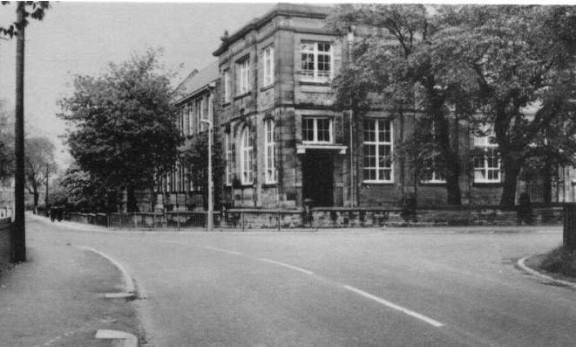
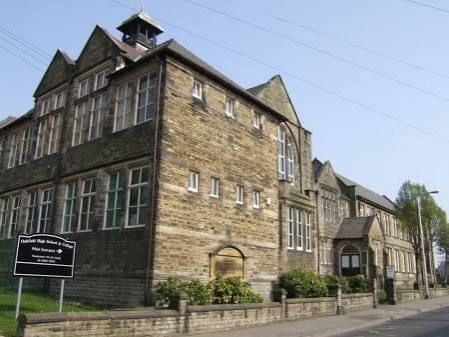
HND Higher National Diploma Overview and Historical Timeline by Year

Higher National Diploma (HND) is a Level 5 vocational qualification in the UK, equivalent to the first two years of a university bachelor’s degree. Designed to provide industry-specific practical skills, it typically takes two years of full-time study or three to four years part-time. 

Higher National Diploma HND in Computer Studies (3)

Historical Timeline of the HND

The HND has evolved from a niche engineering credential into a globally recognised vocational standard. 

The Early Era: Origins and Industrial Focus (1920s–1950s)

  • 1920: The Higher National Diploma was first introduced in England and Wales alongside the Ordinary National Diploma (OND) and Higher National Certificate (HNC).
  • 1921–1923: Initial subject frameworks were established, starting with Mechanical Engineering (1921) and Electrical Engineering (1923).
  • 1930s: The qualification expanded into Building (1929) and Commerce (1939) to support a growing industrial economy.
  • Post-WWII: The 1944 Butler Act reorganised secondary education, but HNDs remained the primary route for advanced technical training in colleges. 

The Expansion Era: Growth and New Governance (1960s–1970s)

  • 1960s: HNDs gained prominence in polytechnics, addressing critical skills gaps through a practical approach to higher education.
  • 1968–1969: Awards for HNDs saw a massive 665% increase compared to a decade prior, beginning to rival university “ordinary degrees” in popularity.
  • 1972–1974: Under Margaret Thatcher (then Education Secretary), the Haselgrave Report recommendations led to moving qualifications from the City and Guilds to two new bodies: the Business Education Council (BEC) and the Technician Education Council (TEC)

The BTEC and Modernisation Era (1980s–2000s)

  • 1983: BEC and TEC merged to form the Business and Technician Education Council (BTEC), which became the primary awarding body for HNDs.
  • 1990s: BTEC merged with the University of London Examinations Board to form Edexcel (now part of Pearson).
  • 1980s–90s: The curriculum diversified rapidly into modern sectors such as computing, business, catering, and performing arts.
  • 2000s: Global expansion accelerated; for instance, the HND was formally introduced in Cameroon in 2002
Higher National Diploma HND in Computer Studies (1)

The Contemporary Era: Frameworks and Global Standard (2010s–Present)

  • 2013–2014: Despite a decline in public sector colleges due to the rise of Foundation Degrees, HND student numbers at private providers grew from 13,000 to 30,000 in just one year.
  • 2018: Major global curriculum updates were implemented to integrate digital literacy, sustainability, and entrepreneurship into traditional vocational subjects.
  • 2020s: Current HNDs are positioned at Level 5 on the Regulated Qualifications Framework (RQF) and are delivered in over 60 countries. 

Key Characteristics of the HND

  • Academic Standing: Equivalent to Level 5 (Year 2 of a Degree).
  • Progression: Over 95% of UK universities allow HND graduates to “top up” to a full bachelor’s degree, often entering directly into the final year.
  • Assessment: Focuses on practical projects, case studies, and work placements rather than just theoretical exams. 

HND Higher National Diploma Overview and Historical Timeline by Year

Higher National Diploma HND in Computer Studies (2)

Salford Quays Overview and Comprehensive Timeline by Era

Salford Quays is a major waterfront destination in Greater Manchester, originally the site of the Manchester Docks. After the docks closed in 1982, the area underwent one of the UK’s most ambitious urban regeneration projects, transforming from a derelict industrial zone into a vibrant cultural, commercial, and residential hub. It is now home to landmarks such as The LowryImperial War Museum North, and the MediaCityUK media cluster. 

Comprehensive Historical Timeline

The history of Salford Quays is defined by three distinct eras: the rise of the Manchester Docks, a period of industrial decline, and its modern rebirth through regeneration. 

I. The Industrial Era (1887–1960s)

This era saw the construction and peak of the Manchester Docks, which turned Manchester into an inland port despite being 40 miles from the sea. 

  • 1887: Construction of the Manchester Ship Canal begins to bypass high charges from Liverpool’s docks.
  • 1893: The canal is flooded in November, preparing for its opening.
  • 1894: Queen Victoria officially opens the Manchester Ship Canal and Salford Docks on 21 May.
  • 1905: King Edward VII opens No. 9 Dock, the largest in Salford, on the former site of the Manchester racecourse.
  • 1920: Employment peaks with approximately 16,000 labourers working at the docks.
  • 1927: Official Dock offices open on Trafford Road.
  • 1950s: The docks reach their peak traffic, annually seeing over 16 million tons of cargo and 5,000 ships.

II. The Era of Decline (1960s–1982) 

Technological shifts in shipping and industrial unrest led to the eventual closure of the port. 

  • 1966: A 47-day strike by the National Union of Seamen leads to a significant loss of customer confidence.
  • 1969: The vessel Manchester Courage hits the Irlam lock gates, trapping ships in the docks for five weeks.
  • 1970s: The rise of containerisation makes the Ship Canal too narrow for modern, larger ships, causing a rapid decline in trade.
  • 1982: The docks officially close, resulting in the loss of 3,000 jobs and leaving the area derelict and polluted. 

III. The Regeneration Era (1983–Present) 

Salford City Council and private partners began transforming the abandoned docks into a modern “urban living” quarter. 

  • 1983: Salford City Council acquires the derelict docks from the Manchester Ship Canal Company.
  • 1984: The area is officially rebranded as Salford Quays.
  • 1985: The Salford Quays Development Plan is published, outlining a mix of housing, offices, and leisure.
  • 1986: Regeneration work officially begins; the MGM Canon Cinema (the first new building) opens in December.
  • 1987: The Copthorne Hotel opens. A compressed air mixing system is introduced to oxygenate the water, allowing 12,000 fish to be introduced.
  • 1989: Mariner’s Canal is opened by the Duke of York.
  • 1991: The Anchorage office complex is completed, becoming a major commercial landmark.
  • 1994: The Centenary Walkway is opened by Princess Anne to commemorate the canal’s 100th anniversary.
  • 1999: The Metrolink tram extension to the Quays opens.
  • 2000: The Lowry arts centre is officially opened by Queen Elizabeth II on 28 April.
  • 2001: The Lowry Outlet Mall (now Quayside) and the Salford Watersports Centre open.
  • 2002: Imperial War Museum North, designed by Daniel Libeskind, opens its doors.
  • 2007: Construction begins on MediaCityUK after the BBC proposes moving several departments from London.
  • 2011: The BBC completes its move to MediaCityUK; the University of Salford opens its satellite campus there.
  • 2013: Coronation Street moves its production and iconic cobbles to a new site at MediaCity.
  • 2021: MediaCityUK buildings become the first in the UK to achieve net zero carbon status.
  • 2023: High-rise developments continue with the completion of the 29-storey Eda (Erie Dock Apartments).

Salford Quays Overview and Comprehensive Timeline by Era

Agile Development Overview and Detailed Timeline by Era

Agile development is an iterative and incremental approach to project management and software delivery that prioritises flexible planning, frequent delivery of working software, and rapid response to change. At its core, Agile seeks to shorten work cycles to deliver value to customers quickly while using frequent feedback to improve quality. 

Core Overview

The foundation of modern Agile is defined by the Agile Manifesto (2001), which establishes four central values: 

  • Individuals and interactions over processes and tools.
  • Working software over comprehensive documentation.
  • Customer collaboration over contract negotiation.
  • Responding to change over following a plan. 

The Agile life cycle typically moves through six phases: Concept, Inception, Iteration, Release, Maintenance, and Retirement


Comprehensive Timeline of Agile Development

Agile did not emerge in a vacuum; it evolved from early 20th-century industrial concepts and decades of experimentation in software engineering. 

Era 1: The Industrial & Theoretical Roots (1910s – 1960s)

This era established the foundational concepts of efficiency, waste reduction, and iterative cycles that would later inform Agile frameworks. 

  • 1911: Frederick Taylor publishes The Principles of Scientific Management, advocating for managers to analyse and adopt worker-led process improvements.
  • 1930s: Walter Shewhart at Bell Labs develops the Plan-Do-Check-Act (PDCA) cycle, a groundbreaking iterative methodology for quality control.
  • 1948: Toyota formalises the Toyota Production System (Lean), introducing concepts like Kaizen (continuous improvement) and Just-in-Time manufacturing.
  • 1957: Gerald Weinberg and others at IBM begin using incremental development on projects.
  • 1958: NASA’s Project Mercury uses half-day iterations and test-first development, marking one of the earliest high-stakes uses of iterative cycles.

Era 2: Evolutionary Alternatives to Waterfall (1970s – 1980s) 

As the rigid Waterfall model became dominant, practitioners began developing “lightweight” alternatives to handle complex, shifting requirements. 

  • 1970s: Barry Boehm proposes Wideband Delphi, an early forerunner to Planning Poker.
  • 1976: Tom Gilb publishes the Evolutionary Delivery Model (Evo), perhaps the first explicitly named incremental alternative to Waterfall.
  • 1980: Toyota introduces Visual Control, the predecessor to Agile “information radiators” like Kanban boards.
  • 1986: Hirotaka Takeuchi and Ikujiro Nonaka publish “The New New Product Development Game” in Harvard Business Review, introducing the “rugby” approach that inspired the Scrum framework.
  • 1988: Barry Boehm formalises the Spiral Model, an iterative model focused on identifying and reducing risks. 

Era 3: The Proliferation of Frameworks (1990 – 2000) 

This decade saw a “crisis” in software development where traditional methods failed to keep up with the personal computing boom, leading to the birth of modern frameworks. 

  • 1991: James Martin publishes Rapid Application Development (RAD), formalising the use of timeboxing and iterations.
  • 1993: Jeff Sutherland and team at Easel Corporation first implement Scrum as a formal process.
  • 1994: The Dynamic Systems Development Method (DSDM) is created as a non-profit consortium to provide a framework for RAD.
  • 1995: Ken Schwaber and Jeff Sutherland co-present the Scrum methodology at the OOPSLA conference.
  • 1996: Kent Beck creates Extreme Programming (XP) while working on the Chrysler Comprehensive Compensation (C3) project.
  • 1997: Jeff De Luca introduces Feature-Driven Development (FDD).
  • 1999: Kent Beck publishes Extreme Programming Explained, popularising many engineering practices like pair programming.

Era 4: The Manifesto & Mainstream Adoption (2001 – 2010)

Agile shifted from a niche experimental approach to a global industry standard. 

  • 2001 (Feb): 17 developers meet at Snowbird, Utah, and author the Manifesto for Agile Software Development.
  • 2001 (Post): The Agile Alliance is formed to promote the manifesto’s values.
  • 2003: Mary and Tom Poppendieck publish Lean Software Development, formally linking Lean manufacturing principles to Agile.
  • 2005: Mike Cohn introduces Planning Poker in Agile Estimating and Planning.
  • 2007: The Scaled Agile Framework (SAFe) is introduced by Dean Leffingwell to apply Agile to large enterprises.
  • 2009: The concept of DevOps emerges, seeking to bridge the gap between Agile development and IT operations. 

Era 5: Scale, Transformation, and Modern Evolution (2011 – Present)

Agile has expanded beyond software into marketing, HR, and education, becoming a “culture” rather than just a tool. 

  • 2011: The Project Management Institute (PMI) introduces the Agile Certified Practitioner (PMI-ACP).
  • 2012–2015: Agile adoption surpasses 50% in the development world as success metrics become undeniably clear.
  • 2017: AXELOS updates PRINCE2 to make agility a core focus of the project management standard.
  • 2020s: Continued evolution toward “Business Agility,” where entire organisations adopt Agile mindsets to survive rapidly changing market conditions. 

Agile Development Overview and Detailed Timeline by Era

HP NonStop Tandem Overview and Timeline History by year

HP NonStop is a series of fault-tolerant server computers designed for online transaction processing (OLTP) and mission-critical applications that require 100% uptime. Originally introduced by Tandem Computers Inc. in 1976, the platform uses a proprietary, integrated hardware and software stack known as NonStop OS (formerly Guardian) to eliminate single points of failure through massive redundancy and “fail-fast” logic

Historical Timeline by Era

1. The Tandem Founding Era (1974–1981) 

  • 1974: Tandem Computers Inc. is founded by James (Jimmy) Treybig and a team from Hewlett-Packard’s HP 3000 division.
  • 1976: The first system, the Tandem/16 (later NonStop I), is shipped to Citibank.
  • 1977: Tandem systems gain early traction as intelligent front-end processors for bank ATM networks. 

2. The Stack Machine Expansion (1981–1990) 

  • 1981: NonStop II is introduced, adding 32-bit addressing capabilities and replacing magnetic core memory with battery-backed DRAM.
  • 1983: NonStop TXP (Transaction Processing) launches as the first new implementation of the architecture, featuring cache memory and 2.0 MIPS performance.
  • 1986: Introduction of NonStop VLX (Very Large eXpansion) and NonStop SQL, the first fault-tolerant relational database designed for linear scalability.
  • 1987: NonStop CLX launches as a lower-cost, compact minicomputer for remote office environments.
  • 1989: NonStop Cyclone is released for high-end mainframe markets, featuring superscalar CPUs and fiber optic interconnects. 

3. The MIPS RISC Transition & Acquisitions (1991–2003)

  • 1991: Cyclone/R (or CLX/R) marks the move to MIPS R3000 RISC processors, using object code translation to maintain backward compatibility.
  • 1993: Himalaya K-series is released using MIPS R4400 processors.
  • 1995: Open System Services (OSS) is added to the NonStop Kernel to provide a POSIX/Unix-like environment.
  • 1997: Compaq acquires Tandem Computers. The Himalaya S-Series introduces ServerNet, which later becomes the InfiniBand industry standard.
  • 2002/2003: HP merges with Compaq, bringing the NonStop line under Hewlett-Packard. 

4. The HP Integrity & x86 Era (2005–Present)

  • 2005: HP Integrity NonStop (TNS/E) is introduced, migrating the platform to Intel Itanium microprocessors.
  • 2014: NonStop X (TNS/X) launches, shifting the architecture to Intel x86-64 processors for greater industry-standard alignment.
  • 2015: Following the HP corporate split, NonStop becomes part of Hewlett Packard Enterprise (HPE).
  • 2020: Sales of Itanium-based systems officially end in July 2020.
  • 2024–2025: HPE expands the platform with Virtualized NonStop Software for private clouds and consumption-based models via HPE GreenLake.

HP NonStop Tandem Overview and Timeline History by year

HPE NonStop (formerly Tandem and Compaq NonStop) is a family of fault-tolerant, integrated hardware and software systems designed for mission-critical enterprise workloads. Since its introduction in 1976, it has served as the backbone for high-volume transaction environments like banks, stock exchanges, and payment systems, offering 100% continuous uptime

Core Architecture and Features

The platform is defined by its “shared-nothing” architecture, where every component is redundant to eliminate single points of failure. 

  • Continuous Availability: If a hardware or software component fails, a backup takes over immediately without disrupting the application, a process often managed through process pairs (primary and hot backup processes).
  • Linear Scalability: You can add capacity (CPUs, memory) seamlessly without downtime. Systems can scale from a few processors to clusters of over 4,000 CPUs while maintaining a single-system image for management.
  • Integrated Stack: Unlike standard servers, NonStop includes a fully integrated stack of hardware, the NonStop OS (a proprietary kernel), a relational database (NonStop SQL), and middleware.
  • Fail-Fast Design: Modules are self-checking; they stop immediately upon detecting an error to prevent data corruption, allowing the redundant backup to resume processing from the last known good state. 

Current Hardware and Deployment

While historically based on proprietary or Itanium processors, modern NonStop systems (NonStop X) utilize industry-standard Intel Xeon processors and high-speed InfiniBand interconnects. 

  • High-End Systems: Models like the NS9 X5 are built for the most demanding high-volume transaction processing (OLTP).
  • Mid-Range/Entry Systems: Models like the NS5 X5 offer fault tolerance for smaller enterprises or development environments.
  • Virtualization & Cloud: HPE Virtualized NonStop Software allows the platform to run on standard private cloud infrastructure (e.g., VMware, OpenStack), and it is also available via HPE GreenLake as a consumption-based, pay-as-you-go service. 

Software and Security

  • Database: Supports NonStop SQL/MX and SQL/MP for multi-tenant, fault-tolerant data management.
  • Development: Supports modern languages like Java, C++, Python, COBOL, and the TACL scripting language. Developers can use the Eclipse-based IDE for building and debugging applications.
  • Security: Built with Zero Trust principles, including hardware-level vulnerability mitigations (e.g., against Spectre/Meltdown) and real-time threat detection. 

Detailed Architecture

HPE NonStop architecture is a fault-tolerant, shared-nothing, massively parallel computing platform designed for 100% operational continuity. Originally developed by Tandem Computers, it is engineered so that no single hardware or software failure can bring down the system. 

Core Architectural Pillars

  • Shared-Nothing Architecture: Each processor has its own dedicated memory, I/O bus, and copy of the HPE NonStop Operating System (NSK). This eliminates resource contention and single points of failure found in shared-memory systems.
  • Massive Scalability: Systems scale linearly by adding more processors. A single node can support up to 16 CPUs, and multiple nodes can be clustered to support over 4,000 CPUs.
  • Fault Tolerance (Process Pairs): Software availability is maintained through “process pairs”—a primary process and a passive backup process. If the primary fails, the backup immediately takes over without losing data or state.
  • Fail-Fast Design: Hardware and software modules are designed to stop immediately upon detecting an error (“fail-stop”) to prevent data corruption from propagating. 

Hardware Components

  • Compute Nodes: Modern HPE NonStop X systems use standard Intel Xeon x86-64 processors but implement fault tolerance through specialized system interconnects.
  • System Interconnect (Fabric):
    • InfiniBand: Used in NonStop X systems for high-speed, low-latency communication between CPUs and I/O devices (up to 56 Gbps).
    • ServerNet: The legacy high-speed, point-to-point switched fabric used in older S-series and Integrity i-series systems.
  • CLIMs (Cluster I/O Modules): Specialized offload engines for networking (IP CLIM), storage (Storage CLIM), and telco protocols. They handle I/O processing to free up the main host CPUs. 

Integrated Software Stack

The NonStop platform is a “tightly coupled” environment where hardware and software are integrated for availability. 

  • NonStop OS (NSK): A message-based operating system that manages the distributed resources as a single system image.
  • HPE NonStop SQL/MX: A distributed, fault-tolerant relational database that provides ANSI SQL compliance and automatic load balancing across the cluster.
  • HPE Pathway (TS/MP): An application server and middleware framework that manages workload distribution, load balancing, and automatic process restarts.
  • TMF (Transaction Monitoring Facility): Ensures database integrity by managing atomic transactions; if an update fails, TMF automatically rolls back the changes. 

Modern Deployment Options

  • HPE Virtualized NonStop (vNS): The complete software stack decoupled from proprietary hardware, allowing it to run as a set of virtual machines on industry-standard x86 servers within a private cloud (VMware).
  • HPE GreenLake: A consumption-based model providing NonStop capabilities as a cloud-like service. 

Roger Federer Overview and Detailed Timeline History by Era

Roger Federer is a Swiss former professional tennis player who is widely regarded as one of the greatest of all time, having won 20 Grand Slam singles titles and held the world No. 1 ranking for 310 weeks. Known for his effortless playing style and versatile shot-making, he revolutionized the sport during a career that spanned over two decades from 1998 to 2022. 

Won by Roger Federer for the fifth consecutive time, a feat only before achieved in the Open Era by Björn Borg.

Career Overview Statistics

Won by Roger Federer for the 5th time

According to ATP Tour statistics, Federer concluded his career with the following major achievements:

Federer concluded his career with the following major achievements

Detailed Timeline by Era

1. Early Career & Breakthrough (1998–2002)

Federer transitioned from a dominant junior—finishing 1998 as the world No. 1 junior—to a rising star on the ATP Tour. 

  • 1998: Turned professional; won Wimbledon junior singles and doubles titles.
  • 1999: Youngest player to finish the year in the Top 100 (ranked 64th).
  • 2001: Won first ATP title in Milan; defeated 7-time champion Pete Sampras at Wimbledon to reach his first major quarter-final.
  • 2002: Won first Masters title in Hamburg and entered the world Top 10 for the first time. 

2. Peak Dominance Era (2003–2007) 

This period marked Federer’s absolute peak, where he reached all four Grand Slam finals in a single calendar year twice (2006, 2007). 

  • 2003: Won first Grand Slam title at Wimbledon and his first Year-End Championship.
  • 2004: Won three of four majors (Australian Open, Wimbledon, US Open) and became world No. 1 on 2 February.
  • 2006: Career-best season with a 92–5 record, reaching all four major finals and winning three.
  • 2007: Defended three major titles and beat Rafael Nadal to win his fifth consecutive Wimbledon

3. The Rivalry Era & Career Slam (2008–2012)

Federer faced intense competition from the emergence of the “Big Four” (Nadal, Djokovic, and Murray). 

  • 2008: Battled mononucleosis; won fifth consecutive US Open; won Olympic Gold in doubles with Stan Wawrinka.
  • 2009: Won first French Open to complete the Career Grand Slam; passed Sampras’ record with a 15th major at Wimbledon.
  • 2010: Won fourth Australian Open.
  • 2012: Won 7th Wimbledon title and Olympic Silver in singles; reclaimed world No. 1 to break the record for total weeks at the top. 

4. Injury Struggles & Renaissance (2013–2019)

After several years plagued by back and knee injuries, Federer staged a remarkable late-career comeback. 

  • 2014: Led Switzerland to its first Davis Cup title.
  • 2016: Underwent first knee surgery; missed the second half of the season for recovery.
  • 2017: Returned after a 6-month hiatus to win the Australian Open (defeating Nadal) and a record 8th Wimbledon title.
  • 2018: Won 20th Grand Slam at the Australian Open; became the oldest No. 1 in history at age 36.
  • 2019: Won 100th career title in Dubai; reached 12th Wimbledon final. 

5. Final Years & Retirement (2020–2022)

Persistent knee issues eventually forced the conclusion of his competitive career. 

  • 2020–21: Underwent multiple knee surgeries; reached Wimbledon quarter-finals in 2021 as the oldest man in the Open Era to do so.
  • 2022: Officially retired on 23 September at the Laver Cup in London, playing his final match in doubles alongside long-time rival and friend Rafael Nadal.

Roger Federer Overview and Detailed Timeline History by Era

Llandudno Pier Overview and Historical Timeline by Era

Llandudno Pier, often called the “Queen of Welsh Piers”, is the longest pier in Wales at 2,295 feet (700 metres). It is a Grade II* listed structure renowned for its Victorian and Edwardian elegance, featuring ornate ironwork and classic kiosks. 

Llandudno Pier, often called the “Queen of Welsh Piers”, is the longest pier in Wales

Historical Timeline by Era

Early Origins (The Pre-Pier Era)

  • 1858: A short wooden pier (242 ft) was built by the St George’s Harbour and Railway Company to export limestone.
  • 1859: This original structure was severely damaged by the “Royal Charter Storm”.
  • 1860–1875: Though repaired, the wooden pier was too short for steamships except at high tide. 

Victorian Era: Construction and Growth

  • 1875: The Llandudno Pier Company was formed to build a new, modern structure.
  • 1876: Construction began in June/July. The first pile was driven on 16 September 1876.
  • 1877: The pier officially opened on 1 August, initially measuring 1,234 feet.
  • 1878: Construction was fully completed; the first steamboat (Prince Arthur) landed in May.
  • 1884: A landward extension was added, bringing the pier to its current length of 2,295 feet.
  • 1886: The Pier Pavilion opened on 16 September as a 2,000-seat theatre and concert hall.
  • 1887: Renowned conductor Jules Rivière took charge of the pier’s orchestra, which eventually grew to symphony proportions.
  • 1891: A new landing stage was added to accommodate increased steamship traffic. 

Edwardian and Mid-20th Century

  • 1905: A pier-head pavilion was constructed.
  • 1910: Extensive improvements were made, including widening most of the pier.
  • 1938: Major alterations were carried out on the landing stage.
  • 1968: The pier was purchased by the Trust House Forte Group.
  • 1969: The landing stage was totally rebuilt in concrete and steel to handle large Isle of Man steamers. 

Modern Era: Challenges and Restoration

  • 1983: The pier became part of the First Leisure Corporation.
  • 1984: The Pier Pavilion theatre closed.
  • 1994: A major fire destroyed the Pier Pavilion on 13 February, leaving only the iron supports.
  • 1998: Purchased by Leisure Parks Ltd (Trevor Hemmings) along with several other UK piers.
  • 2005: Voted “Pier of the Year” by the National Piers Society.
  • 2015: Purchased by local entrepreneur Adam Williams (Tir Prince Leisure Group) for £4.5 million.
  • 2021: Adam Williams purchased the derelict Pavilion site to protect the pier’s future.
  • 2025: Voted “Pier of the Year” for the second time following major restoration efforts. 

Llandudno Pier Overview and Historical Timeline by Era

Project Quality Plan PQP in QA/QC Overview

Project Quality Plan PQP in QA/QC Overview

The primary purpose of a Project Quality Plan (PQP) is to define the standards, tools, and processes required to ensure a project’s deliverables are “fit for purpose” and meet all stakeholder expectations. It serves as a strategic roadmap for the project team to maintain consistent quality throughout the project lifecycle rather than treating it as an afterthought. 

Core Objectives

A PQP is designed to achieve several critical goals: 

  • Define “Quality”: Translates vague stakeholder needs into measurable criteria and specific benchmarks.
  • Prevent Defects: Establishes Quality Assurance (QA) processes to proactively “build in” quality from the start, reducing the risk of errors.
  • Detect and Correct Issues: Outlines Quality Control (QC) activities, such as testing and inspections, to identify and fix defects before they reach the customer.
  • Clarify Accountability: Assigns specific roles and responsibilities so every team member knows who is responsible for performing, checking, and approving work.
  • Ensure Compliance: Guarantees the project adheres to relevant internal policies, legal regulations, and industry standards like ISO 9001. 

Strategic Benefits

Implementing a structured quality plan provides tangible advantages for project management: 

  • Reduced Costs and Rework: By catching errors early, the team avoids expensive last-minute fixes and wasted resources.
  • Improved Efficiency: Standardised workflows and clear metrics allow the team to focus on production rather than constant troubleshooting.
  • Increased Stakeholder Trust: Providing objective evidence through audits and reports gives sponsors and clients confidence in the final outcome.
  • Continuous Improvement: The plan often includes feedback loops and lessons-learned processes to refine and enhance quality for future project phases.

Project Quality Plan PQP in QA/QC Overview

Agile Scrum Methodology Summary Breakdown Overview

Scrum is lightweight framework within the broader Agile methodology used to manage complex work through iterative, incremental delivery. It organizes work into fixed-length cycles called sprints, typically lasting two to four weeks, to deliver a usable “increment” of value at the end of each cycle. 

Core Components (The 3-5-3 Structure)

The framework is built around three accountabilities, five events, and three artifacts. 

1. Three Accountabilities (Roles)

  • Product Owner: Represents the customer and stakeholders. They manage the Product Backlog and prioritize work to maximize the value delivered by the team.
  • Scrum Master: A servant leader who coaches the team on Scrum theory and removes impediments that block progress.
  • Developers: A cross-functional, self-managing team that does the actual work to create the product increment. 

2. Five Events (Ceremonies)

  • The Sprint: The container for all other events; a time-boxed period where work is performed.
  • Sprint Planning: The team defines what will be delivered in the sprint and how the work will be achieved.
  • Daily Scrum: A 15-minute daily check-in for developers to synchronize progress and plan the next 24 hours.
  • Sprint Review: Held at the end of the sprint to inspect the outcome with stakeholders and adapt the Product Backlog.
  • Sprint Retrospective: An internal team meeting to reflect on the process and identify improvements for the next sprint. 

3. Three Artifacts

  • Product Backlog: An ordered, evolving list of everything needed for the product.
  • Sprint Backlog: The subset of product backlog items selected for the current sprint, plus a plan for delivering them.
  • Increment: The concrete sum of all completed backlog items that meet the Definition of Done. 

The Three Pillars of Empiricism

Scrum is founded on empirical process control, which relies on: 

  1. Transparency: The process and work must be visible to everyone involved.
  2. Inspection: Frequent checks of artifacts and progress to detect variances.
  3. Adaptation: Adjusting the process or product if an inspection reveals unacceptable deviations. 

Key Values

Success with Scrum depends on the team’s commitment to five core values: Commitment, Courage, Focus, Openness, and Respect

Agile Scrum Methodology Summary Breakdown Overview

PRINCE2 Management Stages Overview

In PRINCE2, a project is managed through a series of management stages, which are discrete sections of a project that the Project Board authorises at specific decision points. Every PRINCE2 project must have at least two stages: an initiation stage and at least one further delivery stage

PRINCE2 Management Stages Overview

A detailed breakdown of these stages, aligned with the seven core PRINCE2 processes, is provided below. 

1. Starting Up a Project (SU)

This is a pre-project process designed to determine if the project is viable and worthwhile before committing significant resources. 

  • Key Activities:
    • Appointing the Executive and Project Manager.
    • Developing an Outline Business Case.
    • Creating a Project Brief which defines objectives and scope.
    • Planning the initiation stage itself. 

2. Initiating a Project (IP)

This represents the first management stage of the project. It establishes the firm foundation for the project’s execution. 

  • Key Activities:
    • Creating the Project Initiation Documentation (PID), which includes the full Business Case, Project Plan, and management strategies for risk, quality, and communication.
    • Setting up project controls and refining the project approach.
    • Securing formal approval from the Project Board to proceed. 

3. Directing a Project (DP)

This is an ongoing process that spans the entire project lifecycle, focusing on high-level decision-making by the Project Board. 

  • Key Activities:
    • Authorising the project to start and approving each subsequent stage.
    • Giving ad hoc direction and advice to the Project Manager.
    • Making the final “stop/proceed” decisions at stage boundaries.

4. Controlling a Stage (CS)

This covers the day-to-day management of each delivery stage by the Project Manager. 

  • Key Activities:
    • Assigning work to teams via Work Packages.
    • Monitoring progress and managing risks and issues.
    • Reporting status to the Project Board through Highlight Reports

5. Managing Product Delivery (MP)

This process manages the link between the Project Manager and the Team Managers who are actually building the products

  • Key Activities:
    • Teams accepting and executing Work Packages.
    • Ensuring work meets the specified quality standards.
    • Delivering completed and tested products back to the Project Manager. 

6. Managing a Stage Boundary (SB)

This occurs at the end of each stage (except the final one) to help the Project Board decide whether to continue. 

  • Key Activities:
    • Reporting on the performance of the current stage.
    • Creating a detailed Stage Plan for the next stage.
    • Updating the overall Project Plan and Business Case with the latest information. 

7. Closing a Project (CP)

This is the final part of the last management stage, ensuring the project is shut down in a controlled manner. 

  • Key Activities:
    • Confirming all products have been accepted by the customer.
    • Capturing Lessons Learned for future projects.
    • Preparing an End Project Report to evaluate performance against the original plan.

PRINCE2 Management Stages Overview