Mark Whitfield detailed timeline by Decade, Focus Areas and Outcomes

Mark Whitfield is a highly prominent, SC-cleared Senior IT Project Manager, Engagement Manager, and technology executive based in the UK.
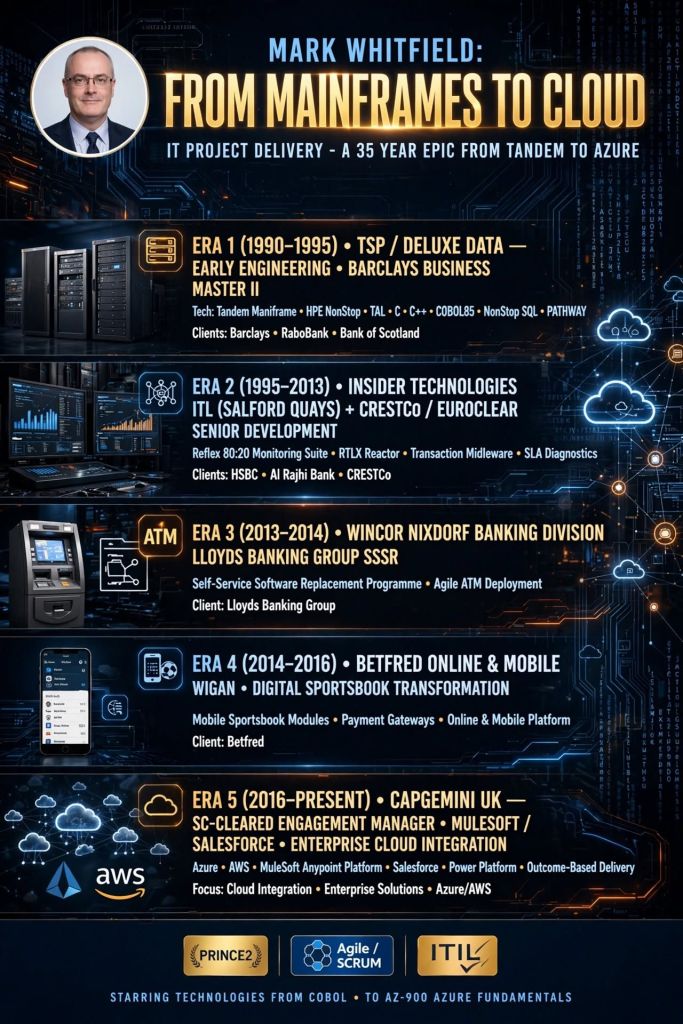
Over a career spanning more than 35 years, he has successfully transitioned from deep technical software engineering on legacy banking mainframes to steering multi-million-pound enterprise-scale cloud migrations and API-led digital transformations.

He is also the author of the widely used PROject Templates platform.
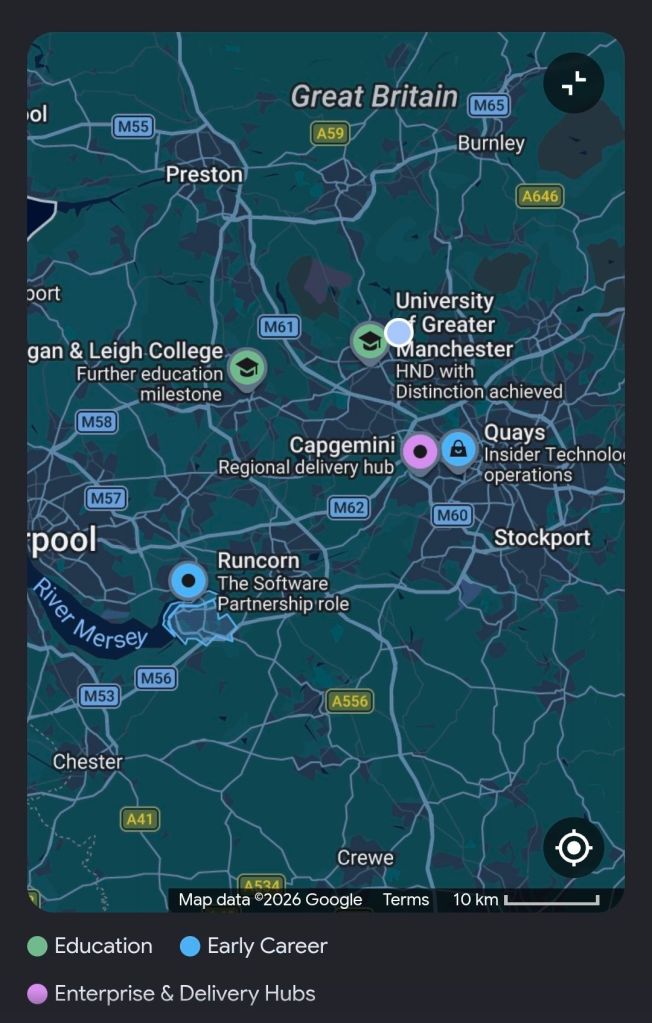
Mark Whitfield detailed timeline by Decade, Focus Areas and Outcomes

🎓 Foundational Era & Education (1975–1990)

  • Focus Areas: Logic systems, structural systems analysis, programming methodology, and corporate data processing.
  • Timeline Milestones:
    • 1975–1980: Attended Hindley Green County Primary School, developing an early interest in computing logic.
    • 1980–1985: Attended Park High Secondary School (Wigan), completing 8 GCE ‘O’ Levels including a focus on Computer Studies.
    • 1985–1988: Attended Leigh College for ‘A’ Levels in Computer Science and Biology. He built a custom ad-revenue tracking solution in Turbo Pascal on an Amstrad PC 1512.
    • 1988–1990: Attended the Bolton Institute of Higher Education (now the University of Greater Manchester).
  • Outcomes: Graduated with a BTEC Higher National Diploma (HND) in Computer Studies with Distinction, finishing first in his class.

💾 The 1990s: Core Software Engineering & Infrastructure Benchmarking

  • Focus Areas: Electronic banking software systems, legacy Tandem Mainframes (HPE NonStop), code architecture, and high-availability volume benchmarking.
  • Timeline Milestones:
    • 1990–1995: Core Programmer at The Software Partnership (acquired by Deluxe Data in 1994) in Runcorn.
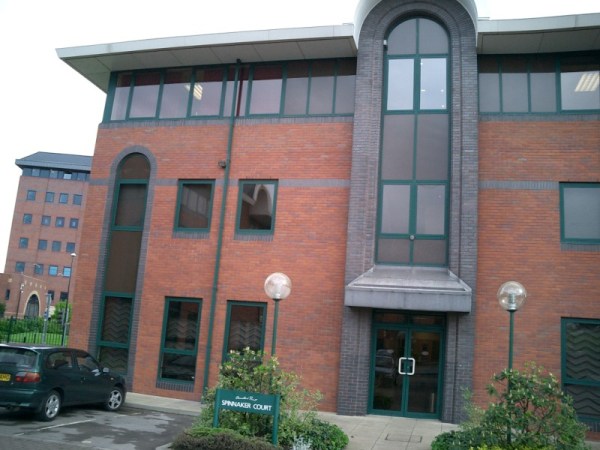
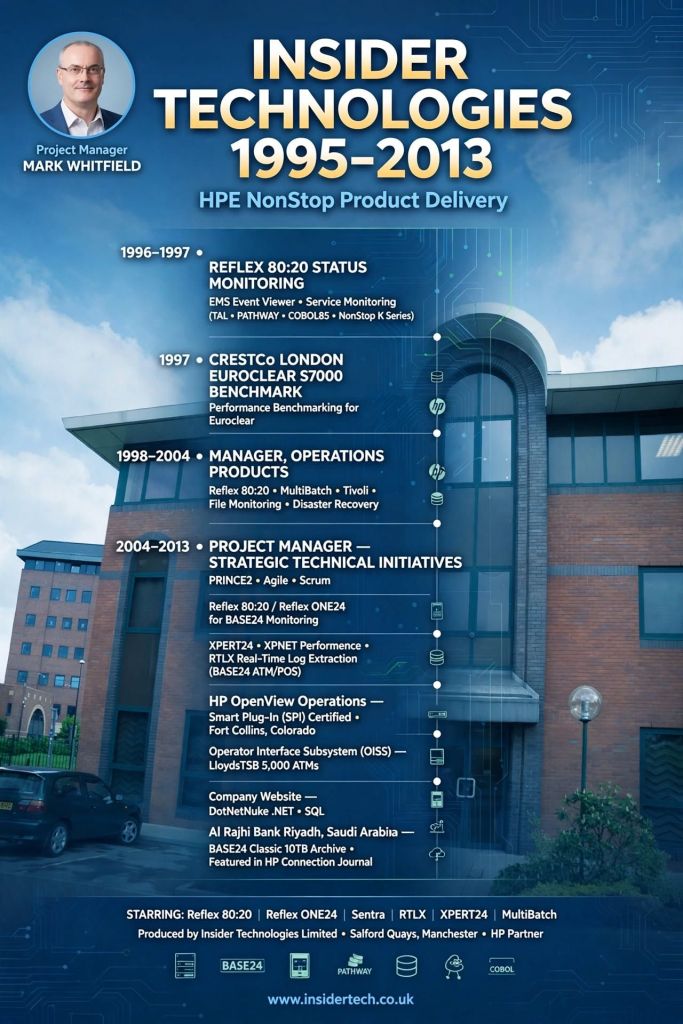
    • 1995–1996: Joined Insider Technologies Limited (ITL) in Salford Quays as a core developer.
    • 1997–1998: Stepped up as a Technical Infrastructure Consultant for CRESTCo (now Euroclear) at St. Katharine’s Dock, London.
  • Outcomes: Built cutting-edge mainframe software packages like sp/ARCHITECT-BANK for blue-chip clients such as Barclays Bank, TSB, and Bank of Scotland. He successfully architected platform diagnostics for the flagship Reflex 80:20 tracking console and executed critical benchmark testing on Tandem S7000 nodes to secure European equity settlement pathways.

💳 The 2000s: Technical Consulting & High-Volume Transaction Monitoring

  • Focus Areas: Automated Teller Machine (ATM) and Point-of-Sale (POS) electronic transaction tracking, telemetry engines, SLA monitoring suites, and project coordination.
  • Timeline Milestones:
    • 1999–2001: Headed vital telemetry initiatives for Tier-1 institutions including the Bank of England and Deutsche Bank.
    • 2001–2009: Escalated into a Lead Consultant and Project Manager at Insider Technologies Limited, regularly representing the group across international stages like the European BASE24 User Group (EBUG).
  • Outcomes: Oversaw the delivery of complex mainframe transaction security architectures for high-volume banking institutions (including HSBC and Al Rajhi Bank). Successfully guarded SLA tracking parameters for national central banking ecosystems using specialized ACI XPNET software configurations.

📱 The 2010s: Transition to Agile Delivery & Enterprise Engagement Leadership

  • Focus Areas: Transitioning from Waterfall frameworks to hybrid Agile SCRUM models, e-commerce, consumer betting application releases, and client-facing stakeholder relationship management.
  • Timeline Milestones:
    • 2013–2014: Recruited as an Agile IT Project Manager at Wincor Nixdorf, standardizing ATM pipeline delivery structures for major UK retail banks.
    • 2014–2016: Appointed Senior IT Project Manager at Betfred, heading high-throughput transaction, sportsbook, and gaming release cycles.
    • 2016–2019: Scaled into enterprise-tier leadership by joining Capgemini as an SC-cleared, client-facing Engagement Project Manager.
  • Outcomes: Successfully deployed high-traffic native mobile apps (iOS & Android) and online payment gateways for Betfred. At Capgemini, he orchestrated the massive Royal Mail Group Core Interface Migration, which won Capgemini’s Project of the Year Award and earned Mark an individual PM recognition award.

☁️ The 2020s: Enterprise Cloud Migrations & API-Led Ecosystems (Present Day)

  • Focus Areas: Hybrid cloud overhauls (AWS and Microsoft Azure), API middleware architectures, large-scale public sector governance frameworks, and executive project tracking tooling.
  • Timeline Milestones:
    • 2018–2020: Directed large-scale Microsoft Dynamics enterprise platform upgrade modules.
    • 2020–2023: Spearheaded a multi-million-pound Public Sector Enterprise Application Estate Migration.
    • 2023–2024: Managed the high-profile UK Government CHIP Framework under stringent active UK Security Check (SC) protocols.
    • 2024–Present (2026): Formally augmented into MuleSoft (a Salesforce company) as a Delivery Manager overseeing the Anypoint Platform portfolio. [1]
  • Outcomes: Successfully directed total cloud infrastructure modernizations for top-tier defense and public sector branches. Concurrently, he packaged his 24+ years of delivery logic into the widely acclaimed Premium PM Delivery Templates Suite, which provides visual Plan on a Page (POaP) layouts and RAID tracking dashboards to thousands of digital project leaders worldwide.
Higher National Diploma HND detailed timeline from introduction

The Higher National Diploma (HND) is a cornerstone of the British vocational education system. Introduced over a century ago to address gaps in industrial and technical training, it has evolved into a globally recognized Level 5 qualification equivalent to the first two years of a bachelor’s degree.


📅 The Comprehensive Timeline of the HND

🏭 1920s: Origins and the Industrial Revolution Response

  • 1920: The Higher National Diploma (HND) and Ordinary National Diploma (OND) were first introduced in England and Wales. They were created on an industry-by-industry basis to fix perceived inadequacies in traditional “Science and Art” technical exams.
  • 1921–1923: Initial subject frameworks were established. Mechanical Engineering launched in 1921, followed by Electrical Engineering in 1923, setting a trend for heavy technical specialization.

🏗️ 1930s–1950s: Expansion and Post-War Reorganization

  • 1929–1939: The qualification expanded rapidly to support the growing industrial economy, adding Building (1929) and Commerce (1939).
  • 1944: The Butler Act reorganized secondary and further education in the UK. HNDs remained the primary route for advanced, hands-on technical training within local colleges.

💼 1960s–1970s: The Shift to Business and Standardized Awarding

  • Early 1960s: Recognizing a shifting economy, Business Studies was introduced to replace older, outdated commerce frameworks.
  • 1974: The UK government established the Technician Education Council (TEC) and the Business Education Council (BEC) to standardize vocational curriculums. These bodies took over validation of HNDs to ensure national quality.

🎓 1980s–1990s: The BTEC Era and Globalization

  • 1983: BEC and TEC merged to form the Business & Technology Education Council (BTEC). From this point on, HNDs became widely known as “BTEC HNDs.”
  • 1996: BTEC merged with the University of London Examinations and Assessment Council to form Edexcel, scaling the qualification globally.

🌍 2000s–2010s: Pearson Takeover and International Adoption

  • 2002: The HND model was adopted internationally by other countries. For instance, Cameroon officially introduced the HND into its professional university pipeline by ministerial order.
  • 2003–2005: Global education giant Pearson fully acquired Edexcel.
  • 2015: HNDs were officially mapped to Level 5 on the UK’s Regulated Qualifications Framework (RQF), formally certifying them as equivalent to a Foundation Degree or the second year of a Bachelor’s degree.

🚀 2020s–Present: Modernization and Academic “Top-Ups”

  • 2020s: Pearson modernized HND frameworks into “Higher Nationals,” optimizing them for remote learning, portfolio assessments, and direct workplace entry.
  • Today: The HND is taught across more than 60 countries. It serves as a popular flexible option, allowing students to either enter the workforce immediately or pursue a one-year university “top-up” program to graduate with a full Bachelor’s Honours Degree in just three years total.

Higher National Diploma HND detailed timeline from introduction

Insider Technologies Limited detailed timeline from 1989

Insider Technologies Limited is a Manchester, UK-based enterprise software and service management company founded in 1989. The company specializes in real-time tracking, service management, high-precision time synchronization, and transaction monitoring, heavily embedded within critical UK financial infrastructure, the public sector, and defense.

The detailed timeline of Insider Technologies Limited is broken down by operational eras and their corresponding product suites below.


📅 The Foundational Era (1989–2000)

This era established the company’s technical footprint, focusing tightly on building infrastructure-level monitoring tools for high-availability systems, specifically the HP NonStop (Tandem) platform.

  • 1989: Insider Technologies Limited is founded in Manchester, UK, by a group of experienced IT industry veterans.
  • Early 1990s: The company develops its core software “DNA”, introducing automated operations and scheduling software.
  • 1995: The firm enters a period of rapid expansion. It secures contracts to provide 24/7 technical support for backbone financial entities, including the Bank of England, Royal Bank of Scotland, and Euroclear (formerly CRESTCo) (which handles settlement for 88% of UK equities).
  • Core Products Introduced:
    • MultiBatch: An enterprise batch job scheduler designed for Tandem/HP NonStop environments.
    • Reflex: Early iterations of real-time monitoring and alerting software to optimize system uptime.
    • ActionView.400: A specialized transaction processing and diagnostic tool tailored to manage and monitor OSI/MHS X.400 messaging layers.

🚀 The Expansion Era (2001–2014)

During this period, Insider Technologies diversified beyond traditional financial mainframes, adding security partnership integrations, simulation platforms, and modern payment tracking capabilities.

  • 2002: The company launches an innovative Systems Training Platform featuring unique, hyper-realistic simulation tools.
  • Mid-2000s: Insider scales its security footprint, providing 24/7 infrastructure support for Thales e-SECURITY products (such as the Security Resource Manager on NonStop, alongside SafeSign Authentication and Management Servers on Windows/Unix).
  • 2004–2013: Iterative rollouts expand the Reflex flagship family into modular frameworks designed for complex financial transaction compliance.
  • 2014: The company explicitly pivots towards capturing digital banking trends, updating its portfolio to deliver real-time diagnostics for electronic payments and point-of-sale (POS) systems.
  • Core Products Introduced:
    • Systems Training Platform: Powered by 4x Patented Cloning Technology, allowing corporate and government clients to clone system states to train employees in realistic environments rather than on static images.
    • Reflex 80:20 & Reflex ONE24: Advanced variations of their monitoring software tailored for high-volume banking transaction visibility and immediate system alerts.
    • Sentra: A centralized monitoring platform geared toward real-time modern transaction tracking.
    • RTLX Reactor: A diagnostic, diagnostic-trending, and tracking software optimized for high-throughput electronic payment engines.

🛡️ The Acquisition & Public Sector Integration Era (2015–Present)

This era is marked by corporate consolidation, cross-platform product fusion, and an expansion into high-precision utilities for government frameworks.

  • 2015 (July 1): Mainframe storage and backup solution provider ETI-NET acquires Insider Technologies. The move integrates Insider’s tracking and monitoring capabilities directly with ETI-NET’s enterprise backup solutions.
  • 2018: Hewlett Packard Enterprise (HPE) declares the foundational X.400 messaging subsystems obsolete. Insider Technologies steps in to provide bespoke support for legacy setups.
  • 2019: Insider marks 30 years of operation, using its RTLX engine to monitor modern contactless “tap” and modern POS infrastructure.
  • 2020s–Present: The firm leverages its transaction processing expertise to solidify its standing as a critical supplier for the UK Government, defense sectors, and public sector IT tracking frameworks.
  • Core Products & Services Implemented:
    • High-Precision Time Synchronization (TimeKeeper): A specialized service delivering sub-microsecond clock synchronization and audit-ready timestamping across mixed-platform architectures, vital for modern forensic tracking and financial regulatory compliance.
    • Bespoke Legacy ActionView.400 Support: Continued custom alignment of their legacy monitoring toolkit specifically for Military and Government entities requiring legal accountability over secure message protocols.

WordPress Overview and Detailed Timeline by Era and Year

WordPress has evolved from a niche blogging tool in 2003 into the dominant Content Management System (CMS), powering over 43% of all websites on the internet as of 2026. Its history is defined by consistent innovation, transitioning from simple blogging to a block-based full-site editing platform. This https://mark-whitfield.com website is WordPress.

This personal website has been built using WordPress

✨ The Eras of WordPress Evolution

  • 2003–2004: The Birth (Fork of b2/cafelog): Started as a solution for a stalled project by Matt Mullenweg and Mike Little, focusing on typography and ease of use.
  • 2005–2010: The Plugin & Theme Era: The introduction of plugins (1.2), themes (1.5), and the dashboard (2.0) turned it into a flexible platform rather than just a blog.
  • 2011–2017: The CMS & Mobile Era: Focus on custom post types, multisite capabilities, responsive admin interfaces, and the REST API made it a true CMS.
  • 2018–Present: The Gutenberg/Block Era: The shift from a classic editor to the block editor (Gutenberg) in version 5.0 (2018) revolutionized content creation toward “what you see is what you get” (WYSIWYG) site building. 

📜 Detailed Historical Timeline by Era and Year

Phase 1: Foundations and Early Growth (2003–2007)

  • 2003: WordPress 0.70 (May 27) is released, a fork of b2/cafelog.
  • 2004: WordPress 1.0 (Davis) is released (Jan), adding search-engine-friendly permalinks. WordPress 1.2 (Mingus) (May) introduces the plugin architecture, enabling developers to extend functionality without modifying the core.
  • 2005: WordPress 1.5 (Strayhorn) debuts the Theme system and static Pages. Version 2.0 (Duke) launches the first modern dashboard, image uploading, and faster editing.
  • 2006: First WordCamp is organized. WordPress receives its official logo.
  • 2007: Version 2.1 (Ella) introduces auto-save, spell check, and a cleaner UI. Version 2.3 (Dexter) adds native tagging support. 

Phase 2: Expanding to a CMS (2008–2014) 

  • 2008: Version 2.5 (Brecker) launches a major dashboard redesign. Version 2.7 (Coltrane) streamlines the admin interface and adds automatic updates.
  • 2009: Version 2.9 (Carmen) adds built-in image editing (crop/rotate) and global undo (trash functionality).
  • 2010: Version 3.0 (Thelonious) is a landmark release, merging WordPress MU (Multisite) with the core, introducing Custom Post Types, and the first “Twenty Ten” default theme.
  • 2011: Version 3.1 (Reinhardt) adds the Admin Bar and Post Formats. Version 3.3 (Sonny) focuses on tablet usability and drag-and-drop media uploads.
  • 2012: Version 3.4 (Green) improves theme customization. Version 3.5 (Elvin) launches a simplified media manager.
  • 2013: Version 3.7 (Basie) introduces automatic background updates for security. Version 3.8 (Parker) updates the admin design to be fully responsive.
  • 2014: Version 4.0 (Benny) improves media management with grid views and better embed handling. 

Phase 3: The Block Editor & Full Site Editing (2015–Present)

  • 2015–2016: Versions 4.2–4.7 focus on Emoji support, the REST API (crucial for headless WordPress), and Custom CSS in the Live Preview.
  • 2017: Version 4.9 (Tipton) introduces major improvements to the Customizer, including scheduling and draft capabilities.
  • 2018: Version 5.0 (Bebo) launches, introducing the Gutenberg Block Editor as the default editor, replacing the TinyMCE classic editor.
  • 2019–2020: Versions 5.1–5.6 polish the block editor. Version 5.5 adds lazy-loading images and native XML sitemaps.
  • 2021: Version 5.8 (Tatum) introduces Block Widgets and the Template Editor, marking the beginning of Full Site Editing (FSE).
  • 2022: Version 5.9 (Joséphine) debuts Twenty Twenty-Two, the first default block theme, allowing users to edit site-wide templates. Version 6.0 (Arturo) enhances styling and block-locking capabilities.
  • 2023: Version 6.2 (Dolphy) brings the Site Editor out of beta and introduces a distraction-free mode. Version 6.4 introduces the Twenty Twenty-Four theme, designed to be highly versatile.
  • 2024: Version 6.5 (Regina) adds a native Font Library and enhanced data views. Version 6.6/6.7 focus on performance, block binding APIs, and zoom-out previews.
  • 2025–2026 (Projections/Recent): Continued emphasis on AI integration, faster page loads (averaging 3.4s, which is a key competitive challenge), and deeper WooCommerce integration. 

📊 Key Insight Metrics (2026)

  • Web Usage: ~43.5% of all websites.
  • CMS Market Share: ~62.8% of the CMS market (9x the closest competitor, Shopify).
  • WooCommerce: Powers over 33% of all online stores.
  • Gutenberg Adoption: ~72% of WordPress sites use the Gutenberg block editor. 

The platform continues to grow, with roughly 660 new WordPress sites created daily. 

WordPress Overview and Detailed Timeline by Era and Year

COBOL Programming Overview & Detailed Timeline History by Era and Year

COBOL, (COmmon Business-Oriented Language) is a high-level, compiled programming language designed specifically for business, finance, and administrative systems. Developed as a portable “stopgap” for the US Department of Defense, it has endured for over 65 years and remains the backbone of global financial infrastructure. 

Programming Overview

  • Design Philosophy: It features a “prose” syntax designed to be self-documenting and readable by non-technical business professionals.
  • Structure: Programs are strictly divided into four Divisions:
    1. Identification: Defines the program name and metadata.
    2. Environment: Specifies the physical computer and files used.
    3. Data: Defines variables, structures, and record layouts.
    4. Procedure: Contains the logic and executable statements.
  • Core Paradigms: Originally strictly procedural and imperative, COBOL was updated in 2002 to include object-oriented features.
  • Key Characteristics: It is known for its verbosity (using over 300 reserved words), weak/static typing, and exceptional reliability in large-scale batch and transaction processing. 

Detailed Historical Timeline

Era 1: The Foundation (1950s)

This era focused on consolidating disparate manufacturer-specific languages into a single, hardware-independent standard for business. 

  • 1955: Grace Hopper develops FLOW-MATIC, which introduced English-like commands and influenced COBOL’s design.
  • 1958: IBM releases COMTRAN, another major precursor focused on commercial translation.
  • 1959 (April): Mary Hawes organizes a meeting at the University of Pennsylvania to propose a common business language.
  • 1959 (May): The Pentagon hosts a meeting creating CODASYL (Committee on Data Systems Languages) to oversee the project.
  • 1959 (December): The first specifications, “COBOL – Specifications for a COmmon Business Oriented Language,” are released. 

Era 2: Early Versions & Rapid Adoption (1960–1967)

The language quickly transitioned from a theoretical specification to a functioning industry standard. 

  • 1960: COBOL-60 is officially published.
  • 1960 (August): The first COBOL program runs on an RCA 501.
  • 1961: COBOL-61 is released, providing a major cleanup of original logical flaws.
  • 1962: IBM announces COBOL as its primary development language, ending work on COMTRAN.
  • 1963: COBOL-61 Extended is released, introducing “Sort” and “Report Writer” facilities.
  • 1965: COBOL Edition 1965 adds mass storage file handling and table processing.

Era 3: Standardization & Dominance (1968–1984)

COBOL became the most widely used language in the world as ANSI and ISO codified its rules. 

  • 1968: COBOL-68 (ANSI X3.23-1968) is published as the first official US standard.
  • 1970: COBOL becomes the world’s most widely used programming language.
  • 1974: COBOL-74 is standardized, introducing the DELETE statement and file organization improvements.
  • 1978: ISO formally adopts the COBOL-74 standard. 

Era 4: Structured Programming & Modernization (1985–2001) 

The language evolved to support better logic flow while managing the massive global codebase. 

  • 1985: COBOL-85 introduces structured programming features like END-IF, EVALUATE, and nested subprograms.
  • 1989: First amendment to COBOL-85 adds Intrinsic Function Modules.
  • 1997: Gartner Group estimates 200 billion lines of COBOL code are in existence.
  • 1999: Massive effort peaks to patch legacy COBOL code for the Y2K (Year 2000) problem. 

Era 5: The Object-Oriented & Modern Era (2002–Present)

Recent updates focus on interoperability with modern web and cloud environments. 

  • 2002: COBOL-2002 introduces Object-Oriented Programming (OOP), Unicode support, and recursion.
  • 2014: COBOL-2014 standardizes IEEE 754 data types and method overloading.
  • 2020: The COVID-19 pandemic highlights a critical shortage of COBOL programmers to maintain aging state unemployment systems.
  • 2023: COBOL-2023 adds asynchronous messaging (SEND/RECEIVE) and transaction processing (COMMIT/ROLLBACK).
  • 2024: COBOL celebrates its 65th anniversary of active service.

COBOL Programming Overview & Detailed Timeline History by Era and Year

Agile Development Overview and Detailed Timeline by Era

Agile development is an iterative and incremental approach to project management and software delivery that prioritises flexible planning, frequent delivery of working software, and rapid response to change. At its core, Agile seeks to shorten work cycles to deliver value to customers quickly while using frequent feedback to improve quality. 

Core Overview

The foundation of modern Agile is defined by the Agile Manifesto (2001), which establishes four central values: 

  • Individuals and interactions over processes and tools.
  • Working software over comprehensive documentation.
  • Customer collaboration over contract negotiation.
  • Responding to change over following a plan. 

The Agile life cycle typically moves through six phases: Concept, Inception, Iteration, Release, Maintenance, and Retirement. 


Comprehensive Timeline of Agile Development

Agile did not emerge in a vacuum; it evolved from early 20th-century industrial concepts and decades of experimentation in software engineering. 

Era 1: The Industrial & Theoretical Roots (1910s – 1960s)

This era established the foundational concepts of efficiency, waste reduction, and iterative cycles that would later inform Agile frameworks. 

  • 1911: Frederick Taylor publishes The Principles of Scientific Management, advocating for managers to analyse and adopt worker-led process improvements.
  • 1930s: Walter Shewhart at Bell Labs develops the Plan-Do-Check-Act (PDCA) cycle, a groundbreaking iterative methodology for quality control.
  • 1948: Toyota formalises the Toyota Production System (Lean), introducing concepts like Kaizen (continuous improvement) and Just-in-Time manufacturing.
  • 1957: Gerald Weinberg and others at IBM begin using incremental development on projects.
  • 1958: NASA’s Project Mercury uses half-day iterations and test-first development, marking one of the earliest high-stakes uses of iterative cycles.

Era 2: Evolutionary Alternatives to Waterfall (1970s – 1980s) 

As the rigid Waterfall model became dominant, practitioners began developing “lightweight” alternatives to handle complex, shifting requirements. 

  • 1970s: Barry Boehm proposes Wideband Delphi, an early forerunner to Planning Poker.
  • 1976: Tom Gilb publishes the Evolutionary Delivery Model (Evo), perhaps the first explicitly named incremental alternative to Waterfall.
  • 1980: Toyota introduces Visual Control, the predecessor to Agile “information radiators” like Kanban boards.
  • 1986: Hirotaka Takeuchi and Ikujiro Nonaka publish “The New New Product Development Game” in Harvard Business Review, introducing the “rugby” approach that inspired the Scrum framework.
  • 1988: Barry Boehm formalises the Spiral Model, an iterative model focused on identifying and reducing risks. 

Era 3: The Proliferation of Frameworks (1990 – 2000) 

This decade saw a “crisis” in software development where traditional methods failed to keep up with the personal computing boom, leading to the birth of modern frameworks. 

  • 1991: James Martin publishes Rapid Application Development (RAD), formalising the use of timeboxing and iterations.
  • 1993: Jeff Sutherland and team at Easel Corporation first implement Scrum as a formal process.
  • 1994: The Dynamic Systems Development Method (DSDM) is created as a non-profit consortium to provide a framework for RAD.
  • 1995: Ken Schwaber and Jeff Sutherland co-present the Scrum methodology at the OOPSLA conference.
  • 1996: Kent Beck creates Extreme Programming (XP) while working on the Chrysler Comprehensive Compensation (C3) project.
  • 1997: Jeff De Luca introduces Feature-Driven Development (FDD).
  • 1999: Kent Beck publishes Extreme Programming Explained, popularising many engineering practices like pair programming.

Era 4: The Manifesto & Mainstream Adoption (2001 – 2010)

Agile shifted from a niche experimental approach to a global industry standard. 

  • 2001 (Feb): 17 developers meet at Snowbird, Utah, and author the Manifesto for Agile Software Development.
  • 2001 (Post): The Agile Alliance is formed to promote the manifesto’s values.
  • 2003: Mary and Tom Poppendieck publish Lean Software Development, formally linking Lean manufacturing principles to Agile.
  • 2005: Mike Cohn introduces Planning Poker in Agile Estimating and Planning.
  • 2007: The Scaled Agile Framework (SAFe) is introduced by Dean Leffingwell to apply Agile to large enterprises.
  • 2009: The concept of DevOps emerges, seeking to bridge the gap between Agile development and IT operations. 

Era 5: Scale, Transformation, and Modern Evolution (2011 – Present)

Agile has expanded beyond software into marketing, HR, and education, becoming a “culture” rather than just a tool. 

  • 2011: The Project Management Institute (PMI) introduces the Agile Certified Practitioner (PMI-ACP).
  • 2012–2015: Agile adoption surpasses 50% in the development world as success metrics become undeniably clear.
  • 2017: AXELOS updates PRINCE2 to make agility a core focus of the project management standard.
  • 2020s: Continued evolution toward “Business Agility,” where entire organisations adopt Agile mindsets to survive rapidly changing market conditions. 

Agile Development Overview and Detailed Timeline by Era

Roger Federer Overview and Detailed Timeline History by Era

Roger Federer is a Swiss former professional tennis player who is widely regarded as one of the greatest of all time, having won 20 Grand Slam singles titles and held the world No. 1 ranking for 310 weeks. Known for his effortless playing style and versatile shot-making, he revolutionized the sport during a career that spanned over two decades from 1998 to 2022. 

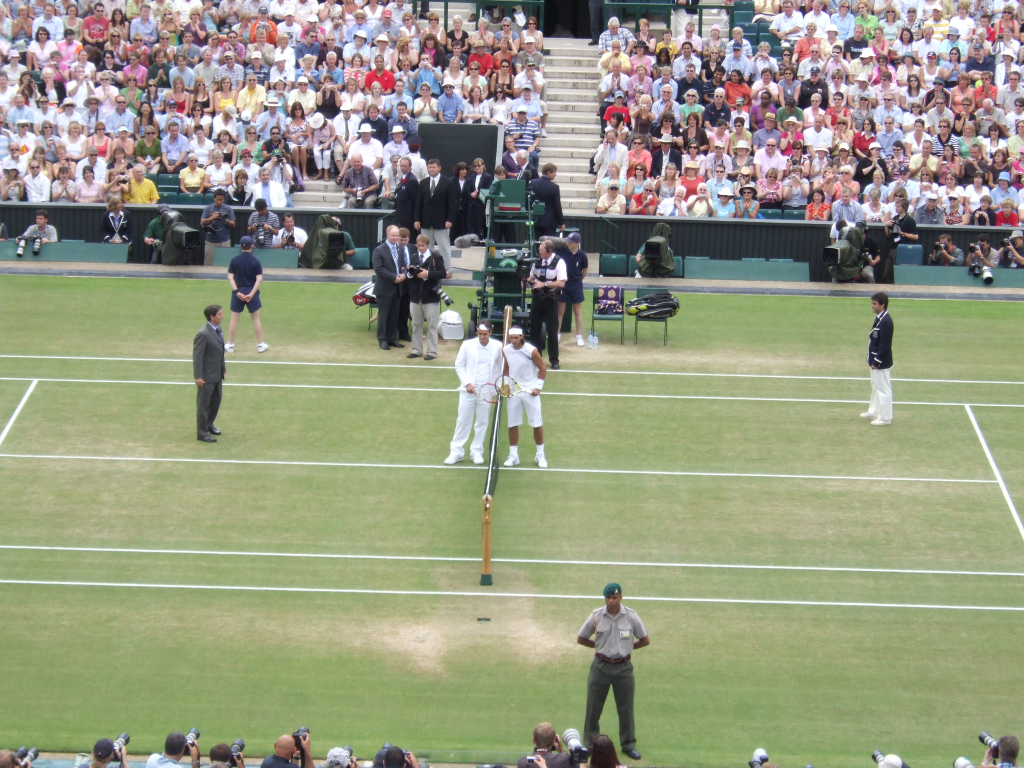
Won by Roger Federer for the fifth consecutive time, a feat only before achieved in the Open Era by Björn Borg.

Career Overview Statistics

Won by Roger Federer for the 5th time

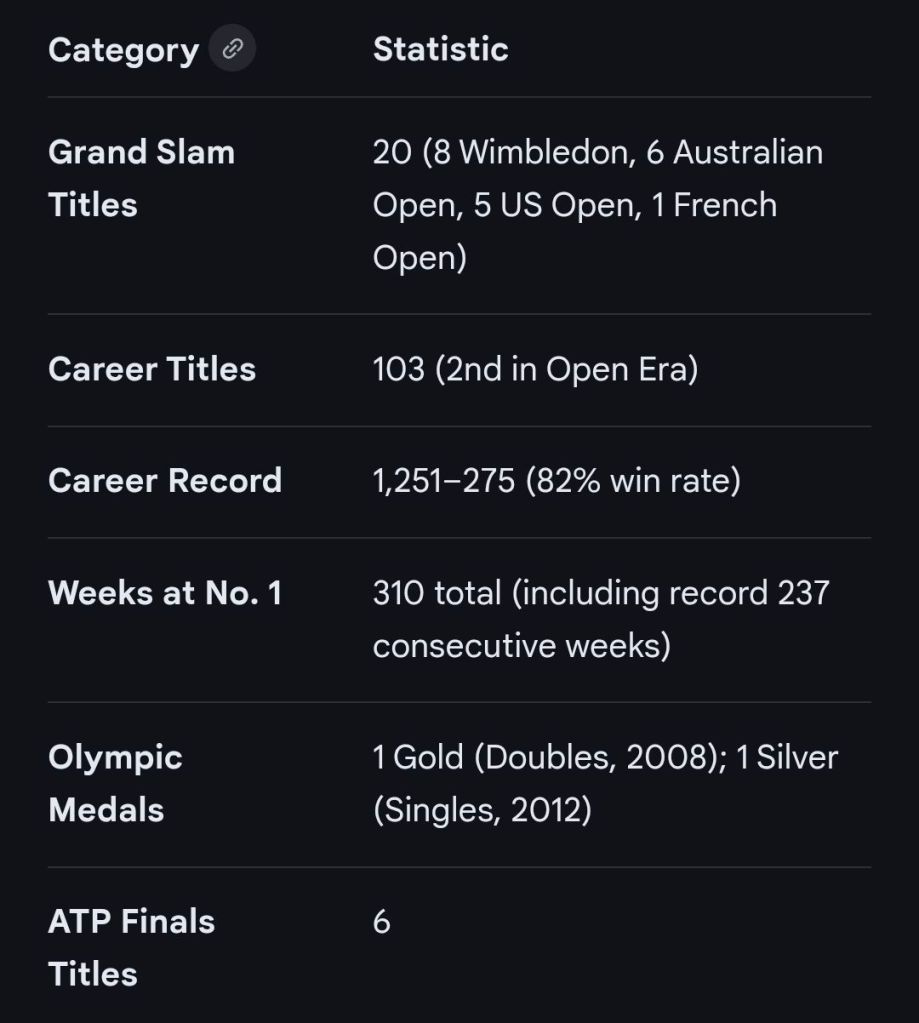
According to ATP Tour statistics, Federer concluded his career with the following major achievements:

Federer concluded his career with the following major achievements

Detailed Timeline by Era

1. Early Career & Breakthrough (1998–2002)

Federer transitioned from a dominant junior—finishing 1998 as the world No. 1 junior—to a rising star on the ATP Tour. 

  • 1998: Turned professional; won Wimbledon junior singles and doubles titles.
  • 1999: Youngest player to finish the year in the Top 100 (ranked 64th).
  • 2001: Won first ATP title in Milan; defeated 7-time champion Pete Sampras at Wimbledon to reach his first major quarter-final.
  • 2002: Won first Masters title in Hamburg and entered the world Top 10 for the first time. 

2. Peak Dominance Era (2003–2007) 

This period marked Federer’s absolute peak, where he reached all four Grand Slam finals in a single calendar year twice (2006, 2007). 

  • 2003: Won first Grand Slam title at Wimbledon and his first Year-End Championship.
  • 2004: Won three of four majors (Australian Open, Wimbledon, US Open) and became world No. 1 on 2 February.
  • 2006: Career-best season with a 92–5 record, reaching all four major finals and winning three.
  • 2007: Defended three major titles and beat Rafael Nadal to win his fifth consecutive Wimbledon. 

3. The Rivalry Era & Career Slam (2008–2012)

Federer faced intense competition from the emergence of the “Big Four” (Nadal, Djokovic, and Murray). 

  • 2008: Battled mononucleosis; won fifth consecutive US Open; won Olympic Gold in doubles with Stan Wawrinka.
  • 2009: Won first French Open to complete the Career Grand Slam; passed Sampras’ record with a 15th major at Wimbledon.
  • 2010: Won fourth Australian Open.
  • 2012: Won 7th Wimbledon title and Olympic Silver in singles; reclaimed world No. 1 to break the record for total weeks at the top. 

4. Injury Struggles & Renaissance (2013–2019)

After several years plagued by back and knee injuries, Federer staged a remarkable late-career comeback. 

  • 2014: Led Switzerland to its first Davis Cup title.
  • 2016: Underwent first knee surgery; missed the second half of the season for recovery.
  • 2017: Returned after a 6-month hiatus to win the Australian Open (defeating Nadal) and a record 8th Wimbledon title.
  • 2018: Won 20th Grand Slam at the Australian Open; became the oldest No. 1 in history at age 36.
  • 2019: Won 100th career title in Dubai; reached 12th Wimbledon final. 

5. Final Years & Retirement (2020–2022)

Persistent knee issues eventually forced the conclusion of his competitive career. 

  • 2020–21: Underwent multiple knee surgeries; reached Wimbledon quarter-finals in 2021 as the oldest man in the Open Era to do so.
  • 2022: Officially retired on 23 September at the Laver Cup in London, playing his final match in doubles alongside long-time rival and friend Rafael Nadal.

Roger Federer Overview and Detailed Timeline History by Era

Detailed timeline of Mount Kilimanjaro and Map location

Key Geographic Details

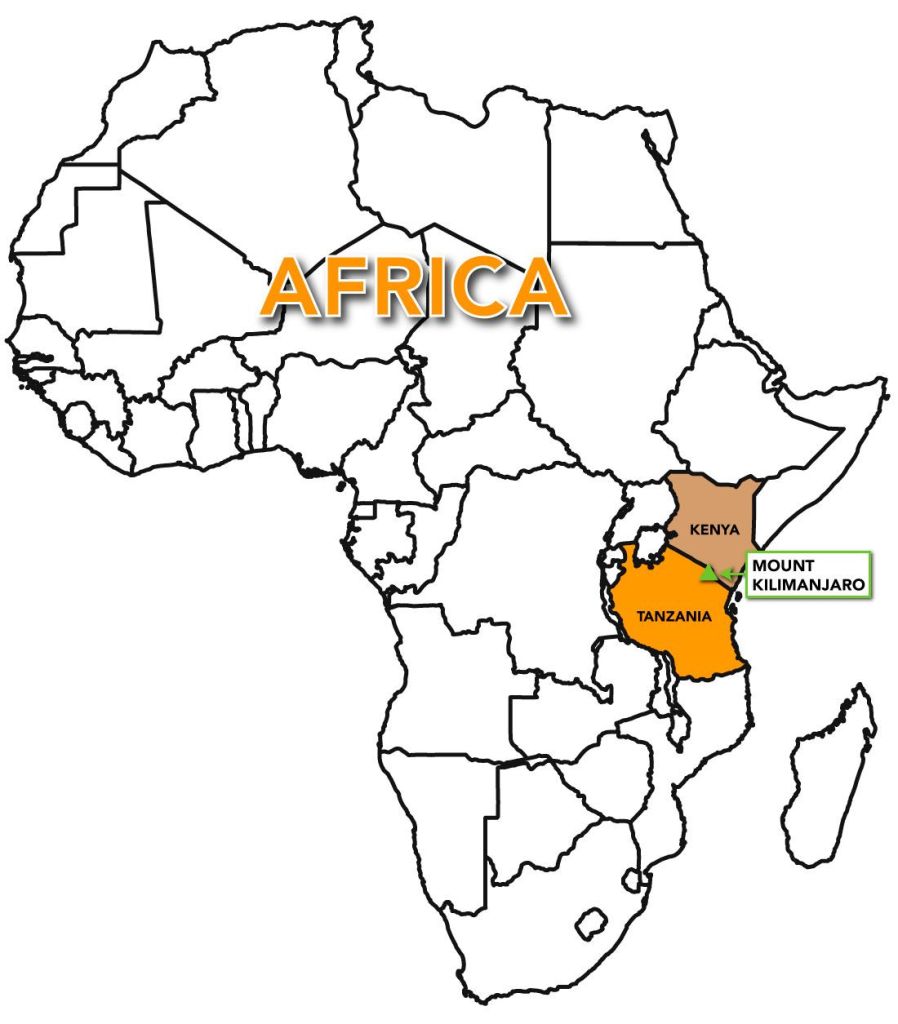
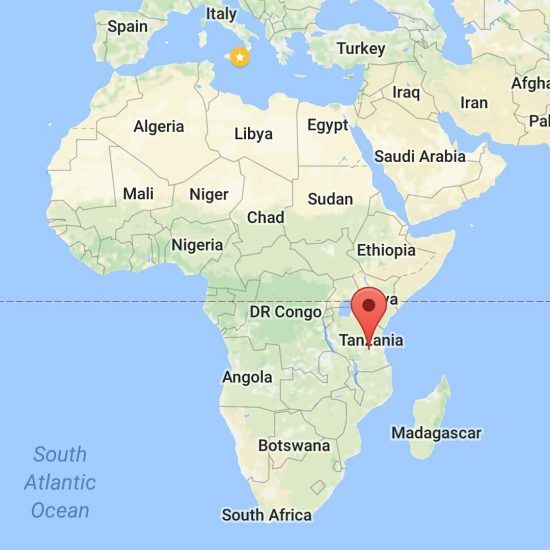
Location of Mount Kilimanjaro

Climbing Mount Kilimanjaro is a journey through five distinct climate zones, and your experience depends heavily on matching your timeline with the mountain’s seasonal rhythms. About 50,000 visitors attempt the summit annually. 

Seasonal Visitor & Weather Timeline

The mountain follows a predictable cycle of dry and rainy seasons. 

  • Long Dry Season (June – October): This is the peak visitor period due to the most stable weather and clear skies. July and August are particularly busy, coinciding with Northern Hemisphere holidays.
  • Short Dry Season (January – March): A popular window with high footfall but slightly quieter than the June–October peak. January and February are often cited as the best months for clear views and warm daytime temperatures.
  • Shoulder Seasons (March, June, October, November): These transition months offer a balance of moderate crowds and manageable weather. November brings the “short rains,” but trails are significantly emptier.
  • Rainy Seasons (April – May): The lowest visitor numbers occur during the “long rains”. Trails can be muddy and treacherous, making this suitable only for experienced trekkers seeking absolute solitude.
Mount Kilimanjaro

Geological and Ancient History

Kilimanjaro was formed by volcanic activity along the East African Rift. 

  • 2.5 Million Years Ago: Volcanic activity begins at the Shira centre.
  • 1 Million Years Ago: Eruptions begin at the Mawenzi and Kibo cones.
  • 360,000 Years Ago: The last major eruption occurred.
  • 150,000–200,000 Years Ago: Final volcanic activity at Kibo created the current summit crater.
  • 1000 BC: Evidence of human cultures on the slopes found via stone tools.
  • 150 AD: Ptolemy of Alexandria makes early references to “lands” near the mountain. 

Exploration and Climbing Milestones

The late 19th century marked the beginning of recorded ascents and scientific study. 

  • 1889: Hans Meyer and Ludwig Purtscheller become the first recorded people to reach the summit (Uhuru Peak) on 6 October.
  • 1909: Gertrude Benham of London reaches the summit alone.
  • 1926: Pastor Richard Reusch discovers a dead leopard on the crater rim, a finding later immortalised in literature.
  • 1957: The volcano is officially declared dormant.
  • 1961: Tanganyika gains independence; a torch is placed on the summit, and the peak is renamed Uhuru (“Freedom”).
  • 2020s: Tourism reaches over 35,000–50,000 climbers per year, with various routes established for different skill levels. 
Kilimanjaro Height

Typical Modern Trekking Timelines

Climbs generally take 5 to 9 days depending on the route chosen to ensure proper acclimatisation.

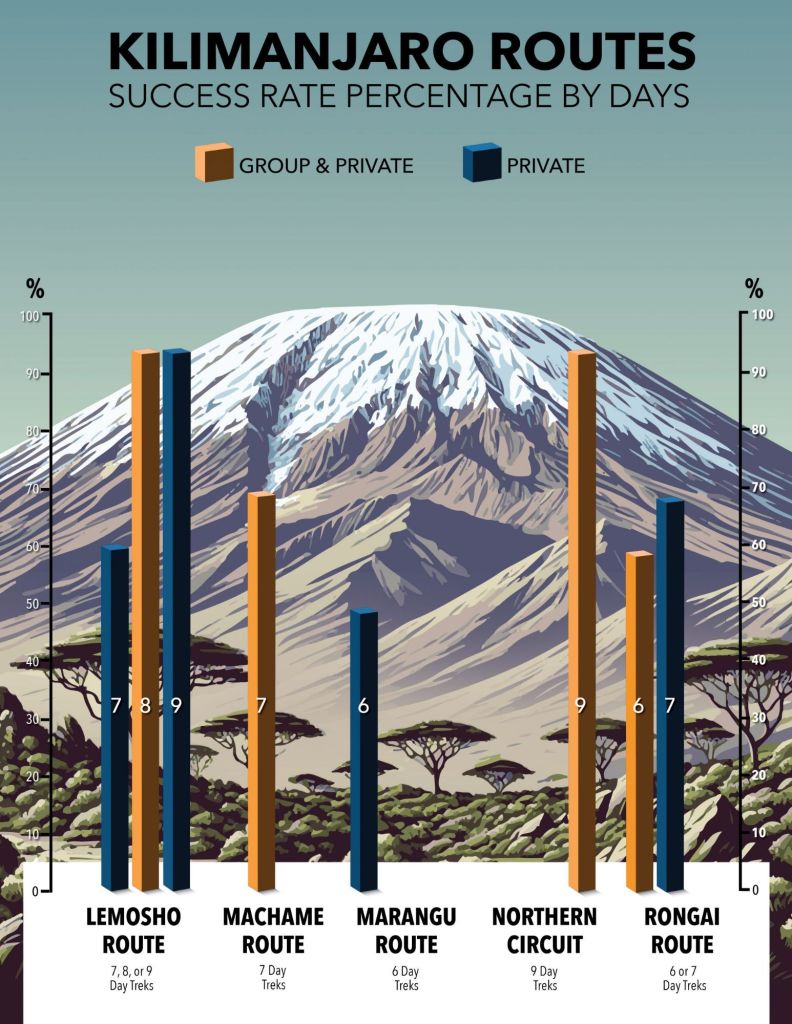
Route Typical Duration Characteristics

Marangu 5–6 Days The “Coca-Cola” route; sleep in huts.

Machame 6–7 Days Most popular; scenic “Whiskey” route.

Lemosho 7–8 Days High success rate; beautiful scenery.

Northern Circuit 9 Days Longest route; highest summit success rate.

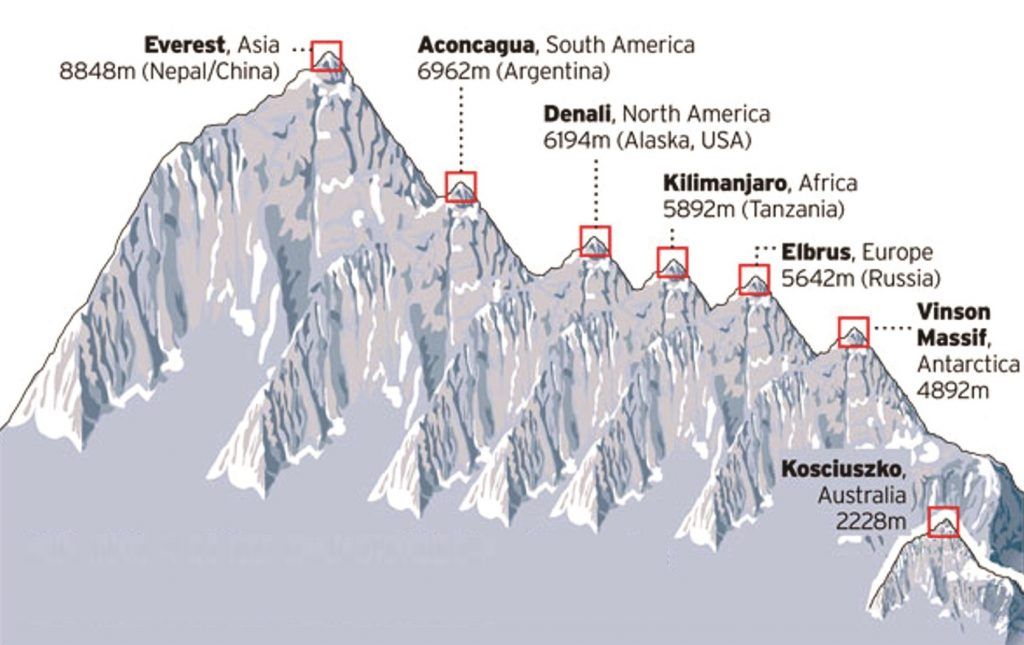
Respective heights for Big 7

Standard Daily Expedition Routine

A typical day on the mountain follows a strict rhythm to manage fatigue and altitude: 

  • 06:00 – 07:00: Wake up and breakfast at camp.
  • 08:00: Begin the day’s trek (typically 4–7 hours of walking).
  • 13:00: Hot lunch followed by further trekking or rest.
  • 17:00: Reach next camp; “hike high, sleep low” acclimatisation walks.
  • 23:00 – 00:00 (Summit Night): Final ascent begins in the dark to reach the peak by sunrise.
Kilimanjaro Routes
Mount Kilimanjaro location on World Map