

Mark Whitfield spent 18 years (August 1995 – September 2013) at Insider Technologies Limited (ITL) in Salford Quays, Greater Manchester.
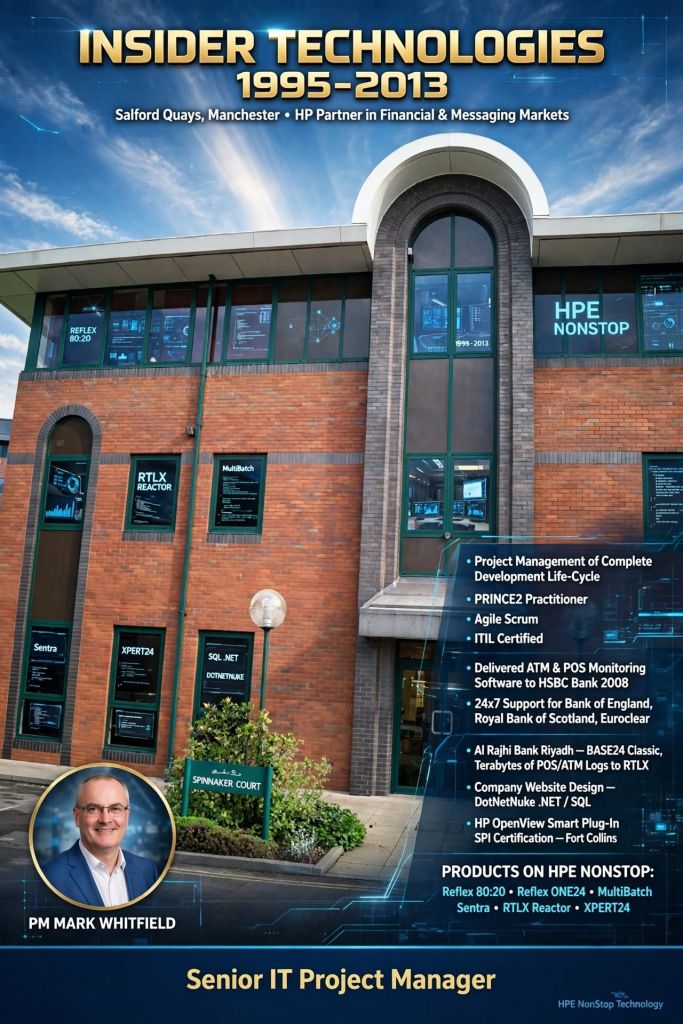
During this tenure, he progressed from a Senior HP NonStop Developer and Team Leader into a Product Manager and PRINCE2-certified Senior IT Project Manager.
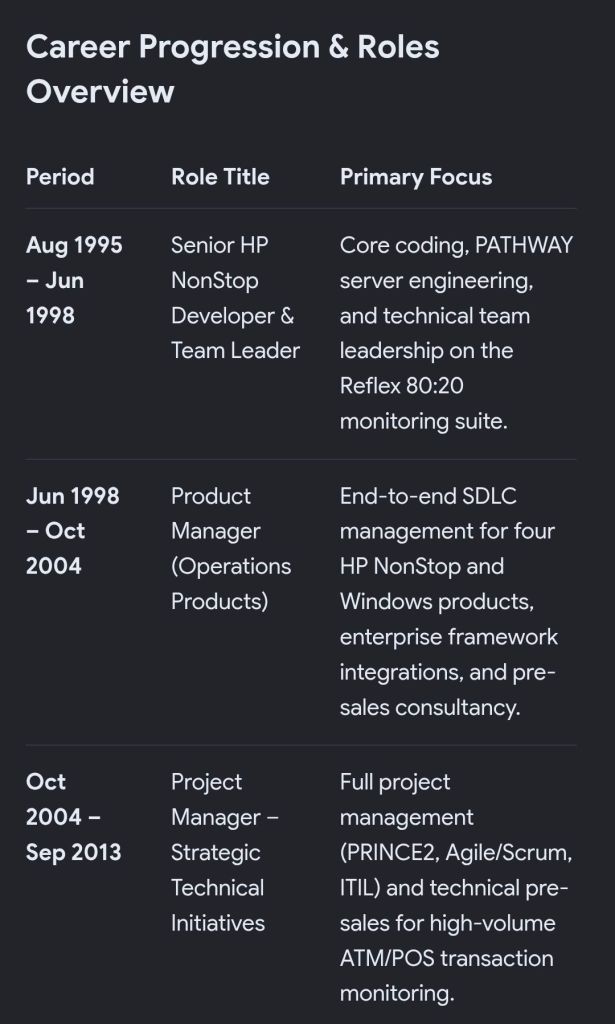
Detailed Chronological Timeline (1995–2013)
1995–1996: Reflex 80:20 Core Engineering & Event Console
- Reflex 80:20 Core Development. Whitfield joined ITL as a Senior Programmer to build SCOBOL requesters and update COBOL85 servers on Tandem K-Series Tandem mainframes. These modules polled CPU, disk, and process health metrics to feed a Windows 3.1 GUI front end.
- Guardian Security Layer. He designed and built two SCOBOL requesters and a PATHWAY server to authenticate Guardian users. This added role-based task ownership and execution security to the Reflex console.
- HP NonStop EMS Event Viewer Console. Following formal Transaction Application Language (TAL) training at HP High Wycombe, he engineered a TAL PATHWAY server using Subsystem Programmatic Interface (SPI) calls. This enabled multi-user EMS event filtering, token breakdown, and automated alert triggers via email or SMS.
1996–1997: Graphical Status & Service Monitoring
- Graphical NSK Status Monitor. Promoted to Team Leader, Whitfield designed ITL’s first SQL database project alongside a TAL PATHWAY server. The system grouped NonStop objects into a “Windows Explorer” style drill-down tree for operations bridges at clients like the Bank of England.
- Cross-Sectional Service Monitor. After completing C/C++ training in London in March 1997, he led the development of ITL’s first NonStop C and C++ PATHWAY servers. Using embedded SQL and Boolean rules, the software correlated component health across multiple nodes to warn of business service degradation.
Aug 1997 – Nov 1997: CRESTCo (Euroclear) London Placement
- Volume & Benchmark Testing. ITL contracted Whitfield on-site for three months at CRESTCo (now Euroclear) at St. Katherine’s Dock, London. He wrote custom volume-testing and benchmark software in COBOL85, NonStop SQL, and TACL.
- Hardware Validation. His benchmarking suite validated the performance of CRESTCo’s Stock Settlement application on the UK’s first newly installed Tandem S7000 G-Series ServerNet nodes against legacy K-Class systems.
1997–1998: Management Information Systems (MIS) Reporting
- First Project Management Assignment. Returning from London as a Product Manager, Whitfield led the project to add MIS reporting to Reflex 80:20.
- Cross-Platform Relay Architecture. He architected PATHWAY servers to extract NonStop metrics and relay them to a Windows Microsoft SQL Server database. This enabled historical tabular and graphical performance trend reporting.
1998–2001: Product Management & Enterprise Integrations
- Multi-Product Lifecycle Ownership. Appointed Manager of Operations Products, he oversaw 6 to 8 NonStop and Windows developers across four core software products under strict ISO9001 quality standards.
- Enterprise Framework Integrations. He managed the integration of Reflex 80:20 with IBM Tivoli Enterprise Manager and B&B COMMAND/POST (later BMC Patrol), alongside comprehensive NonStop file monitoring and site-swap disaster recovery features.
- MultiBatch & Central Bank Telemetry (1999–2001). Whitfield oversaw real-time telemetry, automated file monitors, and MultiBatch job scheduling deployments for the Bank of England and Deutsche Bank to support Euro-zone cross-border transaction auditing.
- International Training & Conferences. He delivered on-site Reflex 80:20 training for Shell in the Netherlands (February 1999) and Deutsche Bank in Salford Quays (November 2000), while representing ITL at the South African Tandem User Group (SATUG) in 1999.
2002–2003: HP OpenView Certification & Reflex ONE24 Launch
- HP OpenView Operations (OVO) Smart Plug-In. Following research at HP OpenView Universe in Lisbon, Whitfield managed the engineering of a 2-way Smart Plug-In (SPI) linking Reflex 80:20 with HP OVO. He oversaw acceptance testing at HP Labs in Fort Collins, Colorado, securing the world’s first official HP certification for a NonStop OVO Smart Plug-In.
- Reflex ONE24 for BASE24. He architected low-CPU PATHWAY servers using XPNET APIs and Insession ICE DDL libraries to “listen rather than interrogate” ACI’s BASE24 payment engine. He deployed Reflex ONE24 and trained staff at LloydsTSB (March 2003), Bank of Ireland, Bank of Valletta (Malta), and Commercial and Piraeus Banks (Greece).
- LloydsTSB OISS Bid. He led the technical gap analysis and costing for a major bid to replace LloydsTSB’s legacy OISS operations tool managing 5,000 ATMs with Reflex ONE24.
2004–2007: RTLX Reactor & Retail Banking Rollouts
- RTLX Reactor Development. Whitfield joined the core team building Real-Time Log eXtraction (RTLX) as an add-on to ITL’s Windows-based Sentra console. The system used ITL’s proprietary FastPipe TCP/IP protocol to stream BASE24 ATM and POS transaction logs (TLF / PTLF) from NonStop to Microsoft SQL Server.
- UK Clearing Bank Deployments. Working with joint architects at Alliance & Leicester (now Santander) in Bootle and HSBC in London, he designed real-time browser dashboards and SQL Reporting Services outputs. He launched RTLX internationally at the 2006 European BASE24 User Group (EBUG) in Lisbon.
- Bespoke Acquiring Monitoring (2007). Following EBUG engagements in Lisbon and Istanbul, he helped secure and deliver a customized RTLX deployment for a major Sheffield-based bank. He authored the Technical Interface Specification to parse proprietary TLF/PTLF layouts and built graphical “hypervisor” displays tracking retailer authorization and denial rates.
2008–2010: XPERT24 & Global Payment Expansion
- HSBC Mainframe Rollout (2008). Whitfield headed the delivery team implementing enterprise ATM and POS monitoring across HSBC’s heavily customized BASE24 mainframe environment.
- XPERT24 Product Architecture. He wrote the technical design and program specifications for XPERT24 (XPNET Performance Monitoring and Tracking) and managed its acceptance testing at ACI Worldwide in Watford.
- Corporate Web Presence. In 2009, ITL tasked him with designing, authoring, and optimizing the corporate website (
insidertech.co.uk) using the .NET SQL DotNetNuke CMS framework.
2011–2013: Al Rajhi Bank Mega-Project & Strategic Integrations
- PRINCE2 & Agile Formalization (2011). Whitfield formalized his delivery methodology by qualifying as a Certified PRINCE2 Practitioner (May 2011), completing Agile Scrum training, and earning ITIL Foundation certification (January 2012).
- Al Rajhi Bank Riyadh Rollout (2011–2013). For his final major ITL initiative, he made multiple trips to Riyadh, Saudi Arabia, to manage the deployment of RTLX Reactor for Al Rajhi Bank’s BASE24 Classic estate. The project engineered optimized parsing to ingest and query multiple terabytes (10 years’ worth) of tape-archived ATM and POS transaction logs, earning a feature in the global HPE NonStop journal The Connection in 2013.
- Global Enterprise Integrations & 24/7 Support. Through September 2013, he managed SLA monitoring and framework integrations for Global Payments and Standard Chartered, while providing 24/7 specialist support for Bank of England, RBS, Euroclear, and Thales e-SECURITY cryptographic gateways (SRM and SafeSign).
Core Technical & Methodological Stack at ITL
- Platforms & Hardware: Tandem / HP NonStop (K-Series, ServerNet S-Series, Itanium J-Series), GUARDIAN / NSK OS, Windows NT/2000/XP, Unix/Linux.
- Payment & Monitoring Software: Reflex 80:20, Reflex ONE24, RTLX Reactor, Sentra, XPERT24, MultiBatch, ACI BASE24 Classic & BASE24-eps, XPNET, HP OpenView Operations, IBM Tivoli, Thales HSM8000 / PayShield 9000.
- Languages & Databases: TAL, NonStop C/C++, COBOL85, SCOBOL, TACL, PATHWAY, ENSCRIBE, NonStop SQL, Microsoft SQL Server, ASP.NET, Java, Crystal Reports, BIRT.
Mark Whitfield, Career Progression at Insider Technologies from 1995 to 2013 above


