Bangor Garth Pier into Menai Strait toward Anglesey, North Wales, UK

Bangor Garth Pier is a Grade II* listed Victorian landmark in North Wales, recognized as the second-longest pier in Wales and the ninth-longest in the British Isles. Stretching 1,500 feet (460m) into the Menai Strait, it is celebrated for its well-preserved architectural elegance and panoramic views of the Eryri (Snowdonia) mountains and Anglesey. 

Bangor Pier taken 15th March, 2026

Key Highlights

  • Award-Winning Heritage: It was named Pier of the Year 2022 by the National Piers Society for its successful community-led restoration and original Victorian charm.
  • Victorian Kiosks: The deck features a series of distinctive octagonal, onion-domed kiosks that house local independent businesses, including sweet shops, artisan crafts, and a gallery.
  • The Pavilion: At the pier-head stands a large domed pavilion housing a family-friendly café famous for its tea, coffee, and homemade scones.
  • Leisure & Wildlife: The pier is a popular spot for crabbing and fishing. Visitors can also spot local wildlife, including a colony of black guillemots often referred to as “Bangor Penguins”.

Bangor’s Garth Pier is a Grade II* listed structure stretching 1,500 feet (460m) into the Menai Strait toward Anglesey. It is the second-longest pier in Wales and is renowned for its well-preserved Victorian architecture, featuring original kiosks and ornamental ironwork. Unlike many other piers, it was never heavily modified with large theatres, retaining its elegant, traditional character. 

Bangor Pier, March 2026

Comprehensive Historical Timeline

The Early Origins (Pre-1896)

  • 1292: Records mention the Porthesgob ferry operated by the Bishop of Bangor, establishing the area as a key crossing point to Anglesey.
  • 1826: The principal crossing shifted to the new Menai Bridge, though the local Garth ferry continued operating for many years.
  • 1893: A Parliamentary Bill was passed to authorize the construction of a permanent pier. 

The Victorian Boom (1896–1914)

  • 1896 (May 14): Lord Penrhyn officially opened the pier. It was designed by JJ Webster and cost approximately £17,000.
  • 1896–1914: The pier thrived as a landing stage for pleasure steamers from Liverpool, Blackpool, and the Isle of Man. A 3-foot gauge tramway ran its length to transport passenger luggage.
  • 1914: The cargo ship SS Christiana broke free and crashed into the pier, severing a section of the structure. The baggage railway was subsequently removed. 

Transition & Decline (1915–1971)

  • 1921: Permanent repairs for the 1914 ship damage finally resumed following the conclusion of World War I.
  • 1927: Professor Phillip White established a small marine laboratory in one of the pier kiosks, eventually leading to Bangor University’s renowned marine science department.
  • 1939–1945: The pier remained a local landmark through WWII; historical photos show servicemen and locals using the structure.
  • 1960s: Lack of investment led to severe structural deterioration.
  • 1971: The pier was officially closed to the public on safety grounds. 

Threat of Demolition & Rescue (1974–1988) 

  • 1974: Ownership passed to Arfon Borough Council, which proposed demolishing the structure.
  • 1975–1978: Following public outcry, Bangor City Council purchased the pier for a symbolic fee of 1p.
  • 1982: A major six-year restoration project began, funded by the National Heritage Memorial Fund and the Manpower Services Commission.
  • 1983: The ongoing project won the Prince of Wales Award.
  • 1988 (May 7): The Marquess of Anglesey officially reopened the pier after a £3 million restoration. 

The Modern Era (2011–Present)

  • 2011: Surveys revealed new structural issues, specifically with the sub-structure.
  • 2017: A new £1 million restoration programme commenced to strengthen the structure and replace handrails.
  • 2021: The pier celebrated its 125th anniversary, and the Friends of Bangor Garth Pier volunteer group took over a kiosk to support further fundraising.
  • 2022: The National Piers Society named it Pier of the Year.
  • 2024: The pier head shelter, absent since 2018, began reconstruction in-situ.
  • 2026: The city plans to hold major celebrations for the pier’s 130th anniversary

Bangor Garth Pier into Menai Strait toward Anglesey, North Wales, UK

Llandudno Town Map, North Wales, UK, 15th March 2026

Llandudno Town Map, North Wales, UK

Technical Program Manager Roadmap

Technical Program Manager Roadmap

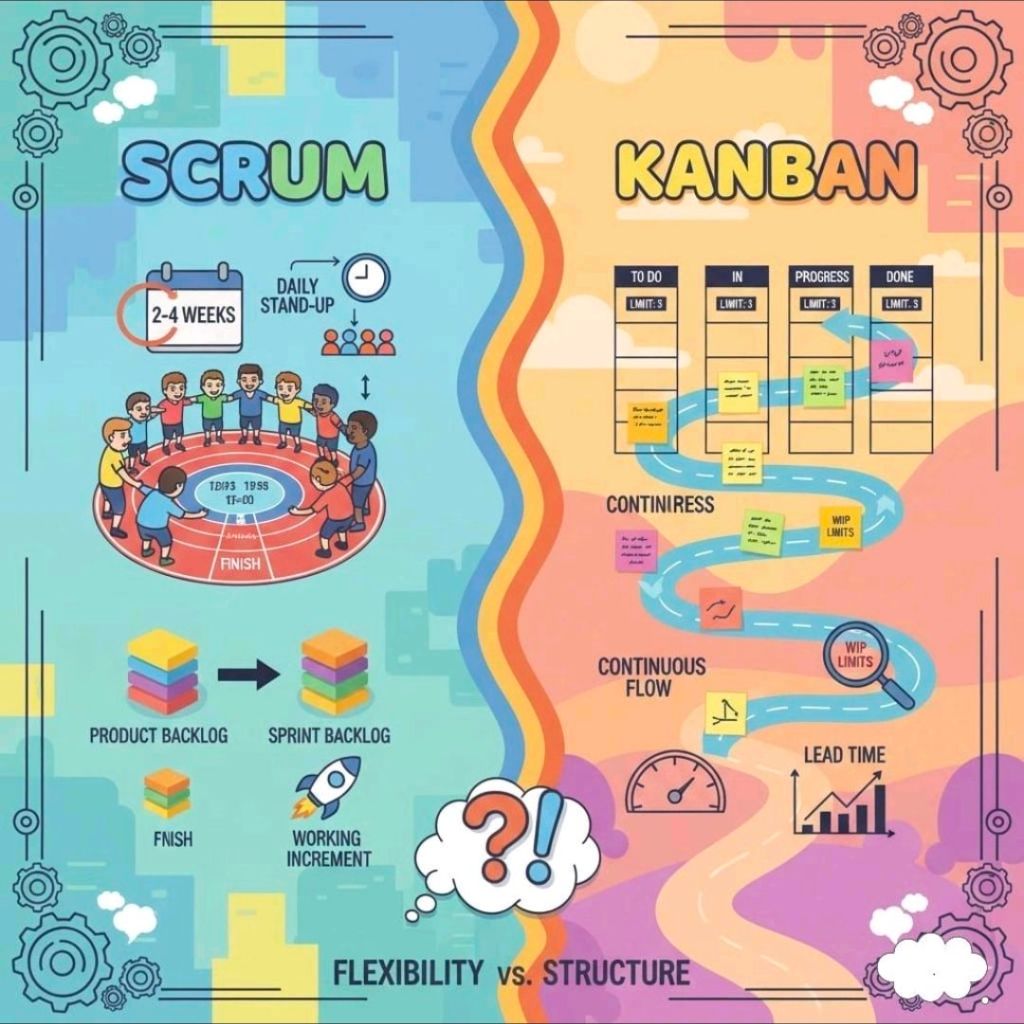
Agile Scrum Methodology Summary Breakdown Overview

Scrum is lightweight framework within the broader Agile methodology used to manage complex work through iterative, incremental delivery. It organizes work into fixed-length cycles called sprints, typically lasting two to four weeks, to deliver a usable “increment” of value at the end of each cycle. 

Core Components (The 3-5-3 Structure)

The framework is built around three accountabilities, five events, and three artifacts. 

1. Three Accountabilities (Roles)

  • Product Owner: Represents the customer and stakeholders. They manage the Product Backlog and prioritize work to maximize the value delivered by the team.
  • Scrum Master: A servant leader who coaches the team on Scrum theory and removes impediments that block progress.
  • Developers: A cross-functional, self-managing team that does the actual work to create the product increment. 

2. Five Events (Ceremonies)

  • The Sprint: The container for all other events; a time-boxed period where work is performed.
  • Sprint Planning: The team defines what will be delivered in the sprint and how the work will be achieved.
  • Daily Scrum: A 15-minute daily check-in for developers to synchronize progress and plan the next 24 hours.
  • Sprint Review: Held at the end of the sprint to inspect the outcome with stakeholders and adapt the Product Backlog.
  • Sprint Retrospective: An internal team meeting to reflect on the process and identify improvements for the next sprint. 

3. Three Artifacts

  • Product Backlog: An ordered, evolving list of everything needed for the product.
  • Sprint Backlog: The subset of product backlog items selected for the current sprint, plus a plan for delivering them.
  • Increment: The concrete sum of all completed backlog items that meet the Definition of Done. 

The Three Pillars of Empiricism

Scrum is founded on empirical process control, which relies on: 

  1. Transparency: The process and work must be visible to everyone involved.
  2. Inspection: Frequent checks of artifacts and progress to detect variances.
  3. Adaptation: Adjusting the process or product if an inspection reveals unacceptable deviations. 

Key Values

Success with Scrum depends on the team’s commitment to five core values: Commitment, Courage, Focus, Openness, and Respect

Agile Scrum Methodology Summary Breakdown Overview

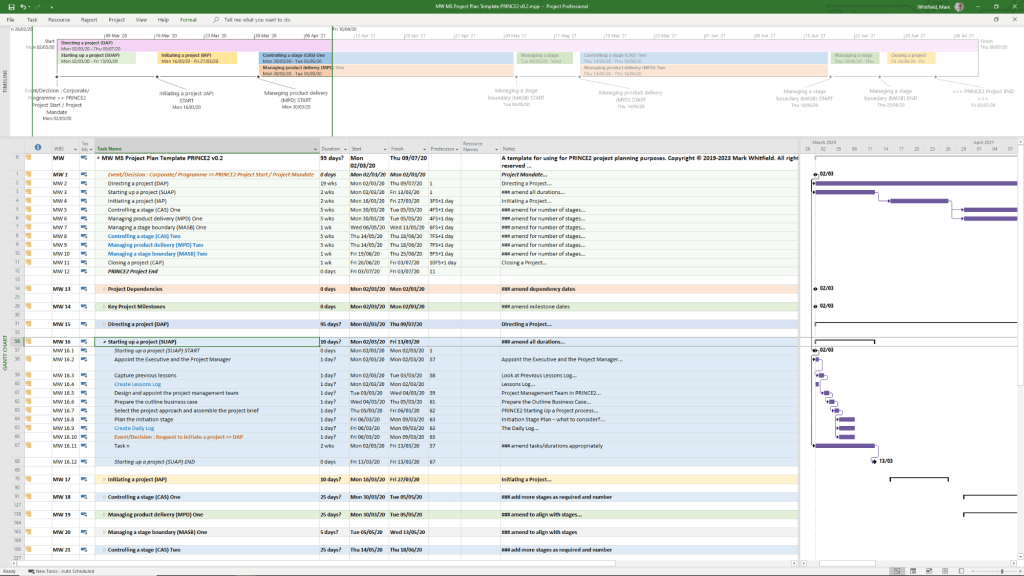
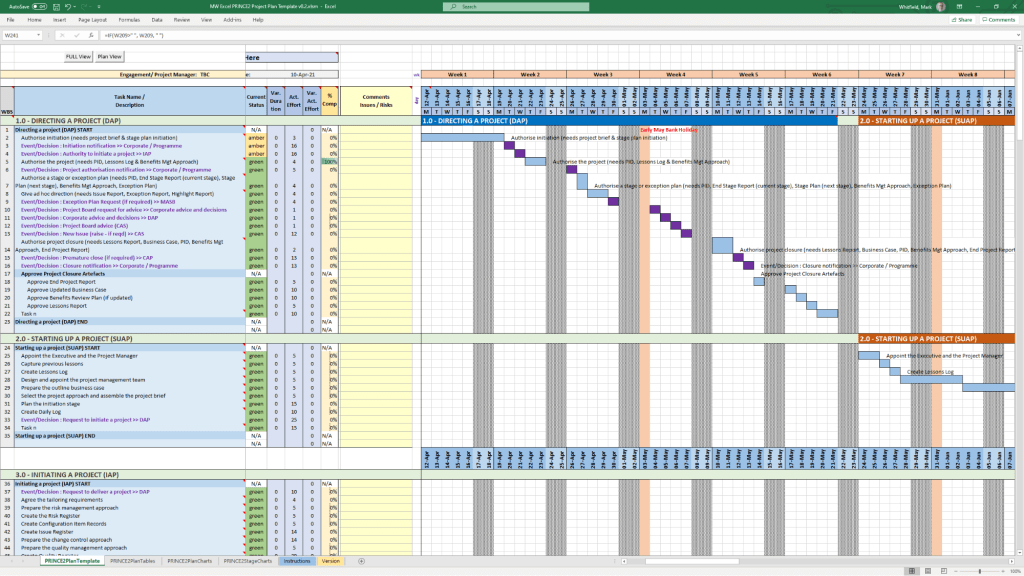
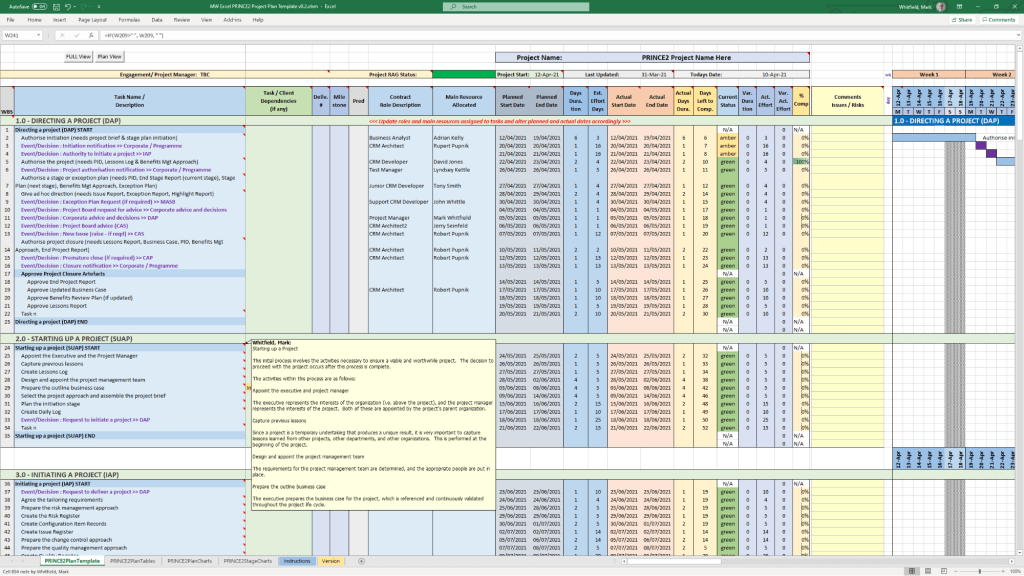
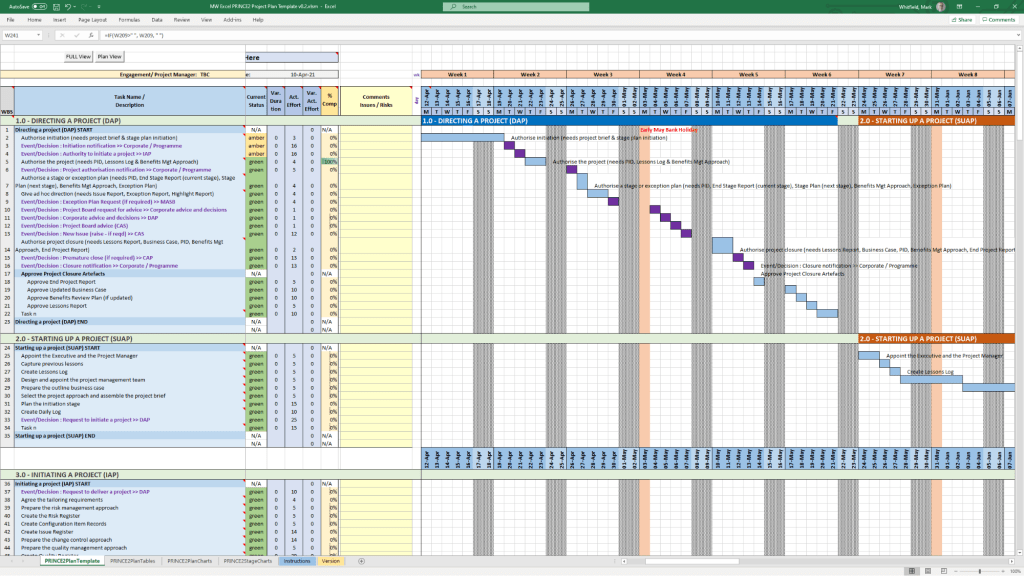
PRINCE2 Management Stages Overview

In PRINCE2, a project is managed through a series of management stages, which are discrete sections of a project that the Project Board authorises at specific decision points. Every PRINCE2 project must have at least two stages: an initiation stage and at least one further delivery stage

PRINCE2 Management Stages Overview

A detailed breakdown of these stages, aligned with the seven core PRINCE2 processes, is provided below. 

1. Starting Up a Project (SU)

This is a pre-project process designed to determine if the project is viable and worthwhile before committing significant resources. 

  • Key Activities:
    • Appointing the Executive and Project Manager.
    • Developing an Outline Business Case.
    • Creating a Project Brief which defines objectives and scope.
    • Planning the initiation stage itself. 

2. Initiating a Project (IP)

This represents the first management stage of the project. It establishes the firm foundation for the project’s execution. 

  • Key Activities:
    • Creating the Project Initiation Documentation (PID), which includes the full Business Case, Project Plan, and management strategies for risk, quality, and communication.
    • Setting up project controls and refining the project approach.
    • Securing formal approval from the Project Board to proceed. 

3. Directing a Project (DP)

This is an ongoing process that spans the entire project lifecycle, focusing on high-level decision-making by the Project Board. 

  • Key Activities:
    • Authorising the project to start and approving each subsequent stage.
    • Giving ad hoc direction and advice to the Project Manager.
    • Making the final “stop/proceed” decisions at stage boundaries.

4. Controlling a Stage (CS)

This covers the day-to-day management of each delivery stage by the Project Manager. 

  • Key Activities:
    • Assigning work to teams via Work Packages.
    • Monitoring progress and managing risks and issues.
    • Reporting status to the Project Board through Highlight Reports

5. Managing Product Delivery (MP)

This process manages the link between the Project Manager and the Team Managers who are actually building the products

  • Key Activities:
    • Teams accepting and executing Work Packages.
    • Ensuring work meets the specified quality standards.
    • Delivering completed and tested products back to the Project Manager. 

6. Managing a Stage Boundary (SB)

This occurs at the end of each stage (except the final one) to help the Project Board decide whether to continue. 

  • Key Activities:
    • Reporting on the performance of the current stage.
    • Creating a detailed Stage Plan for the next stage.
    • Updating the overall Project Plan and Business Case with the latest information. 

7. Closing a Project (CP)

This is the final part of the last management stage, ensuring the project is shut down in a controlled manner. 

  • Key Activities:
    • Confirming all products have been accepted by the customer.
    • Capturing Lessons Learned for future projects.
    • Preparing an End Project Report to evaluate performance against the original plan.

PRINCE2 Management Stages Overview

Essential Requirements Practices for a Business Analyst

Essential Requirements Practices for a Business Analyst

PRINCE2 7 Themes / Practices of PRINCE2

In the PRINCE2 project management methodology, Themes (renamed to Practices in the 7th edition released in 2023) are the seven functional areas of project management that must be addressed continuously throughout the project lifecycle. They provide a structured framework for managing key aspects like cost, risk, and quality to ensure the project remains on track. 

7 Themes / Practices of PRINCE2

Overview of the Seven Themes (Practices)

  • Business Case: Focuses on the “Why” of the project. It establishes the justification for the investment and ensures the project remains desirable, viable, and achievable.
  • Organisation: Addresses the “Who” by defining the project’s structure of accountability and responsibilities. It identifies key stakeholders and establishes the project management team.
  • Quality: Focuses on the “What” by defining the user’s requirements and quality standards. It ensures that deliverables are fit for purpose and meet stakeholder expectations.
  • Plans: Describes the “How,” “How Much,” and “When”. This theme provides techniques for creating project, stage, and team plans to facilitate communication and control.
  • Risk: Manages the “What If” by identifying, assessing, and controlling uncertainties that could impact the project’s objectives, whether they are threats or opportunities.
  • Change (Issues): Deals with the impact of changes and unexpected events. It provides a formal process for capturing, assessing, and controlling requests for change to project baselines.
  • Progress: Evaluates “Where are we now?” versus “Where are we going?”. It establishes mechanisms to monitor actual achievements against planned outcomes and manage deviations through tolerances. 

Key Concepts and Terminology

  • Continuous Application: Unlike processes, which follow a sequence, themes are applied simultaneously throughout the project.
  • Tolerances: Each theme uses tolerances (allowable deviations for time, cost, quality, etc.) to support the principle of Manage by Exception.
  • PRINCE2 7 Updates: The latest edition introduces Sustainability as a 7th performance target and emphasizes People as a core element alongside Principles, Practices, and Processes.

PRINCE2 Process Model Overview

PRINCE2 Process Model

The PRINCE2 process model provides a structured, process-driven roadmap for managing a project from its initial conception to formal closure. It consists of seven core processes that define specific activities, responsibilities, and decision points across the project lifecycle. 

The 7 PRINCE2 Processes

The processes are designed to ensure control and align with the project’s management levels: 

  • Starting Up a Project (SU): A pre-project process that filters out unviable ideas. It focuses on confirming if there is a “viable and worthwhile” business case and appoints the Project Manager and Executive.
  • Directing a Project (DP): Spans the entire project from start to finish. It is the responsibility of the Project Board, which provides strategic oversight, makes key decisions (e.g., authorising stages), and manages by exception.
  • Initiating a Project (IP): Occurs during the first management stage. It involves detailed planning to establish solid foundations, resulting in the Project Initiation Documentation (PID), which includes the project plan, risk management approach, and full business case.
  • Controlling a Stage (CS): Focuses on the Project Manager’s day-to-day management of a stage. This includes assigning work to teams, monitoring progress, and dealing with issues or risks within agreed tolerances.
  • Managing Product Delivery (MP): Governs the link between the Project Manager and Team Managers. It is where the “specialist products” (actual deliverables) are created, quality-checked, and delivered.
  • Managing a Stage Boundary (SB): Occurs at the end of each management stage (except the final one). The Project Manager reviews the current stage, updates the project plan and business case, and plans the next stage for Board approval.
  • Closing a Project (CP): Ensures an orderly end to the project. It confirms that objectives have been met, products have been accepted by the user, and lessons are captured before the project is formally disbanded. 

Hierarchy of Management Levels

The process model operates across four distinct levels of authority: 

  1. Corporate or Programme Management: Sets the initial project mandate.
  2. Directing (Project Board): Responsible for overall governance and major decisions (Directing a Project).
  3. Managing (Project Manager): Handles daily management and stage control (Controlling a Stage, Initiating a Project).
  4. Delivering (Team Members/Managers): Focuses on creating the physical products (Managing Product Delivery). 

Key Characteristics

  • Management Stages: Projects are broken into at least two stages (Initiation and at least one Delivery stage) to provide “stop/go” decision points.
  • Triggers: Each process is activated by a specific trigger, such as a “Project Mandate” from corporate management to start the SU process.
  • Management Products: These are documents like the Business CaseProject Brief, and Highlight Reports used to facilitate control and communication.