HPE Nonstop Technology Architecture – specialized, 100% fault-tolerant infrastructure

The official HPE Nonstop Technology Architecture is a specialized, 100% fault-tolerant infrastructure built with a tightly integrated hardware and software stack designed to eliminate any single point of failure. Formal instruction and architectural frameworks have been modernized under the newly relaunched HPE Nonstop Compute Training Portfolio curriculum.

Originally developed by Tandem Computers in 1976, the platform eventually became part of Hewlett Packard Enterprise (HPE). Unlike standard servers that can crash due to a single component failure, NonStop uses a tightly integrated, “shared-nothing” architecture to ensure that if a hardware or software component fails, another instantly takes over with zero downtime or data loss.

Core Architectural Features

To understand how HPE NonStop works, you need to understand its unique design principles:

  • Shared-Nothing Architecture: Every processor has its own dedicated memory, I/O channels, and copy of the operating system. No single component is shared, eliminating any single point of failure.
  • Process Pairs: Applications run using a primary process and a backup process on a different processor. The primary process constantly copies its state to the backup. If the primary fails, the backup immediately takes over.
  • Massive Scalability: Systems can scale up seamlessly from small distributed environments to massive clusters containing up to 24,000 processor cores without interrupting running operations.
  • Hardware Platform: The modern software environment runs on industry-standard x86 architectures, available as physical server racks (like the HPE NonStop NS9 X5) or as virtualized instances in hybrid cloud environments.

Dual Operating Environments

HPE NonStop runs a specialized operating system called NonStop OS. Inside this OS, developers and administrators interact with two distinct environments:

  • Guardian Environment: The native, proprietary environment optimized for high-volume Online Transaction Processing (OLTP). It handles tasks sequentially through process-oriented manually-started jobs rather than traditional automated queues.
  • Open System Services (OSS): A UNIX-like, POSIX-compliant environment built on top of the NonStop kernel. This allows organizations to run standard open-source applications, tools, and scripts natively alongside Guardian.

Ecosystem and Use Cases

HPE NonStop is rarely used for standard office automation or basic web hosting. Instead, it serves as the backbone for global industries where an hour of downtime could cost millions of dollars:

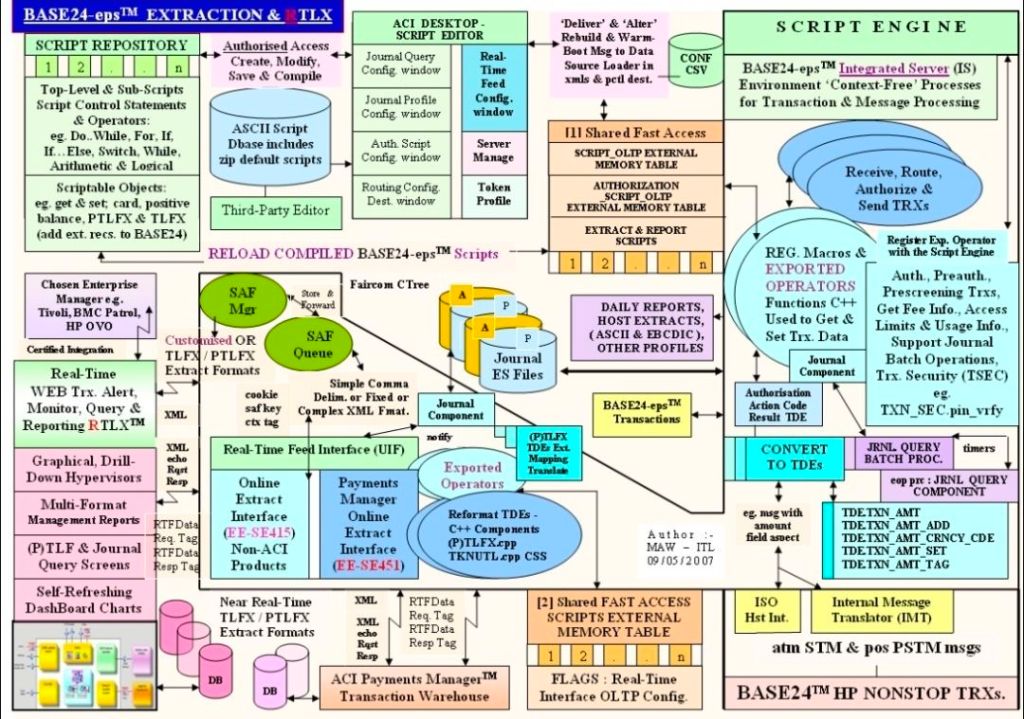
  • Financial Transactions: Powers global stock exchanges, automated teller machines (ATMs), and retail point-of-sale credit card processing, eg. BASE24.
  • Travel and Logistics: Runs critical airline reservation systems and real-time cargo routing infrastructure.
  • Database Management: Features its own highly secure, distributed database engine called NonStop SQL, which guarantees absolute data integrity across all transactions.
  • Modern Development: Supports traditional languages like COBOL85 and ANSI C, alongside modern DevOps integrations like Git, Ansible, and Eclipse-based IDE environments.

If you plan to work directly with these systems, you can explore formal pathways like the Concepts and Facilities for HPE NonStop Systems course provided by HPE Education Services.


Core Architectural Layers (Diagram Blueprint)

An architectural blueprint of an HPE NonStop environment typically separates the layout into three core interdependent layers:

  • Hardware & Fabric Layer: Consists of independent, loosely-coupled Processor Nodes (handling up to 24,000 cores globally) connected via an ultra-fast InfiniBand or ServerNet system fabric backbone.
  • I/O & Subsystem Layer: Utilizes Cluster I/O Protocols (CLIMs), splitting tasks between Storage CLIMs (SCLIMs) and Network CLIMs (NCLIMs) to isolate external communication from main processing.
  • Operating System & DB Layer: Runs the NonStop OS, which simultaneously manages the traditional Guardian environment, Open System Services (OSS) for UNIX/Linux paradigms, and the NonStop SQL distributed database engine.

Recommended Architecture Training Curriculum

HPE organizes its technical blueprints into structured educational paths for engineers.

1. Foundational Blueprint Concepts

  • Course Code: U4147S (HPE Nonstop Compute System Fundamentals).
  • Focus: Delivers a top-down view of system goals, transaction processing, and fundamental architecture.
  • Key Modules: Explores Guardian vs OSS, Pathway application management, and basic database interaction.

2. System Operations & Administration

  • Course Code: H1SC3S (HPE Nonstop Compute System Administration I).
  • Focus: Maps physical and virtual components to real-world deployment.
  • Key Modules: Covers Processor Nodes, configuring SCLIMs/NCLIMs, and hands-on fault-scenario testing.

3. Low-Level OS Internals

  • Course Code: U8609S (HPE Integrity Nonstop Operating System Architecture).
  • Focus: Deep dive into runtime architecture, process control, and memory allocation.
  • Key Modules: Focuses on Inter-process Message Systems, synchronization mechanisms, and system debugging.

Training Delivery Options

Enrolling via HPE Education Services grants access to various professional development features:

  • HPE vLabs: Direct sandbox access to practice configuration and live fault injection inside virtual environments.
  • Digital Learner Credits: Flexible licensing options to assign corporate learning units across teams.
  • Modernized Tracks: Courses have been fully overhauled to support contemporary cloud paradigms and hybrid integration via HPE GreenLake frameworks.

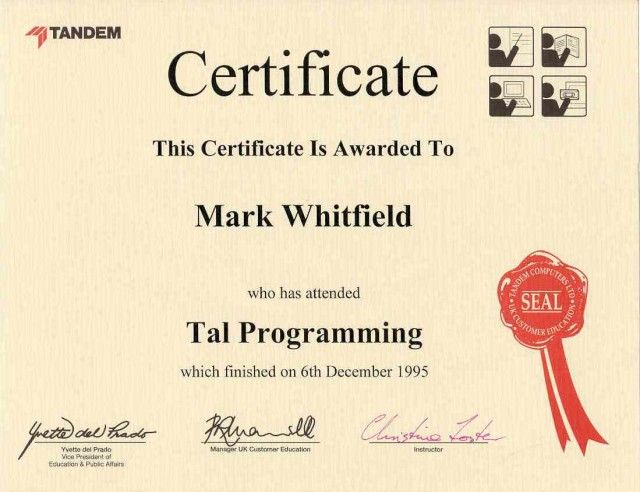
My HPE NonStop (Tandem Computers) Certificates :

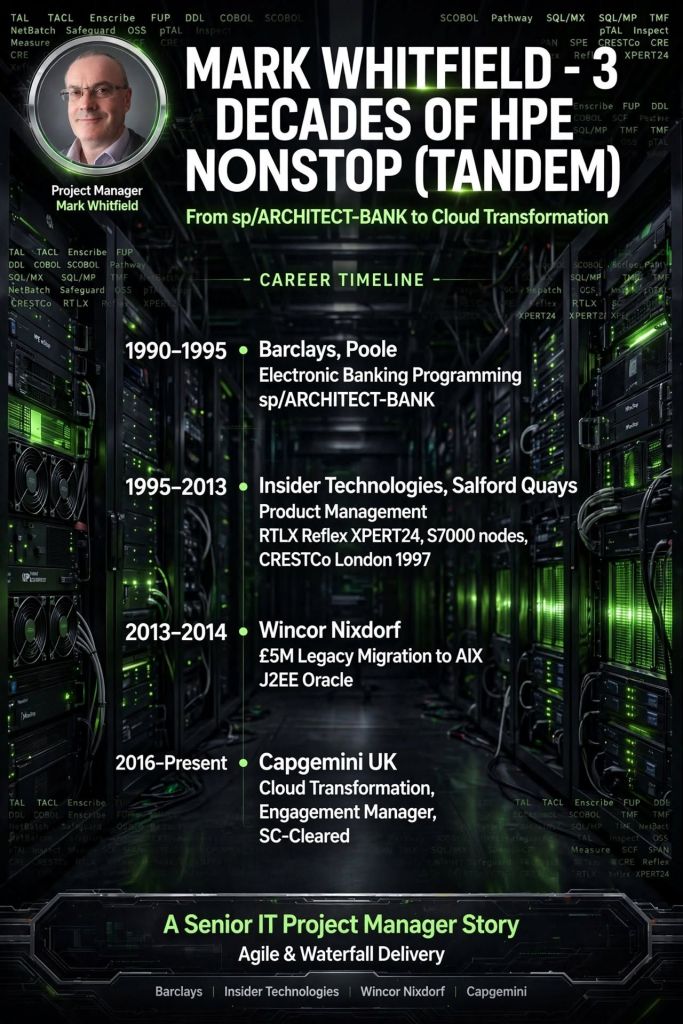
HPE NonStop (Tandem) Career Experience at Insider Technologies Limited, ITL
BASE24 eps monitoring

HPE NonStop previously Tandem Computers

NonStop is a series of server computers introduced to market in 1976 by Tandem Computers Incorporated,[1] beginning with the NonStop product line.[2] It was followed by the Tandem Integrity NonStop line of lock-step fault-tolerant computers, now defunct (not to be confused with the later and much different Hewlett-Packard Integrity product line extension). The original NonStop product line is currently offered by Hewlett Packard Enterprise since Hewlett-Packard Company’s split in 2015. Because NonStop systems are based on an integrated hardware/software stack, Tandem and later HPE also developed the NonStop OS operating system for them.

NonStop systems are, to an extent, self-healing. To circumvent single points of failure, they are equipped with almost all redundant components. When a mainline component fails, the system automatically falls back to the backup.

These systems can be used by banksstock exchanges, payment applications, retail companies, energy and utility services, healthcare organizations, manufacturers, telecommunication providers, transportation, and other enterprises requiring extremely high uptime.

History

Originally introduced in 1976 by Tandem Computers Inc., the line was later owned by Compaq (from 1997), Hewlett-Packard Company (from 2003)[3] and Hewlett Packard Enterprise (since 2015). In 2005, the HP Integrity “NonStop i” (or TNS/E) servers, based on Intel Itanium microprocessors, was introduced. In 2014, the first “NonStop X” (or TNS/X) systems, based on Intel x86-64 processors, were introduced. Sales of the Itanium-based systems ended in July 2020.[4]

Early NonStop applications had to be specifically coded for fault tolerance. That requirement was removed in 1983 with the introduction of the Transaction Monitoring Facility (TMF), along with Pathway transaction management software and SCOBOL applications (or, later, NonStop Tuxedo transaction management software), which handles the various aspects of fault tolerance on the system level.

Software

NonStop OS is a message-based operating system designed for fault tolerance. It works with process pairs and ensures that backup processes on redundant CPUs take over in case of a process or CPU failure. Data integrity is maintained during those takeovers; no transactions or data are lost or corrupted.

The operating system as a whole is branded NonStop OS and includes the Guardian layer, which is a low-level component of the operating system and the Open System Services (OSS) personality which runs atop this layer, which implements a Unix-like interface for other components of the OS to use.

The operating system and application are both designed to support the fault tolerant hardware. The operating system continually monitors the status of all components, switching control as necessary to maintain operations. There are also features designed into the software that allow programs to be written as continuously available programs. That is accomplished using a pair of processes where one process performs all the primary processing and the other serves as a “hot backup”, receiving updates to data whenever the primary reaches a critical point in processing. Should the primary stop, the backup steps in to resume execution using the current transaction.[5]

The systems support relational database management systems like NonStop SQL and hierarchical databases such as Enscribe.

Languages supported include Java,[6] CC++,[6] COBOL, SCOBOL (Screen COBOL), Transaction Application Language (TAL), etc. It uses the scripting and job control language TACL (Tandem Advanced Command Language), and is written in TAL and C.

Hardware

The HPE Integrity NonStop computers are a line of fault-tolerant, message-based server computers based on the Intel Xeon processor platform,[4] and optimized for transaction processing. Average availability levels of 99.999% have been observed.[7] NonStop systems feature a massively parallel processing (MPP) architecture and provide linear scalability. Each CPU runs its own copy of the OS, and systems can be expanded up to over 4000 CPUs. This is a shared-nothing architecture—a “share nothing” arrangement also known as loosely coupled multiprocessing.

Due to the integrated hardware/software stack and a single system image for even the largest configurations, system management requirements for NonStop systems are rather low. In most deployments there is just a single production server, not a complex server farm.

Most customers also have a backup server in a remote location for IT disaster recovery. There are standard products to keep the data of the production and the backup server in sync, for example, HPE’s Remote Database Facility (RDF),[8] hence there is fast takeover and little to no data loss also in a disaster situation with the production server being disabled or destroyed.

HP also developed a data warehouse and business intelligence server line, HP Neoview, based on the NonStop line. It acted as a database server, providing NonStop OS and NonStop SQL, but lacked the transaction processing functionality of the original NonStop systems. The line was retired, and no longer marketed, as of 24 January 2011.[9]

See also

HP NonStop (HPE) fault tolerant servers originally developed by Tandem Computers – Summary

My IT career between the years 1990 and 2014, involved significant programming and large projects for Tandem HP NonStop servers.

HP NonStop Tandem Computers

HP NonStop refers to the line of fault-tolerant servers and software originally developed by Tandem Computers and now owned by Hewlett Packard Enterprise (HPE). These systems are designed for continuous operation and uninterrupted transaction processing by using redundant hardware components and independent processors to automatically failover in the event of a failure, ensuring high availability for critical applications in banking, telecommunications, and healthcare. 

Origins and Evolution

  • Tandem Computers: Founded in 1974, Tandem introduced the NonStop system, a pioneering fault-tolerant computer with no single point of failure, revolutionizing continuous availability for online transaction processing. 
  • Acquisitions: Tandem Computers was acquired by Compaq in 1997, and Compaq was later acquired by Hewlett-Packard (HP) in 2001. 
  • Current Ownership: After the split of HP into Hewlett Packard Enterprise (HPE) and HP Inc. in 2015, the NonStop product line became part of HPE. 

Key Features and Uses

  • Fault Tolerance: The systems are built with redundant components, including identical processors and storage devices, allowing them to automatically detect and recover from hardware or software failures without interruption. 
  • High Availability: This fault-tolerant architecture is ideal for mission-critical applications that require constant uptime, such as financial transactions, emergency services, and large-scale banking systems. 
  • Scalability: NonStop systems are designed for scalability, able to handle large commercial workloads by adding independent processors. 
  • Dedicated Operating System: Historically, NonStop systems ran on proprietary software like the Guardian operating system and used the TAL programming language
  • Specialized Database: The line includes NonStop SQL (currently SQL/MX), a relational database designed for the high availability and scalability needs of these systems.