In Agile and Scrum frameworks, the Business Analyst (BA) bridges the gap between high-level business vision and tactical development execution. During Sprint Planning, a BA’s primary focus is to ensure that the development team has absolute requirement clarity, eliminating assumptions before a single line of code is written.
The exact focus areas of an Agile Business Analyst are divided into pre-planning readiness, active session support, and look-ahead risk management.
1. Requirements Readiness (Definition of Ready)
The primary pre-planning objective for a BA is ensuring that the top of the Product Backlog satisfies the team’s “Definition of Ready” (DoR).
INVEST Criteria: Verifying that each Product Backlog Item (PBI) is Independent, Negotiable, Valuable, Estimable, Small, and Testable.
Acceptance Criteria: Drafting robust, edge-case-tested functional parameters (often using the Given-When-Then format) to govern testing.
Business Rules & Models: Mapping complex data models, workflows, and process rules so developers have clear visuals alongside text.
2. Guarding the Business Value and Sprint Goal
While the Product Owner (PO) sets the priority, the BA confirms that the selected sprint backlog items align logically to form a cohesive target.
Sprint Goal Formulation: Supporting the PO in defining a functional, clear objective for the iteration rather than a random collection of tickets.
Value Justification: Serving as the “voice of the user,” reminding the technical team why a feature is being built and how it affects the end-user journey.
3. Technical and Functional Bridging
During the actual planning meeting, developers break down stories into sub-tasks and estimate effort. The BA provides live context.
Assumption Removal: Answering immediate clarifications regarding data constraints, legacy dependencies, or UI expectations.
Sizing Support: Assisting the team during story-point estimation by highlighting hidden functional complexities that impact effort.
Scope Trimming: Helping break down massive User Stories (Epics) into bite-sized, single-sprint tasks if an item is deemed too large.
4. Dependency and Risk Mitigation
A critical focus for the BA is ensuring the upcoming sprint does not get blocked by outside factors.
Cross-Team Alignment: Identifying if a story relies on an API or data feed managed by an external team, ensuring those pieces are unblocked.
Non-Functional Requirements (NFRs): Catching frequently missed parameters, such as specific security protocols, compliance standards, or localization requirements, before work kicks off.
ProjectTemplatesSoft on Etsy is a highly rated, UK-based digital storefront specializing in professional-grade project management spreadsheets and presentation documents. Founded by Mark Whitfield, a veteran Senior Project Manager with over 30 years of delivery experience in IT and the Software Development Lifecycle (SDLC), the shop bridge the gap between heavy enterprise software and simple, flexible spreadsheets.
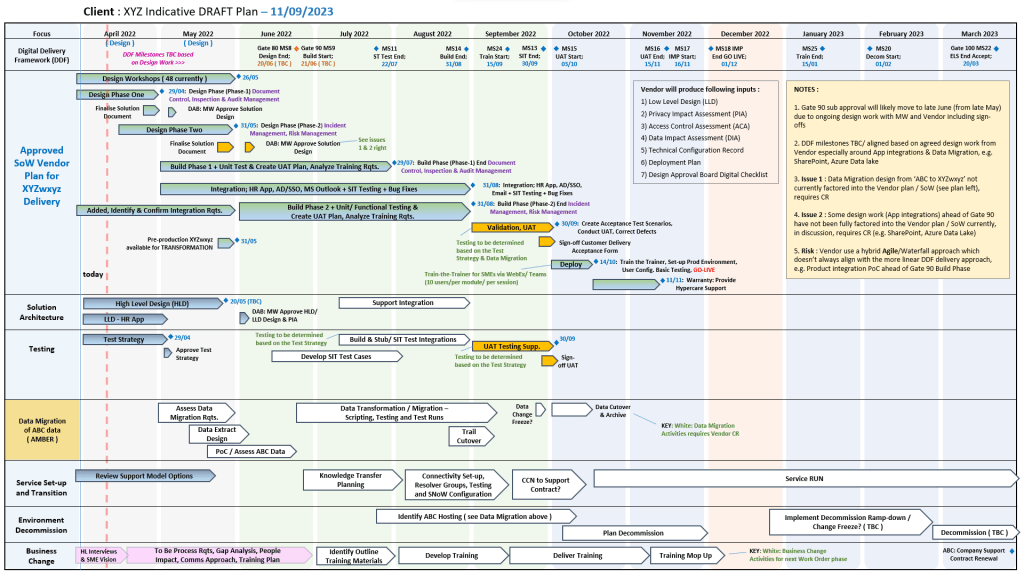
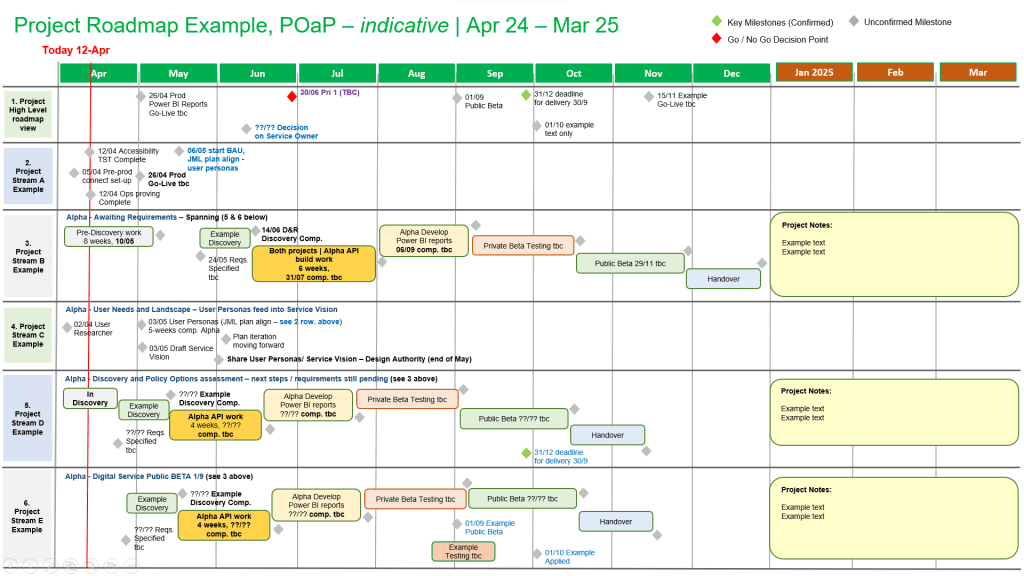
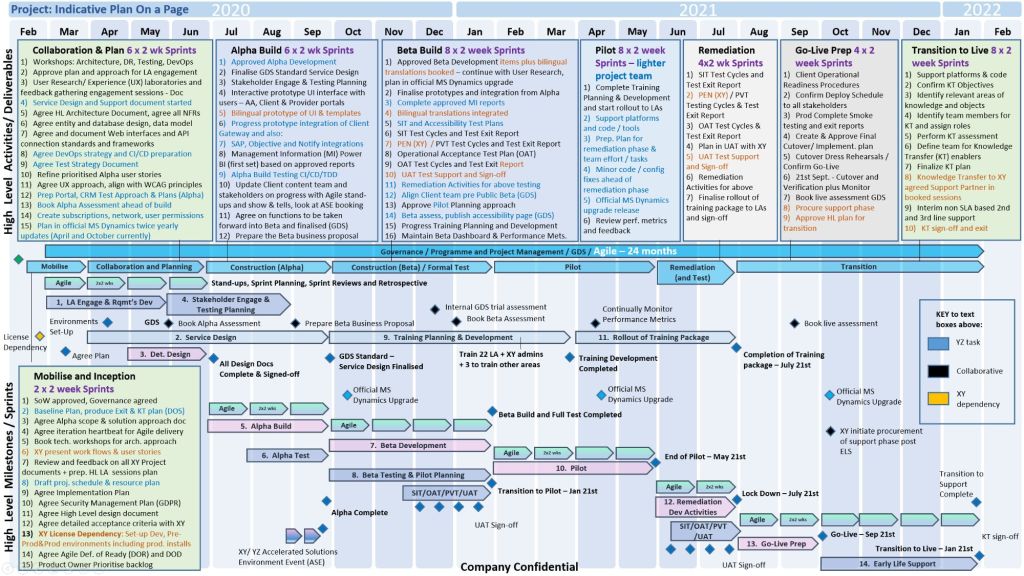
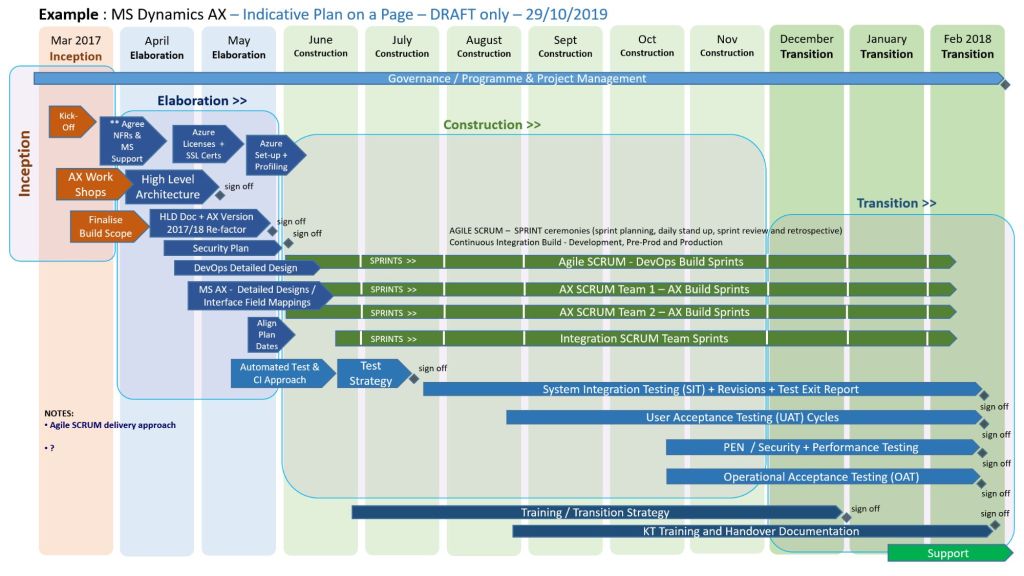
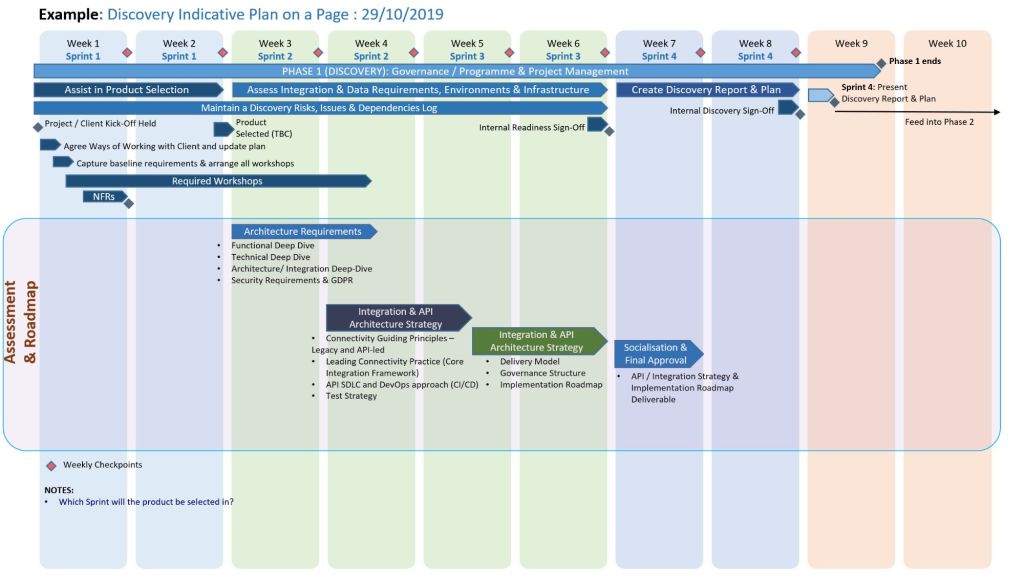
Example POaP PPT and XLS plan project templates (200+ in all)
The products are distinctively built around core professional methodologies including PRINCE2 Waterfall and Agile Scrum frameworks. A key differentiator for this storefront is its customer lifetime model: all template upgrades and functional versions are 100% free after a single purchase by contacting the seller directly. The tools are fully unlocked, editable, and act as a portable alternative for teams or clients without expensive Microsoft Project licensing.
Product Breakdown by Category Focus
📊 1. Schedule Planning & Waterfall Templates
These tools target timeline generation, resource distribution, and critical path management for traditional structured delivery.
Waterfall Project Planner & Cost Tracker: An advanced interactive timeline engine that acts as a localized alternative to MS Project. It allows teams to map out milestones while calculating live run-rate expenditures.
Plan on a Page (POaP) Blueprint: A high-level stakeholder alignment presentation tool crafted in Microsoft Excel and PowerPoint designed to condense multi-layered delivery milestones into one scannable executive slide.
Work Breakdown Structure (WBS) Matrix: Structural templates built to parse complex client scopes into manageable, sequential project tasks.
🔄 2. Agile & Scrum Framework Toolkits
Tailored for modern software development environments executing iterative design, rapid deployments, and sprint-based task management.
Agile Scrum Master Pack: Complete tracking logs optimizing sprint velocities, backlog grooming sessions, and team capacity limits.
Built for Programme Management Offices requiring cross-project transparency, strict risk mitigation, and central staff scheduling.
Central RAID Log: A classic, comprehensive spreadsheet designed to track project Risks, Assumptions, Issues, and Dependencies under strict corporate governance standards.
Resource Absence & Sickness Tracker: A centralized planner for operations managers to log annual leave, sickness intervals, and alternative project allocations.
Project Team Kick-Off Decks: Professionally designed slide blueprints that outline scope definitions, stakeholder communication channels, and milestone objectives during initiation phases.
Essential Shop & Resource Hyperlinks
To explore the complete range of toolkits, check out the official ProjectTemplatesSoft Etsy Shop Page.
To access detailed execution frameworks, read customer documentation, or seek professional delivery guidance, visit the developer’s hub at Mark Whitfield’s Project Management Blog.
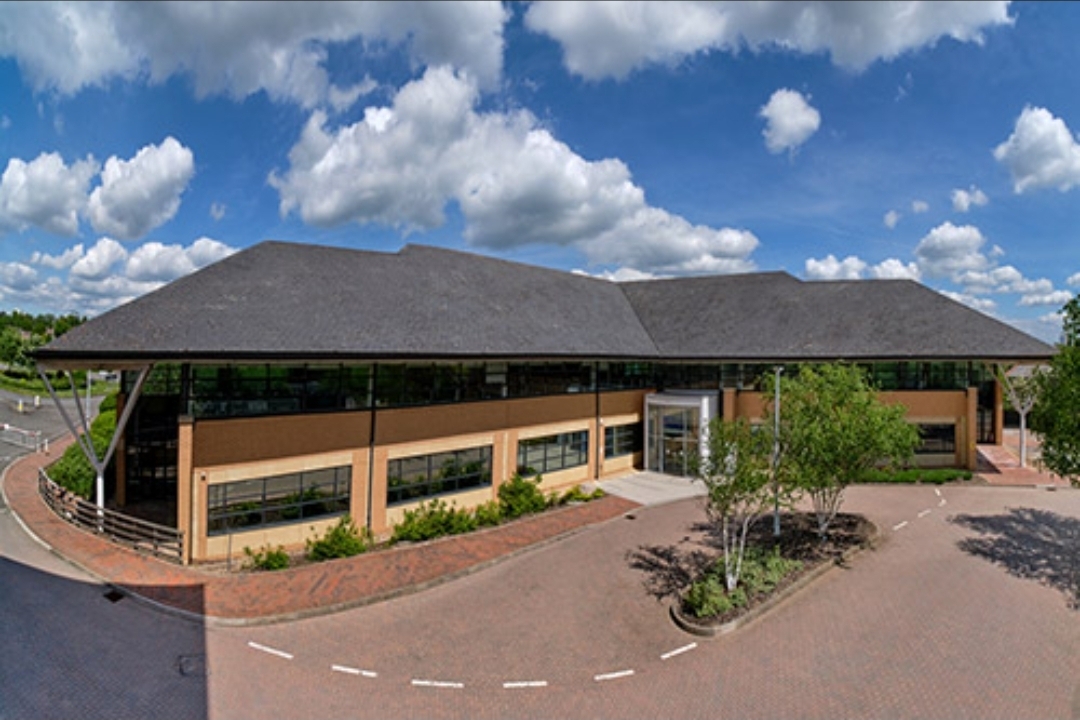
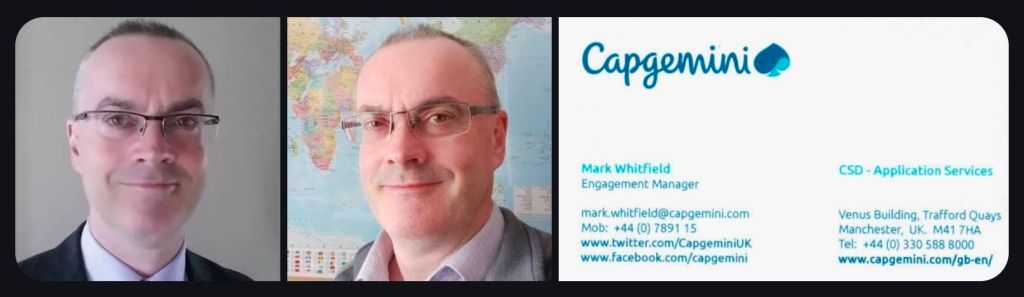
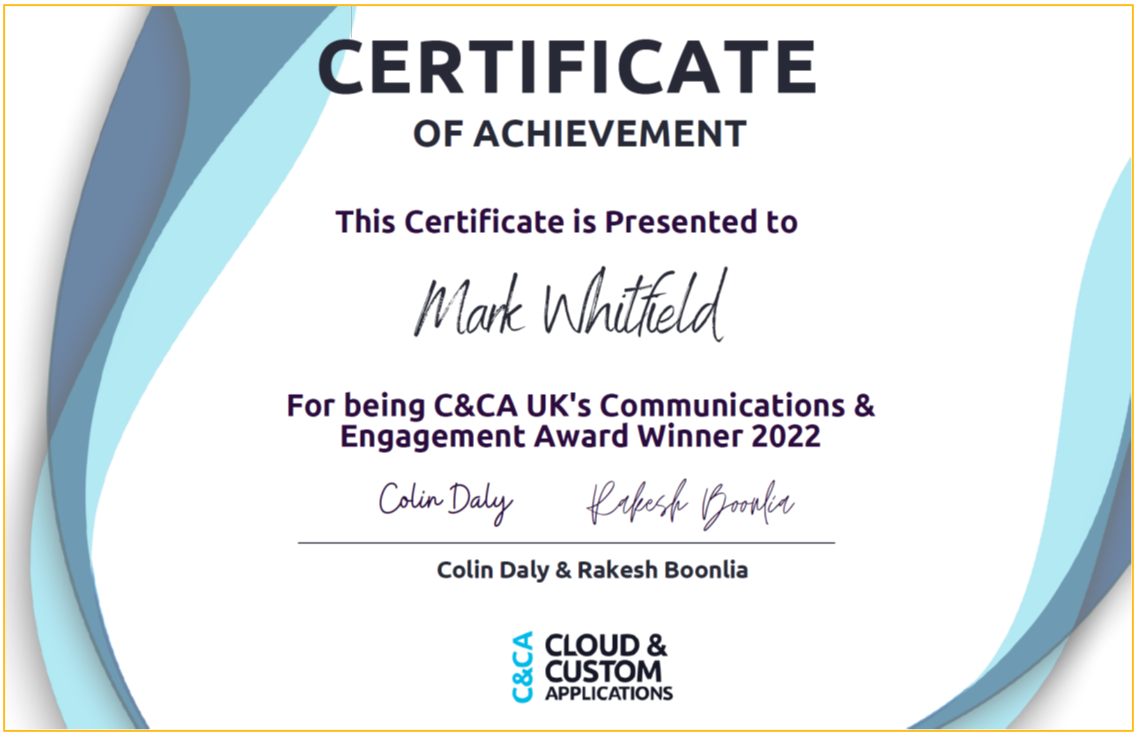
Mark Whitfield is a Greater Manchester-based Senior IT Project and Engagement Manager.
With over 30 years in the IT and software development industry, he has continuously upskilled in project delivery, Agile methodologies, cloud platforms, and cyber security.
Phase 1: Foundational Education
1985 – 1988: Leigh College, UK
Focus: Computer Science and Biology (‘A’ Levels)
1988 – 1990: University of Greater Manchester (formerly Bolton Institute of Higher Education, BIHE)
Focus: Higher National Diploma (HND) in Computer Studies (Graduated with Distinction; First overall in the year)
Key Modules: System Analysis, Programming Methodology, Database Architecture, and Business Information Systems
Phase 2: Project Management & Professional Training
2000 – 2006: Industry Integration & Early Methodologies
Focus: Service-Oriented Architecture (SOA), Agile, Sales, and early project management
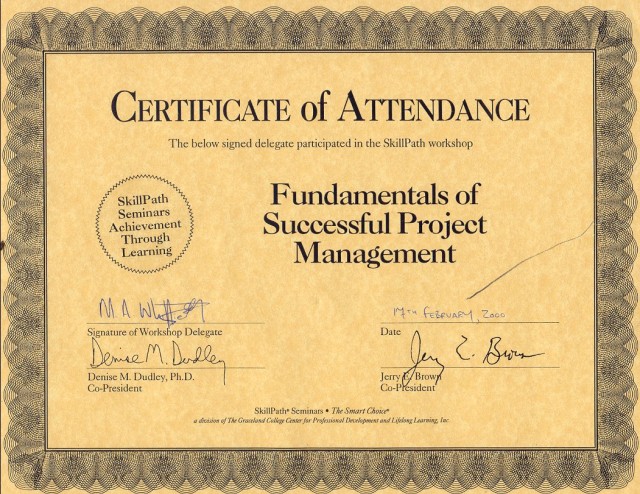
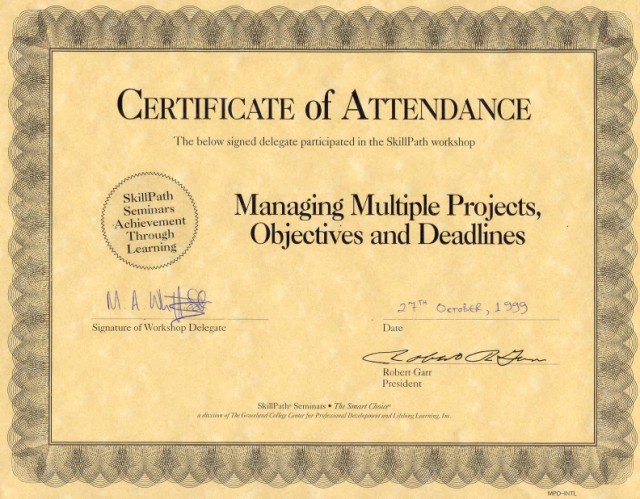
Courses/Certifications: Sales and Marketing (In-house Outsource, 2001), Web Services and SOA (Insider Technologies, 2005), PRINCE2 Foundation (2006), Designing Good Marketing Literature (SkillPath Seminars, 2006)
2009: Digital & Communications
Focus: Digital marketing and content
Courses: Writing for the Web, and Website Promotion and Visibility by Design (iTrain Education)
2011: Structured Frameworks
Focus: Formal project frameworks and delivery methodologies

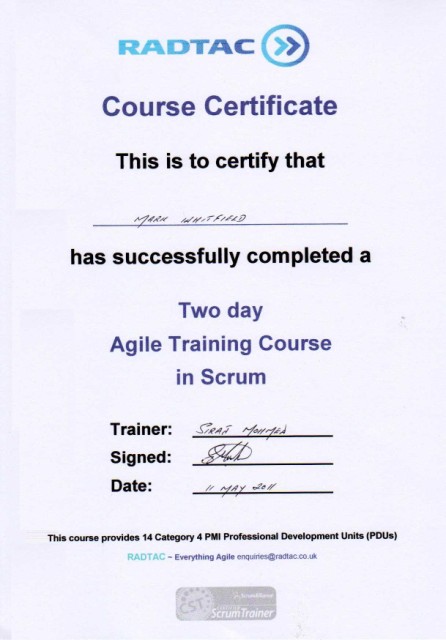
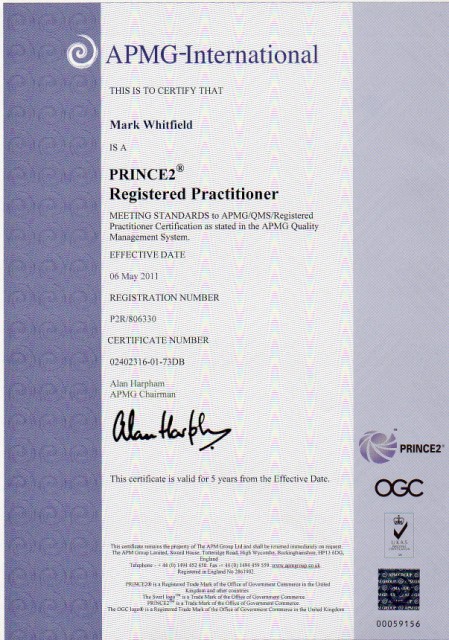
Courses/Certifications: PRINCE2 Foundation & Practitioner (ILX Group), Agile Scrum (RADTAC)
2012: Operational Management
Focus: Service management best practices
Courses/Certifications: ITIL Foundation
Phase 3: Advanced Engagement & Enterprise Training
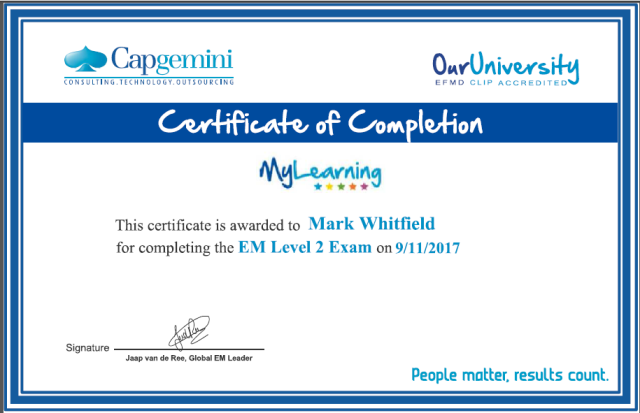
2017 – 2019: Capgemini Engagement & Compliance
Focus: High-level engagement management and corporate governance
Courses/Certifications: Advanced Engagement Management Certification (Level 2), Group Anti-Corruption, and Intellectual Property Rights (IPR) Training
2022: Cloud Modernization
Focus: Enterprise cloud computing fundamentals
Courses/Certifications: AZ-900 Microsoft Certified Azure Fundamentals
Mark Whitfield’s Project Management (PM) methodology relies on over 200 editable templates tailored for both Agile Scrum and Waterfall / PRINCE2 frameworks. Developed over 24 years of IT and digital delivery, the toolkit focuses on high-level reporting, rigorous risk control, and visual tracking to align teams with corporate governance.
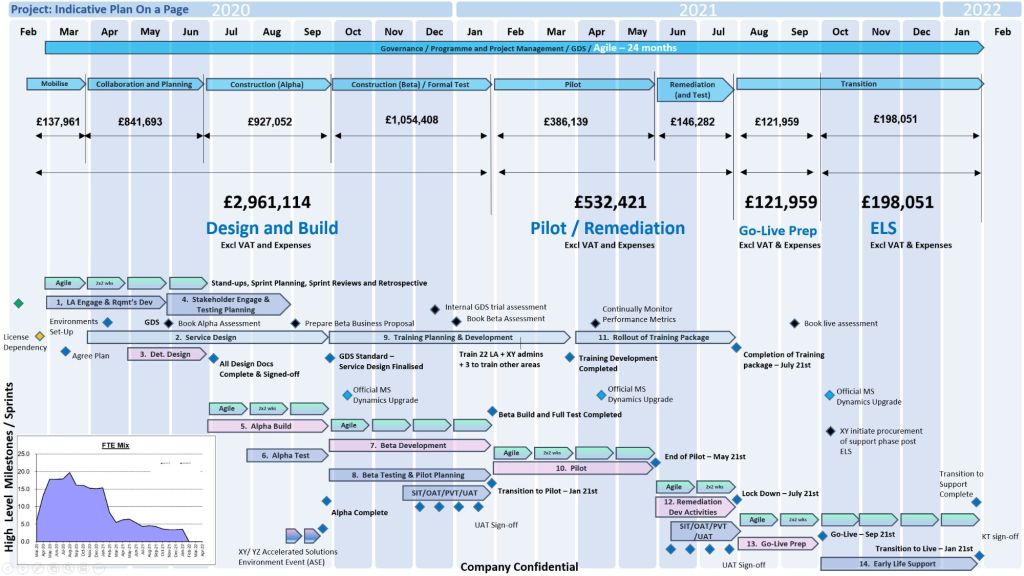
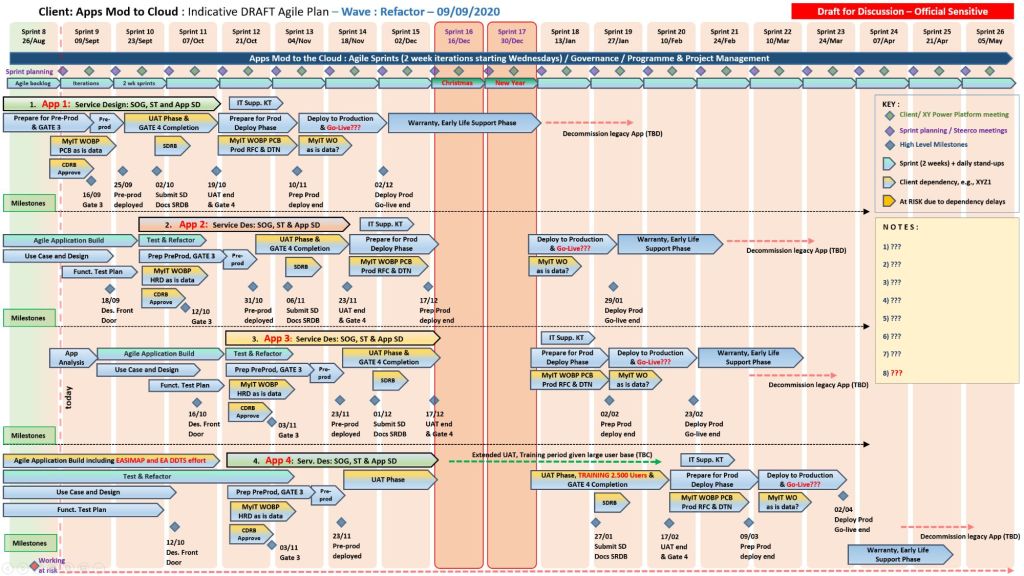
An example of many Plan On a Page (POAP) templates
Templates by Category and Methodology
1. Detailed Planning & Scheduling
Methodology: Mapped to the Software Development Life Cycle (SDLC) for both sequential Waterfall phases and iterative Agile sprints.
Templates:
Microsoft Project (MPP): Fully loaded schedules detailing project inception, elaboration, construction, and transition.
Excel Detailed Plans: Work Breakdown Structure (WBS) mapped to sequential and date-driven task management with built-in RAG (Red/Amber/Green) status indicators.
2. Visual Reporting & Execution (Plan on a Page)
Methodology: Focuses on structural, executive communication to prevent scope creep and keep stakeholders aligned.
Templates:
POaP (Plan on a Page): High-level visual summaries designed for client presentations and quick-glance milestone tracking in Excel and PowerPoint.
Burn-up / Burn-down Charts: Visual tracking metrics used in Agile Sprints to show progress towards delivery goals.

3. Risk & Governance Control
Methodology: Built on strict risk/action tracking and regular lessons learned to manage uncertainty throughout the project lifecycle.
Change Requests/Decisions Log: Supplementary tabs within the RAID register to strictly manage scope changes and project governance.
4. Financial Trackers
Methodology: Ensures project adherence to contracted margins, tracking both internal/external costs and resource efforts.
Templates:
Budget & Resource Trackers: Spreadsheets for forecasting versus actual expenses, variance calculations, expense reporting, and margin tracking with pivot-table readiness.
5. Team RACI & Status Reporting
Methodology: Clearly defines stakeholder roles and communication frequencies (weekly/monthly) to ensure continuous monitoring and control.
Templates:
RACI Matrix: A mapping tool defining who is Responsible, Accountable, Consulted, and Informed.
Weekly Status Reports: Word/Excel templates detailing internal and external project health, current milestones, and upcoming sprints.
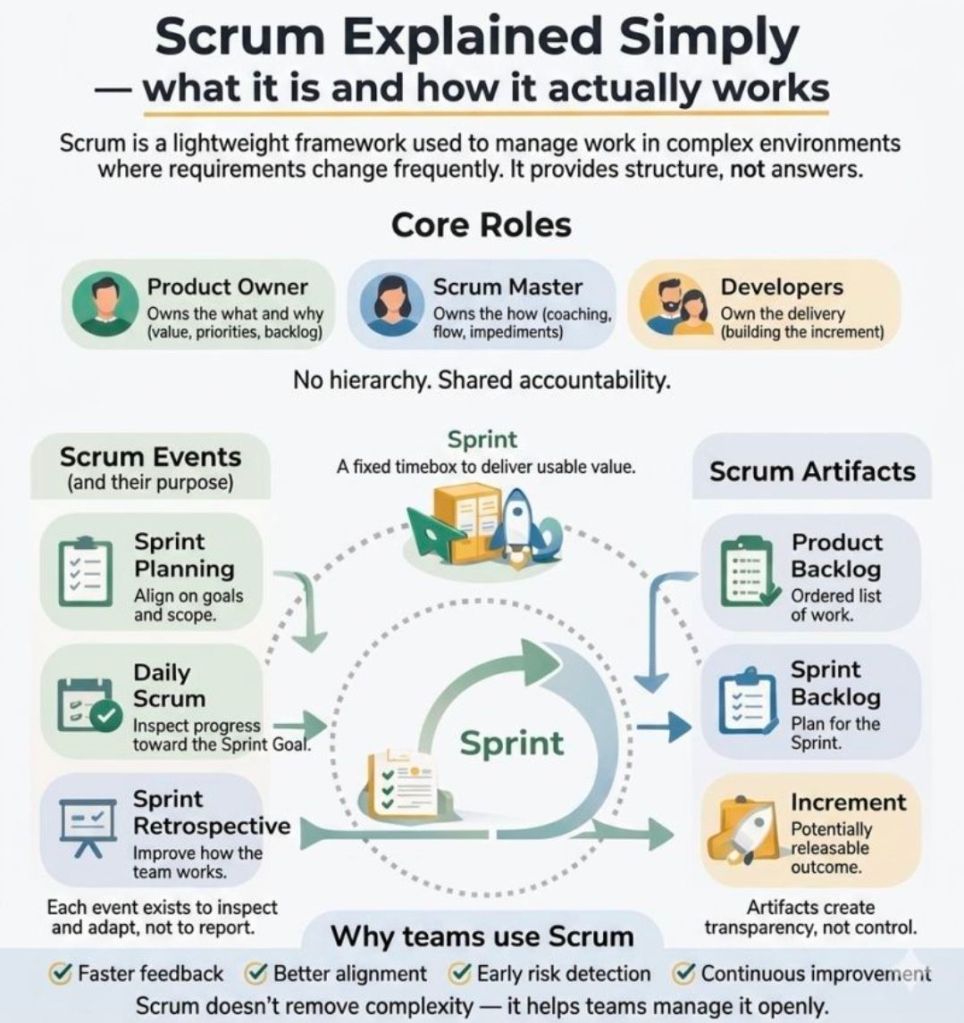
Empiricism is the foundational theory of the Agile Scrum framework, asserting that knowledge comes from experience and that decisions should be based on real-world observations rather than upfront predictions. Instead of following a rigid, predefined plan, Scrum relies on an iterative process to navigate complex and unpredictable environments. This empirical process control model is sustained by three distinct pillars.
The Three Pillars of Empiricism
The Scrum Guide specifies three pillars that must work together to create an effective empirical feedback loop:
Transparency: The significant aspects of the process must be visible to those responsible for the outcome. Decisions are driven by the perceived state of artifacts, which means any hidden issues or misreported metrics directly sabotage future decision-making.
Inspection: Scrum artifacts and progress toward agreed goals must be evaluated frequently and diligently. This continuous assessment identifies unwanted variances or deviations from the desired outcome.
Adaptation: If an inspection reveals that aspects of a process or product deviate outside acceptable limits, the team must adjust immediately. An adjustment must be made as quickly as possible to minimize further deviation.
How Scrum Events Enable Empiricism
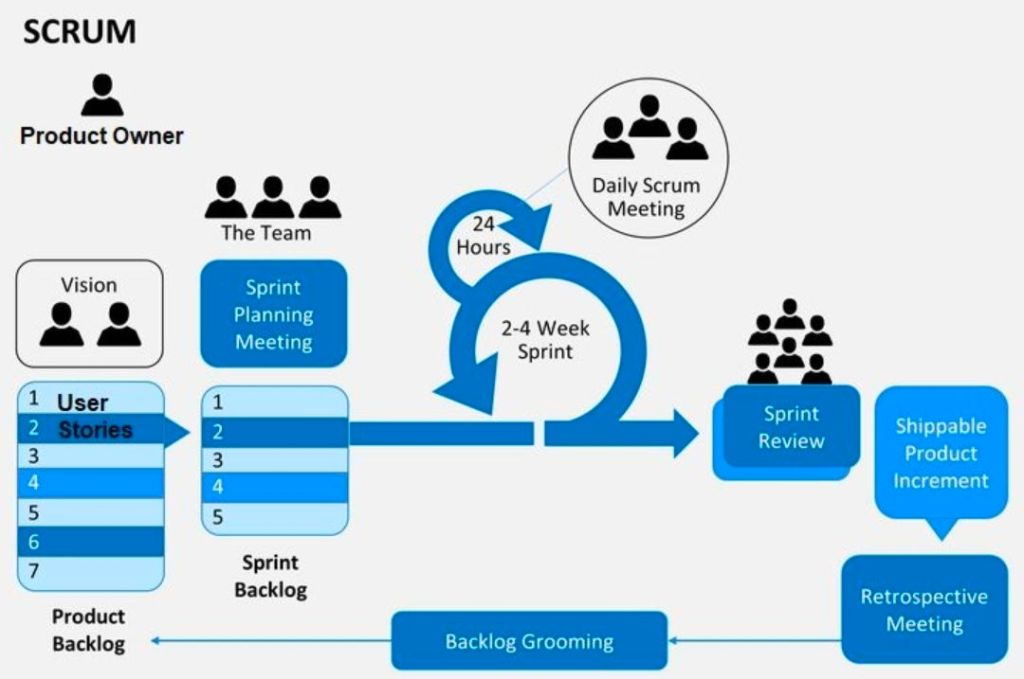
Inspection and adaptation cannot happen in a vacuum. Scrum provides four formal events that act as a structured cadence for empirical evaluation:
Sprint Planning: The team inspects the Product Backlog and adapts their upcoming workload to define a realistic Sprint Goal.
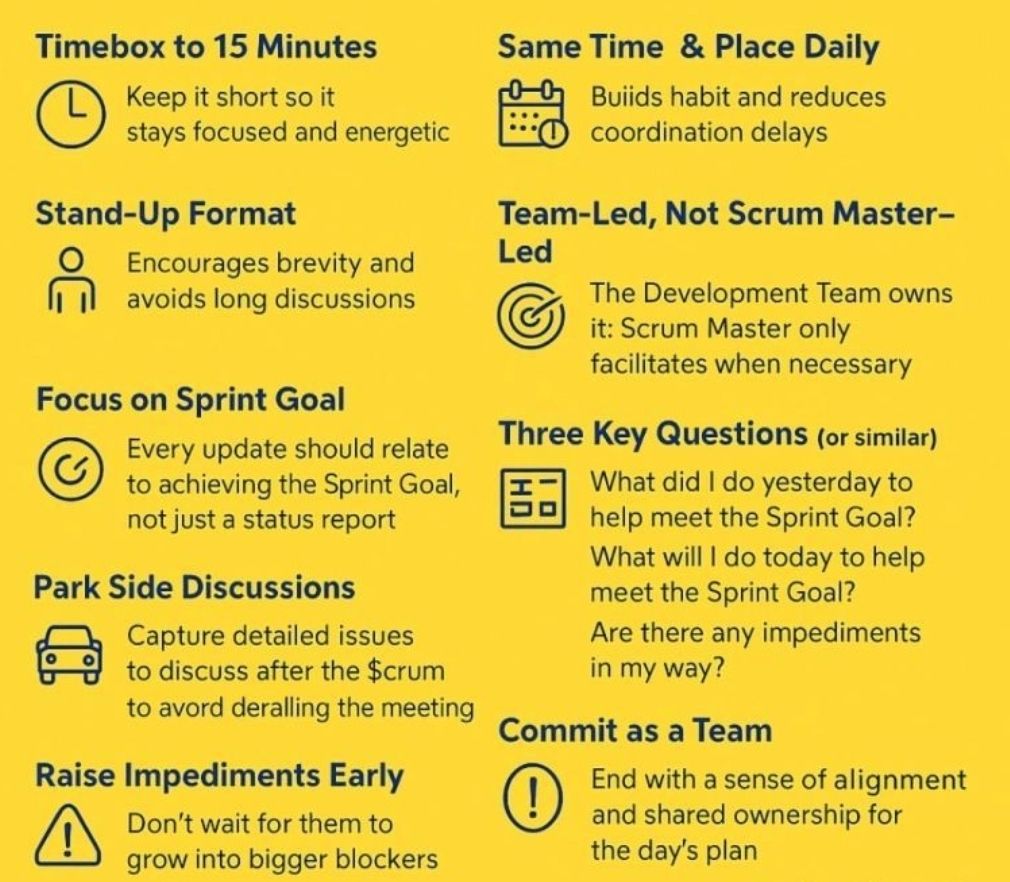
Daily Scrum: Developers inspect progress toward the Sprint Goal and adapt their immediate daily plan.
Sprint Review: The team and stakeholders inspect the newly created product increment to adapt the Product Backlog for future value.
Sprint Retrospective: The team inspects their internal dynamics, tools, and processes to adapt how they operate in the next Sprint.
The Critical Role of Trust
Empiricism fails without a baseline culture of trust and psychological safety. For transparency to occur, team members must possess the courage to share bad news and highlight product deficiencies early. When individuals fear blame, they hide reality—rendering subsequent inspection flawed and any adaptation completely wasteful.