

Project Management Office
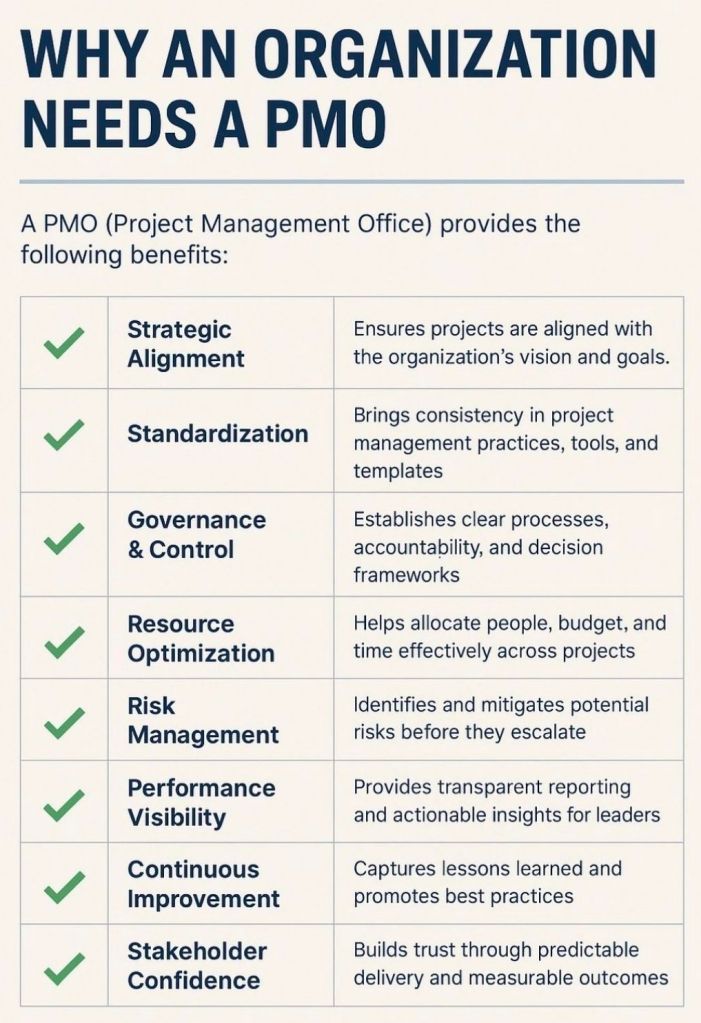
An organisation needs a Project Management Office (PMO) to act as the strategic backbone that standardises processes, minimises operational risks, and directly aligns day-to-day project execution with long-term business goals.
Research by the Project Management Institute (PMI) highlights that 80% of high-performing organisations have established PMOs. Furthermore, companies utilizing a PMO deliver initiatives up to 2.5 times faster and waste 38% less budget compared to those operating without one.
1. Strategic Alignment & Portfolio Prioritisation
- Goal connection: PMOs act as a filter, continuously checking that all active projects serve the corporate strategy.
- Value redirection: The office can proactively recommend pausing or canceling redundant projects, redirecting resources to high-value initiatives.
- Intake governance: They design a structured framework for project intake to stop random, impulsive investments.
2. Standardisation & Quality Assurance
- Unified framework: PMOs replace chaotic “every-team-for-itself” habits with shared templates, common metrics, and standard delivery methodologies.
- Repetitive economy: Creating consistent guidelines allows multi-project execution to become a predictable machine, reducing human error.
- Performance baselines: Standardised metrics give leadership an objective rubric to compare project health across entirely different business units.
3. Resource Optimisation
- Bottleneck reduction: Centralised control prevents staff from being unsustainably double-booked across competing silo projects.
- Capacity visibility: Real-time capacity mapping lets the executive suite understand exactly who is available before approving future workloads.
- Skills leverage: PMOs actively track internal talents, allowing organisations to pivot specialized professionals to high-priority issues quickly.
4. Data-Driven Governance & Risk Management
- Executive transparency: PMOs deliver aggregated status dashboards (like “Stop Light” reporting) to keep stakeholders clearly informed without digging through minor details.
- Early risk mitigation: Using institutional tools like RAID logs, they catch budget variances and deadline slips before they cascade out of control.
- Compliance protection: They ensure strict adherence to industry regulations, corporate ethics, and legal benchmarks to safeguard the firm from penalties.
5. Knowledge Management & Continuity
- Lessons learned: The PMO retains historical metrics, helping project teams build realistic, accurate cost and timeframe estimates on subsequent iterations.
- Mentorship hubs: They provide ongoing skills coaching and workshops to organically raise the project management maturity level across the company.


