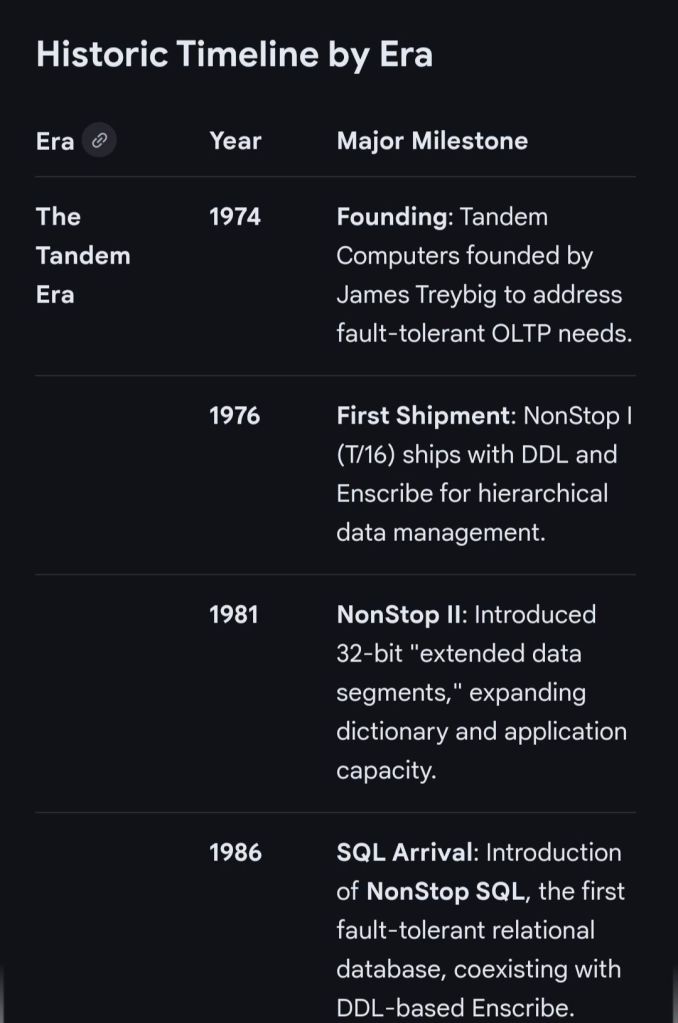
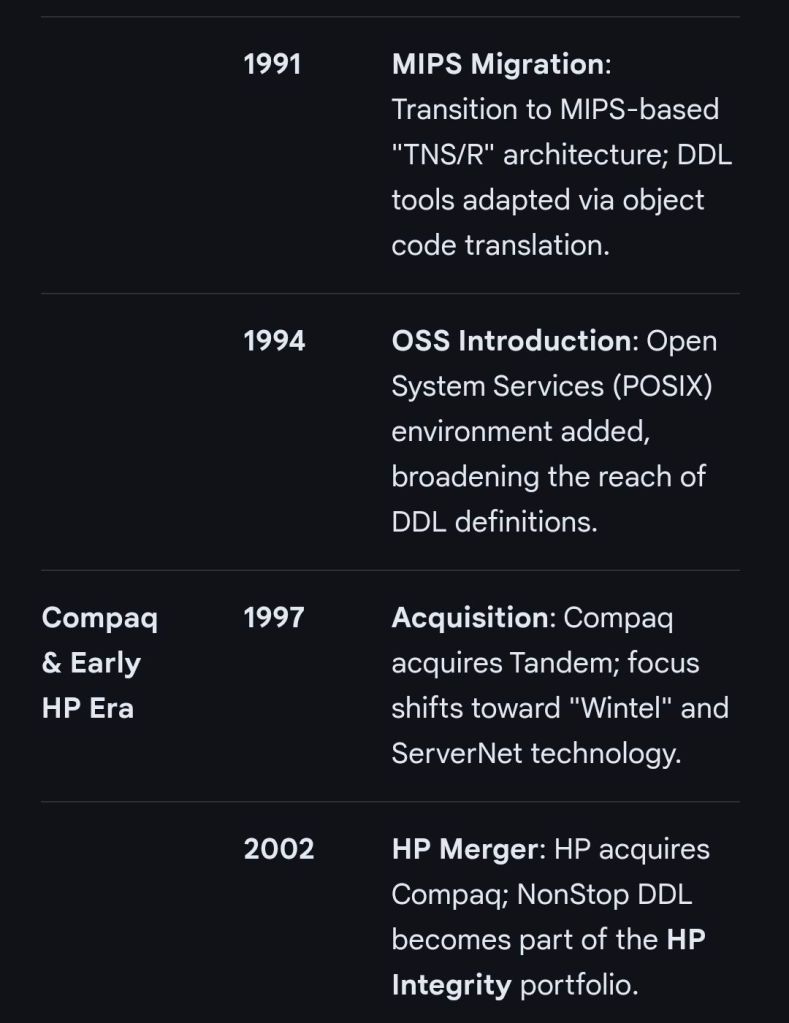
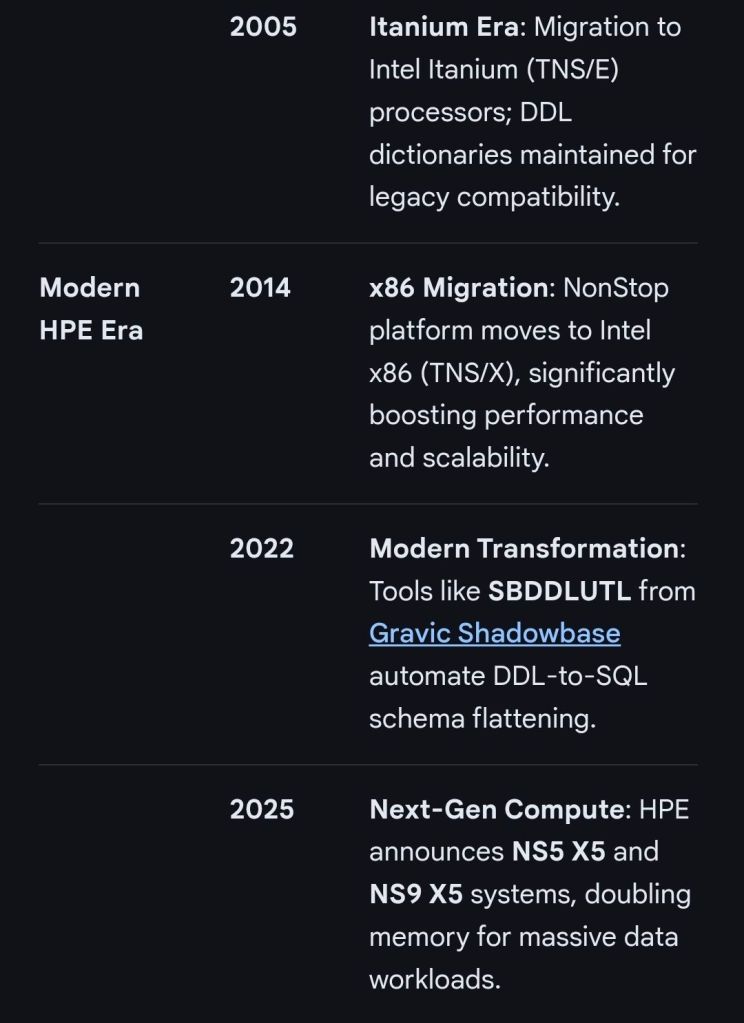
HPE NonStop Data Definition Language (DDL) dictionary overview and timeline

The HPE NonStop Data Definition Language (DDL) dictionary is a specialized subsystem used to define and manage data objects for Enscribe files and translate those definitions into source code for various programming languages. It serves as a central repository for metadata, ensuring consistent data structures across applications written in C, COBOL, TAL, or TACL. 

Program Summary

The DDL dictionary program functions as a metadata management tool. Key capabilities include: 

  • Centralised Definition: Defines records, fields, and file attributes in a hierarchical structure.
  • Code Generation: Translates DDL definitions into language-specific source code (e.g., COBOL copybooks or C headers).
  • Dictionary Maintenance: Allows users to create, examine, and update dictionaries to reflect changes in data structures.
  • Interoperability: Modern tools like Ddl2Bean convert dictionary files into Java Beans or XML, enabling cross-language and cross-platform use. 

Future Outlook

The future of HPE NonStop DDL focuses on modernisation and integration rather than replacement. 

  • Data Virtualization: Integration with AI factories and object storage platforms to expose legacy metadata in open-table formats like Apache Iceberg.
  • API Centricity: Enhancements to the NonStop API Gateway will likely use DDL metadata to automate REST/JSON service orchestration.
  • Real-time Analytics: Native streaming of NonStop data into platforms like Kafka, using DDL definitions to map real-time changes into analytics-ready formats. 

Internet Links & Manuals

HPE NonStop Data Definition Language (DDL) dictionary overview and timeline

HPE NonStop Spoolcom subsystem Spooler Command Language program Overview and Timeline

The HPE NonStop Spoolcom (Spooler Command Language) program is the administrative interface for managing the Spooler subsystem on HPE NonStop systems. It allows operators to configure, monitor, and control print jobs, collectors, and print processes. 

Program Summary

  • Purpose: Used to define and manage spooler objects such as collectors, devices, and jobs.
  • Key Functions: Starting/stopping the spooler, modifying device attributes, and controlling job states (e.g., hold, release, delete).
  • Architecture: Operates within the Guardian environment, communicating with the Spooler supervisor process to maintain 24/7 fault-tolerant printing operations. 

Historical Timeline by Era

1. The Tandem Era (1974–1997) 

  • 1976: Introduction of the Tandem NonStop system; basic spooling capabilities were essential for early OLTP (Online Transaction Processing).
  • 1980s: The Spooler evolved to handle complex routing and multiple collectors to support growing enterprise needs.
  • 1997: Spooler D41 released, providing stable management for the MIPS-based architecture. 

2. The Compaq & Early HP Era (1997–2014)

  • 1999–2000: Release of Spooler D46, enhancing device ownership and virtual device support.
  • 2001–2002: Spooler D48 released during the transition to the HP Integrity NonStop (Itanium) platform.
  • 2012: Major updates to Spooler D48 to support H01 and H02 RVUs, improving scalability for high-end systems. 

3. The Modern HPE Era (2014–Present)

  • 2014: NonStop X (x86-64) introduced. Spoolcom adapted to support the new architecture and virtualised environments.
  • 2018–2020: Focus shifted toward modernised interfaces. While Spoolcom remains the CLI standard, graphical alternatives like MultiBatch began gaining traction for batch management.
  • 2023–2024: Continued integration with HPE GreenLake and hybrid cloud models, ensuring spooling services are available in private cloud deployments. 

Futures and Roadmap

  • Modernisation: HPE is pushing toward “modernisation through tradition,” which includes better integration of legacy tools like Spoolcom with modern DevSecOps and cloud-native frameworks.
  • Kernel-Level Threading (KLT): Future updates aim to leverage KLT to improve the performance and scale-up capabilities of management processes.
  • Data-Centric Security: Integration with security platforms like TAMUNIO for field-level tokenization ensures that printed data remains compliant with PCI DSS 4.0 and GDPR. 

Useful Resources

HPE NonStop Spoolcom subsystem Spooler Command Language program – Overview and Timeline

Jackson Structured Programming JSP is a program design methodology, overview and timeline

Jackson Structured Programming (JSP) is a program design methodology developed by British software consultant Michael A. Jackson in the 1970s. It focuses on mapping the structure of a problem—specifically its data structures—directly onto the structure of the program used to solve it. 

Overview of Jackson Structured Programming

JSP is designed to create programs that are easy to maintain and modify because the program’s control structure naturally handles the input and output data structures. 

  • Core Principle: Requirement changes are typically minor tweaks to existing data structures. By aligning program structure with data structure, small changes to inputs or outputs translate into small, manageable changes in the code.
  • Methodology: The technique involves analyzing the structure of input files and output files, constructing diagrammatic representations of these, and then creating a program structure that handles both.
  • Key Constructs: JSP utilizes three basic structures for both data and programs, which can be visualized as a form of regular expression:
    • Sequence: A series of operations performed in order.
    • Iteration: The repetition of operations until a specific condition is met.
    • Selection: Choosing between different operations based on a condition.
  • Diagrams: JSP uses structure diagrams rather than flowcharts to represent the design, breaking down complex tasks into smaller, simpler parts. 
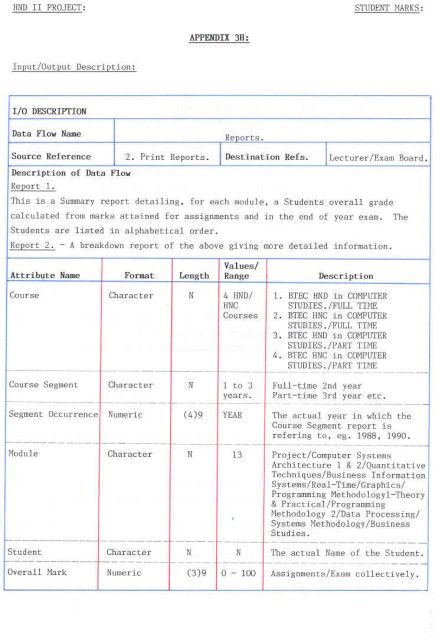
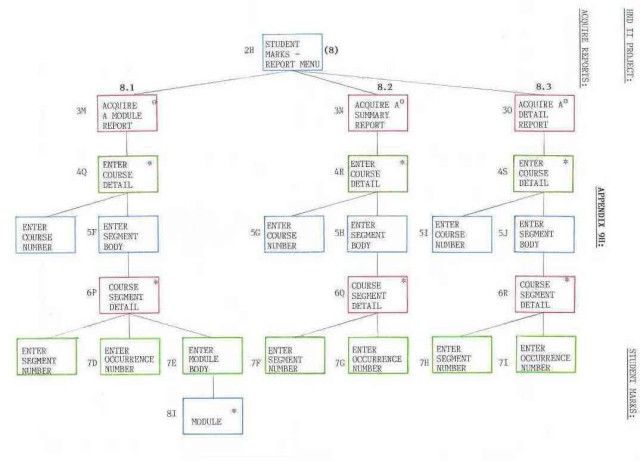
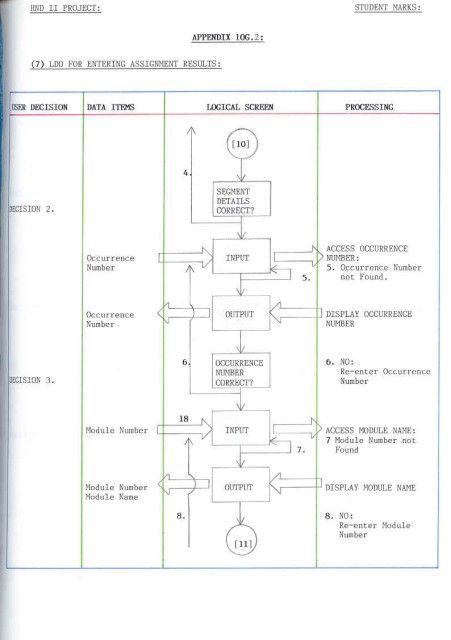
Excerpts from my HND project which made use of Jackson Structured Programming (JSP) as part of the program design phase

Detailed Historical Timeline

Early Years (1960s–1974): Conceptualization and Founding

  • 1960s: Michael A. Jackson works in data processing, encountering limitations in program reliability and seeking more systematic approaches to software design.
  • 1968: Jackson contributes to the early modular programming movement, collaborating with other pioneers.
  • 1970: Jackson leaves John Hoskyns & Company to found Michael Jackson Systems Limited, aimed at fully developing a new design methodology.
  • 1971: JSP becomes the core product of Michael Jackson Systems Limited, offering consultancy and training services.
  • 1974: The name “Jackson Structured Programming” is coined by a Swedish licensee of the company.

Established Method (1975–1979): Documentation and Adoption

  • 1975: Jackson publishes “Principles of Program Design,” the definitive text documenting JSP.
  • 1975: Michael Jackson Systems Ltd. begins offering software tools to support JSP design for COBOL programs.
  • 1977: JSP is widely recognized and adopted in Europe, the US, and Asia.
  • Late 1970s: The UK government adopts JSP (under the name “SDM” – System Development Methodology) as its standard program design method.
  • Late 1970s: The World Health Organization adopts JSP as a standard for program specification. 

Evolution into System Design (1980s): JSD

  • Early 1980s: Building on the principles of JSP, Jackson develops Jackson System Development (JSD) to address the design of entire information systems, not just individual programs.
  • 1983: Jackson publishes “System Development,” formally introducing JSD.
  • 1983-1989: JSD continues to evolve, with new features introduced in subsequent publications and manuals. 

Maturity and Retrospective (1990s–Present)

  • 1990s: Jackson develops the Problem Frames Approach, his third major methodology focusing on requirements analysis.
  • 1997: Jackson receives the Stevens Award for Software Development Methods.
  • 1998: Jackson receives the British Computer Society Lovelace Medal.
  • 2001: At a conference, Jackson provides a retrospective analysis of JSP’s driving forces and its relevance to modern software engineering.
  • Present: While overshadowed by object-oriented and agile methods, JSP principles remain useful for programming “in the small” and handling specific batch processing or embedded software tasks.

Jackson Structured Programming JSP is a program design methodology, overview and timeline

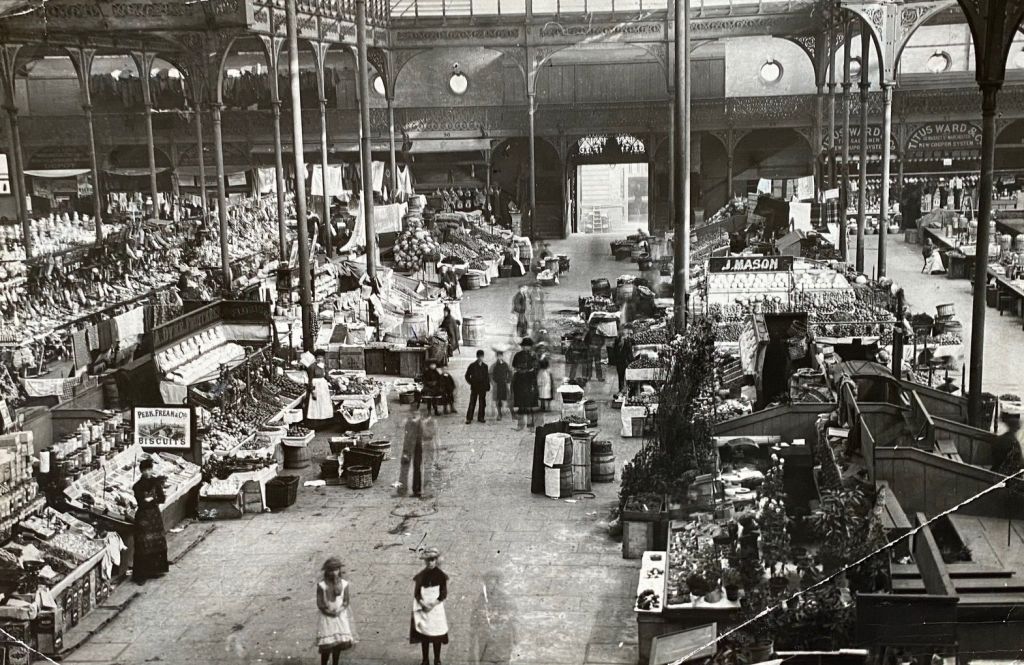
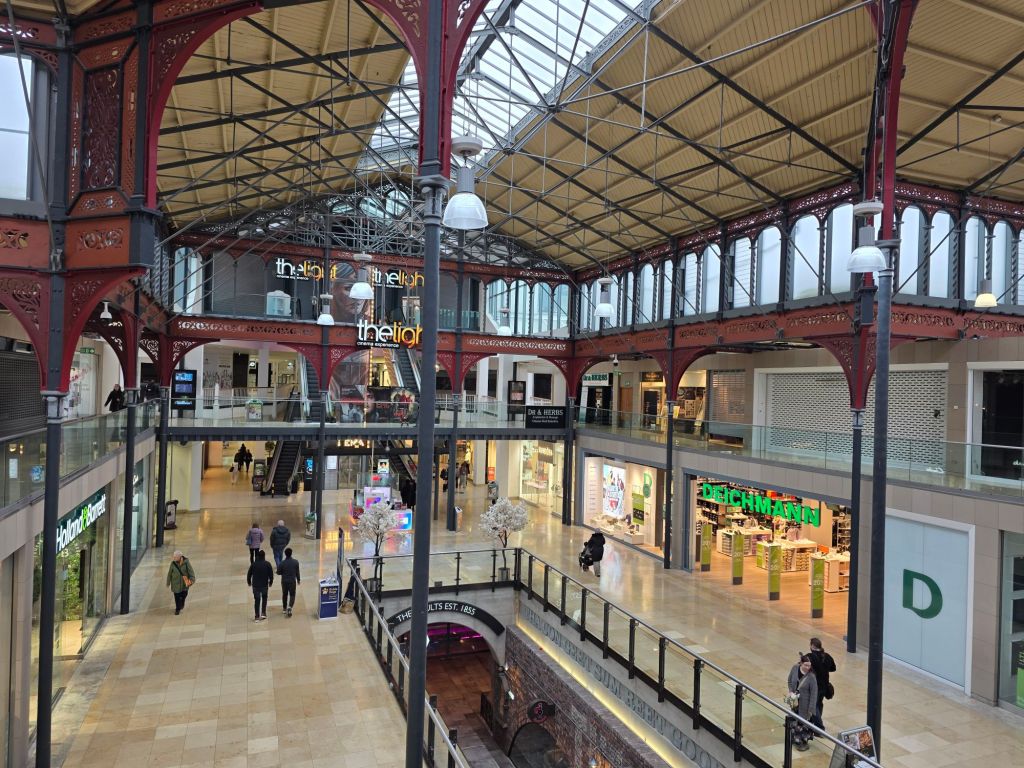
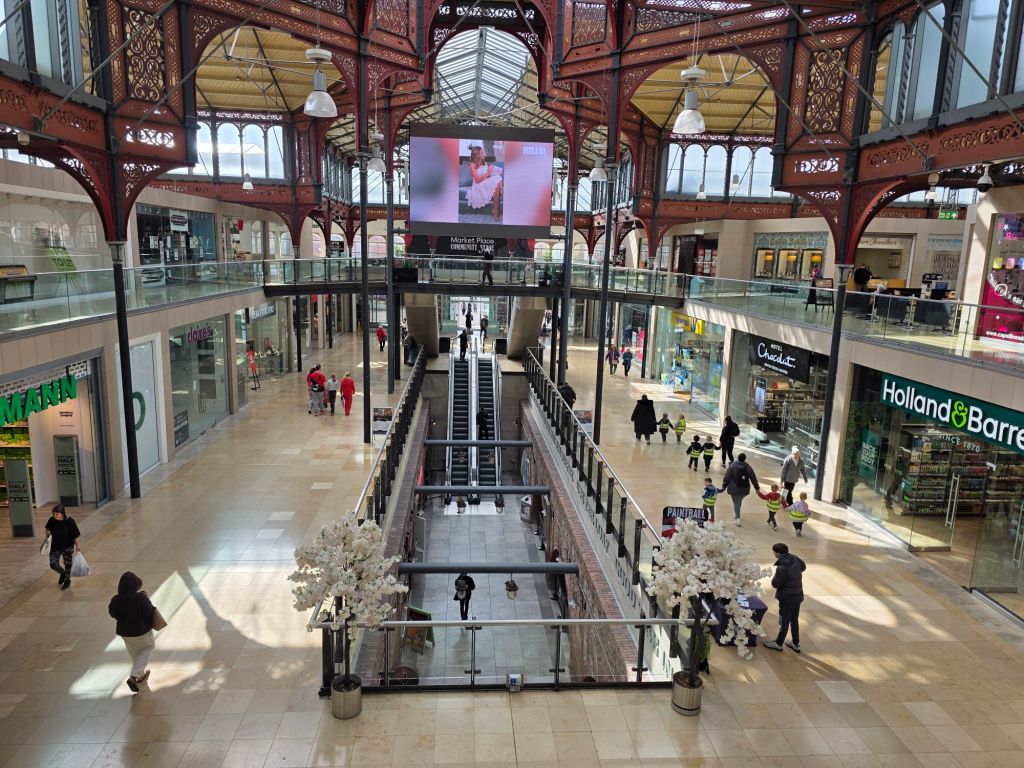
Bolton Market Place – About and Timeline History with Images

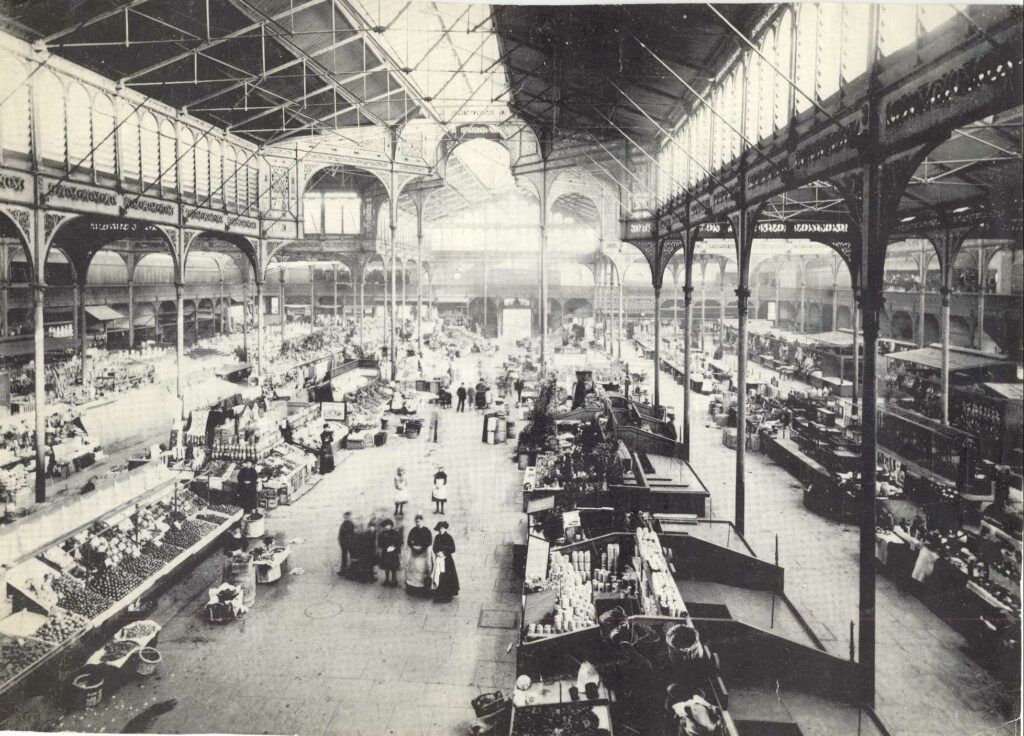
Bolton Market Place is a major retail and leisure destination in Bolton town centre, primarily housed within the Grade II listed Victorian Market Hall. Originally opened in 1855, it was once celebrated as the “largest covered market in the kingdom” and serves as a historical anchor for the town’s commercial heart. 

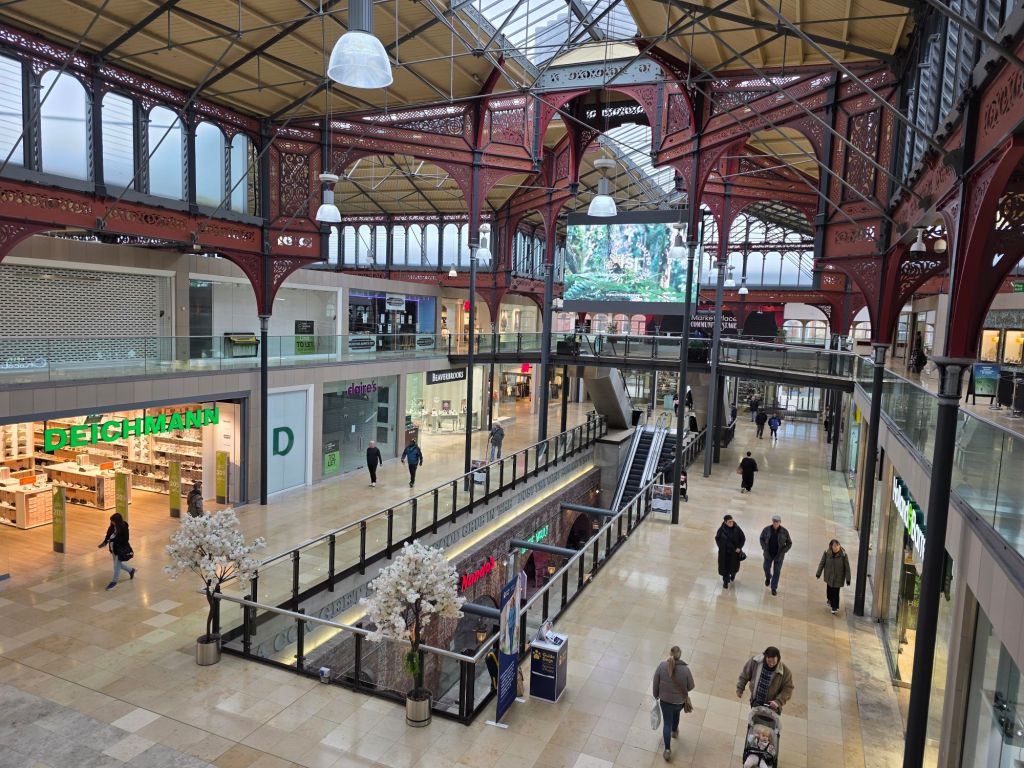
Market Place Bolton is a Grade II listed shopping and leisure destination located in the heart of Bolton town centre. Originally opened in 1855 as a covered market hall, it was once considered the largest in the kingdom. Today, it combines historic Victorian architecture—including its famous restored ironwork and glass roof—with modern retail and entertainment facilities. 

Shopping & Major Retailers

The centre spans two floors of retail space and features a mix of high-street giants and independent boutiques. 

  • Key Retailers: Primark (new 40,000 sq ft store opened Dec 2024), Next, H&M, New Look, JD Sports, River Island, and Footasylum.
  • Specialty Stores: Pandora, Hotel Chocolat, The Body Shop, and The Entertainer.
  • Recent Additions: The Works (opened 2024) and Carrs Pasties (opened 2026). 

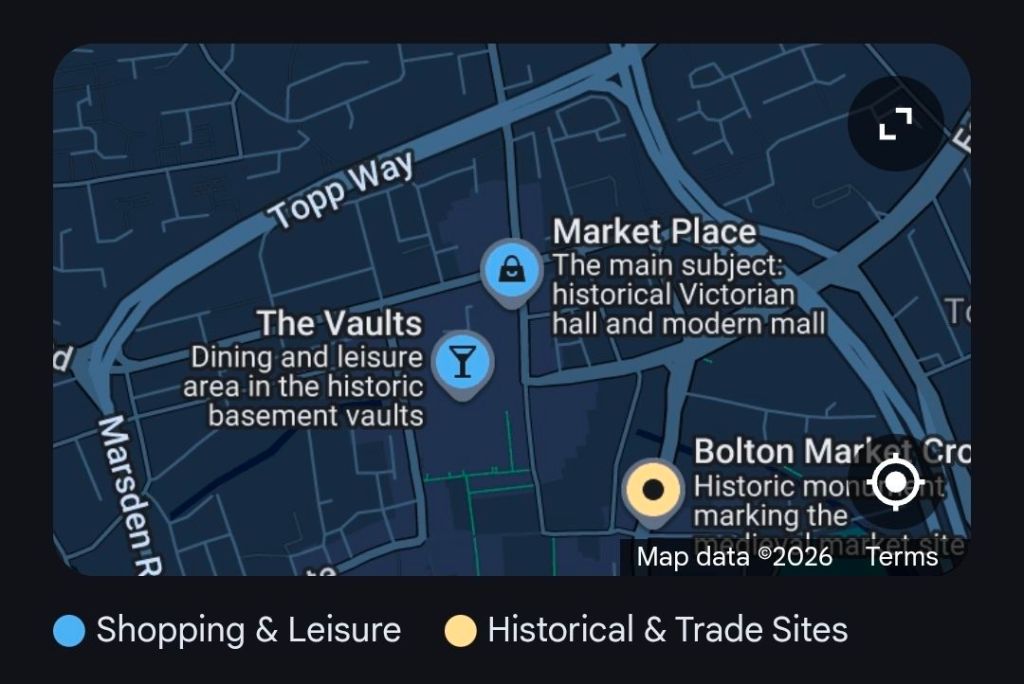
Dining: The Vaults

The lower ground floor houses The Vaults, a converted Victorian basement that retains original stonework and atmospheric archways. 

  • Restaurants: Popular chains such as Nando’s and Prezzo, alongside various bars and cafes.
  • Food Court: A vibrant hub for socialising with a range of global cuisines. 

Leisure & Entertainment

Market Place has pivoted toward being a “leisure-first” destination to combat declining retail trends. 

  • The Light Cinema: A luxury 9-screen multiplex cinema located on the top floor.
  • Family Activities: Includes Amazonia (kids’ play area with adventure golf and a train), an escape room, and an indoor crazy golf course.
  • Events: The centre regularly hosts free events, such as art exhibitions and “Little Rascals” kids’ club activities. 

Visitor Information

  • Parking: On-site multi-storey car park with over 500 spaces. Offers competitive rates, often including incentives like one hour free.
  • Accessibility: Fully accessible for disabled visitors, with dedicated parking and a free wheelchair service available from the Customer Service desk.
  • Location: Knowsley Street, Bolton, BL1 2AL. It is roughly a 10-minute walk from the main bus and train stations. 

Historical Timeline of Bolton Market Place

The Victorian Era: Foundation & Grandeur

  • 1251: Bolton is granted a Royal Charter to hold a market, originally held on Mondays in the Churchgate area.
  • 1482: The Market Cross is first established at the entrance to Churchgate as a landmark for trade.
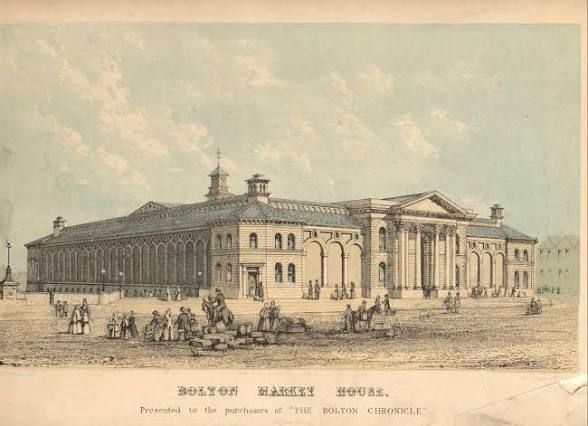
  • 1855: The Bolton Market Hall officially opens on 19 December. Designed by architect G. T. Robinson, it cost £50,000 and featured a massive cast-iron and glass roof.
  • 1865: A dedicated Fish Market is added next to the main hall at a cost of £30,000, further establishing Bolton as a major trading hub in the North.
  • 1894: The hall undergoes its first major modifications, including the addition of exterior shops on Knowsley Street and Corporation Street. 

Early to Mid-20th Century: Adaptation

  • 1909: The current version of the Market Cross is commissioned with bronze plaques detailing the town’s history.
  • 1932: The Victorian fish market is demolished as trade shifts toward the new Ashburner Street market.
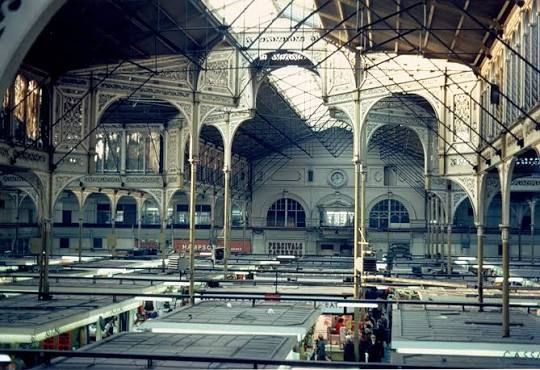
  • 1938: The interior layout is modernised, replacing long rows of stalls with roofed islands to better manage foot traffic. 

Late 20th Century: The Shopping Centre Era 

  • 1982: A competition to redevelop the site into a modern shopping mall is won by Chapman Taylor Partners.
  • 1988: The refurbished site is reopened by Queen Elizabeth II as the Market Place Shopping Centre on 1 December.
  • 1998: Sunday trading is briefly suspended in the Market Hall due to low trader turnout. 

21st Century: Modernisation & Leisure 

  • 2004: Controversial plans to move traditional market stallholders out of the hall spark a petition with over 80,000 names.
  • 2007: After 151 years of traditional trading, the last 50 stallholders move out to allow for a full retail conversion.
  • 2008: The modernised Market Place, featuring units “slotted” into the historic listed structure, officially opens in October.
  • 2013: The centre is acquired by Moorgarth, who announce a £15 million investment plan.
  • 2016–2017: The development of The Vaults (dining/leisure in the basement) and a new 9-screen cinema on the roof is completed.
  • 2025: The centre continues to evolve with ongoing development plans to further enhance its position as a leading regional destination. 

Images through the years :

Last 3 images taken by Mark Whitfield (website author) in early 2026

Bolton Market Place – About and Timeline History with Images

PASCAL Programming Language Overview, Timeline and Technical Insight

Pascal is a historically significant imperative and procedural programming language designed by Niklaus Wirth between 1968 and 1969. It was created to encourage structured programming and efficient data structuring, serving as a clean, disciplined alternative to more complex languages of the time like ALGOL 60 and FORTRAN. 

Key Features and Overview

  • Strong Typing: Every variable must have a defined type (e.g., Integer, Real, Boolean, Char), and the compiler strictly enforces these to prevent errors during execution.
  • Rich Data Structures: Pascal introduced built-in support for complex types including records, sets, enumerations, subranges, and pointers.
  • Structured Control: It uses clear, English-like keywords such as begin, end, if-then-else, and while to organize program logic into manageable blocks.
  • Educational Focus: Originally intended as a teaching tool, it became the global standard for introductory computer science courses for nearly two decades. 

Historical Timeline of Pascal

The Foundation Era (1960s)

  • 1964–1966: Niklaus Wirth joins the IFIP Working Group to design a successor to ALGOL 60. His “pragmatic” proposal is rejected in favour of the more complex ALGOL 68.
  • 1966: Wirth implements his proposal at Stanford as ALGOL W, which introduces many concepts later found in Pascal.
  • 1968: Wirth begins designing a new language at ETH Zurich, naming it Pascal after the 17th-century mathematician Blaise Pascal. 

The Emergence Era (1970–1979)

  • 1970: The first Pascal compiler becomes operational on the CDC 6000 mainframe, and the official language definition is published.
  • 1971: Formal announcement of Pascal appears in Communications of the ACM.
  • 1972: The first successful port to another system (ICL 1900) is completed by Welsh and Quinn.
  • 1973: The Pascal-P kit (P-code) is released, providing a portable intermediate code that allows Pascal to be easily ported to different hardware.
  • 1975: The UCSD Pascal system is developed at the University of California, San Diego, eventually bringing the language to microcomputers like the Apple II.
  • 1979: Apple releases Apple Pascal, licensing the UCSD p-System for its platforms. 

The Dominance Era (1980–1989)

  • 1983: ISO 7185:1983 is published, establishing the first international standard for Pascal.
  • 1983: Borland International releases Turbo Pascal 1.0. Priced at $49.95, its extreme speed and integrated environment revolutionize PC programming.
  • 1984: The Educational Testing Service (ETS) adopts Pascal as the official language for the AP Computer Science exam in the U.S..
  • 1985: Apple introduces Object Pascal on the Macintosh to support object-oriented programming.
  • 1989: Borland adds object-oriented features to Turbo Pascal 5.5, adopting the Apple Object Pascal extensions. 

The Transition and Legacy Era (1990–Present)

  • 1990: The Extended Pascal standard (ISO/IEC 10206) is released, adding modularity and separate compilation.
  • 1995: Borland releases Delphi, a Rapid Application Development (RAD) tool based on Object Pascal, designed for the Windows graphical interface.
  • 1997: The open-source Free Pascal compiler (originally FPK Pascal) emerges to provide a cross-platform alternative to commercial tools.
  • 1999: Pascal is replaced by C++ as the official language for the AP Computer Science exam, marking the end of its educational dominance.
  • Present: Pascal remains active through projects like Lazarus (an open-source IDE for Free Pascal) and continued updates to Embarcadero Delphi for Windows, macOS, Android, and iOS development. 

Pascal is a historically significant, high-level, and statically typed programming language designed in the late 1960s by Niklaus Wirth. Its primary technical goal was to encourage structured programming—a disciplined approach that uses clear, logical sequences and data structuring to make code more readable and reliable. 

Technical Insights

The technical architecture of Pascal is built on a few core pillars that distinguish it from its contemporaries like C or FORTRAN: 

  • Strong Typing: Unlike many early languages, Pascal is strongly typed, meaning data types cannot be mixed or converted without explicit instruction. This reduces runtime errors by catching type mismatches during compilation.
  • Block-Structured Design: Programs are organized into clear blocks (using BEGIN and END), including nested procedures and functions. This hierarchical structure allows for precise control over variable scope.
  • Unique Data Structures: Pascal introduced native support for sets (representing mathematical sets as bit vectors) and variant records, which allow different fields to overlap in memory to save space.
  • One-Pass Compilation: The strict ordering of declarations (constants, then types, then variables, then procedures) was originally designed to allow the compiler to process the entire program in a single pass. 

General Programming Approach

Pascal enforces a “think before you code” philosophy through its rigid syntax and organizational requirements: 

  1. Top-Down Design: The language encourages breaking complex problems into smaller, manageable sub-tasks (procedures and functions).
  2. Explicit Declarations: Every variable must be declared in a specific VAR section before the executable code begins. This prevents the “spaghetti code” common in earlier languages.
  3. Algorithmic Focus: Because the syntax is so close to pseudo-code, the approach focuses heavily on the logic of the algorithm rather than language-specific “tricks”.
  4. Parameter Passing Control: Developers have explicit control over how data moves; using the VAR keyword allows passing by reference (modifying the original variable), while omitting it passes by value (working on a copy). 

Modern Relevance

While its peak in education was the 1980s and 90s, Pascal evolved into Object Pascal, which powers modern tools: 

  • Delphi: A popular IDE by Embarcadero Technologies used for rapid application development (RAD) on Windows, macOS, and mobile.
  • Free Pascal (FPC) & Lazarus: Open-source alternatives that bring modern features like generics and anonymous methods to the language. 

BASE24 by ACI Worldwide timeline by era and year

BASE24 is the world’s most widely used payment processing platform, developed by ACI Worldwide. Originally designed for ATM networks, it evolved into a comprehensive system for acquiring, authenticating, and routing card-based and digital transactions across various channels. It is known for its high-performance, fault-tolerant architecture, processing nearly 50% of the world’s electronic transactions at its peak. 

Comprehensive Timeline by Era

Era 1: Foundations & The Rise of BASE24 Classic (1975–1990s)

This era focused on high-availability software for the emerging automated banking industry, specifically for Tandem NonStop servers. 

  • 1975: ACI founded in Omaha, Nebraska, to develop software for the new “NonStop” server computers used by banks and stock exchanges.
  • 1981: Secured its first international client, an Australian bank, marking the start of global expansion.
  • 1982: Launch of BASE24, the first global product designed for 24-hour system operations, originally focused on ATM networks.
  • 1986: Rapid growth led to 131 customers across 14 different countries. 

Era 2: Expansion & Public Transition (1995–2000s) 

The platform expanded into Point of Sale (POS) and branch systems while the company underwent major structural changes. 

  • 1995: The company went public on NASDAQ as Transaction Systems Architects (TSA).
  • 1997: Officially adopted the name ACI Worldwide.
  • Early 2000s: Introduction of BASE24-es (later renamed BASE24-eps), a next-generation platform using C++ and object-based architecture to replace the legacy monolithic design. 

Era 3: Modernisation & The “eps” Shift (2005–2015)

ACI shifted focus toward BASE24-eps, a more flexible, open-architecture version designed for multi-channel transaction processing. 

  • 2005: ACI launches BASE24-eps, featuring a modular engine capable of processing approximately 2,000 transactions per second (TPS) with extremely low latency.
  • 2007: TSA officially rebranded all operations under the ACI Worldwide, Inc. (ACIW) name.
  • 2008: Announced that BASE24 Classic would begin maturing in 2011, urging customers to migrate to the eps platform for better integration with modern systems like IBM System z.
  • 2011–2012: Release of BASE24-eps 11.1, adding support for DB2 on IBM System p, enhanced EMV acquiring, and tools for easier migration from legacy BASE24. 

Era 4: Cloud & Universal Payments (2015–Present)

The platform moved toward cloud-native capabilities and broader ecosystem integration. 

  • 2015: ACI celebrated its 40th anniversary, continuing to power electronic payments for over 6,000 organisations worldwide.
  • 2018: Introduction of UP BASE24-eps on Linux in the Cloud, demonstrating significantly reduced Total Cost of Ownership (TCO) through public and private cloud deployment.
  • Present: BASE24 remains a core pillar of ACI’s portfolio, supporting traditional card, ATM, mobile commerce, and internet banking transactions.

BASE24-eps by ACI Worldwide timeline by era and year

BASE24-eps is a modular, high-availability payment processing engine developed by ACI Worldwide. It evolved from the original “BASE24 Classic” to provide a more flexible, open-system architecture for acquiring, authenticating, routing, and authorizing electronic transactions. 

Base24-eps Overview

  • Architecture: Unlike the TAL-based Classic version, BASE24-eps uses an object-oriented design written primarily in C++ and Java.
  • Key Features:

Detailed Timeline

The Foundation Era (1970s – 1990s)

  • 1975: ACI is founded in Omaha, Nebraska, initially developing software for NonStop server computers.
  • Late 1970s: Development of the original BASE24 (now known as “Classic”), focused on high-uptime ATM processing.
  • 1981: First international customer (an Australian bank) signs on, starting the global expansion of BASE24. 

Transition & Development Era (2000 – 2005)

  • Early 2000s: ACI begins developing the “next generation” platform, initially called BASE24-es (extended systems), which later becomes BASE24-eps (enterprise payment system).
  • 2003 – 2004: The product begins migrating to open architectures, moving away from platform-specific languages. 

Mainstream Adoption Era (2006 – 2013)

  • 2007: ACI highlights BASE24-eps as its strategic future platform in investor overviews.
  • 2008: ACI announces the maturation of BASE24 Classic (ending standard maintenance in 2011), urging customers to migrate to BASE24-eps.
  • 2009: IBM Redbooks releases technical guides for BASE24-eps 08.2 on z/OS, solidifying its place in enterprise banking.
  • 2013: Release of BASE24-eps 2.0, introducing the “customer component” and enhanced service-enabling wrappers. 

Modernization & Cloud Era (2014 – Present)

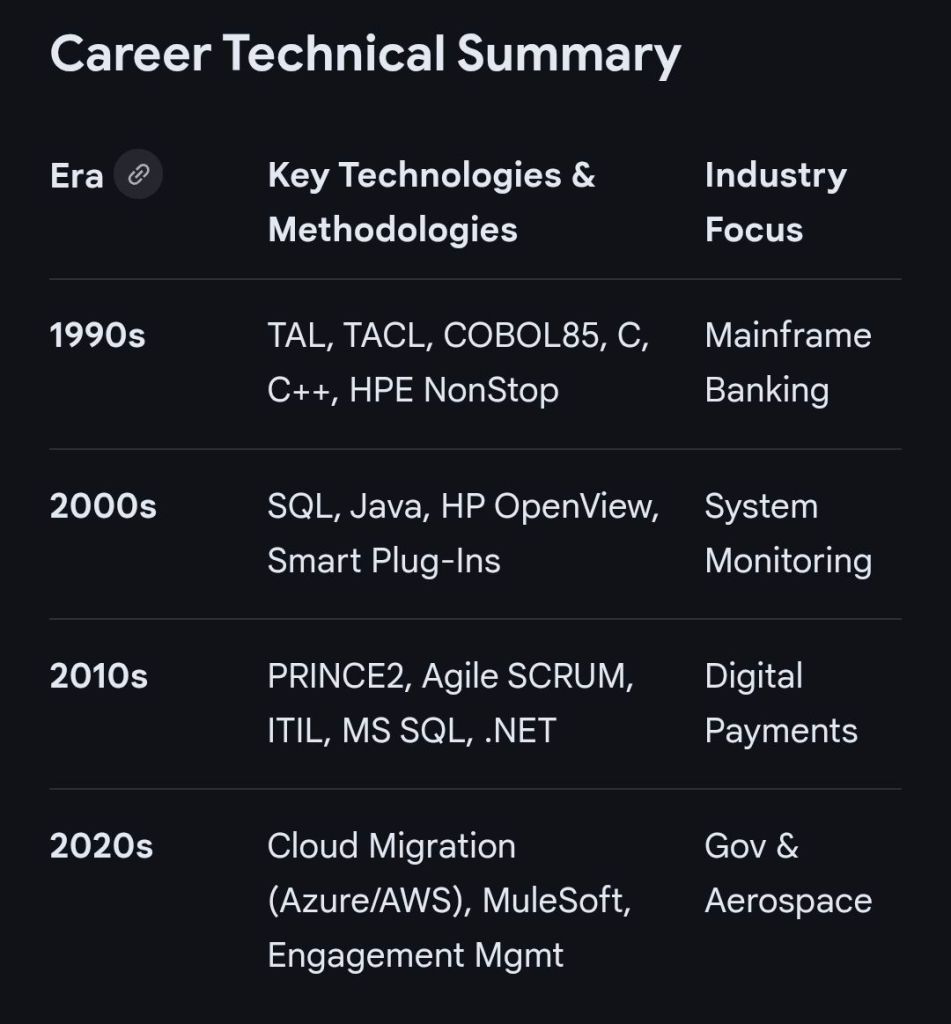
Website Author IT Career Timeline Breakdown

Mark Whitfield is a highly experienced IT professional with a career spanning over 30 years, transitioning from a technical programmer to a senior digital engagement and project manager. His expertise is rooted in HPE NonStop (Tandem) systems and has evolved to encompass complex Agile and Cloud delivery across diverse industries. 

Early Technical Era (1990–1995)

Following his graduation in Computing in 1990, Whitfield began his career as a Programmer at The Software Partnership (later Deluxe Data). 

  • Focus: Electronic banking software, specifically sp/ARCHITECT-BANK on Tandem Mainframe Computers.
  • Key Work: Developed code for major banks including TSB, Barclays, and Rabobank. This included early digital innovations like voice-driven phone banking and inter-account transfers before the internet was widespread. 

Growth and Product Management Era (1995–2004) 

Whitfield joined Insider Technologies Limited (ITL) in 1995 as a Senior Programmer. 

  • Focus: Platform health and diagnostic software for HPE NonStop systems.
  • Key Projects:
    • Co-developed diagnostic plug-ins for the Reflex monitoring suite.
    • Managed the first HP OpenView Operations (OVO) Smart Plug-In certification for the NonStop platform in 2002.
    • Consulted for CRESTCo (Euroclear) in 1997, conducting benchmark testing on new S7000 nodes. 

Strategic Leadership and Project Management Era (2005–2014) 

During this decade, he transitioned into IT Project Management, focusing on high-value financial transaction tracking. 

  • Focus: Waterfall and Agile project delivery for payment systems and banking infrastructure.
  • Key Milestones:
    • 2011: Led a massive transaction tracking project at Al Rajhi Bank (Saudi Arabia), parsing terabytes of tape-archived data into a normalised SQL database.
    • 2013–2014: At Wincor Nixdorf, managed a £5+ million project for Lloyds Banking Group to migrate ATM driving responsibilities from legacy systems to AIX-based Oracle technologies. 

Senior Digital Engagement Era (2014–Present)

Since 2014, Whitfield has focused on senior-level digital transformation and engagement management. 

  • Betfred (2014–2016): Served as Senior Digital Project Manager for online and mobile platforms (iOS/Android), managing fraud detection and payment gateway integrations.
  • Capgemini (2016–Present): Joined as an Engagement Manager (SC cleared).
    • Focus: Managing large-scale Agile and Waterfall digital projects across aerospace, defence, and government sectors.
    • Notable Projects: Leading a £13.5m programme to migrate 130 UK government applications to the cloud (AWS/Azure) and delivering real-time airspace monitoring apps for air traffic organisations. 
Mark Whitfield IT Career Timeline Breakdown

HP NonStop Tandem Overview and Timeline History by year

HP NonStop is a series of fault-tolerant server computers designed for online transaction processing (OLTP) and mission-critical applications that require 100% uptime. Originally introduced by Tandem Computers Inc. in 1976, the platform uses a proprietary, integrated hardware and software stack known as NonStop OS (formerly Guardian) to eliminate single points of failure through massive redundancy and “fail-fast” logic. 

Historical Timeline by Era

1. The Tandem Founding Era (1974–1981) 

  • 1974: Tandem Computers Inc. is founded by James (Jimmy) Treybig and a team from Hewlett-Packard’s HP 3000 division.
  • 1976: The first system, the Tandem/16 (later NonStop I), is shipped to Citibank.
  • 1977: Tandem systems gain early traction as intelligent front-end processors for bank ATM networks. 

2. The Stack Machine Expansion (1981–1990) 

  • 1981: NonStop II is introduced, adding 32-bit addressing capabilities and replacing magnetic core memory with battery-backed DRAM.
  • 1983: NonStop TXP (Transaction Processing) launches as the first new implementation of the architecture, featuring cache memory and 2.0 MIPS performance.
  • 1986: Introduction of NonStop VLX (Very Large eXpansion) and NonStop SQL, the first fault-tolerant relational database designed for linear scalability.
  • 1987: NonStop CLX launches as a lower-cost, compact minicomputer for remote office environments.
  • 1989: NonStop Cyclone is released for high-end mainframe markets, featuring superscalar CPUs and fiber optic interconnects. 

3. The MIPS RISC Transition & Acquisitions (1991–2003)

  • 1991: Cyclone/R (or CLX/R) marks the move to MIPS R3000 RISC processors, using object code translation to maintain backward compatibility.
  • 1993: Himalaya K-series is released using MIPS R4400 processors.
  • 1995: Open System Services (OSS) is added to the NonStop Kernel to provide a POSIX/Unix-like environment.
  • 1997: Compaq acquires Tandem Computers. The Himalaya S-Series introduces ServerNet, which later becomes the InfiniBand industry standard.
  • 2002/2003: HP merges with Compaq, bringing the NonStop line under Hewlett-Packard. 

4. The HP Integrity & x86 Era (2005–Present)

  • 2005: HP Integrity NonStop (TNS/E) is introduced, migrating the platform to Intel Itanium microprocessors.
  • 2014: NonStop X (TNS/X) launches, shifting the architecture to Intel x86-64 processors for greater industry-standard alignment.
  • 2015: Following the HP corporate split, NonStop becomes part of Hewlett Packard Enterprise (HPE).
  • 2020: Sales of Itanium-based systems officially end in July 2020.
  • 2024–2025: HPE expands the platform with Virtualized NonStop Software for private clouds and consumption-based models via HPE GreenLake.

HP NonStop Tandem Overview and Timeline History by year

HPE NonStop (formerly Tandem and Compaq NonStop) is a family of fault-tolerant, integrated hardware and software systems designed for mission-critical enterprise workloads. Since its introduction in 1976, it has served as the backbone for high-volume transaction environments like banks, stock exchanges, and payment systems, offering 100% continuous uptime. 

Core Architecture and Features

The platform is defined by its “shared-nothing” architecture, where every component is redundant to eliminate single points of failure. 

  • Continuous Availability: If a hardware or software component fails, a backup takes over immediately without disrupting the application, a process often managed through process pairs (primary and hot backup processes).
  • Linear Scalability: You can add capacity (CPUs, memory) seamlessly without downtime. Systems can scale from a few processors to clusters of over 4,000 CPUs while maintaining a single-system image for management.
  • Integrated Stack: Unlike standard servers, NonStop includes a fully integrated stack of hardware, the NonStop OS (a proprietary kernel), a relational database (NonStop SQL), and middleware.
  • Fail-Fast Design: Modules are self-checking; they stop immediately upon detecting an error to prevent data corruption, allowing the redundant backup to resume processing from the last known good state. 

Current Hardware and Deployment

While historically based on proprietary or Itanium processors, modern NonStop systems (NonStop X) utilize industry-standard Intel Xeon processors and high-speed InfiniBand interconnects. 

  • High-End Systems: Models like the NS9 X5 are built for the most demanding high-volume transaction processing (OLTP).
  • Mid-Range/Entry Systems: Models like the NS5 X5 offer fault tolerance for smaller enterprises or development environments.
  • Virtualization & Cloud: HPE Virtualized NonStop Software allows the platform to run on standard private cloud infrastructure (e.g., VMware, OpenStack), and it is also available via HPE GreenLake as a consumption-based, pay-as-you-go service. 

Software and Security

  • Database: Supports NonStop SQL/MX and SQL/MP for multi-tenant, fault-tolerant data management.
  • Development: Supports modern languages like Java, C++, Python, COBOL, and the TACL scripting language. Developers can use the Eclipse-based IDE for building and debugging applications.
  • Security: Built with Zero Trust principles, including hardware-level vulnerability mitigations (e.g., against Spectre/Meltdown) and real-time threat detection. 

Detailed Architecture

HPE NonStop architecture is a fault-tolerant, shared-nothing, massively parallel computing platform designed for 100% operational continuity. Originally developed by Tandem Computers, it is engineered so that no single hardware or software failure can bring down the system. 

Core Architectural Pillars

  • Shared-Nothing Architecture: Each processor has its own dedicated memory, I/O bus, and copy of the HPE NonStop Operating System (NSK). This eliminates resource contention and single points of failure found in shared-memory systems.
  • Massive Scalability: Systems scale linearly by adding more processors. A single node can support up to 16 CPUs, and multiple nodes can be clustered to support over 4,000 CPUs.
  • Fault Tolerance (Process Pairs): Software availability is maintained through “process pairs”—a primary process and a passive backup process. If the primary fails, the backup immediately takes over without losing data or state.
  • Fail-Fast Design: Hardware and software modules are designed to stop immediately upon detecting an error (“fail-stop”) to prevent data corruption from propagating. 

Hardware Components

  • Compute Nodes: Modern HPE NonStop X systems use standard Intel Xeon x86-64 processors but implement fault tolerance through specialized system interconnects.
  • System Interconnect (Fabric):
    • InfiniBand: Used in NonStop X systems for high-speed, low-latency communication between CPUs and I/O devices (up to 56 Gbps).
    • ServerNet: The legacy high-speed, point-to-point switched fabric used in older S-series and Integrity i-series systems.
  • CLIMs (Cluster I/O Modules): Specialized offload engines for networking (IP CLIM), storage (Storage CLIM), and telco protocols. They handle I/O processing to free up the main host CPUs. 

Integrated Software Stack

The NonStop platform is a “tightly coupled” environment where hardware and software are integrated for availability. 

  • NonStop OS (NSK): A message-based operating system that manages the distributed resources as a single system image.
  • HPE NonStop SQL/MX: A distributed, fault-tolerant relational database that provides ANSI SQL compliance and automatic load balancing across the cluster.
  • HPE Pathway (TS/MP): An application server and middleware framework that manages workload distribution, load balancing, and automatic process restarts.
  • TMF (Transaction Monitoring Facility): Ensures database integrity by managing atomic transactions; if an update fails, TMF automatically rolls back the changes. 

Modern Deployment Options

  • HPE Virtualized NonStop (vNS): The complete software stack decoupled from proprietary hardware, allowing it to run as a set of virtual machines on industry-standard x86 servers within a private cloud (VMware).
  • HPE GreenLake: A consumption-based model providing NonStop capabilities as a cloud-like service.