

BASE24 is a foundational electronic payments software suite developed by ACI Worldwide, first launched in 1982 to provide “always-on” (24/7/365) transaction processing, primarily on HP NonStop servers.
It is used by large financial institutions to acquire, authenticate, route, switch, and authorize card- and non-card-based financial transactions across multiple channels, including ATMs, point-of-sale (POS) terminals, and mobile/internet banking.
The product has evolved from “Base24 Classic” into BASE24-eps (formerly BASE24-es), a modern, object-oriented, platform-independent payments engine designed to support high-volume, real-time transaction processing in hybrid or cloud-based environments.
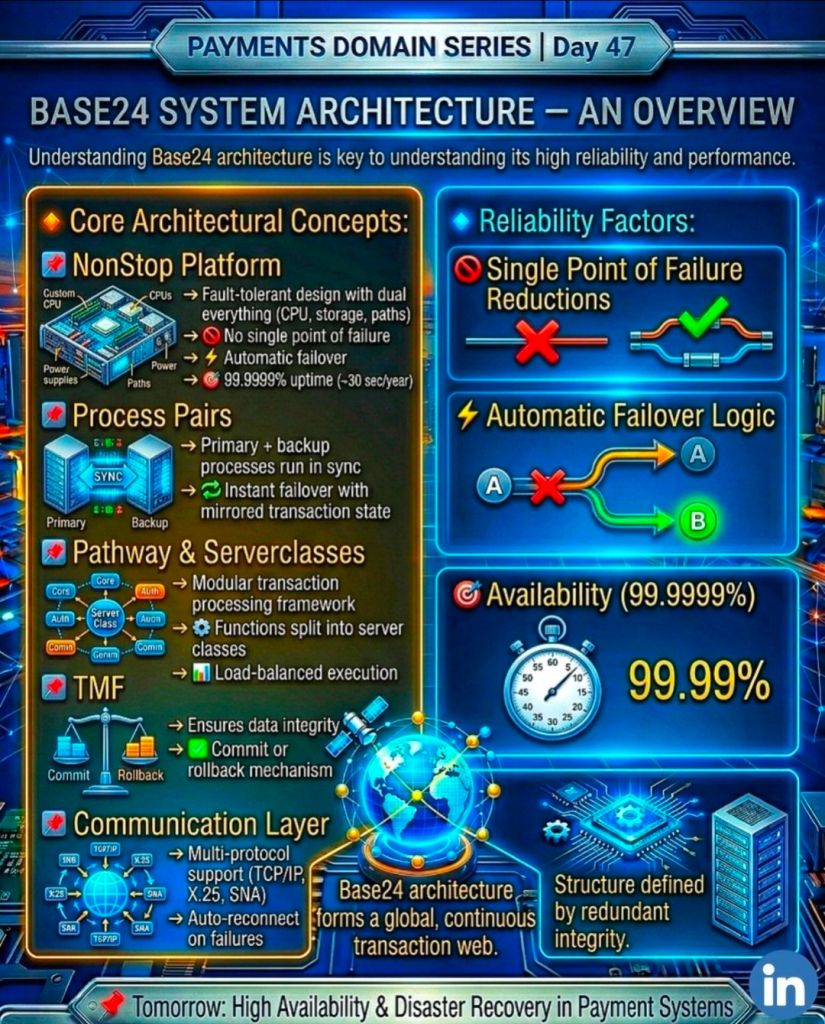
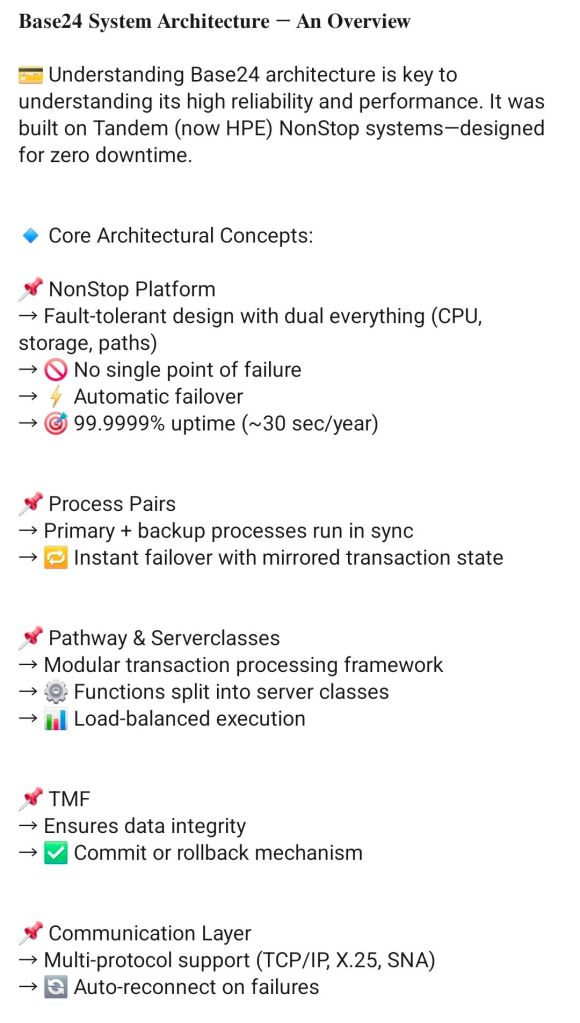
Comprehensive Historical Timeline of BASE24
- The Foundation Era (1975–1981): ACI (Applied Communications, Inc.) was founded in Omaha, Nebraska, in 1975, initially developing software for fault-tolerant Tandem NonStop computers. The focus was on connecting the first wave of ATMs to bank systems.
- The Launch and Global Expansion (1982–1990):
- 1982: BASE24 product family is officially launched, serving as the “baseline” software for 24-hour operations.
- 1986: By 1986, ACI has 131 customers in 14 countries, expanding globally.
- 1987: ACI receives the U.S. President’s “E” Award for Excellence in Export.
- Public Company and Modernization (1995–2000):
- 1995: ACI becomes a public company.
- 1997: Adopts the name ACI Worldwide.
- 1996–2000: Initial expansion of support to platforms beyond Tandem, including IBM mainframes and UNIX, to support rising internet commerce.
- The Transition to Open Systems: BASE24-eps (2001–2010):
- Early 2000s: Introduction of BASE24-es (later renamed BASE24-eps), a Next-Gen, C++ based engine.
- 2003: BASE24-eps is live on HP NonStop, IBM zSeries, and IBM pSeries/Sun Solaris.
- 2006: ACI announces a version of BASE24-es to support UK Faster Payments.
- 2008–2010: ACI moves toward a unified strategy, with BASE24-eps becoming the mainstream offering while Classic matured.
- Modernization and Cloud Era (2011–Present):
- 2011: BASE24-eps wins the Most Innovative Financial Product Award.
- 2015: ACI celebrates 40 years of operation and introduces advanced fraud detection (Proactive Risk Manager) integrated with BASE24-eps.
- 2023: ACI goes live as an early adopter of the Federal Reserve’s FedNow Service, using modernized BASE24-eps technology.
- 2024–2025: BASE24-eps becomes fully PCI-SSF compliant (PCI 4.0), running on Red Hat Enterprise Linux and supporting hybrid cloud deployments.
Key Features of BASE24-eps
- Fault Tolerance: Designed for high availability with near-zero downtime.
- Multi-Channel Support: Manages ATM (NCR, Diebold Nixdorf), POS, and Mobile/Web traffic in a single engine.
- Scripting Engine: Uses JavaScript-like scripts to allow customers to define authorization logic without modifying the core system.
- Universal Connectivity: Supports 40+ global and regional network interfaces (Visa, Mastercard, etc.).
- Platform Independence: Runs on HPE NonStop, IBM z/OS (CICS), and Linux/x86_64.
- Real-time Fraud Prevention: Integrated with ACI Proactive Risk Manager.
BASE24 Classic vs. BASE24-eps
- Classic: Monolithic, Tandem-dependent, older technology.
- eps: Object-oriented (C++), open systems architecture, 30% faster processing, supports cloud-native approaches.
BASE24 Overview and Historical Timeline


