Agile Scrum teams use Fibonacci story points to account for exponential uncertainty, eliminate low-value debates over absolute hours, and establish relative sizing based on complexity.
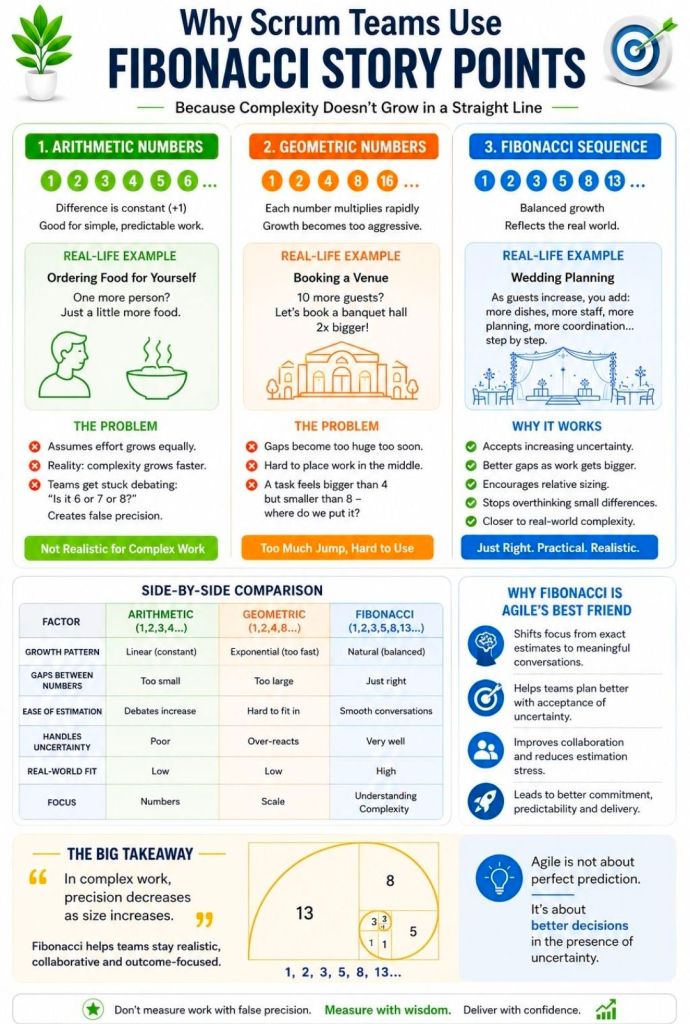
Instead of using a standard linear scale (\(1, 2, 3, 4, 5…\)), Agile frameworks adopt the Fibonacci sequence (\(1, 2, 3, 5, 8, 13…\)) or a modified version (\(1, 2, 3, 5, 8, 13, 20, 40…\)) to fundamentally change how teams measure and discuss work.
🧠 The Psychology and Science of Sizing
Weber’s Law: Human brains struggle to detect minor differences in large magnitudes. While you can easily spot the difference between a 1kg and 2kg weight, you cannot easily tell the difference between 20kg and 21kg. The Fibonacci sequence mimics this by expanding the numbers proportionally (roughly a 60% jump each time), aligning with how humans naturally perceive effort.
Increasing Uncertainty: The larger a software development task is, the more unknowns it contains. The widening gaps between Fibonacci numbers (e.g., the jump from 8 to 13) visually represent this growing exponential risk and ambiguity.
Prevents False Precision: Estimating a complex feature at “39 hours” gives a false sense of security. Forcing the team to bucket a highly complex task as an 8 or 13 keeps the focus on high-level estimation rather than pixel-perfect precision.
🚀 Operational Benefits for Scrum Teams
Faster Planning Poker Sessions: Linear scales cause teams to waste valuable time arguing whether a task is a 5 or a 6. Because the Fibonacci sequence jumps straight from 5 to 8, it eliminates minor nitpicking and drives significantly quicker team alignment.
Shifts Focus to “CUE”: Story points measure Complexity, Uncertainty, and Effort altogether. Moving away from traditional hours breaks the mental link to individual time constraints, allowing a senior and a junior developer to agree on a task’s relative size even if they would complete it at different speeds.
Natural “Epic” Indicators: High Fibonacci scores serve as an immediate operational trigger. Most Scrum teams establish a rule that any user story rated an 8 or 13 is too large for a single sprint and must be broken down into smaller, bite-sized tasks.
PRINCE2 (Projects IN Controlled Environments) is a globally recognized, process-driven project management methodology. It provides a structured, scalable approach to manage projects from start to finish. It is built on 7 core principles, 7 themes, and 7 step-by-step processes.
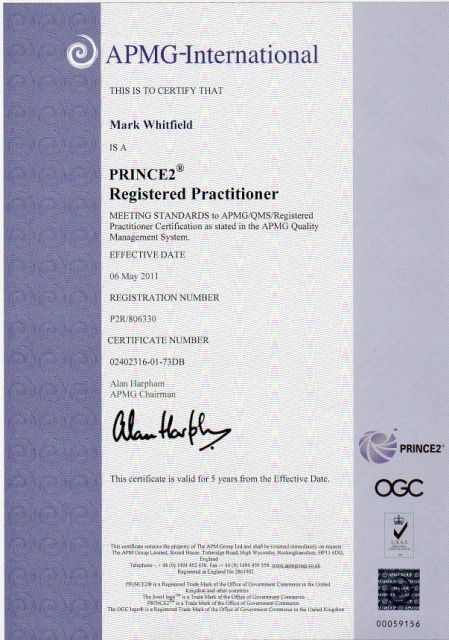
May 2011 – Registered PRINCE2 Practitioner with ILX
The 7 Pillars of PRINCE2
To truly grasp PRINCE2, you should be familiar with its three core elements:
7 Principles: Continued business justification, learn from experience, defined roles and responsibilities, manage by stages, manage by exception, focus on products, and tailor to suit the project environment.
7 Themes: Business Case, Organization, Quality, Plans, Risk, Change, and Progress.
7 Processes: Starting Up, Directing, Initiating, Controlling a Stage, Managing Product Delivery, Managing a Stage Boundary, and Closing a Project.
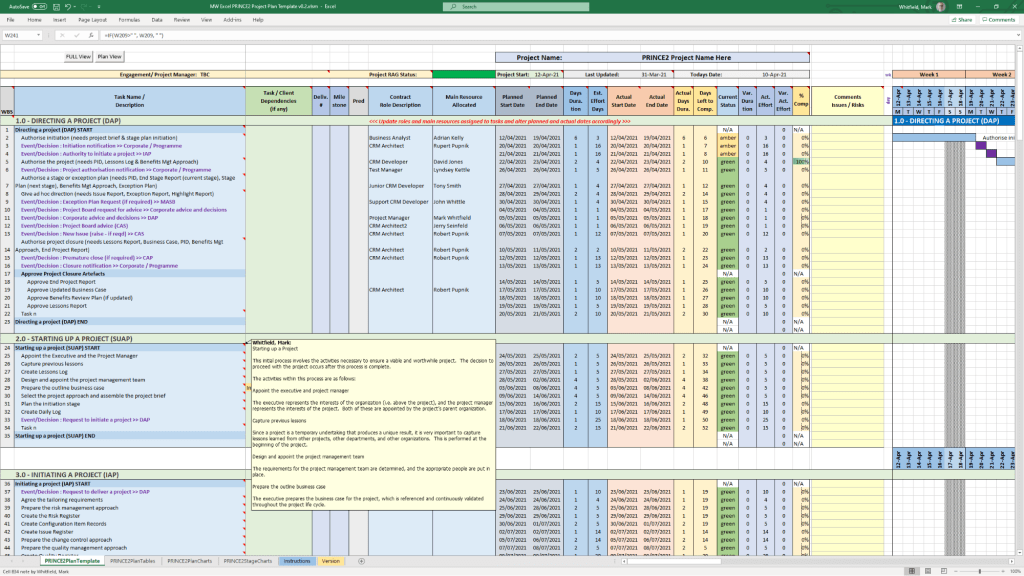
Example MS Excel PRINCE2 template (available on this website)
Detailed Timeline Breakdown by Year
The evolution of PRINCE2 spans over 50 years, transitioning from an internal UK IT standard into a global, flexible methodology.
Mid-1970s: Simpact Systems Limited creates the PROMPT methodology (Project, Resource, Organization, Management, and Planning Technique).
Early 1980s: The Central Computer and Telecommunications Agency (CCTA) in the UK licenses PROMPT to manage complex IT overruns.
1989: CCTA enhances the PROMPT method, renames it to PRINCE (PROMPT in the CCTA Environment), and mandates it for UK IT projects.
1990: PRINCE is released into the public domain and experiences widespread private and public sector adoption.
1996: The UK Cabinet Office officially publishes PRINCE2 and its global certifications. The acronym is updated to PRojects IN Controlled Environments and adapted to fit any industry or project type (not just IT).
2000: Ownership transfers to the newly formed Office of Government Commerce (OGC) in the UK.
2002/2005: Manual structure undergoes major revisions to strengthen the methodology’s “product-based planning” approach.
2009: A massive “Refresh” is released. This update simplifies the framework, introduces the foundational 7 principles, and significantly improves customization.
2013: Ownership transitions to AXELOS Ltd, a joint venture between the UK Government and Capita.
2017: AXELOS publishes the PRINCE2 2017 Update (later designated the 6th Edition). This update places heavy focus on tailoring the method to project scale, flexibility, and practical execution.
2018:PRINCE2 Agile is launched, combining the traditional, controlled PRINCE2 governance model with agile delivery methods.
2021:PeopleCert, a global examination provider, acquires AXELOS and takes full ownership of the PRINCE2 methodology.
2023–Present: PeopleCert releases the PRINCE2 7th Edition, which brings modernizations, digital improvements, and greater sustainability tracking, branding the framework simply as “PRINCE2 Project Management”.
To explore the latest resources, certification paths, or officially recognized guides, you can visit the PRINCE2 Official Website or the community-driven PRINCE2 Wiki.
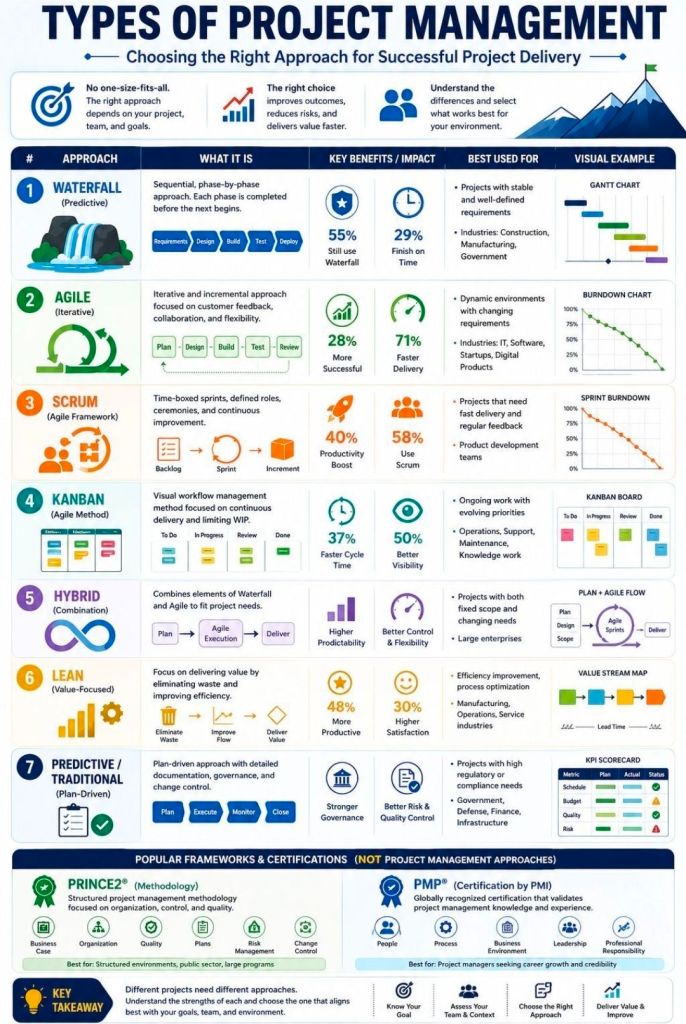
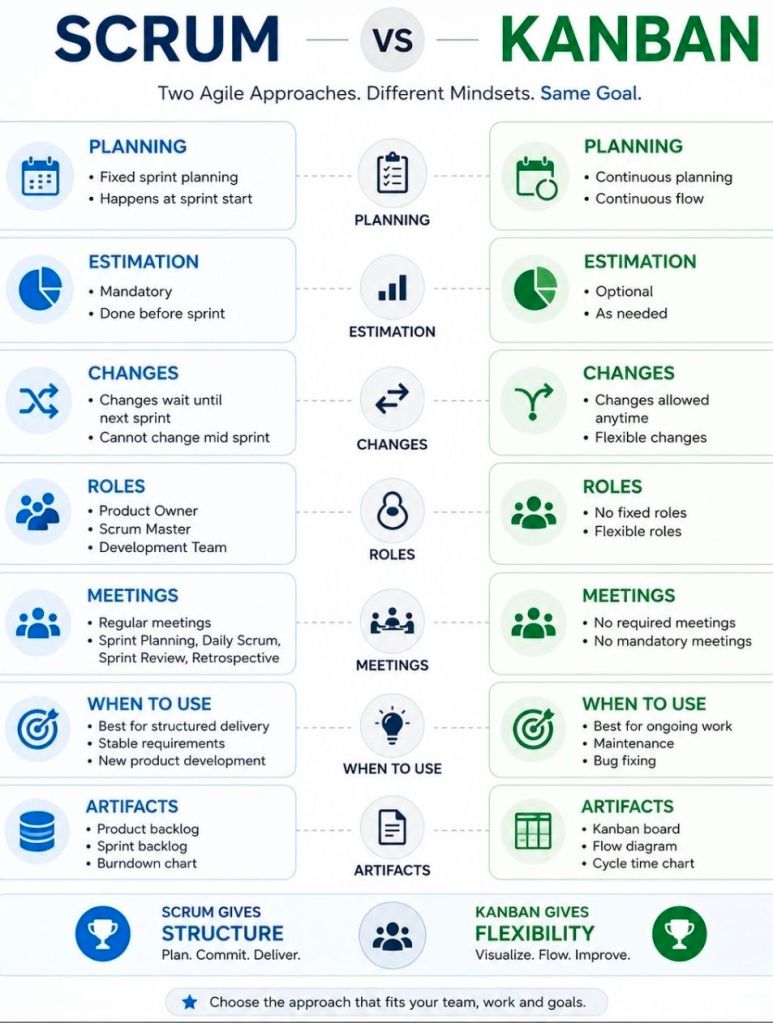
Scrum and Kanban are both popular Agile project management frameworks, but Scrum relies on rigid, time-boxed cycles with explicit roles, while Kanban focuses on continuous workflow and limiting work-in-progress to resolve bottlenecks.
Core Mechanics of Scrum
Time-Boxed Sprints: Work is divided into locked iterations where the team commits to a specific batch of deliverables.
Strict Ceremonies: Requires mandatory structural events including Sprint Planning, Daily Scrums, Sprint Reviews, and Retrospectives.
Clear Accountabilities: Relies on a Product Owner to dictate priorities, and a Scrum Master to eliminate work blockers.
Core Mechanics of Kanban
WIP Limits: Explicitly caps the maximum number of active items allowed in any single workflow column to prevent overloading.
Continuous Delivery: Tasks flow from the backlog to “Done” independently as resources allow, rather than in batched releases.
Evolutionary Change: Fits seamlessly over existing operational hierarchies without requiring an organizational overhaul.
How to Choose the Right Framework
Choose Scrum if:
You are building a complex product requiring highly disciplined planning cycles.
The project requires substantial stakeholder engagement and frequent product reviews.
Your team prefers structured routine, cross-functional collaboration, and highly concrete targets.
Choose Kanban if:
Your workflow is dictated by inbound, unpredictable operational tasks (like IT support or bug tracking).
You want a visual aid to reveal pipeline bottlenecks without altering current team roles.
Note: Many organizations merge these models into a hybrid approach known as Scrumban, leveraging Scrum’s regular event cadences alongside Kanban’s visual WIP flexibility.