

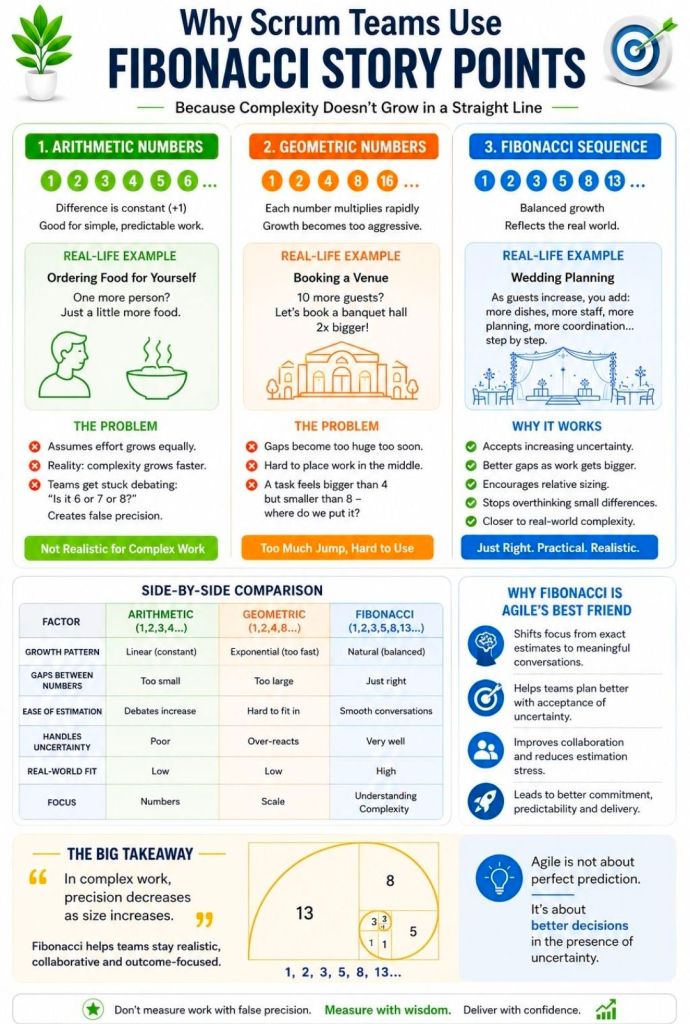
Agile Scrum teams use Fibonacci story points to account for exponential uncertainty, eliminate low-value debates over absolute hours, and establish relative sizing based on complexity.
Instead of using a standard linear scale (\(1, 2, 3, 4, 5…\)), Agile frameworks adopt the Fibonacci sequence (\(1, 2, 3, 5, 8, 13…\)) or a modified version (\(1, 2, 3, 5, 8, 13, 20, 40…\)) to fundamentally change how teams measure and discuss work.
🧠 The Psychology and Science of Sizing
- Weber’s Law: Human brains struggle to detect minor differences in large magnitudes. While you can easily spot the difference between a 1kg and 2kg weight, you cannot easily tell the difference between 20kg and 21kg. The Fibonacci sequence mimics this by expanding the numbers proportionally (roughly a 60% jump each time), aligning with how humans naturally perceive effort.
- Increasing Uncertainty: The larger a software development task is, the more unknowns it contains. The widening gaps between Fibonacci numbers (e.g., the jump from 8 to 13) visually represent this growing exponential risk and ambiguity.
- Prevents False Precision: Estimating a complex feature at “39 hours” gives a false sense of security. Forcing the team to bucket a highly complex task as an 8 or 13 keeps the focus on high-level estimation rather than pixel-perfect precision.
🚀 Operational Benefits for Scrum Teams
- Faster Planning Poker Sessions: Linear scales cause teams to waste valuable time arguing whether a task is a 5 or a 6. Because the Fibonacci sequence jumps straight from 5 to 8, it eliminates minor nitpicking and drives significantly quicker team alignment.
- Shifts Focus to “CUE”: Story points measure Complexity, Uncertainty, and Effort altogether. Moving away from traditional hours breaks the mental link to individual time constraints, allowing a senior and a junior developer to agree on a task’s relative size even if they would complete it at different speeds.
- Natural “Epic” Indicators: High Fibonacci scores serve as an immediate operational trigger. Most Scrum teams establish a rule that any user story rated an 8 or 13 is too large for a single sprint and must be broken down into smaller, bite-sized tasks.
Why Agile Scrum Teams Use Fibonacci Story Points


