Mark Whitfield Senior SC Cleared IT Project Manager

Mark Whitfield is a Senior, SC cleared IT Project and Engagement Manager with over 30 years of experience, specializing in the software development lifecycle (SDLC) for large-scale digital and financial payment systems. 
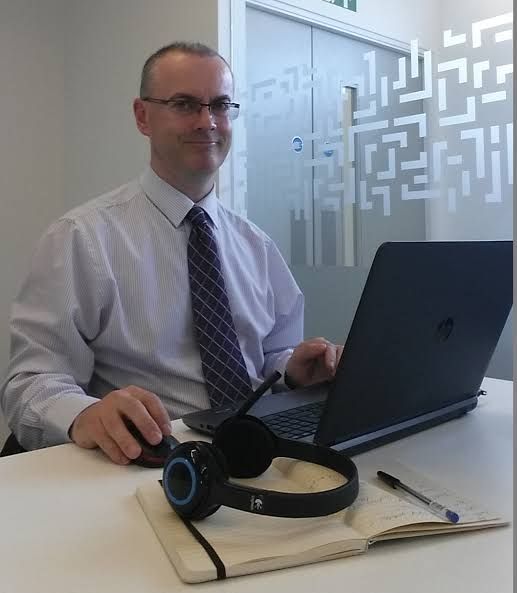
Mark Whitfield is a Senior, SC cleared IT Project and Engagement Manager

Professional Experience by Year

  • 2016–Present: Capgemini UK (Manchester)
    • Role: SC cleared Engagement Manager (A8), Custom Bespoke Solutions.
    • Key Projects: Leading high-value digital transformations and cloud migrations for UK Government applications, automotive (Jaguar Land Rover), and aerospace (Air Traffic Management iOS apps).
  • 2014–2016: Betfred Limited (UK)
    • Role: IT Senior Digital Project Manager, Online and Mobile Division.
    • Key Projects: Managed multiple Agile SCRUM projects for payment gateways, sportsbooks, and virtual gaming components across iOS, Android, and Windows platforms.
  • 2013–2014: Wincor Nixdorf Limited (UK)
    • Role: Project Manager, Professional Services – Banking Division.
    • Key Projects: Managed a £5M+ workstream for Lloyds Banking Group’s Self-Service Software Replacement (SSSR) program, migrating legacy HP NonStop systems to AIX-based Oracle technologies.
  • 1995–2013: Insider Technologies Limited
    • Role: Project Manager – Strategic Technical Initiatives / Senior Development Engineer.
    • Key Projects: Led the development of diagnostic products like Reflex 80:20 and RTLX for global banks including HSBC and Al Rajhi Bank in Saudi Arabia.
  • 1990–1995: The Software Partnership (later Deluxe Data/FIS)
    • Role: Senior Programmer / Lead Analyst.
    • Key Projects: Developed electronic banking software (sp/ARCHITECT) for major banks like Barclays and TSB on Tandem/HP NonStop mainframes. 
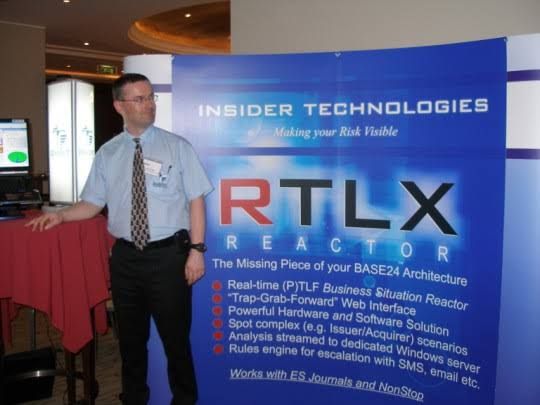
Led the development of diagnostic products like Reflex 80:20 and RTLX

Education

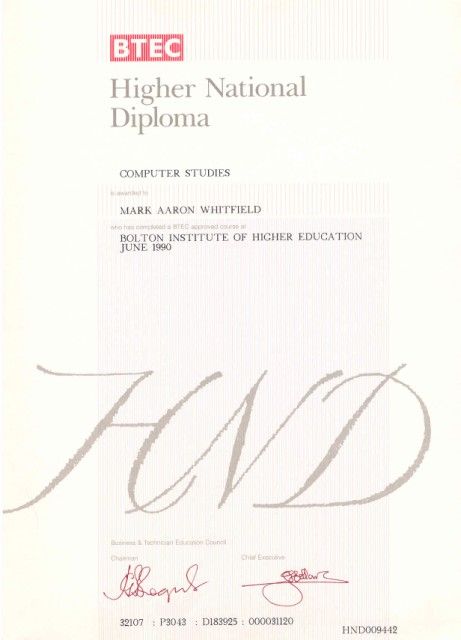
  • Higher National Diploma (HND) in Computer Studies (1988–1990)
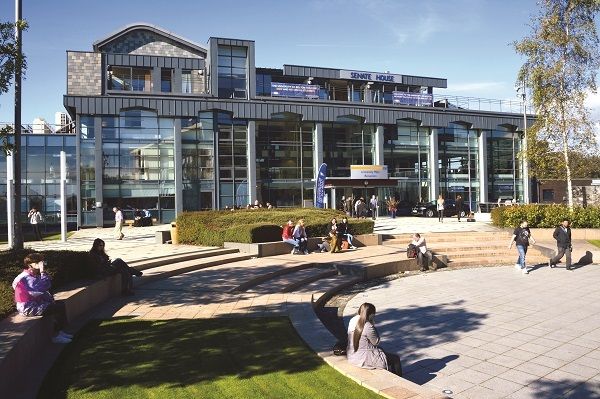
    • Institution: Bolton Institute of Higher Education, BIHE (now University of Greater Manchester).
    • Achievement: Graduated with Distinction (overall first in class across 2 years).
  • A-Levels in Computer Science and Biology (1985–1988)
    • Institution: Leigh College. 

Awards and Key Certifications
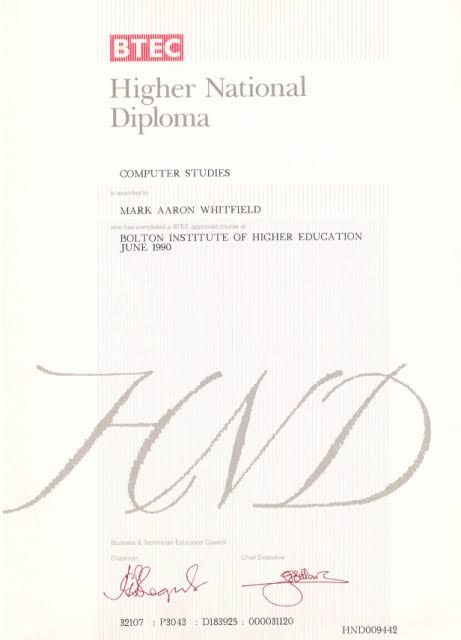
Higher National Diploma (HND) in Computer Studies (1988–1990)
  • Communications & Engagement Award Winner (2022): Awarded by Capgemini UK for Cloud & Custom Applications.
  • Project Recognition Award (2014): Awarded by Wincor Nixdorf for successful delivery of the Lloyds Banking Group SSSR project.
  • Microsoft Certified: Azure Fundamentals (AZ-900) (2022).
  • Certified Engagement Manager (2016): Level 2 Certification through Capgemini.
  • Registered PRINCE2 Practitioner (Since 2011).
  • Agile SCRUM Certified (Since 2011).
  • ITIL Foundation Certified (Since 2012).

Mark Whitfield Senior SC Cleared IT Project Manager
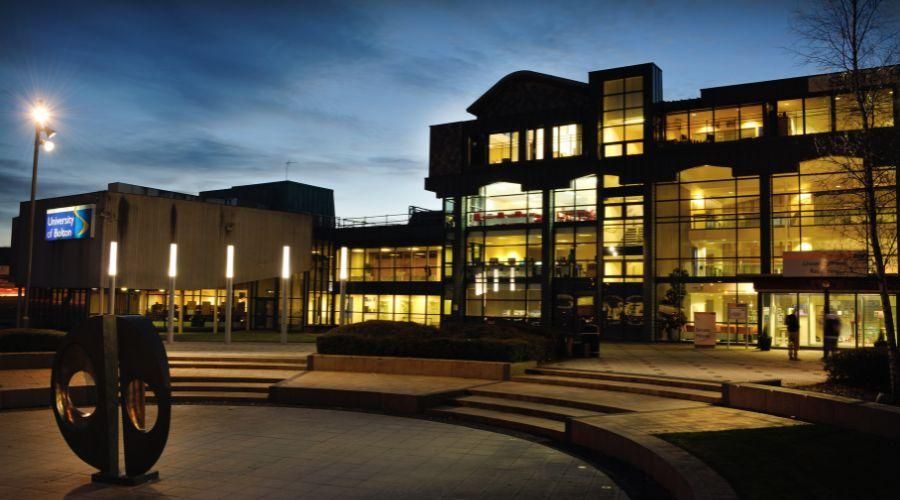
Higher National Diploma (HND) in Computer Studies, Bolton Institute of Higher Education (BIHE)—now the University of Greater Manchester

The Higher National Diploma (HND) in Computer Studies at the Bolton Institute of Higher Education (BIHE)—now the University of Greater Manchester—is a two-year, Level 5 vocational qualification designed to provide practical, industry-specific skills. 

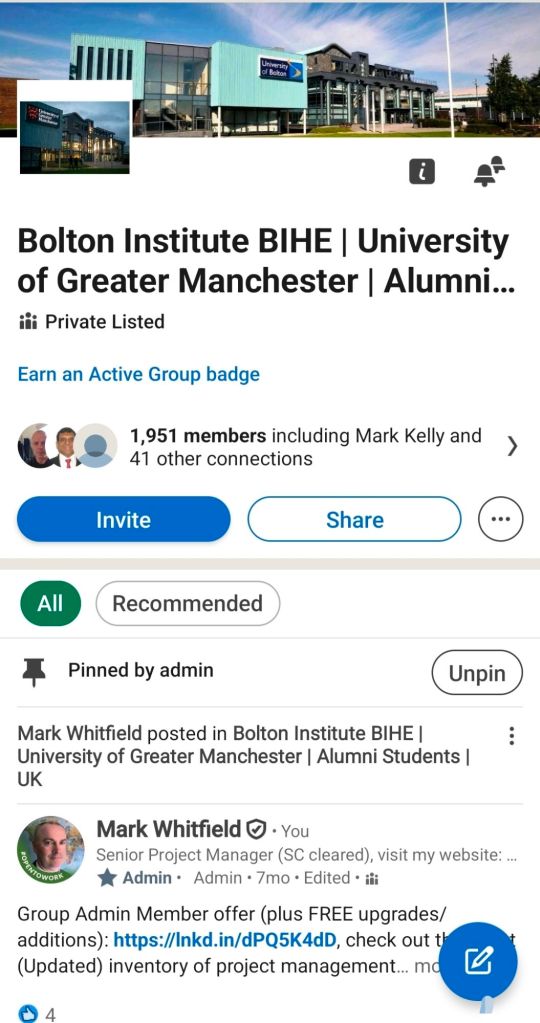
LinkedIn Group: https://www.linkedin.com/groups/51224

BIHE / University of Greater Manchester Evolution

The institution has undergone several name changes and status upgrades that affected the delivery of the HND: 

  • 1982: BIHE was formed through the merger of Bolton Institute of Technology and Bolton College of Education (Technical).
  • 1992: The Institute was granted the power to award taught degrees.
  • 2004/2005: BIHE achieved full university status, becoming the University of Bolton.
  • 2024: The university rebranded as the University of Greater Manchester

HND Computer Studies: Detailed Timeline

The course traditionally follows a two-year full-time or three-year part-time structure. 

Year 1: Foundations (HE4 Level)

The first year focuses on establishing core technical and business knowledge. In many versions of the Bolton curriculum, Year 1 is common across several computing programmes to allow for flexible progression. 

  • Core Modules:
    • Introduction to Programming: Developing fundamental coding logic.
    • Computer Platforms & Systems Architecture: Understanding the hardware and software environments.
    • Information Systems & Databases: The basics of data management.
    • Website Production & Networking Fundamentals: Introduction to web technologies and connectivity.
    • Quantitative Techniques & Business Studies: Integrating mathematical and commercial contexts. 

Year 2: Specialisation (HE5 Level)

The second year shifts toward advanced application, systems analysis, and professional practice. 

  • Advanced Modules:
    • Systems Analysis & Design: Producing system requirements and user interface specifications.
    • Programming Methodology: Moving into more complex application development.
    • Business Information Systems: Exploring how IT supports organizational requirements.
    • Database Design: Implementing industry-standard database packages.
  • Final Year Project: A major 20-credit core project where students investigate a specific field and apply their cumulative skills to a real-world scenario. 

Progression and Modern Standards

  • Academic Standing: Completion of the HND is equivalent to the first two years of a Bachelor’s degree (Level 5).
  • Degree Top-Up: Successful HND graduates can typically proceed directly into the final year (Level 6) of the BSc (Hons) Computer Science or BSc (Hons) Computing at Bolton.
  • Modern HTQs: Current versions of the course, such as the HND Computing for England (HTQ), now integrate modern fields like Artificial IntelligenceCloud Computing, and VR technologies.
1988 to 1990 : University of Greater Manchester (previously Bolton Institute of Higher Education – BIHE)
Higher National Diploma (HND) in Computer Studies, Bolton Institute of Higher Education (BIHE)—now the University of Greater Manchester

University of Greater Manchester Bolton formerly Bolton Institute BIHE LinkedIn

University of Greater Manchester Bolton formerly Bolton Institute BIHE LinkedIn

Group link: https://www.linkedin.com/groups/51224

Mark Whitfield Online Resume Overview

Mark Whitfield is a highly experienced Senior IT Project Manager and former developer with over 30 years of expertise in HP NonStop (formerly Tandem) systems, primarily within the electronic banking and payments sectors. He is currently a Senior Project Manager at Capgemini (SC cleared until 2031) and maintains a professional portfolio at mark-whitfield.com

Historical Timeline & Customer Breakdown

  • 1990 – 1995: The Software Partnership / Deluxe Data (now FIS)
    • Customer/Projects: Developed electronic banking software, specifically sp/ARCHITECT-BANK, for major financial institutions including TSBBank of ScotlandRabobank, and Girofon (Denmark).
    • Technical Breakdown: Focused on low-level programming using COBOL85NonStop SQL, and TAL (Transaction Application Language).
    • Role: Programmer.
  • 1995 – 2013: Insider Technologies Ltd (ITL)
    • Customer/Projects: Focused on HP NonStop monitoring, diagnostic, and payment software for high-value banking clients. Key products included Enterprise ManagerXPNETBASE24, and EPS.
    • Technical Breakdown:
      • XPERT24: Produced technical designs for this performance monitoring tool to track XPNET layers and transaction interchange counters (ATM/POS approval rates).
      • RTLX Payments: Served as IT Project Manager for RTLX (Real-Time Long-term eXchange) payment software.
      • Infrastructure: Extensive use of Guardian utilities (PATHWAY, SCF, FUP, INSPECT), TACL, and SCOBOL.
    • Role: Software Design, Team Leading, and Product Management.
  • 2013 – 2016: Freelance / Contract Projects
    • Customer/Projects: Managed software development lifecycle (SDLC) projects for various blue-chip companies.
    • Role: IT Project Manager.
  • 2016 – Present: Capgemini
    • Customer/Projects: Managing large-scale digital and public sector transformations. Notable clients include UK Government (MS Azure Cloud migration), Jaguar Land Rover (JLR)HeathrowRoyal Mail GroupBank of EnglandHSBCBarclays, and Deutsche Bank.
    • Technical Breakdown: Transitioned from legacy Tandem environments to modern Agile Scrum delivery and Microsoft Azure Cloud hosting.
    • Role: Senior Project Manager / Technical Delivery Manager.

Technical Breakdown by Competency

  • Operating Systems: HP NonStop (Guardian/NSK), Windows, Linux, Unix.
  • Programming Languages: TALTACLCOBOL85SCOBOL, C, C++, Java, and ASP.NET framework.
  • Databases: NonStop SQL/MP, MS SQL.
  • NonStop Middleware: PATHWAYXPNETBASE24EPS, and EMS (Event Management System).
  • Methodologies: Registered PRINCE2 PractitionerAgile SCRUM, ITIL, and ISO9001:2008. 

Web Hyperlinks & Resources

Salford Quays Overview and Comprehensive Timeline by Era

Salford Quays is a major waterfront destination in Greater Manchester, originally the site of the Manchester Docks. After the docks closed in 1982, the area underwent one of the UK’s most ambitious urban regeneration projects, transforming from a derelict industrial zone into a vibrant cultural, commercial, and residential hub. It is now home to landmarks such as The LowryImperial War Museum North, and the MediaCityUK media cluster. 

Comprehensive Historical Timeline

The history of Salford Quays is defined by three distinct eras: the rise of the Manchester Docks, a period of industrial decline, and its modern rebirth through regeneration. 

I. The Industrial Era (1887–1960s)

This era saw the construction and peak of the Manchester Docks, which turned Manchester into an inland port despite being 40 miles from the sea. 

  • 1887: Construction of the Manchester Ship Canal begins to bypass high charges from Liverpool’s docks.
  • 1893: The canal is flooded in November, preparing for its opening.
  • 1894: Queen Victoria officially opens the Manchester Ship Canal and Salford Docks on 21 May.
  • 1905: King Edward VII opens No. 9 Dock, the largest in Salford, on the former site of the Manchester racecourse.
  • 1920: Employment peaks with approximately 16,000 labourers working at the docks.
  • 1927: Official Dock offices open on Trafford Road.
  • 1950s: The docks reach their peak traffic, annually seeing over 16 million tons of cargo and 5,000 ships.

II. The Era of Decline (1960s–1982) 

Technological shifts in shipping and industrial unrest led to the eventual closure of the port. 

  • 1966: A 47-day strike by the National Union of Seamen leads to a significant loss of customer confidence.
  • 1969: The vessel Manchester Courage hits the Irlam lock gates, trapping ships in the docks for five weeks.
  • 1970s: The rise of containerisation makes the Ship Canal too narrow for modern, larger ships, causing a rapid decline in trade.
  • 1982: The docks officially close, resulting in the loss of 3,000 jobs and leaving the area derelict and polluted. 

III. The Regeneration Era (1983–Present) 

Salford City Council and private partners began transforming the abandoned docks into a modern “urban living” quarter. 

  • 1983: Salford City Council acquires the derelict docks from the Manchester Ship Canal Company.
  • 1984: The area is officially rebranded as Salford Quays.
  • 1985: The Salford Quays Development Plan is published, outlining a mix of housing, offices, and leisure.
  • 1986: Regeneration work officially begins; the MGM Canon Cinema (the first new building) opens in December.
  • 1987: The Copthorne Hotel opens. A compressed air mixing system is introduced to oxygenate the water, allowing 12,000 fish to be introduced.
  • 1989: Mariner’s Canal is opened by the Duke of York.
  • 1991: The Anchorage office complex is completed, becoming a major commercial landmark.
  • 1994: The Centenary Walkway is opened by Princess Anne to commemorate the canal’s 100th anniversary.
  • 1999: The Metrolink tram extension to the Quays opens.
  • 2000: The Lowry arts centre is officially opened by Queen Elizabeth II on 28 April.
  • 2001: The Lowry Outlet Mall (now Quayside) and the Salford Watersports Centre open.
  • 2002: Imperial War Museum North, designed by Daniel Libeskind, opens its doors.
  • 2007: Construction begins on MediaCityUK after the BBC proposes moving several departments from London.
  • 2011: The BBC completes its move to MediaCityUK; the University of Salford opens its satellite campus there.
  • 2013: Coronation Street moves its production and iconic cobbles to a new site at MediaCity.
  • 2021: MediaCityUK buildings become the first in the UK to achieve net zero carbon status.
  • 2023: High-rise developments continue with the completion of the 29-storey Eda (Erie Dock Apartments).

Salford Quays Overview and Comprehensive Timeline by Era

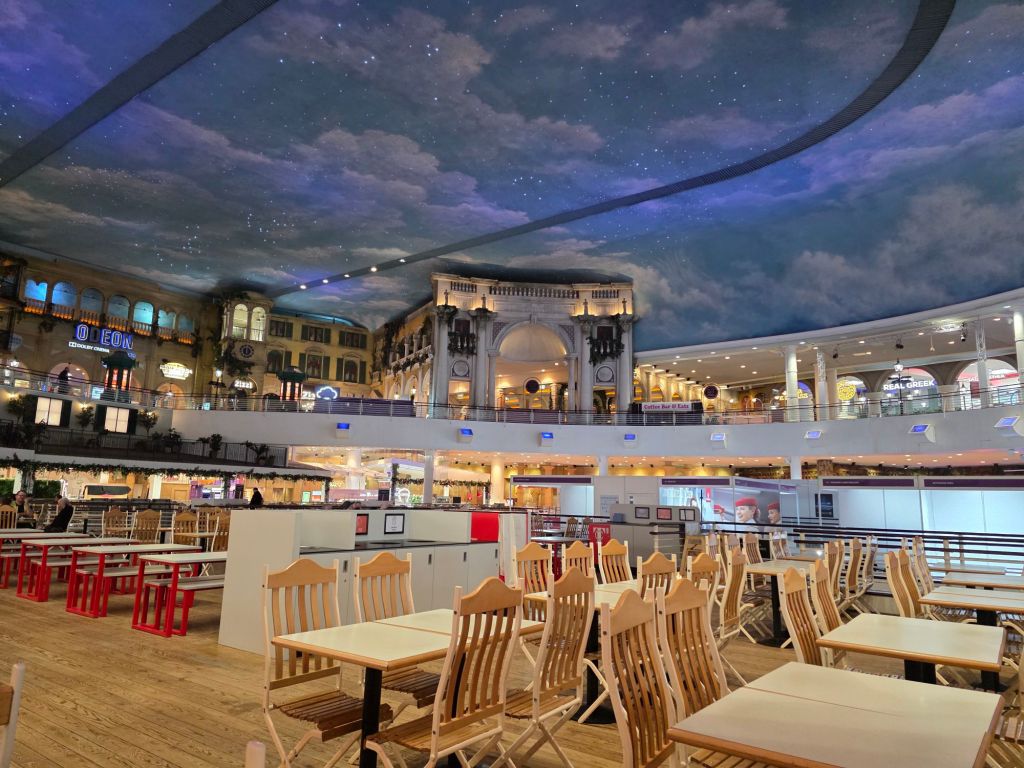
Back at the Trafford Centre…

Back at the Trafford Centre…

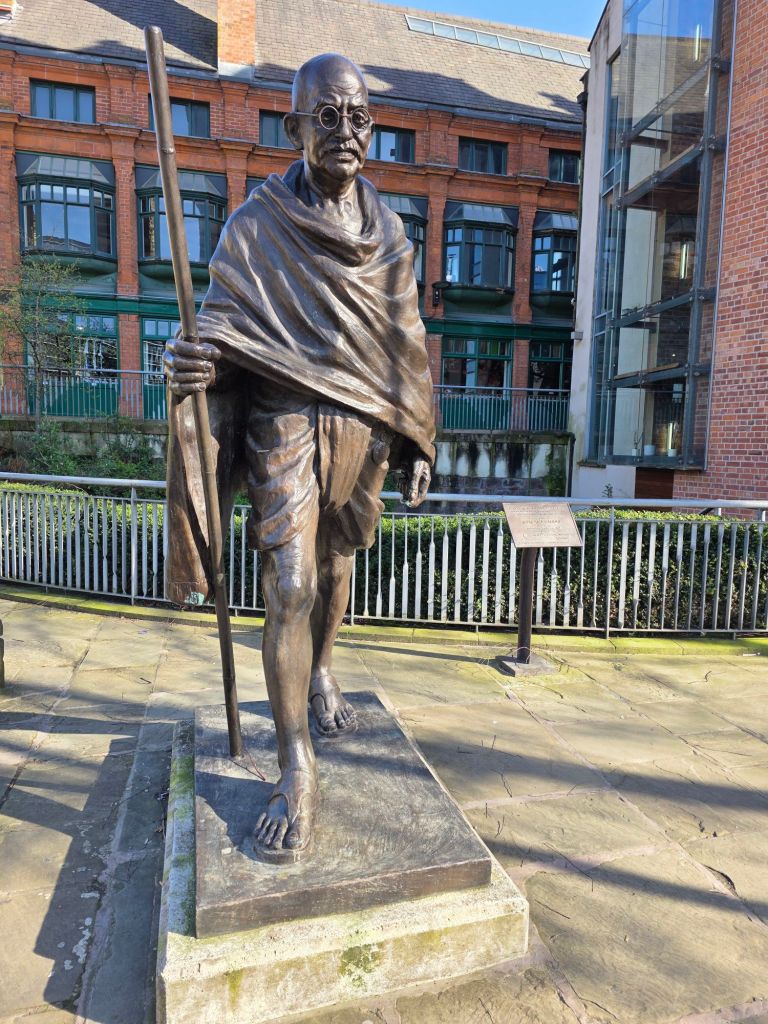
An amble around Manchester, 17th March 2026

Ghandi, Manchester City Centre
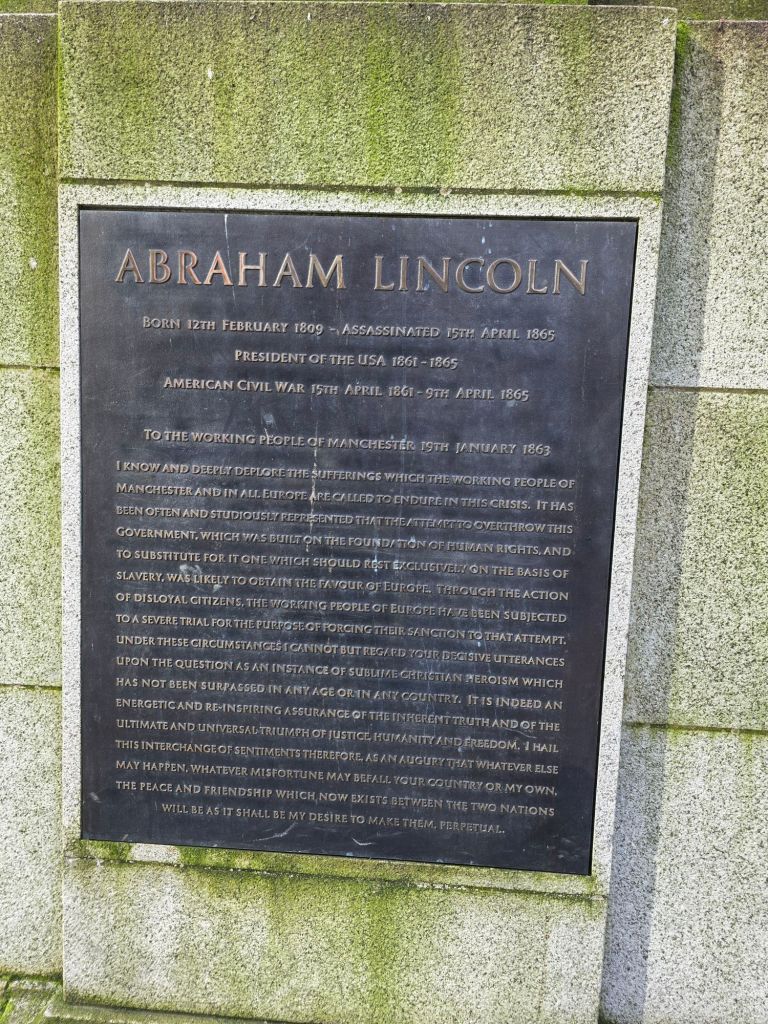
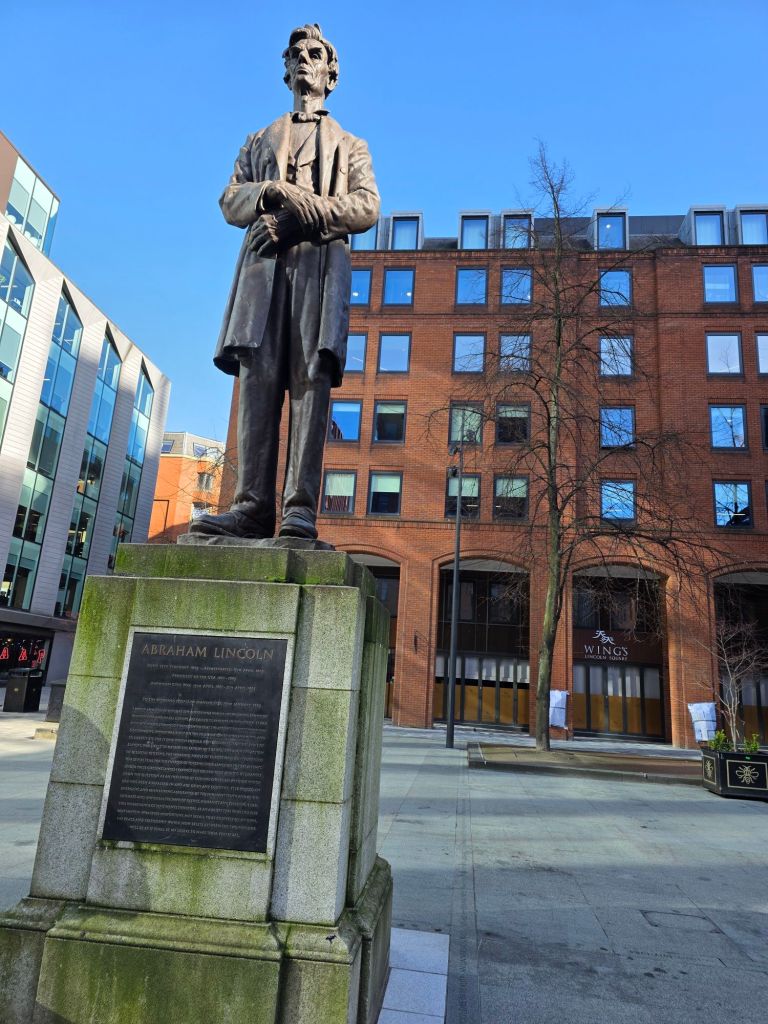
Abraham Lincoln 1, Manchester City centre
Abraham Lincoln 2, Manchester City centre
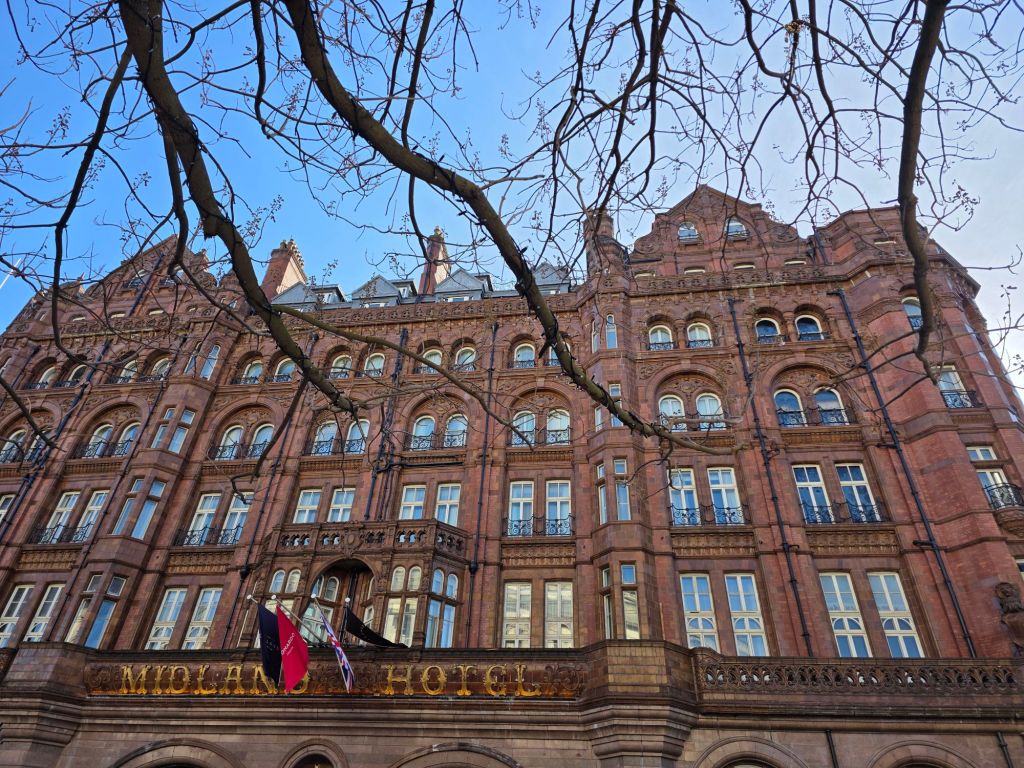
Midland Hotel, Manchester

An amble around Manchester, 17th March 2026

Trafford Centre, Greater Manchester, Development Timeline

The Trafford Centre, located in Greater Manchester, has evolved from a controversial planning proposal in the 1980s into one of the UK’s largest shopping and leisure destinations. 

Pre-Opening & Construction (1984–1997)

  • 1984: The concept for the Trafford Centre is first conceived by the Manchester Ship Canal Company (later Peel Holdings).
  • 1986: Initial planning permission is sought for the Dumplington site.
  • 1987–1992: A series of public inquiries are held due to significant opposition from local councils and competing shopping centres.
  • 1993: Outline planning permission is granted, though it is immediately challenged in the High Court.
  • 1995: After years of legal battles, the House of Lords officially upholds the planning permission, giving the final go-ahead.
  • 1996: Construction begins on-site in May; by August, the assembly of the massive steel frame starts.
  • 1997: The steel frame is completed, and significant progress is made on the ornate facade and interior. 

The Early Years (1998–2005)

  • 1998: The Trafford Centre officially opens on 10 September with 140,000 visitors on opening day. Key anchors include the first Selfridges store outside London.
  • 1999: The centre gains international attention when Monica Lewinsky visits for a book signing tour.
  • 2001: A major Marks & Spencer store opens.
  • 2005: The four-storey John Lewis & Partners opens in May, replacing the original “Festival Village” area. 

Expansion & Ownership Changes (2006–2019)

  • 2007: The Great Hall dining area opens in March, featuring a 1930s steamship theme and one of the world’s largest chandeliers.
  • 2008: Barton Square (now Trafford Palazzo) opens in March as a dedicated homewares and furniture wing.
  • 2010: LEGOLAND Discovery Centre opens within Barton Square.
  • 2011: Peel Group sells the centre to Capital Shopping Centres (CSC) for £1.6 billion, the largest single property transaction in British history at the time.
  • 2013: Following a corporate rebrand of CSC, the mall is renamed intu Trafford Centre in February; SEA LIFE Manchester also opens this year.
  • 2018: The centre celebrates its 20th anniversary with record footfall. 

Modern Era & Redevelopment (2020–Present) 

  • 2020: Developer Intu Properties enters administration in June. Ownership is transferred to the Canada Pension Plan Investment Board (CPPIB) in December.
  • 2021: Barton Square is legally separated and re-acquired by the original developer, Peel L&P, who rebrands it as Trafford Palazzo.
  • 2022: As part of an overhaul by new asset managers Pradera Lateral, the decorative pool in the Orient is removed.
  • 2023: The centre celebrates its 25th anniversary with a special show headlined by 90s pop group B*Witched.
  • 2024: Major new tenants are announced, including a massive Inditex flagship (Zara, Bershka, and Pull&Bear) taking over the former M&S site.
  • 2025: Significant retail reshuffling continues with the opening of a massive new Zara and the first Sephora in the North of England.

The Trafford Centre is a major shopping and leisure destination in Manchester, famous for its grand Baroque architecture. 

Sunday Hours (Sunday 8 March 2026)

  • Shops: 12:00 PM – 6:00 PM
  • Dining & Leisure: 12:00 PM – 6:00 PM (times for individual venues like the cinema or restaurants may vary) 

Events & Attractions

  • Science Fair: A free family event featuring experiments and robots is currently running until 6:00 PM today.
  • Holi Festival of Colours: A celebration of music and well-being scheduled for Saturday 14 March at Orient Car Park 12.
  • Leisure Hub: Home to an ODEON cinema, SEA LIFE ManchesterParadise Island Adventure Golf, and Namco Funscape

Shopping & Dining

  • Popular Brands: Key stores include SelfridgesJohn LewisZaraApple, and Next.
  • Dining Hubs: The Orient and The Great Hall host over 60 eateries, including Hello Oriental, Archie’sFive Guys, and Wingstop.
  • New for 2026: Standalone stores for The White CompanyShake Shack, and expanded locations for Stradivarius and Foot Asylum are opening this spring. 

Visitor Information

  • Address: The Trafford Centre, Trafford Park, Manchester, M17 8AA.
  • Parking: Over 10,000 free parking spaces are available. Premium Parking options are available for £7.50.
  • Transport: Accessible via the Metrolink tram (Trafford Park line) and dedicated bus routes like the X50 from Manchester City Centre. 

Trafford Centre, Greater Manchester, Development Timeline