This resume summarizes the career of Mark Whitfield, a Senior IT Project Manager with over 30 years of experience specializing in digital and software development lifecycles, cloud migrations, and HP NonStop systems.
Core Focus: Senior Project Management for Digital/ Software Development Lifecycles (SDLC).
Expertise: Transitioning from a technical background in programming (pre-2000) to senior leadership in large-scale projects for global blue-chip companies.
Key Skills & Competencies
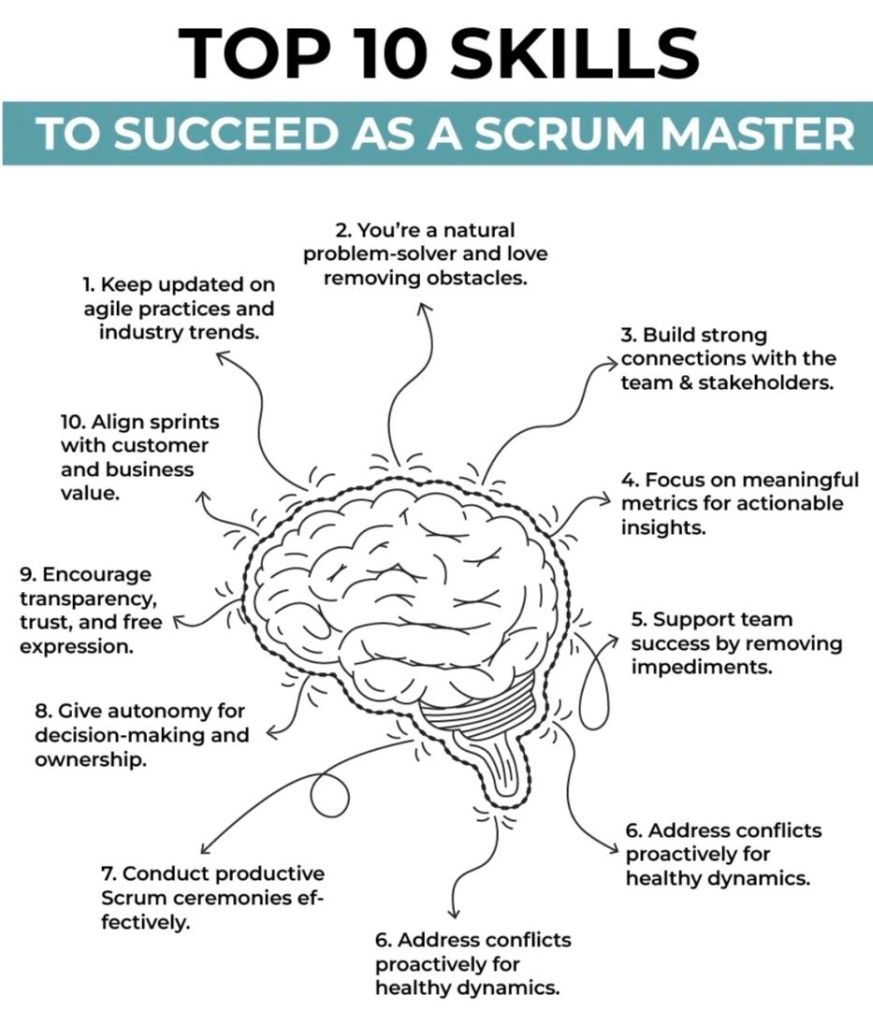
Methodologies: PRINCE2 Practitioner, Agile (Scrum/ Kanban), Waterfall, ITIL, ISO QA.
Project Controls: MS Project, Budget & Burn Tracking, GDPR compliance, Supplier & Stakeholder Management, Statement of Work (SoW).
Technical Proficiencies:
Platforms: HP NonStop (Tandem), Cloud Migration (Hybrid).
Languages (Historical): C/C++, Java, COBOL85, TAL, TACL, SCOBOL, SQL, MS SQL.
Utilities: PATHWAY, SCF, FUP, INSPECT, XPNET.
Professional Experience
Senior IT Project Manager (Various Projects):
Managed large-scale solutions for clients including Jaguar Land Rover (JLR), Heathrow, Royal Mail Group (RMG), NATS, and Euroclear.
Extensive work within the financial sector for Bank of England, Barclays, HSBC, Santander, Standard Chartered, Deutsche Bank, and Global Payments.
Government and public sector projects for Defra, UKEF, Welsh Water, and Scottish Water.
Early Career (Programmer / Technical Lead):
1990 – 1995: Programmer at The Software Partnership (later Deluxe Data) in Runcorn, specializing in electronic banking software (sp/ARCHITECT-BANK) on Tandem Mainframe Computers.
Education & Certifications
Degree: Higher National Diploma (HND) in Computing (Distinction, Graduated 1990).
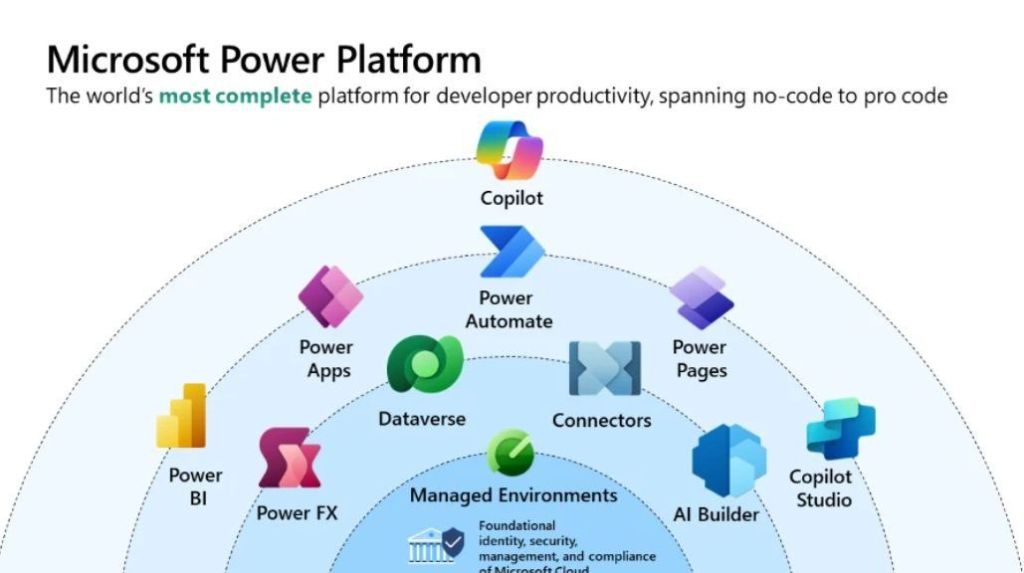
Microsoft Power Platform is a suite of low-code tools designed to help organizations analyze data, build custom solutions, automate processes, and create AI-powered agents. It enables both professional developers and “citizen developers” (business users) to rapidly build end-to-end business applications that integrate with the broader Microsoft Cloud ecosystem.
Microsoft Power Platform
Core Product Areas
The platform consists of five primary applications:
Power Apps: A low-code development environment for building custom web and mobile business applications.
Power Automate: A service for workflow automation and robotic process automation (RPA).
Power Pages: A platform for creating and hosting secure, external-facing business websites.
Copilot Studio: A graphical tool for building and customizing AI-powered agents and chatbots.
Underlying Capabilities
The platform’s strength lies in its shared infrastructure:
Microsoft Dataverse: A secure, cloud-scale data store that provides a common data model for all Power Platform apps.
Connectors: Over 1,000 prebuilt integrations that allow apps to communicate with external data sources like SAP, Salesforce, and Google Analytics.
AI Builder: A capability that allows users to add AI models (e.g., sentiment analysis or object detection) to their apps and flows without writing code.
Power Fx: A low-code, strongly-typed programming language used for expressing logic across the platform.
The Microsoft Power Platform has evolved from individual components like Power BI and Power Apps into a unified suite, now heavily integrated with Copilot and AI.
Origins & Early Growth (2013–2018)
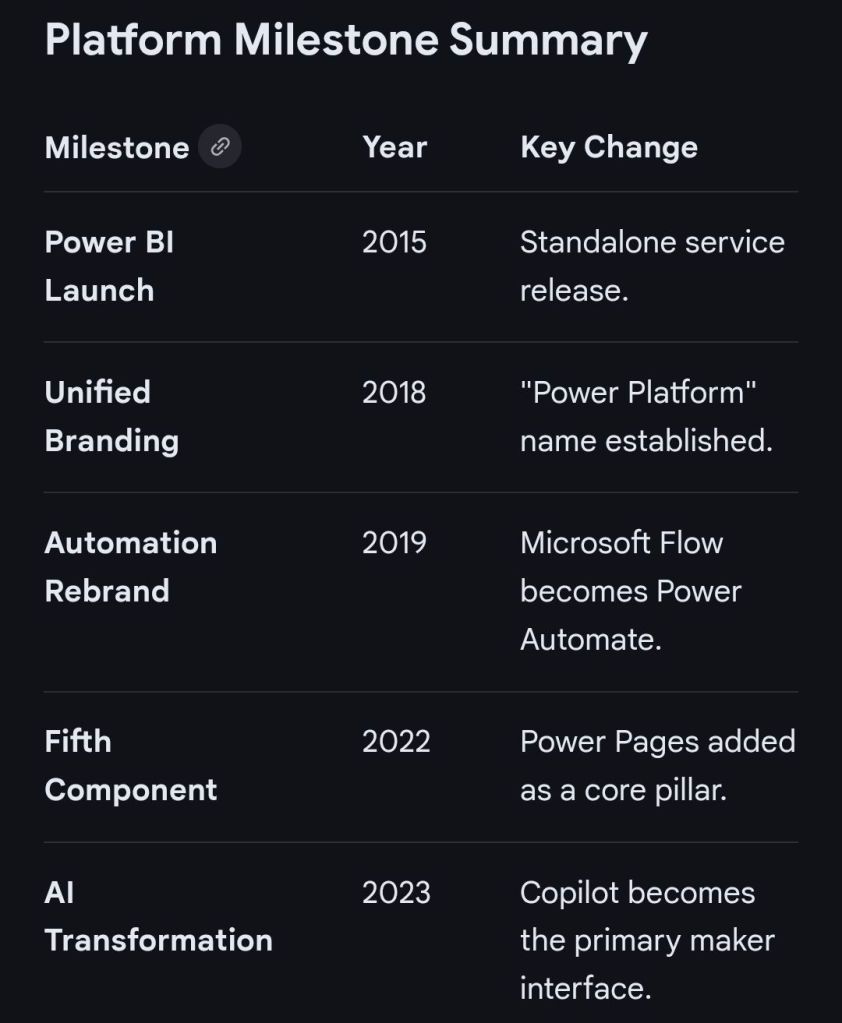
2013: Power BI is first released as an Excel add-in before becoming a standalone service in 2015.
2015: Power Apps enters public preview as a low-code tool for building business applications.
2016: Microsoft Flow (now Power Automate) is launched to provide workflow automation across apps and services.
2018: The term “Microsoft Power Platform” is officially introduced to unify Power BI, Power Apps, and Flow.
Expansion & Rebranding (2019–2022)
2019: Power Virtual Agents is added to the suite for creating no-code chatbots. Microsoft Flow is rebranded as Power Automate.
2020: Launch of Power BI Premium per user and the Dataverse (formerly Common Data Service) rebranding.
2021: Power Fx, an open-source formula language based on Excel, is introduced as the standard language across the platform.
2022: Power Pages is launched as the fifth standalone product for building secure, low-code business websites.
The AI & Copilot Era (2023–Present)
2023: Integration of Copilot across all Power Platform products, allowing users to build apps, flows, and reports using natural language.
2024: Introduction of Timeline Highlights in Power Apps to provide AI-generated summaries of record activities.
2025: Microsoft announces the retirement of the Power Apps per app plan (January) and ends support for contact tracking in the Dynamics 365 App for Outlook (October).
2026: The 2026 Release Wave 1 begins (April–September), focusing on deeper Role-based Copilot offerings and enhanced security agents.
Microsoft Power Platform Milestone Summary
The Microsoft Power Platform originated from Microsoft’s effort to democratise data and app development by evolving its existing business tools into a unified low-code ecosystem.
Origins and Evolution (2003–2015)
The platform’s roots trace back to early business solutions that were eventually merged into the modern suite:
Dynamics CRM 1.0 (2003): The foundation for what became the Microsoft Dataverse (formerly Common Data Service), providing a secure relational database.
Project Siena (2013): A “garage project” at Microsoft aimed at building web apps without professional coding tools. This project eventually became Power Apps.
Power BI Launch (2015): Originally “Project Crescent” for SQL Server, Power BI was the first of the modern “Power” services to be delivered, entering preview in January 2015.
Expansion and Formalisation (2016–2019)
Microsoft transitioned from individual tools to an integrated platform:
Power Apps and Flow (2016):Power Apps and Microsoft Flow (later renamed Power Automate) became generally available in November 2016.
Common Data Service (2016): Introduced to provide a shared data platform across Dynamics 365 and the new “Power” tools.
Official Branding (2018–2019): The term “Microsoft Power Platform” was officially established as an umbrella brand for the suite of tools. In 2019, Microsoft Flow was rebranded to Power Automate to align with the platform’s naming convention.
Modern Era and AI Integration (2020–Present)
The platform has shifted toward “AI-first” development and expanded its core pillars:
New Components:Power Virtual Agents (now Copilot Studio) and Power Pages (for external websites) were added to the core lineup.
Acquisitions: Microsoft acquired Softomotive (2020) and Minit (2022) to bolster Power Automate with Robotic Process Automation (RPA) and process mining capabilities.
Generative AI: Recent updates have focused on integrating Copilots across all products, allowing users to build apps and automations using natural language.
Microsoft Power Platform Development Timeline Overview
Centiun Microsoft Business Applications and AI Specialists
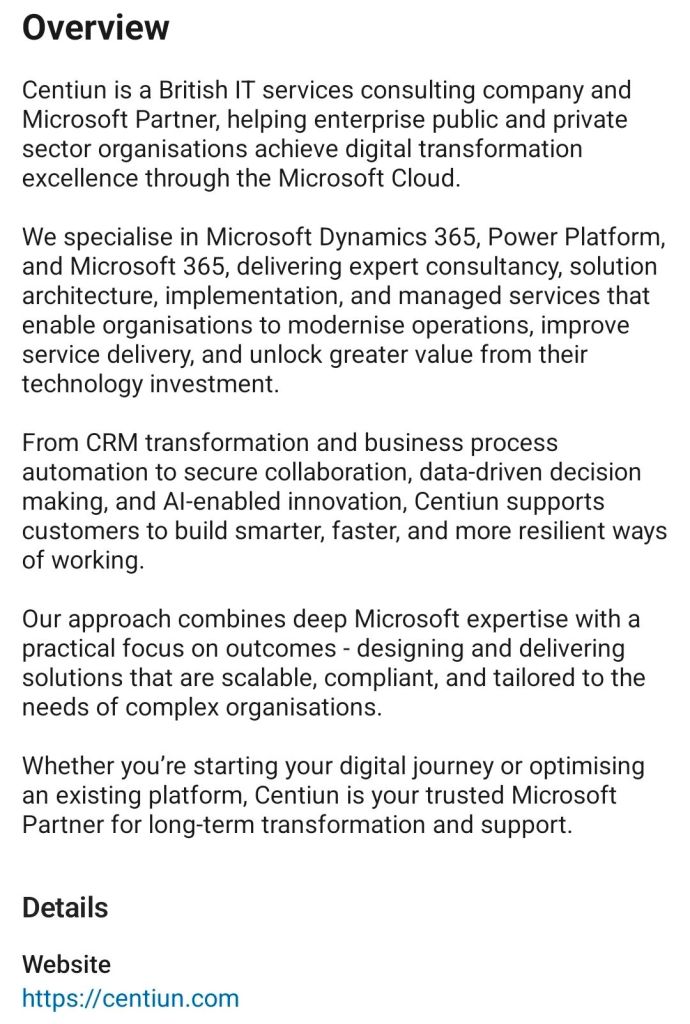
CentiunOverview
Centiun is a British IT services consulting company and Microsoft Partner, helping enterprise public and private sector organisations achieve digital transformation excellence through the Microsoft cloud.
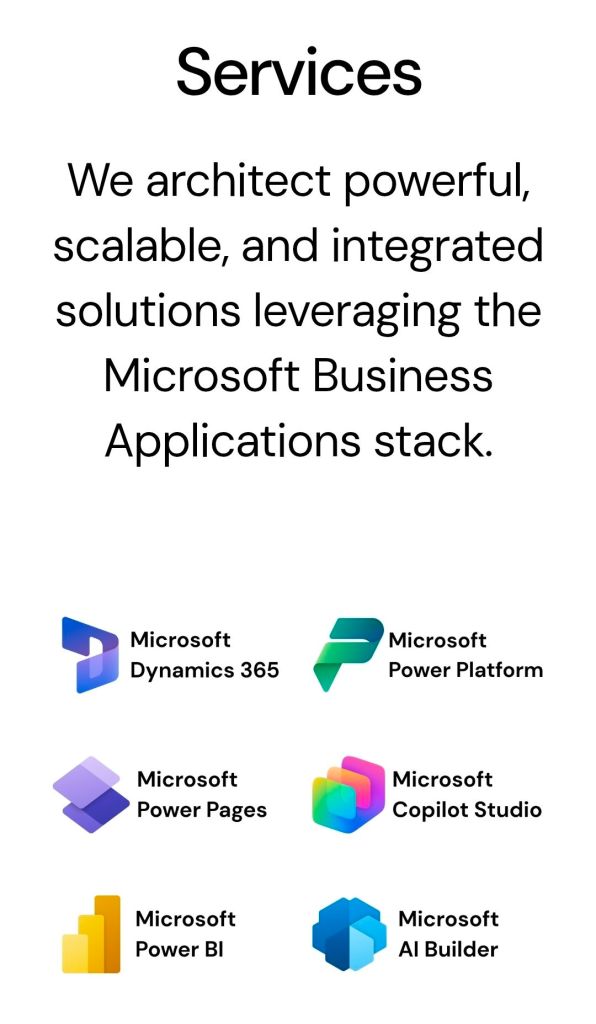
We specialise in Microsft Dynamics 365, Power Platform, and Micrisoft 365, delivering expert consultancy, solution architecture, implementation, and managed services that enable organisations to modernise operations, improve service delivery, and unlock greater value from their technology investment.
From CRM transformation and business process automation to secure collaboration, data-driven decision making, and AI enabled innovation, Centiun supports customers to build smarter, faster and more resilient ways of working.
Our approach combines deep Microsoft expertise with a practical focus on outcomes – designing and delivering solutions that are scalable, compliant, and tailored to the needs of complex organisations.
Whether you’re starting your digital journey or optimising an existing platform, Centiun is your trusted Microsoft for long-term transformation and support.
Mark Whitfield, an experienced IT Project Manager, has a career and certification history spanning over 30 years. His professional development includes a range of technical, project management, and cloud-based qualifications.
2020s: Cloud & Modern Platforms
2024 (July): Microsoft Excel Refresher Course – Udemy.
2022 (December/February): C&CA UK’s Communications & Engagement Award and AZ-900 Microsoft Certified Azure Fundamentals.
2010s: Advanced Management & Development
2017 (November/April): Advanced Engagement Management (Level 2) and Microsoft Excel 2010 Expert Skills.
2014 (July): Advanced Microsoft Excel 2013.
2011 (May–July): PRINCE2 Practitioner, Agile SCRUM, Java, and Android programming.
2000s: Web Applications & Database Systems
2009 (March–November): Thales e-Security, BIRT, Web Design, and SQL Server training.
2006 (Feb–Dec): NetObjects Fusion, Cryptography, and Thales e-SECURITY SafeSign.
2004 (March): MultiBatch NSK Job Scheduling.
2000 (February): Fundamentals of Successful Project Management.
1990s: Core Programming & System Fundamentals
1990s (1993–1999): TANDEM/HP NonStop systems, C/C++ programming, project management, and HND in Computer Studies (1990).
Mark Whitfield Training IT Career Timeline Overview
Mark Whitfield, a Senior IT Project Manager who has spent over 30 years specialising in HP NonStop (formerly Tandem) computing systems.
Professional Background
Specialisation: Mark Whitfield is a highly experienced technician and project manager for the HP NonStop platform, which is a high-availability, fault-tolerant mainframe environment used primarily for mission-critical financial transactions.
Career Timeline:
The Software Partnership / Deluxe Data (1990–1995): Began as a programmer working on the sp/ARCHITECT-BANK solution for Tandem computers.
Insider Technologies (1995–2013): Spent 18 years focusing on monitoring and diagnostic software for HP NonStop, including products like Reflex 80:20, XPERT24, and Enterprise Manager.
Capgemini (2016–Present): Currently serves as an SC-cleared Senior Project Manager, delivering complex IT projects for major banks and government agencies.
Key Technical Contributions to NonStop
Product Development: He co-developed Reflex (a platform health/diagnostic tool) and designed XPERT24 to monitor performance in the XPNET layer of BASE24.
Financial Systems: He has managed major projects for global financial entities, including Barclays, HSBC, Bank of England, and Royal Mail Group, often involving ATM and POS monitoring systems.
Programming Expertise: His technical skill set includes NonStop-specific languages and tools such as TAL (Tandem Application Language), PATHWAY, XPNET, COBOL85, and C++.
About HP NonStop Systems
In the context of Mark Whitfield’s work, NonStop refers to a “shared-nothing” architecture designed by Tandem Computers. These systems are uniquely capable of:
Fault Tolerance: Handling hardware or software failures without system downtime.
Scalability: Doubling throughput by adding processors (up to 4,000) without hitches in performance.
Core Banking: Processing massive commercial workloads for retail banks and stock exchanges globally.