Agentic AI Artificial Intelligence, Layers of Capability Explained

Agentic AI Artificial Intelligence, Layers of Capability Explained

Home Computer historical development timeline by era

The transition from massive, industrial room-sized mainframes to the “home computer” was driven by the invention of the microprocessor in the early 1970s

The Pre-Home Era (1971–1976) 

Before “home computers” existed as off-the-shelf products, they were sold as DIY kits for electronics hobbyists. 

  • 1971Intel releases the 4004, the first commercial single-chip microprocessor.
  • 1974: The MITS Altair 8800 is featured in Popular Electronics; it is widely considered the spark of the personal computer revolution.
  • 1976Apple Computer is founded. The Apple I goes on sale as a hand-soldered board for $666.66.
  • 1976: MOS Technology releases the KIM-1, the first single-board computer kit. 

The “1977 Trinity” & Early Adoption

In 1977, three computers were released that targeted ordinary consumers rather than just hobbyists. 

  • Apple II: Features colour graphics and eight expansion slots, becoming a standard for schools and early home users.
  • Commodore PET 2001: The first “all-in-one” home computer with a built-in monitor and tape drive.
  • TRS-80 Model I: Sold through Radio Shack stores, making computers accessible on the high street for $399. 

The 1980s Boom

This decade saw fierce competition between manufacturers and the rise of gaming and office productivity. 

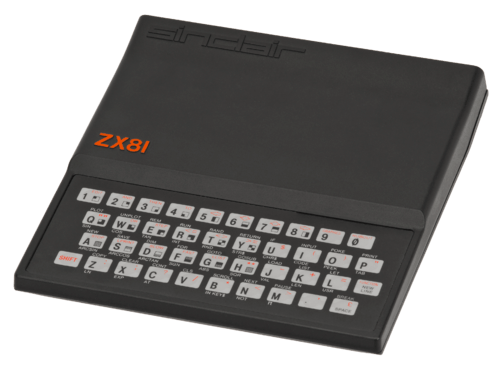
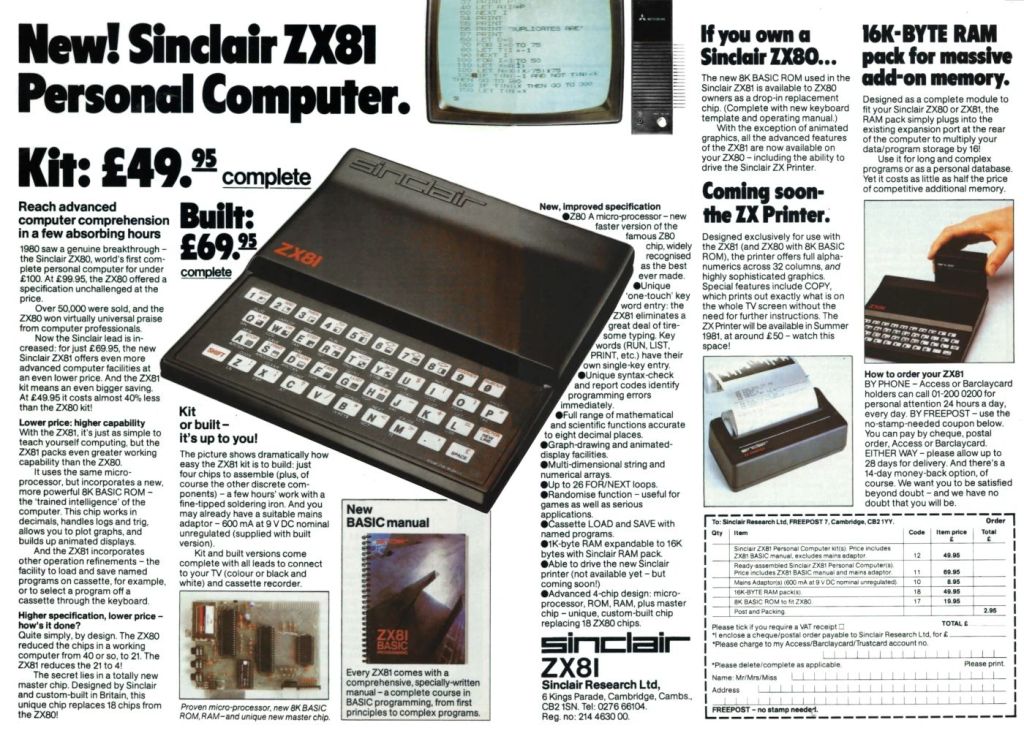
  • 1980Sinclair ZX80 launches in the UK as a very low-cost entry point into computing.
  • 1981: The IBM PC is released, creating the “PC-compatible” standard that still dominates today.
  • 1981: The Commodore VIC-20 becomes the first computer to sell over one million units.
  • 1982: The Commodore 64 launches and eventually becomes the best-selling single computer model of all time.
  • 1984Apple launches the Macintosh, the first successful mass-market computer with a Graphical User Interface (GUI) and a mouse.
  • 1985: The Amiga 1000 and Atari ST bring advanced multimedia and multitasking to the home. 

Standardisation & The Modern Age (1990s–Present) 

The market shifted away from proprietary “home computers” toward standardized “PCs” and portable devices. 

  • 1990Microsoft Windows 3.0 is released, making GUI computing standard on IBM-compatible PCs.
  • 1995Windows 95 launches, moving the PC away from its MS-DOS roots and integrating internet support.
  • 1998: The Apple iMac revitalizes Apple’s consumer line with an integrated, colourful design and USB ports.
  • 2010: The Apple iPad introduces the “tablet” as a primary home computing device for many users.
  • 2012: The Raspberry Pi launches, bringing home computing back to its DIY and educational roots.

The history of the home computer evolved from large, room-sized mainframes into the diverse, interconnected devices used today. This timeline categorises the evolution by era and key annual milestones

The Pre-Home Era: Mainframes & Minicomputers (1940s–1960s) 

Before computers could fit in a home, they were massive machines used by governments and corporations. 

  • 1945ENIAC (Electronic Numerical Integrator and Computer) is completed as the first general-purpose electronic digital computer.
  • 1951UNIVAC I is delivered to the US Census Bureau, becoming the first commercial computer produced in the US.
  • 1960DEC PDP-1 is introduced, representing the first “minicomputer” that was smaller than its predecessors.
  • 1965: The DEC PDP-8 launches, becoming the first commercially successful minicomputer. 

The Hobbyist Era: The First Personal Computers (1970–1976) 

The invention of the microprocessor allowed computers to become small enough for individuals to own, though they often required manual assembly. 

  • 1971Intel 4004, the first single-chip microprocessor, is released.
  • 1974: The MITS Altair 8800 appears on the cover of Popular Electronics, sparking the hobbyist revolution.
  • 1976: The Apple I, a single-board computer kit designed by Steve Wozniak, is released.

The “1977 Trinity” & The Home Boom (1977–1983) 

This era saw the transition from kits to fully assembled, consumer-ready “home computers”. 

  • 1977: The “1977 Trinity” launches: the Apple II (with colour graphics), the Commodore PET, and the Tandy TRS-80.
  • 1980Sinclair ZX80 is released as one of the first low-cost home computers in the UK.
  • 1981: The IBM PC is released, setting the industry standard for hardware and software compatibility.
  • 1981: The Osborne 1 is released as the first commercially successful portable computer.
  • 1982: The Commodore 64 launches; it eventually becomes the best-selling single computer model of all time.
  • 1982: The ZX Spectrum is released, becoming a cultural icon in Europe. 

The Graphical User Interface (GUI) Era (1984–1994)

Computers moved away from text-based commands toward visual icons and mice. 

  • 1984: The Apple Macintosh launches, popularising the mouse and Graphical User Interface (GUI).
  • 1985: The Commodore Amiga 1000 and Atari ST launch, bringing advanced multimedia and multitasking capabilities.
  • 1990: Tim Berners-Lee creates the World Wide Web, fundamentally changing how home computers would be used.
  • 1994: PowerPC processors are introduced by Apple, significantly increasing processing speed. 

The Internet & Mobility Era (1995–Present)

Home computing shifted focus toward connectivity, portability, and eventually, the cloud. 

  • 1995Windows 95 is released, integrating internet support and making PCs user-friendly for the masses.
  • 1998: The Apple iMac launches, ditching the floppy drive and embracing USB.
  • 2000s: Laptops begin to outsell desktops as portable computing gains momentum.
  • 2010: The Apple iPad pioneers the modern tablet market, creating a new “casual computing” category.
  • 2012: The Raspberry Pi is released, re-engaging a new generation in hobbyist computer building.
  • 2020s: The rise of Cloud Computing and AI Integration (like the Apple M1 chip) shifts the focus from local storage to remote applications and machine learning.

Azure AI vs Google Cloud AI vs AWS AI vs IBM Watson vs Alibaba Qwen

Azure AI vs Google Cloud AI vs AWS AI vs IBM Watson vs Alibaba Qwen

HPE NonStop Tandem Programming Languages, a development timeline

HPE NonStop (formerly Tandem) has evolved through distinct architectural eras, each introducing specific programming languages and environments to maintain its legendary fault tolerance. 

1. The Tandem Stack Machine Era (1974–1990)

This era focused on the proprietary 16-bit stack-based architecture (TNS), where software was designed to “fail-fast” and operate in process pairs. 

  • Nov 1974: Tandem Computers founded by Jimmy Treybig.
  • May 1976: TAL (Transaction Application Language) launched with the first Tandem/16 (NonStop I) system. It was the only language available at launch, derived from HP 3000’s SPL.
  • Late 1970s: COBOL74FORTRAN, and MUMPS were added to support business and scientific applications.
  • 1981: NonStop II introduced support for 32-bit addressing, enabling larger application memory.
  • 1983: SCOBOL (Screen COBOL) emerged alongside the Pathway transaction manager to handle terminal-based user interfaces and fault-tolerant logic.
  • 1986: NonStop SQL released as the first fault-tolerant relational database language.
  • 1987: C was introduced to the platform.
  • 1989: Integrity S2 line launched using MIPS processors, introducing a variant of Unix called NonStop UX

2. The MIPS RISC / Himalaya Era (1991–2004)

As Tandem migrated to MIPS processors (TNS/R), it introduced a Unix-like personality to attract modern developers while maintaining its legacy Guardian environment. 

  • 1991: Cyclone/R launched. Most software still ran in TNS stack mode using an “Accelerator” tool to translate code to MIPS instructions.
  • 1993: Himalaya K-Series released with native-mode compilers for C and COBOL to leverage MIPS performance.
  • 1994/1995: Open System Services (OSS) introduced a POSIX-compliant environment, enabling C++ and standard Unix utilities.
  • 1995: Java was first supported on the platform.
  • 1997: Compaq acquired Tandem; ServerNet became the standard interconnect.
  • Late 1990s: Support for scripting languages like PerlPython, and PHP began appearing in the OSS environment.

3. The HP Integrity Itanium Era (2005–2013)

Following the HP merger, the architecture moved to Intel Itanium (TNS/E), branded as HP Integrity NonStop

  • 2005: NonStop i introduced. Compilers for CC++, and Java were updated for the Itanium architecture.
  • 2000s: pTAL (Portable TAL) became the standard for system-level programming to bridge legacy TAL code to modern RISC/Itanium architectures.
  • 2011: Enhanced support for modern web languages and frameworks within the OSS environment. 

4. The Modern x86 / NonStop X Era (2014–Present)

HPE migrated the entire stack to standard Intel x86-64 processors (TNS/X) while retaining binary compatibility for legacy applications. 

  • 2014: NonStop X launched. All languages (COBOL, C, C++, Java) were migrated to target x86-64.
  • 2015: Transition to Hewlett Packard Enterprise (HPE) branding.
  • Recent Years: Integration of modern open-source dev-ops tools and languages, including JavaScript (Node.js)Python 3Go, and Samba via the HPE NonStop OSS environment. 

HPE NonStop (formerly Tandem) programming has evolved from proprietary languages designed for fault-tolerant, transaction-oriented processing (TAL, COBOL85) to supporting open-source languages (Java, C++, Python, PHP) on modern x86-64 hardware. The ecosystem spans from the initial Guardian OS to modern J-series and L-series OS, supporting TNS, TNS/R, TNS/E, and TNS/X architectures. 

Key Programming Languages & OS Timeline

  • 1970s–1980s (Tandem Guardian): Core development centered on TAL (Transaction Application Language) (system programming), COBOL85 (business logic), and TACL (Tandem Advanced Command Language) (command shell scripting).
  • 1990s (Guardian 90 / NonStop UX): Introduction of C and C++ for more flexible application development, alongside Pascal and FORTRAN.
  • 2000s (H-Series / J-Series – Itanium): Shift towards Java and enhanced support for C/C++ in the Pathway server environment.
  • 2010s–Present (J-Series / L-Series – x86-64): Modern NonStop systems, particularly on x86-64, expanded to include scripting languages like PerlPHP, and Python within the Open System Services (OSS) environment.
  • pTAL (Portable TAL): Introduced to bridge native TAL to newer, more portable processor architectures. 

Operating System & Architecture Evolution

  • Guardian (TNS): The foundational OS, relying on Tandem’s native stack, with TAL as the primary low-level language.
  • OSS (Open System Services): Introduced to bring POSIX-compliant, Unix-like functionality to NonStop, enabling easier porting of C/C++ and open-source applications.
  • Modern OS (J-series/L-series): Supports both Guardian (native) and OSS environments, allowing for a hybrid approach where traditional transaction processing (COBOL/TAL) mixes with modern web services (Java/Python).

Evolution of C++ on HPE NonStop Tandem systems

The evolution of C++ on HPE NonStop systems traces the platform’s transition from proprietary Tandem architectures to modern x86-64 standards.

HPE NonStop C++ Evolution Timeline

  • Early 1990s: Introduction of Native C/C++ (TNS/R)
    With the move to MIPS-based TNS/R architecture, Tandem introduced native C and C++ compilers. These supported the Guardian and the then-new Open System Services (OSS) personalities.
  • 2005: Itanium Transition (TNS/E)
    As the platform migrated to Intel Itanium processors (J-Series), the C++ compiler was updated to support the TNS/E (Tandem Native Stack / EPOC) architecture. This era introduced more robust Standard C++ Library support, though it required specific header management (e.g., CPATHEQ pragmas).
  • 2015: x86 Migration (TNS/X)
    The launch of NonStop X (L-Series) on Intel x86-64 marked a major shift. The compiler suite was re-engineered to leverage the x86-64 Instruction Set Architecture, providing significantly higher performance for C++ applications.
  • 2017: 64-Bit Addressing Support
    HPE introduced comprehensive 64-bit support for OSS processes (LP64 data model). This allowed C++ applications to access massive memory heaps beyond the previous 32-bit (ILP32) limits.
  • 2020–2022: Modern C++ Standards (C++11/14/17)
    HPE updated its toolchains to support modern language standards. The NonStop Development Environment for Eclipse (NSDEE) 13.x versions specifically introduced a dedicated UI for setting the C++17 Language Standard.
  • 2024: Kernel-Level Threading (KLT)
    The release of the L25.09 RVU brought Kernel-Level Threading to native C++ applications. This allowed C++ threads to execute concurrently across different IPUs, moving beyond the older POSIX User Threads (PUT) model.
  • 2025: Cloud-Native Development
    HPE now offers the HPE NonStop Development Environment (NSDevEnv) in the public cloud, allowing developers to build fault-tolerant C++ applications using a cross-compiler model without on-premise hardware. 

Evolution of C++ on HPE NonStop Tandem systems

HPE NonStop Pathway (now often part of NonStop TS/MP) – Detailed Timeline

HPE NonStop Pathway (now often part of NonStop TS/MP) has a legacy spanning nearly five decades, evolving from a terminal management system into a sophisticated middleware for high-scale, fault-tolerant Online Transaction Processing (OLTP)

Comprehensive Evolution Timeline

  • 1976: Genesis (Tandem Computers)
    The HP NonStop platform was originally introduced by Tandem Computers Inc. as the first fault-tolerant commercial computer. Pathway was soon developed to manage the distribution of transaction requests across multiple server processes.
  • 1980s: The Classic Pathway Era
    Pathway became the standard for “Screen COBOL” applications. It introduced the PATHMON process to monitor and manage serverclasses, ensuring that if one process failed, another would immediately take its place.
  • 1997: Compaq Acquisition
    Compaq acquired Tandem, integrating the NonStop technology into its enterprise portfolio. During this time, Pathway began adapting to newer networking protocols and client-server architectures.
  • 2002: Hewlett-Packard (HP) Acquisition
    HP merged with Compaq, and the platform was rebranded as HP NonStop. Pathway evolved into NonStop TS/MP (Transaction Services/Massive Parallelism), allowing for even greater scalability across massive clusters of processors.
  • 2014–2015: The x86 Revolution
    HP announced the NonStop X architecture, moving the platform from Itanium processors to standard Intel x86 hardware. Pathway (TS/MP) was optimized to run on this new architecture, providing the same high availability with modern hardware performance.
  • 2015–Present: HPE and Modern Middleware
    Following the split of HP, Hewlett Packard Enterprise (HPE) continued developing Pathway. Modern versions (like NonStop TS/MP 2.8) support advanced features like:
    • Dynamic Server Processes: Automatically scaling server instances based on load.
    • Heterogeneous Interoperability: Allowing TUXEDO or Java clients to access Pathway servers.
    • Virtualization: Deployment via HPE NonStop Virtual Enterprise (vNS). 

Core Components Over Time

  • PATHMON: The “manager” process that monitors all objects in the environment.
  • PATHCOM: The command-line interface used to configure and start Pathway objects.
  • Serverclasses: Groups of identical server processes that distribute transaction load for fault tolerance. 

HPE NonStop Pathway (now often part of NonStop TS/MP) – Detailed Timeline

TACL for HPE NonStop Tandem, Detailed Timeline

Tandem Advanced Command Language (TACL) is the interpreted, high-level command and programming language for HPE NonStop (formerly Tandem) systems. Its timeline follows the evolution of Tandem hardware and the Guardian operating system. 

Comprehensive TACL Timeline

  • 1974–1976: Foundation of Tandem
    • Tandem Computers Inc. was founded. The initial operating system, Guardian, was designed for fault-tolerant computing.
  • Late 1970s: Initial Release
    • TACL was introduced in the 1970s as the primary command interface, replacing or augmenting earlier, more primitive command interpreters. It was written in TAL (Tandem Application Language).
  • 1980s: Mature Programming Capabilities
    • TACL evolved from a simple shell into a powerful programming language. Key features like MacrosRoutines, and Variables (TEXT, ALIAS, STRUCT) were solidified during this era to automate complex system tasks.
  • 1994: D-Series (D30.00) Release
    • A significant update was documented in the TACL Programming Guide for D30.00, which detailed advanced features like Nowait I/OPathway Server integration, and SPI/EMS programmatic interfaces.
  • 1997–2000s: Corporate Transitions (Compaq & HP)
    • 1997: Compaq acquired Tandem.
    • 2002: HP merged with Compaq, and TACL development continued under the HP NonStop banner.
    • 2000: Updated reference manuals detailed TACL’s environment customization and the use of the _EXECUTE variable for program flow.
  • 2010s: H-Series and HPE Era
    • 2013: Comprehensive Reference Manuals were released, refining built-in functions for the H-Series architecture.
    • 2015: Hewlett Packard Enterprise (HPE) was formed. TACL is now maintained as part of the HPE NonStop software stack.
  • Current: Legacy & Automation
    • TACL remains the essential tool for administrative tasks and system-level automation on modern HPE NonStop X (x86) platforms.

TACL for HPE NonStop Tandem, Detailed Timeline

HPE NonStop Tandem TAL Detailed Timeline

TAL (Tandem Application Language) is the original system programming language for the HPE NonStop (formerly Tandem) platform. Developed by Tandem Computers in the mid-1970s, it was designed to provide high-level efficiency while allowing low-level machine access, similar to C but with a syntax influenced by ALGOL. 

Detailed Development Timeline

  • Mid-1970s: The Genesis
    • Tandem Computers, founded by James Treybig, introduces the first NonStop I system in 1976.
    • TAL is released as the primary language for writing the Guardian Operating System and system-level utilities.
    • The Tandem Advanced Command Language (TACL) is initially developed during this decade using TAL.
  • 1980s: Growth and Maturity
    • 1981–1983: Introduction of the NonStop II and TXP systems. TAL becomes the standard for developing mission-critical transaction applications like banking and point-of-sale systems.
    • 1985: The TAL Reference Manual is updated (March 1985), formalising advanced features like DEFINEsLITERALs, and complex pointer arithmetic.
  • 1990s: Transition to RISC
    • Tandem introduces TNS/R (RISC) systems based on MIPS processors.
    • pTAL (Portable TAL) is introduced to allow TAL code to run “natively” on RISC hardware, offering better performance than the emulated TNS environment.
  • 2000s–Present: Modernisation and Maintenance
    • 2003–2005: HP (which acquired Compaq, who had bought Tandem) migrates NonStop to Intel Itanium (TNS/E) and later x86 architectures (TNS/X).
    • 2006: The Common Run-Time Environment (CRE) is enhanced to support mixed-language programs (C, COBOL, pTAL) seamlessly.
    • Current Status: TAL is considered a legacy language, with most new development occurring in C/C++ or Java. However, it remains vital for maintaining the core Guardian OS and legacy banking kernels. 

Typical Program Development Workflow

According to the TAL Programmer’s Guide, a developer follows this “timeline” to create a program:

  1. Source Code Creation: Writing statements, removing comments, and defining PROCs and SUBPROCs.
  2. Compilation: Running the TAL Compiler to generate an object file.
  3. Binding: Using the Binder Program to link the object file with the TALLIB Run-Time Library.
  4. Acceleration: Running the Accelerator (for TNS code) to optimise it for native hardware execution.
  5. Execution: Deploying via the TACL interface. 

HPE NonStop Tandem TAL Detailed Timeline

COBOL Development Detailed Timeline Overview

COBOL (Common Business-Oriented Language) has evolved from a 1959 “stopgap” experiment into a cornerstone of global finance, currently powering approximately 95% of ATM swipes and 80% of in-person credit card transactions

The Early Years (1959–1965)

  • 1959 (Origins): Following a meeting at the Pentagon in May, the Conference on Data Systems Languages (CODASYL) was formed to create a machine-independent language for business. It was heavily influenced by Grace Hopper’s FLOW-MATIC.
  • 1960 (First Release): The COBOL-60 specifications were published. In December, the same program was successfully run on two different manufacturers’ computers (RCA and Univac), proving portability.
  • 1961–1965 (Rapid Revisions): Successive updates included COBOL-61 and COBOL-65, which introduced critical features like the SORT and REPORT WRITER facilities. 

Standardisation & Dominance (1968–1985) 

  • 1968 (COBOL-68): The American National Standards Institute (ANSI) published the first official standard, making COBOL the industry benchmark.
  • 1974 (COBOL-74): This update added file organisation methods and the DELETE statement, further refining data management capabilities.
  • 1985 (COBOL-85): A major milestone that introduced structured programming (e.g., END-IFEVALUATE) to improve code readability and maintainability. 

Modernisation & Object-Orientation (2002–Present) 

  • 2000 (The Y2K Crisis): COBOL regained global attention as programmers rushed to fix the “Millennium Bug” in legacy systems.
  • 2002 (COBOL-2002): The first major update in 17 years introduced Object-Oriented (OO) features, Unicode support, and XML processing.
  • 2014 (COBOL-2014): Simplified the language by making several niche features (like the SCREEN SECTION) optional and adopting IEEE 754 floating-point math.
  • 2023 (COBOL-2023): The current ISO/IEC 1989:2023 standard added modern programming comforts like asynchronous messaging (SEND/RECEIVE), transaction processing (COMMIT/ROLLBACK), and bitwise operators. 

Today, despite its age, an estimated 800 billion lines of COBOL remain in active use, with modernization efforts focusing on cloud integration and interoperability with Java and .NET.

COBOL Development Detailed Timeline Overview