Mark Whitfield IT Project Manager Training Focus

Mark Whitfield, an IT Project Manager specializing in HP NonStop systems, has a career and training history that spans over three decades, from his academic beginnings in the late 1980s to advanced cloud certifications in the 2020s. 

Early Career & Foundations (1988–1995)

During this era, Whitfield focused on core computer science and specialized mainframe systems while working for The Software Partnership (TSP) and Deluxe Data

  • 1988–1990: Completed a Higher National Diploma (HND) in Computing at the Bolton Institute of Higher Education (BIHE). Modules included Computer Systems Architecture, Programming Methodology, and Data Processing.
  • May 1993: Tandem Guardian Principles Course.
  • September 1994: VPS 7000/9000 Series and VPS Application Development (VOS 4.3).
  • June 1995: HP NonStop (Tandem) Performance Analysis and Tuning.

Development & Technical Specialisation (1995–2005)

Working primarily with Insider Technologies Limited, this period was marked by software development training in languages like C++ and initial forays into project management. 

  • November 1995: HP NonStop TAL Programming.
  • March 1997: C / C++ Programming at Comtec Computer Training.
  • October 1998: Managing Multiple Projects, Objectives, and Deadlines at SkillPath.
  • February 1999: Successful Project Management at SkillPath.
  • May 2000Microsoft Project ’98 Certification (Orange Belt) at the IIL UK Education Centre.
  • February 2001: Sales and Marketing training (In-House).
  • March 2004: MultiBatch NSK Job Scheduling Product.
  • February 2005: Web Services and SOA. 

Web Development & Security Focus (2006–2010) 

This era shows a shift toward web-based technologies and specialized security products. 

  • January 2006: PRINCE2 Project Management Foundation.
  • February 2006: NetObjects Fusion.
  • March 2006: Cryptography (In-House at Thales e-Security).
  • December 2006: Thales e-Security SafeSign Product.
  • January 2007: Developing Web Applications Using Microsoft Visual Studio .NET.
  • March 2009: Querying Microsoft SQL 2000 with Transact SQL (M2071) at QA Training.
  • May 2009: Writing for the Web and Website Visibility & Promotion at iTrain Education.
  • November 2009: Thales e-Security HP NonStop Security Resource Manager (SRM). 

Agile & Advanced Management (2011–Present) 

In his current era at companies like Betfred and Capgemini, Whitfield has prioritized professional certifications in management and cloud infrastructure. 

  • May 2011: Agile SCRUM Training (RADTAC) and PRINCE2 Practitioner Certification (ILX Group).
  • June–July 2011: Java and Google Android programming using the Eclipse IDE.
  • January 2012: ITIL Foundation Course.
  • July 2014: Advanced Microsoft Excel 2013.
  • November 2017Advanced Engagement Management Certification (Level 2) at Capgemini.
  • February 2022AZ-900 Microsoft Certified Azure Fundamentals.
  • July 2024: Microsoft Excel Refresher 2024 via Udemy. 

Mark Whitfield IT Project Manager Training Focus

Mark Whitfield Senior SC Cleared IT Project Manager

Mark Whitfield is a Senior, SC cleared IT Project and Engagement Manager with over 30 years of experience, specializing in the software development lifecycle (SDLC) for large-scale digital and financial payment systems. 

Mark Whitfield is a Senior, SC cleared IT Project and Engagement Manager

Professional Experience by Year

  • 2016–Present: Capgemini UK (Manchester)
    • Role: SC cleared Engagement Manager (A8), Custom Bespoke Solutions.
    • Key Projects: Leading high-value digital transformations and cloud migrations for UK Government applications, automotive (Jaguar Land Rover), and aerospace (Air Traffic Management iOS apps).
  • 2014–2016: Betfred Limited (UK)
    • Role: IT Senior Digital Project Manager, Online and Mobile Division.
    • Key Projects: Managed multiple Agile SCRUM projects for payment gateways, sportsbooks, and virtual gaming components across iOS, Android, and Windows platforms.
  • 2013–2014: Wincor Nixdorf Limited (UK)
    • Role: Project Manager, Professional Services – Banking Division.
    • Key Projects: Managed a £5M+ workstream for Lloyds Banking Group’s Self-Service Software Replacement (SSSR) program, migrating legacy HP NonStop systems to AIX-based Oracle technologies.
  • 1995–2013: Insider Technologies Limited
    • Role: Project Manager – Strategic Technical Initiatives / Senior Development Engineer.
    • Key Projects: Led the development of diagnostic products like Reflex 80:20 and RTLX for global banks including HSBC and Al Rajhi Bank in Saudi Arabia.
  • 1990–1995: The Software Partnership (later Deluxe Data/FIS)
    • Role: Senior Programmer / Lead Analyst.
    • Key Projects: Developed electronic banking software (sp/ARCHITECT) for major banks like Barclays and TSB on Tandem/HP NonStop mainframes. 
Led the development of diagnostic products like Reflex 80:20 and RTLX

Education

  • Higher National Diploma (HND) in Computer Studies (1988–1990)
    • Institution: Bolton Institute of Higher Education, BIHE (now University of Greater Manchester).
    • Achievement: Graduated with Distinction (overall first in class across 2 years).
  • A-Levels in Computer Science and Biology (1985–1988)
    • Institution: Leigh College. 

Awards and Key Certifications

Higher National Diploma (HND) in Computer Studies (1988–1990)
  • Communications & Engagement Award Winner (2022): Awarded by Capgemini UK for Cloud & Custom Applications.
  • Project Recognition Award (2014): Awarded by Wincor Nixdorf for successful delivery of the Lloyds Banking Group SSSR project.
  • Microsoft Certified: Azure Fundamentals (AZ-900) (2022).
  • Certified Engagement Manager (2016): Level 2 Certification through Capgemini.
  • Registered PRINCE2 Practitioner (Since 2011).
  • Agile SCRUM Certified (Since 2011).
  • ITIL Foundation Certified (Since 2012).

Mark Whitfield Senior SC Cleared IT Project Manager

SDLC vs ADLC Traditional vs Agentic

SDLC vs ADLC Traditional vs Agentic

Editable Project Management Templates for Agile and Waterfall projects

Mark Whitfield’s project management (PM) template collection is a comprehensive professional toolkit containing over 200 editable templates. Designed for both Agile Scrum and PRINCE2/Waterfall delivery, the set is built on over 24 years of real-world experience and is available for purchase on his official website and Etsy

Core Planning & Tracking Templates

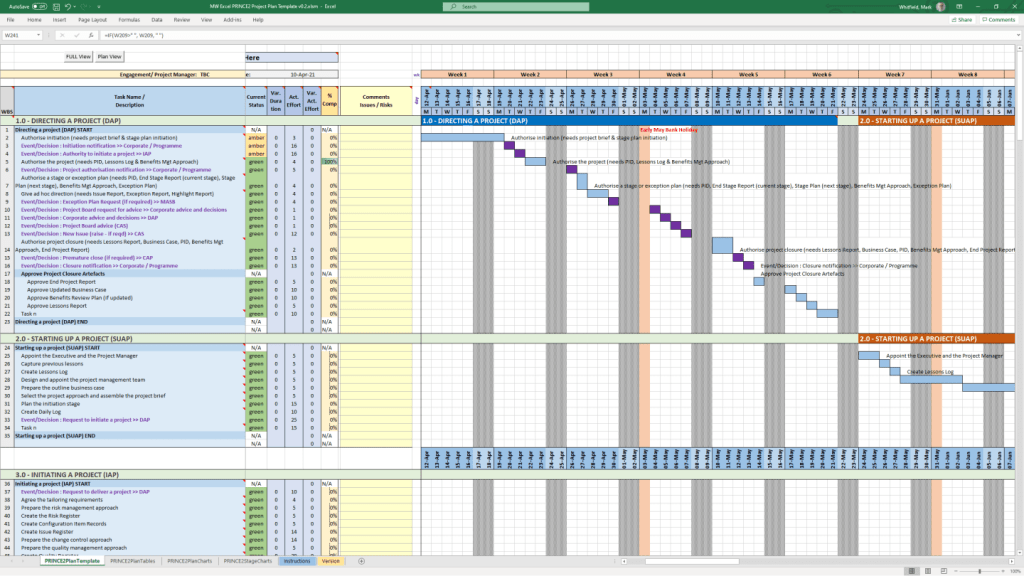
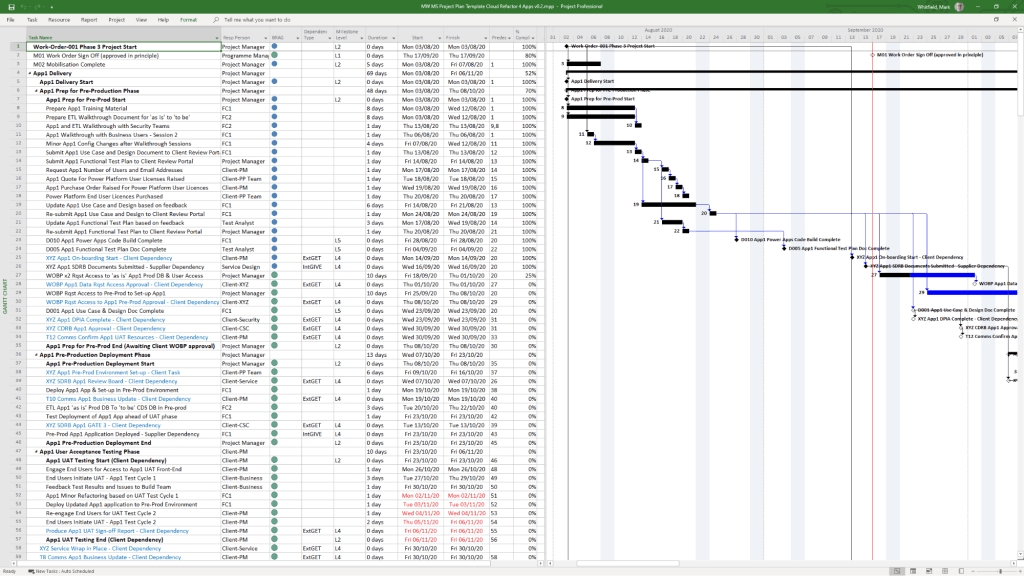
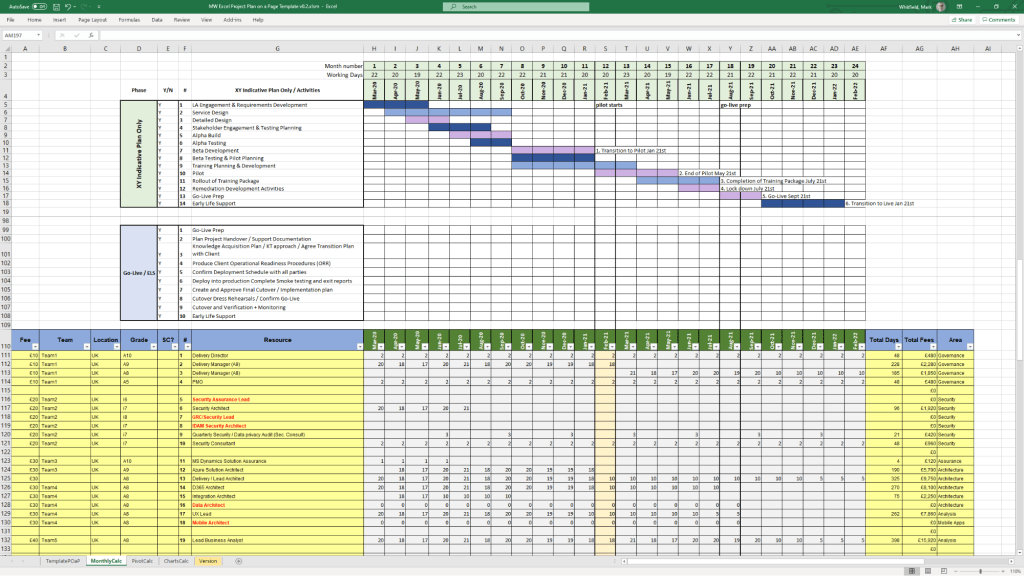
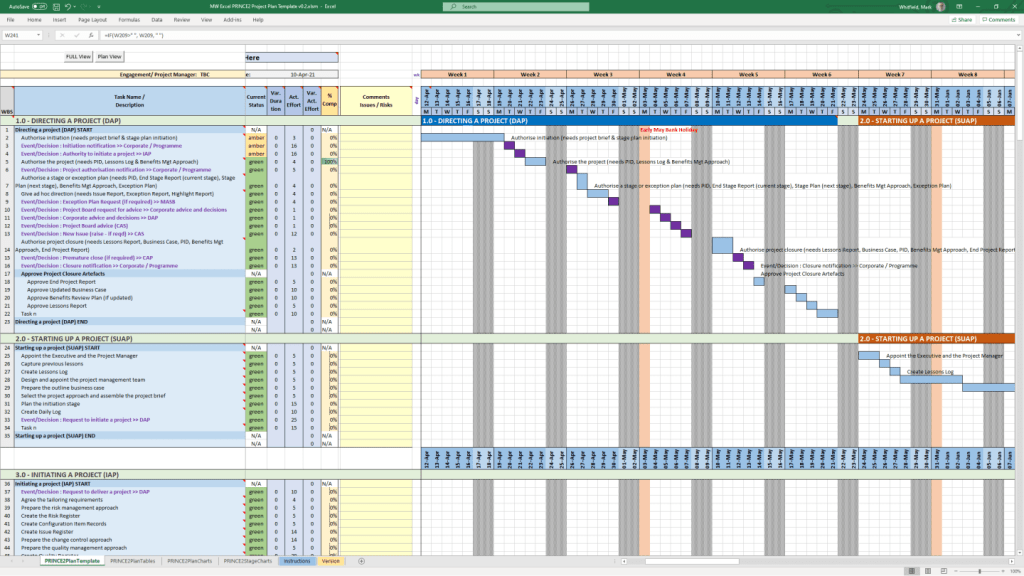
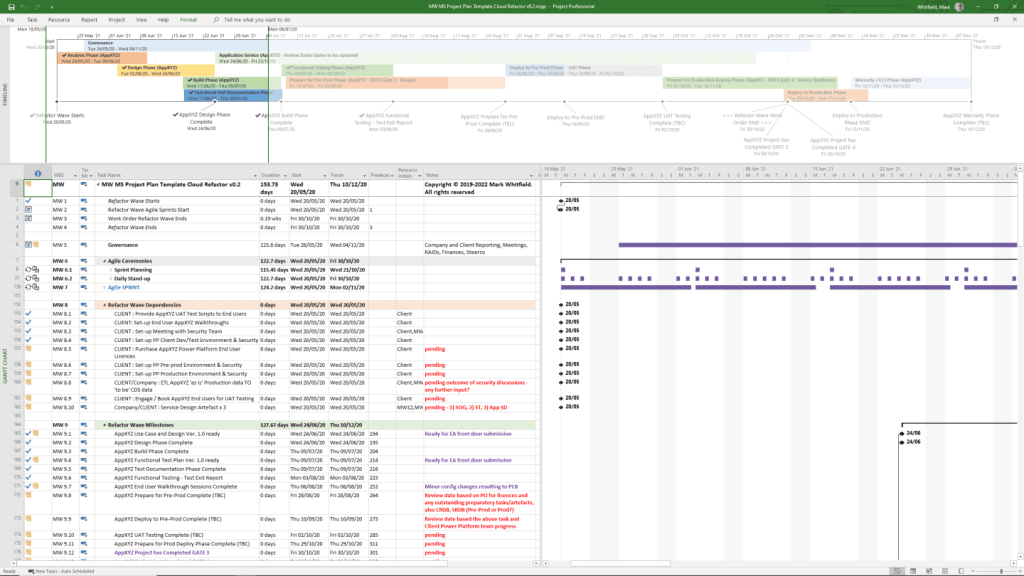
  • Detailed Project Plans: Comprehensive Microsoft Project (MPP) and Excel plans mapped to the Software Development Life Cycle (SDLC).
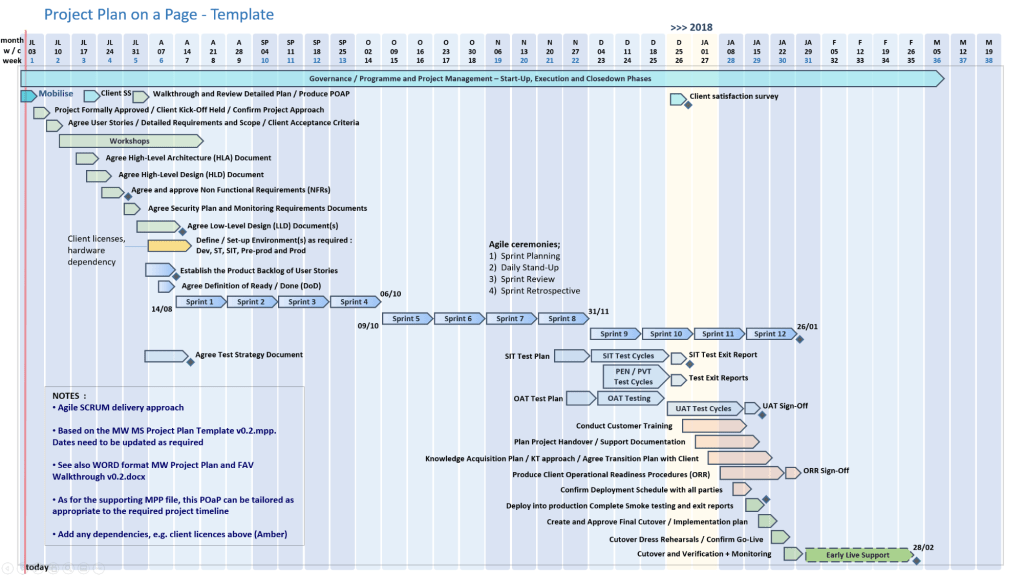
  • Plan on a Page (POaP): High-level visual summaries for client presentations, provided in both Excel and PowerPoint.
  • RAID Log: A robust Excel tracker managing Risks, Assumptions, Issues, and Dependencies, often including tabs for Change Requests and Lessons Learned.
  • Financial Trackers: Detailed spreadsheets for tracking project forecasts, actuals, variance, and resource costing.
  • RACI Matrix: Essential for defining roles (Responsible, Accountable, Consulted, Informed) within the project team. 

Methodology-Specific Artifacts

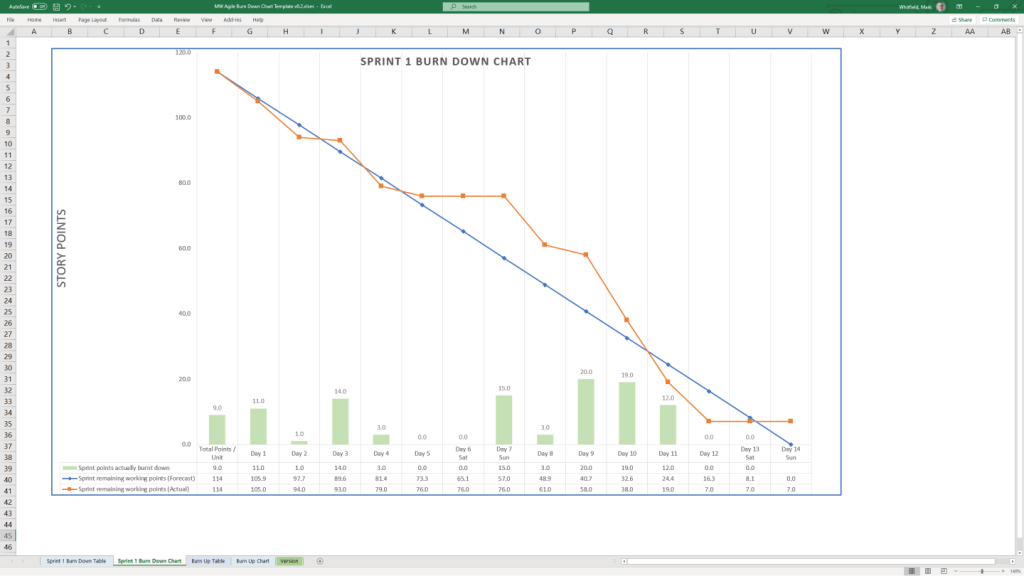
  • Agile Scrum: Includes burn-down and burn-up charts, sprint planning logs, and templates for daily stand-ups and retrospectives.
  • PRINCE2/Waterfall: Tailored plans for 7th Edition standards, including project mandates, transition plans, and close-out checklists. 

Reporting & Documentation

  • Status Reports: Weekly and monthly templates in Word and PowerPoint to communicate project health to stakeholders.
  • Walkthrough Guides: The ZIP package includes Microsoft Word documents explaining how to use and customise each major template.
  • Additional Tools: Benefits realisation plans, resource trackers, project organisation charts, and dependency logs. 

Key Features

  • Format: Primarily Microsoft Office (Excel, Word, PowerPoint, Project) for compatibility across desktop and mobile.
  • Lifetime Value: A one-time purchase typically includes FREE upgrades for life; users can re-contact the author for updated versions of the toolkit.
  • Customisability: All files are fully editable to suit specific project or organizational needs.

Editable Project Management Templates for Agile and Waterfall projects

Higher National Diploma (HND) in Computer Studies, Bolton Institute of Higher Education (BIHE)—now the University of Greater Manchester

The Higher National Diploma (HND) in Computer Studies at the Bolton Institute of Higher Education (BIHE)—now the University of Greater Manchester—is a two-year, Level 5 vocational qualification designed to provide practical, industry-specific skills. 

LinkedIn Group: https://www.linkedin.com/groups/51224

BIHE / University of Greater Manchester Evolution

The institution has undergone several name changes and status upgrades that affected the delivery of the HND: 

  • 1982: BIHE was formed through the merger of Bolton Institute of Technology and Bolton College of Education (Technical).
  • 1992: The Institute was granted the power to award taught degrees.
  • 2004/2005: BIHE achieved full university status, becoming the University of Bolton.
  • 2024: The university rebranded as the University of Greater Manchester

HND Computer Studies: Detailed Timeline

The course traditionally follows a two-year full-time or three-year part-time structure. 

Year 1: Foundations (HE4 Level)

The first year focuses on establishing core technical and business knowledge. In many versions of the Bolton curriculum, Year 1 is common across several computing programmes to allow for flexible progression. 

  • Core Modules:
    • Introduction to Programming: Developing fundamental coding logic.
    • Computer Platforms & Systems Architecture: Understanding the hardware and software environments.
    • Information Systems & Databases: The basics of data management.
    • Website Production & Networking Fundamentals: Introduction to web technologies and connectivity.
    • Quantitative Techniques & Business Studies: Integrating mathematical and commercial contexts. 

Year 2: Specialisation (HE5 Level)

The second year shifts toward advanced application, systems analysis, and professional practice. 

  • Advanced Modules:
    • Systems Analysis & Design: Producing system requirements and user interface specifications.
    • Programming Methodology: Moving into more complex application development.
    • Business Information Systems: Exploring how IT supports organizational requirements.
    • Database Design: Implementing industry-standard database packages.
  • Final Year Project: A major 20-credit core project where students investigate a specific field and apply their cumulative skills to a real-world scenario. 

Progression and Modern Standards

  • Academic Standing: Completion of the HND is equivalent to the first two years of a Bachelor’s degree (Level 5).
  • Degree Top-Up: Successful HND graduates can typically proceed directly into the final year (Level 6) of the BSc (Hons) Computer Science or BSc (Hons) Computing at Bolton.
  • Modern HTQs: Current versions of the course, such as the HND Computing for England (HTQ), now integrate modern fields like Artificial IntelligenceCloud Computing, and VR technologies.
1988 to 1990 : University of Greater Manchester (previously Bolton Institute of Higher Education – BIHE)
Higher National Diploma (HND) in Computer Studies, Bolton Institute of Higher Education (BIHE)—now the University of Greater Manchester

HP NonStop Tandem Training provided by HPE Education Services

HP NonStop (originally Tandem) training focuses on the platform’s unique fault-tolerant architecture, designed to ensure 24×7 availability and data integrity for mission-critical industries like finance and telecommunications. Current training is provided by HPE Education Services, which offers expert-led courses ranging from basic concepts to advanced system management and database administration. 

Training Overview

HPE’s curriculum is structured to support IT teams at all levels—from beginners to experienced operators—and can be customised for specific business needs. Key training areas include: 

  • System Operations: Managing NonStop environments, including S-Series or newer x86-based systems.
  • Architecture & Concepts: Understanding fault tolerance, “fail fast” mechanisms, and message-based operating systems.
  • Database Management: Specialized courses for NonStop SQL/MXSQL/MP, and Enscribe.
  • Application Development: Training in languages like C/C++COBOL, and TAL (Transaction Application Language).
  • Modern Environments: Transitioning to virtualised instances and hybrid cloud infrastructures. 

Detailed course information, including outlines and lab access, is available through the HPE NonStop Compute training portfolio


Detailed Textual Timeline: Era & Year

The NonStop platform has undergone three major architectural shifts since its founding.

1. The Tandem Era (1974–1997)

  • 1974: Tandem Computers Inc. is founded by James (Jimmy) Treybig.
  • 1975: Design of the Tandem/16 (later NonStop I) is completed.
  • 1976: The first system is shipped to Citibank, marking the birth of commercial fault-tolerant computing.
  • 1981: NonStop II is introduced, adding 32-bit addressing support.
  • 1983: NonStop TXP launches as the first new implementation of the instruction set, featuring cache memory.
  • 1983: Transaction Monitoring Facility (TMF) and Pathway are introduced, removing the need for applications to be manually coded for fault tolerance.
  • 1986: NonStop VLX is released with 32-bit datapaths and NonStop SQL, the first fault-tolerant SQL database.
  • 1987: NonStop CLX is introduced for the low-end/distributed market.
  • 1989: NonStop Cyclone debuts for high-end mainframe-level performance.
  • 1991: Migration to MIPS architecture begins with the Cyclone/R.
  • 1993: NonStop Himalaya K-series is released, using native MIPS R4400 processors.
  • 1994: Open System Services (OSS) adds a POSIX-compliant environment to the NonStop Kernel.
  • 1997: NonStop Himalaya S-Series introduces ServerNet, replacing older bus architectures. WikipediaWikipedia +7

2. The Compaq Era (1997–2002)

  • 1997: Compaq acquires Tandem Computers.
  • 1999: Zero Latency Enterprise (ZLE) solutions are introduced for real-time information access.
  • 2001: Compaq announces the migration of the entire NonStop line to Intel Itanium processors. 

3. The HP / HPE Era (2002–Present)

  • 2002: HP merges with Compaq, bringing the NonStop division under HP.
  • 2005: HP Integrity NonStop (“NonStop i” or TNS/E) is launched, completing the migration to Itanium.
  • 2014: NonStop X (TNS/X) is introduced, transitioning the platform to Intel x86-64 architecture.
  • 2015: Hewlett-Packard splits; NonStop becomes part of Hewlett Packard Enterprise (HPE).
  • 2020: Sales of Itanium-based systems officially end.
  • 2023–2024: NonStop evolves to support virtualised instances and deployment on hybrid infrastructures. 

HP NonStop Tandem Training provided by HPE Education Services

MuleSoft Architecture Overview, API-Led Connectivity

MuleSoft Architecture Overview, API-Led Connectivity

MuleSoft (a Salesforce company) – From October 2018 – June 2019, assigned as a Delivery Manager at MuleSoft (augmented) to deliver the Anypoint Platform.

Agentic Artificial Intelligence AI Explained

Agentic Artificial Intelligence AI Explained