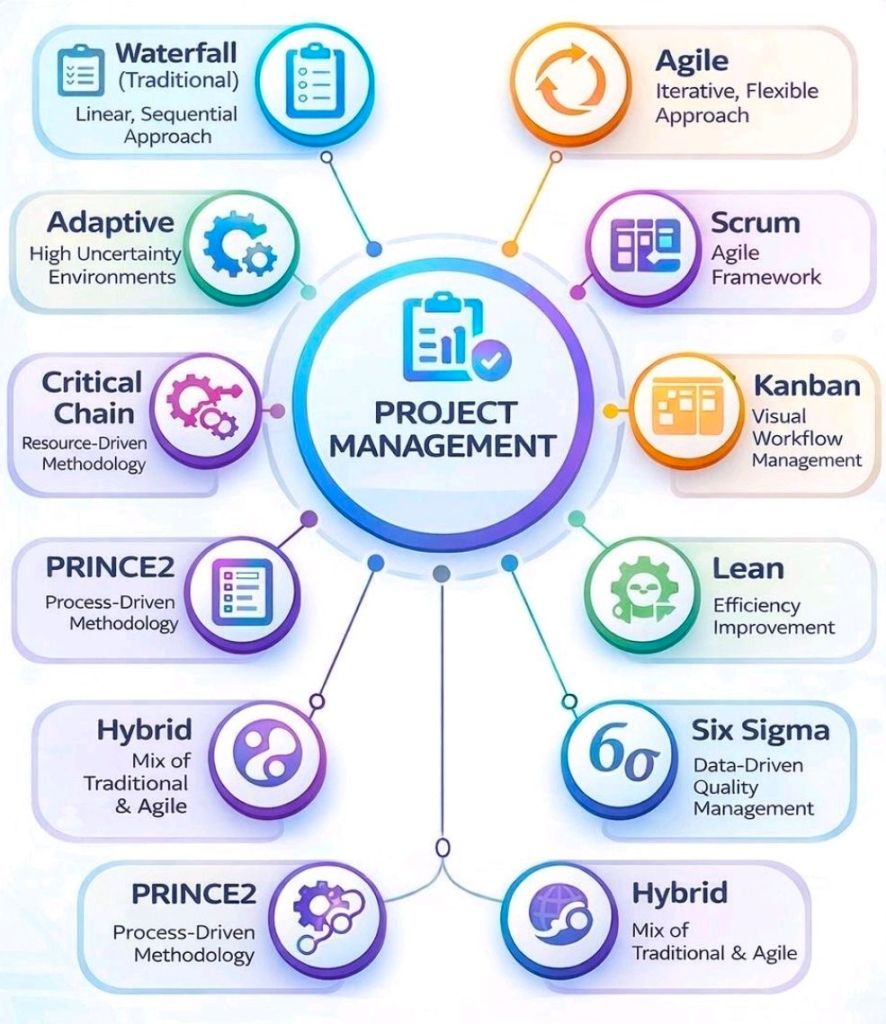
Project Management Methodologies Summarised

Project Management Methodologies Summarised

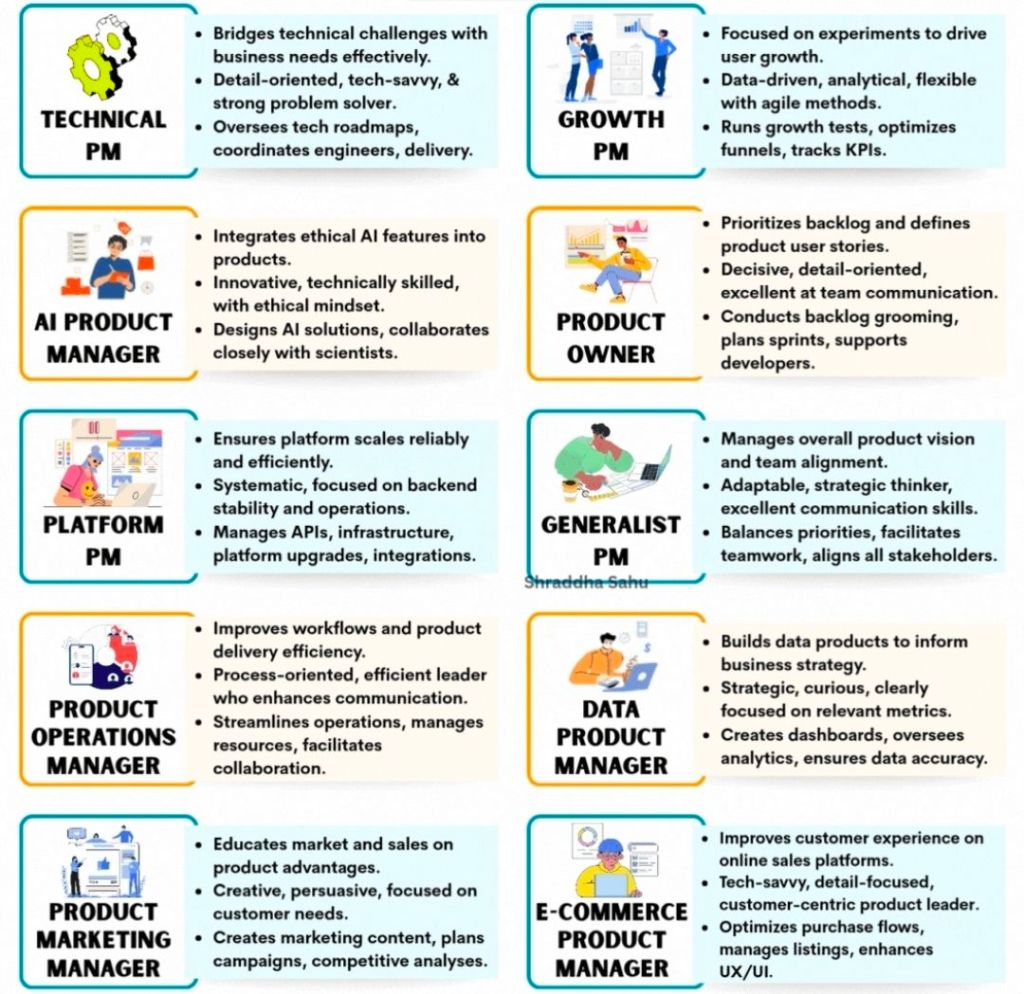
Types of Product Managers Overview

Types of Product Managers Overview

Project Management Methodologies, historical timeline by era and year

This is a detailed, comprehensive historical timeline of project management methodologies, tracing the evolution from ancient practices to modern adaptive frameworks.

I. Pre-Modern Era (Before 1900): Foundation of Task Coordination

  • 2570 BC (Great Pyramid of Giza): Completion of the pyramids, demonstrating early project organization with managers for each of the four faces, planning, and logistics.
  • 208 BC (Great Wall of China): Construction of the Great Wall, involving massive workforce organization divided into soldiers, citizens, and criminals.
  • 1850s (Transcontinental Railroad): US railroad projects requiring large-scale resource and schedule management.
  • 1896 (Harmonogram): Karol Adamiecki developed the harmonogram, a predecessor to the Gantt chart (published in 1931). 

II. Early Modern Era (1910s–1950s): The Scientific Management Era 

This era brought “scientific management” to project control, focusing on efficiency and visualization. 

  • 1910s (Gantt Chart): Henry Gantt developed the Gantt chart, a visual tool for scheduling tasks over time.
  • 1911 (Scientific Management): Frederick Taylor published The Principles of Scientific Management, focusing on efficiency and time-saving.
  • 1931–1936 (Hoover Dam): One of the first large-scale applications of Gantt charts for complex scheduling.
  • 1942–1945 (Manhattan Project): Development of the atomic bomb, creating a need for rapid, complex planning and large-scale team coordination. 

III. The “Golden Age” of Project Management (1950s–1960s): Formal Methodologies 

This era introduced mathematical models for managing complex, interdependent tasks. 

  • 1956 (AACE Formed): The American Association of Cost Engineers (now AACE International) was formed, specializing in cost control and scheduling.
  • 1957 (Critical Path Method – CPM): Developed by Dupont Corporation to manage chemical plant maintenance shutdowns.
  • 1958 (Program Evaluation and Review Technique – PERT): Created by the US Navy Special Projects Office for the Polaris missile submarine project to manage task time and risk.
  • 1962 (Work Breakdown Structure – WBS): The US Department of Defense mandated the use of WBS for large, complex projects.
  • 1965 (IPMA Founded): The International Project Management Association (IPMA) was launched, the world’s first project management association.
  • 1969 (PMI Founded): The Project Management Institute (PMI) was launched to promote the profession, later developing the PMP certification. 

IV. The “Silver Age” (1970s–1980s): Systems and Controls 

  • 1970s (Waterfall Introduction): While used informally earlier, the Waterfall methodology was formalized for software development in the 1970s, emphasizing sequential phases.
  • 1975 (PROMPTII): Simpact Systems Ltd created PROMPTII, a methodology to handle cost overruns in computer projects, which later formed the basis of PRINCE.
  • 1975 (Mythical Man-Month): Fred Brooks published his seminal work on software engineering project management.
  • 1978 (Toyota Production System): Lean production and Kanban techniques, used in manufacturing, began to influence project workflow.
  • 1984 (Theory of Constraints – TOC): Dr. Eliyahu Goldratt published The Goal, introducing the Theory of Constraints for managing constraints (bottlenecks).
  • 1986 (Scrum): Takeuchi and Nonaka defined Scrum as a project management style for fast-paced development.
  • 1987 (PMBOK Guide): The Project Management Institute published the first Project Management Body of Knowledge (PMBOK) white paper.
  • 1989 (PRINCE): The UK government launched PRojects IN Controlled Environments (PRINCE), the standard for information systems projects. 

V. Rebirth and Modern Era (1990s–2000s): Agile and Adaptive Methods 

  • 1994 (CHAOS Report): The Standish Group published the first report documenting high IT project failure rates.
  • 1995 (Scrum Formalization): Jeff Sutherland and Ken Schwaber formally defined the Scrum framework.
  • 1996 (PRINCE2): PRINCE was updated to PRINCE2 to become a generic, more flexible methodology applicable to all project types.
  • 1997 (Critical Chain Project Management – CCPM): Eliyahu Goldratt invented CCPM, based on the Theory of Constraints.
  • 1998 (PMBOK Standard): The American National Standards Institute (ANSI) recognized PMBOK as a standard.
  • 2001 (Agile Manifesto): 17 software developers met to publish the Manifesto for Agile Software Development, prioritizing collaboration and adaptability over rigid plans.
  • 2007 (Kanban for Software): David Anderson adopted Kanban for software development, focusing on visualizing work and limiting work-in-progress. 

VI. The Contemporary Era (2010s–Present): Hybrid, AI, and Speed 

  • 2012 (ISO 21500): The International Organization for Standardization published ISO 21500:2012, “Guidance on Project Management”.
  • 2017 (PMBOK 6th Ed & PRINCE2 Update): PMI introduced Agile/adaptive practices into PMBOK, while AXELOS released a more flexible PRINCE2.
  • 2018 (PRINCE2 Agile): PRINCE2 Agile was launched to combine the governance of PRINCE2 with the flexibility of Agile.
  • 2021 (PMBOK 7th Ed): A major shift in PMI standards, moving from process-based to principle-based, focusing on project outcomes.
  • 2020s–Present (AI/Hybrid): Rise of AI-driven project management, automated reporting, and hybrid methodologies combining Waterfall stability with Agile speed. 

Project Management Methodologies, historical timeline by era and year

Extreme Programming XP project management summary and detailed historical timeline by era and year

Extreme Programming (XP) is a prominent, disciplined Agile software development framework designed to improve software quality and responsiveness to changing customer requirements. Developed by Kent Beck in the mid-1990s, it focuses on taking beneficial engineering practices—such as pair programming, testing, and continuous integration—to “extreme” levels. 

Project Management Summary: Core XP Components

XP differs from other Agile methods by focusing intensely on technical engineering practices alongside project management techniques. 

  • Core Values: Communication, Simplicity, Feedback, Courage, and Respect.
  • Key Practices: Pair Programming, Test-Driven Development (TDD), Collective Ownership, Continuous Integration, Refactoring, and Small Releases.
  • Project Management Focus:
    • The Planning Game: Combines business priorities with technical estimates to determine what to build next.
    • Small Releases: Frequent, working software releases (often 1–2 weeks) to gather rapid customer feedback.
    • On-site Customer: A customer representative works with the team to provide instant feedback and clarify requirements.
    • Sustainable Pace: Limiting work weeks to 40 hours to avoid burnout and maintain quality. 

Detailed Historical Timeline of XP

Era 1: Origins and The Chrysler C3 Project (1993–1996) 

  • 1993: Chrysler launches the Comprehensive Compensation System (C3) project to upgrade payroll software, which struggles for years.
  • March 1996: Kent Beck is brought in to lead the C3 project. To salvage the project, Beck starts encouraging team members to adopt a set of technical practices he developed based on his experiences.
  • 1996: Ward Cunningham heavily influences the development of early XP concepts, particularly the “metaphor”.
  • 1996: The project begins adopting daily meetings, pair programming, and TDD.

Era 2: Formalization and “Embracing Change” (1997–2000) 

  • 1997: Ron Jeffries is brought in to coach the C3 team, helping solidify the practices.
  • 1998: The term “Extreme Programming” becomes widely discussed within the Smalltalk and Object-Oriented programming communities.
  • October 1999: Kent Beck publishes Extreme Programming Explained: Embrace Change, formally defining the framework.
  • February 2000: Daimler-Benz acquires Chrysler and cancels the C3 project after 7 years of work. Despite cancellation, the methodology proved that it could produce working, high-quality software, just not fast enough to overcome the legacy backlog. 

Era 3: Rise of Agile and Expansion (2001–2005)

  • February 2001: Kent Beck and Ron Jeffries are among the 17 developers who draft the Manifesto for Agile Software Development at Snowbird, Utah. XP is recognized as one of the foundational “Agile” methods.
  • 2001: The first Agile Alliance conference is held. XP is considered the dominant agile methodology during this period.
  • 2002–2003: XP gains global popularity; numerous books are published expanding on the core 12 practices.
  • 2004: The second edition of Extreme Programming Explained is released, shifting focus from 12 rigid practices to more adaptive principles. 

Era 4: Integration with DevOps and Continuous Delivery (2006–Present)

  • 2006-2010: As Scrum gains popularity for general project management, XP practices like TDD and Pair Programming become the “standard” technical practices for high-performing teams, often blended with Scrum (ScrumXP).
  • 2010s: The rise of DevOps and continuous delivery, which inherently requires XP practices like CI/CD (Continuous Integration/Continuous Delivery).
  • 2020-2026: While fewer companies identify strictly as doing “XP,” its technical practices are considered essential to modern software development and are integrated into almost all Agile methodologies to ensure quality and speed.

Extreme Programming XP project management summary and detailed historical timeline by era and year

Free Upgrade Project Management Templates Download by focus area

Mark Whitfield provides a comprehensive suite of over 200 editable project management templates designed for both Agile and Waterfall delivery. These tools are built based on 21+ years of IT project delivery experience and are formatted for Microsoft Office (Excel, Word, PowerPoint) and Microsoft Project (MPP).


Core Planning & Tracking Templates

  • Detailed Project Plans: Comprehensive MPP and Excel files covering the full Software Development Life-cycle (SDLC), including Waterfall and Agile Scrum sprints.
  • Plan on a Page (POaP): High-level visual summaries in PowerPoint or Excel for client reporting and executive snapshots.
  • RAID Log: A central tracker for Risks, Actions, Issues, and Dependencies, often including tabs for Decisions, Opportunities, and Lessons Learned.
  • RACI Matrix: A tracker to define roles and responsibilities (Responsible, Accountable, Consulted, Informed). 

Financial & Resource Management

  • Project Finance Tracker: Tools for managing project budgets, including forecasts vs. actuals, margin analysis, and variation tracking.
  • Resource Planning: Grid templates for costing project resources per phase and tracking team allocations.
  • Benefits Realisation: A spreadsheet to compare initial project goals against actual business outcomes and costs. 

Reporting & Communication

  • Status Reports: Weekly and monthly templates in Word and PowerPoint that include milestone dashboards, project health indicators, and “next steps”.
  • Organisation Charts: Templates for visualising the project hierarchy and stakeholder contacts.
  • Agile Dashboards: Excel-based Burn Down and Burn Up charts for teams that do not have access to tools like Jira. 

Methodology Support

  • PRINCE2 7th Edition: Specific MPP and Excel templates aligned with the latest PRINCE2 standards.
  • Agile Frameworks: Templates for Sprint Planning, Daily Stand-ups, and Sprint Retrospectives. 

These templates are available for purchase on Mark Whitfield’s official site and typically include free lifetime upgrades. 

Free Upgrade Project Management Templates Download by focus area

Editable Project Management Templates for Agile and Waterfall projects

Mark Whitfield’s project management (PM) template collection is a comprehensive professional toolkit containing over 200 editable templates. Designed for both Agile Scrum and PRINCE2/Waterfall delivery, the set is built on over 24 years of real-world experience and is available for purchase on his official website and Etsy

Core Planning & Tracking Templates

  • Detailed Project Plans: Comprehensive Microsoft Project (MPP) and Excel plans mapped to the Software Development Life Cycle (SDLC).
  • Plan on a Page (POaP): High-level visual summaries for client presentations, provided in both Excel and PowerPoint.
  • RAID Log: A robust Excel tracker managing Risks, Assumptions, Issues, and Dependencies, often including tabs for Change Requests and Lessons Learned.
  • Financial Trackers: Detailed spreadsheets for tracking project forecasts, actuals, variance, and resource costing.
  • RACI Matrix: Essential for defining roles (Responsible, Accountable, Consulted, Informed) within the project team. 

Methodology-Specific Artifacts

  • Agile Scrum: Includes burn-down and burn-up charts, sprint planning logs, and templates for daily stand-ups and retrospectives.
  • PRINCE2/Waterfall: Tailored plans for 7th Edition standards, including project mandates, transition plans, and close-out checklists. 

Reporting & Documentation

  • Status Reports: Weekly and monthly templates in Word and PowerPoint to communicate project health to stakeholders.
  • Walkthrough Guides: The ZIP package includes Microsoft Word documents explaining how to use and customise each major template.
  • Additional Tools: Benefits realisation plans, resource trackers, project organisation charts, and dependency logs. 

Key Features

  • Format: Primarily Microsoft Office (Excel, Word, PowerPoint, Project) for compatibility across desktop and mobile.
  • Lifetime Value: A one-time purchase typically includes FREE upgrades for life; users can re-contact the author for updated versions of the toolkit.
  • Customisability: All files are fully editable to suit specific project or organizational needs.

Editable Project Management Templates for Agile and Waterfall projects

Building a Product on Paper and in Reality

Building a Product on Paper and in Reality

Project Management LinkedIn Group

Project Management LinkedIn Group

https://www.linkedin.com/groups/163300

Project Management Café, PRINCE2 Agile SCRUM Kanban MPP MSP Templates ITIL LEAN DevOps PMP Six Sigma

This is a Project Management Group Café for PM students, graduates and professionals looking to either locate, discuss or contribute ideas for PM templates for; Agile, Scrum, Kanban, PRINCE2 Waterfall projects, e.g. Plan on a Page (POaP), RACI, MPP, RAID logs, finance trackers, status reports, org charts etc. etc.

Project Management LinkedIn Group