Project Management Methodologies, historical timeline by era and year

This is a detailed, comprehensive historical timeline of project management methodologies, tracing the evolution from ancient practices to modern adaptive frameworks.

I. Pre-Modern Era (Before 1900): Foundation of Task Coordination

  • 2570 BC (Great Pyramid of Giza): Completion of the pyramids, demonstrating early project organization with managers for each of the four faces, planning, and logistics.
  • 208 BC (Great Wall of China): Construction of the Great Wall, involving massive workforce organization divided into soldiers, citizens, and criminals.
  • 1850s (Transcontinental Railroad): US railroad projects requiring large-scale resource and schedule management.
  • 1896 (Harmonogram): Karol Adamiecki developed the harmonogram, a predecessor to the Gantt chart (published in 1931). 

II. Early Modern Era (1910s–1950s): The Scientific Management Era 

This era brought “scientific management” to project control, focusing on efficiency and visualization. 

  • 1910s (Gantt Chart): Henry Gantt developed the Gantt chart, a visual tool for scheduling tasks over time.
  • 1911 (Scientific Management): Frederick Taylor published The Principles of Scientific Management, focusing on efficiency and time-saving.
  • 1931–1936 (Hoover Dam): One of the first large-scale applications of Gantt charts for complex scheduling.
  • 1942–1945 (Manhattan Project): Development of the atomic bomb, creating a need for rapid, complex planning and large-scale team coordination. 

III. The “Golden Age” of Project Management (1950s–1960s): Formal Methodologies 

This era introduced mathematical models for managing complex, interdependent tasks. 

  • 1956 (AACE Formed): The American Association of Cost Engineers (now AACE International) was formed, specializing in cost control and scheduling.
  • 1957 (Critical Path Method – CPM): Developed by Dupont Corporation to manage chemical plant maintenance shutdowns.
  • 1958 (Program Evaluation and Review Technique – PERT): Created by the US Navy Special Projects Office for the Polaris missile submarine project to manage task time and risk.
  • 1962 (Work Breakdown Structure – WBS): The US Department of Defense mandated the use of WBS for large, complex projects.
  • 1965 (IPMA Founded): The International Project Management Association (IPMA) was launched, the world’s first project management association.
  • 1969 (PMI Founded): The Project Management Institute (PMI) was launched to promote the profession, later developing the PMP certification. 

IV. The “Silver Age” (1970s–1980s): Systems and Controls 

  • 1970s (Waterfall Introduction): While used informally earlier, the Waterfall methodology was formalized for software development in the 1970s, emphasizing sequential phases.
  • 1975 (PROMPTII): Simpact Systems Ltd created PROMPTII, a methodology to handle cost overruns in computer projects, which later formed the basis of PRINCE.
  • 1975 (Mythical Man-Month): Fred Brooks published his seminal work on software engineering project management.
  • 1978 (Toyota Production System): Lean production and Kanban techniques, used in manufacturing, began to influence project workflow.
  • 1984 (Theory of Constraints – TOC): Dr. Eliyahu Goldratt published The Goal, introducing the Theory of Constraints for managing constraints (bottlenecks).
  • 1986 (Scrum): Takeuchi and Nonaka defined Scrum as a project management style for fast-paced development.
  • 1987 (PMBOK Guide): The Project Management Institute published the first Project Management Body of Knowledge (PMBOK) white paper.
  • 1989 (PRINCE): The UK government launched PRojects IN Controlled Environments (PRINCE), the standard for information systems projects. 

V. Rebirth and Modern Era (1990s–2000s): Agile and Adaptive Methods 

  • 1994 (CHAOS Report): The Standish Group published the first report documenting high IT project failure rates.
  • 1995 (Scrum Formalization): Jeff Sutherland and Ken Schwaber formally defined the Scrum framework.
  • 1996 (PRINCE2): PRINCE was updated to PRINCE2 to become a generic, more flexible methodology applicable to all project types.
  • 1997 (Critical Chain Project Management – CCPM): Eliyahu Goldratt invented CCPM, based on the Theory of Constraints.
  • 1998 (PMBOK Standard): The American National Standards Institute (ANSI) recognized PMBOK as a standard.
  • 2001 (Agile Manifesto): 17 software developers met to publish the Manifesto for Agile Software Development, prioritizing collaboration and adaptability over rigid plans.
  • 2007 (Kanban for Software): David Anderson adopted Kanban for software development, focusing on visualizing work and limiting work-in-progress. 

VI. The Contemporary Era (2010s–Present): Hybrid, AI, and Speed 

  • 2012 (ISO 21500): The International Organization for Standardization published ISO 21500:2012, “Guidance on Project Management”.
  • 2017 (PMBOK 6th Ed & PRINCE2 Update): PMI introduced Agile/adaptive practices into PMBOK, while AXELOS released a more flexible PRINCE2.
  • 2018 (PRINCE2 Agile): PRINCE2 Agile was launched to combine the governance of PRINCE2 with the flexibility of Agile.
  • 2021 (PMBOK 7th Ed): A major shift in PMI standards, moving from process-based to principle-based, focusing on project outcomes.
  • 2020s–Present (AI/Hybrid): Rise of AI-driven project management, automated reporting, and hybrid methodologies combining Waterfall stability with Agile speed. 

Project Management Methodologies, historical timeline by era and year

Mark Whitfield, Senior IT Project Manager

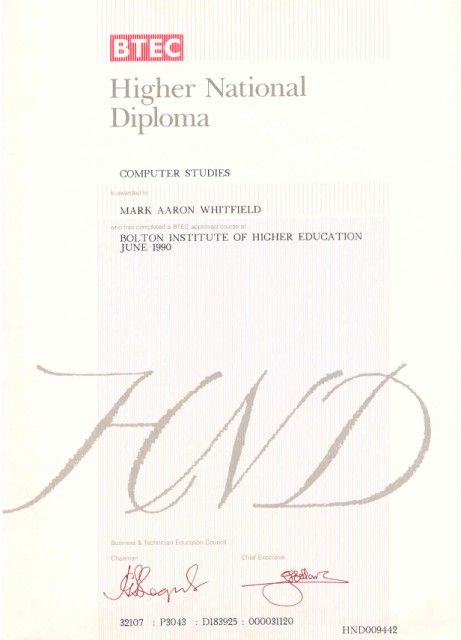
Mark Whitfield is a highly experienced IT Senior Project Manager and Engagement Manager based in Manchester, UK, specializing in Agile Scrum, PRINCE2, and Waterfall methodologies. He holds a degree in Computing (1990) and has extensive experience in IT hardware solutions, financial services, and Aerospace & Defence. 

Here is a comprehensive summary of his profile, with links based on the provided search data:

Professional Profile

  • Name: Mark Whitfield
  • Role: IT Senior Project Manager / Engagement Manager (SC Cleared)
  • Key Skills: Agile Scrum, PRINCE2, ITIL, Financial Forecasting, Stakeholder Management, Technical Initiative Leadership.
  • Education: Computing (Graduated 1990). 

Comprehensive Career History

  • Capgemini UK (Jan 2016 – Present): SC Cleared Engagement Manager (A8) in Custom Bespoke Solutions.
    • Recent Experience: Project Manager for a UK-wide Air Traffic organisation, delivering new Apple iOS Apps for military and public use.
  • Betfred Limited (Dec 2014 – Jan 2016): IT Senior Digital Project Manager, Online and Mobile Division.
  • Wincor Nixdorf Limited (Sep 2013 – Dec 2014): Project Manager, Professional Services – Banking Division.
    • Key Project: Managed a £5+ million project replacing legacy HP NonStop software systems with AIX-based J2EE/Oracle technologies for a major UK bank.
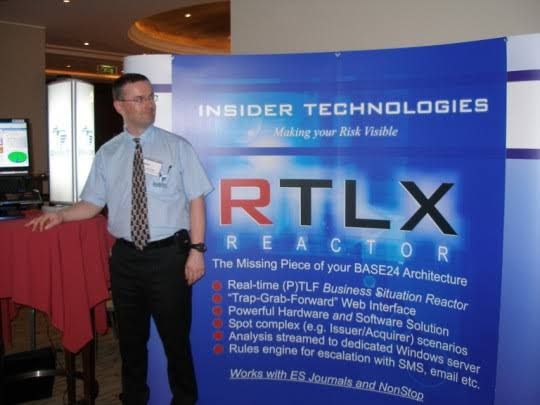
  • Reflex / Insider Technologies (Aug 1995 – Sep 2013): Project Manager – Strategic Technical Initiatives.
  • eFunds (1994 – 1995): Lead Analyst. 

Certifications & Training

  • Cloud & Project Management: AZ-900 Microsoft Certified Azure Fundamentals (2022), Advanced Engagement Management (2017), Registered PRINCE2 Practitioner (2011).
  • Agile: Agile SCRUM Training (2011).
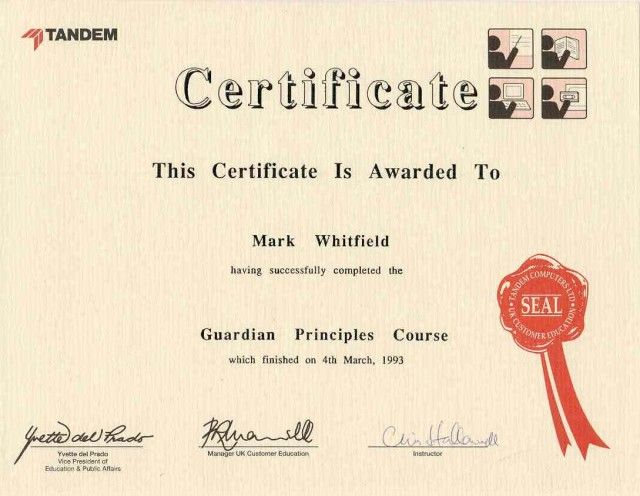
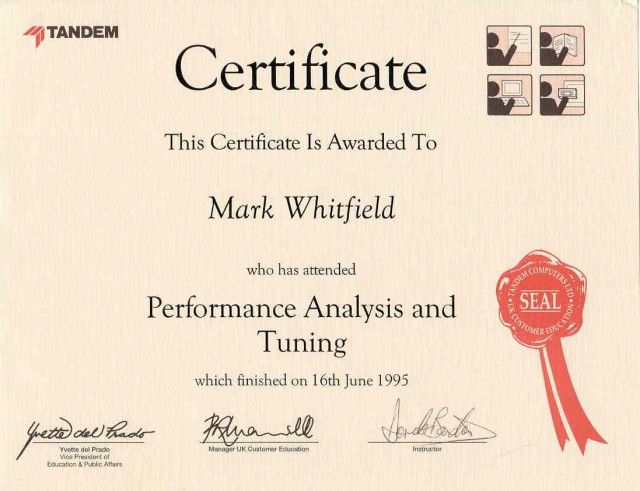
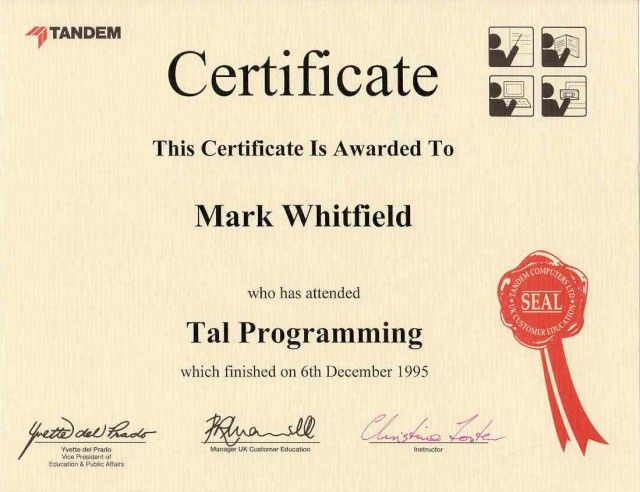
  • Technical: TANDEM Performance Analysis (1995), C++ for Non-C Programmers (1997), Querying MS SQL 2000 (2009). 

Awards

  • C&CA UK’s Communications & Engagement Award Winner – Cloud & Custom Applications (Capgemini UK, Dec 2022).
  • Project Recognition Award – Wincor Nixdorf (Retail Banking Project). 

Web Presence & Documents

Mark Whitfield, Senior IT Project Manager

By era;

Mark Whitfield is a highly experienced IT Project Manager, Senior Developer, and SC-cleared consultant with over 30 years of experience, specializing in HP NonStop (Tandem) systems, banking software, and digital transformation projects. He is currently an Engagement Project Manager at Capgemini. 

Career Overview

  • Specialism: HP NonStop (Tandem) mainframes, BASE24, transaction monitoring, Agile/Waterfall methodologies.
  • Key Industries: Financial services, electronic banking, government, automotive, aerospace.
  • Core Competencies: Software development (C, C++, COBOL, TAL), Project Management (PRINCE2 Practitioner, Scrum), Pre-sales technical consultancy. 

Career Timeline by Era and Year

1. The Foundation & Tandem Era (1990–1995)

  • 1990: Graduated in Computing and started as a Programmer for The Software Partnership in Runcorn, specializing in sp/ARCHITECT-BANK on Tandem Computers.
  • 1990-1994: Developed banking code for TSB, Bank of Scotland, Rabobank, and Girofon (Denmark).
  • 1992: Worked on the Barclays Business Master II (BBM II) project in Knutsford.
  • 1994: Company taken over by Deluxe Data (later FIS). 

2. Insider Technologies & Monitoring Era (1995–2013)

  • 1995–2013: Joined Insider Technologies Ltd as a Senior Development Engineer and Project Manager.
  • 1995-2004: Developed monitoring/diagnostic software (Reflex 80:20, Reflex ONE24) for HP NonStop payment systems.
  • 1997: Worked on projects for CRESTCo.
  • Early 2000s: Focused on HP NonStop transaction/payment monitoring for ATM/POS devices using ACI’s XPNET.
  • 2005-2013: Managed first HP OpenView Operations Smart Plug-In certification for NonStop; designed XPERT24.
  • 2011: Certified as a PRINCE2 Practitioner. 

3. Banking Transformation & Consultancy Era (2013–2016)

  • 2013–2014: Wincor Nixdorf UK – Worked as a Project Manager in Professional Services for the Banking Division.
  • 2013-2014: Assigned to Lloyds Banking Group (LBG) for the Self-Service Software Replacement (SSSR) program (ATM estate upgrade).
  • 2014–2016: Joined Betfred as an IT Project Manager in the gambling/casinos industry, delivering mobile/online payment gateways (iOS, Android). 

4. Digital Transformation & Capgemini Era (2016–Present) 

  • 2016: Joined Capgemini UK as a client-facing Engagement Manager.
  • 2016-2017: Led digital projects for automotive, local government, and aerospace sectors.
  • 2017: Obtained Microsoft Excel Expert skills and Advanced Engagement Management certifications.
  • 2018–2019: Augmented into MuleSoft as a Delivery Manager for the Anypoint Platform.
  • 2022: Completed Microsoft Azure Fundamentals (AZ-900) certification.
  • 2023–2024: Assigned to a UK Government account for a cloud migration of 130+ applications and the Fish Export Service (FES) project. 

Key Qualifications

  • PRINCE2 Practitioner & Agile Scrum
  • ITIL Certified
  • SC Cleared (UK Government)
  • Technical Skills: C, C++, MS SQL, COBOL, TAL, Java, ASP.NET, HP NonStop

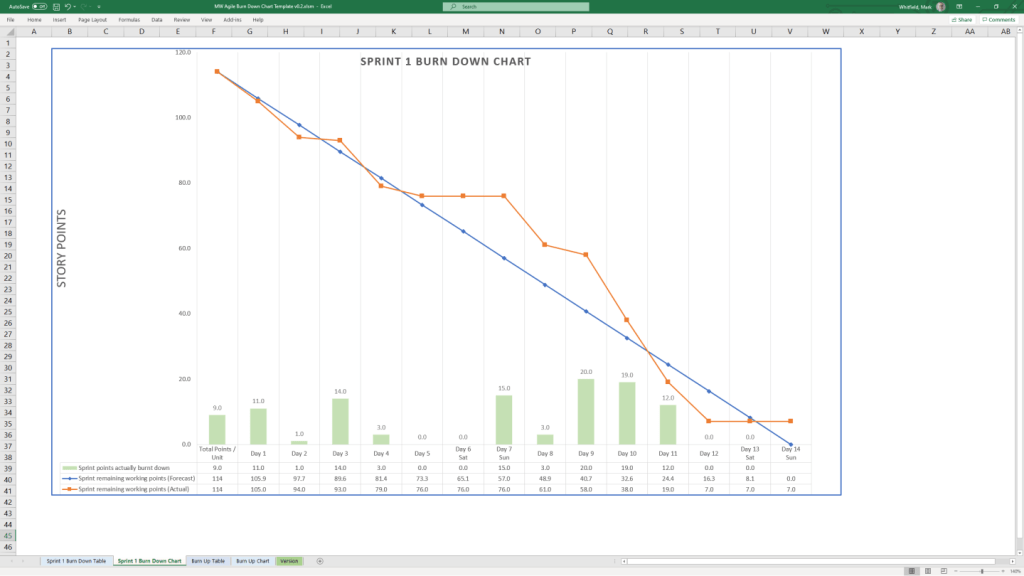
Agile Scrum on a page, summary of core focus areas

Agile Scrum on a page, summary of core focus areas

Agile Scrum Backlog Grooming & Sprint Planning

Agile Scrum Backlog Grooming & Sprint Planning

Extreme Programming XP project management summary and detailed historical timeline by era and year
Extreme Programming (XP) is a prominent, disciplined Agile software development framework designed to improve software quality and responsiveness to changing customer requirements. Developed by Kent Beck in the mid-1990s, it focuses on taking beneficial engineering practices—such as pair programming, testing, and continuous integration—to “extreme” levels. 

Project Management Summary: Core XP Components

XP differs from other Agile methods by focusing intensely on technical engineering practices alongside project management techniques. 

  • Core Values: Communication, Simplicity, Feedback, Courage, and Respect.
  • Key Practices: Pair Programming, Test-Driven Development (TDD), Collective Ownership, Continuous Integration, Refactoring, and Small Releases.
  • Project Management Focus:
    • The Planning Game: Combines business priorities with technical estimates to determine what to build next.
    • Small Releases: Frequent, working software releases (often 1–2 weeks) to gather rapid customer feedback.
    • On-site Customer: A customer representative works with the team to provide instant feedback and clarify requirements.
    • Sustainable Pace: Limiting work weeks to 40 hours to avoid burnout and maintain quality. 

Detailed Historical Timeline of XP

Era 1: Origins and The Chrysler C3 Project (1993–1996) 

  • 1993: Chrysler launches the Comprehensive Compensation System (C3) project to upgrade payroll software, which struggles for years.
  • March 1996: Kent Beck is brought in to lead the C3 project. To salvage the project, Beck starts encouraging team members to adopt a set of technical practices he developed based on his experiences.
  • 1996: Ward Cunningham heavily influences the development of early XP concepts, particularly the “metaphor”.
  • 1996: The project begins adopting daily meetings, pair programming, and TDD.

Era 2: Formalization and “Embracing Change” (1997–2000) 

  • 1997: Ron Jeffries is brought in to coach the C3 team, helping solidify the practices.
  • 1998: The term “Extreme Programming” becomes widely discussed within the Smalltalk and Object-Oriented programming communities.
  • October 1999: Kent Beck publishes Extreme Programming Explained: Embrace Change, formally defining the framework.
  • February 2000: Daimler-Benz acquires Chrysler and cancels the C3 project after 7 years of work. Despite cancellation, the methodology proved that it could produce working, high-quality software, just not fast enough to overcome the legacy backlog. 

Era 3: Rise of Agile and Expansion (2001–2005)

  • February 2001: Kent Beck and Ron Jeffries are among the 17 developers who draft the Manifesto for Agile Software Development at Snowbird, Utah. XP is recognized as one of the foundational “Agile” methods.
  • 2001: The first Agile Alliance conference is held. XP is considered the dominant agile methodology during this period.
  • 2002–2003: XP gains global popularity; numerous books are published expanding on the core 12 practices.
  • 2004: The second edition of Extreme Programming Explained is released, shifting focus from 12 rigid practices to more adaptive principles. 

Era 4: Integration with DevOps and Continuous Delivery (2006–Present)

  • 2006-2010: As Scrum gains popularity for general project management, XP practices like TDD and Pair Programming become the “standard” technical practices for high-performing teams, often blended with Scrum (ScrumXP).
  • 2010s: The rise of DevOps and continuous delivery, which inherently requires XP practices like CI/CD (Continuous Integration/Continuous Delivery).
  • 2020-2026: While fewer companies identify strictly as doing “XP,” its technical practices are considered essential to modern software development and are integrated into almost all Agile methodologies to ensure quality and speed.

Extreme Programming XP project management summary and detailed historical timeline by era and year
Waterfall project management is a linear, sequential methodology

Waterfall project management is a linear, sequential methodology where progress flows steadily downward through defined phases, much like a physical waterfall. In this model, each stage—such as requirements, design, implementation, and testing—must be fully completed and approved before the next one begins. 

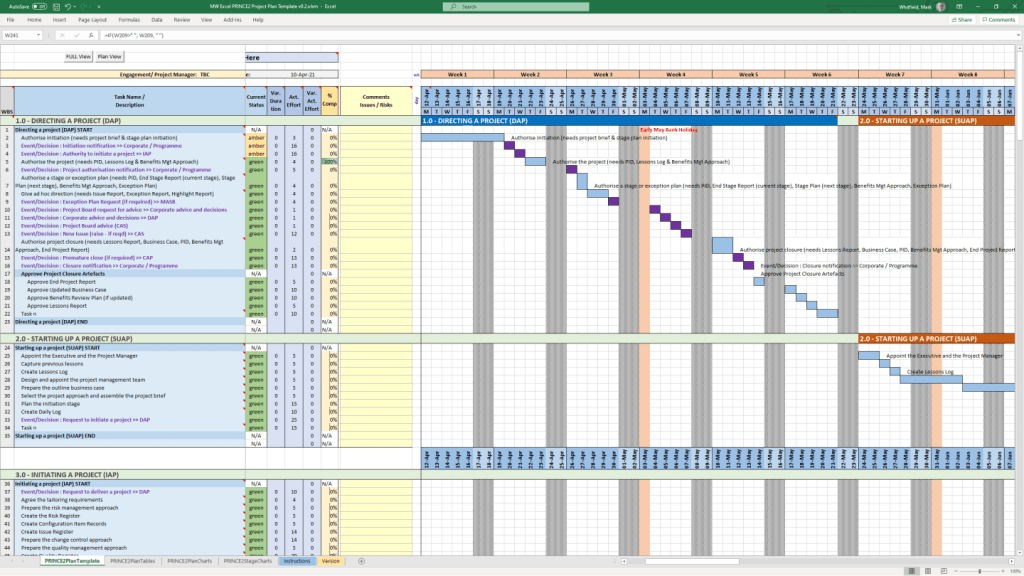
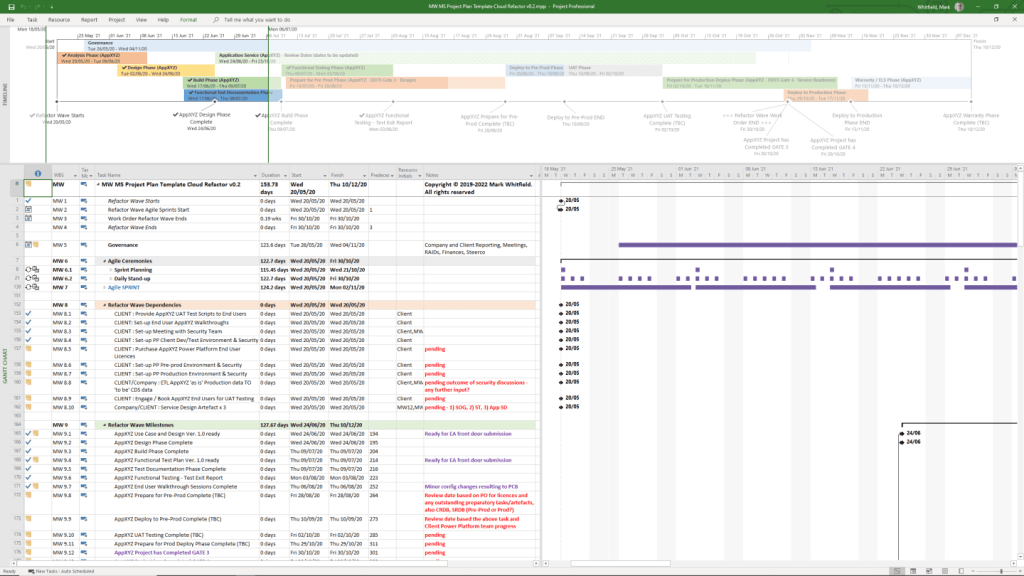
Waterfall Project Plans, .xls and .mpp file formats respectively

Core Characteristics

  • Sequential Design: No overlapping phases; each “cascades” into the next.
  • Documentation-Driven: Extensive upfront planning and detailed records are required at every step.
  • Fixed Scope: Requirements are gathered at the start, making the project’s timeline and budget highly predictable but difficult to change.
  • Specialised Use: Best suited for regulated industries like aerospace, construction, and healthcare, where changes are costly or safety is paramount. 

Historical Timeline by Era and Year

The following timeline tracks Waterfall from its origins in post-WWII engineering to its current role in hybrid project management.

Examples, Waterfall Plan On a Page POaP in MS PowerPoint format

The Pre-Formal Era (1950s – 1969)

Software development adopted structured, sequential approaches from engineering, largely driven by complex, high-risk projects. 

  • 1956Herbert D. Benington documented a sequential process for the SAGE project, establishing the technical roots.
  • Late 1960sNASA applied linear, rigid methodologies to Apollo missions, setting a precedent for high-stakes, documentation-heavy development.
  • 1968: The NATO Software Engineering Conference highlighted the “software crisis,” prompting a push for formal, disciplined development models. 

The Formalisation Era (1970 – 1979)

The model was officially, yet ironically, described and named. 

  • 1970Dr. Winston W. Royce published his foundational paper on managing large software systems, often cited as the origin of the “Waterfall” model, though he originally presented it as a cautionary, flawed approach.
  • 1976T.E. Bell and T.A. Thayer likely first used the term “Waterfall” in literature. 

The Institutional Era (1980 – 1999)

Waterfall became the mandatory standard for large-scale, complex projects. 

  • 1985: The U.S. DoD mandated DOD-STD-2167, cementing Waterfall as the standard for military software.
  • 1989: The UK Government introduced PRINCE2, deeply influenced by Waterfall principles.
  • 1994: The U.S. DoD formally abandoned strict Waterfall mandates for more flexible methods. 

The Modern & Hybrid Era (2000 – Present)

Waterfall transitioned from the default standard to a specialised methodology. 

  • 2001: The Agile Manifesto marked a shift toward iterative development, reducing Waterfall’s dominance.
  • Present Day: It remains vital in regulated sectors (e.g., aerospace) and is often combined with Agile in hybrid approaches.

Waterfall project management is a linear, sequential methodology

Click on the link in the website banner above to purchase example, editable template project plans shown and many others.

Oracle SQL Forms triggers, event-handlers historical timeline by era

Oracle Forms triggers are event-handlers written in PL/SQL (originally a proprietary step-based language) that execute in response to specific events within an application, such as mouse clicks, data entry, or database transactions. They allow developers to augment or replace default processing behavior. 

My final year Higher National Diploma project in Oracle SQL forms.

HND Oracle SQL forms design example 1, 1990

Historical Timeline of Oracle Forms & Triggers

The evolution of Oracle Forms is defined by its transition from character-mode terminals to graphical user interfaces (GUI) and eventually to web-based and cloud architectures. 

HND Oracle SQL forms design example 2, 1990

Era 1: The Character Mode & Macro Era (1979 – 1980s)

In this era, applications were designed for text-only terminals like the VT220. Logic was primitive and lacked the structural flow of modern programming. 

  • 1979 – Interactive Application Facility (IAF): The earliest form of the tool, consisting of a compiler (IAG) and a runtime interpreter (IAP).
  • 1984 – FastForms / SQL*Forms 2.0: Renamed during the Oracle v4/v5 database era.
    • Trigger Detail: Triggers did not use PL/SQL. They used a proprietary language based on trigger steps. To achieve logic like an IF statement, developers had to jump between steps based on the success or failure of a SQL statement.
  • 1987 – SQL*Forms 2.3: A significant improvement that introduced procedural capabilities via EXEMACRO CASE for more complex logic. 

Era 2: The PL/SQL & GUI Revolution (Late 1980s – 1990s)

This period marked the shift toward modern programming standards and the Windows operating system.

  • 1988 – SQL*Forms 3.0: The first version to support PL/SQL within triggers. This replaced the old step-based triggers with block-structured code.
  • 1993 – Oracle Forms 4.0: The first true GUI-based version, supporting checkboxes, radio groups, and mouse-based interactions.
  • 1994 – Oracle Forms 4.5: A “quantum leap” in the product’s history.
    • Trigger Detail: Introduced GUI-based triggers (e.g., WHEN-MOUSE-CLICK) and a modern IDE with an Object Navigator and Code Editor. 


Era 3: The Web & Internet Era (Late 1990s – 2010s)

As the internet grew, Oracle pivoted to a three-tier architecture where forms ran in web browsers via Java. 

  • 1999 – Oracle Forms 6i: The ‘i’ stood for Internet. It introduced the Forms Server, allowing forms to run in a browser using a Java applet.
  • 2002 – Oracle Forms 9i: Officially dropped support for client-server and character-mode deployment. Triggers began to support Java integration via imported Java classes.
  • 2004 – Oracle Forms 10g: Integrated more deeply with J2EE and web services.
  • 2009 – Oracle Forms 11g: Introduced external events and JavaScript support, allowing triggers to interact with web-based elements. 

Era 4: Modern Cloud & Standalone Era (2015 – Present)

The current focus is on maintaining legacy reliability while adapting to modern infrastructure without a browser dependency. 

  • 2015 – Oracle Forms 12c: Introduced Java Web Start (JWS) and standalone modes, allowing applications to run without a parent browser.
  • 2023 – Oracle Forms 12.2.1.19: Released with features like automatic language detection and browser-less launching (FSAL).
  • 2024 – Oracle Forms 14.1.2: The latest stable release (skipping version 13), featuring modernized widgets and support for REST data sources.
  • 2025/2026 – Transition Period: Long-time product advocates have left Oracle, signaling a shift toward sustaining mode where users are encouraged to modernize toward Oracle APEX. 

Oracle Forms SQL triggers, event-handlers historical timeline by era

HPE NonStop architecture overview and technical commentary and approach by era and year

The HPE NonStop architecture is defined by its “shared-nothing” design, where every hardware and software component is redundant and operates independently to ensure 100% operational continuity. For over 40 years, it has evolved through four distinct hardware eras while maintaining upward software compatibility.

1. The Tandem Era (1974–1997): Proprietary Foundations 

  • Architecture Approach: Founded by James Treybig, Tandem introduced the first commercial fault-tolerant system using a proprietary 16-bit stack-based architecture.
  • Key Technical Milestones:
    • 1976 (NonStop I/T16): Introduced the Dynabus, a custom inter-processor backplane, and the Guardian OS, which used message-passing instead of shared memory to isolate faults.
    • 1981–1983 (NonStop II & TXP): Introduced 32-bit addressing and the Transaction Monitoring Facility (TMF), which allowed applications to be fault-tolerant without specialized coding.
    • 1986–1989 (VLX & Cyclone): Scaled to the mainframe market with ECL gate-array chips and the first fault-tolerant relational database, NonStop SQL

2. The MIPS Era (1991–2004): Migration to RISC

  • Architecture Approach: To keep pace with industry performance, Tandem transitioned from proprietary processors to off-the-shelf MIPS RISC processors while emulating the original instruction set for compatibility.
  • Key Technical Milestones:
    • 1991 (Cyclone/R): The first MIPS-based system.
    • 1997 (Himalaya S-Series): Replaced Dynabus with ServerNet, a high-speed system interconnect that later evolved into the industry-standard InfiniBand.
    • Ownership Shift: Compaq acquired Tandem in 1997, and HP merged with Compaq in 2002. 

3. The Itanium Era (2005–2013): HP Integrity NonStop 

  • Architecture Approach: Branded as Integrity NonStop (NonStop i), this era moved the platform to Intel Itanium processors.
  • Key Technical Milestones:
    • 2005 (NS-series/J-series): Focused on “NonStop Advanced Architecture” (NSAA), leveraging standard HP server components to lower costs while maintaining Availability Level 4 (AL4).
    • Technical Commentary: While powerful, the reliance on Itanium’s EPIC architecture eventually limited growth as the industry consolidated around x86-64. 

4. The Modern HPE Era (2014–Present): x86-64 & Virtualization 

  • Architecture Approach: Shifted to standard Intel x86-64 processors (NonStop X), fully decoupling the software stack from proprietary hardware.
  • Key Technical Milestones:
    • 2014 (NonStop X/TNS/X): Introduced the L-series operating system. The architecture transitioned to a standard InfiniBand fabric for inter-processor communication.
    • 2017–2020 (vNS): Launched Virtualized NonStop (vNS), allowing the environment to run on standard hypervisors like VMware, bringing fault tolerance to private and hybrid clouds.
    • 2025 (NS9 X5): Modern systems now support up to 8 TB of RAM and are integrated into the HPE GreenLake consumption-based cloud model. 
  • Summary of Architectural Evolution