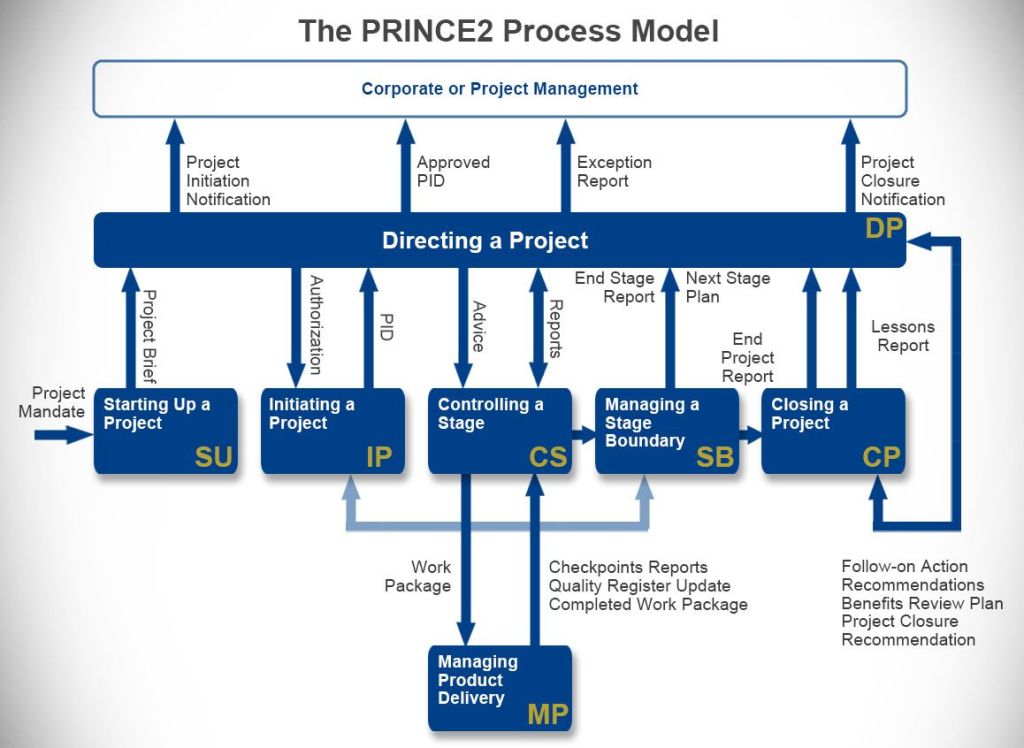
In 2026, the PRINCE2 7 (7th Edition) remains the current global standard for the methodology. The core diagram, known as the PRINCE2 Process Model, illustrates how the 7 processes interact across the four management levels: Corporate, Direction, Management, and Delivery.
The PRINCE2 7 Process Model
The diagram typically visualises the project lifecycle from a “Project Mandate” to “Project Closure” through these processes:
Starting Up a Project (SU): The pre-project process where a mandate is converted into a project brief.
Directing a Project (DP): The Project Board’s high-level oversight, running from project start to finish.
Initiating a Project (IP): Establishing firm foundations, including the Project Initiation Documentation (PID) and the Business Case.
Controlling a Stage (CS): The daily management of a stage by the Project Manager.
Managing Product Delivery (MP): The link between the Project Manager and Team Managers to ensure products are built.
Managing a Stage Boundary (SB): Occurs at the end of each management stage to plan the next one and review the current.
Closing a Project (CP): The final process for a formal decommissioning of the project.
PRINCE2 (PRojects IN Controlled Environments) is a structured, process-based project management methodology used globally to manage projects of any size and complexity. It focuses on dividing projects into manageable stages, ensuring accountability, and maintaining a clear business justification from start to finish.
Core Framework (PRINCE2 7)
The latest version, PRINCE2 7th Edition (2023), centers on five integrated elements:
7 Principles: The “guiding obligations” that must be followed for a project to be considered PRINCE2 (e.g., Continued Business Justification, Learn from Experience, and Manage by Exception).
7 Practices: Essential aspects of management (formerly “Themes”) applied throughout the lifecycle: Business Case, Organizing, Plans, Quality, Risk, Issues, and Progress.
7 Processes: A step-by-step guide from Starting up a Project to Closing a Project.
People: A major addition in Version 7, focusing on the human side of change and team dynamics.
Project Context: Emphasises the need to tailor the methodology to suit the specific project environment.
Foundation: Introduces basic concepts and terminology; no prerequisites required.
Practitioner: Focuses on applying and tailoring the method to real-world scenarios. Requires a valid Foundation-level certificate or an equivalent (like PMP or CAPM).
PRINCE2 Agile: A specialised version that blends the structure of PRINCE2 with agile delivery frameworks like Scrum and Kanban.
Comparison and Value
Geographic Dominance: PRINCE2 is the de facto standard in the UK public sector and is widely used across Europe and Australia. In contrast, the PMP (from PMI) is more prevalent in the USA and Canada.
Cost: In the UK, Foundation courses typically range from £549 to £1,000, while Practitioner courses cost between £599 and £1,100.
Renewal: All current PRINCE2 certifications must be renewed every three years.
PRINCE2 (PRojects IN Controlled Environments) is a structured, process-based project management methodology.
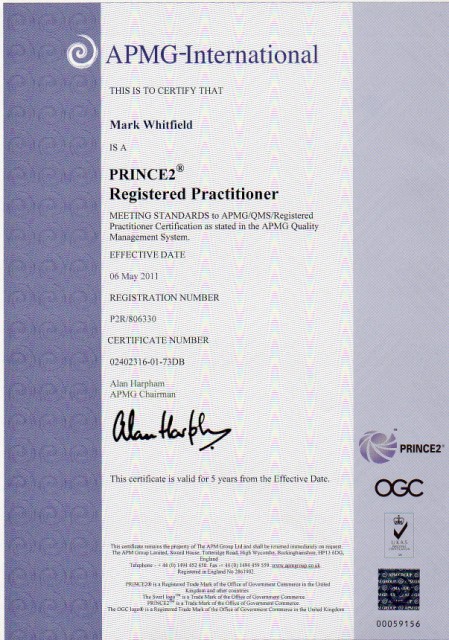
May 2011 – Registered PRINCE2 Practitioner with ILX
PRINCE2 (PRojects IN Controlled Environments) is a structured, process-based project management methodology