Key Agile Terms Explained

Key Agile Terms Explained
Agile Terms Explained

Mark Whitfield, Biography overview

Mark Whitfield is a prominent UK-based, SC-cleared Senior IT Project Manager, Engagement Manager, and technology executive with over 35 years of experience spanning the entire Software Development Lifecycle (SDLC). He specialises in complex digital transformations, hybrid cloud migrations, and API-led system integrations.

Throughout his career, he has successfully delivered enterprise-scale solutions for massive blue-chip clients, including Barclays Bank, Jaguar Land Rover (JLR), Royal Mail Group (RMG), Lloyds Banking Group, and the Bank of England.

Executive Overview:

  • Core Expertise: Hybrid Cloud Migrations (Azure, AWS), API middleware architectures, and digital banking platforms.
  • Methodologies: Certified PRINCE2 Practitioner and Agile SCRUM delivery lead.
  • Security Clearance: Active UK Security Check (SC until 2031) clearance for public and defense-sector projects.
  • Industry Portfolio: Banking, Automotive, Gambling/Casinos, Aerospace & Defence, and Regional Government.

Professional Timeline & Milestones:

  • 1990–1995 (Early Engineering): Began his career immediately after graduating in Computing. He worked as a core programmer at The Software Partnership, building cutting-edge electronic banking software (sp/ARCHITECT-BANK) on legacy Tandem Mainframes (now HPE NonStop).
  • 1995–2013 (Insider Technologies Limited): Spent 18 years escalating from a Senior Programmer into a strategic project manager in Salford Quays, UK. He spearheaded high-volume mainframe transaction monitoring systems and ATM software delivery for major global banking institutions like HSBC and Al Rajhi Bank.
  • 2013–2016 (Retail & Gaming Delivery): Transitioned to Wincor Nixdorf as an Agile IT PM managing ATM software pipelines, followed by a Senior PM role at Betfred, delivering complex mobile sportsbook and online payment gateways.
  • 2016–Present (Enterprise Leadership): Joined Capgemini as a client-facing Engagement Project Manager. He later augmented into MuleSoft (a Salesforce company) as a Delivery Manager for the Anypoint Platform, directing massive cloud infrastructure overhauls.

Thought Leadership & Knowledge Sharing

Beyond active corporate execution, he is the creator of PROject Templates, an open professional repository where he publishes free upgrade enterprise project tracking models, RAID logs, and Agile planning frameworks used extensively by modern PMOs.

Mark Whitfield, Microsoft Azure Cloud Projects

Mark Whitfield is an SC-cleared Senior IT Project Manager and Engagement Manager based in Greater Manchester, UK.

Since joining Capgemini UK in 2016, he has specialized in complex, public-sector hybrid cloud migrations and API-led integration programs utilizing Microsoft Azure and associated Microsoft Power Platform capabilities. He holds the AZ-900 Microsoft Certified Azure Fundamentals credential.

His primary Azure-focused projects and delivery milestones include the following:

  • UK Government CHIP Project (2023–2024): Served as a Technical Delivery Manager on a £1M+ project to integrate the Fish Export Service (FES) into the Common Entry Health Document Inspection Portal (CHIP). This build used the Azure Cloud to extend live API components to support cross-border health verification systems.
  • UK Government MS Dynamics Migration & Cloud Portals (2022–2023): Managed Azure Cloud resources to migrate 12 Microsoft Dynamics 2016 applications onto the Microsoft Dynamics 365 Online platform. This included leading discovery workshops, creating statements of work (SoW), and managing project plans for a contract value of approximately £0.4M.
  • UK Utility Industry Enablon Migration (2022): Led a £0.5M project moving a client from a legacy document management system to an Azure-based Enablon product. This required extensive extract-transform-load (ETL) processing for categorized living documents.
  • UK Government Hybrid Cloud Proof of Concept (2020): Directed a £375k Agile proof-of-concept project moving three client legacy databases (MS Access, Oracle, and SQL 2008) onto Microsoft Azure and the Dynamics 365 Power Platform using Azure-aligned refactoring patterns.
  • Local Regional Government Telephony Integration (2017): Managed a £400k deployment for a new Support for Mortgage Interest (SMI) call center campaign. This involved integrating a programmatic dialler solution with an Azure-deployed CRM application.

Agile, Approach to User Story Estimation Technique

Agile Approach to User Story Estimation Technique
Approach to User Story Estimation Technique

Agile Scrum Master AI Prompts

Scrum Master AI Prompts Agile
Scrum Master AI Prompts

As an agile Scrum Master, you can significantly boost your efficiency and team collaboration by using AI tools for repetitive tasks, metric analysis, and ceremony preparation. The best way to utilize AI is to follow the CRAFT framework (Context, Role, Action, Format, and Tone) to give your AI model the necessary background. To get started, replace placeholder bracketed text with your specific information.

Review the structured AI prompts below, categorized by core Scrum Master responsibilities:

Sprint Planning Optimization

These prompts will help you streamline backlog management and ensure your next sprint cycle is data-driven and realistic.

  • Predict Velocity & Capacity: “Based on historical sprint data: [insert last 3 sprints], predict our team’s velocity for the next 2-week sprint. Consider the following changes: [insert team changes, e.g., one developer out for a week], and provide a confidence interval.”
  • Refine and Format Backlog Items: “As an expert in Agile backlog refinement, help me break down this user story: ‘[insert raw requirement text]’. List logical sub-tasks with realistic developer effort in hours, and flag any missing requirements or testability gaps.”

Daily Stand-up & Alignment

Enhance your team’s focus and identify bottlenecks before they impact flow.

  • Goal-Oriented Stand-Up Agenda: “Act as a Stand-Up facilitator. Summarize these daily updates from my team: [insert team members’ updates]. Identify if we are at risk of missing the Sprint Goal, highlight cross-team dependencies, and suggest one follow-up question I can ask to redirect the team from ‘status updates’ to ‘problem-solving’.”
  • Impediment Stress Test: “A common user story is stuck in the QA testing column for the third consecutive day, causing spillover risks. As an expert Scrum Master, suggest how I can facilitate a conversation with the team to address this impediment. Provide a tactical 3-step action plan.”

Retrospective Facilitation

Say goodbye to repetitive, generic retrospectives and tap into targeted, continuous improvement.

  • Action-Oriented Theme Clustering: “Analyze these raw retrospective comments from my agile team: [insert list of comments]. Identify recurring themes, sentiment patterns, and root causes. Present the results in a ‘Start, Stop, Continue’ format, and suggest a concrete, actionable plan for the next sprint.”
  • Psychological Safety & Conflict Simulation: “Tension has been mounting among team members regarding estimation methods and story point allocations. As an Agile conflict mediator, suggest opening questions I can use during the retro to encourage quiet team members to speak and de-escalate the disagreement.”

Coaching & Team Health

Use AI to strengthen your servant leadership and develop customized educational content.

  • Agile Concept Teaching: “Generate a comprehensive guide on the Scrum framework for a team new to Agile. Focus on the core values of Scrum, how they relate to the Daily Scrum, and avoid overly technical jargon.”
  • Handling Unrealistic Expectations: “Simulate a challenging conversation between myself (a Scrum Master) and a senior stakeholder who is demanding mid-sprint scope changes. Outline an approach I can use, rooted in Agile principles, to educate the stakeholder on the value of a frozen sprint goal without damaging the relationship.”

Best Practices for Agile Prompting

To avoid generic, hallucinated, or unhelpful answers, keep these best practices in mind:

  • Context is Key: Always include your team’s composition (number of members, skill levels) and your product vision.
  • Assign a Persona: Prompt the AI to “Act as an Agile Coach,” “Act as a Jira Expert,” or “Act as a QA Reviewer” to get specialized viewpoints.
  • Validate Everything: AI is a sounding board, not a decision-maker. Always review suggestions and validate metrics using your human experience and team’s consensus.

IT Project Management (PM) toolkits provide over 200 tailored templates spanning Agile, Waterfall, & PRINCE2 methodologies

The IT Project Management (PM) toolkits created by Mark Whitfield provide over 200 tailored templates spanning Agile, Waterfall, and PRINCE2 methodologies. These artifacts are designed to structure, track, and report on software delivery lifecycles (SDLC).

The framework’s core templates are categorized below by operational delivery area, specific template artifact, and native file format:

📅 Schedule, Planning & Timelines

Focuses on structural design, building work breakdown structures (WBS), and visualizing milestones for senior stakeholders.

  • Detailed SDLC / PRINCE2 Project Plan: Microsoft Project (.mpp), Excel (.xlsx)
  • Agile Scrum Sprint Planner & Delivery Plan: Microsoft Project (.mpp), Excel (.xlsx)
  • Plan on a Page (POaP) Milestone Visualizer: PowerPoint (.pptx)—over 35 custom variations
  • Gantt Chart Trackers: Excel (.xlsx)

🔍 Risk, Issue & Change Control (RAID)

Manages constraints, operational hazards, dependencies, and baseline deviations.

  • Simple RAID Log (Risks, Assumptions, Issues, Dependencies): Excel (.xlsx)
  • Comprehensive Tracking Register (Includes RAIDs, Suppliers, Deliverables, and Out-of-Scope tasks): Excel (.xlsx)
  • Change Request Tracker: Excel (.xlsx)

📊 Governance, Tracking & Status Reporting

Facilitates communication across team tiers and summarizes health indicators for client or internal reviews.

  • Weekly & Monthly Project Status Reports: PowerPoint (.pptx), Word (.docx)
  • RACI Matrix (Roles & Responsibilities Tracker): Excel (.xlsx)
  • Agile Burndown and Burnup Charts: Excel (.xlsx)
  • Meeting Minutes and Action Item Logs: Word (.docx)

💰 Finance, Resources & Benefits

Tracks financial trajectories, internal/external staffing allocation, and post-launch outcomes.

  • Full Project Financial Tracker (Forecasts, Actuals, Variances, Margins, and Expenses): Excel (.xlsx)
  • Simple Monthly Budget Forecast: Excel (.xlsx)
  • Resource Cost & Annual Leave Tracker: Excel (.xlsx)
  • Benefits Realisation Analysis Tracker: Excel (.xlsx)

🏗️ Initiation, Structure & Walkthroughs

Establishes the foundation of the delivery framework and walks team members through how to execute templates.

  • Project Kick-Off Presentation Deck: PowerPoint (.pptx)
  • Project Organisation Charts: PowerPoint (.pptx)
  • Template Walkthrough Documentation Guides: Word (.docx)

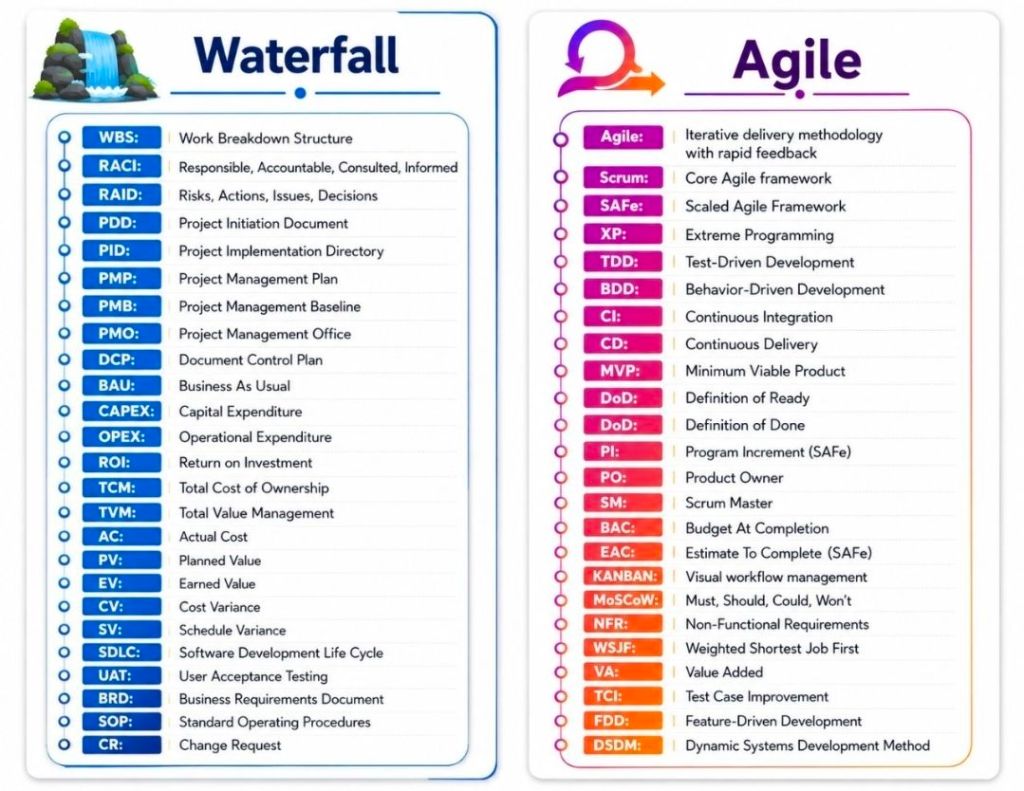
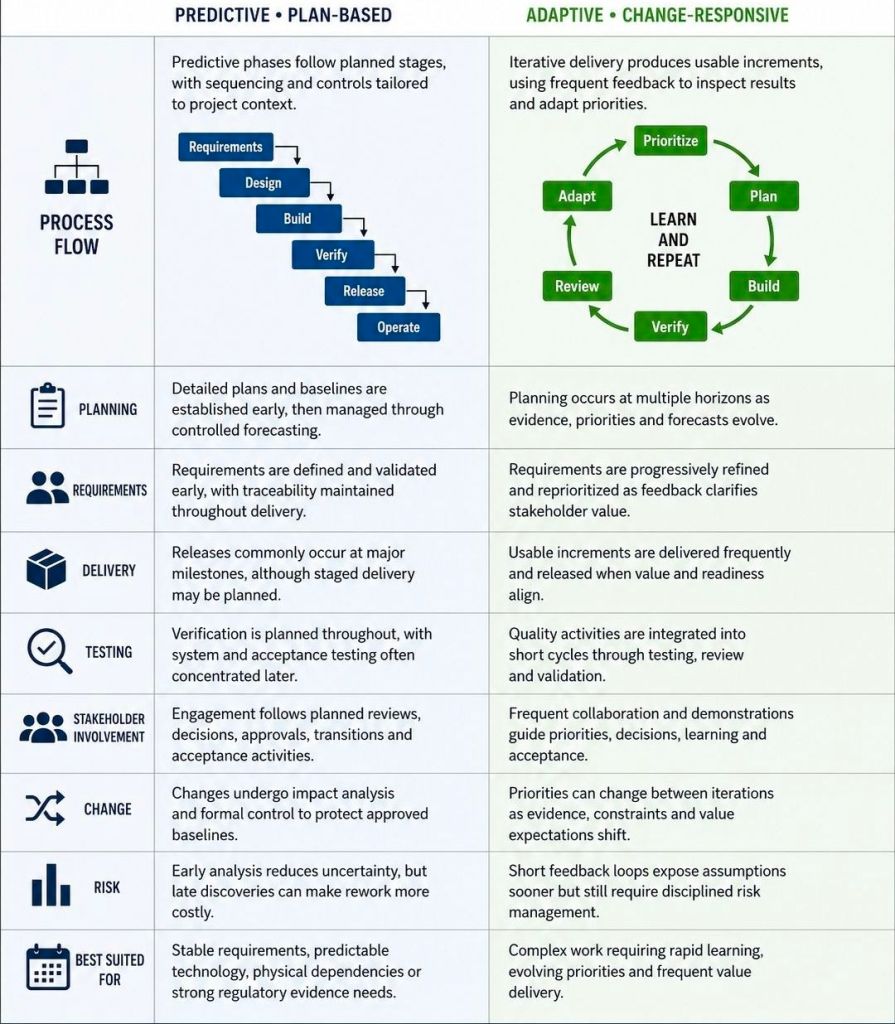
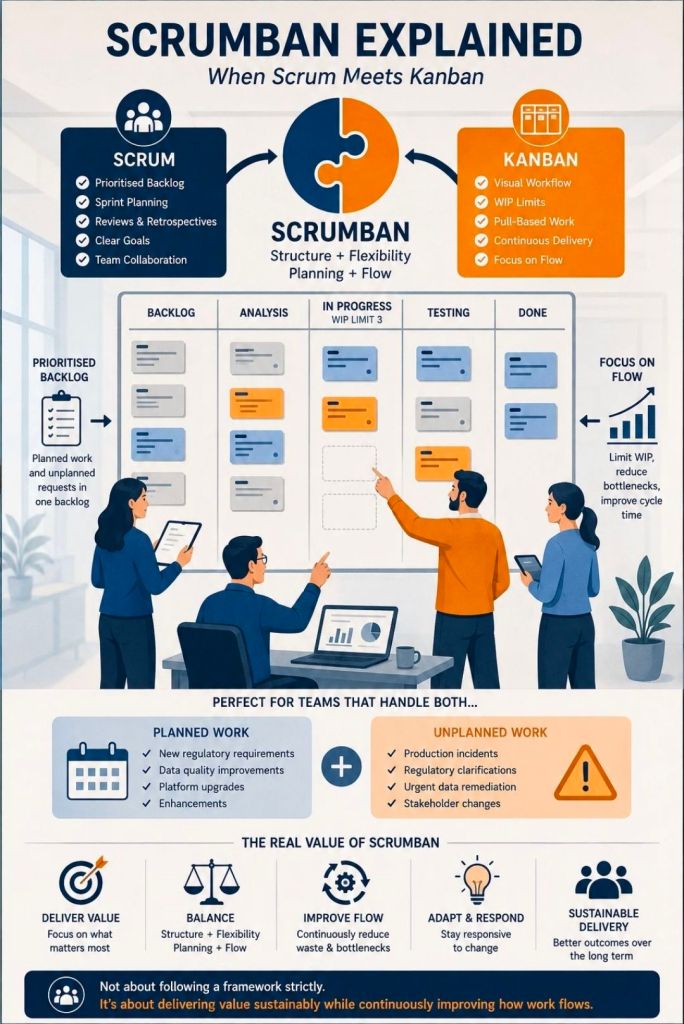
Agile Waterfall Scrum Kanban Lean XP for BA & PO

Agile Waterfall Scrum Kanban Lean XP for BA & PO

The 3 Agile Scrum Pillars

The 3 Agile Scrum Pillars

The three pillars of Scrum are Transparency, Inspection, and Adaptation. Together, they form the foundation of empirical process control—a methodology where decisions are based on observation and experience rather than unverified plans.

1. Transparency

Transparency ensures that all aspects of the process and progress are visible to both the team performing the work and the stakeholders. This requires a common, shared understanding of what constitutes “done” and maintaining open, honest communication. Key Scrum artifacts like the Product Backlog and Sprint Backlog are tools used to maintain this visibility.

2. Inspection

Scrum teams must regularly inspect their artifacts (like the product increment) and their overall progress toward the Sprint Goal to detect any unwanted variances or problems. This is achieved through established Scrum events such as the Daily Scrum, Sprint Review, and Sprint Retrospective.

3. Adaptation

If an inspection reveals that aspects of a process or the product are deviating outside acceptable limits, the team must adjust the process or the material being worked on. Adaptation involves making necessary changes as soon as possible to minimize further deviations and continuously improve the end product.

For more specific guidance, you can explore the official Scrum Alliance breakdown or learn more via Atlassian’s Agile Project Management Guide.