Barclays locations worked at for Tandem HP NonStop code development

Radbroke Hall is a 64-acre “Innovation Campus” in Cheshire that serves as the global technology and operations hub for Barclays. Originally built as a French chateau-style private residence in 1917, it transitioned through use by a nuclear research group before Barclays acquired it in 1972. Today, it employs approximately 4,000–6,500 staff and has been the development site for pioneering banking technology, including the first ATMs, debit cards, and mobile banking platforms. 

Radbroke Hall History Timeline

Era 1: Private Residence (1914–1956)

  • 1914: Construction begins on the Hall for Manchester textile manufacturer Claude Hardy and his wife Olga.
  • 1916: Claude Hardy dies; Olga oversees the completion of the Portland stone building alone.
  • 1917: The Hall is completed as a private residence.
  • 1920s–1930s: The Hall remains largely unoccupied during these decades. 

Era 2: Industrial & Nuclear Research (1956–1972)

  • 1956: The Hardy family sells the estate to The Nuclear Power Group.
  • 1956–1972: The site is used for nuclear energy research, with offices and a testing tower constructed on the grounds. 

Era 3: The Barclays Transformation (1972–1990s)

  • 1972: Barclays purchases the site from The Nuclear Power Group to reduce high rental costs in London.
  • 1972 (Relocation): Approximately 1,400 staff are relocated from London or hired locally; many find the move from London to the “rural North” a significant culture shock.
  • 1970s–1980s: The site begins its role as an IT hub, instrumental in developing the first cash machines (ATMs) and debit cards.
  • 1985: Barclays reorganises its UK and International banks into a single entity, further centralising tech and staff services at Radbroke. 

Era 4: Global Tech & Modernisation (2000s–Present)

  • Early 2000s: The campus leads the development of Barclays’ online and mobile banking applications.
  • 2012: Barclays celebrates the 40th anniversary of its presence at Radbroke Hall.
  • 2017: The original Hall building marks its 100th anniversary.
  • 2021: Barclays announces a major redevelopment plan to modernise the campus, including the demolition of older buildings (Kilburn, Lovelace, and Brooker Houses) to create a new central “town square” and “re-green” 80,000 sq. ft. of land.
  • 2024: Investment continues to transform Radbroke into a “world-class campus” focused on the future of work and advanced banking APIs.

Barclays House, located at 1 Wimborne Road, was a dominant fixture of the Poole skyline for 46 years. Originally built to decentralise Barclays Bank International operations from London, the nine-storey brutalist structure served as a major regional headquarters from 1976 until its closure in 2022. Following its vacancy, the building was earmarked for conversion into a residential complex featuring 362 apartments

Historical Overview

  • Purpose: The building was commissioned to move staff away from high London costs and boost local employment in Poole.
  • Architecture: Designed by Wilson, Mason and Partners, it features three interlinked octagonal/hexagonal towers in the brutalist style.
  • Landmark Features: A massive 14-foot aluminium eagle logo (the Barclays emblem) adorned the front of the building for decades. 

Detailed Timeline Breakdown

The Development Era (1960s – 1975) 

  • Late 1960s: Poole is selected as the primary location for Barclays Bank DCO (Dominion, Colonial and Overseas) decentralisation.
  • 1971 (August): Planning permission is granted for the project after a public inquiry, with an estimated cost of £5 million.
  • 1972 (September): Construction begins, led by the John Laing Group.
  • 1975 (June): Construction is officially completed. 

The Operational Era (1976 – 2021) 

  • 1976 (January): Barclays first occupies the building.
  • 1976 – 1980s: Workforce grows rapidly; in its first year, it employed 800 people, eventually peaking at roughly 2,500 employees.
  • 2007 (January): A planning bid to demolish the building for flats is refused due to its scale and lack of amenity space.
  • 2008: Barclays announces plans to build a new HQ in Poole, though these did not result in immediate relocation from the Wimborne Road site.
  • 2016: The building undergoes a major refurbishment to celebrate its 40th anniversary

The Closure & Transition Era (2022 – Present) 

  • 2022 (January 26): Barclays officially closes its doors at Wimborne Road after 46 years.
  • 2022 (October 27): The iconic Barclays eagle logo is removed from the building’s facade by cranes.
  • 2022 (December): Remaining staff (approximately 700) are relocated to new offices in Bournemouth.
  • 2023: VCRE Four Poole submits a planning bid to convert the structure into 362 homes.
  • 2024 (March 8): The separate Poole High Street branch also closes.
  • 2024 (June 10): Bournemouth, Christchurch and Poole (BCP) Council grants final approval for the conversion of Barclays House into residential apartments.

Barclays locations worked at for Tandem HP NonStop code development

Website Author IT Career Timeline Breakdown

Mark Whitfield is a highly experienced IT professional with a career spanning over 30 years, transitioning from a technical programmer to a senior digital engagement and project manager. His expertise is rooted in HPE NonStop (Tandem) systems and has evolved to encompass complex Agile and Cloud delivery across diverse industries. 

Early Technical Era (1990–1995)

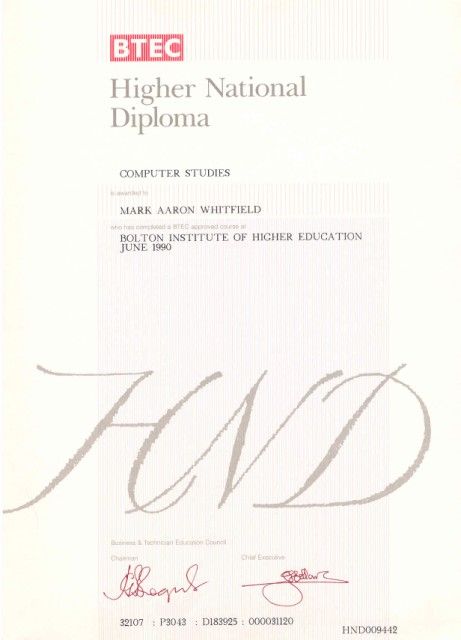
Following his graduation in Computing in 1990, Whitfield began his career as a Programmer at The Software Partnership (later Deluxe Data). 

  • Focus: Electronic banking software, specifically sp/ARCHITECT-BANK on Tandem Mainframe Computers.
  • Key Work: Developed code for major banks including TSB, Barclays, and Rabobank. This included early digital innovations like voice-driven phone banking and inter-account transfers before the internet was widespread. 

Growth and Product Management Era (1995–2004) 

Whitfield joined Insider Technologies Limited (ITL) in 1995 as a Senior Programmer

  • Focus: Platform health and diagnostic software for HPE NonStop systems.
  • Key Projects:
    • Co-developed diagnostic plug-ins for the Reflex monitoring suite.
    • Managed the first HP OpenView Operations (OVO) Smart Plug-In certification for the NonStop platform in 2002.
    • Consulted for CRESTCo (Euroclear) in 1997, conducting benchmark testing on new S7000 nodes. 

Strategic Leadership and Project Management Era (2005–2014) 

During this decade, he transitioned into IT Project Management, focusing on high-value financial transaction tracking. 

  • Focus: Waterfall and Agile project delivery for payment systems and banking infrastructure.
  • Key Milestones:
    • 2011: Led a massive transaction tracking project at Al Rajhi Bank (Saudi Arabia), parsing terabytes of tape-archived data into a normalised SQL database.
    • 2013–2014: At Wincor Nixdorf, managed a £5+ million project for Lloyds Banking Group to migrate ATM driving responsibilities from legacy systems to AIX-based Oracle technologies. 

Senior Digital Engagement Era (2014–Present)

Since 2014, Whitfield has focused on senior-level digital transformation and engagement management. 

  • Betfred (2014–2016): Served as Senior Digital Project Manager for online and mobile platforms (iOS/Android), managing fraud detection and payment gateway integrations.
  • Capgemini (2016–Present): Joined as an Engagement Manager (SC cleared).
    • Focus: Managing large-scale Agile and Waterfall digital projects across aerospace, defence, and government sectors.
    • Notable Projects: Leading a £13.5m programme to migrate 130 UK government applications to the cloud (AWS/Azure) and delivering real-time airspace monitoring apps for air traffic organisations. 
Mark Whitfield IT Career Timeline Breakdown

Mark Whitfield Online Resume Overview

Mark Whitfield is a highly experienced Senior IT Project Manager and former developer with over 30 years of expertise in HP NonStop (formerly Tandem) systems, primarily within the electronic banking and payments sectors. He is currently a Senior Project Manager at Capgemini (SC cleared until 2031) and maintains a professional portfolio at mark-whitfield.com

Historical Timeline & Customer Breakdown

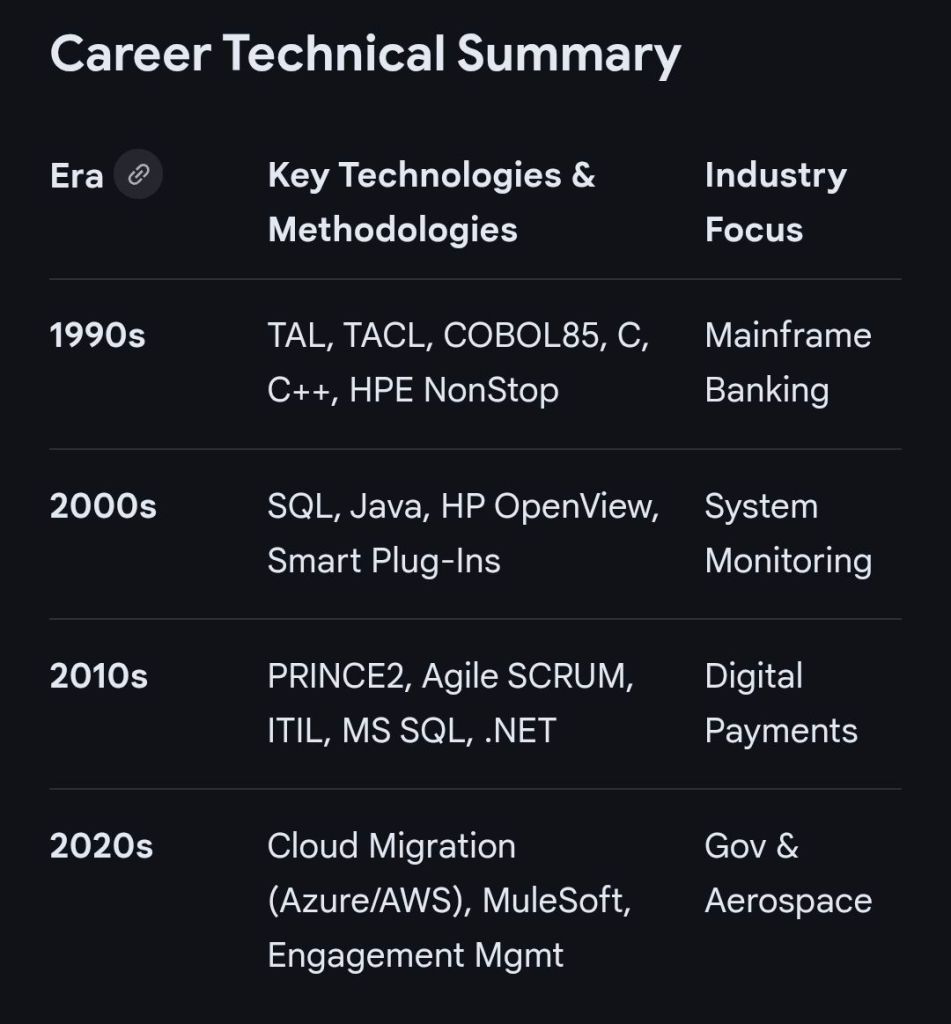
  • 1990 – 1995: The Software Partnership / Deluxe Data (now FIS)
    • Customer/Projects: Developed electronic banking software, specifically sp/ARCHITECT-BANK, for major financial institutions including TSBBank of ScotlandRabobank, and Girofon (Denmark).
    • Technical Breakdown: Focused on low-level programming using COBOL85NonStop SQL, and TAL (Transaction Application Language).
    • Role: Programmer.
  • 1995 – 2013: Insider Technologies Ltd (ITL)
    • Customer/Projects: Focused on HP NonStop monitoring, diagnostic, and payment software for high-value banking clients. Key products included Enterprise ManagerXPNETBASE24, and EPS.
    • Technical Breakdown:
      • XPERT24: Produced technical designs for this performance monitoring tool to track XPNET layers and transaction interchange counters (ATM/POS approval rates).
      • RTLX Payments: Served as IT Project Manager for RTLX (Real-Time Long-term eXchange) payment software.
      • Infrastructure: Extensive use of Guardian utilities (PATHWAY, SCF, FUP, INSPECT), TACL, and SCOBOL.
    • Role: Software Design, Team Leading, and Product Management.
  • 2013 – 2016: Freelance / Contract Projects
    • Customer/Projects: Managed software development lifecycle (SDLC) projects for various blue-chip companies.
    • Role: IT Project Manager.
  • 2016 – Present: Capgemini
    • Customer/Projects: Managing large-scale digital and public sector transformations. Notable clients include UK Government (MS Azure Cloud migration), Jaguar Land Rover (JLR)HeathrowRoyal Mail GroupBank of EnglandHSBCBarclays, and Deutsche Bank.
    • Technical Breakdown: Transitioned from legacy Tandem environments to modern Agile Scrum delivery and Microsoft Azure Cloud hosting.
    • Role: Senior Project Manager / Technical Delivery Manager.

Technical Breakdown by Competency

  • Operating Systems: HP NonStop (Guardian/NSK), Windows, Linux, Unix.
  • Programming Languages: TALTACLCOBOL85SCOBOL, C, C++, Java, and ASP.NET framework.
  • Databases: NonStop SQL/MP, MS SQL.
  • NonStop Middleware: PATHWAYXPNETBASE24EPS, and EMS (Event Management System).
  • Methodologies: Registered PRINCE2 PractitionerAgile SCRUM, ITIL, and ISO9001:2008. 

Web Hyperlinks & Resources

IT Career snapshot of Mark Whitfield, Senior IT Project Manager (SC cleared)

This resume summarizes the career of Mark Whitfield, a Senior IT Project Manager with over 30 years of experience specializing in digital and software development lifecycles, cloud migrations, and HP NonStop systems

Personal Details

  • Name: Mark A. Whitfield
  • Location: Manchester, UK
  • Nationality: British
  • Security Clearance: SC Cleared to 2031
  • Professional Profiles: Official Website | LinkedIn Profile 

Executive Summary

  • Experience: 30+ years in IT.
  • Core Focus: Senior Project Management for Digital/ Software Development Lifecycles (SDLC).
  • Expertise: Transitioning from a technical background in programming (pre-2000) to senior leadership in large-scale projects for global blue-chip companies. 

Key Skills & Competencies

  • Methodologies: PRINCE2 Practitioner, Agile (Scrum/ Kanban), Waterfall, ITIL, ISO QA.
  • Project Controls: MS Project, Budget & Burn Tracking, GDPR compliance, Supplier & Stakeholder Management, Statement of Work (SoW).
  • Technical Proficiencies:
    • Platforms: HP NonStop (Tandem), Cloud Migration (Hybrid).
    • Languages (Historical): C/C++, Java, COBOL85, TAL, TACL, SCOBOL, SQL, MS SQL.
    • Utilities: PATHWAY, SCF, FUP, INSPECT, XPNET. 

Professional Experience

  • Senior IT Project Manager (Various Projects):
    • Managed large-scale solutions for clients including Jaguar Land Rover (JLR)HeathrowRoyal Mail Group (RMG)NATS, and Euroclear.
    • Extensive work within the financial sector for Bank of EnglandBarclaysHSBCSantanderStandard CharteredDeutsche Bank, and Global Payments.
    • Government and public sector projects for DefraUKEFWelsh Water, and Scottish Water.
  • Early Career (Programmer / Technical Lead):
    • 1990 – 1995: Programmer at The Software Partnership (later Deluxe Data) in Runcorn, specializing in electronic banking software (sp/ARCHITECT-BANK) on Tandem Mainframe Computers. 

Education & Certifications

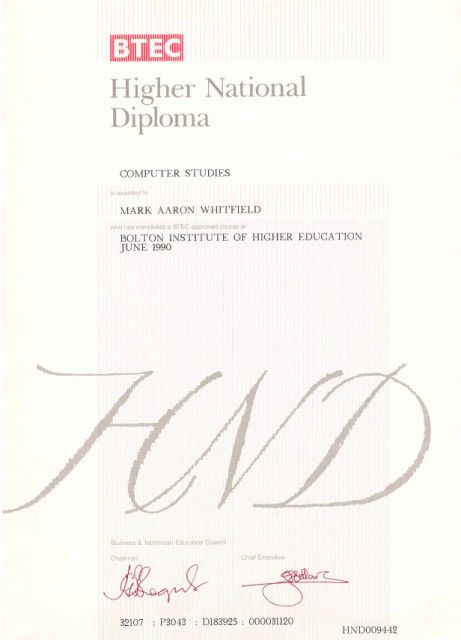
  • Degree: Higher National Diploma (HND) in Computing (Distinction, Graduated 1990).
  • Certifications:
    • Microsoft Azure Fundamentals (Certified).
    • PRINCE2 Practitioner.
    • Agile/ Radtac Course Completion. 

HPE NonStop Tandem Programming Languages, a development timeline

HPE NonStop (formerly Tandem) has evolved through distinct architectural eras, each introducing specific programming languages and environments to maintain its legendary fault tolerance. 

1. The Tandem Stack Machine Era (1974–1990)

This era focused on the proprietary 16-bit stack-based architecture (TNS), where software was designed to “fail-fast” and operate in process pairs. 

  • Nov 1974: Tandem Computers founded by Jimmy Treybig.
  • May 1976: TAL (Transaction Application Language) launched with the first Tandem/16 (NonStop I) system. It was the only language available at launch, derived from HP 3000’s SPL.
  • Late 1970s: COBOL74FORTRAN, and MUMPS were added to support business and scientific applications.
  • 1981: NonStop II introduced support for 32-bit addressing, enabling larger application memory.
  • 1983: SCOBOL (Screen COBOL) emerged alongside the Pathway transaction manager to handle terminal-based user interfaces and fault-tolerant logic.
  • 1986: NonStop SQL released as the first fault-tolerant relational database language.
  • 1987: C was introduced to the platform.
  • 1989: Integrity S2 line launched using MIPS processors, introducing a variant of Unix called NonStop UX

2. The MIPS RISC / Himalaya Era (1991–2004)

As Tandem migrated to MIPS processors (TNS/R), it introduced a Unix-like personality to attract modern developers while maintaining its legacy Guardian environment. 

  • 1991: Cyclone/R launched. Most software still ran in TNS stack mode using an “Accelerator” tool to translate code to MIPS instructions.
  • 1993: Himalaya K-Series released with native-mode compilers for C and COBOL to leverage MIPS performance.
  • 1994/1995: Open System Services (OSS) introduced a POSIX-compliant environment, enabling C++ and standard Unix utilities.
  • 1995: Java was first supported on the platform.
  • 1997: Compaq acquired Tandem; ServerNet became the standard interconnect.
  • Late 1990s: Support for scripting languages like PerlPython, and PHP began appearing in the OSS environment.

3. The HP Integrity Itanium Era (2005–2013)

Following the HP merger, the architecture moved to Intel Itanium (TNS/E), branded as HP Integrity NonStop

  • 2005: NonStop i introduced. Compilers for CC++, and Java were updated for the Itanium architecture.
  • 2000s: pTAL (Portable TAL) became the standard for system-level programming to bridge legacy TAL code to modern RISC/Itanium architectures.
  • 2011: Enhanced support for modern web languages and frameworks within the OSS environment. 

4. The Modern x86 / NonStop X Era (2014–Present)

HPE migrated the entire stack to standard Intel x86-64 processors (TNS/X) while retaining binary compatibility for legacy applications. 

  • 2014: NonStop X launched. All languages (COBOL, C, C++, Java) were migrated to target x86-64.
  • 2015: Transition to Hewlett Packard Enterprise (HPE) branding.
  • Recent Years: Integration of modern open-source dev-ops tools and languages, including JavaScript (Node.js)Python 3Go, and Samba via the HPE NonStop OSS environment. 

HPE NonStop (formerly Tandem) programming has evolved from proprietary languages designed for fault-tolerant, transaction-oriented processing (TAL, COBOL85) to supporting open-source languages (Java, C++, Python, PHP) on modern x86-64 hardware. The ecosystem spans from the initial Guardian OS to modern J-series and L-series OS, supporting TNS, TNS/R, TNS/E, and TNS/X architectures. 

Key Programming Languages & OS Timeline

  • 1970s–1980s (Tandem Guardian): Core development centered on TAL (Transaction Application Language) (system programming), COBOL85 (business logic), and TACL (Tandem Advanced Command Language) (command shell scripting).
  • 1990s (Guardian 90 / NonStop UX): Introduction of C and C++ for more flexible application development, alongside Pascal and FORTRAN.
  • 2000s (H-Series / J-Series – Itanium): Shift towards Java and enhanced support for C/C++ in the Pathway server environment.
  • 2010s–Present (J-Series / L-Series – x86-64): Modern NonStop systems, particularly on x86-64, expanded to include scripting languages like PerlPHP, and Python within the Open System Services (OSS) environment.
  • pTAL (Portable TAL): Introduced to bridge native TAL to newer, more portable processor architectures. 

Operating System & Architecture Evolution

  • Guardian (TNS): The foundational OS, relying on Tandem’s native stack, with TAL as the primary low-level language.
  • OSS (Open System Services): Introduced to bring POSIX-compliant, Unix-like functionality to NonStop, enabling easier porting of C/C++ and open-source applications.
  • Modern OS (J-series/L-series): Supports both Guardian (native) and OSS environments, allowing for a hybrid approach where traditional transaction processing (COBOL/TAL) mixes with modern web services (Java/Python).

COBOL Development Detailed Timeline Overview

COBOL (Common Business-Oriented Language) has evolved from a 1959 “stopgap” experiment into a cornerstone of global finance, currently powering approximately 95% of ATM swipes and 80% of in-person credit card transactions

The Early Years (1959–1965)

  • 1959 (Origins): Following a meeting at the Pentagon in May, the Conference on Data Systems Languages (CODASYL) was formed to create a machine-independent language for business. It was heavily influenced by Grace Hopper’s FLOW-MATIC.
  • 1960 (First Release): The COBOL-60 specifications were published. In December, the same program was successfully run on two different manufacturers’ computers (RCA and Univac), proving portability.
  • 1961–1965 (Rapid Revisions): Successive updates included COBOL-61 and COBOL-65, which introduced critical features like the SORT and REPORT WRITER facilities. 

Standardisation & Dominance (1968–1985) 

  • 1968 (COBOL-68): The American National Standards Institute (ANSI) published the first official standard, making COBOL the industry benchmark.
  • 1974 (COBOL-74): This update added file organisation methods and the DELETE statement, further refining data management capabilities.
  • 1985 (COBOL-85): A major milestone that introduced structured programming (e.g., END-IFEVALUATE) to improve code readability and maintainability. 

Modernisation & Object-Orientation (2002–Present) 

  • 2000 (The Y2K Crisis): COBOL regained global attention as programmers rushed to fix the “Millennium Bug” in legacy systems.
  • 2002 (COBOL-2002): The first major update in 17 years introduced Object-Oriented (OO) features, Unicode support, and XML processing.
  • 2014 (COBOL-2014): Simplified the language by making several niche features (like the SCREEN SECTION) optional and adopting IEEE 754 floating-point math.
  • 2023 (COBOL-2023): The current ISO/IEC 1989:2023 standard added modern programming comforts like asynchronous messaging (SEND/RECEIVE), transaction processing (COMMIT/ROLLBACK), and bitwise operators. 

Today, despite its age, an estimated 800 billion lines of COBOL remain in active use, with modernization efforts focusing on cloud integration and interoperability with Java and .NET.

COBOL Development Detailed Timeline Overview