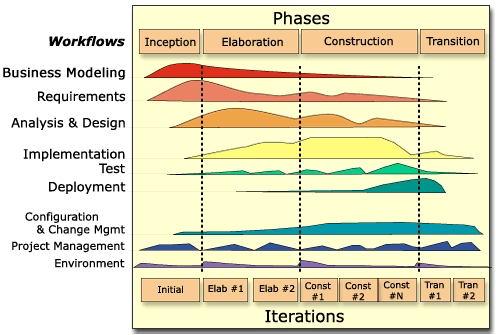
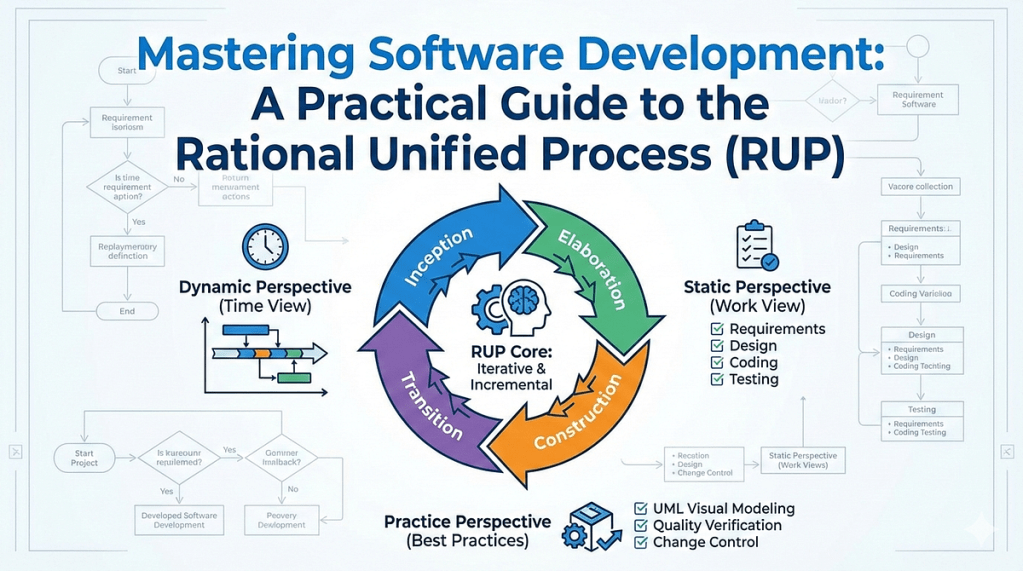
The Rational Unified Process (RUP) timeline is a two-dimensional framework where the horizontal axis represents time (divided into phases and iterations) and the vertical axis represents work/activities (divided into disciplines).
Rational Unified Process, RUP
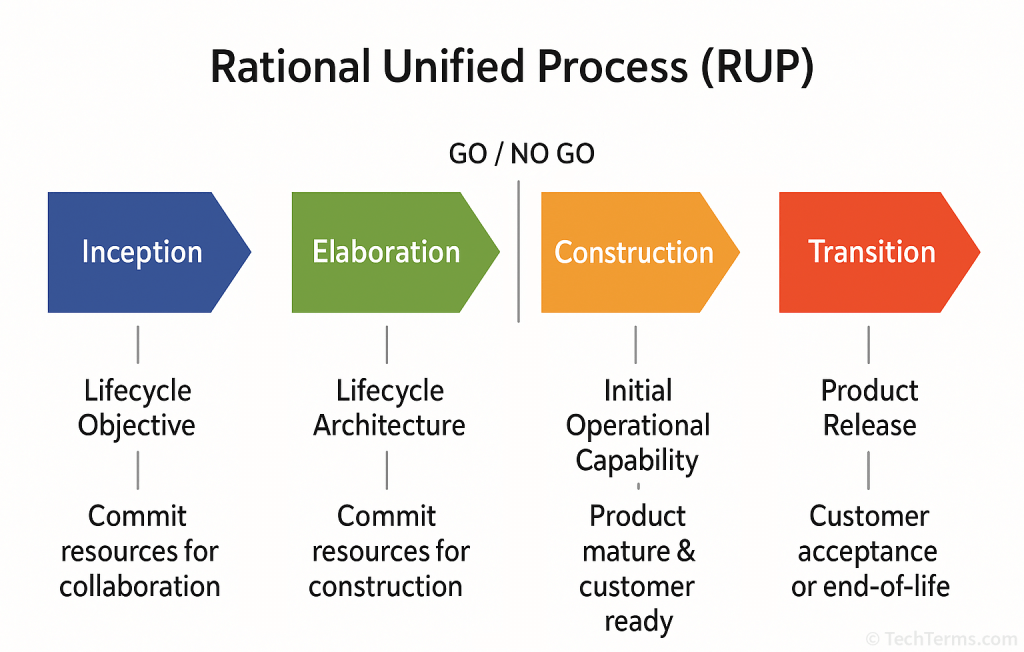
The process is structured into four sequential phases, each culminating in a major milestone where the project’s progress is assessed before moving forward.
RUP Phases, Iterations and Workflows
RUP Project Phases and Milestones
Each phase of the RUP lifecycle has a specific objective and a corresponding milestone.
Inception Phase
Goal: Define project scope, identify business risks, and establish the Business Case.
Milestone: Lifecycle Objective Milestone – Stakeholders agree on scope and cost/schedule estimates.
Elaboration Phase
Goal: Analyze requirements in detail and design a stable Software Architecture.
Milestone: Lifecycle Architecture Milestone – The architecture is validated and major risks are mitigated.
Construction Phase
Goal: Build the software system by developing and testing all components and features.
Milestone: Initial Operational Capability Milestone – A product is ready for beta testing by users.
Transition Phase
Goal: Deploy the software to the end users and perform final Beta Testing and training.
Milestone: Product Release Milestone – The development cycle is finished and the product is formally accepted.
Detailed Iteration Timeline
Within each phase, work is performed in iterations (typically lasting 2 to 6 weeks). Each iteration is a mini-lifecycle that includes:
Requirements Analysis: Refining what needs to be built.
Design: Modeling the system architecture and components.
Implementation: Writing the code for specific features.
Testing: Verifying the quality of the iteration’s output.
Assessment: Evaluating the iteration against its planned goals.
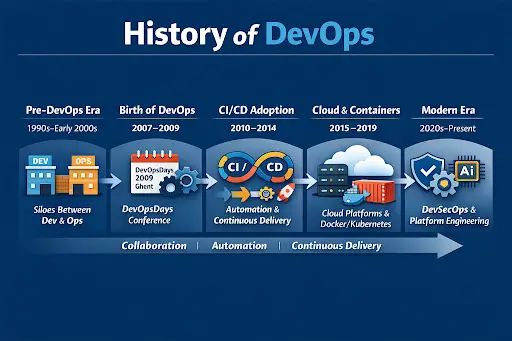
The history of DevOps is a transition from siloed development and operations teams toward a unified culture of automation and collaboration.
Timeline History of DevOps
Pre-DevOps & Foundations (2001–2008)
2001: The Agile Manifesto is published, laying the groundwork for iterative software development and cross-functional teamwork.
2006: Amazon Web Services (AWS) launches, providing the cloud infrastructure necessary for rapid, automated deployments.
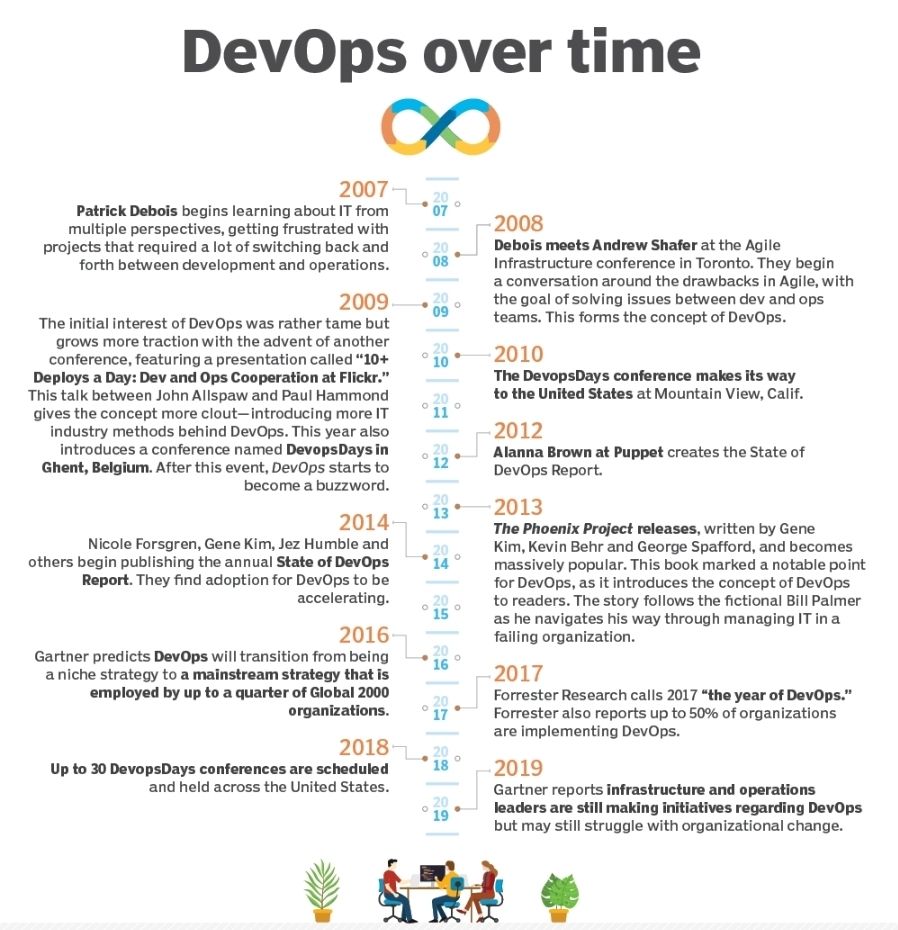
2007: Belgian consultant Patrick Debois begins investigating ways to bridge the gap between development and operations while working on a data centre migration project.
2008: At the Agile conference in Toronto, Andrew Shafer and Patrick Debois meet and discuss “Agile Infrastructure,” marking the conceptual start of the movement.
The Emergence of DevOps (2009–2014)
2009: John Allspaw and Paul Hammond give the legendary talk “10+ Deploys Per Day: Dev and Ops Cooperation at Flickr” at the Velocity Conference.
2009: Patrick Debois organises the first DevOpsDays in Ghent, Belgium, and coins the term “DevOps“.
2011: Analyst firm Gartner officially predicts DevOps will evolve from a niche concept to a mainstream strategy.
2013: The book The Phoenix Project is published, popularising DevOps principles through a fictional narrative of a company’s digital transformation.
2013: Docker is released, revolutionising the industry by making containerization accessible and consistent across environments.
2014: The first State of DevOps Report is published by Puppet, providing data-driven evidence of DevOps’ impact on performance.
Mainstream Adoption & Cloud-Native (2015–2019)
2015: Google releases Kubernetes as an open-source project, establishing the standard for container orchestration.
2015: Major cloud providers launch managed container services, such as Google Kubernetes Engine (GKE).
2017: Security begins “shifting left,” leading to the formalisation of DevSecOps within development pipelines.
2018: The book Accelerate is published, detailing the science behind high-performing DevOps organisations.
2019: DevOpsDays celebrates its 10th anniversary with events in over 20 countries, signalling global maturity.
The AI & Platform Era (2020–2026)
2020: The COVID-19 pandemic accelerates remote work and digital transformation, making DevOps practices essential for enterprise survival.
2023: Generative AI begins to be integrated into CI/CD pipelines for automated code generation, testing, and anomaly detection.
2024: The focus shifts to Platform Engineering, aiming to reduce developer cognitive load through Internal Developer Platforms (IDPs).
2025: AIOps (Artificial Intelligence for IT Operations) becomes standard for predictive analytics and self-healing infrastructure.
2026: DevOps continues to evolve with a focus on zero-CVE container images and high-demand roles for engineers who can manage AI-driven workflows.
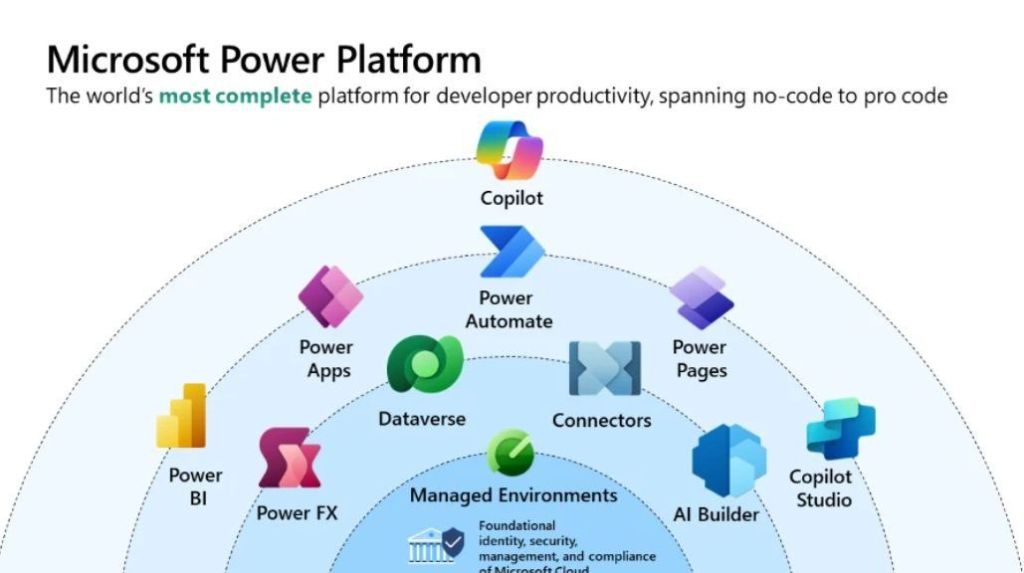
Microsoft Power Platform is a suite of low-code tools designed to help organizations analyze data, build custom solutions, automate processes, and create AI-powered agents. It enables both professional developers and “citizen developers” (business users) to rapidly build end-to-end business applications that integrate with the broader Microsoft Cloud ecosystem.
Microsoft Power Platform
Core Product Areas
The platform consists of five primary applications:
Power Apps: A low-code development environment for building custom web and mobile business applications.
Power Automate: A service for workflow automation and robotic process automation (RPA).
Power Pages: A platform for creating and hosting secure, external-facing business websites.
Copilot Studio: A graphical tool for building and customizing AI-powered agents and chatbots.
Underlying Capabilities
The platform’s strength lies in its shared infrastructure:
Microsoft Dataverse: A secure, cloud-scale data store that provides a common data model for all Power Platform apps.
Connectors: Over 1,000 prebuilt integrations that allow apps to communicate with external data sources like SAP, Salesforce, and Google Analytics.
AI Builder: A capability that allows users to add AI models (e.g., sentiment analysis or object detection) to their apps and flows without writing code.
Power Fx: A low-code, strongly-typed programming language used for expressing logic across the platform.
The Microsoft Power Platform has evolved from individual components like Power BI and Power Apps into a unified suite, now heavily integrated with Copilot and AI.
Origins & Early Growth (2013–2018)
2013: Power BI is first released as an Excel add-in before becoming a standalone service in 2015.
2015: Power Apps enters public preview as a low-code tool for building business applications.
2016: Microsoft Flow (now Power Automate) is launched to provide workflow automation across apps and services.
2018: The term “Microsoft Power Platform” is officially introduced to unify Power BI, Power Apps, and Flow.
Expansion & Rebranding (2019–2022)
2019: Power Virtual Agents is added to the suite for creating no-code chatbots. Microsoft Flow is rebranded as Power Automate.
2020: Launch of Power BI Premium per user and the Dataverse (formerly Common Data Service) rebranding.
2021: Power Fx, an open-source formula language based on Excel, is introduced as the standard language across the platform.
2022: Power Pages is launched as the fifth standalone product for building secure, low-code business websites.
The AI & Copilot Era (2023–Present)
2023: Integration of Copilot across all Power Platform products, allowing users to build apps, flows, and reports using natural language.
2024: Introduction of Timeline Highlights in Power Apps to provide AI-generated summaries of record activities.
2025: Microsoft announces the retirement of the Power Apps per app plan (January) and ends support for contact tracking in the Dynamics 365 App for Outlook (October).
2026: The 2026 Release Wave 1 begins (April–September), focusing on deeper Role-based Copilot offerings and enhanced security agents.
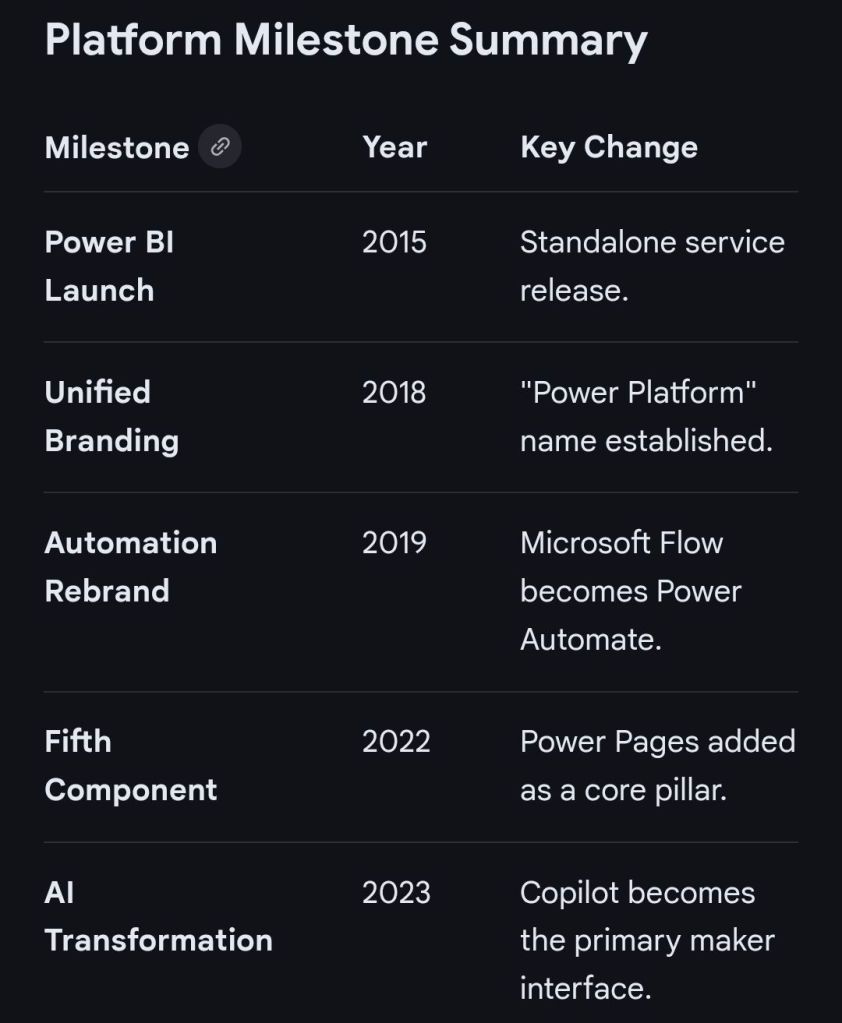
Microsoft Power Platform Milestone Summary
The Microsoft Power Platform originated from Microsoft’s effort to democratise data and app development by evolving its existing business tools into a unified low-code ecosystem.
Origins and Evolution (2003–2015)
The platform’s roots trace back to early business solutions that were eventually merged into the modern suite:
Dynamics CRM 1.0 (2003): The foundation for what became the Microsoft Dataverse (formerly Common Data Service), providing a secure relational database.
Project Siena (2013): A “garage project” at Microsoft aimed at building web apps without professional coding tools. This project eventually became Power Apps.
Power BI Launch (2015): Originally “Project Crescent” for SQL Server, Power BI was the first of the modern “Power” services to be delivered, entering preview in January 2015.
Expansion and Formalisation (2016–2019)
Microsoft transitioned from individual tools to an integrated platform:
Power Apps and Flow (2016):Power Apps and Microsoft Flow (later renamed Power Automate) became generally available in November 2016.
Common Data Service (2016): Introduced to provide a shared data platform across Dynamics 365 and the new “Power” tools.
Official Branding (2018–2019): The term “Microsoft Power Platform” was officially established as an umbrella brand for the suite of tools. In 2019, Microsoft Flow was rebranded to Power Automate to align with the platform’s naming convention.
Modern Era and AI Integration (2020–Present)
The platform has shifted toward “AI-first” development and expanded its core pillars:
New Components:Power Virtual Agents (now Copilot Studio) and Power Pages (for external websites) were added to the core lineup.
Acquisitions: Microsoft acquired Softomotive (2020) and Minit (2022) to bolster Power Automate with Robotic Process Automation (RPA) and process mining capabilities.
Generative AI: Recent updates have focused on integrating Copilots across all products, allowing users to build apps and automations using natural language.
Microsoft Power Platform Development Timeline Overview
Mark Whitfield, an experienced IT Project Manager, has a career and certification history spanning over 30 years. His professional development includes a range of technical, project management, and cloud-based qualifications.
2020s: Cloud & Modern Platforms
2024 (July): Microsoft Excel Refresher Course – Udemy.
2022 (December/February): C&CA UK’s Communications & Engagement Award and AZ-900 Microsoft Certified Azure Fundamentals.
2010s: Advanced Management & Development
2017 (November/April): Advanced Engagement Management (Level 2) and Microsoft Excel 2010 Expert Skills.
2014 (July): Advanced Microsoft Excel 2013.
2011 (May–July): PRINCE2 Practitioner, Agile SCRUM, Java, and Android programming.
2000s: Web Applications & Database Systems
2009 (March–November): Thales e-Security, BIRT, Web Design, and SQL Server training.
2006 (Feb–Dec): NetObjects Fusion, Cryptography, and Thales e-SECURITY SafeSign.
2004 (March): MultiBatch NSK Job Scheduling.
2000 (February): Fundamentals of Successful Project Management.
1990s: Core Programming & System Fundamentals
1990s (1993–1999): TANDEM/HP NonStop systems, C/C++ programming, project management, and HND in Computer Studies (1990).
Mark Whitfield Training IT Career Timeline Overview
Mark Whitfield, a Senior IT Project Manager who has spent over 30 years specialising in HP NonStop (formerly Tandem) computing systems.
Professional Background
Specialisation: Mark Whitfield is a highly experienced technician and project manager for the HP NonStop platform, which is a high-availability, fault-tolerant mainframe environment used primarily for mission-critical financial transactions.
Career Timeline:
The Software Partnership / Deluxe Data (1990–1995): Began as a programmer working on the sp/ARCHITECT-BANK solution for Tandem computers.
Insider Technologies (1995–2013): Spent 18 years focusing on monitoring and diagnostic software for HP NonStop, including products like Reflex 80:20, XPERT24, and Enterprise Manager.
Capgemini (2016–Present): Currently serves as an SC-cleared Senior Project Manager, delivering complex IT projects for major banks and government agencies.
Key Technical Contributions to NonStop
Product Development: He co-developed Reflex (a platform health/diagnostic tool) and designed XPERT24 to monitor performance in the XPNET layer of BASE24.
Financial Systems: He has managed major projects for global financial entities, including Barclays, HSBC, Bank of England, and Royal Mail Group, often involving ATM and POS monitoring systems.
Programming Expertise: His technical skill set includes NonStop-specific languages and tools such as TAL (Tandem Application Language), PATHWAY, XPNET, COBOL85, and C++.
About HP NonStop Systems
In the context of Mark Whitfield’s work, NonStop refers to a “shared-nothing” architecture designed by Tandem Computers. These systems are uniquely capable of:
Fault Tolerance: Handling hardware or software failures without system downtime.
Scalability: Doubling throughput by adding processors (up to 4,000) without hitches in performance.
Core Banking: Processing massive commercial workloads for retail banks and stock exchanges globally.
The Commodore 64 (C64) is the best-selling single computer model of all time, with an estimated 12.5 to 30 million units sold during its 12-year production run.
January: Engineers at MOS Technology begin a project to design state-of-the-art video and sound chips (VIC-II and SID) for the next generation of games consoles.
November: The cutting-edge chips are completed, and Commodore decides to use them for a new home computer to succeed the VIC-20.
August: The C64 begins shipping in the USA, featuring its iconic “breadbox” design.
Other Models: The Japan-only MAX Machine (a console version) and the Educator 64 (aimed at schools) are also released.
1983: Price Wars and Portables
January: Commodore introduces the SX-64, the world’s first portable computer with a colour screen, retailing for approximately $1,600.
June: To dominate the market, Commodore slashes the C64 price to $300, triggering an intense price war that drives competitors like Texas Instruments out of the market.
1984: Leadership Changes
January: Founder Jack Tramiel resigns from Commodore after a disagreement with chairman Irving Gould.
Expansion: The Commodore 16 and Plus/4 are introduced as low-cost alternatives, though they lack full C64 compatibility.
1985: Peak Performance
C128 Release: Commodore launches the Commodore 128, which includes a dedicated C64 compatibility mode to leverage the existing library.
Gaming Dominance: The C64 becomes the primary platform for video games, with thousands of titles released by developers like System 3 and MicroProse.
1986: The Redesign
May: The Commodore 64C is released, featuring a sleeker, flatter cream-coloured case similar to the Amiga 500.
Milestones: To celebrate selling one million units in Germany, a limited “Gold Edition” is presented at the BMW museum.
1987–1989: Late-Era Variants
1987: The C64 Aldi is sold through German supermarkets as a budget model.
1988: The C64G is introduced, returning to the original breadbox shape but using the modern 64C internal hardware.
1990: Consolidation and Consoles
C64 Games System (GS): Commodore attempts to enter the console market by releasing the C64 GS (a keyboardless C64), but it fails to compete with the rising 16-bit systems like the Sega Genesis.
1994: The End of an Era
April: Despite reaching a final sales total of roughly 17–22 million units, Commodore International files for bankruptcy and the C64 is officially discontinued.
The timeline of the world’s tallest buildings has evolved from ancient stone monuments to modern steel and concrete megastructures. Historically, the title has shifted from religious and funerary structures in Egypt and Europe to the corporate skyscrapers of North America, and most recently, to the massive mixed-use towers of Asia and the Middle East.
Ancient & Medieval Era (Spiritual & Funerary)
For millennia, the tallest structures were largely pyramids and cathedrals, often holding records for centuries.
c. 2570 BC – 1311 AD: Great Pyramid of Giza (Egypt) – 146.6m. Held the record for over 3,800 years.
1311 – 1548: Lincoln Cathedral (England) – 160m. The first structure to surpass the Great Pyramid.
1548 – 1884: European Cathedrals (Various) – Following the collapse of Lincoln’s spire, several cathedrals held the title, including St. Mary’s Church (151m) and Cologne Cathedral (157m).
The Rise of Modern Structures (1884–1930)
The Industrial Revolution introduced steel frames and safety elevators, moving the “race to the sky” to the United States.
1884 – 1889: Washington Monument (USA) – 169m. The world’s tallest all-stone structure.
1889 – 1930: Eiffel Tower (France) – 312m. Nearly doubled the previous record; it was the first structure to exceed 300 metres.
1894 – 1908: Philadelphia City Hall (USA) – 167m. Often cited as the first modern building to hold the title.
The “Golden Age” of NYC Skyscrapers (1930–1974)
A fierce competition in New York City led to rapid record-breaking.
1930: Chrysler Building – 319m. The first building to surpass 1,000 feet.
1931 – 1970: Empire State Building – 381m. Held the record for 40 years and was the first building with over 100 stories.
1970 – 1973: World Trade Center (North Tower) – 417m. Briefly the world’s tallest before being surpassed by Chicago.
The Contemporary Era (1974–Present)
The record moved from the US to Asia and the Middle East as construction technology advanced.