TACL for HPE NonStop Tandem, Detailed Timeline

Tandem Advanced Command Language (TACL) is the interpreted, high-level command and programming language for HPE NonStop (formerly Tandem) systems. Its timeline follows the evolution of Tandem hardware and the Guardian operating system. 

Comprehensive TACL Timeline

  • 1974–1976: Foundation of Tandem
    • Tandem Computers Inc. was founded. The initial operating system, Guardian, was designed for fault-tolerant computing.
  • Late 1970s: Initial Release
    • TACL was introduced in the 1970s as the primary command interface, replacing or augmenting earlier, more primitive command interpreters. It was written in TAL (Tandem Application Language).
  • 1980s: Mature Programming Capabilities
    • TACL evolved from a simple shell into a powerful programming language. Key features like MacrosRoutines, and Variables (TEXT, ALIAS, STRUCT) were solidified during this era to automate complex system tasks.
  • 1994: D-Series (D30.00) Release
    • A significant update was documented in the TACL Programming Guide for D30.00, which detailed advanced features like Nowait I/OPathway Server integration, and SPI/EMS programmatic interfaces.
  • 1997–2000s: Corporate Transitions (Compaq & HP)
    • 1997: Compaq acquired Tandem.
    • 2002: HP merged with Compaq, and TACL development continued under the HP NonStop banner.
    • 2000: Updated reference manuals detailed TACL’s environment customization and the use of the _EXECUTE variable for program flow.
  • 2010s: H-Series and HPE Era
    • 2013: Comprehensive Reference Manuals were released, refining built-in functions for the H-Series architecture.
    • 2015: Hewlett Packard Enterprise (HPE) was formed. TACL is now maintained as part of the HPE NonStop software stack.
  • Current: Legacy & Automation
    • TACL remains the essential tool for administrative tasks and system-level automation on modern HPE NonStop X (x86) platforms.

TACL for HPE NonStop Tandem, Detailed Timeline

HPE NonStop Tandem TAL Detailed Timeline

TAL (Tandem Application Language) is the original system programming language for the HPE NonStop (formerly Tandem) platform. Developed by Tandem Computers in the mid-1970s, it was designed to provide high-level efficiency while allowing low-level machine access, similar to C but with a syntax influenced by ALGOL. 

Detailed Development Timeline

  • Mid-1970s: The Genesis
    • Tandem Computers, founded by James Treybig, introduces the first NonStop I system in 1976.
    • TAL is released as the primary language for writing the Guardian Operating System and system-level utilities.
    • The Tandem Advanced Command Language (TACL) is initially developed during this decade using TAL.
  • 1980s: Growth and Maturity
    • 1981–1983: Introduction of the NonStop II and TXP systems. TAL becomes the standard for developing mission-critical transaction applications like banking and point-of-sale systems.
    • 1985: The TAL Reference Manual is updated (March 1985), formalising advanced features like DEFINEsLITERALs, and complex pointer arithmetic.
  • 1990s: Transition to RISC
    • Tandem introduces TNS/R (RISC) systems based on MIPS processors.
    • pTAL (Portable TAL) is introduced to allow TAL code to run “natively” on RISC hardware, offering better performance than the emulated TNS environment.
  • 2000s–Present: Modernisation and Maintenance
    • 2003–2005: HP (which acquired Compaq, who had bought Tandem) migrates NonStop to Intel Itanium (TNS/E) and later x86 architectures (TNS/X).
    • 2006: The Common Run-Time Environment (CRE) is enhanced to support mixed-language programs (C, COBOL, pTAL) seamlessly.
    • Current Status: TAL is considered a legacy language, with most new development occurring in C/C++ or Java. However, it remains vital for maintaining the core Guardian OS and legacy banking kernels. 

Typical Program Development Workflow

According to the TAL Programmer’s Guide, a developer follows this “timeline” to create a program:

  1. Source Code Creation: Writing statements, removing comments, and defining PROCs and SUBPROCs.
  2. Compilation: Running the TAL Compiler to generate an object file.
  3. Binding: Using the Binder Program to link the object file with the TALLIB Run-Time Library.
  4. Acceleration: Running the Accelerator (for TNS code) to optimise it for native hardware execution.
  5. Execution: Deploying via the TACL interface. 

HPE NonStop Tandem TAL Detailed Timeline

HPE NonStop Tandem Timeline History

HPE NonStop (originally Tandem) has a nearly 50-year history as the gold standard for fault-tolerant, “always-on” computing. Originally developed by Tandem Computers to eliminate single points of failure, the platform has survived through several major corporate acquisitions while evolving its underlying processor architecture. 

Founding and The Tandem Era (1974–1997)

The “NonStop” architecture was born from the idea that a single hardware failure should never crash a system.

  • 1974: Tandem Computers is founded by Jimmy Treybig and three former HP engineers.
  • 1976: The first Tandem/16 (later NonStop I) is shipped to Citibank. It featured a “shared-nothing” architecture where each CPU had its own memory and copy of the Guardian OS.
  • 1981: NonStop II is released, introducing 32-bit addressing to support larger applications.
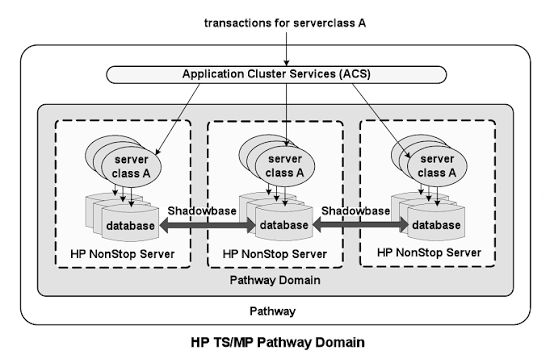
  • 1983: The NonStop TXP and Pathway software are introduced. Pathway revolutionized the platform by allowing programmers to write fault-tolerant apps without manually coding “checkpoints”.
  • 1986: NonStop SQL is launched, the first fault-tolerant relational database.
  • 1989: NonStop Cyclone arrives, a high-end mainframe-class system.
  • 1991–1993: Transition to MIPS RISC processors begins with the Cyclone/R and the Himalaya K-series

Corporate Acquisitions and Transition (1997–2014)

The platform changed hands twice in five years, but the mission-critical nature of the technology kept it alive.

  • 1997: Compaq acquires Tandem for $3 billion to bolster its enterprise server offerings.
  • 1997: The Himalaya S-Series introduces ServerNet, a high-speed interconnect that later evolved into the industry-standard InfiniBand.
  • 2002: HP merges with Compaq, bringing the NonStop line under Hewlett-Packard.
  • 2005: NonStop i (Integrity) is launched, transitioning from MIPS to Intel Itanium processors. 

The Modern HPE Era (2015–Present)

Today, the platform focuses on integrating with modern data centre standards like x86 and cloud-native virtualisation. 

  • 2014–2015: NonStop X (TNS/X) is introduced, moving the architecture to industry-standard Intel x86-64 processors.
  • 2015: HP splits; the server line becomes part of Hewlett Packard Enterprise (HPE).
  • 2017: Virtualised NonStop (vNS) is released, allowing the software stack to run in virtual machines (KVM/OpenStack).
  • 2020: HPE officially ends sales of Itanium-based systems, completing the transition to x86.
  • 2024: The platform celebrates its 50th anniversary, continuing to power the majority of the world’s ATM and credit card transactions

HPE NonStop Tandem Timeline History

My Career in HPE NonStop Tandem, 1995 thru 2013
My Career in HPE NonStop Tandem, 1990 thru 1995

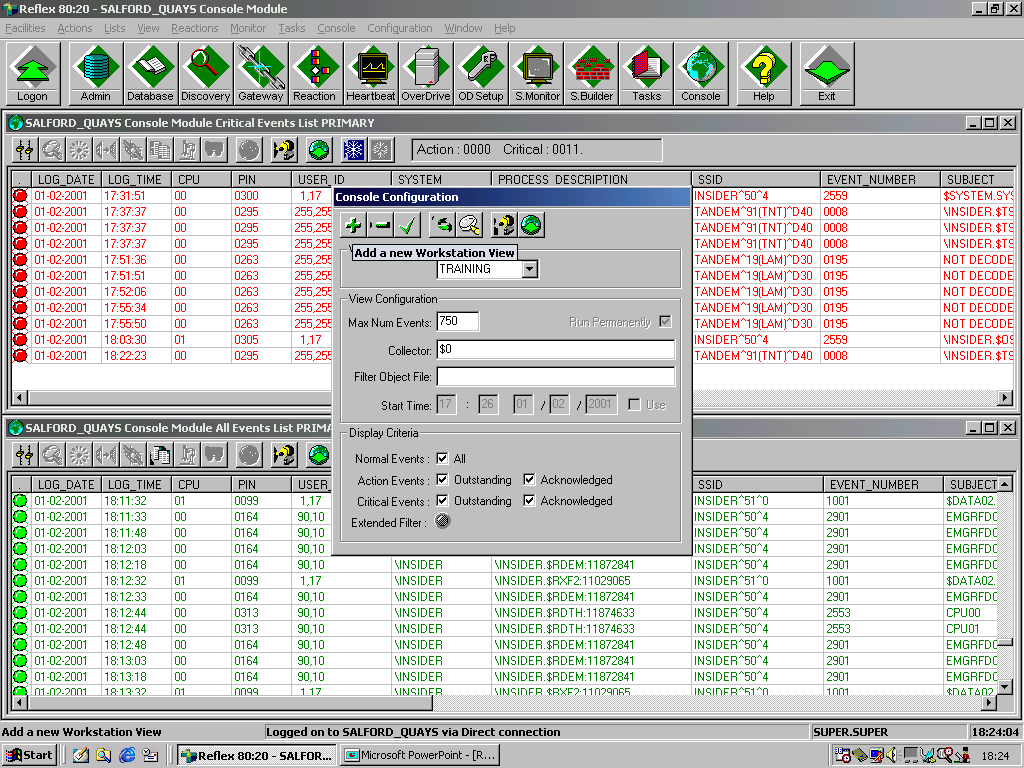
HPE NonStop Tandem ViewPoint EMS Event log viewer

The timeline of HPE NonStop ViewPoint (and its modern successor, Web ViewPoint) reflects the evolution of NonStop systems from Tandem’s fault-tolerant beginnings to Hewlett Packard Enterprise’s modern cloud-integrated management. 

Detailed History Timeline

  • Pre-2000: Legacy ViewPoint
    • Originally developed for the Tandem NonStop platform to provide a graphical operations interface for monitoring system status and events.
    • Featured early support for DSM/PM (Distributed Systems Management/Performance Monitor) and event management through primary and alternate event logs.
  • 2003–2005: Transition to Web ViewPoint
    • September 2003: Version 4 AAD released as an early iteration of the web-based management tool.
    • May–October 2004: Progressive upgrades (Versions 5.0 and 5 AAF) introduced refined management capabilities for S-Series servers.
    • March 2005: Version 5 AAG released, consolidating features for the S-Series.
    • November 2005: Web ViewPoint for Itanium (Version H01AAI) launched, marking the shift to the Intel Itanium-based Integrity NonStop architecture.
  • 2013–2015: The x86 Revolution & Virtualization
    • 2014: Support for Intel x86 architecture was officially announced, leading to the launch of NonStop X.
    • Evolution to Web ViewPoint Enterprise (WVP E): The platform evolved into an automated management product, eventually adding integration with cloud-based analytics like HPE Remote Analyst.
  • 2018–Present: Modern Hybrid Cloud Era
    • L-Series Support: Continued updates provided support for L-Series operating environments and enhanced security monitoring.
    • 2023–2024: Recent developments focus on Web ViewPoint Enterprise, featuring a global configuration platform and enhanced historical data capture through integrations like Sentinel for HPE NonStop

For more specific documentation, you can browse the HPE NonStop Manuals on the HPE Support Center

HPE NonStop Tandem represents a line of fault-tolerant, high-availability servers

HPE NonStop (formerly Tandem) represents a line of fault-tolerant, high-availability servers designed for 24/7, zero-downtime operations. Originally created by Tandem Computers in 1974, the architecture is now owned by Hewlett Packard Enterprise (HPE) and supports mission-critical workloads like banking and finance. 

Key Aspects of HPE NonStop (Tandem):

  • Continuous Availability: Designed to eliminate single points of failure with 100% fault tolerance.
  • Architecture: Initially used a proprietary Tandem T/16 design; modern systems are based on HPE Integrity/x86 architectures.
  • Operating System: Traditionally runs the Guardian OS, which handles the system’s specialized, continuous processing capabilities.
  • Evolution: Founded by James Treybig in 1974, Tandem was acquired by Compaq in 1997, which then merged with HP in 2002.
  • Applications: Ideal for transactional applications requiring strict data integrity and real-time processing.
  • Modern Platforms: Current systems include HPE NonStop Compute NS9 X5 and NS5 X5. 

The systems are still widely used today for mission-critical applications that cannot afford to be offline. 

HPE NonStop (formerly Tandem) represents a line of fault-tolerant, high-availability servers.

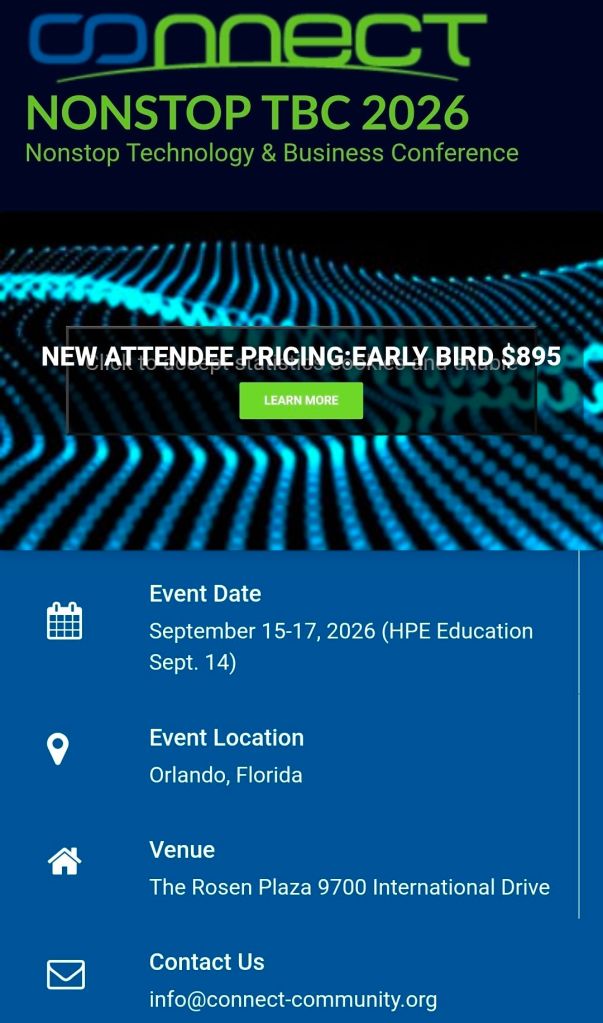
Connect : HPE Nonstop Ecosystem – formerly NSK, Tandem, Himalaya

Connect’s Influencer of the Year Program

Connect : HPE Nonstop Ecosystem – formerly NSK, Tandem, Himalaya

HPE NonStop Tandem NonStop – Guardian Principles Course – 1993 – High Wycombe

HPE NonStop Tandem NonStop – Guardian Principles Course – 1993 – High Wycombe

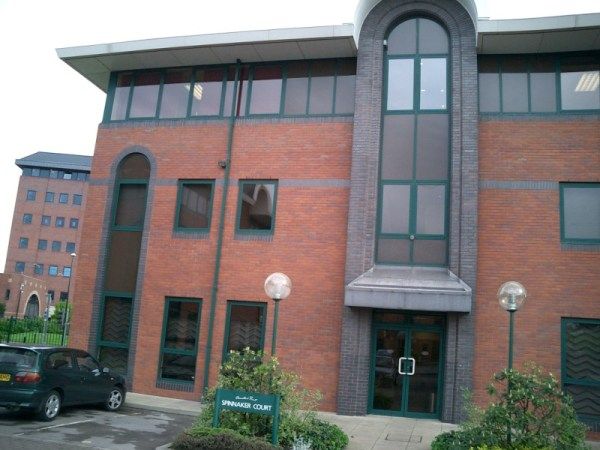
Career, Insider Technologies Limited, ITL – 1995 to 2013 as HPE NonStop Tandem specialist and Product Manager

Career, Insider Technologies Limited, ITL – 1995 to 2013 as HPE NonStop Tandem specialist and Product Manager