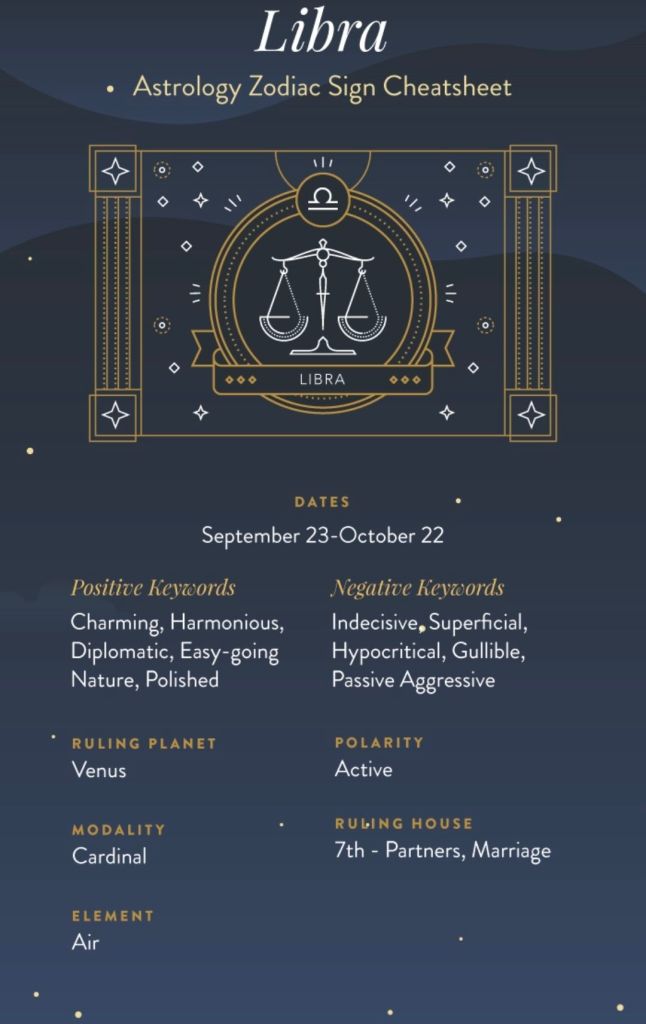
Horoscope, Libra is the 7th sign of the Zodiac, governing the period from approximately Sept 23 to Oct 22.

Libra is the seventh star sign of the zodiac, governing the period from approximately September 23 to October 22. As a cardinal air sign ruled by Venus, Libra is symbolized by the Scales, representing a deep commitment to balance, justice, and harmony. 

7th Star Sign of the Zodiac, governing period from approximately Sept 23 to Oct 22

Full Insight: Personality and Traits

  • Core Characteristics: Libra is cooperative, diplomatic, gracious, and fair-minded, with a strong preference for partnership.
  • The “Scales” Energy: They are driven by a need for equilibrium in all aspects of life, particularly in relationships. They are the only sign represented by an inanimate object.
  • Strengths: Highly social, intellectual, charming, and adept at mediation.
  • Weaknesses: Indecisive, prone to avoiding conflict at all costs, and can hold grudges.
  • Interests: They value beauty, art, fashion, and intellectual conversation. 

Detailed Historical Timeline

  • Ancient Beginnings (Sumerian & Roman Times): The constellation was originally seen by Sumerians as Zib-ba An-na (“balance of heaven”). Roman astronomers developed the sign in the first century BCE, identifying the scales as the ones held by the goddess of justice.
  • Astronomical Origins: It was previously considered part of Scorpius, which is why the brightest stars, Zubeneschamali and Zubenelgenubi, translate to “northern claw” and “southern claw”.
  • Medieval Representation: In the 14th-15th centuries, Libra was heavily featured in European manuscripts (e.g., Book of Hours) and utilized in royal courts for horoscope readings.
  • 1995-1997: The North Node was in Libra, bringing a period of focus on creating new partnerships, fairness, and a shift in social structures.
  • 2018–April 2026: Uranus was in Taurus, acting in Libra’s eighth house, bringing significant shifts, sudden changes, and, in some cases, upheavals regarding money, investments, and deep partnerships. 

Current Timeline: 2025-2026

  • October 2024–April 2025: A six-month cycle began with a new moon solar eclipse in Libra (October 2). This cycle forced a re-evaluation of personal identity, relationships, and how Libras “show up” in partnerships.
  • March 29, 2026: A new moon solar eclipse in Aries begins a new six-month cycle of relationship changes, acting as a “golden buzzer” moment for growth.
  • April 2, 2026: A Full Moon in Libra occurred, bringing awareness to the balance between personal needs and partnership demands.
  • End of April 2026: Uranus moves into Gemini, beginning a 7-year journey in Libra’s 9th house, sparking a shift toward expanding horizons, learning, and fresh mental landscapes. 

Key 2026 Themes for Libra

  • Relationship Recalibration: Balancing personal independence with partnership needs is the main focus, influenced by the Aries/Libra eclipse axis.
  • The “Golden Buzzer” Era: Early April 2026 is a high-frequency, lucky period due to a stellium in Aries (Sun) and Venus in Taurus, promoting major life-changing opportunities.
  • Shifting Focus: The focus moves from intense financial or deep psychological change (Uranus in 8th) to intellectual and expansive growth (Uranus in 9th). 

Tandem Computers ( HPE NonStop ) Overview & Detailed Timeline

Tandem Computers, founded in 1974 by James (Jimmy) Treybig, revolutionized the computing industry by pioneering fault-tolerant computer systems. Designed specifically for online transaction processing (OLTP) in banking, stock exchanges, and telephone switching, Tandem’s “NonStop” systems provided near-zero downtime by utilizing redundant, modular processors and a “shared-nothing” architecture. 

Tandem remained an independent, rapidly growing company until it was acquired by Compaq in 1997, later becoming part of Hewlett Packard Enterprise (HPE). 

Overview of Key Technologies

  • NonStop Architecture: The core design featured multiple independent processors, each with its own memory and I/O bus, interconnected by a redundant inter-CPU bus called the Dynabus.
  • Guardian OS: A message-based operating system designed to detect faults immediately (“fail-fast”) and mirror process states to a backup processor, allowing seamless failover.
  • NonStop SQL (1986): The first fault-tolerant SQL database, known for linear scalability.
  • ServerNet (1995): A high-speed, scalable, point-to-point network system that replaced the Dynabus and influenced modern InfiniBand standards. 

Detailed Historic Timeline by Era and Year

The Founding Era (1974–1979) 

  • 1974: Tandem Computers is founded in Cupertino, California, by Jimmy Treybig, formerly of HP. Initial venture capital investment comes from Kleiner & Perkins.
  • 1975: Design of the Tandem/16 (T/16) is completed.
  • 1976: The first T/16 NonStop system is shipped to Citibank.
  • 1977: Tandem goes public; sales begin rapid, exponential growth.
  • 1978: Introduction of the ENCOMPASS database management system.

The Growth and Competition Era (1980–1989)

  • 1980: Inc. magazine ranks Tandem as the fastest-growing public company in America.
  • 1981: NonStop II is introduced, supporting 32-bit addressing to allow for larger applications.
  • 1982: Competition intensifies as Stratus Technologies enters the fault-tolerant market. Tandem faces its first quarter of declining growth.
  • 1983: Introduction of the NonStop TXP, the first entirely new implementation of the TNS architecture with cache memory.
  • 1985: Attempted entry into the PC market with the MS-DOS-based Dynamite PC, which fails commercially and is withdrawn.
  • 1986: Introduction of the NonStop VLX (32-bit datapath) and the revolutionary NonStop SQL database.
  • 1987: Introduction of the low-cost NonStop CLX for small office environments.
  • 1988: Tandem acquires Ungermann-Bass, Inc. to strengthen networking capabilities.
  • 1989: Introduction of the NonStop Cyclone, a high-end ECL-based processor aimed at mainframe markets. 

The Open Standards & MIPS Transition Era (1990–1996)

  • 1990: Tandem introduces the Integrity line of fault-tolerant Unix systems.
  • 1991: Cyclone/R (CLX/R) is released, marking the start of the migration from proprietary stack machines to MIPS R3000 RISC microprocessors.
  • 1993: Introduction of the NonStop Himalaya K-series using faster MIPS R4400 processors.
  • 1994: NonStop Kernel (NSK) is extended with Open System Services (OSS), a POSIX-compliant Unix environment.
  • 1995: Introduction of ServerNet, designed for extremely low-latency inter-processor communication.
  • 1995–1997: Partnered with Microsoft on the “Wolfpack” project, which becomes Microsoft Cluster Server. 

Acquisition and Integration Era (1997–Present)

  • 1997: Compaq acquires Tandem Computers for roughly $3 billion. The Himalaya S-Series is introduced.
  • 1998: Compaq acquires DEC, leading to a shift in engineering strategy towards Alpha/Itanium instead of MIPS.
  • 2001: Compaq terminates Alpha engineering, committing to Intel’s Itanium (Merced) processors.
  • 2002: Hewlett-Packard acquires Compaq. Tandem becomes the core of the HP Integrity NonStop Server division.
  • 2005: The first HP Integrity NonStop servers (TNS/E) based on Itanium processors are released.
  • 2014: Completion of the migration to Intel x86 architecture (NonStop X). 

Note: Following the split of HP into Hewlett Packard Enterprise (HPE) and HP Inc., the NonStop product line continues to be developed and supported by HPE.

Tandem Computers Overview and Detailed Timeline

The Ryder Cup Golf Competition

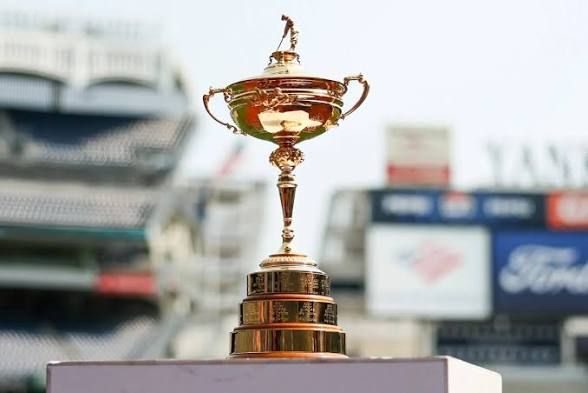
The Ryder Cup is a prestigious biennial men’s golf competition pitting a team of professionals from the United States against a team from Europe. Founded in 1927 by English businessman Samuel Ryder, the event is renowned for its intense match-play format, team camaraderie, and the absence of prize money, focusing purely on pride and nationality. 

The Ryder Cup Golf Competition

Detailed Historical Timeline by Era

1. The Origin & Early Years (1921-1937)

  • 1921: Unofficial match played at Gleneagles, Scotland, won by Great Britain.
  • 1926: An unofficial match at Wentworth saw a British victory, leading Samuel Ryder to donate the trophy.
  • 1927: 1st Official Ryder Cup. USA wins 9½–2½ in Worcester, MA.
  • 1929: Great Britain records its first victory at Moortown, England.
  • 1933: Great Britain defeats the US by a narrow margin, 6½–5½.
  • 1935-1937: The United States initiates its dominance, winning the next two contests comfortably. 

2. The Post-War Era & US Dominance (1947-1977)

Following a pause during World War II, the USA solidified its dominance with superior putting and depth, winning 18 of the first 22 matches. 

  • 1947: Play resumes with a dominant US win in Portland, Oregon.
  • 1957: Great Britain wins at Lindrick, England, providing a brief respite from US dominance.
  • 1961: Matches reduced from 36-hole to 18-hole contests.
  • 1963: The format expands to three days and introduces fourball matches.
  • 1969: Famously, Jack Nicklaus conceded a 4-foot putt to Tony Jacklin, resulting in the first-ever tie (16–16).
  • 1973: The British team expands to include players from Ireland. 

3. The Birth of Team Europe (1979-1999)

To address the lack of competitiveness, the GB & Ireland team was expanded to include all of continental Europe, transforming the tournament into a truly competitive rivalry. 

  • 1979: First official “Team Europe” competes.
  • 1985: Europe breaks the streak. Led by Tony Jacklin, Europe wins on US soil for the first time in decades at The Belfry.
  • 1987: Europe wins again, retaining the cup on American soil at Muirfield Village.
  • 1989: The matches end in a 14–14 tie, with Europe retaining the cup.
  • 1991: “War on the Shore.” A highly controversial and intense US win in Kiawah Island, South Carolina.
  • 1997: The Ryder Cup is held in continental Europe for the first time (Valderrama, Spain), with Seve Ballesteros as captain.
  • 1999: “Battle of Brookline.” USA overcomes a large final-day deficit to win, leading to controversial celebrations. 

4. The Modern Era & European Dominance (2002-Present)

Since 2000, Europe has won the majority of matches, creating a new period of intense competition. 

  • 2001/2002: The 2001 event was postponed to 2002 due to 9/11, shifting the tournament to even-numbered years (until 2021).
  • 2004: Europe records its biggest ever win at Oakland Hills (18½–9½).
  • 2010: Europe regains the cup in Wales after a tense Monday finish.
  • 2012: “The Miracle at Medinah.” Europe stages the greatest comeback in history, trailing 10-6 before winning 14½-13½.
  • 2014: Paul McGinley leads Europe to a third consecutive victory at Gleneagles, Scotland.
  • 2018: Team Europe dominance in France, highlighted by the “Moliwood” pairing (Fleetwood/Molinari).
  • 2021: USA dominates a young European team 19-9, the largest margin of victory in modern history, at Whistling Straits.
  • 2023: Europe regains the cup in Italy, ensuring their home soil winning streak continues. 

Key Ryder Cup Facts

  • Recent Winner: Europe (2023)
  • Most Points: Sergio Garcia (Europe) – 25.5 points
  • Format: Three-day event consisting of Foursomes, Fourballs, and Singles matches.
  • Venue Rotation: Alternates between European and American soil every two years.

The Ryder Cup Golf Competition

Logo; The Ryder Cup Golf Competition

COBOL Programming Overview & Detailed Timeline History by Era and Year

COBOL, (COmmon Business-Oriented Language) is a high-level, compiled programming language designed specifically for business, finance, and administrative systems. Developed as a portable “stopgap” for the US Department of Defense, it has endured for over 65 years and remains the backbone of global financial infrastructure. 

Programming Overview

  • Design Philosophy: It features a “prose” syntax designed to be self-documenting and readable by non-technical business professionals.
  • Structure: Programs are strictly divided into four Divisions:
    1. Identification: Defines the program name and metadata.
    2. Environment: Specifies the physical computer and files used.
    3. Data: Defines variables, structures, and record layouts.
    4. Procedure: Contains the logic and executable statements.
  • Core Paradigms: Originally strictly procedural and imperative, COBOL was updated in 2002 to include object-oriented features.
  • Key Characteristics: It is known for its verbosity (using over 300 reserved words), weak/static typing, and exceptional reliability in large-scale batch and transaction processing. 

Detailed Historical Timeline

Era 1: The Foundation (1950s)

This era focused on consolidating disparate manufacturer-specific languages into a single, hardware-independent standard for business. 

  • 1955: Grace Hopper develops FLOW-MATIC, which introduced English-like commands and influenced COBOL’s design.
  • 1958: IBM releases COMTRAN, another major precursor focused on commercial translation.
  • 1959 (April): Mary Hawes organizes a meeting at the University of Pennsylvania to propose a common business language.
  • 1959 (May): The Pentagon hosts a meeting creating CODASYL (Committee on Data Systems Languages) to oversee the project.
  • 1959 (December): The first specifications, “COBOL – Specifications for a COmmon Business Oriented Language,” are released. 

Era 2: Early Versions & Rapid Adoption (1960–1967)

The language quickly transitioned from a theoretical specification to a functioning industry standard. 

  • 1960COBOL-60 is officially published.
  • 1960 (August): The first COBOL program runs on an RCA 501.
  • 1961COBOL-61 is released, providing a major cleanup of original logical flaws.
  • 1962: IBM announces COBOL as its primary development language, ending work on COMTRAN.
  • 1963COBOL-61 Extended is released, introducing “Sort” and “Report Writer” facilities.
  • 1965COBOL Edition 1965 adds mass storage file handling and table processing.

Era 3: Standardization & Dominance (1968–1984)

COBOL became the most widely used language in the world as ANSI and ISO codified its rules. 

  • 1968COBOL-68 (ANSI X3.23-1968) is published as the first official US standard.
  • 1970: COBOL becomes the world’s most widely used programming language.
  • 1974COBOL-74 is standardized, introducing the DELETE statement and file organization improvements.
  • 1978: ISO formally adopts the COBOL-74 standard. 

Era 4: Structured Programming & Modernization (1985–2001) 

The language evolved to support better logic flow while managing the massive global codebase. 

  • 1985COBOL-85 introduces structured programming features like END-IFEVALUATE, and nested subprograms.
  • 1989: First amendment to COBOL-85 adds Intrinsic Function Modules.
  • 1997: Gartner Group estimates 200 billion lines of COBOL code are in existence.
  • 1999: Massive effort peaks to patch legacy COBOL code for the Y2K (Year 2000) problem

Era 5: The Object-Oriented & Modern Era (2002–Present)

Recent updates focus on interoperability with modern web and cloud environments. 

  • 2002COBOL-2002 introduces Object-Oriented Programming (OOP), Unicode support, and recursion.
  • 2014COBOL-2014 standardizes IEEE 754 data types and method overloading.
  • 2020: The COVID-19 pandemic highlights a critical shortage of COBOL programmers to maintain aging state unemployment systems.
  • 2023COBOL-2023 adds asynchronous messaging (SEND/RECEIVE) and transaction processing (COMMIT/ROLLBACK).
  • 2024: COBOL celebrates its 65th anniversary of active service.

COBOL Programming Overview & Detailed Timeline History by Era and Year

Golf Overview and Historical Timeline by Era and Year

Modern golf originated in 15th-century Scotland, where it was played on coastal linksland with wooden clubs and leather balls. While earlier stick-and-ball games like the Roman paganica and Dutch colf likely influenced its development, Scotland is credited with formalising the game into the sport known today. 

Comprehensive Overview of Golf Eras

  • Ancient Origins (Pre-1400s): Various cultures played stick-and-ball games, including the Roman paganica (1st century) and the Chinese chuiwan (960–1279 AD).
  • Early Scottish Era (1400–1743): Golf took shape in Scotland. It was famously banned by King James II in 1457 to prioritise archery practice. The ban was later lifted by King James IV in 1502, who became an avid player himself.
  • The Enlightenment & Formalisation (1744–1850): The first official golf clubs were formed, and the first “13 Rules of Golf” were written by the Honourable Company of Edinburgh Golfers in 1744.
  • The Victorian Boom & Expansion (1851–1900): The Industrial Revolution and the birth of railways allowed golf to spread globally. The first Open Championship was held in 1860, and the United States Golf Association (USGA) was founded in 1894.
  • The Modern Professional Era (1901–Present): Professional organisations like the PGA of America (founded 1916) and the PGA Tour (spun off in 1968) formalised the competitive circuit. The late 20th century saw the rise of global icons like Jack Nicklaus and Tiger Woods. 

Detailed Historical Timeline

Origins & Royal Influence

  • 1457: King James II of Scotland bans golf (“ye golf”) via a parliamentary decree because it distracted soldiers from archery.
  • 1502: King James IV lifts the ban after signing the Treaty of Perpetual Peace with England; he commissions the first custom set of clubs.
  • 1552: First recorded evidence of golf played at St Andrews.
  • 1567: Mary, Queen of Scots, is recorded playing golf; she is credited with coining the term “caddy” (from the French cadets).
  • 1618: The “feathery” ball (leather stuffed with boiled goose feathers) is invented, replacing primitive wooden balls.
  • 1659: First reference to golf in America—a ban on playing in the streets of Albany, New York. 

Era of Clubs & Rules

  • 1744: The Gentlemen Golfers of Leith (later the Honourable Company of Edinburgh Golfers) form the first official club and establish the first 13 rules.
  • 1754: The Society of St Andrews Golfers is founded; it later becomes the Royal and Ancient Golf Club (R&A).
  • 1764: St Andrews reduces its course from 22 holes to 18 holes, establishing the global standard.
  • 1766: Royal Blackheath is formed near London, the first golf club outside Scotland.
  • 1810: First recorded women’s golf competition is held at Musselburgh Links, Scotland.
  • 1848: Invention of the “guttie” ball (made from gutta-percha), which was cheaper and more durable than the feathery. 

The Championship Era

  • 1860: The inaugural Open Championship is held at Prestwick Golf ClubWillie Park Sr. is the first champion.
  • 1888: The St Andrew’s Golf Club of Yonkers is formed, marking the permanent arrival of golf in the U.S..
  • 1894: The USGA is founded to standardise rules in the United States.
  • 1895: The first U.S. Open and U.S. Amateur championships are held.
  • 1900: The Haskell ball (rubber core) is introduced, significantly increasing driving distances. 

Modern Professional Era

  • 1916: The Professional Golfers’ Association (PGA) of America is established.
  • 1927: The first Ryder Cup takes place in Worcester, Massachusetts.
  • 1930: Bobby Jones wins the first and only Original Grand Slam.
  • 1934: The first Masters Tournament (then the Augusta National Invitation Tournament) is held.
  • 1947: The U.S. Open becomes the first golf tournament televised live.
  • 1968: The PGA Tour officially forms as a separate entity from the PGA of America.
  • 1971: Astronaut Alan Shepard hits a golf ball on the Moon during the Apollo 14 mission.
  • 1996: Tiger Woods turns professional, sparking a global boom in the sport’s popularity.
  • 2023: The PGA Tour and Saudi-backed LIV Golf announce a framework agreement to merge and reunite professional golf. 

Golf Overview and Historical Timeline by Era and Year

HP NonStop Tandem Overview and Timeline History by year

HP NonStop is a series of fault-tolerant server computers designed for online transaction processing (OLTP) and mission-critical applications that require 100% uptime. Originally introduced by Tandem Computers Inc. in 1976, the platform uses a proprietary, integrated hardware and software stack known as NonStop OS (formerly Guardian) to eliminate single points of failure through massive redundancy and “fail-fast” logic

Historical Timeline by Era

1. The Tandem Founding Era (1974–1981) 

  • 1974: Tandem Computers Inc. is founded by James (Jimmy) Treybig and a team from Hewlett-Packard’s HP 3000 division.
  • 1976: The first system, the Tandem/16 (later NonStop I), is shipped to Citibank.
  • 1977: Tandem systems gain early traction as intelligent front-end processors for bank ATM networks. 

2. The Stack Machine Expansion (1981–1990) 

  • 1981: NonStop II is introduced, adding 32-bit addressing capabilities and replacing magnetic core memory with battery-backed DRAM.
  • 1983: NonStop TXP (Transaction Processing) launches as the first new implementation of the architecture, featuring cache memory and 2.0 MIPS performance.
  • 1986: Introduction of NonStop VLX (Very Large eXpansion) and NonStop SQL, the first fault-tolerant relational database designed for linear scalability.
  • 1987: NonStop CLX launches as a lower-cost, compact minicomputer for remote office environments.
  • 1989: NonStop Cyclone is released for high-end mainframe markets, featuring superscalar CPUs and fiber optic interconnects. 

3. The MIPS RISC Transition & Acquisitions (1991–2003)

  • 1991: Cyclone/R (or CLX/R) marks the move to MIPS R3000 RISC processors, using object code translation to maintain backward compatibility.
  • 1993: Himalaya K-series is released using MIPS R4400 processors.
  • 1995: Open System Services (OSS) is added to the NonStop Kernel to provide a POSIX/Unix-like environment.
  • 1997: Compaq acquires Tandem Computers. The Himalaya S-Series introduces ServerNet, which later becomes the InfiniBand industry standard.
  • 2002/2003: HP merges with Compaq, bringing the NonStop line under Hewlett-Packard. 

4. The HP Integrity & x86 Era (2005–Present)

  • 2005: HP Integrity NonStop (TNS/E) is introduced, migrating the platform to Intel Itanium microprocessors.
  • 2014: NonStop X (TNS/X) launches, shifting the architecture to Intel x86-64 processors for greater industry-standard alignment.
  • 2015: Following the HP corporate split, NonStop becomes part of Hewlett Packard Enterprise (HPE).
  • 2020: Sales of Itanium-based systems officially end in July 2020.
  • 2024–2025: HPE expands the platform with Virtualized NonStop Software for private clouds and consumption-based models via HPE GreenLake.

HP NonStop Tandem Overview and Timeline History by year

HPE NonStop (formerly Tandem and Compaq NonStop) is a family of fault-tolerant, integrated hardware and software systems designed for mission-critical enterprise workloads. Since its introduction in 1976, it has served as the backbone for high-volume transaction environments like banks, stock exchanges, and payment systems, offering 100% continuous uptime

Core Architecture and Features

The platform is defined by its “shared-nothing” architecture, where every component is redundant to eliminate single points of failure. 

  • Continuous Availability: If a hardware or software component fails, a backup takes over immediately without disrupting the application, a process often managed through process pairs (primary and hot backup processes).
  • Linear Scalability: You can add capacity (CPUs, memory) seamlessly without downtime. Systems can scale from a few processors to clusters of over 4,000 CPUs while maintaining a single-system image for management.
  • Integrated Stack: Unlike standard servers, NonStop includes a fully integrated stack of hardware, the NonStop OS (a proprietary kernel), a relational database (NonStop SQL), and middleware.
  • Fail-Fast Design: Modules are self-checking; they stop immediately upon detecting an error to prevent data corruption, allowing the redundant backup to resume processing from the last known good state. 

Current Hardware and Deployment

While historically based on proprietary or Itanium processors, modern NonStop systems (NonStop X) utilize industry-standard Intel Xeon processors and high-speed InfiniBand interconnects. 

  • High-End Systems: Models like the NS9 X5 are built for the most demanding high-volume transaction processing (OLTP).
  • Mid-Range/Entry Systems: Models like the NS5 X5 offer fault tolerance for smaller enterprises or development environments.
  • Virtualization & Cloud: HPE Virtualized NonStop Software allows the platform to run on standard private cloud infrastructure (e.g., VMware, OpenStack), and it is also available via HPE GreenLake as a consumption-based, pay-as-you-go service. 

Software and Security

  • Database: Supports NonStop SQL/MX and SQL/MP for multi-tenant, fault-tolerant data management.
  • Development: Supports modern languages like Java, C++, Python, COBOL, and the TACL scripting language. Developers can use the Eclipse-based IDE for building and debugging applications.
  • Security: Built with Zero Trust principles, including hardware-level vulnerability mitigations (e.g., against Spectre/Meltdown) and real-time threat detection. 

Detailed Architecture

HPE NonStop architecture is a fault-tolerant, shared-nothing, massively parallel computing platform designed for 100% operational continuity. Originally developed by Tandem Computers, it is engineered so that no single hardware or software failure can bring down the system. 

Core Architectural Pillars

  • Shared-Nothing Architecture: Each processor has its own dedicated memory, I/O bus, and copy of the HPE NonStop Operating System (NSK). This eliminates resource contention and single points of failure found in shared-memory systems.
  • Massive Scalability: Systems scale linearly by adding more processors. A single node can support up to 16 CPUs, and multiple nodes can be clustered to support over 4,000 CPUs.
  • Fault Tolerance (Process Pairs): Software availability is maintained through “process pairs”—a primary process and a passive backup process. If the primary fails, the backup immediately takes over without losing data or state.
  • Fail-Fast Design: Hardware and software modules are designed to stop immediately upon detecting an error (“fail-stop”) to prevent data corruption from propagating. 

Hardware Components

  • Compute Nodes: Modern HPE NonStop X systems use standard Intel Xeon x86-64 processors but implement fault tolerance through specialized system interconnects.
  • System Interconnect (Fabric):
    • InfiniBand: Used in NonStop X systems for high-speed, low-latency communication between CPUs and I/O devices (up to 56 Gbps).
    • ServerNet: The legacy high-speed, point-to-point switched fabric used in older S-series and Integrity i-series systems.
  • CLIMs (Cluster I/O Modules): Specialized offload engines for networking (IP CLIM), storage (Storage CLIM), and telco protocols. They handle I/O processing to free up the main host CPUs. 

Integrated Software Stack

The NonStop platform is a “tightly coupled” environment where hardware and software are integrated for availability. 

  • NonStop OS (NSK): A message-based operating system that manages the distributed resources as a single system image.
  • HPE NonStop SQL/MX: A distributed, fault-tolerant relational database that provides ANSI SQL compliance and automatic load balancing across the cluster.
  • HPE Pathway (TS/MP): An application server and middleware framework that manages workload distribution, load balancing, and automatic process restarts.
  • TMF (Transaction Monitoring Facility): Ensures database integrity by managing atomic transactions; if an update fails, TMF automatically rolls back the changes. 

Modern Deployment Options

  • HPE Virtualized NonStop (vNS): The complete software stack decoupled from proprietary hardware, allowing it to run as a set of virtual machines on industry-standard x86 servers within a private cloud (VMware).
  • HPE GreenLake: A consumption-based model providing NonStop capabilities as a cloud-like service. 

Mark Whitfield HP NonStop Tandem experience & Project Management Templates

Mark Whitfield is an experienced IT Project Manager and software developer who has spent over 22 years specialising in HP NonStop (formerly Tandem) systems. He is currently an Engagement Project Manager at Capgemini

Career & Expertise

Whitfield’s career in HP NonStop began in 1990 and includes significant technical and leadership roles across the financial and technology sectors: 

  • Software Development: Early in his career, he worked as a programmer for The Software Partnership (later Deluxe Data/FIS), focusing on electronic banking software like sp/ARCHITECT on Tandem mainframes.
  • Insider Technologies (1995–2013): He spent 18 years at Insider Technologies as a Senior Development Engineer and Project Manager. His work involved:
    • Developing monitoring and diagnostic software such as Reflex 80:20Reflex ONE24, and RTLX (Real-Time Log Extraction) for payment systems.
    • Managing the first HP OpenView Operations Smart Plug-In certification for the NonStop platform.
    • Designing XPERT24, a performance tracking product for ACI’s XPNET layer.
  • Capgemini (2016–Present): As an Engagement Project Manager, he has led digital projects for major clients in the automotive, government, and aerospace sectors, including a cloud migration for UK Government applications. 

Technical Contributions

  • Publications: He has authored articles for globally published journals like The Connection (2013), discussing topics such as querying terabytes of legacy transaction log data from NonStop mainframes.
  • Project History: He has managed high-value projects, including a £5 million initiative to migrate legacy HP NonStop software to AIX-based technologies for a large UK retail bank.
  • Training: He is trained in various NonStop-specific technologies, including TAL (Transaction Application Language), COBOL85PATHWAY, and NonStop SQL

Whitfield also maintains a professional website, mark-whitfield.com, where he provides project management templates and resources related to HP NonStop and Tandem systems. 

Mark Whitfield provides a comprehensive bundle of over 200 editable project management templates designed for Agile, Waterfall, and PRINCE2 methodologies. These templates are based on over 30 years of project delivery experience and are available for purchase via his official website or Etsy shop. 

Key Template Categories

The bundle includes a wide variety of tools across different formats (Excel, PowerPoint, Word, and MS Project): 

  • Planning & Scheduling:
    • Plan on a Page (POaP): Over 30 PowerPoint slide examples for executive-level summaries.
    • Detailed Project Plans: MS Project (MPP) and Excel templates for SDLC, PRINCE2 7th Edition, and Agile Scrum projects.
    • Gantt Charts: Built-in tracking views for both MS Project and Excel.
  • Tracking & Control:
    • RAID Logs: Comprehensive logs for tracking Risks, Actions, Issues, and Dependencies, plus additional tabs for Change Requests and Lessons Learned.
    • RACI Matrix: Templates to define project roles and responsibilities (Responsible, Accountable, Consulted, Informed).
    • Finance Trackers: Tools for internal and external forecast vs. actual costs, including margin and variance tracking.
  • Agile Specific Tools:
    • Burn Down & Burn Up Charts: Excel-based alternatives when tools like Jira are unavailable.
    • Agile Story Dependency Tracking: Specifically for managing dependencies between agile stories and external suppliers.
  • Reporting & Governance:
    • Status Reports: Weekly and monthly templates in Word and PowerPoint formats.
    • Stakeholder Analysis: Power/interest mapping and engagement plan templates.
    • Benefits Realisation: Plans to track project outcomes against initial business goals. 

Purchase Benefits

  • Lifetime Upgrades: Once purchased, all future additions and updates to the template package are provided for free.
  • Compatibility: Templates are designed for Microsoft Office 365 but also include Excel versions compatible with earlier software.
  • Support: The package typically includes walkthrough Word documents to guide users on how to use each major template.

Mark Whitfield HP NonStop Tandem experience & Project Management Templates

Structured Systems Analysis and Design Method (SSADM) Timeline

The Structured Systems Analysis and Design Method (SSADM) is a highly structured, “waterfall” methodology developed in the 1980s for the UK government to standardise IT project management. Its timeline can be viewed through two lenses: its historical evolution as a standard and its internal execution phases

Historical Evolution Timeline

SSADM evolved through several versions to become an “open” standard used widely in public and private sectors. 

  • 1980: The Central Computer and Telecommunications Agency (CCTA) evaluates various analysis and design methods.
  • 1981: Consultants from Learmonth & Burchett Management Systems (LBMS) are selected to develop SSADM v1.
  • 1983: SSADM is made mandatory for all new information system developments within the UK government.
  • 1984–1986: Version 2 (1984) and Version 3 (1986) are released, with the latter being adopted by the National Computing Centre (NCC).
  • 1990: Version 4 is launched, introducing more refined modules and stages.
  • 1995: SSADM V4+ is announced, followed by the release of V4.2.
  • 2000: The CCTA rebrands SSADM as “Business System Development,” repackaging it into 15 core modules with additional specialized modules. 

Methodological Execution Timeline (Stages 0–6)

SSADM follows a strict linear sequence where each stage must be completed and “signed off” before the next begins. 

  1. Stage 0: Feasibility Study – Analyzes technical, financial, and organizational feasibility to determine if the project is cost-effective.
  2. Stage 1: Investigation of Current Environment – Models the existing system using Data Flow Diagrams (DFDs) to understand current data and processes.
  3. Stage 2: Business System Options – Presents up to six different ways to build the new system, allowing users to choose the best strategic direction.
  4. Stage 3: Requirements Specification – A complex stage that builds a full logical specification of what the system must do, including Entity Life Histories (ELHs).
  5. Stage 4: Technical System Options – Evaluates hardware and software architectures to determine the best technical implementation.
  6. Stage 5: Logical Design – Defines user dialogues, update processes, and enquiry processes in an implementation-independent manner.
  7. Stage 6: Physical Design – The final stage where logical specifications are converted into real hardware and software database structures and program specifications.